




Abstract
Background
Euthanasia is a controversial practice in many countries. Since Spain’s Euthanasia Law came into effect on March 24, 2021, healthcare providers have faced a new challenge since they must inform patients, provide care, accompany them, and implement the law. It also represents a new stumbling block at universities, which must adapt to regulatory changes and educate future professionals accordingly. Little is known about the attitude of nursing students in Spain toward euthanasia since this law was implemented.
Objective
This study aims to answer the following research questions: What is the attitude of nursing students toward euthanasia? What factors influence this attitude?
Research design
A cross-sectional study was conducted using an online questionnaire.
Participants and research context
The study population comprised all nursing students at a public university in Barcelona (n = 444), Spain, during the 2022–2023 academic year. The validated Spanish version of the Euthanasia Attitude Scale was employed. A bivariate analysis was performed.
Ethical considerations
The university Ethics Committee (CEEAH 6247) approved this study. All participating students signed an informed consent form. Participation was voluntary, and data anonymity and confidentiality were guaranteed.
Results
Two hundred and forty-four nursing students responded to the questionnaire. The mean total score was 79.64. Participants with religious beliefs presented lower scores, indicating a more negative attitude toward euthanasia. Participants in their second, third, or fourth year of the nursing degree scored higher, demonstrating a more positive attitude.
Conclusions
The attitude of nursing students toward euthanasia was remarkably positive. Working on ethical content during the degree course and clinical practice are factors that help to develop a more positive attitude. In addition, nursing education should encourage professional aspects to prevail over religious beliefs in euthanasia situations.
Introduction
Euthanasia is a controversial practice in many countries. Since Spain’s Euthanasia Law came into effect on March 24, 2021, 1 healthcare providers have faced a new challenge since they must inform patients, provide care, accompany them, and implement the law. It also represents a stumbling block at universities, which must adapt to regulatory changes and educate future professionals accordingly. Little is known about the attitude of nursing students in Spain toward euthanasia since this law was implemented. It is essential to understand the attitude of future professionals and what factors influence it to enable education and awareness-raising measures that guarantee respect for patient decision-making and good care practice by the healthcare providers of tomorrow.
Background
Euthanasia is a controversial practice that sparks intense debate in social and professional contexts. Etymologically speaking, euthanasia means “good death” and can be defined as the act of deliberately ending a person’s life, as explicitly requested by them, to limit suffering. 1 Euthanasia is practiced legally in seven countries: the Netherlands (2001)—the first nation in the world to approve active euthanasia, Belgium (2002)—country which in 2014 modified the law to decriminalize euthanasia in minors, Luxembourg (2008), Colombia (2015), Canada (2016), some Australian states (2017) and, recently, Spain (2021).2,3 Spanish legislation also encompasses physician-assisted death, which is the only assistance to die legally available in other countries and some US states. 4 To request euthanasia in Spain, the person must be of legal age (≥18 years) and be capable and conscious at the time of the request. In addition, the person must suffer from a serious and incurable illness or a serious, chronic and disabling condition, certified by the responsible doctor. 1 This last situation includes physical or mental suffering. Spanish law is very protective 5 requiring the favorable report of the referring physician, the consulting physician and of the Guarantee and Review Committee, a multidisciplinary committee that includes physicians, nurses and jurists. This committee verifies the cases before euthanasia is carried out. Afterwards it verifies that the process was provided in accordance with the law. 6
The participation of nurses in the euthanasia process varies depending on the context. In Canada, registered nurses working under the authority of a physician or a nurse practitioner can provide euthanasia. In Belgium, the role of the nurse is mentioned in the legislation (article 2.4 of the Belgian Act on Euthanasia), explicitly stating that “the attending physician informs the patient about the results of this consultation [with an additional physician]” and that “if there is a nursing team that has regular contact with the patient, [the attending physician must] discuss the request of the patient with the nursing team or its members.” 7 Spanish legislation makes no mention about the role of nurses as professionals involved in euthanasia despite their presence and participation in the process. 1 Indeed, they play a fundamental role. Nurses are responsible for patient care, which is why they are confronted with requests for euthanasia, either directly or through colleagues. 8 They not only provide assistance but also perform various patient and family care tasks as part of the euthanasia care process.9,10
Training and emotional support for all professionals involved in this practice is crucial 8 and nursing education should cover issues such as how to address euthanasia requests and other aspects linked to the end of life. 8 Although professionals in countries where euthanasia is legal consider themselves capable of handling these requests, they believe more training would improve their approach and management. In countries where it is not legal, the range of knowledge about the euthanasia process is greater, and the absence of university training in this area is likely the source of any knowledge deficit. 9
Nursing students may encounter euthanasia cases during their clinical practicum. Furthermore, since they will be the health professionals responsible for providing appropriate end-of-life care in the future, it is important to understand their attitude toward euthanasia, especially in countries like Spain where it was only recently legalized and there is scarce research on the matter. Research carried out with nursing students reveals that, in general, attitudes differ depending on the cultural context. Negative attitudes appear in some studies carried out in different countries, especially in those where euthanasia is not legal 11 or where, by religion, euthanasia is not allowed, as in the case of Iran. 12 In these studies, having little knowledge about euthanasia or religion seem to be related to this attitude. Religious beliefs are one of the most important predictors of attitude toward euthanasia. Religious people have a more negative attitude13,14 and less religious are associated with agreement with euthanasia. 15 However, in other studies also conducted in Iran, the majority of nursing students reported neutral 16 or positive attitudes towards euthanasia, 17 a fact that the authors relate to the completion of a medical ethics course, differences in religiosity levels and being mostly single and younger. Other factors found in the literature to influence students’ attitudes are school origin, parental work, and parental education. 18 Among several studies that show positive attitudes towards euthanasia19–22 it is reported that ethical dilemmas prevail among students. 21 In Spain, few studies have been conducted among nursing students since the law was approved in 2021. One of them, in addition to showing a favorable position towards euthanasia, suggests the need for extra training in ethical conflicts at the end of life to prevent potential psychological consequences in nursing students. 20 Integrate education on euthanasia in curricula is strongly recommended for health care students. 23 This study aims to answer the following research questions: What is the attitude of nursing students toward euthanasia? What factors influence this attitude?
Objectives
This study aims to know the attitude and related factors towards euthanasia of nursing students following its legalization and identify its association with sociodemographic characteristics.
Methods
Research design
A cross-sectional study was conducted.
Research context
The study was conducted at the Nursing Department of the Universitat Autònoma de Barcelona (UAB), a public university in Catalonia, Spain. In Spain, university nursing education consists of a 4-year bachelor’s degree of 240 ECTS (European Credit Transfer and Accumulation System). At the UAB, the nursing degree curriculum includes a compulsory subject called Ethical and Methodological Foundations of Nursing, worth 6 ECTS and taught during the second semester of the first year. In addition to nursing methodology content, this subject allows students to develop the ethical skills established in the syllabus. In the fourth year of the degree, there is an elective subject worth 6 ECTS called Learning to Experience and Accompany the Process of Dying. Students begin their clinical practicum, consisting of 2300 h and worth 81 ECTS, in the second semester of the second year.
Participants and sample
The study population comprised all nursing degree students enrolled in the 2022–2023 academic year. The questionnaire was sent to 444 students, distributed as follows: 230 first-year students (the number of spots offered tripled in the 22–23 academic year), 68 second-year students, 75 third-year students, and 71 fourth-year students. No exclusion criteria were applied. A prior sample size calculation was not performed; the sample size was based on the entire population of students, and the final sample depended on voluntary participation. A post sample size calculation was performed with a 95% confidence level and 5.1% margin of error, 202 surveys are needed.
Data collection
The nursing students’ attitude toward euthanasia was assessed using the Spanish version of the Euthanasia Attitude Scale (EAS-ES). 19 The original Euthanasia Attitude Scale (EAS) features 21 dichotomous-response items and was developed and validated in 1979 in the United States by Tordella and Neutens 24 and revalidated in 1996 by Rogers. 25 In 2004, Chong and Fok 26 replaced the dichotomous scale with a 5-point Likert scale, ranking from 1 (strongly agree) to 5 (strongly disagree). Moreover, based on their results, they categorized the items into four dimensions or factors: (1) Ethical Considerations (11 items); (2) Practical Considerations (4 items); (3) Treasuring Life (4 items); and (4) Naturalistic Beliefs (2 items). The EAS was adapted and validated in Spanish in 2020 and comprises the 21 items from the original scale organized into the four dimensions suggested by Chong and Fok, 26 with some slight modifications. The items are answered on a 5-point Likert scale (5 = strongly agree, 4 = agree, 3 = neither agree nor disagree, 2 = disagree, and 1 = strongly disagree). Some items were reversed. The scores ranged from 21 to 105. A higher score corresponds to a more positive attitude toward euthanasia. For example, the following questions were included among the items: “A person with a terminal illness has the right to decide to die” (ethical considerations); “Euthanasia is acceptable if the person is old” (practical consideration); “There are very few cases when euthanasia is acceptable” (treasuring life); and “A person should not be kept alive by machines” (naturalistic beliefs). Regarding the factor analysis, the loadings for each dimension were: ethical considerations = 0.478–0.798; practical considerations = 0.461–0.750; treasuring life = −0.450–0.754; and lastly, naturalistic beliefs = 0.468–0.626. The reliability for the total EAS scores (Cronbach’s alpha) was 0.878.
An online questionnaire was developed using Microsoft 36 Forms. The questionnaire included sociodemographic variables (sex, age, civil status, children, religiosity, current year in the nursing degree, professional experience as an assistant nursing care technician, personal experience in the practice of euthanasia), and the EAS scale. A link to the questionnaire was sent to students in February 2023 via the virtual campus in subjects not coordinated by any member of the research team. It should be noted that subjects in the same course have approximately the same number of students regardless of the teacher. For this purpose, these teachers were contacted beforehand and asked to collaborate in the submission. All of them accepted. Written information for students and the request for participation were sent along with the link. Informed consent was also included. A participation reminder was made 15 and 30 days after the first sending of the link. No financial compensation was offered for participating in the study.
Data analysis
Descriptive statistics were performed by calculating mean (M) and standard deviation (SD). The age was initially collected as a continuous variable; subsequently, it was transformed into a binary categorical variable using the reclassification criterion of 25 years to facilitate group comparisons. The normality of the distribution for the variables was assessed using Kolmogorov–Smirnov test. The means obtained for the four dimensions and the total score were evaluated by comparing means of independent samples using Student's t test, due to its normal distribution. The p-value was set to <0.05. An assessment of internal consistency was conducted using Cronbach’s alpha coefficient to establish reliability, which was 0.870 in the present study.
All analyses were performed using SPSS software (version 25).
Ethical considerations
The study was approved by the Ethics Committee on Animal and Human Experimentation of the UAB (CEEAH 6247). The students signed the online informed consent form which described the study objectives, the voluntary nature of participation, and the anonymity of responses. Data confidentiality was also guaranteed. All data were saved on a secure server at the UAB.
Results
Participants characteristics
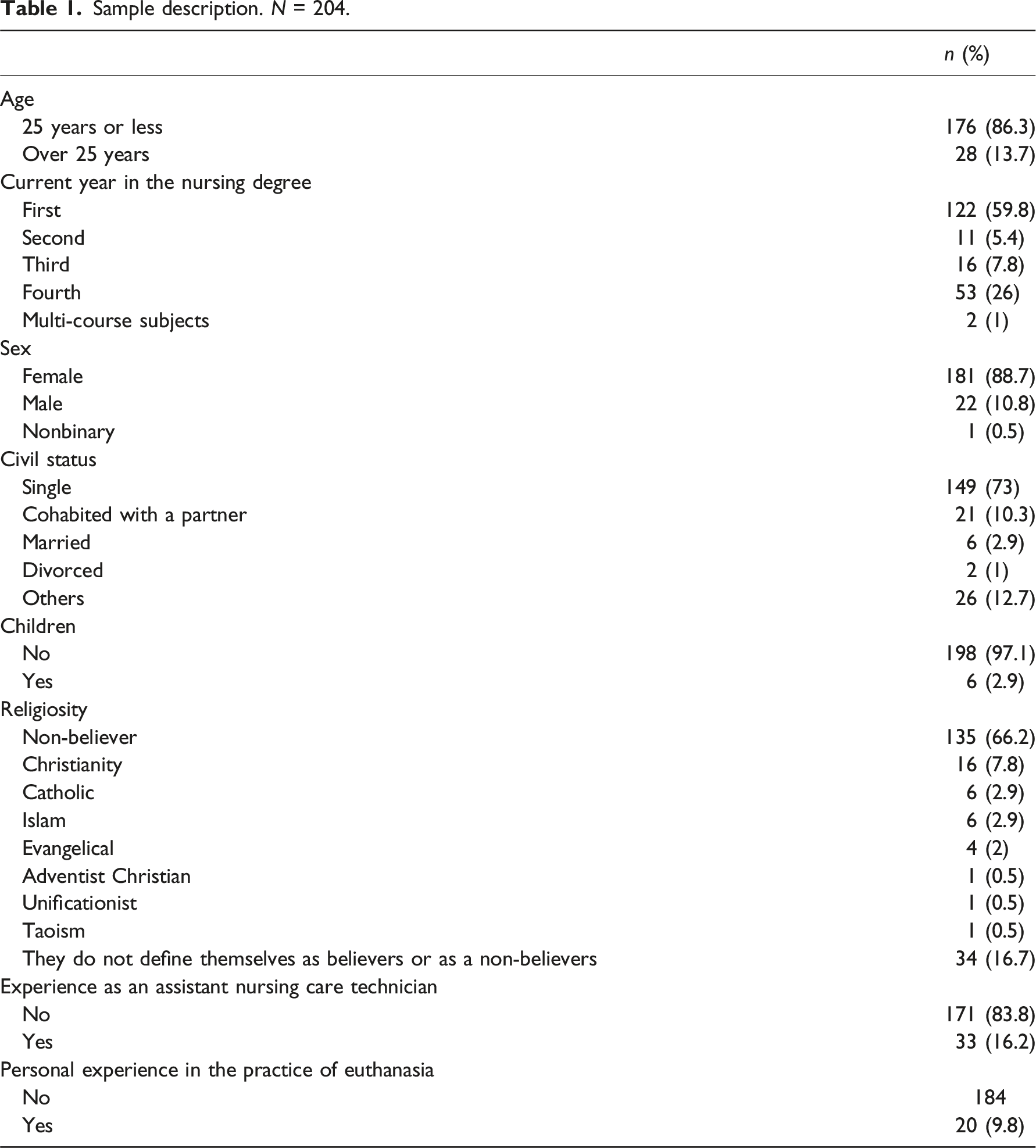
A total of 204 nursing students participated in this study, yielding a response rate of 46%. The age range of participants was 18 to 55 years, with a mean age of 21.72 (SD = 5.7); 181 were women (88.7%). The mean age of those over 25 was 33, and the mean age of those 25 and under was 19.88.
60% of participants were first-year students in the degree. Of those surveyed, 33 (16.2%) had experience as assistant nursing care technicians, and of these, 10 had come into professional contact with situations of euthanasia. Of the total participants, 20 (9.8%) had had personal experience with euthanasia.
Sample description. N = 204.
Descriptive statistics for the EAS-ES
Means and standard deviations of items, subscales and global score of EAS. Within parentheses, the dimension to which each item belongs is indicated: Ethical considerations (EC), Treasuring life (TL), Practical considerations (PC), Naturalistic beliefs (NB).
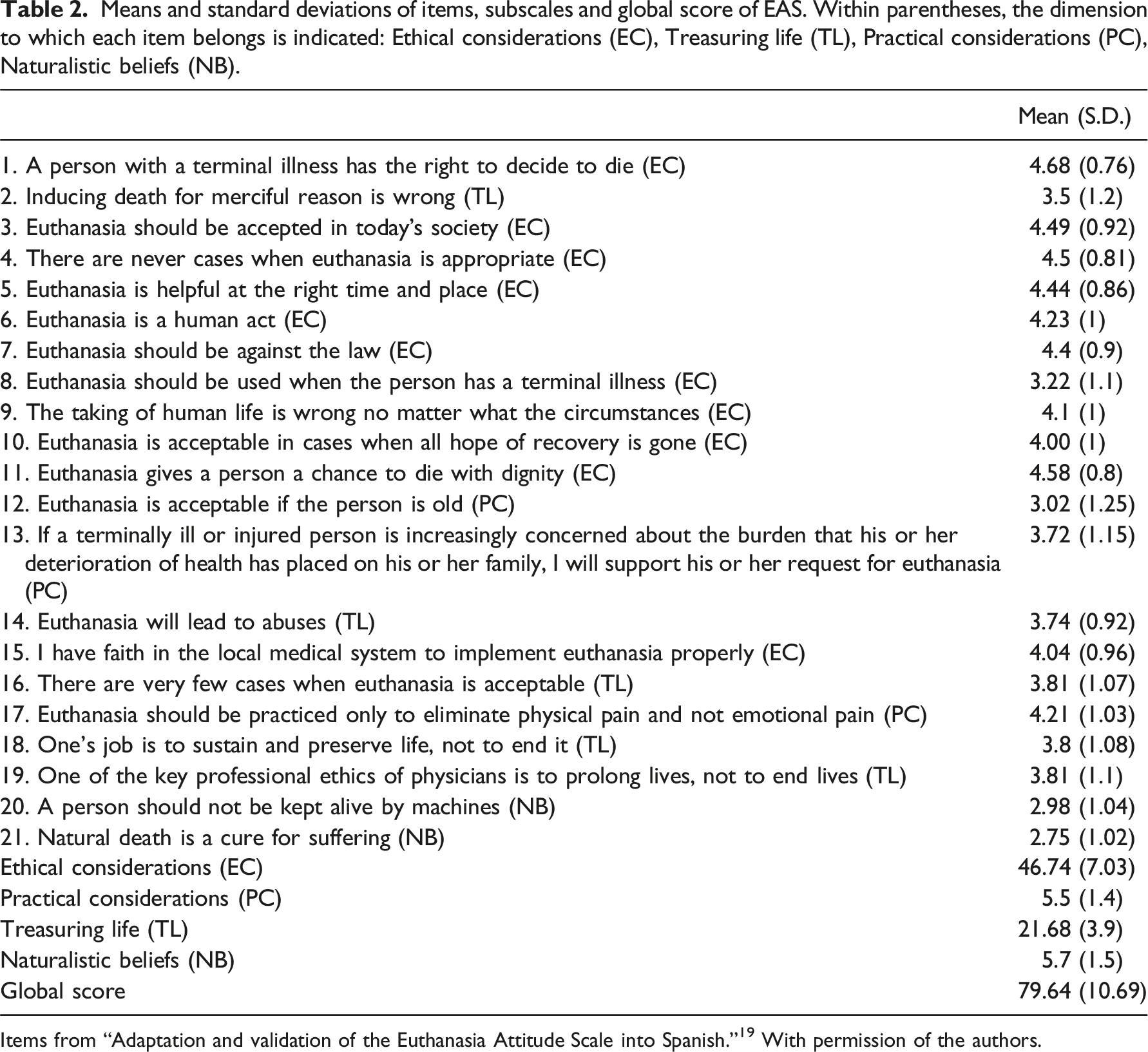
Items from “Adaptation and validation of the Euthanasia Attitude Scale into Spanish.” 19 With permission of the authors.
Bivariate analysis for the EAS-ES
The dimensions of the scale and the total score were compared using the following comparison variables: personal experience with euthanasia, professional experience as an assistant nursing care technician, holding religious beliefs, current year in the degree, and age.
Regarding total score, significant differences were found for religious beliefs (p = .041) and current year in the degree (p = .005). In the dimension of practical considerations, there were significant differences for religious beliefs (p = .015) and current year in the degree (p = .006). There were differences in the dimension of treasuring life due to personal experience with euthanasia (p = .04), religious beliefs (p < .001), and current year in the degree (p < .001). In the dimension of naturalistic beliefs, there were differences related to current year in the degree (p = .014). Lastly, there were differences in the dimension of ethical considerations due to personal experience with euthanasia (p = .039) and religious beliefs (p < .001).
Means comparison of subscales and global score.
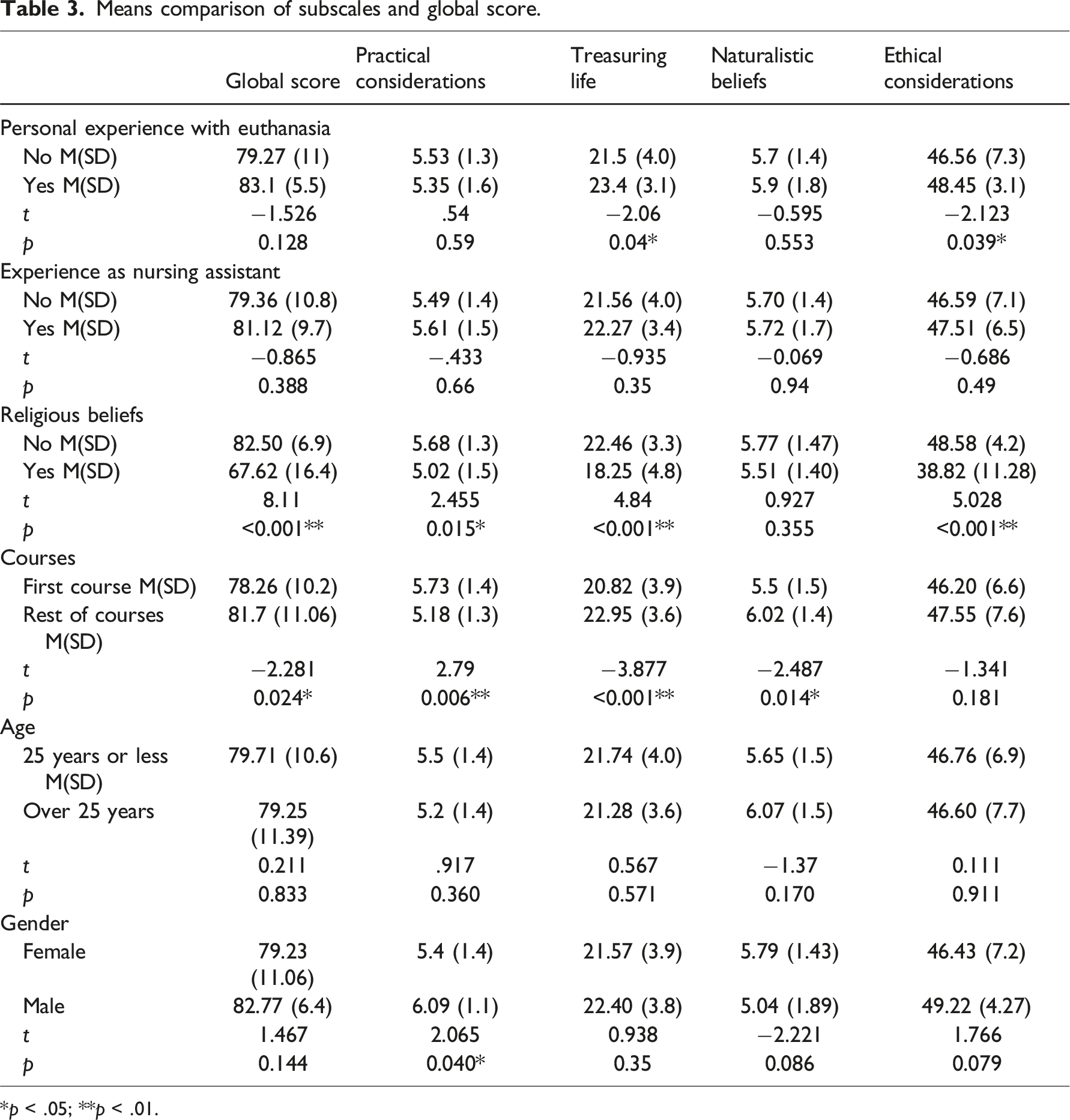
*p < .05; **p < .01.
Discussion
This study sheds light on the attitude of nursing students toward euthanasia following its legalization in Spain and how this attitude is associated with various factors such as age, sex, current year in the nursing degree, religiosity, and previous experiences with euthanasia. This is one of the few studies on the attitude of nursing students following the 2021 approval of the Spanish law. Since there are such few studies focused on nursing students that use the same scale, we compare our results with the existing, less specific literature that explores the attitude of nurses and/or health science students toward euthanasia.
Overall, the attitude of the students in this study toward euthanasia was remarkably positive (79.64/105). Previous studies conducted among nursing students report a similar positive attitude in countries such as Spain19,27 and Belgium, 22 while others show neutral (41.6%) or negative (34.2%) attitudes in places such as Iran. 16 A recent scoping review found that the different attitudes may be associated with the legality of the practice, since in countries like Greece, where it is illegal, nurses tend to disagree with it, although they would probably consider it as an option if it were legal. 13 In fact, in Spain in 2020, before the euthanasia law was approved, nursing students from the autonomous community of Castilla-La Mancha, scored a little lower on the EAS than those in this study. 19
Ethical consideration, such as patient’ autonomy under which the patient has the right to decide when and where to die, is an important factor in positive attitudes toward euthanasia.13,28 Autonomy and respect are fundamental aspects of what patients, family members, and professionals all consider a good death. 29 Indeed, autonomy is a decisive ethical principle in nurses’ understanding of euthanasia and physician-assisted death.30,31 In democratic societies, patient autonomy is a fundamental right. Life is no longer the highest good, as demonstrated by the right of patients to refuse treatment (including life support measures) under Spain’s Patient Autonomy Law of 2002. 32
Our results show that the students consider euthanasia to offer an opportunity to die with dignity. One review points out that while dying with dignity is an important basic human right for dying patients, families, and healthcare professionals, it is an ambiguous concept. 33 In addition to being a human right, the review defines it as both a subjective experience and a value influenced by others. As a subjective experience, it is intrinsically constructed with a specific self and is perceived in terms of personal values and norms, so dying with dignity can mean different things for each person 34. It is not possible to develop a single, best way of dying that honors and defends the dignity of all.33,34 However, patients and health professionals agree that dying with dignity is defined by being human, being self, achieving existential satisfaction, having self-respect and being respected by others, maintaining meaningful relationships, maintaining autonomy and independence, etc. 33 For the person dying, external sources of dignity tend to include autonomy, control, privacy, the absence of pain, connection with loved ones, spiritual resources, and preparation for death. 34
The results of this study suggest that not holding religious beliefs and having already completed the first year of the nursing degree result in a more positive attitude toward euthanasia. The religious beliefs of the students in this study contributed to more negative attitudes toward euthanasia, affecting both the total score and most dimensions. The evidence, whether qualitative or quantitative, points to the same results regardless of the type of religious belief.16,19,27 For Catholics, euthanasia is in direct opposition to the fifth commandment: “Thou shalt not kill.” For Muslims, the Quran states that “Believers shall not kill.” And one voluntary rule of Buddhism is to refrain from killing or harming another life. It is worth recalling that Spain is a secular state but has a significant religious tradition, so many beliefs are still widely held.
The main explanation for why having already completed the first year of the nursing degree is associated with a positive attitude is that certain ethical theories are integrated during the first year in a compulsory subject, and students start their clinical practicum during the second year at our university. The curriculum for the participants of this study includes 81 ECTS of clinical practices, most of which are performed in a hospital setting. This involves many hours of contact with human suffering and death, which might reshape students’ initial attitude. In line with this argument, various studies make similar conclusions. Most students go through life without giving much thought to death. 35 The majority have their first experience with death during clinical practices, which is when they come face-to-face with the fear, the pain of saying goodbye, the anguish, the emotional trauma, and death itself.35,36 Most students feel helpless in the face of death, but witnessing the death of patients made them think about their own death and the definition of a good death. 35 Whether or not the students in this study had contact with the euthanasia process, the experience of death in clinical practices has likely made them reflect on what constitutes a good death. Clinical practice promotes and consolidates knowledge of the subjects and care skills to be offered. 37
Attitude did not differ between male and female nursing students in our data, unlike the results of other studies on nurses,38,39 although the evidence in this regard is diverse. 13 One review underlines that women are more likely to be against euthanasia than men. 13 Another study in India found significant differences between male and female nurses on issues such as the right to end life, social cost, and the right to a dignified life: female nurses were more likely to oppose euthanasia. 40 This reluctance may be the result of women performing more caregiving roles in their daily lives, potentially leading them to disagree with the notion that “caring for a terminally ill patient who is going to die is a burden for relatives” as a reason for euthanasia. More research is needed on the effect of gender on attitude toward euthanasia, as well as its association with the legality of the practice.
Limitations
This study has some limitations. It wasn’t easy to ensure a high level of participation from students in each year of the degree. Conducting the survey online may have influenced the response rate. To curtail this limitation, participation reminders were sent via the virtual campus at 7 and 15 days after the first invitation. Other limitations include the non-probabilistic sampling, not giving all individuals the same opportunity to be selected for the research, as well as the study being performed at a single university. However, it is one of the main public universities in Barcelona and a reference both regionally and nationally and thus has a very diverse population.
Conclusion
The attitude of nursing students toward euthanasia was remarkably positive. Holding religious beliefs and being a first-year student negatively affected attitude. There is no evidence that gender affects attitude.
Based on the findings, it is concluded that working on ethical content during the degree course and clinical practice are factors that help to develop a more positive attitude towards euthanasia. In addition, nursing education should encourage professional aspects to prevail over religious beliefs in euthanasia situations.
The practical implications of these results are clear. The first-year syllabus should cover the basic aspects of implementing the euthanasia law, patient autonomy, and euthanasia as a care process and service. Since religious beliefs condition a positive attitude, it must be made clear to undergraduate students that while they may object to the practice, they must not abandon patients in this situation but help them find another professional to accompany them in the process. Additionally, more specific monitoring of the clinical practicum should be performed since it seems to affect attitude. Such monitoring should include assessing potential emotional repercussions in students who have experienced clinical situations related to euthanasia during their training to better understand the emotional impact and provide the necessary support for coping. More research is needed in this field to broaden our understanding of nursing students’ attitudes toward euthanasia and help refine pedagogical approaches on this topic in nursing education.
Footnotes
Declaration of conflicting interests
The author(s) declared no potential conflicts of interest with respect to the research, authorship, and/or publication of this article.
Funding
The author(s) received no financial support for the research, authorship, and/or publication of this article.
