




Abstract
Background
Nursing students must graduate prepared to bravely enact the art and science of nursing in environments infiltrated with ethical challenges. Given the necessity and moral obligation of nurses to engage in discourse within nursing ethics, nursing students must be provided a moral supportive learning space for these opportunities. Situating conversations and pedagogy within a brave space may offer a framework to engage in civil discourse while fostering moral courage for learners.
Research Objective
The aim of this research is to explore the influence of a structured self-assessment tool called the ESA “Engagement Self-Assessment” on the alignment and creation of a brave space in a nursing ethics course.
Research Design
This study used an exploratory, cross-sectional survey design.
Participants and Study Setting
Data from 39 undergraduate nursing students enrolled in a nursing healthcare ethics & law course using the ESA were recruited.
Ethical Considerations
Participation was voluntary and informed without coercion. Written consent was obtained prior to participation. Research ethics approval was obtained by the Institutional Research Ethics Board of the recruited participants (Ethics # 2022-23-03).
Findings
The ESA provided structured self-reflection on the impact of shared vulnerability within a brave space. However, commitment to a brave space was not strongly influenced by the ESA, but rather by a mutual “commitment to others.”
Conclusion
A teaching tool such as an ESA can be used to facilitate instructor expectations of civil discourse and discussion of difficult topics. Rules of engagement such as those found in brave spaces can help transform fear of vulnerability into authentic growth for learners. A morally supportive learning space can support critical opportunities for ethical development. This study provides insight into how self-assessment and the use of a brave space in nursing ethics education can facilitate a morally supportive learning space.
Keywords
Introduction
Nursing students must graduate prepared to bravely enact the art and science of nursing in environments infiltrated with ethical challenges. Graduates will not only face the nuances and intimacies of everyday ethics in the nursing profession, but are also entering into a volatile workforce and complex landscape of healthcare accentuated by the COVID 19 pandemic. 1 Nurse educators have a moral imperative to support nursing students in their abilities to engage in ethical dialogue, advocate for priority populations, and enact moral courage in practice.2,3 Given the necessity, expectation, and moral obligation to engage in nursing ethics discourse,3,4 nursing students must have opportunities to practice moral reasoning and moral courage within their educational programs. With calls for educators and institutions to welcome diversity in higher education,5,6 creating an inclusive classroom while building a morally supportive environment for this dialogue, presents unique challenges for the nursing ethics educator. Situating conversations and pedagogy within a brave learning space may offer a framework to engage in civil discourse while fostering moral courage for learners in nursing ethics courses. A “brave space” in this manuscript refers to a learning environment that learners and the instructor adhere to mutually agreed upon expectations for those in the space to allow for moral courage and bravery to be enacted.
Background
The case for a morally supportive learning space
A lack of “best practice” in undergraduate nursing ethics education adds complexity in the evaluation of ideal pedagogical methods.2,7 Despite numerous debates on the optimal nursing ethics course delivery, content and instruction are impacted by faculty expertise, available resources 8 and learner needs. 9 The outcomes of nursing ethics education vary but often have a common emphasis on ethical theories and principles; however, a shift to practical application of ethics to develop ethical sensitivity in everyday ethics has been highlighted.10,11 Assuming students enter their nursing program with a level of moral reasoning, the nurse ethics educator is tasked with building moral sensitivity founded in professional values to promote congruence with the profession. 12 Spekkink and Jacobs 10 assert moral sensitivity cannot be contained to one dimension such as cognition. In their scoping review of the development of moral sensitivity in nursing students three main dimensions were identified to strengthen moral sensitivity a) the moral agent to reflect and recognize the impact of one’s actions, b) awareness of moral issues while framing and naming moral issues, and c) reflecting on the process known as moral reasoning. 10 This way of thinking requires the moral agent to engage in perspective taking and awareness of one’s self within a larger ethical community. As moral sensitivity is an antecedent to moral action, 11 other elements of ethical decision-making such as moral courage deserve attention in the development of ethical competence of students. Giving nursing students opportunities to practice and develop the components of ethical decision-making requires consideration beyond the cognitive domain and towards praxis within the learning space itself as a moral environment.
The learning space must be viewed as a moral space, one which has potential to either support or hinder the development of ethical competence as a whole. Despite moral obligations to create and support practice environments that support ethical practice3,4 morally supportive environments are not guaranteed in the workplace; unfortunately the learning space is no exception. Nursing ethics discourse explores deep emotion, values, and vulnerabilities which must be taught with intentionality and attention to the learning environment. In conversations surrounding inequality and justice, which are often situated within the throws of ethics, educators have the responsibility of creating spaces that support genuine and structured conversations. 13 A morally supportive environment/space is one in which moral agents can articulate concerns founded in ethical sensitivity, feel supported when moral courage is needed, and reflect constructively.3,14 It is essential to recognize the learning space of nursing ethics courses, as the arena in which students can practice and develop moral sensitivity, moral courage, and moral reasoning. How can educators create a morally supportive learning space? Beyond this, how can educators also encourage nursing students to become a part of the creation of morally supportive learning spaces?
The shift towards brave spaces
Engaging in challenging dialogue situated within nursing ethics, can be exceedingly uncomfortable. However, relational ethics researcher Vangie Bergum, 15 explains ethics is about questioning and reflection situated within dialogue 15 furthering the necessity to engage in difficult discussions to obtain full appreciation of the ethical situation. Nursing is relational and relational ethics emphasizes the relationships and shared commitments we hold with one another. 16 Applying this lens to nursing ethics education, learners consider the relationships and commitments they have to one another in learning, and the creation of morally supportive environments within the learning space to openly share their ethical concerns and questions. For nursing students who are developing their professional voice and building bravery and skill to enact moral courage in their clinical practice, offering learning activities that include engaging in difficult discussions related to nursing ethics may help build this virtue. As moral courage is considered to be a virtue of value, entering into spaces which support the development and flourishing of moral courage 17 and the dismantling of hierarchies 18 is needed. In academia, the educator holds positional power; however hierarchies may also exist between students. Consideration for those in the shared space requires understanding of mutuality. Mutual respect and mutuality are key themes in relational ethics, with intentions to dismantle power dynamics and create relationship. 19 The same consideration of mutuality and dismantling of power dynamics must be applied to the learning space if all voices are valued and want to be heard.
The dismantling of power dynamics and recognition of the impacts of differing positionalities in the learning space has been discussed in academic settings within conversations of “equity, diversity, inclusion and Indigenization” (EDII). “Safe spaces” have historically been situated in movements related to culture, marginalization, and oppression; however, the appropriateness of the “safe space” terminology and approach in the classroom has been questioned.20,21 Some academics argue the language and promise of “safe spaces” can be counterproductive to learning and critical thinking as the notion of “being safe” represents comfort and resistance to differences in thought that may bring about discomfort.21,22 Following a secondary analysis of undergraduate nursing students’ perceptions of the creation of culturally safe classrooms, Canadian authors Moffit and Durnford 23 suggest brave spaces may better serve classrooms which require genuine conversation and inclusiveness. Just as safe spaces cannot be realistically created in clinical practice for nurses, arguably safety and comfort cannot be guaranteed in learning spaces which require courage and application of ethical sensitivity such as in nursing ethics courses.
A brave space fundamentally differs from a safe space in the framing of disagreements and expectations of the students in the learning space. A brave space leans into discomfort and emphasizes the genuine learning from one another. 22 A brave space is more fitting to discuss key topics in nursing ethics courses such as moral commitments to conversations about intersectionality, anti-racism, and to structure controversial discussion such as medical assistance in dying and conscientious objection. Arao and Clemens 24 suggest facilitation of challenging conversations should go beyond the traditional view of safe spaces in the classroom and require a shift to brave spaces. 24
Arao and Clemens’
24
work in social justice education helped popularize the term “brave space” as a framework for instructors to apply to the learning space and facilitate conversations which are situated in oppression and controversy; that is, to reframe difficult conversations to ones that shift to civil discourse. To shift away from the fear of disagreement “ground rules” are required to build the foundation for civility.
25
The ground rules, or rules of engagement, for brave spaces adopted in the nursing ethics course studied were taken from the work of Arao and Clemens (p. 98–101)
24
and are as follows: 1. Controversy with civility - stepping into courage to continue dialogue that is diverse in views 2. Own your intentions and your impact - recognizing despite good intentions, actions and words may impact others and we need to acknowledge them 3. Challenge by choice - students are invited to participate in challenging discussion with the option of opting out 4. Respect - mutual respect for one another; ideally this definition is defined by the students 5. No attacks - consider viewpoints and ways of thinking rather than naming a person
Creating a learning space that embraces diversity of thought and voices takes commitment from the learner and educator, while also requiring intentionality of how brave spaces are applied in the learning space. 26
Intentional pedagogy: Creating brave spaces in nursing ethics education
In the undergraduate nursing ethics course included in our research study, priority topics explored included: ethical and legal considerations in medical assistance in dying and beginning of life, conscientious objection, pandemic ethics, unethical practice, anti-racism, intersectionality, and implicit bias. Given course outcomes and ethical obligations from the Canadian Nurses Association, Code of Ethics for Registered Nurses require ethical dialogue, 3 learning activities and course structure emphasized discussion in the learning space. Authentic self-reflection, perspective taking, building moral courage to raise alternative points of view or disagreements with nursing practice or law, and engaging in controversy with civility was best achieved using a brave space for learning. Ground rules for the learning space, also known as rules of engagement, or group norms, aligned with brave spaces as described by Arao and Clemens. 24 Structured expectations in communication and interactions, such as a rubric may contribute to a set of ground rules, which help establish a brave space in group facilitation. An engagement rubric can also offer a clear vision of expectations for interactions and preparation for learners. 27 Given the novel application of brave spaces in the course, intentional pedagogy was utilized.
Engagement rubric for engagement self-assessment (ESA).
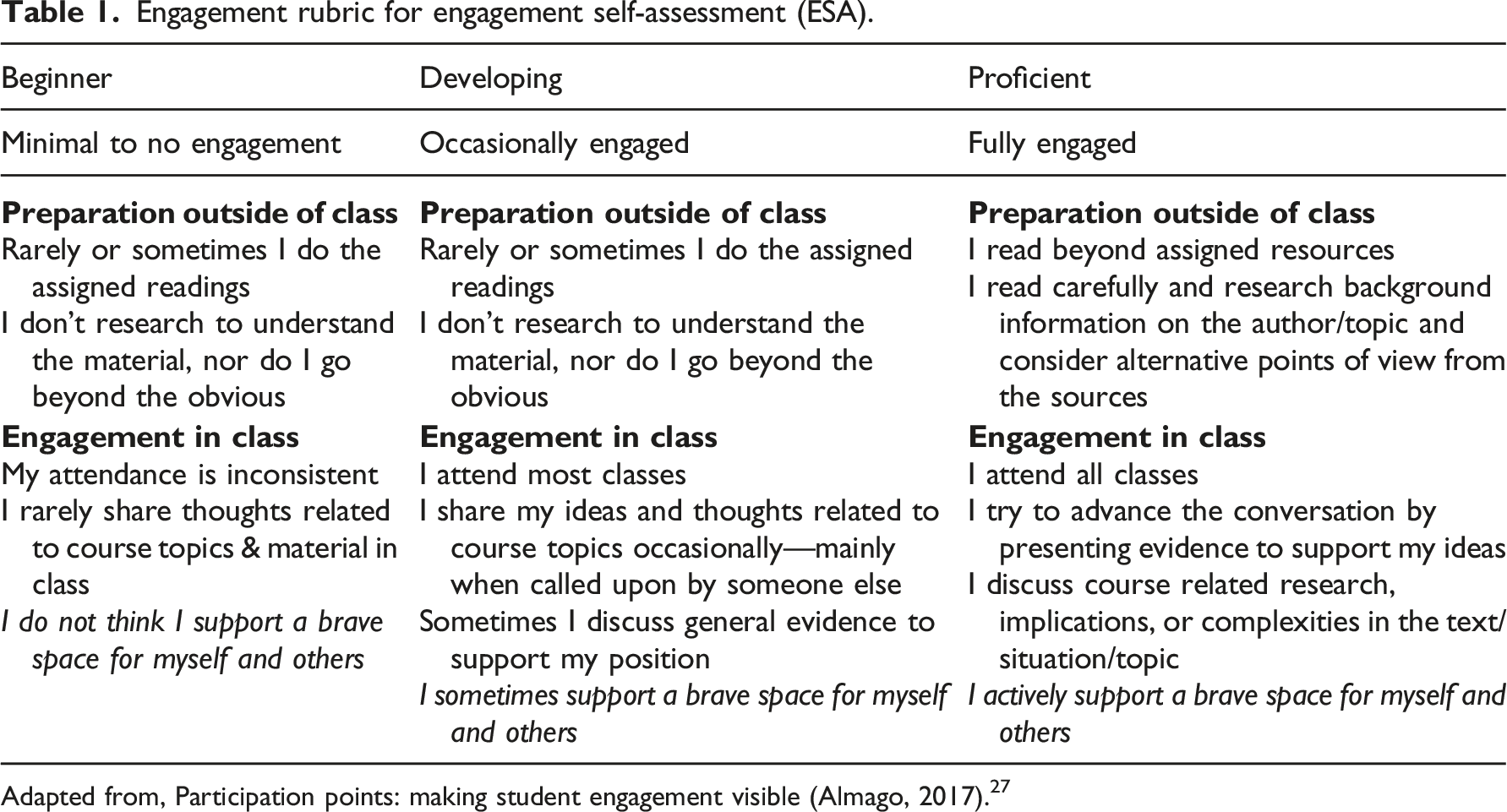
Adapted from, Participation points: making student engagement visible (Almago, 2017). 27
For the course a brave space definition was modified from Arao and Clemens (2013) and defined as: A space that allows for controversy with civility and genuineness, one that we own our intentions and recognise potential impacts on others, a place of respect, a space to challenge our own perspectives and thoughts but will not allow attacks against one another, but instead redirect to viewpoints. Lastly it is a space that we all recognise and accept a level of accountability to create together, even if it is imperfect.
As the language of a brave space was a new approach in the nursing curricula, “ground rules” as defined by Arao and Clemens 24 were introduced to the learners prior to the course start date via a podcast made by the course instructor embedded in the institutional learning management system for the class. The ground rules within a brave space for the course were explored together at course orientation. Learners gave examples of how they felt respected in conversation and what they needed to fully engage in difficult conversations. The ESA was reviewed in course orientation and then again at midterm. The ESA was then submitted at the end of the course. The instructor made an explicit effort to role model the ground rules embedded in the brave space by inviting students to participate “challenge by choice,” and to also “own your impact” if learners challenged word choice or statements. This meant recognizing power differentials and demonstrating personal vulnerabilities in challenging dialogue or ethical discourse that can require moral courage. Merit is seen in creating learning spaces which include elements of morally supportive environments as a strategy to foster moral courage in nursing students. A brave space has the potential to transform learning spaces in nursing ethics and possibly other courses. Research investigating the implementation of a brave space in nursing ethics education is unexplored in the current literature. Therefore investigating teaching strategies to implement and support a brave space within a nursing ethics course is a prudent starting point.
Research aim
The aim of the research was to explore the influence of a structured self-assessment tool called the ESA “Engagement Self-Assessment” on engagement, brave spaces, and learning. The focus of this manuscript will be the research findings specific to the ESA and alignment and creation of a brave space in a nursing ethics course.
Method
Design
An exploratory cross-sectional survey design was used, along with purposeful sampling from one course offering. The research method followed scholarship of teaching and learning as faculty and researchers.
Participants and study setting
A purposeful sample of undergraduate nursing students enrolled in a nursing healthcare ethics and law course using the ESA were included. Participants were in their senior year of the nursing program. The nursing ethics and law course in which participants were recruited was delivered in a synchronous, face-to-face format within discussion-based learning, and was taught by the primary author of the research team. A total of 39 participants (38 females; 1 male) completed the questionnaire. Thirty of the students identified as white and the remaining students identified as Indigenous, Black, East Asian, or Southeast Asian. Twenty-five of the students were in the age range 18–25 years; seven were 26–30; seven were over 30 years of age
Data collection
Data was collected from the research participant’s overall ESA mark and course grade, and their ESA exit questionnaire responses. The ESA exit questionnaire was open for 2 weeks at the end of the course and contained questions related to learning, engagement, and brave spaces using Likert scales and open-text responses asking for participant elaboration of their chosen Likert response. Only questionnaire responses related to the influence of the ESA on a brave space are discussed in this manuscript. These questions included: 1) On a scale of 1–5 how would you rate the influence of the ESA on your learning in the course? 2) On a scale of 1–5 how would you rate the influence of the ESA on the creation of a brave space in this course? 3) On a scale of 1–5 how would you rate the alignment of the ESA with your definition of brave space in the classroom?
Data analysis
Quantitative data using the final ESA mark and course grades were analyzed with inferential and descriptive statistics. The questionnaire was analyzed in both quantitative and qualitative manners. Open-text responses were analyzed using thematic analysis. Individual responses were organized under each question. Each response was read line by line. Key words and repetitive words were highlighted. Key words/phrases and codes were placed into themes within each question using an iterative process. The process repeated for each question data set. The final step combined like questions of brave space to confirm and generate larger themes within the topics. The open-text responses were then triangulated with the numerical data and situated with the literature.
Trustworthiness of the study
Thematic analysis was completed and validated by two researchers. Repetitive and key words were discussed along with codes and themes until 100% consensus was reached. Decision-making points and analysis were meticulously documented at each step for transparent tracking. As the purpose of the questionnaire was not intended to measure the concept of engagement or brave spaces validity was not established.
Ethical considerations
Ethics approval was granted by the Institutional Research Ethics Board of the participants. As the primary author of this manuscript was also the course instructor of participants, Tri Council policies were followed with particular attention to ethical considerations of scholarship and teaching related to coercion. Written consent for the use of overall course grade and final ESA marks in addition to their ESA exit questionnaire responses were obtained by a neutral institutional data collector not involved with the course. Consent was obtained prior to the deployment of the questionnaire. Consent was confirmed again by the participants by inputting their unique research code prior to completing the questionnaire. Information sheets were provided explaining the risks and benefits of the study at time of written consent. Results of the exit questionnaire were not released to the research team, including the instructor, until final grades were submitted. Participants’ identities associated with the research codes were unknown to the research team.
Results
A questionnaire response rate of 87% was achieved. Participant’s final course grade and final ESA mark were analyzed: the mean ESA final grade was 9.39 (standard deviation 0.58) and mean overall course grade was 90.77 (standard deviation 4.98). Due to the non-normal distribution of these grades, a Spearman’s correlation was computed on these grades, which yielded a nonsignificant ρ = 0.28, p = 0.09. Although not statistically significant, the relationship between final ESA grade and final course grade was positive, suggesting that those students who obtained high course grades, also tended to obtain high ESA grades.
Questionnaire rating scores for learning and brave spaces (N = 39).

Open-text responses gave context and descriptive data beyond the numerical ratings from the questionnaire. From the data sets related to brave spaces key themes were identified: a) Knowing expectations (What is expected in the learning space) b) Entering into bravery together (Sensing mutuality in vulnerability) c) Reflective practice (Awareness of individual impact) d) Commitment to others (Why commit to brave spaces)
Participants articulated the added benefit of knowing expectations within the engagement rubric; however, responses highlighted the initial framing of a brave space at the beginning of the course directed their expectations within the learning space early on. Despite the risk of discomfort in vulnerability, participants articulated a sense of “safety” in knowing they were entering into bravery together. The required reflection component of the ESA illuminated individual agency and accountability in the learning space through the process of reflective practice. The ambivalence in scores of the influence of the ESA on the creation of brave spaces correlated with their open-text responses as a commitment to others was identified as a key driver for the creation of a brave space, not the ESA.
a) Knowing expectations (What is expected in the learning space)
Establishing ground rules and exploring the definition of a brave space for the learning environment early on helped “set the tone” for many students. The ESA was seen as an additional support to help clarify the rules and expectations of a brave space: “...the ESA helped provide clear expectations for what was expected in class which helped to create safe environment” “The ESA highlighted the importance of supporting a brave space by including this as one of the indicators on the rubric”
The pedagogical alignment of the ESA also supported expectations of a brave space. Room for diversity of expression and implicit expression of value of the voice of the learner in the ESA helped frame the concept of a brave space: “(The) ESA creates a brave space in that it acknowledges all students come from different positionalities and because of this it is important to include the voices of students regarding their own reflection of their learning and engagement”
b) Entering into bravery together (Sensing mutuality in vulnerability)
A fear to “accidently use the wrong language” remained a barrier to share thoughts for some. However, the majority of students shared a collective sense of courage or bravery entering the learning space together: “I was able to express my opinions and vulnerability without any fear of judgment” “There was a safety net of relationships in the classroom and mutual respect among peers” “The ESA motivated me to be more open and vulnerable in class. Therefore, creating a space for others to be vulnerable as well. Being vulnerable helped me become more engaged in class topics and discussions”
The instructor was viewed as a member of the mutual learning space. The instructor helped role model elements of brave spaces through respect and a non-judgmental approach: “The brave space created safety, non-judgment, trust, and openness between fellow peers, the instructor and guest speakers to discuss challenging topics”
c) Reflective practice (Awareness of individual impact)
Students acknowledging their own agency in learning was facilitated by reflection. They viewed themselves in relationship with each other - one which their actions impacted others beyond themselves: “The ESA created a reflective practice that allowed myself to be open. By being open and vulnerable I am creating a space where others feel open and vulnerable” “Having this assignment made me reflect on how I have supported my peers in the past and how I can do more to consistently show them respect and make everyone feel comfortable” “I felt that being encouraged to consistently evaluate your own learning allowed me to recognize that my peers are also on a unique learning journey - and to create a brave space for them to share their perspectives”
d) Commitment to others (Why commit to brave spaces)
The ESA was not highlighted as a dominant reason to commit to a brave space, rather committing to a brave space was an act that held intrinsic value and demonstrated commitment to others: “ I feel that regardless of the ESA I would have supported a brave space due to my personal values”
Committing to the brave space took on moral weight for some, one which aligned with personal or collective values of the profession: “This is something that as nurses we should be practicing regardless of whether we are being graded or not. This is an ethical aspect of ourselves that I believe makes us nurses. Without being someone that can create a brave space, I think that would conflict with our ethical and moral duties in our personal and professional life.”
Discussion
The findings of this study provide insight into the use of brave spaces in nursing ethics courses while highlighting the influence of a rubric and self-assessment tool which aligned with the participants views of a brave space in learning. Setting expectations of the learning space as a forum to expand learner’s awareness of moral sensitivity through discussion helped situate the ground rules. Ground rules are not unique to brave spaces. Setting ground rules, norms, or expectations in courses contributes to civility, a sense of community and collective engagement. 25 In nursing ethics education, learners are often asked and invited to experience levels of discomfort. Discomfort, in fact, may be the first sign of moral sensitivity. However, we are mindful that discomfort is not a universal sign of progress, sensitivity, or learning; therefore, recognition that despite embracing discomfort for learning, discomfort may not be productive for everyone. Engaging in reflection helped illuminate the personal and collective impact of vulnerability and the impacts of discomfort for the participants in the study.
Participants used the terms “vulnerability,” “safety,” and “comfort” when entering the brave space created in the classroom. Cook-Sather 22 affirms by adopting a brave space “those who enter the space have the courage to face that danger and to take risks because they know they will be taken care of” (2016, p. 1). 22 In knowing the expectations of trust and respect when stepping into vulnerability, our research indicates a sense of safety or comfort may be created for students. Zuban et al. 28 claim, “Creating a brave space recognizes the vulnerability associated with authentic learning and encourages students to be courageous in embracing their vulnerability as an opportunity to grow” (2018, p.104). 28 This view is supported in a shift towards the learner as an agent in their learning which requires bravery instead of safety or comfort. 22 Beyond individual commitment to bravery and possible discomfort, participants articulated the need to commit to others in the learning space.
A sense of mutuality was shared, committing to one another, or sharing their vulnerability to help someone else. It is understood that civility lends to a collective good by intention.21,25 The instructor was seen as part of the collective by participants by role modeling adherence to the ground rules. This finding aligns with the understanding that the creation of brave spaces, requires collective responsibility.22,24 Some participants articulated the responsibility to uphold a brave space was based on duty and virtue, or in alignment of their personal and professional values. Commitment to a brave space held moral weight for some, which appeared to parallel a professional and moral duty to create a morally supportive learning environment in practice.
Particular benefit was noted in the reflective component of the ESA as it served as an avenue to commit to accountability and agency in learning. Clearly self-reflection has intrinsic professional, academic, and personal value, all of which can be transformational. Reflection on action is embedded in ethics frameworks,3,29 in moral reasoning, 10 and has been identified as a starting point to bridge theory to practice in nursing ethics education. 30 The ESA facilitated a continued self-reflection of the learner’s commitment to a brave space and engagement in the classroom. Despite the perceived lack of direct influence of ESA on the commitment to a brave space by participants, the reflective component provided some merit to assessing learning within a brave space.
Although the application of brave spaces in nursing ethics education shows promise and value, educators must be mindful of the original context of brave spaces in social justice courses related to oppression and bringing voice to marginalized groups. Relational ethics emphasize the recognition of all voices. In ethics courses educators are tasked with ways to bring forward voices or values of those who may be underrepresented; the underrepresented or vulnerable voice in healthcare is often viewed as the patient voice. However, in the learning space which embraces a brave space inviting all voices in the learning space may be asking a disproportionate few students we are not a part of the dominant culture to be overburdened in this obligation. 26 Verduzco-Baker suggests “modified brave spaces” to shift reliance away from dependence on personal accounts of students belonging to marginalized groups, and offering alternative versions of personal stories to bring voice to unique or less dominant perspectives in the learning space (2018, p. 589). 26 It was emphasized in the course, personal stories were not required from anyone, rather learners were encouraged to ask questions about diversities in voices and values. Austin 31 insists the health of moral communities benefits from hearing diversity of voices. In brave spaces it is emphasized that disagreements and differences are both essential and expected. 5 This change in expectation better mimics the reality of interprofessional workplaces and experiences of everyday ethics.
Bravery in the classroom was exhibited through articulation of disagreements in ethical action within case scenarios, sharing vulnerability in conflicts of conscience, and practicing situations that require moral courage such as reporting unethical practice. Courage and bravery are not clearly differentiated within the brave space literature; however in this manuscript, engaging in action despite fear was deemed as both brave and courageous. Not all demonstrations of bravery or courage were moral in nature; however within the course, learners were provided with opportunities to practice moral courage or moral bravery through authentic engagement in difficult conversation within nursing ethics discourse.
Commitment to the importance of nursing ethics education must remain a priority, and reflection on how our learning environments support a moral space is needed. 2 With intentional pedagogy, learning spaces within nursing ethics courses have the potential to parallel morally supportive environments for learners; spaces where bravery and courage is needed, diversity of voices is encouraged, and respect is evident. Rubrics combined with self-assessment components may have benefits in supporting components of brave spaces such as clear expectations, accountability for actions, and reflection. The effectiveness of teaching methods from the view of learners as active members in the learning process deserves further exploration. 32
Brave spaces provide a way to frame difficult conversations and engage students in authentic learning through discomfort and growth. How brave spaces translate into clinical workplaces can be challenging given the need for mutuality and understanding of ground rules. Brave spaces to support courage and uncomfortable discourse in the clinical care of women and children has been suggested in hopes to begin this dialogue. 33 Continued evaluation as to how educators can best prepare and support nursing students in morally supportive learning spaces is needed.
Limitations
Although novel findings were articulated in this study, several limitations need to be discussed. The research method, clarity of the questionnaire, and sample population need to be reviewed. The ESA was a new assessment, and the questionnaire was not pilot tested prior to deployment; however, this is in keeping with scholarship and teaching and learning by testing new teaching practices or assessments in action. The question “How would you rate the alignment of the ESA with your definition of brave space” could have been clarified. Although an operational definition was given for brave spaces-some participants did not correlate the question with the provided definition, but rather responded to the alignment of the ESA as a whole. This brought new insights for the researchers related to alignment of the assessment with brave spaces, however evidence of confusion regarding the framing of the question was evident.
The ESA was worth 10% of the overall course grade. There is potential grade inflation when grades are assigned by learners; however, literature also supports the benefit of agency in learners grading themselves as well. The overall ESA mark was assigned 5% by the learner and 5% by the instructor. The exit questionnaire portion of the ESA was not graded, but rather assigned a complete/incomplete to help limit any bias in responses.
This study was also conducted on a small homogenous cohort. Sample size can affect power in statistical analysis, and limits broader inferences. The authors wonder how classes of a bigger size would alter commitments to a brave space and levels of engagement. Additionally, the participants in the sample had established previous relationships as a cohort. Having these connections prior to entering into the course may have influenced their willingness or ability to commit to a brave space. Homogeneity of the class may alter experiences and response to brave spaces, learning, and engagement. As overall cultural diversity was limited in the cohort, themes were not able to be extracted in the qualitative data from learners who identified as Black, Indigenous, or people of color. These kinds of phenomena characterize applied research of teaching and learning, where pre-established groups of students are often used out of necessity. Further research of the influence of an assessment tool like the ESA and pedagogical practices which influence brave spaces is needed. Repeating the study with another cohort would add additional insight and strength to the study findings.
Conclusion
This study provided new insights into the use of a brave space in a nursing ethics course while offering pedagogical tools which align with brave spaces. Application of a brave space in the learning environment may pose new challenges to nursing ethics educators as the classic terms “argue,” “defend,” and “debate” may not be fitting with brave spaces as these approaches naturally lend to convincing versus listening. Controversy with civility requires a shift in how difficult discussions are facilitated in the learning space. Using a brave space framework to help create a morally supportive learning environment shows promise for learners and nurse ethics educators. Teaching tools and assessments like the ESA offer considerable benefit in clarifying expectations within the learning space, and hold merit in the process of reflection, particularly if learners are seen as active agents in learning. Further research is needed to address the gap of literature pertaining to the use of brave spaces in nursing ethics courses. Investigation into the impact of brave spaces on the development of moral sensitivity and moral courage would offer new ways to support nursing students in their ethical competence. Nurse educators are urged to role model bravery and facilitate morally supportive learning environments to foster nurses who can courageously engage in difficult conversations situated in ethics.
Footnotes
Acknowledgments
Thank you to Brenda Joyce, Michelle Edwards Thompson, and Dr. Kirsty Erickon for your support and encouragement of this research. To Nancy Goddard - thank you for your review and comments. To Gillian Lemermeyer-thank you for your support, and insight into relational ethics. Most of all, thank you for bravely pioneering new learning spaces with me. Lastly, we would like to thank the reviewers of this manuscript for their thoughtful comments and suggestions.
Author contributions
Natalie Ford, Red Deer Polytechnic, served as the principal investigator of the study, conceptualized the study, completed formal analysis, and wrote the first draft of the manuscript. Larissa Gomes, Red Deer Polytechnic, helped analyze qualitative data, and made substantial contributions to the manuscript via review, editing, and validation. Dr. Stephen Brown, Red Deer Polytechnic, contributed to study design, completed quantitative analysis, and contributed to manuscript through review and editing.
Declaration of conflicting interests
The author(s) declared no potential conflicts of interest with respect to the research, authorship, and/or publication of this article.
Funding
The author(s) disclosed receipt of the following financial support for the research, authorship, and/or publication of this article: This work was supported by the Red Deer Polytechnic Extended Funding Grant.
