




Abstract
Background
Nursing is a humanitarian and social field that provides health services. It combines science and art and has a rich history. Despite fundamental changes in the provision of medical services and nursing education, the concept of “good nurse” is still unclear.
Purpose
The purpose of this article is to investigate the characteristics of a good nurse from the nurses’ perspective.
Research design and method
A qualitative study was applied using conventional content analysis. The participants were 30 nurses that selected with purposive sampling method. Data were collected through unstructured interviews and simultaneously analyzed via the conventional content analysis approach of Graneheim and Lundman.
Ethical considerations
This study was approved by the Research Ethics Committee of Hormozgan University of Medical Sciences, Iran.
Findings
The study revealed that personal characteristics (Adherence to ethical and human principles, Physical health, Attractive appearance, and Ability to communicate properly); and professional characteristics (knowledge - clinical skill - nursing roles) are essential to being a good nurse.
Conclusion
Coming to know the distinctive features of a good nurse as perceived by nurses themselves creates an opportunity for nurses to rethink their profession and to reflect on the characteristics of the good nurse.
Introduction
Nursing is a human and social field of study which provides medical and healthcare services and combines science and art. 1 Nursing has a long and rich history and despite fundamental changes in healthcare provision and nurse education, the concept of a good nurse is still ambiguous. One reason for this ambiguity is the dependence of this concept on social and cultural variables.2,3 Though ethical codes have existed all over the world to guide nurses on how to provide services, these codes are basically developed according to certain organizational perspectives. As Rchaidia et al. 4 maintained, ethical codes play a key role and can be at the core of good nurses’ characteristics, tasks, and duties. Yet, what matters is that understanding the concept of a good nurse as perceived by those who are directly involved in nursing services (i.e., nurses themselves and patients) is essential. 4 Determining the distinctive features of a good nurse can contribute to nurses’ performance and service provision to patients in the best way. 5 Good nurses act efficiently and maintain high standards at all levels. However, being good and behaving well require certain characteristics, which are not necessarily spiritual in nature or specified in the profession. 2
Characteristics of a good nurse are often described by those who receive nursing services, though we are very well aware of the significance of the consumer’s attitude. 6 Still, it seems that coming to know the professionals’ attitude can significantly contribute to the professional education in this field. In their research, Izumi et al. 5 found that, as perceived by patients, nurses’ professional skills, or qualifications and communication with patients are the key characteristics of a good nurse. 5 Jouybari et al. 7 reported that behaviors such as availability, monitoring, humane communication, and attention to the patient’s convenience by the nurse help to relieve patients’ minds. Er et al. 8 found such features as sympathy, integrity, scientific curiosity, patience, sensitivity, and peace as the characteristics of a good nurse perceived by freshmen and senior nursing students. 8 Santos et al. 1 mentioned accountability, affection, integrity, and supporting patients as the characteristics of a good nurse. 1 This concept is dynamic, variable and context-dependent and nurses’ attitude toward this concept can provide unique insights into different aspects of concerns in this profession.
Purpose
The purpose of the study was to investigate the characteristics of a good nurse as perceived by the clinical nurses.
Methods
Design
A descriptive qualitative study was used to achieve the aim of the study. A conventional content analysis method was used to make replicable and valid inferences from data. This study was conducted from September 2020 to February 2021.
Participants
Demographic characteristics of the participants.
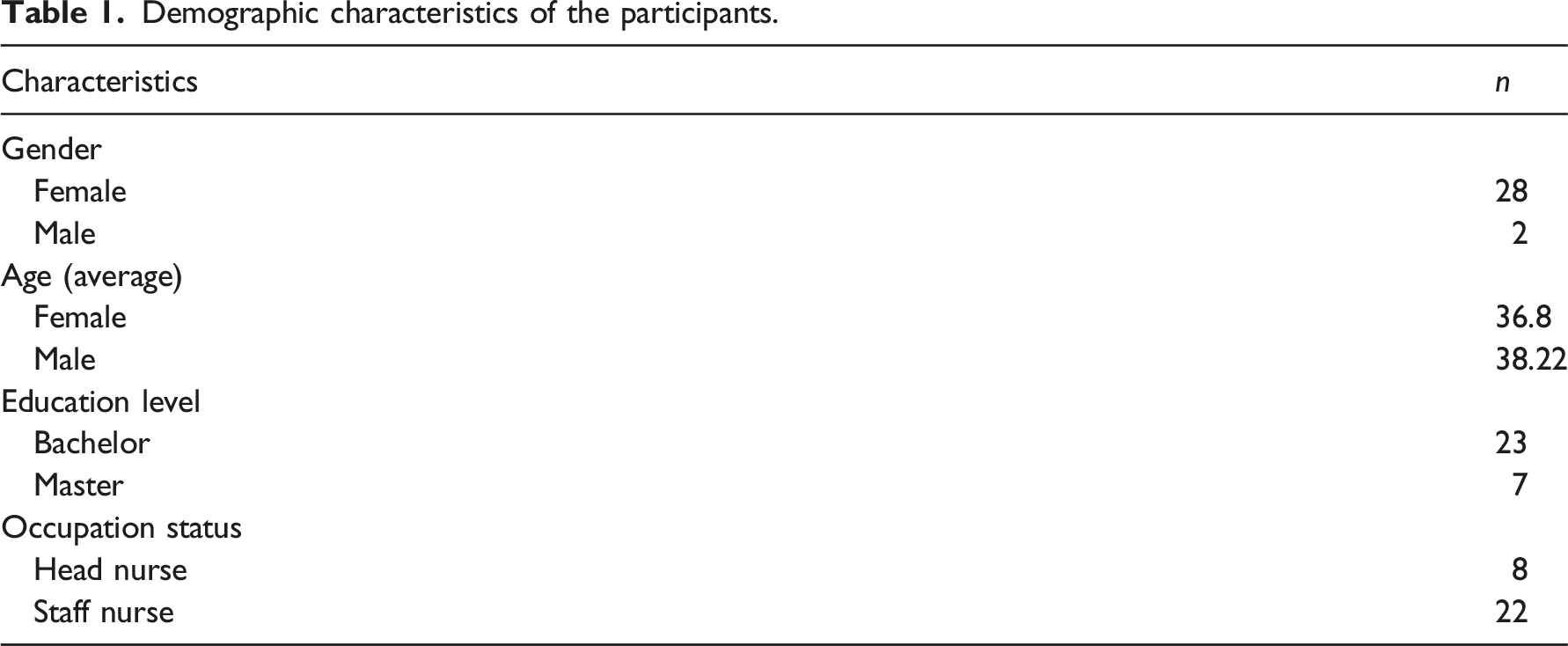
Data collection
The data were collected through unstructured in-depth interviews with the participants. Interview with each participant was carried out in a peaceful environment in the hospital and with prior agreement of the participants. Overall, 30 individual face-to-face interviews were conducted. The interviews began with an open-ended question (e.g., In your opinion, who is a good nurse?). The next questions were asked corresponding to the interviewee’s response and in line with the purpose of research. The exact time of appointment was set as the interviewee preferred. Each interview lasted between 60 and 90 min. All interviews with the permission of the participants were audio-recorded. Each participant was given a code including N1, N2, and so on.
Data analysis
A conventional content analysis approach of Graneheim and Lundman 9 was used in the present research to analyze the qualitative data (interview content).
In a conventional content analysis, the categories are directly extracted from textual data so that the researcher can gain a better view of the phenomenon of interest. The researcher extracts the categories in retrospect and allows the categories and the sub-categories to flow naturally. The best outcome of a conventional content analysis is concept development or model construction. 10 In this research, the data analysis began with the recurrent reading of textual data and creating an overall impression of the data until all researchers were deeply involved with the data. In advance to the research, it was decided to consider both the covert and overt content. Then the units of analysis (i.e., sentences of a particular meaning) were identified and the main concepts in each unit were analyzed as a meaning. Each meaning unit was given a major code and then the sub-codes were set and subsumed under each major code. Afterward, the major codes were categorized with similar meanings and formed the categories. The main themes were also compared and integrated in similar categories. 11
Rigor
To increase the internal validity of research, the member checking method was used. To this aim, after each interview, the interview content was transcribed and returned to the participants to check the accuracy. To increase the external validity, a thick and rich description of dataset was used. To increase the reliability, the organization method of data recording was used in data collection and audit trail. 10
Ethical consideration
This study was approved by the Research Ethics Committee of Hormozgan University of Medical Sciences, Iran (Ethical code: IR.HUMS.REC.1400.361). Ethical considerations such as the right to withdraw in each stage of the study, confidentiality of the information provided and anonymity of the respondents were taken into account.
Findings
Summary of themes and main categories.
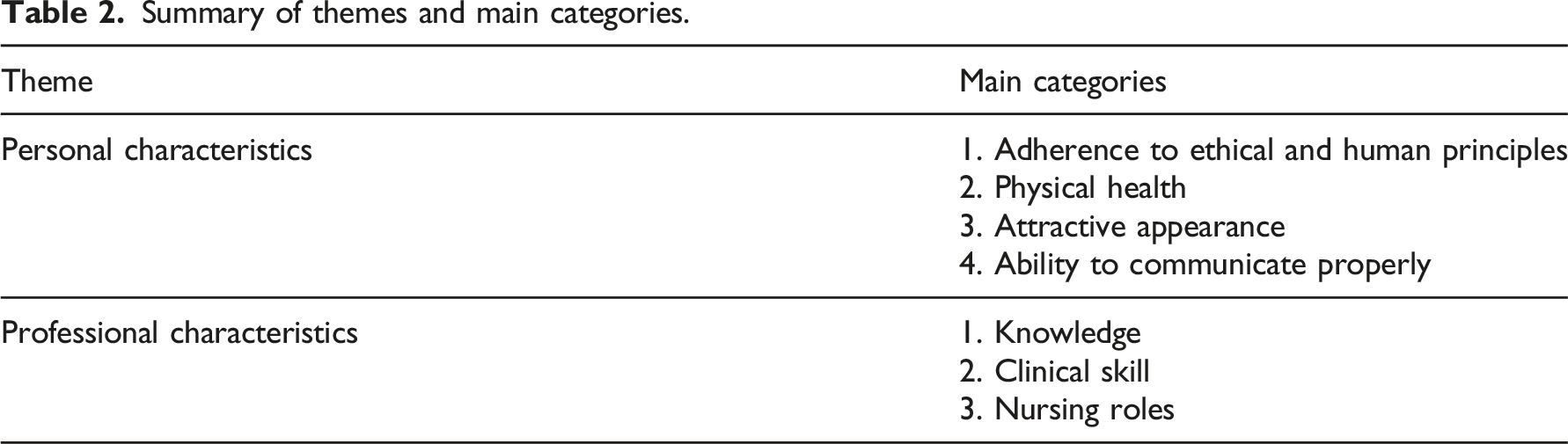
Theme 1: Personal characteristics
All the participating nurses acknowledged that a good nurse had unique personal characteristics that distinguished him/her from others. The four main categories extracted were adherence to ethical and human principles, physical health, attractive appearance, and ability to communicate properly with others.
Category 1: Adherence to ethical and human principles
Most of the interviewees emphasized ethical and human principles as a key feature of a good nurse. For example, a participating nurse said,
“When I see the patient in bed as my own mother or father, I feel sympathy for him/her. I feel it on my conscience and the patient can feel this affection too” (N29).
Another participant in this regard mentioned, “If I am a good nurse, I feel no difference between the patient and a member of my own family during the care-taking. When I am involved in an aggressive procedure and I see the patient is stressed and is in pain, I really suffer, and try to continue the procedure in the least painful way” (N9).
Another participant pinpointed confidentiality as a main human characteristic and an inevitable characteristic of the health system. With this concern, she added: “A patient was hospitalized after she was diagnosed with the self-immunity disease. I saw her sobbing quietly. When I cornered her and broke the ice, she asked me if I thought that was because of her sins. I said no and began to explain her condition. I was not finished when she told me that I was like a sister to her and that she wanted to reveal a secret to me (that she hadn’t told her sister even). Then she explained that she deliberately had an abortion three times, as she disliked her husband. Thus, she aborted on her will. She confided in me and revealed her secret. So, I was expected to keep her secret” (N24).
Category 2: Physical health
The findings of this study indicate the significance of nurses’ physical health due to the nature of nurses’ working conditions, which involve physical effort. Most of the participants mentioned that the nurse should be physical well-being when taking care of the other. One of the participants in this regard said, “As the nursing job is demanding and associated with human suffering and as it is more time-consuming than many other jobs, the nursing staff are required to be physically and mentally fit.” Then, she moved on to elaborate further, “As a simple example, I say how a nurse suffering from varicose veins or intervertebral disc herniation who cannot stand on her feet can do her duties properly!” (N30).
Category 3: Attractive appearance
Although nurses’ physical health is taken into consideration by most of the participants as a Personal characteristic of good nurse, nurses’ appearance is noteworthy features recurrently mentioned in the interviews.
A participant says, “When I, as a nurse, wear a white clean overall working around patients, I for sure influence them and their attitude toward me. When a nurse cannot wear suitable clothes for the position s/he holds, I think it is as hard for the patients to trust him/her” (N2).
Category 4: Ability to communicate properly
The participants not only drew attention to the significance of patient–nurse communication, but also viewed it as a key to success in treatment. This is also linked with the communication principles of a nurse and the other nursing staff. One of the participants in this regard said, “A nurse is communicating with all. Yes, a nurse is supposed to know how to behave with everyone and every member of the medical team. I do not mean that s/he is supposed to respect some more than others. I mean s/he should be able to use a scientific and professional language to speak to the doctor about the patient and the target treatment and speak appropriately to different rankings of the nursing staff including nurse assistants or paramedics logically and according to their prescribed tasks and duties. I have seen colleagues calling a ward to request something but being unable to make their meaning across. Thus, they do not obtain what they ask for. Sometimes, I myself need a lab test result emergently. Though it has been mentioned in the request, I again call the lab and use simple sentences to emphasize what I need. For example, I say I am aware that you are too busy but would appreciate it if you sent us the test result immediately. Believe it or not, these simple words do a miracle” (N3).
Theme 2: Professional characteristics
According to the data, the professional characteristics of a good nurse included the categories of knowledge, clinical skills and nursing roles.
Category 1: Knowledge
The majority of nurses perceived an educated nurse as a good nurse and what they meant by an educated nurse was one who had accurate, adequate, and up-to-date knowledge of his/her profession and used it in the right place. Concerning a nurse’s knowledge, one of the participants stated, “the nature of our job is so dynamic that every hour and every day a new medical treatment is discovered. When the list of new medicines is added to, is a nurse who lacks up-to-date knowledge and makes no attempt to learn new things and only relies on his/her old university days’ knowledge a good nurse? Such a person only works and does not do any nursing” (N13).
Category 2: Clinical skill
In the light of the key points extracted from the interviews, not only does a nurse need extensive up-to-date knowledge but also this knowledge needs to be appropriately used clinically. Therefore, all the interviewees acknowledged that a good nurse needs to have appropriate clinical skills with the least level of risk and the least adverse effects on the patient.
In this regard, a nurse participant said,
“nursing means clinical work and if a nurse does not do the clinical work appropriately, all attempts are deemed fruitless. Is an experienced nurse who is yet not capable of measuring the standard blood pressure a nurse at all before we can decide whether s/he is a good one or not?” (N22)
Similarly, another participant stated, “Though nursing does not only involve clinical skills such as giving the medicines, monitoring vital signs, gavage, etc., the public often expect us to do such stuff. The public know us for these clinical skills” (N7).
Category 3: Nursing roles
In describing this feature, the participants meant the tasks and duties of a nurse among which were care provision, management, education, and support. They approached the nursing role of a good nurse from different aspects. One of the participants mentioned a wide range of conditions required for making clinical decisions and stated, “all nurses, no matter what their duties are in the ward, are always involved in decision-making, as part of their managerial duties: from a patient’s admission to hospital and finding a vacant room and bed to decisions on unexpected events such as abrupt changes or ups and downs in blood sugar and so on. So, it is a nurse’s duty to make the right decision at the right time” (N19).
Similar comments were made by another participant, “A good nurse is a good manager. S/he should be able to manage his/her tasks and have everything under control during his/her work shift. S/he is supposed to solve all major and minor issues. You might be working at the same work shift with a colleague who asks you to help him/her exceptionally more that day” (N12).
Another role mentioned in the interviews was the care providing role. One of the participants in this regard said, “A patient comes to us when s/he is incapable of taking care of him/herself. Thus, we should prioritize healthcare provision. The better we are at care provision, the closer we are to the realization of a good nurse” (N8).
Another nursing role derived from the interviews was the educational role of nurses. The participants defined education as the transfer of knowledge or a certain skill to the patient, and perceived it as an inevitable part of good nursing. One of the participants recalled a colleague as an exemplary good nurse,
“Whenever my colleague is done with her usual duties, she visits her patients one by one and asks them what they know about their disease and where they have got this information. Then, in accordance with their information, she, either orally or in writing, provides them with the key points to know about their disease and even suggests a couple of specialists to them. I like the way she does all this and the patients also perceive her as a very good nurse” (N9).
A number of other participants also pinpointed the supportive role of a good nurse.
“It was my duty as a nurse to support the patient even if I offended a colleague. So, I took the patient’s side and am happy to do that ever” (N17).
Discussion
In this study, the characteristics of a good nurse were identified in two themes, personal characteristics (Adherence to ethical and human principles, Physical health, Attractive appearance, Ability to communicate properly) and professional characteristics (knowledge - clinical skill - nursing roles).
Ethical characteristics were among the major features of nurses as recurrently mentioned in the body of related research.4,5,12 Nurses deal more with patients who care more about the human and ethical characteristics of a nurse and adhere to ethical principles rather than professional features.2,13 However, nurses are unfortunately inefficient in making ethical decisions. 14 Adhering to ethical principles differs as perceived by patients and nurses, and this difference would adversely affect the quality of nursing services and improve the side effects of the disease. 15 In the present research, a good nurse was described by ethical characteristics such as sympathy and empathy. Such a nurse can understand a patient’s suffering, problems, and conditions and react appropriately. This finding is consistent with the definition of empathy in a body of related research and even shows that this empathy is to the benefit of the patient and also to the members of the medical team. 16 A body of research revealed that when ethical privileges such as a good temper, patience, loyalty, and empathy are added to the nursing profession, nursing becomes more humane and the professional value of nurses is increased.17–24 A comparison of the present findings with the related literature shows that patients perceive ethical characteristics as important for a nurse.
Another characteristic of a good nurse in the present research was found to be the attractive appearance such as neat and clean clothes. This was also introduced as a main criterion for creating trust between the nurse and patients. As also addressed in the related literature, a nurse’s clothing affects a patient’s and company’s perception of the nurse’s professional performance. A nurse’s clothing is the first means of non-verbal communication with the nurse. It sends many non-verbal messages. The color and overall condition of these clothes can positively or negatively affect a patient’s and patient’s company’s peace and security. It can also influence the nurses’ self-confidence.25–27
Communication is a central concept in nursing. Communication with patients is part of the nursing education, an introduction to healthcare provision, a factor involved in professional growth, a factor involved in improving the patient’s conditions, and a factor accounting for the growth of social character. 28 The nurse–patient communication is a criterion involved in determining effective and active healthcare. However, researchers believe that the underlying factors of the nurse and patient communication are not investigated well and there is a need for qualitative research on patient’s experience of communicating with nurses. An inefficient communication acts as a potential barrier to healthcare provision. 29 The present findings show that the key to successful treatment, as perceived by nurses, is effective communication and different studies have attested to the significance of a nurse–patient communication.30,31 As a nurse comprises a major part of the medical team and the value of nursing is evident besides the other activities of the care providing team, 32 the appropriate communication between a nurse and other members of the medical team is a key point to consider. The present research showed that the participating nurses attested to the significance of communication with other members of the medical team. The participating nurses perceived a nurse’s physical health to be correlated with the concept of a good nurse as it leads to the provision of better services for those seeking help, which is consistent with some other studies.33,34
The professional characteristics of a good nurse were included the categories of knowledge, clinical skills, and nursing roles. Qualitative research in Iran shows that knowledge and skills are among the criteria for nurses’ professional competency, which is consistent with the criteria for a good nurse in the present research. 35 In this research, such roles as educational, care providing, managerial, and supportive were among the characteristics of a good nurse in professional domain.
It was inferred from the interview content that meeting patients’ potential and actual needs comprised a nurse’s care providing role. A nurse’s attempts to play this role is a key factor involved in the quality of a nurse’s job. Attention to a patient’s care providing needs and meeting them distinguish good and bad care provision. 36 This is in line with the present findings. Some qualitative research in England explored nurses’ perception of their main activities. This research concluded that taking care of the patient and cooperating with the care provision is a priority in nursing activities. 37 These results are consistent with the results of the present research and further highlight the care-taking role of a nurse.
The present participants mentioned the supportive role of a nurse as a distinctive factor for good nursing and associated it with defending the patient’s rights and benefits. This finding is also consistent with a body of research.2,4,35,38
Conclusion
Determining the characteristics of a good nurse open new horizons for the nursing population. It helps nurses to appreciate what it means to be good nurses. Coming to know the distinctive features of a good nurse as perceived by nurses themselves creates an opportunity for nurses to rethink their profession and to analyse the characteristics of the good nurse in relation to their own practice. Qualitative research findings such as the present findings can help the nursing population to move toward completion, progress, and professionalism.
Footnotes
Acknowledgments
The authors would like to gratefully thank all nurses who participated in this research.
Author contributions
Zahra Khademi contributed to the study design and conceptualization. Razieh Beigi Broujeni and Hesamaddin Kamalzadeh contributed to data collection, data analysis, and interpretation. Samireh Abedin contributed to study supervision.
Declaration of conflict of interest
The author(s) declared no potential conflicts of interest with respect to the research, authorship, and/or publication of this article.
Funding
The author(s) disclosed receipt of the following financial support for the research, authorship, and/or publication of this article: This work was supported by the Research Department of Hormozgan University of Medical Sciences, Iran.
