




Abstract
In Dobbs v. Jackson Women’s Health, a 6–3 majority of the US Supreme Court overturned 50 years of established precedent, ruling that the Constitution confers no right to abortion. Since first recognition that the constitutional right to privacy encompassed a (negative) right to pre-viability abortion in 1973, Supreme Court decisions have slowly chipped away at the substance of this right. Dobbs, however, marks a significant shift in abortion (and general) jurisprudence, by deploying an originalist interpretation of the constitution to deny that such a right exists. Consequently, States may now regulate abortion how they see fit, including by introducing complete prohibitions. This note illustrates how Dobbs has dire consequences for reproductive freedom as we have known it, with disastrous legal and practical ramifications for abortion-seekers, pregnant people, and all people with the physiology to become pregnant. Furthermore, the Court’s use of an originalist approach to rescind a constitutional protection signals further moves to derecognise other rights such as contraception, as well as same-sex intimacy.
Dobbs v. Jackson Women’s Health 1 marks the end of ‘reproductive freedom as understood for the past fifty years’ in the United States, 2 and a significant shift in Supreme Court jurisprudence. The constitutional right to abortion, first recognised in 1973, 3 has been being weakened for some time. 4 Goodwin notes that, in many parts of the United States, this right was, in practice, ‘more illusory than real’. 5 Despite jurisprudence since 1973 failing to progress the abortion right (and, in fact, actively eroding its boundaries), the foundational principle from Roe v. Wade that abortion before viability was protected by the Constitution was consistently upheld. This changed on 24 June 2022, when a 6–3 majority of the Supreme Court held that the US Constitution confers no right to abortion. Dobbs is the first time in its history that the Court has rescinded a recognised constitutional right in its entirety.
Dobbs v. Jackson Women’s Health
The Mississippi Gestational Age Act, passed by the Mississippi legislature in March 2018, stipulated that Except in a medical emergency or in the case of a severe fetal abnormality, a person shall not intentionally or knowingly perform, induce, or attempt to perform or induce an abortion of an unborn human being if the probable gestational age of the unborn human being has been determined to be greater than fifteen (15) weeks.
6
On the day of enactment, the Jackson Women’s Health Organization filed suit in the Federal District Court to enjoin enforcement of the Act. This order was granted by Judge Reeves. 7 In banning abortion from 15 weeks (which is before the recognised viability threshold), the provision ran contrary to established precedent. The Fifth Circuit upheld this decision. 8 Mississippi petitioned the Supreme Court on the question of ‘whether all pre-viability prohibitions on elective abortions are unconstitutional’. 9 Mississippi argued that the Court should overrule Roe and Planned Parenthood v. Casey 10 to allow States to regulate abortion by their own democratic processes.
In Roe, the Supreme Court held that a person’s decision to have an abortion is a constitutionally protected liberty under the due process clause in the Fourteenth Amendment. 11 This decision about whether to have an abortion fell under the broader entrenched right to personal privacy. 12 However, Justice Blackmun held that the right to choose could be qualified by the State’s ‘important and legitimate interest in potential life’. 13 The point at which State interest could restrict abortion is ‘at viability’, after which point it may proscribe abortion – except where necessary to preserve the life or health of the pregnant person. 14 The abortion right was, thus, a negative one; a person was entitled to choose abortion before viability, but States had no obligation to facilitate termination of pregnancy. Twenty years later, Casey upheld Roe’s central conclusion that there could be no criminal prohibition on pre-viability abortion. 15 However, Casey marked a significant departure; States could make law about abortion at any point during pregnancy provided that it does not, in purpose or effect, ‘place a substantial obstacle in the path of a woman seeking an abortion before’ viability. 16 The constitutionality of pre-viability abortion restrictions turned on the application of the ‘undue burden’ test; a subjective assessment of whether the law amounted to a substantial obstacle. 17 Casey enabled States to act with great hostility towards abortion, 18 but remained clear that pre-viability abortion bans were unconstitutional. The Mississippi Act directly challenged the latter point of law.
The decision
The majority opinion, delivered by Justice Alito, held that ‘[t]he Constitution makes no reference to abortion, and no such right is implicitly protected by any constitutional provision’. 19 The due process clause in the Fourteenth Amendment may protect components of ‘liberty’ not explicitly mentioned in the Constitution. However, the judgment explains that it must be shown that the claimed implicit right is ‘deeply rooted’ in the ‘Nation’s history and ‘tradition’ and is essential to the Nation’s ‘scheme of ordered liberty’. 20 This is because the term ‘liberty’ alone provides little guidance. 21 Recourse to history, the majority find, acts as a check on the ‘natural human tendency to confuse what the Amendment protects with our own ardent views about the liberty that Americans should enjoy’ and ensures that the Court does not ‘usurp authority that the Constitution entrusts to the people’s elected representatives’. 22
The majority concluded that a right to abortion is not implicit in the constitutional text: ‘the clear answer is that the Fourteenth Amendment does not protect the right to an abortion’. 23 The judgment stipulates that their survey of historical sources support the conclusion that abortion was a crime (with little or no exception) in most States for over a century before the decision in Roe. Consequently, Roe was wrongly decided: a right had been read into the Fourteenth Amendment that it did not protect. Justice Alito described the effects of pregnancy and motherhood on women as ‘important concerns’, 24 but noted that this was not the only consideration; the State has an interest in potential life. Justice Alito observes that Roe’s rationale of viability as the point at which State interest in foetal life becomes compelling is unclear. 25 The majority held, ‘we thus return the power to weigh those arguments to the people and their elected representatives’. 26
On the significance of the Court departing from established precedents, the majority emphasise not only the importance of stare decisis 27 but also the importance of reconsidering previous decisions when rendered necessary by the satisfaction of five conditions. First, an erroneous interpretation of the Constitution. Second, inferior reasoning. Third, a lack of clarity about established rule(s) and/or rules that cannot be consistently applied. Fourth, a disruptive effect on other areas of law. Finally, an absence of concrete reliance on the part of Americans. In applying these criteria, the majority found that ‘Roe was on a collision course with the Constitution from the day it was decided, Casey perpetuated its errors’. 28 The decisions are considered weak because they failed to ground their findings in ‘text, history, or precedent’ and are tantamount to judicial legislation. 29 The undue burden test is determined to be unclear and difficult to apply consistently. 30 Roe and Casey are also labelled disruptive precedents for having ‘diluted the strict standard for facial constitutional challenges’. 31 Finally, the majority conclude that there are no concrete reliance interests frustrated by overturning Roe and Casey because abortion is ‘unplanned activity’. 32 The majority refuse to adjudicate whether there is reliance in a broader sense –in that people might plan their lives around the reality of an abortion right – because they explain this is ‘intangible’ and therefore a matter for State legislatures. 33
If future State law on abortion is subject to constitutional challenge, the majority stipulates that the proper ground for assessment is ‘rational-basis review’. The law is valid if there is a ‘rational basis on which the legislature could have thought that it would serve legitimate state interests’. 34 The majority recognises that such interest could encompass respect and preservation for foetal life at all stages, the elimination of ‘gruesome or barbaric medical procedures’, maintaining the integrity of the medical profession, and eliminating discrimination. 35 The majority hold that the Mississippi Gestational Age Act is justified on these grounds. Justices Kavanaugh and Thomas concur. Justice Roberts concurs in judgement only. Justices Breyer, Sotomayer, and Kagan file dissent.
Originalism and the Fourteenth Amendment
Originalism is a theory of constitutional interpretation directing that where constitutional text is ambiguous, judges should look to historical sources to understand what was meant by the language at the time of ratification. 36 The approach – championed most notably by the late Justice Scalia 37 – is favoured by conservative judges, 38 who now dominate the Supreme Court. It is unsurprising, therefore, that originalism is at the centre of the majority and concurring opinions in Dobbs. The first condition the Court sets out as necessary for the overturning of precedent is an erroneous interpretation of the Constitution; the majority concludes Roe and Casey to be mistaken in their interpretation of the Fourteenth Amendment.
Proponents argue for originalism as neutral and objective. 39 The majority and concurring opinions are at pains to emphasise that their decision is ‘neutral’. 40 Justice Kavanaugh declares that ‘the Constitution is … neither pro-life nor pro-choice. The Constitution is neutral …’. 41 Such language packages their reasoning as dispassionate; a mere matter of explaining what things are (based on how they used to be).
The appeal to objectivity is deceptive. 42 The Constitution contains no explicit rule that it must be interpreted literally and constrained to the realities of the time ratified. Furthermore, originalism is not simply a method of interpretation, but a ‘values-based, goal-oriented political practice’. 43 Seigel explains that the majority and concurring opinions begin ‘in a condemnation of abortion’ and clearly seek out the reversal of Roe. 44 It should not be forgotten that the Supreme Court ended the right to choose abortion, because it should be left to States to decide, only days after it declared a constitutional right to concealed carriage of firearms, because it cannot be left to States to decide without infringing on fundamental rights. 45 The Constitution recognises a right to bear arms but not explicitly to concealed carriage. These different outcomes illustrate the infusion of conservative politics and values into what are result-oriented decisions. The Court was satisfied to conclude that States cannot be trusted to regulate guns, but they can be trusted to regulate people with the physiology to become pregnant. Dobbs is an example of how originalism has the effect of ‘fusing contemporary political concerns with authoritative constitutional narrative’. 46
As the dissent acknowledges, eliminating [rights as fundamental as bodily autonomy] is not taking a ‘neutral’ position … It is instead taking sides: against women who wish to exercise the right, and for States (like Mississippi) that want to bar them from doing so.
47
The majority emphasises the importance of States’ rights – their interest in ‘protecting fetal life’ (and it critiques the dissent for failing to take note of this). However, Alito’s opinion neither acknowledges the harms of forced pregnancy and birth, nor articulates what the State interest in protecting foetal life consists in. (In contrast, the dissent does acknowledge the State interest in foetal life and highlights the majority’s mischaracterisation of Roe and Casey). Despite the emphasis placed on the ‘state interest in fetal life’ in constitutional law, there has been limited exploration of what this comprises and why it must be respected to the degree that it relegates individual liberty to a secondary concern.
Prior to Dobbs, Supreme Court jurisprudence had previously been disciplined but not static in interpreting the Constitution. The dissent notes that ‘the guarantee of liberty encompasses conduct today that was not protected at the time of the Fourteenth amendment’. 48 Those drafting the provision understood that social circumstances evolve, and ‘defined rights in general terms, to permit future evolution in their scope and meaning’. 49 The Court stays faithful to the Constitution where it applies rights ‘in new ways, responsive to new social understandings and conditions’. 50 Justice Kavanaugh acknowledges that ‘the Constitution does not freeze the American people’s rights as of 1791 or 1868’, because existing rights must be applied to unforeseen circumstances. But he contends that ‘when it comes to creating new rights, the Constitution directs the people to the various processes of democratic self-government’. 51 Kavanaugh elides the distinction between recognising what Fourteenth Amendment liberty encompasses and creating ‘new’ rights. No ‘new’ rights are created in the recognition that to have full freedom from State interference, a person must have the ability to control their own body. For people with the physiology to become pregnant, this entails a choice about abortion. The majority opinion and concurrences fail to recognise that the constitutional principle of liberty can ‘evolve while remaining grounded in constitutional principles, constitutional history, and constitutional precedents’. 52
In looking to sources from the time of ratification and before, originalism anchors individual rights to what they meant in the past. It thus ‘locates democratic authority in imagined communities of the past’. 53 It legitimates inequalities based on prevailing historical ideologies – white, male supremacy. Fundamentally, the past legal status of abortion tells us little about what it ought to be now, and much more about who was empowered to determine what was lawful. Relying on history as the source of reasoning enables the Court to exclude the voices of marginalised groups. In Dobbs, the majority justified stripping people of rights they have enjoyed for fifty years ‘by defining women’s constitutionally protected liberties in terms of laws enacted 150 years earlier, in the mid-nineteenth century, a time when women were without voice or vote in the political process’. 54
With such disregard for how people who can become pregnant rely on abortion, there should be concern that the Court may similarly deny in future people who rely other facets of the right to privacy. The conservative approach in Dobbs to interpreting ‘liberty’ under the Fourteenth Amendment may have far-reaching implications for other rights that the Court has found in scope of the provision, for example, contraception, 55 same-sex intimacy, 56 and same-sex marriage. 57 The majority claims that the abortion decision is distinguished because it involves a ‘potential life’. 58 Moreover, each of the other precedents protecting individual liberties would be considered against the test for re-evaluating established precedent above. 59 As the dissent notes, however, ‘[e]ither the mass of the majority’s opinion is hypocrisy, or additional constitutional rights are under threat. It is one or the other’. 60 All rights recognised under the Fourteenth Amendment are ‘part of the same constitutional fabric, protecting autonomous decision making over the most personal of life decisions’. 61 The majority decision overrules Roe and Casey explicitly because they find there to have been no recognition of abortion as individual liberty when the Fourteenth Amendment was ratified in the nineteenth century. There was also no recognition of the rights of LGBTQ+ (lesbian, gay, bisexual, transgender, queer/questioning, plus (others)) people in the 1800s. 62 Justice Thomas was clear in his concurrence that all Fourteenth Amendment cases should be revisited because all jurisprudence surrounding ‘substantive due process’ is on shaky ground; he argues that the Amendment should not be taken to protect any rights not mentioned explicitly in the Constitution. 63
On stare decisis
The conditions Justice Alito sets out as necessary for overturing precedent are vague. Some are inherently political. For example, ‘an erroneous interpretation of the Constitution’ allows the Court to supplant a long-standing interpretation of the Constitution to replace it with an originalist one. Arguably, the reasoning through these ‘conditions’ illustrates how they are insufficient to show the necessity of departing from stare decisis – a fundamental aspect of the rule of law. For example, the condition of unworkability. The Court spends much time critiquing Roe and Casey as being unworkable because their application in different contexts can be challenging. However, as the dissent explains, ‘this Court often crafts flexible standards that can be applied case-by-case to a myriad of unforeseeable circumstances’ 64 and ‘applying general standards to particular cases is, in many contexts, just what it means to do law’. 65 In rejecting the framework altogether, the Court effectively illustrates that it can engage in result-oriented decision-making by describing any set of legal rules as unworkable, since the charge raised against Casey might be made against anything that requires application of a general rule to a specific circumstance (as all law does).
Even if we take these conditions to be those sufficient to overrule precedent, it is not clear from the decision that Roe and Casey meet them. I have already outlined above why Roe and Casey neither necessarily amount to an incorrect interpretation of the Constitution, nor are an unworkable scheme of rules. (This does not mean I take them to be ideal in protecting abortion access). In addition, it is not clear that these precedents were based on inferior reasoning. In holding abortion is not rooted in the Nation’s history, Justice Alito examines nineteenth-century case law (and other sources dating back to the thirteenth century) on abortion, but the landscape is far more complex than he presents it. Specifically, many of the offences listed in the appendix to the opinion make abortion a crime only after quickening, which used to have a similar meaning to viability. This undermines the majority’s conceptualisation of Roe’s reasoning as inferior because the charge they levy here is that the rules on viability are drawn out of thin air. Closer inspection does not support this conclusion.
Furthermore, the majority claims that there is no reliance by the American people on these precedents because the reliance interests at stake are ‘intangible’. Such a conclusion shows the limited knowledge or care the majority have of the experiences of people with the physiology to become pregnant. They characterise abortion as always being an unplanned (meaning unanticipated) activity, but this is unfounded. There are instances when people anticipate needing to rely on abortion services, for example, if they are unable or unwilling to use other forms of contraceptive. The reality is that abortion is common. 66 People rely on terminations when charting the course of their lives. That such matters are considered ‘intangible’ is illustrative of whose voices and perspectives are centred in the Court’s reasoning – and whose are not. The decision embodies how women, and other people with the physiology to become pregnant, are treated as unreliable narrators and irrational actors. The majority note that women’s bodily autonomy is an ‘important concern’ 67 without elaboration. Goodwin notes that this is in sharp contrast to the decisions overruled. Roe and Casey considered ‘the magnitude of health harms associated with coerced pregnancy’ and thus these decisions embodied an ‘ethic of care … Sadly, that ethic of care that centered pregnant women no longer resonates to such a degree among’ the majority of the Supreme Court. 68
Future legal complexities
State-imposed abortion restrictions are now constitutional whenever rational (‘the lowest level of scrutiny known to the law’). 69 In Dobbs, the majority were clear in their belief that it is rational for States to protect foetal life. Consequently, Dobbs has emboldened States to enact whatever prohibitions or restrictions on abortion they see fit. Justice Kavanaugh, concurring, stressed that ‘the Court’s decision today does not outlaw abortion throughout the United States … [it] leaves the question of abortion for the people and their elected representatives’. 70 However, the decision means that ‘[a]cross a vast array of circumstances, a State will be able to impose its own moral choice on a woman and coerce her to give birth to a child’. 71 The result is that far more people will be left with no access to legal abortion. As Dobbs was decided, there were 26 States poised to introduce restrictions. 72 Since the decision, some of these States have had their ‘trigger bans’ come into effect, or legislatures have enacted restrictions on abortion (see Table 1).
States with abortion bans post-Roe.
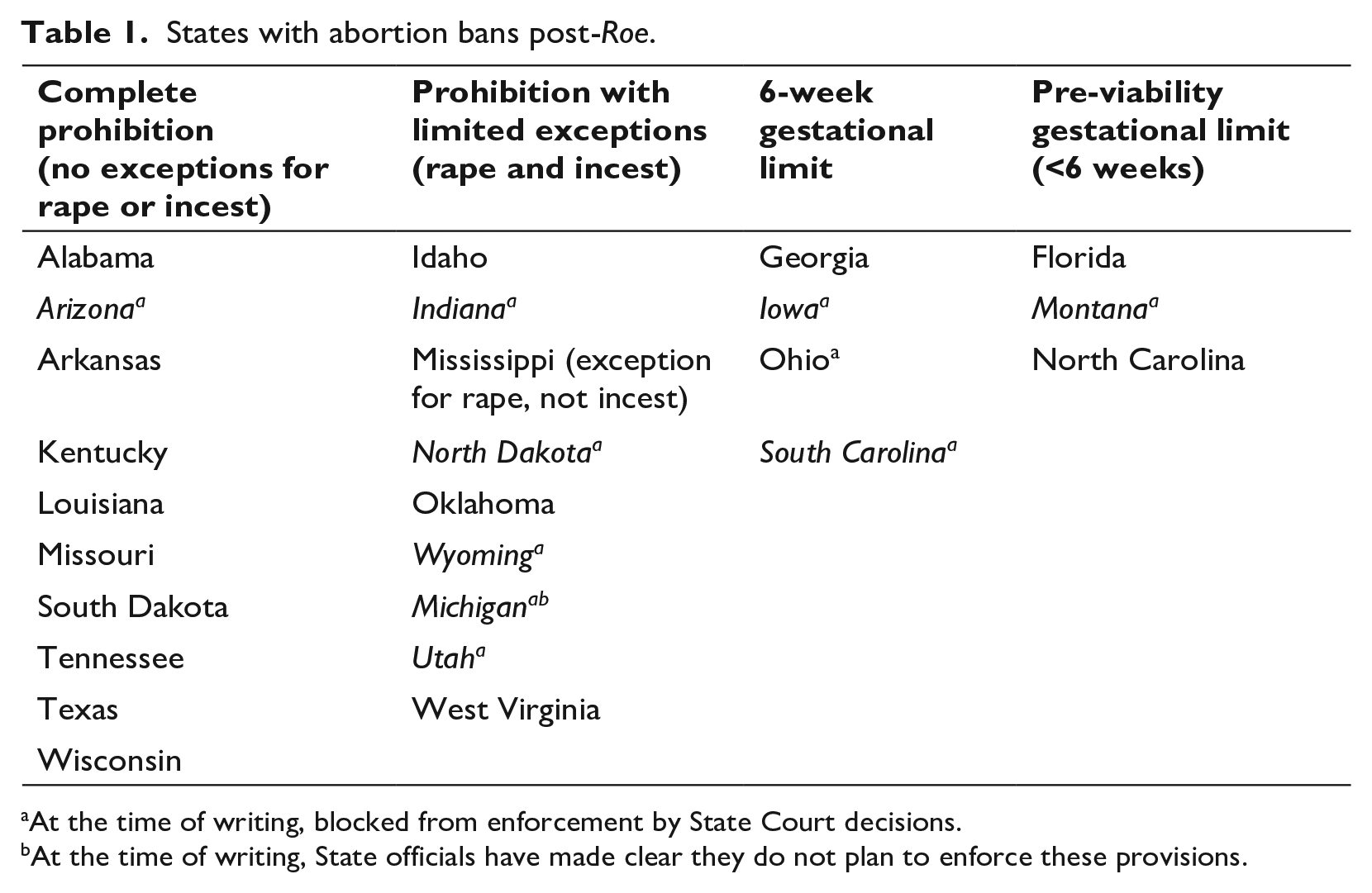
At the time of writing, blocked from enforcement by State Court decisions.
At the time of writing, State officials have made clear they do not plan to enforce these provisions.
Interstate travel for abortion is already necessary for those living in States with ‘abortion deserts’ 73 or restrictive policies. Following the introduction of SB8 in Texas (empowering private citizens to sue individuals who facilitate abortions after 6 weeks), there was a 984% increase in the number of Texans seeking out-of-state abortion. 74 Several abortion-supportive States remain post-Roe. Some have enacted progressive legislation recognising the right to abortion at State level. 75 Even in such States where (early) abortion remains lawful, significant socio-legal barriers remain. 76 With the number of people travelling for abortion increasing proportionately to the prevalence of abortion-hostile regimes, 77 abortion clinics in those States that still allow abortion will struggle to keep up with demand. Waiting times will increase, 78 as do the risks and costs to abortion-seekers.
Cohen and others have warned that ‘interjurisdictional abortion wars are coming’. 79 The dissenters in Dobbs posited that ‘[t]he Constitution protects travel and speech and interstate commerce, so today’s ruling will give rise to a host of new Constitutional questions’. 80 Justice Kavanaugh claimed that States may not bar their residents from travelling to obtain an abortion based on the ‘constitutional right to interstate travel’. 81 Given the hostility towards abortion in States that now have strict prohibitions, however, laws intended to prevent citizens from travelling elsewhere for abortion may be introduced. 82 Indeed, in July 2022, Congress failed to pass a bill expressly protecting the right to travel to another State for abortion. 83 There is no guarantee that the Supreme Court would strike down a State prohibition on interstate travel for abortion. The foundation of the ‘constitutional right to interstate travel’ is the Fourteenth Amendment and long-standing precedent. 84 Consequently, as Cahn and others have observed, ‘the only difference between the right to privacy and the right to travel is how many current Supreme Court justices still support it’. 85 It is hard to predict how the Court will rule on whether States can enforce prohibitions on abortion outside their borders. This is an underdeveloped area of law, and there are the complicating factors of ‘the competing fundamental constitutional principles involved, and the complex web of factual scenarios that could possibly arise’. 86 Self-management also raises complex interstate constitutional questions, since ‘medications can be legally obtained in one jurisdiction, one or both of the drugs can be taken elsewhere, and the pregnancy can end somewhere else entirely’. 87 Much legal uncertainty remains: for a majority so concerned about the ‘complexity’ of the legal framework established by Roe and Casey, it is ironic they have created a landscape far more complex to navigate.
Access, loss of life, and criminalisation
Even in the age of Roe, access to abortion was significantly limited in many parts of the United States – particularly in States hostile to abortion. 88 Draconian TRAP (Targeted Regulation of Abortion Providers) laws 89 and the Hyde Amendment 90 have long resulted in coerced childbearing for many vulnerable people. 91 This coerced childbearing will only increase as increasingly extreme abortion regulation strips even more people of their right to choose. 92 As the dissent noted, ‘there are few greater incursions on a body than forcing a woman to complete a pregnancy and give birth’. 93
People will lose their lives. A recent study predicted that a federal abortion ban – which Dobbs is not, but the figures remain illustrative – would result in a 21% rise in pregnancy-related deaths, with a 33% increase among non-Hispanic Black people. 94 These estimates are based solely on the fact that abortion is always safer than childbirth. 95 These numbers are likely to be much greater if we factor in deaths resulting from homicides, 96 suicides, 97 and instances where people do not seek medical assistance for abortion-related complications because they are afraid of legal consequences. Such deaths are most likely to impact vulnerable populations; abortions are more common among marginalised groups, 98 and with limited resources, they have fewer options in accessing abortion where in-state formal provision is no longer an option for them. Furthermore, while State laws often enable abortion where it is necessary to save a pregnant person’s life or avoid permanent damage to health, there will be instances where pregnant people die because the law is vague about what threat suffices. This has a chilling effect leading to care being provided too late. In Poland, three women have died as a direct consequence of a recent restrictive abortion ban. 99
Prohibitions on abortion do not reduce its incidence. 100 For many experiencing unwanted pregnancy, abortion is rarely considered to be a choice; instead, it is a necessity. 101 Thus, abortion-seekers will turn to extra-legal means beyond formal medical care to end pregnancies. 102 For people living in States that now ban abortion, their options become more limited: either interstate travel (complex for the reasons already explored above) or self-management, both of which carry distinct costs and risks. Since 75% of abortion-seekers in the United States are people living on a low income, 103 self-managed abortion is likely to be more accessible than physically travelling interstate, 104 which involves taking time off work, arranging childcare where necessary, and spending money on travel and stays out-of-state as well as treatment. 105 Self-managed abortion (people administering abortion medication – either misoprostol or a combination of mifepristone and misoprostol – without medical supervision) 106 has been consistently shown to be safe and effective. 107 As Matthews and others note, ‘for the first time in [US] history, illegal avenues can be among the most accessible routes to safe abortion’. 108 There are legal risks, however, to consider 109 – and these affect the overall perception of self-management. Some States have already expressly banned self-induced abortions, 110 and those introducing abortion prohibitions after Dobbs may encompass self-management. How abortion is banned and enforced is entirely in the hands of individual States.
Self-management means that ‘post-Roe America looks very different than much of the Roe and pre-Roe era’. 111 Nevertheless, the fact remains that (fear of) legal consequences will cause severe psychological distress to abortion-seekers. Self-managed abortion is also more challenging for marginalised persons. Information about abortion medication is subject to ‘unjust knowledge gaps’. 112 Public outrage against abortion bans has been considerable and consistent. One notable trend is imagery of coat hangers with slogans reiterating the harm of clandestine abortions. However, framing abortion without the support of a healthcare professional ‘as inherently unsafe fail[s] to capture the reality of present-day self-managed abortion care: it also further stigmatizes the practice’ 113 and may frighten and confuse abortion-seekers. Even where people have the correct information about abortion by medication, poorer people still may have insufficient resources to obtain them. Furthermore, self-management will not be an option for everyone; including persons who may not have a space where they feel safe managing their own abortion. 114 Many people may fear self-management because of the legal consequences of seeking after-care if necessary. Black people, poor people, and other marginalised groups are consistently subject to prosecution at a disproportionate rate. 115 Fear of the law and increased difficulty in figuring out how to access and use medications will make abortion (more) stressful and terrifying.
Dobbs will also significantly impact people carrying (wanted) pregnancies as pregnancy becomes increasingly policed. The majority opinion facilitates the enforcement of foetal homicide laws, including prosecutions for pregnancy loss. 116 In many States (particularly those hostile to abortion rights), there are already routine investigations after pregnancy loss that result in criminal sanction for miscarriage. 117 These prosecutions disproportionately affect Black women and poor people. 118 Spontaneous miscarriage and miscarriage after administration of abortion medications appear clinically indistinguishable, and the same treatment is provided by healthcare professionals. 119 Without Roe, there are concerns that all miscarriage will be treated as suspicious. 120 This may be facilitated by healthcare professionals reporting (even when not obliged) miscarriages to authorities. No matter their outcome, criminal investigations are invasive and traumatic for individuals who have experienced pregnancy loss. Such investigations are a deterrent to seeking healthcare support after pregnancy loss, even among those who have not chosen abortion.
‘Second-class citizens’
Dobbs severely impacts all persons with the physiology to become pregnant. The dissent observed that ‘[w]hatever the scope of the coming laws, one result of today’s decision is certain: the curtailment of women’s rights, and of their status as free and equal citizens’. 121 The majority opinion dismissed the idea that abortion forms part of equal protection under the Fourteenth Amendment. 122 However, the reality is that their decision relegates all people who can become pregnant to a ‘second-class’ status. 123 These people are women (who are already subject to sustained structural discrimination) and gender minorities (who are subject to additional forms of discrimination). A lack of abortion relegates people who are already marginalised. The harm experienced by no/limited access to abortion ‘is broad, experienced not only by female people at the time of unwanted pregnancy but also constantly by all people with the physiology to become pregnant’. 124 Abortion rights have been ‘embedded in the lives of women [and people with female physiology] – shaping their expectations, influencing their choices about relationships and work, supporting (as all reproductive rights do) their social and economic equality’. 125 When abortion is unavailable, anyone with the physiology to become pregnant is denied the ability to make vital decisions about their embodiment, their relationships with others, and their future.
Roe never provided sufficient conditions for reproductive justice: the framework established by Roe and Casey enabled ever increasing restrictions for anti-abortion measures limiting access. In many ways, the restrictions that were increasingly in place meant that Dobbs was a foreseeable end point of this line of jurisprudence within the conservative political and social context of the United States. Following Dobbs, we must think about how legal frameworks can serve all people with the physiology to become pregnant, and specifically abortion-seekers, much better. The Supreme Court held that ‘the authority to regulate abortion is returned to the people’. 126 Voters have since been using their power to protect abortion rights. In all six States where measures about abortion were on the ballot since Dobbs, all – including traditionally red/conservative States – returned in favour of access. In California, Michigan, and Vermont, voters supported a positive affirmation of abortion rights, and in Kansas, Kentucky, and Montana, anti-abortion measures were defeated. While such outcomes are cause for optimism, in the spirit of doing better in a post-Roe United States, changes must be made to ensure access, and equality of access (e.g. addressing laws in abortion-supportive States that limit use of public funds for abortion) in addition to enshrining rights.
Beyond the United States
Roe v. Wade has been consistently referred to in domestic legal decisions in other countries worldwide since it was handed down. There is some concern, therefore, about the global impact that Dobbs may have in emboldening anti-abortion movements and countries globally. Such concern is not unfounded; Dobbs has illustrated how precarious even long-established abortion rights are in high-income democracies. Moreover, in some countries, particularly where there is already organised resistance to abortion rights, there may be direct impacts in invigorating legal challenges, the emboldening of disinformation campaigns, and increased funding. 127 Kaufman et al. raise the concern about anti-abortion groups supported by US conservatives gaining more traction in some Asian countries 128 and some African countries. 129
However, concern about the impact of Dobbs outside the United States may be overstated, resulting from a tendency towards US-centrism. Commentators have long observed that the ‘hollow’ abortion right that existed prior to Dobbs in the United States lagged considerably behind the global community. 130 Dobbs further solidifies that the United States is firmly ‘out of step’ with global norms and trends in abortion. There has been an overall trajectory towards liberalisation across the globe. The United Nations 131 and the World Health Organization 132 have come close to recognising abortion as a human right and have recognised the critical importance of access. In line with abortion-supportive stances from international organisations, we have seen huge victories for abortion rights across Latin America, Europe, and Asia. As Shah suggested before the fall of Dobbs, it is time for abortion advocates and judges worldwide to scrutinise ‘whether and how to reference U.S. abortion jurisprudence’. 133 Kaufman et al. consider that the recent decisions of Latin American nations like Argentina, Colombia, and Mexico instead should be considered ‘comparative legal precedents for other countries’. 134 The focus on human rights standards and the considerable work of social activists in driving social and cultural change in these countries, they emphasise, better prevents future ‘legal retrogression’ of abortion rights. 135 Abortion jurisprudence grounded in the grassroots work of the reproductive justice movement 136 and influenced by international human rights standards is a future for which the United States ought to strive.
Footnotes
Acknowledgements
The author is grateful to Dr Isra Black and Professor Marie Fox for their comments. The author is also thankful to Nathan Chalk, Dr Dunja Begovic, and Dr Richard Gibson for their helpful comments on earlier drafts of this note.
1.
Dobbs v. Jackson Women’s Health Organization, 597 U.S. ___ (2022).
2.
M. Goodwin, ‘Ending the Debate Whether State-Mandated Pregnancies Are Matters of Bioethics Concern’, The American Journal of Bioethics 22 (2022), pp. 31–33, at 31.
3.
Roe v. Wade, U.S. 113 (1973).
4.
R. Copelon, ‘Losing the Negative Right of Privacy: Building Sexual and Reproductive Freedom’, New York University Review of Law and Social Change 8 (1991), pp. 15–50; R. Pine and S. Law, ‘Envisioning a Future for Reproductive Liberty: Strategies for Making the Rights Real’, Harvard Civil Rights-Civil Liberties Law Review 27 (1992), pp. 407–464.
5.
Goodwin, ‘Ending the Debate’, p. 341.
6.
MS Code § 41-41-191 (4) (b) (2018).
7.
Jackson Women’s Health Org. v. Dobbs, 379 F. Supp. 3d 549 (2019).
8.
Whole Woman’s Health v. Jackson, 13 F.4th 434, 448 (5th Cir. 2021).
9.
Dobbs v. Jackson Women’s Health, p. 1.
10.
Planned Parenthood v. Casey, 112 U.S. 2791 (1992).
11.
s.1 stipulates that no ‘state [shall] deprive any person of life, liberty, or property, without due process of law’.
12.
Roe v. Wade, pp. 152–154.
13.
Op. cit., p. 163.
14.
Op. cit., pp. 163–164.
15.
Planned Parenthood v. Casey, p. 860.
16.
Op. cit., p. 878.
17.
Op. cit., p. 894.
18.
M. Goodwin, Policing the Womb: Invisible Women and the Criminalization of Motherhood (Cambridge: Cambridge University Press, 2020), p. 71.
19.
Dobbs v. Jackson Women’s Health, p. 5.
20.
Op. cit., p. 12.
21.
Op. cit., p. 13.
22.
Op. cit., p. 14.
23.
Op. cit., p. 14.
24.
Op. cit., p. 38.
25.
Op. cit., p. 74.
26.
Op. cit., p. 35.
27.
Op. cit., p. 39.
28.
Op. cit., p. 44.
29.
Op. cit., p. 46.
30.
Op. cit., pp. 56–57.
31.
Op. cit., p. 63.
32.
Op. cit., p. 65.
33.
Op. cit.
34.
Op. cit., p. 77.
35.
Op. cit., p. 78.
36.
K. Whittington, ‘Originalism: A Critical Introduction’, Fordham Law Review 82 (2013), pp. 375–410, at 378. There are many different approaches to determining what was meant by the text at the time ratified – for example, some might think this means looking at the framers’ intentions, others might advocate that this means examining ‘original public meaning’: M. Berman, ‘Originalism Is Bunk’, New York University Law Review 84 (2009), pp. 1–96, at 4.
37.
Whittington ‘Originalism’, p. 376.
38.
M. Ziegler, ‘Originalism Talk: A Legal History’, Brigham Young University Law Review 4 (2014), pp. 869–926.
39.
For example, E. Maltz, ‘Foreword: The Appeal of Originalism’, Utah Law Review 1987 (1987), pp. 773–807.
40.
Dobbs v. Jackson Women’s Health, p. 6.
41.
Emphasis added. Dobbs v. Jackson Women’s Health, per Justice Kavanaugh, p. 12.
42.
One of the concurring opinions does not try so hard to hide a result-oriented conclusion behind claims of neutrality. See Dobbs v. Jackson Women’s Health, per Justice Thomas, p. 5: ‘[t]he right to abortion is ultimately a policy goal in desperate search of a constitutional justification’.
43.
44.
Op. cit.
45.
New York State Rifle & Pistol Association, Inc. v. Bruen, 597 U.S. ___ (2022).
46.
R. Post and R. Siegel, ‘Originalism as a Political Practice: The Right’s Living Constitution’, Fordham Law Review 75 (2006), pp. 545–574, at 572.
47.
Dobbs v. Jackson Women’s Health, per Justices Breyer, Sotomayor, and Kagan, p. 21.
48.
Op. cit., p. 9.
49.
Op. cit., p. 16.
50.
Op. cit.
51.
Dobbs v. Jackson Women’s Health, per Justice Kavanaugh, p. 4.
52.
Emphasis added. Dobbs v. Jackson Women’s Health, per Justices Breyer, Sotomayor, and Kagan, p. 18.
53.
Siegel, ‘Memory Games’, p. 8.
54.
Op. cit., p. 11.
55.
Griswold v. Connecticut, 381 U. S. 479 (1965).
56.
Lawrence v. Texas, 539 U. S. 558 (2003).
57.
Obergefell v. Hodges, 576 U. S. 644 (2015).
58.
Dobbs v. Jackson Women’s Health, p. 75.
59.
Op. cit., p. 72.
60.
Dobbs v. Jackson Women’s Health, per Justices Breyer, Sotomayor, and Kagan, p. 5.
61.
Op. cit.
62.
Op. cit.
63.
Dobbs v. Jackson Women’s Health, per Justice Thomas, p. 7.
64.
Dobbs v. Jackson Women’s Health, per Justices Breyer, Sotomayor, and Kagan, p. 33.
65.
Op. cit., p. 34.
66.
In 2017, there were 13.5 abortions per 1,000 women aged 15–44. This figure is likely to be higher since the recorded numbers only include abortions that took place through formal healthcare channels: R.K. Jones, E. Witwer and J. Jerman, ‘Abortion Incidence and Service Availability in the United States, 2017’, Guttmacher Institute, September 2019, available at  (accessed 28 August 2022).
67.
Dobbs v. Jackson Women’s Health, p. 38.
68.
Goodwin ‘Ending the Debate’, p. 33.
69.
Dobbs v. Jackson Women’s Health, per Justices Breyer, Sotomayor, and Kagan, p. 2.
70.
Dobbs v. Jackson Women’s Health, per Justice Kavanaugh, p. 3.
71.
Op. cit., p. 3.
72.
73.
A. Cartwright, M. Karunaratne, W. Barr-Walker, et al., ‘Identifying National Availability of Abortion Care and Distance from Major US Cities: Systematic Online Search’, Journal of Medical Internet Research 20 (2018), p. e186.
74.
75.
For example, Colorado – Reproductive Health Equity Act (HB 22-1279) signed into effect by the Governor in April 2022.
76.
J.A. Parsons and E.C. Romanis, Early Medical Abortion, Equality of Access, and the Telemedical Imperative (Oxford: Oxford University Press, 2021), pp. 31–56.
77.
I.G. Cohen, ‘Travel to Other States for Abortion after Dobbs’, The American Journal of Bioethics 22 (2022), pp. 42–44.
78.
79.
80.
Dobbs v. Jackson Women’s Health, per Justices Breyer, Sotomayor, and Kagan, p. 37.
81.
Dobbs v. Jackson Women’s Health, per Justice Kavanaugh, p. 12.
82.
Cohen et al., ‘New Abortion Battleground’, p. 17.
83.
84.
Shapiro v. Thompson, 394 U.S. 618 (1969).
85.
86.
Cohen et al., ‘New Abortion Battleground’, p. 33.
87.
Op. cit., p. 22.
88.
Goodwin, Policing the Womb, p. 9; p. 207; Parsons and Romanis, Early Medical Abortion, p. 31.
89.
TRAP laws, specifically designed to try and limit abortion provision, were permissible, per Casey, where they did not constitute an ‘undue burden’: Parsons and Romanis, Early Medical Abortion, pp. 33–56.
90.
The Hyde Amendment forbids the use of federal funds for abortion except where pregnancy threatens the person’s life or resulted from rape or incest: Departments of Labor, Health and Human Services, and Education, and Related Agencies Appropriations Act of 1994, §510.
91.
Goodwin, Policing the Womb, p. 67.
92.
M. Montoya and B. Gray, ‘See None, Do None, Teach None: How Dismantling Roe Impacts Medical Education and Physician Training’, The American Journal of Bioethics 22 (2022), pp. 52–54, at 52.
93.
Dobbs v. Jackson Women’s Health, per Justices Breyer, Sotomayor, and Kagan, p. 21.
94.
A.J. Stevenson, ‘The Pregnancy-Related Mortality Impact of a Total Abortion Ban in the United States: A Research Note on Increased Deaths Due to Remaining Pregnant’, Demography 58 (2021), pp. 2019–2028.
95.
Op. cit.
96.
Rates of homicide in pregnant people in the US are increasing: M. Wallace, ‘Trends in Pregnancy-Associated Homicide, United States, 2020’, American Journal of Public Health 112 (2022), pp. 1333–1336.
97.
The American Psychological Association notes that ‘[r]esearch shows people who are denied abortions have worse physical and mental health . . . than those who seek and receive them’ – it is plausible that such circumstances might give rise to people dying by suicide. American Psychological Association, ‘The Facts about Abortion and Mental Health’, APA, 2022, available at (accessed 26 August 2022).
98.
In 2019, non-Hispanic Black women had the highest rate of abortion and non-Hispanic White women had the lowest rate: K. Kortsmit, M. Mandel, J. Reeves, et al., ‘Abortion Surveillance – United States, 2019’, Surveillance Summaries 70 (2021), pp. 1–29, at 6.
99.
100.
E. Jackson, Regulating Reproduction: Law, Technology and Autonomy (Oxford: Hart Publishing, 2001), p. 72.
101.
E. Janiak and A. Goldberg, ‘Eliminating the Phrase “Elective Abortion”: Why Language Matters’, Contraception 93 (2016), pp. 89–92.
102.
D. Grimes, J. Benson, S. Singh, et al., ‘Unsafe Abortion: The Preventable Pandemic’, Lancet 368 (2006), pp. 1908–1919.
103.
104.
L. Harris and D. Grossman, ‘Complications of Unsafe and Self-Managed Abortion’, New England Journal of Medicine 382 (2020), pp. 1029–1040, at 1030.
105.
Parsons and Romanis, Early Medical Abortion, pp. 42–43.
106.
A.R.A. Aiken, I. Digol, J. Trussell, et al., ‘Self Reported Outcomes and Adverse Events after Medical Abortion through Online Telemedicine: Population Based Study in the Republic of Ireland and Northern Ireland’, British Medical Journal 357 (2017), p. j2011.
107.
R.J. Gomperts, K. Jelinska, S. Davies, et al., ‘Using Telemedicine for Termination of Pregnancy with Mifepristone and Misoprostol in Settings Where There Is No Access to Safe Services’, British Journal of Obstetrics and Gynaecology 115 (2008), pp. 1171–1178.
108.
M.M. Matthews, A. Lal and D. Pacia, ‘The Role of Epistemic Injustice in Abortion Access Disparaties’, The American Journal of Bioethics 22 (2022), pp. 49–51, at 49.
109.
Op. cit., p. 51.
110.
For example, Arizona, Delaware, Idaho, Nevada, New York, Oklahoma, South Carolina.
111.
Cohen et al., ‘New Abortion Battleground’, p. 6.
112.
Matthews et al., ‘Epistemic Injustice in Abortion’, pp. 49–50.
113.
114.
B.J. Hill, ‘De-Medicalizing Abortion’, The American Journal of Bioethics 22 (2022), pp. 57–58.
115.
Goodwin, Policing the Womb, p. 11.
116.
117.
Goodwin, Policing the Womb, p. 11.
118.
119.
Harris and Grossman, ‘Complications’, p. 1029.
120.
Matthews et al., ‘Epistemic Injustice in Abortion’, p. 51; L.M. Paltrow, L.H. Harris and M.F. Marshall, ‘Beyond Abortion: The Consequences of Overturning Roe’, The American Journal of Bioethics 22 (2022), pp. 3–15.
121.
Dobbs v. Jackson Women’s Health, per Justices Breyer, Sotomayor, and Kagan, p .4.
122.
Op. cit., p. 11.
123.
Op. cit., p. 2; p. 15.
124.
125.
Dobbs v. Jackson Women’s Health, per Justices Breyer, Sotomayor, and Kagan, p. 57.
126.
Op. cit., p. 1.
127.
Risa Kaufman, Rebecca Brown, Catalina Martínez Coral, et al., ‘Global Impacts of Dobbs v. Jackson Women’s Health Organization and Abortion Regression in the United States’, Sexual and Reproductive Health Matters 30 (2022), pp. 1–10.
128.
Op. cit., p. 5.
129.
Op. cit., p. 6.
130.
131.
For example, UN Committee on the Elimination of Discrimination Against Women, ‘Inquiry Concerning the United Kingdom of Great Britain and Northern Ireland under Article 8 of the Optional Protocol to CEDAW’, 2018, UN Doc. CEDAW/C/OP.8/GBR/1, para. 83.
132.
133.
Shah, ‘Questioning the Comparative Relevance’.
134.
Kaufman et al., p. 4.
135.
Op. cit., p. 4.
136.
Loretta Ross and Rickie Solinger, Reproductive Justice: An Introduction (Oakland, CA: University of California Press, 2017).
Declaration of conflicting interests
The author(s) declared no potential conflicts of interest with respect to the research, authorship, and/or publication of this article.
Funding
The author(s) received no financial support for the research, authorship, and/or publication of this article.