




Abstract
This study, using the revisionist critique of the American Expeditionary Forces (AEF), reopens the issue of US involvement in the ever-engaging field of World War I chemical warfare. It disputes revisionist claims of a lack of US preparedness and insufficient frontline effectiveness, through the concepts of effectiveness and efficiency. After examining the organisation and the decisions concerning research, production and protection from new CW agents, it discusses the four AEF combat episodes on the Western Front during the German spring 1918 offensives. While revisionist critique has a strong rationale, it needs to be examined on a case-by-case basis using often untapped archival sources.
Introduction
The study of the chemical warfare (CW) experience has never constituted a dominant current in World War I (WWI) historiography. Some of the key figures of the three generations of Anglophone scholars – James E. Edmonds, the British official historian of the war, the cultural historian Eric J. Leed or military historians John Keegan, Tim Travers and Niall Ferguson – have either downplayed the role of CW agents (gases) or considered them an insignificant frontline nuisance. 1 Notwithstanding, the historiography of CW established itself as a subfield in the interwar period with medical volumes and quasi-encyclopaedic studies of CW agents and their use, often written by former CW practitioners (Rudolf Hanslian, Charles H. Foulkes, Augustin Prentiss, etc.). 2 The renaissance of interest in CW from the late 1960s to the 1980s was indirectly related to the revisionist currents and the lack of attention to this field of research. Ian V. Hogg, Edward M. Spiers, William Moore and especially Ludwig (‘Lutz’) Haber often employed new multinational archival sources to reaccentuate the serious CW impacts at the front while accepting them not as breakthrough weapons but largely as attrition tools. 3 Haber famously answered his question, ‘Was Gas a Failure?’ in the affirmative. Often overlooked, however, is another of his statements that in anticipation of fighting in 1919, ‘chemical warfare, along with the tank, would have decided the issue’. 4
In the Allied WWI CW operations scholarship, at least two historical revisionisms emerged from the 1970s to the 1990s. The Anglo-centric revisionists, followers of Haber and Spiers, based primarily on the British and Canadian experience, have, since the late 1980s, reemphasised the profound effects of CW agents on soldiers at the front. 5 In contrast, the American Expeditionary Forces (AEF) historians in the mid-1970s began articulating a rather trenchant criticism of the American CW experience, which, however, was only a small part of a much broader assault mainly on the lack of US organisational preparedness for the war and on the AEF for insufficient combat effectiveness. 6 Both of these historical revisions have strong rationales and justifications. However, in retrospect, it seems that many of the latter, although their exponents provide abundant evidence for their claims, have sometimes gone too far in their harsh criticism. Their dispute over key US Army figures, grand strategies, or specific offensives and operations seems generally relevant. In other cases, including those related to CW experience, revisionist claims are exaggerated, mainly because they were based on unsystematic research and selective data. 7
This study, using the revisionist critique of the AEF and the watershed war period from the fall of 1917 to the summer of 1918, which culminated with German spring and early summer offensives, 8 reopened the issue of American involvement in the ever-engaging field of CW. It has no ambition to flatly refute the AEF revisionists’ theses. It looks at the part of the US and AEF experience in an attempt to find and mark the limits of their validity.
The roots of the AEF revisionism are found in early memoirs and biographies of American military leaders published in the 1920s and 1930s that were uncritical and gracious of the organisation, command and combat performance of the US Army on the Western Front. Discussing just CW, the major collections of the 1950s could be described (i.e. the three-volume history of the Chemical Warfare Service, CWS) as the ‘closest thing to an official (army) history’, or (in the case of Rexmond C. Cochrane's monumental collection of twenty case studies of AEF CW experience) it did not set out any all-encompassing critique of the AEF, although it did not hide the combat setbacks and failures of many units. 9
A new phase of interest in US involvement in the war began with Coffman's and DeWeerd's monographs, which expressed the view of a new generation of historians. Both highlighted certain shortcomings of the AEF war effort; nevertheless, they agreed it was crucial to Germany's defeat. 10 A critical distance from complacent portrayals of the US Army organisation, doctrine, command and combat operations themselves, backed by a variety of archival sources, reached a qualitatively new level during the 1970s. 11 It then culminated in a series of richly researched monographs by Allan R. Millett, Donald W. Smythe, David F. Trask or Paul Braim, among others. While some were particularly critical of long-standing emphasis on offensive infantry at the expense of artillery and cavalry, others commented on the AEF's unpreparedness or Pershing's debatable opposition to its attachment to Allied units (‘amalgamation’); the rest documented the ineffective tactics in the Meuse-Argonne campaign. 12
As already hinted, this text is a polemic with other adherents of AEF revisionism, scholars such as Timothy K. Nenninger, James W. Rainey, Stephen J. Lofgren or Charles E. Heller. 13 The reason for this choice is that their writings – usually short articles or book chapters – represent the most trenchant revisionist critique of the AEF, and at the same time, these studies also discuss the CW. In Heller's writings in the mid-1980s, CW even became the heart of his revisionist research. 14 The wave of revisionism has largely waned since the late 1990s. Still, some young authors, as Thomas I. Faith's writings suggest, are occasionally sharply critical of the AEF, at least in anti-gas training, the manufacture of masks and the production of CW agents. 15
Given the multi-layered nature of revisionist critique of the AEF and the US, sometimes encompassing political, strategic, operational and tactical elements, this text focuses only on selected aspects at the organisational and operational-tactical levels. The evaluation seeks to reflect two mutually related concepts of military theory – efficiency and effectiveness. While the first will be understood here largely as the ability to act, e.g., readiness for action or, more specifically, being well-organised or the suitability of a given procedure, and is thus related to preparedness, the latter refers to the process to produce an effect and the extent of its achievement. 16
In addition to historiography, there is another reason for a re-examination of the AEF CW experience. The last 14 months of the conflict, which – not entirely coincidentally – overlapped with the gradual arrival of US troops on the battlefield, are the most transformative phase of the war. By the time the first AEF units entered the fighting, all the major milestones of CW had been achieved: CW agents had been closely integrated into the operations and became part of virtually every battle on Western soil throughout 1918. 17 Belligerents, in anticipation of more lethal agents than phosgene and diphosgene (the Germans marked shells with them with Green Crosses), responsible for up to 85 per cent of all deaths by CW agents during the war, greatly improved gas masks throughout 1916. Finally, largely in response to this, Germans began to employ a new skin-burning blistering agent (vesicant), called ‘mustard gas’, in July 1917. The final phase of the war saw the German attempt to break the stalemate of trench warfare and restore the frontline manoeuvres using several technological and tactical (e.g. doctrinal) shifts, including the innovative employment of CW agents. 18 These shifts have received considerable attention from a new generation of military historians since the early 1980s. 19
The text is arranged into two main parts. The first focuses primarily on efficiency and predominantly discusses US and AEF organisational preparedness regarding its base and the pivotal decisions concerning the CW research and production. Two subparts focus on the response to two new innovative CW agents (or groups of them) – mustard gas and arsines, which attracted considerable attention from the Allies. The second part deals with both efficiency and effectiveness. It examines the AEF battlefield experience, using the example of three divisions and four combat episodes during or shortly before the German spring offensives. Revisionist conclusions are evaluated and measured, depending on the context, either by their terms (according to an estimate of what the state bodies and the AEF could have possibly done differently) or, in the second part, more by how the British and French fared or what the Germans did (in terms of CW fire and AEF CW casualties).
Chemical Warfare, the AEF and the US Response to New CW Agents
The core thesis of the revisionist critique of the US and AEF response to CW is the objection to the long-standing US indifference to and neglect of the development of CW agents. Its roots, according to Heller, go back to the reluctance to support a ban on the use of projectiles spreading asphyxiating poison gases at the First Hague Conference in 1899. 20 It was not until February 1917, two months before the US entered the war, that officials began taking the first steps to protect the military against CW agents. 21
In mid-1917, US CW organisation emerged as a diverse collection of agencies under the wings of individual government departments: The Bureau of Mines (USBM) at the Department of the Interior engaged in the research and synthesis of CW agents; the Medical Department of the Army (USAMD) examined protection against them and production of masks; the Ordnance Department guaranteed production of agents and filling of shells; the General Staff (GS) formulated defensive and offensive doctrine, etc. 22 Nenninger identifies this organisational distraction as a key obstacle to revising Army doctrine and integrating new technologies into it. He may be right from a purely conceptual perspective. Still, from a practical standpoint, the underperformance of some government institutions regarding CW has not been as clear-cut as it seems. There were heated interdepartmental discussions concerning the merits and effectiveness of such centralisation before the unified overseas CWS had been founded in late June 1918. USBM Director Van H. Manning questioned its advisability. Secretary of War, Newton Baker, although accepting Pershing's request, claimed not to see ‘how the work could have been better done than he [e.g. Manning] did it’. 23 Indeed, Nenninger himself admits that the USBM ‘had done more to prepare for gas warfare than had any element of the DoW’. 24
AEF revisionists do not so much question Pershing's (and the AEF command's) initial approach to organising CW. Heller does imply that the AEF command had some delay between mid-June, when Pershing arrived in France, and mid-August, when he asked overseas to organise a Gas and Flame Service regiment (known as Gas (Warfare) Service, GWS), having already appointed Lieutenant Colonel Amos A. Fries as its director. He nevertheless justifies the delay by the circumstances and the difficulty of the move. 25 However, soon after mid-June, General Headquarters (GHQ), assisted by American Scientific Mission member Dr George A. Hulett, began intensive negotiations, consultations and studies of the Allies’ armies and German military CW organisations. 26 Although the GWS was officially established by GHQ General Order (GO) No. 31 of 3 September 1917, Heller – based on Fries’ history – over-emphasises this essentially formal decision. 27 In early August, Pershing had already informed overseas that the organisation had ‘completed of corresponding Gas Service here’. Aware of the need to coordinate with the activities of overseas departments, he required regular biweekly reports concerning domestic research, furnishing supplies and other substantive information of which there was little awareness in GHQ. 28
Nenninger criticises Pershing because the CW organisation behind the battlefield supposedly ‘paralleled or duplicated’ the structure at home. 29 He is probably referring to the GWS leadership's communication with the fragmented CW bodies overseas. His argument seems to be unfair, both because the organisation overseas was fragmented from the start and because the French and the British had chemical facilities both in the rear and near the battlefield. As for ‘duplication’, ironically, the situation was reversed: It was ‘Black Jack’ who requested in early August that CW at the DoW be arranged following their structure in France, which he supported by dispatching Hulett to the US. 30 While Pershing's influence was certainly limited, it was probably the first expert-backed appeal towards centralisation of the US CW. Telling of his dedication to the issue is also his continued effort to get the laboratory service (officially established in mid-October 1917 as the Chemical Service Section, CSS) in France up and running. From probably the first mention in early August, however, it took more than five months for most of the equipment to arrive at Puteaux near Paris, where Pershing set it up. 31 It is difficult to say exactly the main reasons for such supposedly lengthy implementation, though GHQ cables offered several of them: delay in handling gas material, lack of laboratory equipment, unavailability of suitable facilities in Paris, etc. 32
The harsh verdicts, whether of Nenninger and Heller, but also Lofgren and Rainey, seem to fall on much more level ground regarding the development of protective masks, formulation of the CW doctrine and, in part, insufficient or inadequate CW training. 33 The last one will be discussed with examples of AEF units in the second part. Let us now turn to the American response to two new CW agents (or groups of them).
The US Response to Mustard Gas
Dichloroethyl sulfide, first used by the Germans on the night of 12–13 July to halt the British advance at Ypres, attracted well-deserved attention from the Allies. Soon informed about the new persistent agent, marked as Yellow Cross, AEF GHQ reported at the end of August to Washington, D.C. that since its first use, within around forty days, the gas had caused 20,000 British casualties, 5 per cent of which were fatal. The conclusion sounded like a straightforward warning: ‘The only defense is prompt use of the gas mask, and even this only guarantees a reduction in losses’. 34
With full knowledge of the threat, a month and a half later, Pershing personally insisted to the Chief of Ordnance of the US Army, Capt. E. J. W. Ragsdale, that it was ‘vital’ to fully investigate the physiological aspects of mustard gas, the defence against it and its production on a large scale. 35 The ‘extensive laboratories’ Pershing urgently requested did not arrive in Europe for the most part until January. This did not mean that the Americans were idle.
Independent of the British, they had begun, in the fall of 1917, inside the Toxic Materials Development Section of the Chemical Research Division of the War Gas Investigations (WGI) unit of the USBM laboratory, research on new toxic materials as well as the actual production of mustard gas on a moderate scale. 36 Under the direction of section leader James Conant, they tried unsuccessfully, like the British, for almost five months to decipher the complicated Meyer–Clarke chlorhydrin process used by the Germans. 37
In the correspondence between GHQ AEF and the DoW regarding the mustard gas production during these months, we find, however, almost no mention of domestic experiments and research. Almost all references are to British studies and achievements. In late November, Pershing reported that although mustard gas was not yet being produced in quantity, ‘the problem of its manufacture on a large scale is believed solved’ by the British. Following the announcement of a breakthrough in its production by a group of British chemists led by William J. Pope of Cambridge University – first through the sulfur dichloride method in mid-January, then through the sulfur monochloride method in late January and mid-February – Pershing reported that the British discovery was experimentally verified in the AEF laboratories in Puteaux. 38
Does this mean that American domestic research was irrelevant? The merit of Pope is that he turned attention from the tedious Meyer–Clarke producing process to Guthrie's methods by synthesising ethylene with chloride sulfide. However, Conant's team at American University in Washington, D.C., focused on it on its own and achieved it on its own only shortly thereafter. 39
By the beginning of April, GHQ AEF, based on British and French experience, did not doubt that the Americans would prefer the sulfur monochloride method. They argued that the monochloride method worked on a large scale and required only one-third of the time for construction preparations compared to the chlorhydrin process. Although GHQ ‘strongly urged’ the central army office to adopt the former on a large scale, it believed that Americans, like the British, should ‘take no chances and should manufacture by both methods’, 40 probably as a guarantee to achieve a decisive result. This eventually happened when the former method was used to produce the plant in Flushing. In contrast, the latter, with the support of the Manchester firm of Levinstein Ltd., running a ‘cold’ version of Guthrie's process, was used in Edgewood. 41
Current revisionist-influenced research adequately points out the technological flaws and glitches in the production process at the monstrous Edgewood Arsenal mustard gas plant. Similarly, it points to the paradox that the AEF did not fire a single American-made mustard gas (as well as any other CW) shell during the war. 42 This sharp critique, however, somewhat belies the American supply of larger amounts of CW agents to Europe through the summer and autumn of 1918, especially large quantities of chlorine (almost 1500 tons), chloropicrin (1900 tons), and phosgene (420 tons), and also including 300 of the 711 tons of mustard gas produced in Edgewood. 43 However, the first shipments of mustard gas, similar to the previous ones, went out at least a month after the German offensives were over. One may question whether American supplies of chlorine were effective (given the thousands of tons produced by the Allies). Without further investigation, however, it is impossible to say exactly to what extent they were used on the battlefield. 44
The Americans were considerably less successful in protecting against mustard gas. Shortly after the British and French chemists promptly analysed and recognised the toxic liquid, the USBM and the USAMD researchers attempted various treatments for its poisoning and burns. However, their efforts did not bear fruit, and they lamentably concluded that ‘(e)mphasis should therefore be placed particularly upon prevention of the burn rather than upon treatment’. 45
Despite the extreme difficulty in achieving protection from it, it is clear from GHQ AEF correspondence that the Americans paid considerable attention to this issue in the weeks before the first German March offensive began. Lt Cdr A. H. Marks, who developed gas masks for the Navy Department via the USBM, reported to France early that month that sodium sulfide and sodium magnesium, either as a solution or ointment, ‘destroys’ mustard gas on the skin. He, therefore, suggested the creation of blankets using a spray. However, it was abandoned when it became apparent that, in specific combat conditions, in concentration and length of exposure, the ointment would hardly provide protection. 46 Despite ongoing research, ten days before the start of the March offensive, the Americans knew from British experiments little more than the fact that 25 per cent sodium sulfide in 50 per cent alcohol was insufficient to destroy it and that instead of neutralising it on the surface of the blanket cloth, the cloth should have been impermeable. 47 Only in the autumn of 1918, two stronger tar papers were used to protect food, medical supplies and equipment from mustard gas. 48 It seems that the Americans (like the British) made serious efforts to prepare for the mass use of mustard gas by the Germans. So the Americans tried to be as prepared (efficient) as possible; unfortunately, they were not very effective, though probably no less so than the other allies.
The US Response to Arsines
Another new CW challenge for the AEF and the Allies was the arsenic compounds, particularly the groups of aromatic (and also aliphatic) arsines that the Germans chose as a primary pathway for their combat use. Their nature and effects varied to some extent. Although they were generally not as toxic as chlorine or phosgene, all caused nose and throat irritation to some degree (‘respiratory irritants’) and could have side effects of nausea and depression. 49
The first of the arsines, diphenylchloroarsine (DA), had been used at Nieuwpoort, Belgium, only two days before the mustard gas, but went unnoticed by the Allies. It was recognised only in August when the British analysed unexploded shells (‘duds’), marked with a Blue Cross after the Germans used them again near Ypres and in the Wijtschate area at the end of July. 50 Other arsines had more lung-injuring effects than DA. One of the most promising, phenyldichloroarsine, employed from September 1917, was not used alone but only in a mixture, and as a solvent for DA, and from May 1918, also for the DA successor and improvement, diphenylcyanoarsine (DC), used in shells marked as Blue Cross 1. 51 Finally, ethyldichloroarsine (DL) was accepted for combat use in late 1917 despite determined opposition from German chemists who were either unsure of its effectiveness or distrusted it. In addition to its lung-injuring effects, it had some lasting blistering effects, for which it was designated as ‘Yellow Cross 1’ and – in a mixture with other substances – planned for use in the spring offensives. However, its blistering effects were not proven during the first offensives, and it was redesignated ‘Blue Cross 3’ shortly after. 52
However wrong this proved to be, the crystalline substances of DA and DC were intended by the Germans to penetrate, in the form of dust, the ordinary charcoal canisters of gas masks with the assumption that they would force their removal and thus expose soldiers to more toxic gases used in conjunction. 53 The technique of so-called multi-coloured crosses or multi-coloured shots (Buntkreuz, Buntschiessen) – the simultaneous use of Blue and Green Cross shells – was somewhat standardised in German preparations for their spring offensives. 54
Besides the French, it does not appear that the Allies were in any significant way successful or effective in the arsines’ production since their research developed considerably only after the Germans fired the first DA. The British had already worked on the shell design for the DA by the end of April 1918. They manufactured the first batch at the end of June, and by the ceasefire, they had produced over 60 tonnes. 55 Overseas, arsines were investigated by the same Toxic Materials Development Section (later Organic Research Section No. 1) of the WGI of USBM that dealt with mustard gas. It developed methods for making arsenic derivatives, including DA and another promising compound, methyldichloroarsine, throughout 1918. However, these agents were not ready for combat use by the end of the war and remained for laboratory experiments only. 56 The French were the only ones who were able, as of November 1917, to start producing phenyldichloroarsine on a large scale. They began using it in a mixture with 40 per cent DA in a shell called ‘Sternite’. In early May 1918, American University's chemists received details concerning the French production of the DA by the Paris firm Poulenc Frerés. 57 However, it did not lead to its production. Nevertheless, their effort cleared the way for discovering two other, original CW agents – chlorovinyl-dichloroarsine (lewisite) and diphenylaminechloroarsine (adamsite), whose history is mostly unrelated to WWI.
In defence, DA probably did not attract too much attention from the Allies until the beginning of 1918; presumably because it was used sporadically on the battlefield by the Germans, it was not considered much of a threat, and they also had difficulty recognising it. The situation changed at the end of January, when GHQ AEF reported to the DoW that the Germans had begun to use DA extensively. The nature of the danger was clearly understood: ‘DA produces severe irritation and coughing which may cause removal of mask and consequent gassing with highly lethal gases’. Because of investigation reports indicating that DA was easily penetrating existing British SBRs, the cable suggested taking ‘energetic steps … to test these reports’, and if proven, it would be necessary to increase their protection by cellulose wool greatly. 58
Independent of the British, the Americans had demonstrated, in laboratories both at Puteaux and in Washington, D.C., the efficacy of DA when sublimed by heat (demonstrating the suitability of its use in hot weather) or transformed into dust through explosives. Yet in the protection, they seem to have been very dependent on the British, who, as early as the end of February, devised at least temporary protection for the respirators by wrapping them in forty-eight layers of unsized, well-beaten cellulose paper. In February and early March, CSS chemists found that the seventy-two layers were unnecessary and might create resistance to breathing, but they otherwise followed the British recommendations. 59 Since protection through the filter appeared to be the only possible option, the US approach and performance can be judged as promising and efficient, although adopted in cooperation with the British.
The AEF and Four CW Experiences Compared (Up to Mid-July 1918)
As we noted at the outset, the early period of the deployment of AEF units is of particular significance, at least in comparison with the summer French–American counteroffensive on the Aisne-Marne and the Meuse-Argonne offensive of September and November, which have garnered the most attention from AEF scholars. It was because of both major tactical and technological transformations in the war theatre and the role that the first AEF units played in the critical period from January to July. 60 German spring offensives were planned to defeat the Allies before the United States fully deployed all its resources. 61 That is why the deployment of the first AEF units during the offensives, their capacity and will to act (efficiency) and their effectiveness (and the price paid for it) played a vital role.
From a total of eight divisions deployed at the front at that time, 62 episodes with a greater combat impact were chosen and were also previously analysed by Rexmond C. Cochrane. All four selected episodes of the three AEF divisions took place in rather quieter sectors of the front – this was characteristic of all American units deployed early on. The first Division's pioneering deployment in the Ansauville area, southeast of St. Mihiel in Lorraine, the quietest of the four, was related to some future intended AEF command plan to eliminate the long-standing German salient in the French defences. The 1st Division experienced the repercussions of the first German offensive in that area. 63 Subsequently, it moved almost 170 miles away to the village of Cantigny in Picardy, southeast of Amiens. The Germans here, as Millett wrote, at least ‘create[d] the impression that they would continue the drive toward Amiens’ (the next attack was directed to the south, on the Chemin des Dames). The division took advantage of the situation and liberated Cantigny in late May in the first local AEF offensive operation. 64 In the third case, the 2nd Division, after training in the area southeast of Verdun, joined the fighting at an urgent moment of the German third drive north of the river Marne, west of Château-Thierry, at the end of May. Although the sector appeared to be an area of defence against the advance on Paris, in the end, the Americans, in a local counterattack after a nearly month-long battle in late June, pushed the Germans out of Belleau Wood. The victory became one of the most celebrated AEF engagements of the war. 65 The fourth and final case focuses on the 3rd AEF Division's combat experience in the area of the Marne River east of Château-Thierry throughout most of June and the first half of July. While in the previous three cases, AEF units met only ‘secondary manifestations’ of German offensives (Operation Michael in the first case and Operation Blücher-Yorck or the Chemin des Dames offensive in the next two), the 3rd Division faced a direct German attack on the Marne during the fifth and final German drive (Operation Marnechütz-Reims) for several days in mid-July. 66
How to grasp the effectiveness and efficiency of the units in their individual combat experiences? The literature on CW discusses a ‘cost-effective’ type of appraisal working with gains and losses but without a known unit of measure, e.g. without knowing the ‘value’ of expenditure on shells and projectors, deaths and injuries, etc. Among the disadvantages, as Haber points out, is that they often overlook the importance of CW countermeasures and defences. 67 Leaving aside that it is often impossible to assess the exact impact of CW bombardments (and the difficulties of measuring the effectiveness and even scepticism about the concept itself, in contemporary military theory in general), 68 in all four cases, we have no available data on the damage (casualties, in particular) inflicted on the Germans by AEF units.
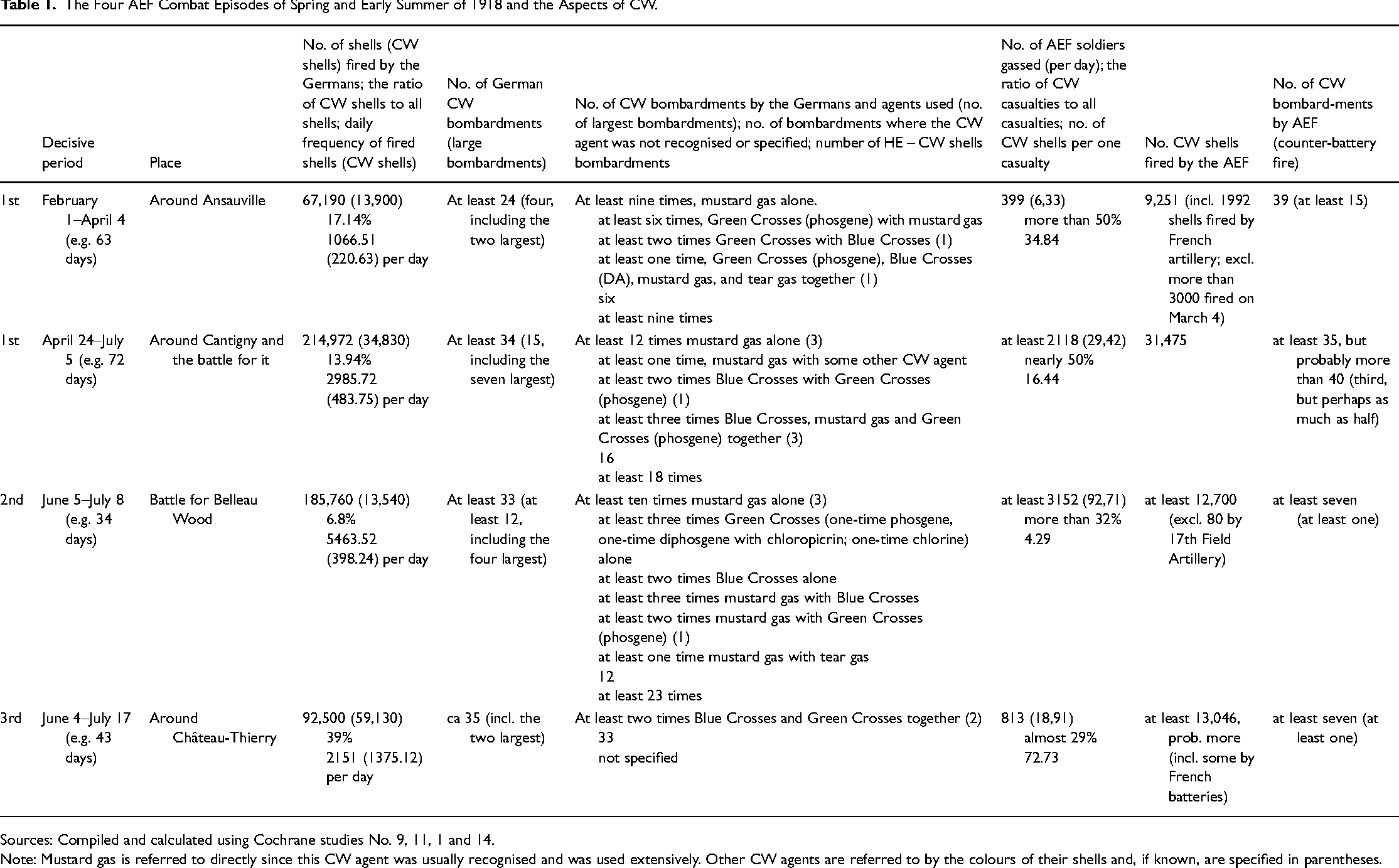
The resulting ‘model’, as summarised in Table 1, is not only schematic but also necessarily fits the available data collected by Cochrane (or data derived and calculated from them). In addition to enemy damage, it discounts territory loss and non-material damage (e.g. psychological health). It reasonably addresses AEF casualties and two AEF countermeasures – its training and discipline and its CW fire. It adds data on the German CW bombardments 69 at the beginning. The calculations derived from them – the ratio of German CW fire and the resulting AEF casualties – are closest to ‘cost-effective’ appraisals. Information on the 3rd Division is less extensive, as its records have not been published and Grotelueschen's study does not discuss it.
The Four AEF Combat Episodes of Spring and Early Summer of 1918 and the Aspects of CW.
Sources: Compiled and calculated using Cochrane studies No. 9, 11, 1 and 14.
Note: Mustard gas is referred to directly since this CW agent was usually recognised and was used extensively. Other CW agents are referred to by the colours of their shells and, if known, are specified in parentheses.
German Bombardments and the Use of CW Agents
German artillery fire itself is not the focus of the AEF's revisionist critique, except for the number of casualties (dead and wounded) that it caused, destroyed armaments and equipment and, of course, lost territory. A significant proportion were usually fired during short periods of intense activity. During the month-long Battle of Belleau Wood, the 2nd Division experienced by far the greatest intensity of conventional (high-explosive, HE) shelling by the Germans – almost twice as much as the 1st Division at Cantigny and more than twice as much as the 3rd Division at Château-Thierry. However, this intensity did not necessarily correlate with the frequency of CW fire in each episode. Around Cantigny, the intensity (nearly 500 CW shells per day; almost 14 per cent of all shells) was a quarter higher than at Belleau Wood (nearly 400; almost 7 per cent of all). However, the daily average of CW shells fired at the 3rd Division (nearly 1,400; 39 per cent of all shells) greatly exceeds these numbers (cf. columns 1 and 2 of Table 1).
While the reason for the 3rd Division was that it was at the heart of the offensive, 70 the lower proportion at Belleau Wood is not entirely clear. German forces amassed large stocks of CW shells for their third offensive, yet the Corps Order of 22 June urged ‘economy of Blue and Green Cross ammunition; the use of yellow cross only for defense’. Given that the Germans used the CW shells mostly on the edges of the Bois de Belleau, Cochrane's speculation as to whether they had enough mustard gas to interdict the entire forest may not be out of place. 71 It is not the purpose here to discuss in any detail the experience of German CW bombardments. Column 3 of Table 1 summarises the German bombardments by the CW agents used. Although Cochrane did not usually specify or recognise them in one-fourth to more than one-third of the cases, it is clear that mustard gas alone was used in a third, but more likely in up to half, of all bombardments, including many of the largest ones in the first three episodes (Ansauville, Cantigny, Belleau Wood). This corresponds to a retrospective assessment by GHQ AEF that mustard gas ‘has been assumed [to be the] predominant gas used just before … the present battle [e.g., the first German Offensive]’. 72 However, the shares of specific CW agents differed, particularly regarding German offensives. 73 Over time, AEF units faced increased use of Blue Cross shells (DA and also DL), both in the Chemin des Dames offensive (the 1st Division near Cantigny) and especially in the last Marneschütz–Reims operation, in which the 3rd Division faced them as the dominant agents.
AEF CW Casualties
Revisionists almost universally emphasise the high numbers of AEF casualties caused by CW agents, which is between one-fourth and one-third of its total casualties. The proportion of CW deaths is often unknown but is negligible in all episodes, at the level of a few or a few dozen cases. 74 Daily CW casualty figures are by far the highest at Belleau Wood (92.7 per day) and Cantigny (29.4 per day) (cf. column 4 of Table 1), although the figures would need to be compared with allied casualties in similar cases. The proportion of CW casualties in total casualties decreased from more than half (Ansauville) to less than one-third (Château-Thierry): In the fourth case, the decline may be related to the dominant shells used – Blue Crosses and the near absence of mustard gas. The proportions, in line with the revisionist view, were still far exceeded in both the British and French armies in 1918, with reported CW casualty rates of 18.2 per cent for the former and 19 per cent for the latter. 75 Some doubts about the accuracy of this conclusion stem from the disproportionate variation in the CW casualty ratio in each case. At Anasauville, ‘seldom again during the war would so many gas shells be required to produce a gas casualty’. 76 However, the even higher ratio (nearly seventy-three CW shells per casualty) at Château-Thierry is misleading, as the predominant Blue Cross shells contained a high proportion of HE and were ‘more likely to produce HE casualties than gas casualties against masked troops’. 77 These are not calculated in the ratio. The extremely high casualty ratio at Belleau Wood (4.29 CW shells per casualty) differs from the other cases by an order of magnitude.
An alternative explanation for this pointed to the role of malingering that had already emerged during the first month of 1918. The USAMD authors eventually considered it evident because of the discrepancy between the high casualty list and the low mortality rate: The CW mortality rates of the French and British in 1915–1918 ranged from 3 per cent to 4 per cent, whereas among the AEF, it was under 2 per cent. 78 The evidence for malingerers is weaker in the case of the Belleau Wood; however, regarding the 1st Division at Cantigny, Cochrane, referring to DGO reports, mentions ‘a large number [of] malingerers’ after the major mustard gas attack of 3–4 May, with perhaps as many as 700 casualties. 79 This was not an exception, as the Allied armies faced the problem of soldiers abusing the system and thus began distinguishing CW casualties from shirkers to an increased degree in the final phase of the war. 80 Yet, systematic methods of separating CW cases from suspected ones and malingerers were introduced only in October, shortly after the uniform procedures to deal with CW casualties were implemented. 81 It seems that AEF malingerers (and hence the lower mortality rate) may partly call into question the high numbers of AEF CW casualties, which is one of the core points of revisionist criticism of the AEF's ‘inefficiency’.
AEF CW Training, Protection and Discipline
Let us leave aside the focal point of revisionist criticism, the lack of general combat training or the inadequacy of training for ‘open warfare’ advocated by senior officials and Pershing in particular. 82 Instead, let us focus strictly on CW training and discipline (and more generally, delayed adaptation to new technologies), to whom AEF revisionists attribute high numbers of CW casualties. 83
The 1st Division, as a ‘showcase unit’ and the first deployed on the front, was also the first to complete training, which was the most extensive of all AEF divisions, with at least three reservations: More than 50 per cent of the unit was a new creation of inexperienced officers and soldiers; the training itself did not adequately anticipate the pivotal role gas would subsequently play; the transfers of officers and men to and from the division disrupted its combat proficiency. 84 Despite the valuable training, the unit suffered high CW casualty rates in both cases. The first major (projector) attack on 26 February, as well as the aforementioned large attack in early May, highlighted the consequences of the unwarranted premature removal of masks after the bombardments. 85 In response to the increasing number of heavy CW casualties, GHQ issued GO No. 79 in late May, establishing gas officers at all unit levels, with the highest having the duty of supervising the training. The division carried out new CW training almost continuously. 86
The 2nd Division belongs among the AEF's most combat-successful units. However, its unique characteristics (it was formed in France and included a brigade of Marines) contributed to the inconsistency of its early training, with some units receiving the best training and others not. 87 During its first phase, CW training included respirator drills, passing through a gas chamber and lectures by the Division Gas Officer (DGO), yet the division's readiness was at best extremely sketchy, according to the January evaluation. Considering the highest casualties (including CW casualties) it suffered in all divisions in the early period, its discipline does not appear to have been very far-sighted. 88 Perhaps this was a consequence of following the official doctrine (‘march and open warfare’), but their early experiences led division commanders at all levels to abandon it. 89
Finally, the 3rd Division belonged among those who were deployed some months before they were ready because of the situation at the front. It appeared there without a CW organisation, although it received some CW training after its DGO was established early in May. 90 The relatively high number of CW and other casualties during the period was – as training reports had noted, apart from poor mask discipline (of wearing masks in combat situations following established regulations) – the result of underestimating the role of trenches and neglecting to dig in, etc. 91 The division resumed training only after mid-August and, despite its DGO efforts, exhibited, as its inspector noted, a ‘constant problem not satisfactorily solved until after the war’. 92
AEF Chemical Fire
The assessment of the AEF use of CW munitions, through artillery (possibly also projectors, mortars or similar weapons), includes both the question of their availability and the effectiveness of their use, as well as how prepared and able (e.g. efficient) the forces were to employ them. At the end of 1917, the GS of the US Army, following the British and French examples, formulated a defensive and offensive CW doctrine, in which, however, according to Heller, the various units did not fully absorb and master. Nenninger, in contrast to his earlier criticism of the CW organisation, argues that they did not understand the offensive use of CW agents and used them only minimally. However, he is primarily referring to big operations in the fall, which are beyond the scope of this text. 93
AEF forces generally did not have a large abundance of CW shells since they were bound by the limitations of the French, whose supply was only 10 per cent relative to that of HE. By late March, GHQ informed the DoW that the French would deliver only 200,000 75 mm shells out of an order of eight million (2.5 per cent) and 40,000 155 mm shells out of an order of one million (4 per cent). Nevertheless, by the war's end, the AEF had fired approximately a million CW shells, about 12.5 per cent of all it had used. 94
Despite the 1st Division's proactive approach at Ansauville, its artillery experienced insufficient CW (but also HE) shells to silence the German batteries at the start of Operation Michael. 95 Although there were complaints at Cantigny about the lack of CW shells, 96 the artillery fired back at Ansauville and Cantigny with approximately the same number as the German units fired against it, including almost 4,500 rounds fired before the raids on the enemy positions on 4 March (cf. column 5 of Table 1). 97 As early as mid-March, HQ of the division determined that each battery would maintain at its position 600 ‘special’ (e.g. CW) shells for the 75 mm and 300 for the 155 mm guns. Two months later, 10,000 75 mm CW shells were allocated for the attack on Cantigny. 98 In both cases, the division, encouraged by the French, carried out extensive and effective CW counterbattery fire: at least in fifteen out of at least thirty-nine bombardments at Ansauville and at least a one-third of at least thirty-five bombardments at Cantigny (cf. column 6 of Table 1).
The 2nd Division artillery near the Belleau Wood also fired at least 12,700 CW rounds (probably more), roughly equivalent to German CW ammunition, but almost half of them (6,000) it fired only on 1 July as part of a mustard gas bombardment. It had its first allotment of French yperite by 23 June, but there were repeated complaints about why it was not being used in the unsuccessful attempts to capture the wooded area. 99 It is claimed that the artillery ultimately ‘smashed the Germans in the wood’ (Cochrane). Still, it was more likely that the division learned painful lessons regarding the value of artillery support. It seems it was repeatedly afraid to carry out CW retaliation, and its CW bombardment was probably the least efficient and effective of all our cases. 100
The 3rd Division was the only one to fire significantly fewer CW shells than the enemy (about 4.5 times fewer). The exact allotment available to her is not certain, but their 29 May reports stated that it had a sufficient supply of ammunition. 101 Corps command initially refused the requests to use CW shells to interdict the preparing enemy, its artillery and transport. However, after 8 July, the division bombarded the enemy with CW shells (including those with mustard gas) very actively, and it was this bombardment that inflicted heavy damage to the Germans, 102 allowing it to stop them soon after. It is clear that at a decisive stage of operational deployment, crucial to the outcome of the battle, the division did not lack the determination to use the CW shells.
Conclusion
The study of WWI CW on the Western Front, in contrast to general combat operations and conflict's political variables, has attracted rather a small amount of scholarly attention, but it is a suitable subject for historical additions, even some corrections. The watershed period of the last 14 months of the war, or its part, with its far-reaching battlefield innovations, renewed frontline movement and the engagement of 1.4 million US Army personnel in combat, probably fully deserves that re-examination.
The polemic with AEF revisionism vindicates no small part of its critique; however, it does not vindicate all of it. There may have been some delays in the AEF CW organisation from mid-June 1917, but they were hardly of any central importance to the situation on the battlefield. GWS or the later CSS worked well under the circumstances. 103 Pershing was not an impediment to better organisation and centralisation of CW warfare, which was more likely to have been the DoW and other government branches. In contrast to the failure to produce CW shells, CW research, supported by information exchange with the British and French, was relatively successful and effective 104 (although for arsines, the dependence on the British was too great). It cannot be said with certainty whether and to what extent US supplies of CW agents for shells, especially chlorine and chloropicrin, were used on the battlefield.
The second part, contrary to the AEF revisionists’ past research and interest in the major offensives and final campaigns of the war, 105 focused on small episodes involving individual units in the early stages of AEF involvement. It tracked AEF's frontline efficiency and effectiveness of three divisions (and four cases) during the German offensives and schematised their performance into four dimensions. The ratio of gassed to all wounded in all four cases is excessive (ranging from 50 per cent to 29 per cent), 106 confirming the revisionist critique, although suspicious malingering (and lower CW mortality rate of AEF units) may call these numbers into question. In the case of training and discipline, a little less credit should be given to the AEF revisionists. We have documented repeated CW failures within the 2nd Division and the poorly trained 3rd Division, but also the much better-trained and more experienced 1st Division. Obviously, inadequate training does not explain them all, and they must also be attributed to poor discipline, particularly in wearing masks due to carelessness, sometimes even disobedience or ignorance of officers’ orders, especially in the case of persistent mustard gas. However, it should be pointed out that from May and June, the divisional HQ at Cantigny and Belleau Wood took systematic measures to improve both the CW training and CW discipline. The revisionist criticism is probably the least valid in the case of the AEF CW fire, which, except for the 3rd Division at Château-Thierry, almost reached the German level. Divisional stocks of CW shells were always limited, sometimes inadequate, but never at a serious shortage. At least as important is the commitment of the troops to use them, including the frequent AEF reprisals for the German CW fire and also counterbattery fire, as the examples of Ansauville, Cantigny and Château-Thierry illustrate.
It does not appear that officials responsible for CW failed significantly after the US entered the war. Nor does it appear that AEF units, even by today's standards, adapted to CW extremely slowly. The most relevant AEF revisionist objections may seem to concern the long-term US neglect of CW agents research and response to them between mid-1915 and April 1917. As Heller nicely points out, the reasons could have been that the soldiers were on the sidelines, and the politicians still enjoyed the distant safety and feeling that events in Europe did not concern them too much. 107 Still, even the circumstances of this ‘neglect’ would merit examination, especially since remotely similar objections have been raised against the US entry into WWII or the early days of the Cold War, etc.
AEF revisionism, like the vast majority of revisionisms concerning historical processes and causes, represents a healthy historical approach that has challenged many unquestioned interpretations and routine assumptions about the past. Thus, objections to it here do not imply its rejection as much as a need for its correction. Mark Grotelueschen's studies illustrate the great need to enrich selected units’ neglected area of operational-tactical engagement. 108 However, a large number of archival sources concerning the organisation of the US CW and the battlefield CW experience of individual units remain untapped.
Turning to the broader contours of the war, its final phase from the autumn of 1917, as this article also attests, fully supports the view of those Anglo-centric revisionists (Richter, Cook, but also Spiers or Edgar Jones), sharing the view that CW agents played an important role, at least as weapons of attrition and German weakening. Incidentally, Gen. Pershing expressed a similar verdict in his Final Report for the DoW (1919), stating that their ‘effect is so deadly to the unprepared that we can never afford to neglect the question’. 109
