




Abstract
Occupation and war transform everyday life and living conditions of people. The Nazi occupation of Norway during Second World War was no exception. A document analysis was conducted to explore everyday life from the perspective of housewives. Findings reveal a changed and challenging information landscape while at the same time, the women were faced with many and completely new information needs. The ability of the housewives to adjust their information behaviour seems vital for survival of the families. This study contributes with an understanding of the important role of information and information literacy during major life events such as war.
Keywords
Introduction
The Second World War and the occupation of Norway in 1940 forcefully changed the lives of Norwegian people. Among the consequences were many changes in the households due to rationing and limited access to resources such as food, clothes, and other necessities. These upheavals altered the routines of Norwegian housewives, who no longer had sufficient access to commodities needed to maintain the household's usual way of living. The limited access to food, the increased need for make do and mend, and everchanging rules and regulations resulted in many and new information needs. At the same time, the information landscape had changed due to censorship, propaganda, and Nazi control. Official sources could no longer be trusted and illegal alternative information sources were developed, resulting in a variety of illegal newspapers.
Much research has been conducted on the Second World War in Norway. Previous work has typically addressed topics such as battles, resistance, sabotage, and Nazi collaborators. Less studies have paid attention towards topics pertaining to everyday life, such as access to information. This article explores the information needs and the information landscape of Norwegian housewives during the Nazi occupation in the period 9th of April 1940 to the 8th of May 1945 through the lens of library and information science.
In this context, a housewife is not restricted to a person working at home, but a person who usually relieves other family members from contributing much or any of their time, effort, and attention to childcare, food preparation, housecleaning, laundry, grocery shopping, and a host of other chores and errands.
1
Two questions are explored in this article: (i) What did the information landscape of Norwegian housewives look like during the Second World War? and (ii) What types of information needs arose among Norwegian housewives during the Second World War? Overall, the information landscape changed during the war and was affected by rules and regulations, ideology, censorship, Nazi propaganda, and paper rationing making it challenging for the housewives to attain trustworthy information. Moreover, the information sources available shows new and complex information needs related to coping information and helping information making information literacy a necessary skill for the households to survive.
The article is structured as follows: The background provides a short overview of occupied Norway and then addresses the role information plays in satisfying basic human needs, especially in times of crisis. The method chapter presents the procedure for document retrieval and analysis. The main findings are then presented according to the two research questions, and a short discussion follows before a conclusion is provided.
Background
Living Conditions in Occupied Norway
Norway was invaded by the Nazis the 9th of April 1940 and had to surrender after two months of fighting. The Norwegian Royal family and Government managed to escape to England before they were captures. At the time of the occupation, there was a small far-right party in Norway entitled ‘Nasjonal Samling’, abbreviated NS. After the occupation, their leader Vidkun Quisling carried out a coup d’état and established a government consisting of NS members. 3 A German occupation system was later established that controlled the country organized as follows: (i) a military part, (ii) a civilian authority and (iii) the SS and police. 4 The term ‘Jøssing’ was used to refer to Norwegian patriots in opposition to the Nazi sympathizers, who were referred to as ‘Quislings’. The occupation lasted for five years, until the 8th of May 1945.
In 1940, there were approximately three million people living in Norway. 5 The number of married women working at home was 615.230 in 1946. 6 Although this number does not properly reflect the cohort described in this study, the numbers at least indicate an approximation of the housewives at the time, keeping in mind that the definition of housewives applied in this study is not limited to women working at home.
The occupation resulted in changed living conditions for all Norwegians. Rationing cards, queues to acquire food, different ways to supplement the rations such as foraging and other ways to procure food was the norm. Keeping their family alive became a full-time job for women.
7
This effort was acknowledged in a proclamation from the leadership of the resistance movement a week after the occupation ended: The Norwegian population has done an effort in the fight for freedom in which they can be proud of. (…). This also applies to our loyal women who bravely and faithfully kept the households up.
8
Human Needs and Information
Human needs can be categorized in different ways, where Maslow's theory of hierarchy of needs represents one of the most applied.
14
According to Maslow,
15
basic human needs can be divided into a hierarchy of five types of needs: physiological, safety, love, esteem, and self-actualization. Dorner, Gorman and Calvert
16
relate Maslow's levels of needs to types of information: coping information, helping information, enlightening information, empowering information, and edifying information. In the hierarchy suggested by Maslow, humans will focus on different levels of needs depending on their life situation: the most prepotent goal will monopolize consciousness and will tend of itself to organize the recruitment of the various capacities of the organism. The less prepotent needs are minimized, even forgotten or denied.
17
Dorner, Gorman and Calvert discuss the relationship between Maslow's hierarchy of needs and information and conclude that the success of individuals in meeting their primary need is dependent on them meeting their information need, which means that satisfying information needs is critical for people to satisfy their basic human needs.
21
Information and Life Events
The theory on Information Sculpting developed by Ruthven 22 addresses how people create information solutions when experiencing life changing events. This theory describes the transition in an individual's information world from ‘life before’ to ‘life after’ comprising three phases (understanding, negotiating, and resolving) and four transition processes (event, engaging, enacting, and establishing). The event and the following transition can be progression from trauma to hope or the other way around. Baumeister and Bratslavsky 23 have pointed out that bad events seem to have a stronger impact on people than good. Further, bad events cause a higher degree of information processing than good events, which may have an impact on cognition and motivation.
Spink 24 addressed information seeking from an evolutionary perspective, and emphasized how information behaviour is one dimension of human behaviour that has been important over time to evolve and survive. There have been studies on information seeking during war time, such as online information needs in the Russian–Ukrainian war 25 or media dependency and trust in the Syrian war. 26 No studies, however, seem to have explored information needs in the Second World War except for addressing topics such as information wars, press history, the illegal press, and other related topics which are more related to media studies.
Method
Procedure
Due to the time gap to the Second World War, it was not possible to interview housewives about their information needs and information access. A qualitative document analysis of two types of material was therefore conducted. An extensive literature searching was applied to explore the primary information sources available to the housewives during the war. Further, archival material including personal communication, diaries, rationing cards, decrees and other documents were examined to explore potential information needs that may have arisen.
Material
The main sources of information were the Norwegian National Library and the archive of Norway's Resistance Museum. The national library database was searched using a set of predefined inclusion criteria, a variety of keywords and constructed subject headings while the archival material was retrieved in collaboration with employees at the museum. Material that was digitized was accessed online. Otherwise, the physical copies were studied in the archive or library's reading room.
Several document types were included, such as books, leaflets, decrees, propaganda, illegal newspapers, magazines, newspapers, posters, rationing cards, personal correspondence and other grey material. The publication date of the material was limited to the 9th of April 1940 until the 8th of May 1945. The only exceptions were memoirs and similar documents published post war. Geographic scope was primarily Norway, but documents produced abroad, e.g., by the Norwegian exile government or resistance movement concerning Norwegian conditions were also included. Target groups for the documents published during the war were the general population, households, housewives, women, children and youth.
Extensive searching was conducted using query terms such as Second World War, Information campaign, Women, Housewives, Food, Cooking, Nutrition, Household, Housekeeping, Rationing, Substitute goods, Increasing the supply of food, Home gardening, Gathering, School, Education, Legislation, Decrees, and Propaganda. The query terms were originally applied in Norwegian, and several linguistic variants were used to express these topics and combined in many ways.
Data Analysis
A qualitative document analysis was applied. Categories were derived based on a thematic analysis 27 using categories derived from sources about everyday life during the war such as Food (rationing, replacement goods, recipes), Increasing the food supply (gardening, animal husbandry, foraging), Health (nutrition), Make do and mend (Repairing, Re-use), Nazi indoctrination (Propaganda), and Safety (rules and regulations).
The Information Landscape
There were many information channels available in 1940, but the information landscape changed due to the occupation and during the war for various reasons. Five key topics emerged in the analysis: (i) rules and regulations, (ii) ideology, (iii) censorship, (iv) Nazi propaganda, and (v) paper rationing.
Rules and Regulations
The most comprehensive regulation affecting information access was the radio ban. From the 1st of August 1941 people in certain parts of Norway had to hand in all radio receivers, and by the 10th of September the radio ban was nationwide. 28 The rationale behind the ban was, among others, because the attitude of people towards the world situation was affected by the BBC broadcasting from London. Civilian resistance due to encouragement promoted by BBC was also increasing. The only people entitled to keep their radios were therefore members of the Norwegian national socialist party Nasjonal Samling (NS) who complied with certain conditions. The radio ban entailed that people had to rely on printed sources for news, and these sources were heavily censored.
Despite strict punishments, many people hid their radios (see Figure 1a) and listened to radio broadcastings comprising, e.g., news from London and speeches by King Haakon 7 but also coded messages pertaining to the resistance movement. 29 This content was written down and distributed through illegal papers with titles such as ‘London-nytt’ (London news), ‘London Radio’, and ‘Radio-Nytt’ (Radio news). 30 News was also written by hand and spread more locally in neighbourhoods or small communities including only people that were trusted to not sympathize with the Nazis. More than 300 different illegal papers were published during the war with approximately 213.907 copies weekly. 31 In 1942, a death penalty was issued for being involved in illegal papers, which made it riskier to rely on these papers as information sources. Nevertheless, people continued making and using illegal papers as an information source but were conscious about handling and storing the papers and creative solutions emerged (see Figure 1b for example).
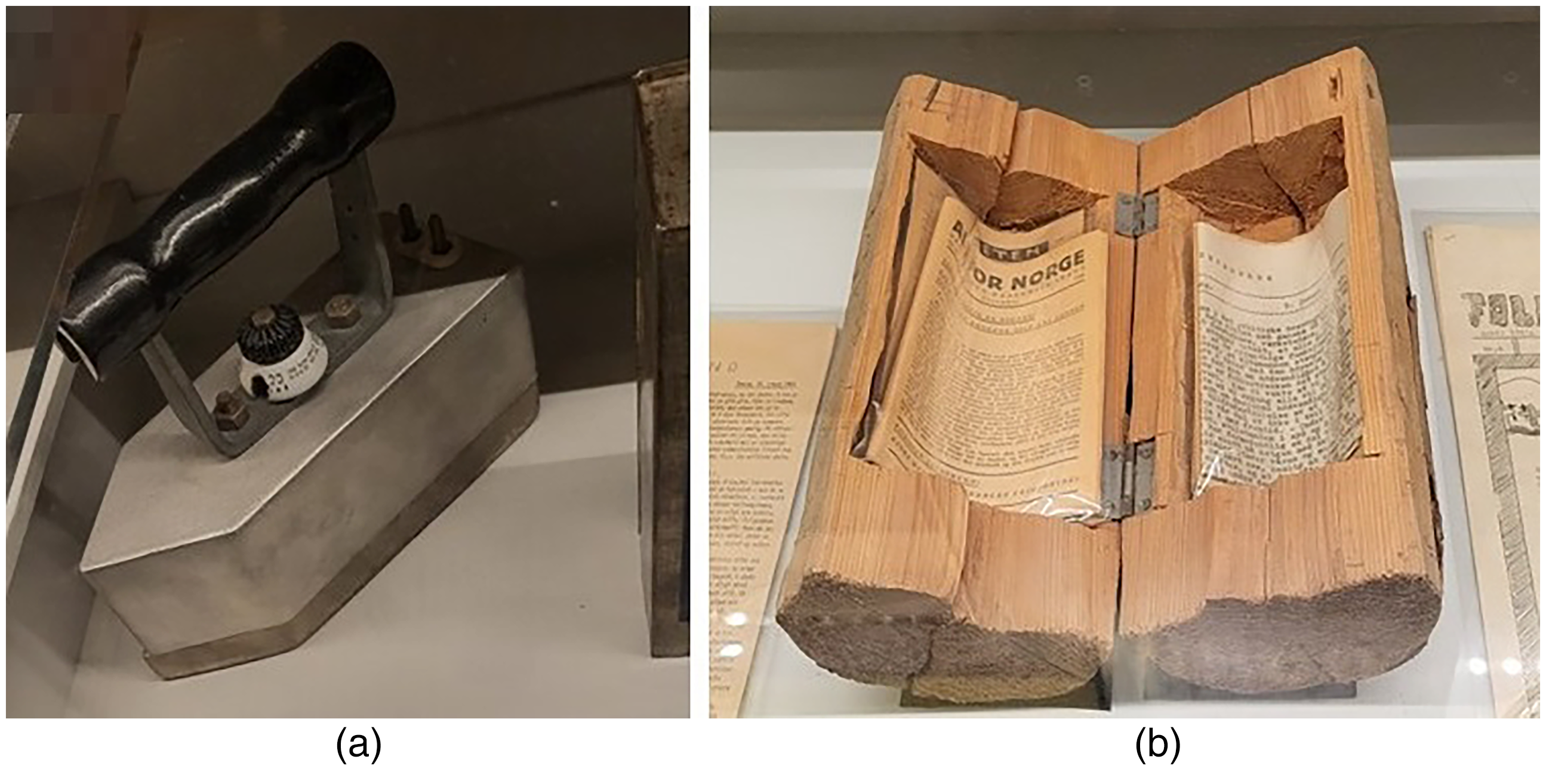
(a) Illegal radio disguised in an iron and (b) hollow log of fire to hide illegal newspapers. The items are displayed at Norway's Resistance Museum and photographed with permission.
Ideology
The information landscape was different for the members of the NS party (and other Nazi sympathizers) compared to the Jøssings, among others because the radio ban did not apply to all of them. Moreover, it seems likely that ideology affected choice of information sources such as newspapers and magazines. Regarding magazines, there were at least thirteen titles available at the beginning of the war that mainly targeted women or wrote about topics regarded relevant for this cohort.
Analyses of material produced during an occupation require careful consideration. This study shows the need to not only know the target groups but also the people or organizations behind each information source. For example, The Housewife Association had 730 local organizations and around 32,000 members in 1940. 32 Their magazine ‘Husmorbladet’ (‘The Housewife magazine’) would seemingly be a primary source of information for many housewives. However, the 13th of June 1941 the association was subject to Nazi control and the elected members were replaced. The takeover of the Housewife Association can clearly be seen in the introduction of issue 7/8 in 1941, which explains the changes and ends with: ‘We request you to loyally stay put and request your representatives in the districts to do the same’. 33 The message is followed by the compulsory greeting applied by NS members in Norway: ‘Heil og sæl’. As a response to this takeover many women burned, discarded or returned the Housewife magazine upon receival. 34 , 35 The magazine was therefore probably not a part of the information landscape of many Jøssing housewives after mid-1941.
In contrast, the magazine ‘Norsk ukeblad’ (‘Norwegian weekly magazine’) continued with its regular editorial office during the occupation. The magazine was stopped for a month in 1942 and was shut down in February 1943 due to a front cover illustration regarded as ‘too patriotic’. 36 The illustrator behind the cover, Gunnar Bratlie, was sent to Grini detention camp for two years. This magazine would most likely be popular among the Jøssings when it was published and constitute an example of a preferential information source compared to Nazi run publications.
The Nazis tried to overtake several Norwegian publishing houses during the war but were counteracted by editorial staff, journalists, and other employees. Consequently, most magazines did not change much during the war, although some issues of certain magazines were stopped due to anti-nazi or ‘too patriotic’ content. 37 Analysis of magazine covers shows clear differences in ideology. Figure 2 shows front pages from a magazine targeting the general population controlled by NS and a general journal intended for (young) women. On the cover of the latter, the front page includes a red knitted cap. Wearing such a cap became illegal in February 1942 because it was regarded as a symbol of Norwegian resistance (this topic will be discussed in more detail below). This magazine included a red cap both in April and August 1942, which may be interpreted as a signal of the publishers being Jøssings, probably making the information source more reliable among Norwegian housewives.
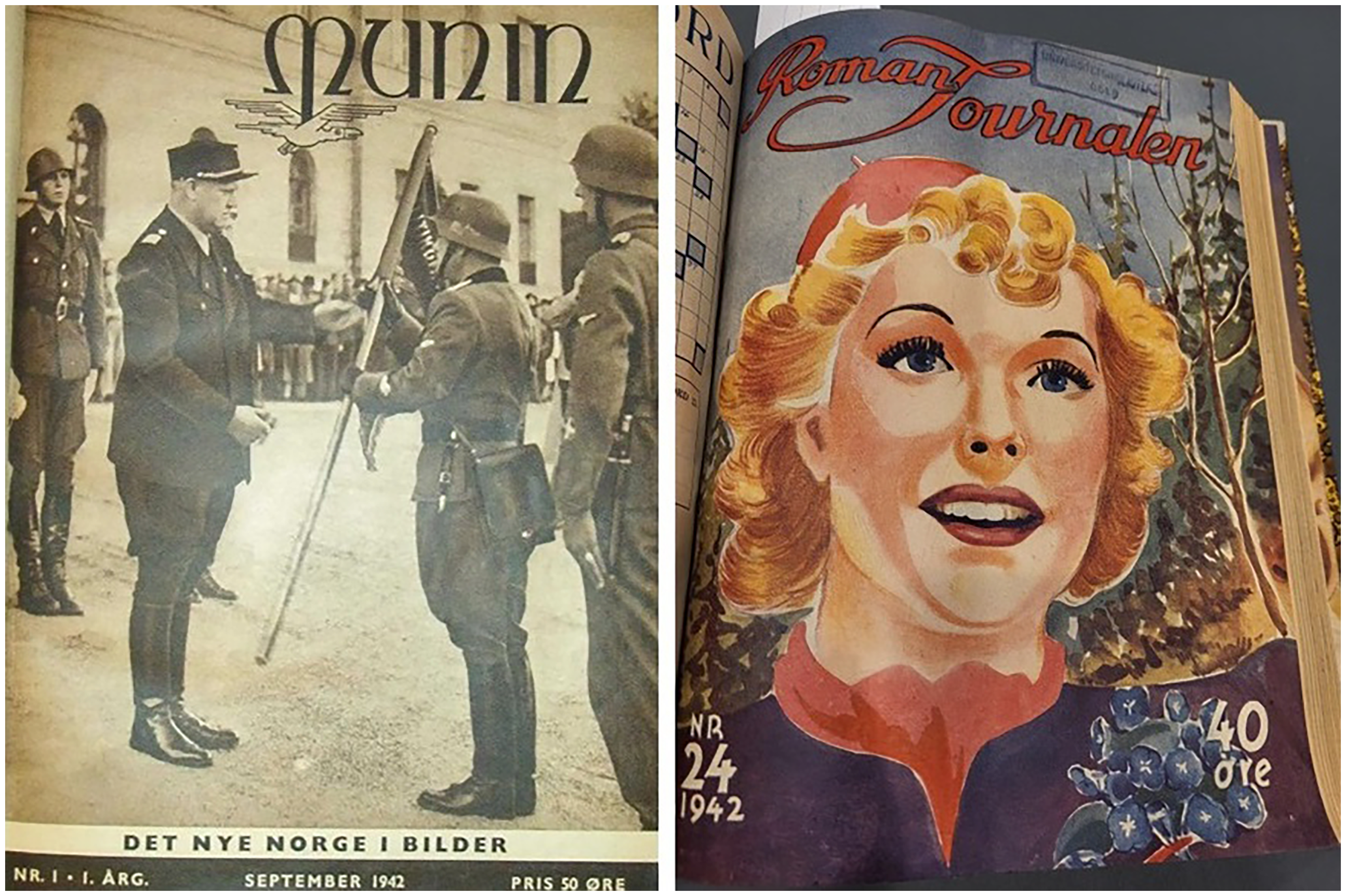
Examples of front pages of magazines from September (left) and August (right) 1942.
Censorship
The occupation had huge impact on what information was available in general and how it was presented to the public, especially regarding world events and news related to the war. Information provided through official channels, including the sources that prior to the war had been independent and regarded as trustworthy, became censored. Nazi propaganda was also heavily applied. Counterinformation had to be obtained through hidden radios and illegal papers. However, personal recollections show that for some people it was difficult to grasp that newspapers could no longer be trusted. One person in the data material refers to how her grandfather still believed everything he read in the newspaper because newspapers had been regarded as trustworthy his whole life. It was simply not possible to convince him of the changes in the information landscape requiring a new type of source criticism. This account shows that for some people it must have been challenging to accept and adapt to the new information landscape. The need to tell the children they could not trust the content of the newspapers was also brought up in the illegal papers, for example, in the paper entitled ‘Den norske kvinne’ (‘The Norwegian woman’). 38
Censorship had a huge impact on the newspapers. The free press no longer existed after the occupation due to restrictive legislations and regulations. For example, the 26th of September 1940 the Press Directorate gave the Department of Culture and Popular Information control over the press. In 1942, there was a new law allowing the Press Directorate authority to stop the production of both newspapers and magazines and 110 newspapers were stopped through Nazi orders. 39 Other newspapers shut down because of, e.g., bombing, destroyed equipment or shortage of paper. 40 At the end of the war, only 120 newspapers were published compared to 270 in 1940. 41
The public libraries were also affected by censorship but remained open during the war. There was an increase in library visits and book loaning causing challenges in providing enough books. The Nazis had confiscated banned books from the library collection, e.g., written by authors who were Jewish, communists or hostile towards Germany or books on socialism, and the labour movement. 42 Further, there was not much money to buy new books, and the paper rationing affected the number of published books. As a result, the books in the library were frequently on loan and parts of the collection became worn-out. 43
Nazi Propaganda
Propaganda was directed towards all the layers of the population, especially young people. The NS party had a dedicated division for children and young people entitled ‘Nasjonal Samlings Ungdomsfylking’ (Nasjonal Samling's Youth Wing). A document on propaganda published by the Nazi party starts by describing the importance of targeting young people: The propaganda by the Youth Wing will primarily focus on making national socialism known among the Norwegian youth. Yes, not only make national socialism known, but make it to the view of life and through that the view of life for the whole population.
44
Paper Rationing
Two years into the war, there was a beginning paper shortage. In 1942, paper was rationed in four stages, which reduced the paper supply for newspapers by 60 per cent. 46 In 1942, 151 newspapers were published in 700,000 exemplars, which the Nazi government found too many due to the paper shortage. 47 Consequently, many newspapers and magazines were reduced in size and eventually disappeared. In 1942, approximately 50 newspapers were stopped. 48 For some of the remaining newspapers, people were in line for subscriptions due to low number of prints because of the paper shortage. 49
By the summer 1943, most magazines that were not nazified were stopped. These changes reduced the access to written information and narrowed the information landscape even further. The changes in format, size and paper quality can be clearly seen in Roman Journalen, which was reduced from 51 to 35 pages in April 1942 and additionally reduced to 27 pages in May 1942. The printed books on topics such as ration friendly recipes, foraging, allotment gardening, and simple animal husbandry were also reduced in numbers after 1941. The books in the data material were distributed as follows: 1940 (10), 1941 (24), 1942 (18), 1943 (17), 1944 (7), 1945 (2), and no date (1).
Information Needs
Information must have played a vital role in the everyday lives of Norwegian housewives. In addition to adhering to a new information landscape, they also had to adapt to new types of information needs to ensure survival of their families in terms of nutrition and health, but also to stay away from trouble with the Nazi regime and avoid Nazi indoctrination of their families. The importance of staying informed and sharing information with others were emphasized in a leaflet entitled ‘The 20 battle commands from the leadership of the Norwegian resistance movement’ which states: It is your obligation to keep yourself posted about what is going on. For the person who really wants to, this is not difficult. It is also your obligation to communicate what you learn to others.
50
At the workplace and in the homes, the women have with irrepressible courage fought against the German's starvation and terror. (…) They have protected the children's minds towards the toxic Nazism and with despair and courage struggled to take care of the children's health. They have struggled to hold their households together despite shortages of food, clothes and fuel and made the homes a strong and unbreakable chain in our invincible Norwegian home guard.
51
Coping Information
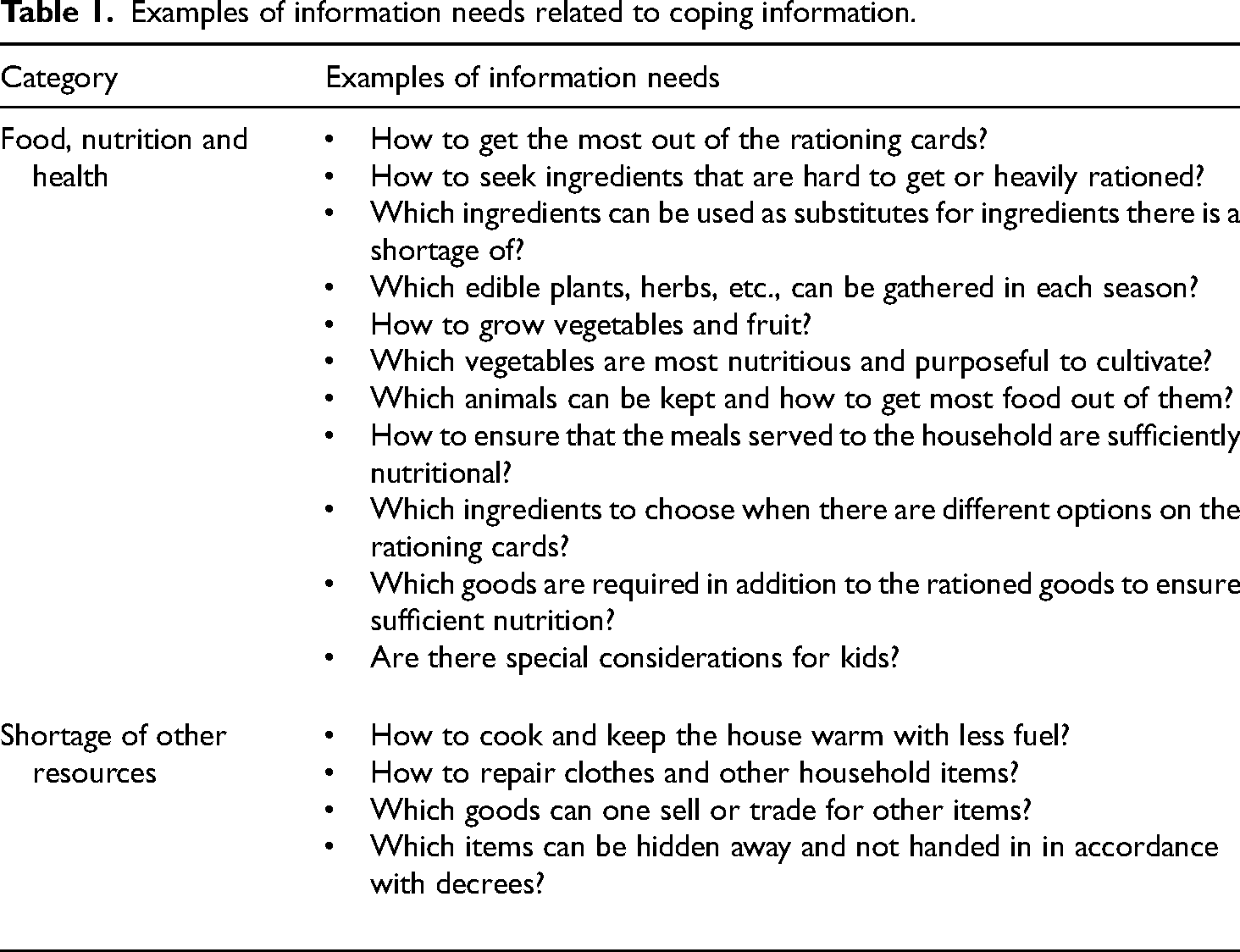
Physiological needs relate to the most pre-potent human needs, e.g., food, drink, shelter and warmth. 53 To accommodate these needs, coping information is required. 54 Many information needs during the war arose from physiological needs related to shortage of food and other resources, nutrition and health. Books, magazines, newspapers and grey material from the Second World War address these categories (see Table 1 for examples).
Examples of information needs related to coping information.
Food, Nutrition and Health
The food situation was getting increasingly worse during the war and the housewives spent hours in queues in attempts to acquire groceries and other necessity items. The situation is described in a book entitled ‘Food in wartime’ as follows: The diet is apparent through the rations we are allocated and the food we can buy additionally. Mrs Housewife does her best to get it all in the house and cook of what she's got – she has more than enough to do and needs all the help and support she can get from her family – and then it is primarily to get enough food every day.
55
Looking at the book market directed at housewives, many books seem to comply with the information needs put forward in Table 1 and are clearly adjusted to war time. The books in the data material can roughly be divided into six categories, each reflecting important information needs, namely Food in wartime/rationing (19), Cultivation (16), Cookbooks (16), Foraging (15), Animal husbandry (11) and Housework (2). The book titles typically refer to coping information, such as rationing and limited access to food (e.g., ‘We eek out our rations’, ‘Food in wartime’, ‘A healthy diet in rationing times’, ‘Potatoes in 120 ways’), getting started with animal husbandry to increase food supplies (e.g., ‘Pig, rabbit and chickens for amateurs’, ‘The chicken book for beginners’, ‘Rabbits in a period of crisis’) and foraging (e.g., ‘Fruit and berries for the winter: get hold of food, preserve vitamin c, save sugar’, ‘Tang and sea grass as vitamin source’, ‘Free food from wild plants’, ‘Weed is also food’). It should also be noted that the category ‘cookbooks’ typically contain adjusted recipes based upon access to food and the use of supplementary ingredients and therefore overlaps with the category food in wartime/rationing. Magazines also provided many recipes adjusted to the wartime and scarce access to resources.
Shortage of Other Resources
During the war, it was increasingly difficult to get hold of items such as clothes, shoes and other everyday items. Decrees demanding households to hand over certain items to the Nazi government to be used by German soldiers might have made the situation even worse. For example, there was a decree the 15th of October 1941 to report and hand over tents, rucksacks, anoraks and windproof trousers. 58 Other examples were the decree of the 20th September 1941 demanding handing in woollen blankets 59 and the decree of the 2nd of November 1942 regarding wellingtons. 60
The hard reality and the need for coping information to survive can be clearly seen in the magazines. For example, ‘Roman Journalen’ was originally a magazine directed at young women containing content such as love stories, news from Hollywood, glamorous people and a reader's queries often related to relationships. This magazine, however, significantly altered its contents to address topics worth knowing in wartime, related to cooking and make do and mend. Over time, this magazine seems to have changed from recreation to also providing coping information directed at less experienced housewives. This change in profile can also be seen in the magazine covers. Figure 3 shows two examples where the cover from April 1940 is glamourous, while the front cover from September 1941 displays a woman wearing an apron making food. The text on the front-page reads ‘Do you pay attention to We will probably manage it’, a permanent column introduced in August 1941 containing various advice related to topics such as: How do we keep healthy? – Do we need to know how to knit? – Do I dare sewing my own clothes? – How do I get stains off my clothes? – What does it entail to know common cooking? – Even ironing must be done correctly. – And many other questions for the well-being of the home will we be thoroughly acquainted with. Now it's just to keep diligently up and have the proper determination, and you will see how clever housewives we will be!
61
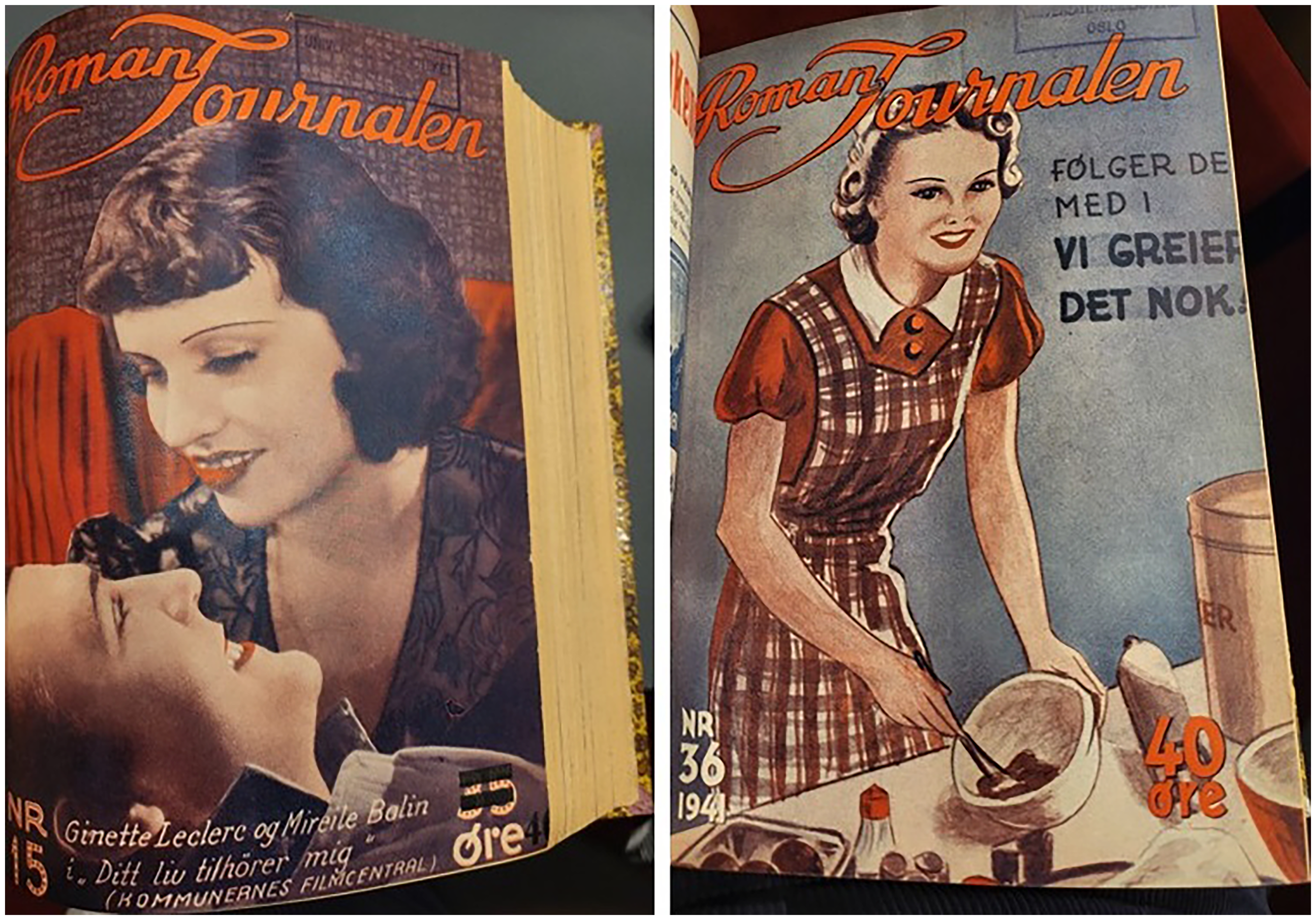
Front pages of 15 April 1940 compared with 36 September 1941.
Make do and mend was given much attention in the women's magazines in general, which often contained knitting recipes showing how to reuse yarn from old garments, how to make children's clothing out of adult clothes and advice on how to style old outfits, for example by making a new collar for a used dress. Several of the magazines provided recipes and advice on alterations of garments in each issue.
Helping Information
Safety needs represent the second level in Maslow's hierarchy of needs. According to Maslow 62 these needs are ‘seen as an active and dominant mobilizer of the organism's resources only in emergencies, e.g., war (…)’. In context of information needs, this category would mainly comprise keeping updated on rules and regulations, but also counteracting indoctrination, and being informed about the safety of family and friends. Such types of information needs require helping information, 63 see Table 2 for examples of information needs.
Examples of information needs related to helping information.
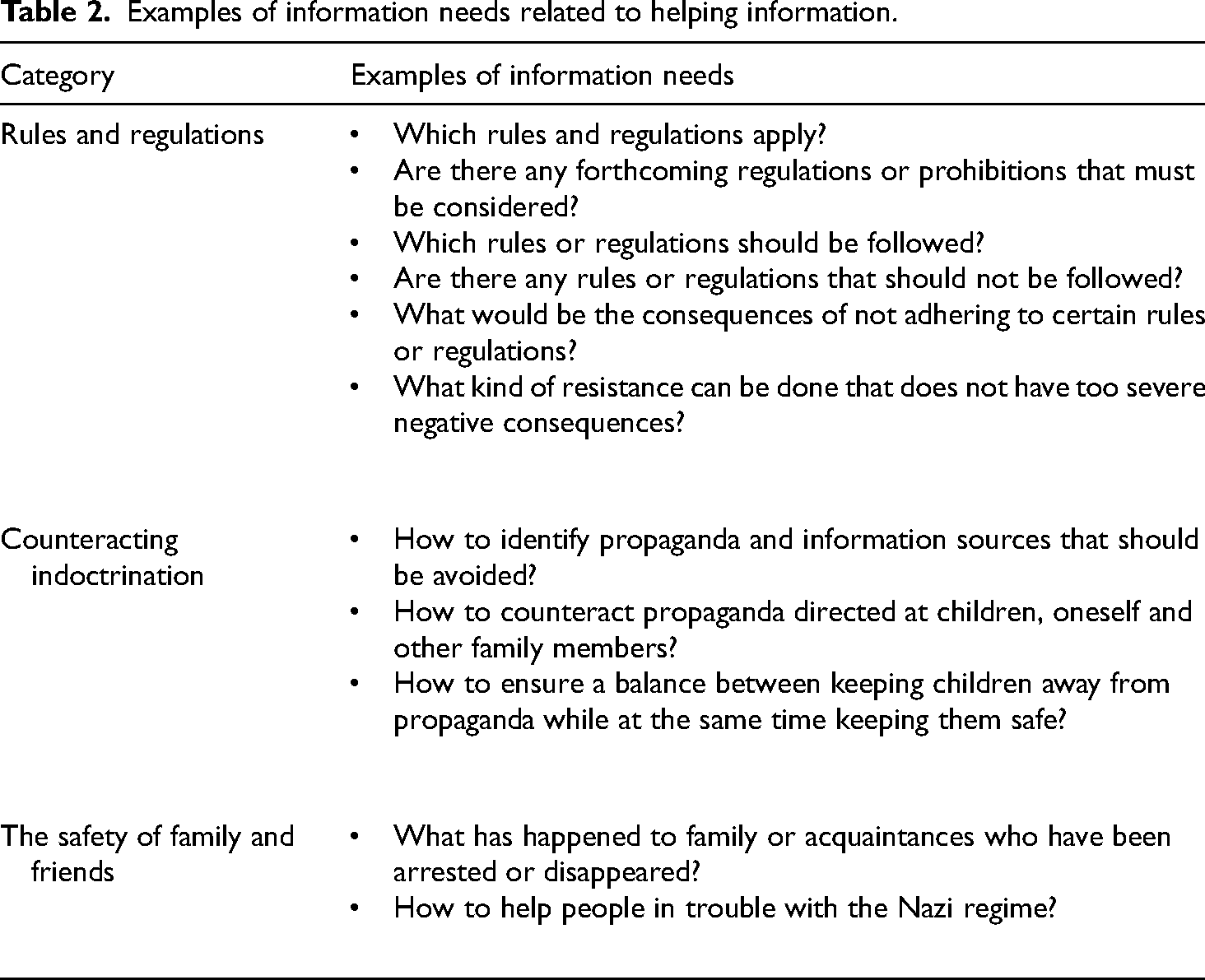
Rules and Regulations
Rules and regulations were rapidly changing during the war. Sometimes, apparently minor matters could cause severe problems. For example, a prohibition against wearing red knitted caps as displayed in Figure 2 was proclaimed by the police in a newspaper in Trondheim in 1942 due to becoming a sign of resistance: The use of red knitted caps has increased so much recently that it from now on will be regarded as demonstration. The use of these caps will therefore be prohibited from Thursday the 26th of February 1942. From this day, knitted caps will be taken from everyone who appear using such and criminal liability will be in force towards the person concerned – for children below 14 years – against parents or guardians.
64
Counteracting Indoctrination
‘How much information should I share with my children regarding the war?’ This question was addressed in February 1940 in ‘Damebladet’ (‘The Women's Magazine). Although this issue was published just before the occupation it addresses a very important information need that might have been even more relevant two months later. The magazine asked: ‘how can we manage to solve the difficulties we face as mothers in these hard times? The most challenging thing is to keep the bitterness away. Because being surrounded by bitterness harms children’. Further, it is suggested to explain to the children what war is about: War is wanting to have more and more. War is starting to fight when people do not get everything they want. (…) I think the right way to do this, is to tell the children the simple truth. (…) To be surrounded by bitterness hurts a child. Therefore, the biggest difficulty right now of being a mother is to work with oneself, manage to keep the bitterness away – and just be filled by unlimited compassion with humanity.
65
the Nazis also know that when they get to the children, teachers or homes cannot accomplish anything. That is why they have started their youth service, and they will therefore with all means threaten their way forward (…) Before the father or mother knows, the Nazi poison will be dripped into the children's mind. A child's mind is flexible and susceptible, it is easier to form than modeler's clay.
67
The Safety of Family and Friends
Another safety related information need was keeping informed about people who were arrested or disappeared. During the war, more than 40,000 Norwegians were arrested 69 and either imprisoned or executed. In some cases where the Nazis could not get hold of wanted people, they arrested parents, sons or daughters instead and kept them as hostages.
Archival material comprising communication between prisoners at Grini prison camp (the largest prison camp in Norway) and their family members shows that some people were allowed to send and receive a few letters during their imprisonment. These letters also reveal information needs related to everyday life, such as questions from housewives regarding how much they could sell certain items for to get money to pay mortgage instalments or other household expenses. A letter from an imprisoned woman at Grini to her parents also shows the shortage of everyday items. She mentions in a postscript a red blanket her mother can use for making cleaning cloths if she has a shortage of cloths.
In contrast, some housewives did not receive information about their loved ones at all. In a letter dated the 24th of January 1942 a 32-year-old man sentenced to death explains to his mother ‘that I have not written earlier is due to being in captivity since the 15th of June last year’. He also said to his mother and sister that ‘I will be shot tomorrow at 9 a.m.’, which implies that he has not been able to provide his family with any information about his captivity.
Discussion
Memoirs and various descriptions of the war effort of Norwegian housewives show a challenging everyday life with a weighty burden placed upon the women. The health and well-being of families must have relied heavily upon the women's ability to adjust to the new life, including keeping themselves updated on various issues affecting the household. Having the ability to seek and utilize information must have been vital, making information literacy a necessity to accommodate, e.g., physiological and safety needs as described by Maslow 70 through coping information and helping information. 71 This study also shows that life events, such as war, can result in new types of information behaviour as discussed by Ruthven. 72
An examination of available sources shows a diminished information landscape caused by rules, regulations, and paper rationing. Moreover, censorship and the heavy Nazi propaganda machine resulted in an unbalanced and often also incorrect information landscape. Accessing or keeping alternative information sources became increasingly dangerous during the war. Involvement with illegal radios or newspapers could result in imprisonment and execution. Nevertheless, the high number of illegal radios and the widespread distribution of newspapers showed the importance of getting access to news and information through channels outside Nazi control despite the strict punishments. Moreover, books and magazines seem to have been particularly useful providers of many types of coping information and seem less affected by Nazi control.
The housewives seem to have used a mix of information sources, depending on the information need. For example, although the newspapers did not contain trustworthy information regarding the news, they were useful for information on topics such as rationing and regulations. The underground newspapers provided a more purposeful source for news, although reading them came with a great risk. Moreover, cookbooks and magazines may have provided useful information for all types of housewives pertaining to typical household issues, such as cooking and obtaining food. These sources were probably the same for all types of housewives, and not that dependant on, e.g., ideology.
The information landscape must have been increasingly limited during the final course of the war, where, among others, paper rationing resulted in the abruption of many newspapers and magazines. At the same time, less books were printed, and library collections were worn out and not much new material was purchased. The role of information sharing among people is not possible to reveal based upon the written material, but it seems likely that personal communication must have played an increasing role in the last part of the war, especially in small communities. This information landscape seems to have been quite similar for people all over the country, both in urban and rural areas.
Regarding the information needs of the housewives during the war, findings from this study are coherent with the theory of Maslow. 73 Most information needs seem to have evolved around the two most basic categories at the bottom of the hierarchy of needs with a somewhat less clear border between coping and helping information. In occupied Norway, these information needs seem to have been closely linked, where for example information about rules and regulations were required for survival. It was also necessary to understand the relationship between resistance and consequences to know when the population could avoid following regulations. The unsuccessful attempt to create an obligatory youth service like the Hitler Jugend in Germany is one example of successful collective resistance that relied on information sharing.
Although the effort of the housewives was mentioned by some people after the war, the main attention has been directed towards topics such as resistance campaigns and battles. Consequently, far less attention has been directed towards the immense effort by the women who held their households together during five difficult years. One must also keep in mind that while we know the duration of the war, the women faced everyday with new challenges not knowing if, and when, Norway would be free again.
Conclusion
This study has aimed at addressing a cohort that has rarely been studied in context of the Second World War. To get an understanding of the impact of war on a society, there is a need to also examine everyday issues and not only focus on topics such as battles and resistance work. The main outcome of this study is that updated and unbiased information plays a vital role in times of crisis to keep informed about events. People are also willing to risk a lot to gain access to correct and useful information. Moreover, survival may depend on the ability to gain coping information and helping information which makes information seeking a vital skill. The information literacy of a population and strategies for information access and sharing in needs of crisis seem to be equally important in the emergency preparedness of societies today.
Footnotes
Acknowledgements
The author is grateful to the Norwegian National Library and the archive of Norway's Resistance Museum for their help and support during the data collection.
Declaration of Conflicting Interest
The author declared no potential conflicts of interest with respect to the research, authorship, and/or publication of this article.
Ethical Considerations
There are no human participants in this article and informed consent is not required.
Funding Statement
The author received no financial support for the research, authorship, and/or publication of this article.
