




Abstract
Until the aftermath of the Great War, the Mboum-Pana populations succeeded in successively thwarting the attempts at domination by the Fulani, the German and then the French colonisers. However, France reoccupied Ubangi-Shary in the wake of the Treaty of Versailles. As a result, political control and economic exploitation were reinforced within the colonised territory. This paper examines the resistance of the Mboum-Pana to the colonial yoke. To this end, it analyses the factors that triggered this resistance and the forms taken by the anti-colonial insurrection. Finally, the analysis will focus on the war of 'pacification' waged to re-establish order.
While historiographers have given ample consideration to the uprising known as the Kongo-Wara war, 1 Mboum (Karre, Lakkas, and mainly Pana) resistance to colonial rule has received scant attention. Furthermore, there is an absence of a relevant conceptual framework on which to base an analysis of the military and administrative archives concerning the resistance. 2 As a result, there is a sore lack of incisive investigations into factors as essential as the forms, significance, and ideology of colonised populations’ resistance, and the coercive logics of violence and appeasement that have governed wars of ‘pacification’. It is essential to understand that the main purpose of enforcing colonial rule is to ‘civilise’ indigenous populations – bringing, or re-establishing colonial laws and practices through coercion, even armed violence.
Historian Carlo Toso and linguist Françoise Nozati have contributed highly informative guides about Pana social organisation. However, they do not make the link between Pana sociocultural particularities and their response to Fulbe, German, and finally, French hegemonies. 3 The aim of this article is to bridge that gap. In this paper, I will therefore examine the complex relationships between the Mboum, and mainly Pana 4 populations maintained with Ubangi-Shary and Ouham-Pende authorities between 1929 and 1931, notably through a critical analysis of French military and administrative archives.
I will consider Pana relations in light of two aspects: firstly, in terms of the colonial preoccupation of occupying a territory, subjugating its individuals, and controlling its resources; and secondly, from the perspective of Pana sociocultural particularities and their fierce determination to safeguard their autonomy. In addition to measuring the forms, objectives and justifications of the Pana resistance, this article will take a critical look at the armed violence the French Equatorial Africa (Afrique Équatoriale Française, or AEF) and Ubangi-Shary colonial authorities believed an indispensable instrument in their ‘civilising’ mission. 5 The Pana resistance did not originate – as it has been argued – in fetish priests’ and indigenous leaders’ ‘jealous desire’ to retain their influence, nor as a mere extension of the Kongo-Wara war. 6 Nor was it the Pana's resistance to being ‘civilised’ that thwarted colonial efforts to seize and control coveted Pana territory; in reality, resistance was an expression of a malaise, a rejection of a colonial–and thus foreign, intrusive, and coercive – regime that threatened Pana social order and autonomy.
The analysis herein is structured around the concepts of resistance, messianism, and pacification. The Pana uprising was a continuation of the Kongo-Wara war promoted by the Bayas of the Haute-Sangha. However, it was invigorated by the messianic discourse carried to the Ouham-Pendé district by Ardo-Maybela, a Pana sorcerer-healer. The latter seems to have been a disciple of Karinou, who was the main promoter of the Bayas insurrection. Evoking the daily resistance of Malaysian peasants in South-East Asia, Scott discusses the complexity of interaction between the state and subordinated groups. He points out that while the state (dominant) implements its mechanisms of domination and subjugation, its subjects (dominated) articulate a discourse, or at least a discordant point of view, from the margins and in the shadow of the dominant's power. 7 Consequently, “rather than openly rebel or publicly protest”, subordinates, particularly Malaysian peasants, “adopted the safer course of anonymous attacks on property, poaching, character assassination, and shunning”.
The Pana's defiance goes beyond the everyday resistance scheme, elaborated from the margins and unbeknownst to the colonial authorities as defined by Scott. The messianic discourse advocates disobedience and refusal to comply with the demands of the colonial authorities. It also explicitly urges for armed resistance to overthrow the colonial yoke, which bring heavy constraints and changes in the daily lives of the colonized. Ardo's message guarantees victory over colonial forces.
Congouara, consisting of a meal and, in the case of the Pana, water blessed by Ardo, called “medicine”, is supposed to give the insurgents immunity from the guns of the colonial troops. It's in this perspective that we must understand the armed resistance of the Pana populations, which, in the light of messianic discourse, is a key condition to end colonial occupation and domination. The Pana resistance, though initially rooted in Ardo's messianic discourse, took a variety of subsequent forms that reveal the Pana people's firm determination to oppose colonial rule. 8 Underlying this resistance was a form of messianism that evinced, as Max Assimeng has argued, ‘a collective and conscious expectation, by a group of people, a hero or a historical epoch which … ushers in a new and golden age. Devotees of messianism believe that the millennial age will differ from the existing social structure which is characterised by hardship, injustice, and oppression.’ 9
Anthropologist Kouvouama takes a closer look at the dynamics of messianism. He identifies three “actions directories” that characterize messianism. The first consists in the presence of a messiah, who “mobilizes narrative, mythical and utopian resources” in the service of a presentification of the past or a “reversal of the world”. The second “action directory” consists of enunciating the advent of a golden age of justice, freedom and happiness. Thirdly, the hope of “an extraordinary event” brought about by the messiah and capable of “changing the course of history”. 10 Considering that the Pana uprising was an extension of the Baya insurrection, it's important to note that the latter took place in a vast territory devoted to the production of rubber and ivory. In fact, it was entrusted to concessionary companies who implemented a system of brutal exploitation. Karinou's messianism, carried forward after his death by Ardo-Maybela, who seems to have been his disciple, was rooted in a “long period of humiliation and suffering”. 11
For its part, Pacification is used here as a space wherein colonial regimes assert their occupancy, ‘through the use of violence and coercion’, to restore “harmony” and re-establish colonial order. 12 According to Mbembe, colonial sovereignty is founded on three forms of violence: the founding violence based on the right of conquest; the legitimizing violence that provides the discursive tools to justify colonialism and its “universalizing mission”; and the violence of ratification and reiteration, in other words, violence that is repeated and crystallized. Colonial sovereignty can only be established when these three forms of violence are combined. 13 Pana and other groups considered savage, barbaric and unorganized must therefore be “pacified”. The pacification of the insurgent Pana area by military columns was the result of these three forms of violence. Achieving pacification ultimately entails ‘appeasement, conciliation, and restoration of peace with the colonized, under the supervision of the army’. 14
An Inevitable Confrontation
A Singular Region, a ‘Refractory’ People
It is important to understand that the ongoing tensions between the Pana and the colonial government arose as much from Pana cultural and territorial particularities as from colonial desire for domination. Pana society was modelled on a distinctive political system, with unique sartorial traditions. They are also singular in that they maintained conflictual relations with neighbouring Baya and Fulbe communities, as well as with the German, and then French, colonisers. 15 Pana society is lineal and troglodytic. Political power is founded on a dual system: a spiritual authority, the Gangpana (‘peace leader’), acts as a link to the ancestors and to divinity; 16 and a temporal authority, the Belaka (‘war leader’), guarantees the security of the community against external threats. 17
In the nineteenth century, relations between the Muslim Fulbe shepherds and Baya, Pana, and Karre farmers were markedly strained. Tensions flared in particular when the Fulbe persisted in pasturing their animals in the valley of the Ubangi River. 18 Pana territory lies in the mountainous heights of the Bouar and Bocaranga plateaus; Pana farmers had long ago found refuge there and established their villages in the shelter of the Yade, Gondoie, and Pana massifs. This unique geographic position is likely what allowed the Pana to preserve their customs, traditions, and autonomy. However, towards the beginning of the twentieth century, colonial expansion rapidly progressed, reaching a critical turning point when the French government sent out several exploratory missions, even while 19 France would nevertheless cede western Ubangi to Germany. 20
The German colonial intrusion into the Pana region of Baibokoum (1912–1916), though ephemeral, generated its own share of tensions. In 1913, the Pana sabotaged a German exploratory mission. The following year, imperial forces retaliated, besieging the Pana Mountain. German colonial authorities tried to force the Pana to settle in the more accessible lowland areas, but were met with stiff resistance (see Map 1 - General Map of the region affected by the war of pacification).
Ultimately, the setbacks Germany experienced on the European front, combined with the loss of its African territories in the aftermath of the Treaty of Versailles, led France once again to covet dominance over the Ubangi-Shary region, and more particularly, Pana territory. In 1919, as part of the efforts to re-establish control of the territory previously ceded to Germany, France sent colonial detachments led by Lieutenants Duquenne and Joseph Laporte, to the Pana Mountains to engage in a vast campaign of war and repression. 21
In short, the return of French colonialism in the Ubangi-Shary territory proved particularly violent, especially for the Pana populations. In fact, the suppression of chronic Pana resistance was seen as necessary to restore order. The military campaigns waged against the Panas of the Ouham-Pendé district were thus justified. Because of their fierce determination to resist the changes brought about by successive colonial presences, the Panas were considered to be “extremely primitive and savage” and lived “by pillaging from the neighboring plains and trading with traffickers from Cameroon”. In the aftermath of the military crackdown, the local administration decided, as repressive measures, to settle the Panas in lowland areas to facilitate their surveillance, the collection of or poll tax (capitation) and the observance of work duties to which they were subject.
Another aspect that had a major impact on the daily lives of local populations was the construction of the Congo-Ocean railway from 1921 to1934. The railroad, which was to connect Pointe Noire to Brazzaville (500 kilometers), led the colonial authorities to attach Ouham-Pendé and Nana-Membéré districts to the colonial territory of Moyen-Congo in 1922. This new administrative organization was motivated by the desire to optimize work forced labor and workers, which were major factors in the railway's construction. It's safe to assume that the requisitioning of labor and the inhumanity of working conditions on construction sites were keenly felt by the colonized. Karinou's messianic discourse in the Bouar region, echoed by Ardo in the Ouham-Pendé district, undermined these economic demands from colonial power.
The uprising against colonial domination is thus justified in the sense that it is likely to put an end to suffering caused to the colonized. In short, it is important to consider that the messianic discourse enunciated with force among Bayas and then Panas populations found particular echoes there. It led to an armed uprising against the colonizer. The socio-cultural particularities inherent in these two populations partly explain the armed nature of their resistance.
In fact, several communities, such as the Yanghere, Baguiri and Lakkas, put up resistance against the local colonial authority. However, the armed mobilization and determination to fight the colonial presence was particularly pronounced among the Bayas and Panas populations. Indeed, it was among them that messianic discourses were first developed and disseminated. The socio-cultural characteristics of these communities explain their fierce determination to safeguard their identity. We can therefore understand, on the one hand, their constant resistance to the colonial yoke and, on the other, the colonizer's determination to portray them as the “most backward populations” in the region. This justifies the use of armed violence underpinned by the idea of a civilizing mission.
The Pana Campaign in Bocaranga: Resurging Resistance (8 November 1930)
The Panas uprising that began with the “Bocaranga affair” on 8 November 1930, was undoubtedly an extension of the Haute-Sangha insurrection. The spirit of insubordination revolt and dissident, whose epicenter was in the Bouar-Baboua region, was first spread by the messianic call from a witch-healer of the Baya community named Karinou. The revival of that spirit in the Ouham-Pendé district, however, is the work of a Pana sorcerer-healer, Ardo-Maybela. Ardo seems to have been a follower of Karinou, whose he adopted modus operandi the day after his death in a confrontation in the village of Nahim (Haute-Sangha). In fact, while the Pana war was an important aspect of the Kongo-Wara war, it took on a particular tone among the Panas. This is due in large part to the specific socio-cultural characteristics of this population, which we'll discuss below.
On 8 November 1930, following a Pana revolt in the Bocaranga subdivision, relations with colonial authorities reached a delicate juncture. The revolt, referred to in colonial archives as ‘l’affaire de Bocaranga’, (“The Bocaranga affair”) formed the mainspring of Pana insubordination, propelling resistance to colonial rule to new heights. Lieutenant Emile Boutin's 29 December 1929 report to the Ubangi-Shary governor gives an account of the ‘incidents’ that would mar the fortunes of the Bocaranga (Ouham-Pende subdivision). It is worth noting that the Bocaranga post was a strategic site built in the 1920s to oversee the region, deemed dissident towards the government's economic requests. 22
In the early 1930s, a ‘native’ sergeant (and not a European official) named Olinda commanded the detachment of 15 regional guards stationed at the administrative post. 23 Olinda's command, however, was rife with nepotism, abuse of authority, and multiple examples of extortion. In addition to the official 15 regional guards, the post housed 80 of their family members – women, children, and other family members, whom the neighbouring villages were expected to feed and provide for without remuneration. 24
In addition, Sergeant Olinda didn’t hesitate to request forced laborers from neighboring villages, which are entrusted with the onerous task of carrying out various chores or work services in the Bocaranga post without receiving pay. In fact, at the time of the post's destruction, it emerged that the money saved by the post commander, Olinda, and a militiaman named Yangakoua (probably one of Olinda's closest subordinates) on their salaries amounted to 800 and 500 francs respectively. These amounts testify to the scale of the exactions and abuses perpetrated on the colonized subjects, a brutal management of a post commander acting on his own account and interest. Despite the misery and hardships, the villagers endured under Olinda's rule, there were various attempts at resisting his demands. Initially, their subversive measures included concealing resources, abandoning villages, and fleeing into the forests. 25
These individual acts of resistance would coalesce into a bona fide armed resistance and attack. Olinda began tiring of the manhunts needed to track down potential forced laborers. In early November 1930, he retaliated, burning down several huts in the village of Debonet. Among them were those containing the ‘medicine’ of the sorcerer healer, Gandadi, whom Olinda refused to compensate. Gandadi turned to the Pana headman, Ardo-Maybela, who committed to attacking the post to avenge Olinda's wrongs and, ultimately, put an end to his abuses. 26 On 8 November 1930, Ardo, together with several hundred Karre and Pana he had mobilised, stormed the Bocaranga military post. 27 According to the report on the political situation in Ubangi-Shary, the attack exacted a heavy toll. No fewer than 1,500 locals had stormed the post, sacking the building, and massacring and/or burning 46 of the guards and their family members. 28 Yet the destruction of the Bocaranga post was much more than an act of revenge by a colonised population, it was symptomatic of their frustration, and also of a wider malaise as poor administration could not be considered sufficient motive for the insurrection, and even less so, insufficient occupation of the territory. 29
In his report, Lieutenant-colonel Boutin – the principal architect of ‘pacification’ operations in the Pana region – absolved the colonial regime of their responsibility in inciting the rebellion by implicitly shifting blame for the rebellious outbreak to Olinda and his exactions. While Olinda was considered a native, he was first and foremost a representative of local administrative authority. In the latter sense, the colonised could not help but blame the colonial presence for Olinda's abuses. The Bocarangan affair is therefore symptomatic of the growing resentment populations of the Bouar-Baboua region felt for the increasingly omnipresent and unpopular colonial regime. 30
Ardo Messianism, the Cornerstone of Pana Resistance
Anthropologist Abdel Kouvouama argues that messianism provides both a stage for a historical figure to proclaim their divine affiliation, and a platform for launching a ‘revolution’ to subvert the established order.
31
Messianism thus proposes a fictionalised version of history, fostering hope of a golden age and the promise of freedom, justice, and happiness. Unsurprisingly, colonial political and military views on the sources of dissent in their region were the antipode of Kouvouama's interpretation. While colonial military and political authorities perceived the influence of ‘fetishism’, they saw the rebellion as the work of threatened indigenous sorcerers, local chiefs, and racketeers who were eager to protect their own interests amidst changes that the colonial order had brought about. Maintenant, on peut se demander pourquoi, ce féticheur (Ardo) prêche ainsi la guerre contre nous. Pour tout sorcier, l’avance de la civilisation, signifie la fin de son règne, de sa puissance sur ces indigènes primitifs et crédules, et qui dans le pana, ne sont pas meilleurs ni pires.
32
Yet Ardo's discourse and actions were part of a messianic dynamic underpinning resistance to the colonial order. 33 Ardo was indeed seen as the key figure in the success of the attack on the Bocaranga post, especially in light of the new ‘medicine’ he had developed. 34 Victory helped to substantiate his prophecy, thus cementing his popularity while reinvigorating Mboum defiance. Moreover, the various names he was given in the territories bordering Baibokoum indicate his strategy was not to hide from colonial authorities – on the contrary, his polyonymy proves his popularity had spread beyond his stronghold in the Bakore massif. 35
Sergent-chef Mollet, commenting on Boutin's records well after the events had taken place, noted that Ardo had obtained le commandement parce qu’il avait déjà un ‘bon médicament’. Son influence de sorcier semble dater de 1914, si l’on en croit certains renseignements obtenus au sujet du massacre d’un détachement allemand. Connu primitivement dans sa région seulement; après l’affaire de Bocaranga, sa réputation de sorcier dépasse Bozoum, Paoua, Bouar, Baboua, Baibokoum. À Bouar on dit: ‘Un grand féticheur, dans le Nord, vient de trouver un médicament beaucoup plus fort que celui de Karinou … Les miliciens, les indigènes soumis, ont été vainçus par Ardo.
36
Two factors contributed to Ardo's authority and influence on the Pana resistance. First, the protective virtues of his medicine purportedly conferred invulnerability, breeding overconfidence in his warriors. Armed with this medicine, the symbol of his divine message and authority, Ardo issued a call that mobilized individuals, galvanised dissent and revived the spirit of resistance. 37 As was remarked during the Kongo-Wara rebellion, dissidence was preceded by a war ritual consisting of dances and singing, wherein Ardo's potion was administered to warriors. Then, the beginning of the war was accompanied by ritual scenes studied by Nzabakodama-Yakoma in the Haute-Sangha region, the epicenter of the Kongo-Wara war. The start of the war is preceded by the Kongo-Wara ceremony, a mystical preparation of the community for mobilization and preparation for war. 38
During this special moment, punctuated by the sound of drums, songs and dances, warriors receive the anointing of the local sorcerer-healer. Although the archives we consulted provide little information on these rituals in the Pana region, we can presume that, as in the Haute-Sangha, insurrection in Pana region is also preceded by war ceremonies during which the sorcerer-healer Ardo, a follower of Karinou, pronounces ritual incantations and distributes a potion with magical virtues that are supposed to protect warriors. The rituals mentioned above play a major role in wartime mobilization. They remind people to rally around a common goal, which is to end colonialism. They also serve to reinforce determination to achieve the ultimate goal of their fight: the precolonial way of life's restoration. Local chiefs and notables were encouraged to reject economic or administrative requests dictated under the ‘colonial situation’,
39
which Ardoist ideology held as symbolic of the colonised population's submission. In Boutin's 1 February 1931 report, which concluded his tour of duty, he commented on Ardo's political and social objectives, as well as the coercive measures Ardo intended to implement to garner broad support. According to Boutin, Ardo désire être le maître dans cette région, il veut que les indigènes reconnaissent son autorité et non celle de l’administration. Il leur fait ressortir que lorsqu’ils seront soumis, ils seront obligés de payer l’impôt, de travailler, de faire les routes… Pour les convaincre de nous résister, il les assure qu’il a donné un médicament d’une efficacité certaine, qui empêchera les fusils de partir et qui rendra les guerriers invulnérables. Il prétend être certain de triompher, il veut le plutôt possible la guerre contre les blancs, et c’est pour fâcher le cœur des blancs qu’il fait ainsi piller les indigènes soumis.
40
Constructing a Space of Resistance, Rationalising a War of Pacification
The Rebellious Space: Mobilisation and Strategy
The complexity and originality of the pana insurgency must be understood through what we might call an insurgent territory, or a “rebellious space”. This notion refers to all the religious, ideological, political and cultural factors mobilized by the Pana populations in order to articulate the mainsprings of their resistance mobilization in a territory subjected to the colonizer but henceforth destined to evade him. This territory of M'Boum-Pana country and its populations thus once again become “indigenous” geographical and human entities, in other words, autonomous. They also form a political body, resisting colonial control and its various manifestations, and the action of its local auxiliaries.
This Pana “rebellious space” was built up between 1927 (official start of the Pana insurrection) and 1929 (“pacification” operations by colonial troops). It took shape following the confluence of three factors – a promised return to a pre-colonial golden age, a ‘medicine’ that guaranteed invulnerability, and a mobilisation for an armed confrontation for either an offensive or a defensive resistance to the colonial order. 41 The first two factors (the return to the old order and invulnerability in battle) were addressed in previous sections. The next section discusses the geography and progression of the hostilities within the space of resistance which is the Pana territory. The Pana Mountain range was undoubtedly the epicentre of this space following an alleged attack by a German detachment in 1914.
The emergence of a Pana resistance space is also linked to the Bocaranga village, whose strategic placement warranted the imposition of a colonial post. It's worth noting that the region's inhabitants (including the Lakka and others) had grown weary of abuses, and thus appealed to Ardo-Maybela, a known sorcerer healer. Ardo's mystical powers were the only force considered strong enough to guard against the wrath of colonial occupation. It is plausible – though not explicitly addressed in military and colonial archives – that the geography of the Pana rebellion was shaped through the spread of Ardo's ‘medicine’ to Mboum villages and communities, propelled by the blessings of the sorcerer healers, chiefs, and notables won over (or forced to adhere) by Ardoist beliefs.
A rite of passage called the Labi is another element that facilitated the acceptance of Ardoist subversion within the Pana and other communities. The Labi is a rite unique to the Mboum and marks the death of the child and the birth of the adult, the moment in which the young come into full possession of their identity. The ceremony also impresses the values of unity and common cultural identity upon them, as they become both members and guarantors of their community. 42 The Pana initiation into manhood includes a martial component and strict respect for ancestral teachings. 43
The visceral sense of attachment the Pana have for their mountain domain, their fierce resistance to both Fulbe and colonial threats to their socio-political ecosystem, are grounded in part in the Labi. Yet, colonial ethnographic descriptions of the Labi are imbued with bias, prejudice, and exaggeration. Ethnographers penetrated no further than the surface trappings of the event, seeing only bloody rituals and preservationist reflexes that were irreconcilable with colonial ambitions. Clearly, Julien Maigret shared this perspective, as we see in the following passage: Étroitement unis par les mystères sanglants de leurs rites, se devant aide et protection même s’ils appartiennent à des clans ennemis, les Labi constituent une force qui s’oppose généralement aux innovations étrangères et qui deviendrait redoutable entre les mains de chefs intelligents et entreprenants, si la simonie, qu’ils pratiquent ingénument, ne venait à amoindrir leurs buts et leurs moyens.
44
The dozen rough military sketches of the region permit a more objective presentation of the insurrectional geography. The rebel territory formed an uneven quadrilateral, its vertices defined by Paoua at the easternmost corner, Bocaranga to the south-west, northward through Tinade and Bellaga-Pana to Baibokoum (at the border of Cameroon), and finally Macoré further north. Mobilisation in this space of resistance was intrinsically motivated by the spread of Ardo's messianic discourse, his ‘medicine’, and the glorified account of the November 1930 attack on the Bocaranga post.
The main protagonists of the resistance were the Pana, but several other neighbouring and/or Mboum communities, such as the Karre, Lakka, Gonghe, Pondo, and Tali were also involved. Nevertheless, the geographical heart of the armed resistance remained Mount Pana itself. After the Bocaranga affair, the Pana had undoubtedly resolved to wage a defensive war against colonial troops, who were themselves intent on punitive operations to destroy bastions of indigenous resistance. It is difficult to precisely analyse how the Pana army organised their military operations, as colonial reporting was laconic and highly selective, and there are no recorded Pana oral histories of their counteroffensive. One identifiable strategy was using the cover provided by the caves and tunnels of Mount Pana to attack using spears and arrows, repelling the colonial military forces (See Map 3 Population affected by the War of pacification).
Using War to ‘Civilise’ a Population
In 1930, on the heels of the Bocaranga affair, reports about the political situation, and reports from colonial officers, flowed in from Ubangi-Shary advocating for the ‘pacification’ of Pana rebel space. Two arguments emerge from these accounts. Firstly, resistance to colonial expansion and the chronic insubordination of the indigenous populations needed to be crushed. Secondly, the use of violence to pacify the recalcitrant, rebellious population was a prerequisite for bringing that population ‘to heel’ – and thereby, for ‘civilising’ them. In the 1931 annual political report for the Ubangi-Shary region, colonial Lieutenant-Governor Adolphe Deitte paints a picture of a region yet unconquered, and of the imperative to subjugate its turbulent populations: Depuis longtemps, les populations Karré, Pana, Mboum, Banda et même Bayas se trouvant comprises entre la rivière Pendé à l’Est et la rivière Mbéré à l’Ouest (limite avec le Cameroun) s’opposaient à notre pénétration. Aucun contact ne pouvait être établi, ces populations encore primitives nous causaient de nombreuses difficultés … Tous ces événements jamais réprimés ne pouvaient qu’encourager les indigènes de cette région, travaillés par des sorciers d’autant plus entreprenants qu’ils avaient déjà été en contact avec les féticheurs Bayas sur les instances de Karinou (événement de 1928 haute-Sangha).
45
In a letter to the public prosecutor, Governor-General Raphael Antonetti equated Pana insurgents with a band of ‘brigands’ hiding in the mountains who attacked peaceful villages. He pushed for the use of armed force to ‘en finir une fois pour toutes avec les brigands qui ensanglantaient périodiquement la région et à briser une résistance qui ne pouvait être plus longtemps tolérée’. 46 In sum, the governor-general contended, their primary objective was to repress the Pana resistance, force them into submission, and finally re-establish order. Military violence was considered the only option likely to ‘shock’ dissidents into compliance, and the absolute prerequisite to ‘l’action politique’ that would ensure a return to peace in the region. 47 To this end, Lieutenant-Colonel Boutin, the district chief of Bouar-Baboua who had coordinated the repression of the 1928–1929 Baya insurrection, was charged with restoring colonial order the Pana insurrection had disturbed. 48
Assaulting Pana Space, Securing Conquest
Colonial Forces Concentrated in the Heart of the Rebel Space
From January to May 1931, AEF and Ubangi-Shary military and administrative authorities waged their campaign of repression. As Table 1 reveals, the Ubangi-Shary forces were commensurate with the scale and nature of the insurrection, the mountainous topography of the Pana territory, and finally, colonial ‘pacification’ objectives. Three detachments of roughly 300 colonial troops were initially mobilised, including 206 regional guards placed under the respective commands of the civil services adjutant, Marcou, and Lieutenant-Colonels Simonu and Laporte. Boutin, as head of the Bouar-Baboua district, led the most structured and well equipped of the three military columns. He commanded 78 tirailleurs from the Chadian 13th Company of the Regiment of Senegalese Tirailleurs (RTS), had six machine guns, six VB rifle grenade launchers, and two Stokes mortars.
Summary of colonial forces fighting the Pana (1931).
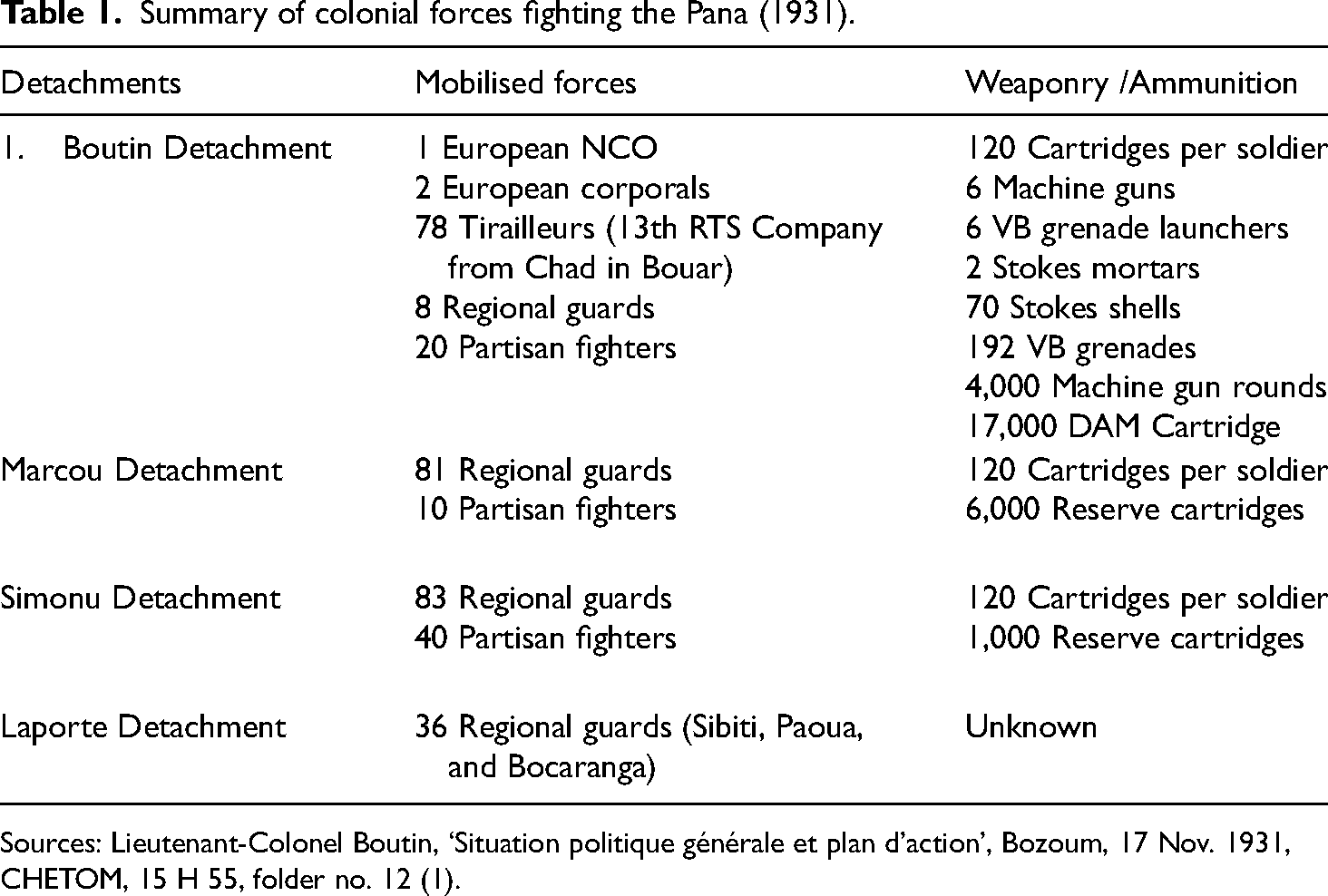
Sources: Lieutenant-Colonel Boutin, ‘Situation politique générale et plan d’action’, Bozoum, 17 Nov. 1931, CHETOM, 15 H 55, folder no. 12 (1).
In March–May 1931, fighting persisted and two further detachments were added. The first, the Laporte detachment, was a contingent of 36 regional guards whose objective was to chase down insurgents on the right bank of the Pende River while taking part in the fighting in Koudoye. 49 Under the command of Captain Nicloux, the second was a Cameroon colonial detachment of 100 riflemen stationed along the border. Their mission was to prevent insurgents and dissidents from crossing over from Ubangi-Shary into Cameroon. 50 Of note is the fact that the plan of action to take back control of resistant regions gives indications of the underlying logic of pacification, as well as the duties and movements of each detachment. Each of these military columns was tasked with two additional objectives: conduct reconnaissance of both dissident and loyal villages, and gather intelligence along the route to Tinade, from where the final assault against Mount Pana would be launched (See Map 2 -Map of pacification operations in the Pana mountains). 51
The first military detachment, led by Boutin, left Bouar on 21 January 1931, and was scheduled to arrive in Tinade on 5 February 1931. 52 The detachment generally marched during the day, along with legions of porters transporting food and equipment. Boutin was to gather information on the political situation in the region between Bouar and Ouantounou. The war diaries and mission reports tell of a significant number of interrogations and scouting expeditions, so many that in February 1931, a detailed report was issued. 53
The report indicates the Boutin detachment sought to identify existing bush camps, contact previously compliant chiefs and villages, and perform a headcount in the villages they encountered along the way. When the detachment passed through a village, such as Zaorolom or Zaoroboutou, 54 Boutin interviewed the chiefs and inhabitants, posing questions about the possibility of attacks, or barring that, of threats. 55 Additionally, he hoped to obtain information about other chiefs and villages, and learn what trails to take. He left informants to appraise the level of dissidence in some of the villages along the way. The detachment continued along the banks of the Nana Barya River to the Lim River, and on through the villages of Zaorolom, Zaoroboutou, Tegoum, and Ouantounou. Boutin sought information on the insurrectional movement as they marched, finally arriving in Zaorolim, where he met up with Lieutenant Marcou's detachment (See Map 3 - Populations affected by the War of Pacification in Haute-Sangha and Ouham-Pendé).
Marcou's detachment (the second) headed towards the Baibokoum Subprefecture in the Moyen-Logone region. His operations were to parallel those of Boutin, but begin in Baibokoum. Marcou gives a detailed account of his actions in his war diary. 56 His instructions had been to follow the road leading to a rendezvous point at Ouantounou, where he would meet up with Boutin and Nicloux, who led the East Cameroon detachment. He was also responsible for establishing a supply point in Bellaga-Pana and reporting on dissident activities in Cameroon's border villages. Additionally, as the villages along his route had purportedly been subdued, it was not his detachment's primary objective to restore peace and count the populations. His orders were to counter the insurgent offensives on villages such as Mann and Nzombu. After a few days’ march, he joined Boutin at Zaorolim, where a second food supply station was established. The two detachments then had the Zaorolim chief (whom they held captive) guide them to Tinade, where they arrived on the morning of February 4. 57
Lieutenant Simonu, head of the Paoua subdivision, took the third detachment out of Paoua to patrol the route in the Pende and Ereke valleys, moving through Bocaranga and then on to Tinade. 58 Like his counterparts, Simonu had several missions: before arriving at the Pana war front, he was to go through the villages, take the pulse of the population, and ensure its leaders remained loyal. He also took the opportunity to explore the mountain ranges and flush out dissidents lying in ambush. In his war diary, Simonu reports a number of abandoned villages, such as Bezere, Koumanguere and Koundjao, describing scenes of ‘desolation’ – burned or abandoned villages, large plantations left fallow, and relocated populations.
Consequently, Simonu's new objective was to find those who had laid waste to the region. 59 He focused primarily on the Simbal Mountains, where dissidents from the region were reportedly hiding, then swept the camps dotting the Sikoum Mountains. The first stage of his itinerary ended with his return through reputedly subdued territory and his arrival in Bocaranga. The detachment then followed the road from Bocaranga to Tinade, passing through the dissident village of Dahouane, which they found deserted. On 5 February 1931, they finally arrived in Tinade, their rendezvous point with Marcou and Boutin.
It is important to note that resistance to colonial advances came in several forms. In particular, the populations engaged in avoidance strategies, wherein indigenous communities relocated their villages to camps located in areas deemed inaccessible to military detachments. The strategy also included a refusal to comply with colonial economic and administrative demands, namely completing the census, building roads and trails, and paying the head tax. The acts of desolation Simonu referred to in his war diary, such as the burned villages and uncultivated fields, were in direct response to colonial military repression and the underlying state of war they initiated. They also indicate the insurgents’ resilience and dogged determination to fight colonial order.
Resistance, Siege Warfare, and the Long Road Towards ‘Appeasement’
Once the colonial detachments had gathered in Tinade, the pacification campaign against the Pana began in earnest. In the first days, they established a supply point and reconnoitred the surrounding area in search of insurgent bush camps. Then, on 9 February, they received explicit instructions to move on to Kelle, Ardo's village, using separate routes; they were to arrive by 13 February. 60 Simonu's detachment was the first to reach Kelle, on the morning of 13 February 1931, having made the trek via the Bakore Mountains. 61 They encountered only a few insurgent groups along the way and engaged in brief – though often brutal – skirmishes that generally resulted in the insurgents’ retreat.
Boutin's detachment had left Tinade the afternoon of February 9, but encountered no dissidents along the track they followed. Their chosen route was relatively short, but the terrain was arduous, some tracks poorly maintained or abandoned altogether. Despite their difficulties, they managed to rendezvous with Simonu at Kelle on the morning of 13 February. As the fighting was in open terrain, the detachments succeeded in forcing the insurgents to retreat deep into the rocky mountain caverns. The siege ended when an exploding shell tore through Ardo-Maybela, killing him instantly. 62
Still without news of Marcou, on 13 February, Boutin left Kelle to attempt to meet up with him. Meanwhile, Marcou's detachment had been following the Dô and Lim rivers. 63 Attacked repeatedly by Pana warriors once in the mountains, Marcou nevertheless managed to besiege the caves in which the insurgents were firmly entrenched. Marcou had the villages they passed torched, seizing the harvests from plantations in Gouboue, Dagapaye, and Kousseg to feed the soldiers. He arrived at Mount Kelle on 15 February, lingering there for a day, hoping to meet up with Boutin. But with no word, Marcou left for the Pana peaks, where he finally joined Boutin a few kilometres from his destination. 64
In an account of the repressive campaign Boutin had led in the Pana Mountain stronghold, Boutin claimed to have denied the strategic capabilities of the insurgency. He attributed the difficulty he had in routing the Pana to the difficult terrain that had provided the insurgents with cover.
65
La grosse force des dissidents résidait surtout dans les difficultés d’accès et de parcours de leur pays chaotique; partout des rochers, des pics, des montagnes, des vallées encombrées d’éboulis, de pierre de granit … Parfois aussi comme à Koudoye ou Kounpana, c’était la montagne elle-même qui était creusée d’ouvertures, de conduits souterrains communiquant entre eux, des couloirs resserrés aboutissant à des sortes de salles enfoncées loin sous terre.
66
While the archives contain only furtive, laconic records of Pana activity, we can nonetheless take the measure of their methods and strategies on the battleground. Lieutenant-colonel Boutin's report denies the insurgents any agency of their own, yet the ingenuity with which the insurgents deployed their resistance tactics and strategies clearly demonstrates this. In fact, the insurgents forced the military to wage complex mountain warfare of sieges. The Pana subjected colonial detachments to repeated, sporadic attacks as they moved into the mountains – mountains which provided cover for the rebels to virtually disappear into the ether as their enemy advanced, fouling attempts at counterattacks. The Pana also posted lookouts along the routes, learning the composition of the detachments, their firepower, and the situation on the ground. The insurgents’ tactic of melting away after sporadic hit-and-run attacks evolved after the capture of Kelle, and Ardo's violent death (see Map 2- Map of pacification operations in the Pana mountains).
The Pana resistance shifted to the mountain fronts, then into the cave tunnels and underground caverns the insurgents had previously prepared to accommodate the non-combatant population (old men, women, and children) and store food to support the upcoming siege war. They began to counter the attacks from approaching colonial tirailleurs, regional guards, and partisan fighters with volleys of assegais and poisoned arrows. The military reports and war diaries also record numerous cases of insurgent attacks from the rear. The reports made only brief, passing mentions of the attacks. Nevertheless, they give ample evidence that the Pana were determined to break the mountain siege.
Boutin's account of the severe wounds inflicted on his men is an equally clear demonstration of the insurgents’ resilience. 67 In one instance, Corporal Tirailleurs Ala Takadjinam and Daye Gakouto suffered multiple leg wounds from assegais during attacks at Touga, Omebo, and Koudoye. Two of his partisan fighters, Bele and Abba, also received arrow wounds near the mouth and suborbital regions in battles at Omebo, Touga and Kelle. 68
In particular, the reports bring to light the constant dread of potential night attacks that haunted patrol leaders and detachment commanders alike. Their obsession is undoubtedly what motivated them to array their troops systematically in square formation each night. Yet, though the war diaries and military reports recorded their own combat tactics in minute detail, they were quick to downplay insurgent strategy, employing sanitised terms such as ‘nettoyage’ and ‘assainissement’ when referring to their mountain operations. 69 Underlying the euphemistic turns of phrase is extreme violence and armed repression, pointing to a veritable policy of extermination.
Characteristic of the violence used was the use of artillery fire and machine guns – against arrows and spears – and tactics such as encirclement, cordoning off the mountain passes, and flushing the underground tunnels with smoke, which proved particularly deadly. The insurgents’ resilience and the mountainous terrain provided justification for the war of extermination, a rationale for reestablishing colonial order in the Pana Mountains. Exterminating the rebels became the sine qua non of ‘civilising’ the indigenous population. Begun in mid-February 1931, the war ended around May 2 as the insurrection died out and thousands of Pana surrendered. The Marcou detachment was dispatched to Touga and remained stationed there. Boutin's and Simonu's troops left the mountains, setting out in the direction of Kounan, then heading for Bocaranga. 70
It is difficult to estimate the overall casualty toll as the military reports provide inconsistent figures. In their reports on the military operation against the Pana, colonial officers in charge of restoring order remained silent as to the exact number of insurgents killed, couching the number of losses in vague terms such as ‘quelques centaines d’individus’ and ‘lourdes pertes’. Their language suggests a reluctance to upset the federal and metropolitan political authorities to whom they reported. Perhaps listing the number of indigenous fatalities would have been viewed as a failure of the colonial state. The reports clearly enumerate the number of wounded tirailleurs, regional guards, and partisan fighters, their respective ethnic groups, and any acts of bravery during their engagement. The mentions were meant to highlight their zeal and dedication, and justify the military distinctions they were awarded at the end of the military campaign. 71
There were two motivations for highlighting the colonial officers’ acts of bravery. The primary motivation was to focus attention on their strategic and tactical acumen in overcoming such fierce, dogged resistance. Moreover, it justified the military distinctions they were awarded. The recapture of the Pana Mountains and conclusion of the violence paved the way to a new phase of appeasement and compromise. Lieutenant-Colonel Boutin believed an estimated 15,000 of the 20,000 individuals in the region had been brought to heel. Naturally, his numbers are highly problematic – census figures were incomplete, but more importantly, there was no clear benchmark for judging Pana submission. Furthermore, many of the indigenous population who had voluntarily moved their villages to escape military repression had since capitulated to the Ouham-Pende colonial authorities, who made sure to relocate them to areas they could more readily police. Finally, colonial authorities had pressed forward, ‘clearing and sanitising’ the mountains of dissidents, forcibly resettling several Pana communities in strategically preferential areas.
Considering these facts, the details of the 1931 report on the political situation in Ubangi-Shary, which included the district of Ouham-Pende, are particularly disturbing. The report refers to a defeated but submissive population, brimming with ‘docilité et d’ardeur au travail qui se sont manifestés par l’ouverture de grandes pistes, construction de villages, plantations vivrières étendues etc.’
72
We can extrapolate from these words that, above all, the period of appeasement and compromise following open warfare was not free from the constraints and coercion of the colonial yoke. Boutin, for one, expressed doubt that the Pana had definitively been conquered. In his report on the general political situation in the region – supposedly ‘en cours de pacification’ – he wrote, Maintenant qu’ils (les Panas) sentent que nous sommes en force, ils obéissent (certains) et descendent dans la plaine, dès que nous serons partis, peut-être retourneront-ils dans leurs montagnes. Ce fait ne pourra être empêché que par l’envoi de fortes patrouilles (30 à 40 fusils), après la dislocation de nos détachements, de façon que l’indigène sente toujours et dès le début notre autorité…
73
Conclusion
In a report, Lieutenant-Colonel Boutin claimed that Ardo-Maybela, the main instigator of the Pana insurgency, had justified pillaging indigenous populations subject to colonial authority by the need to defy the military and ‘fâcher le cœur des blancs’. 74 The expression is symptomatic of the long, drawn-out resistance the Pana had demonstrated since the end of the nineteenth century, first to German colonialism, and then under the French colonial yoke. Ardo's messianism further championed the virtues of Pana autonomy, and a return to the old order, galvanising the insurrectional movement to subvert colonial dominion. Ardoism fuelled the Pana's will to articulate various forms of resistance, ranging from avoidance and insubordination to armed uprisings.
Despite what we now understand of the Pana resistance to colonial domination, there is still a glaring need for further, in-depth studies. Incorporating the Pana perspective by documenting oral histories and comparing these oral sources with official colonial archives will undoubtedly also enhance the interpretation of issues relating to both resistance and ‘pacification’ wars. African messianisms such as Kibanguism and the Mau Mau movement remain etched onto collective memory, yet the anti-colonial resistance of the Pana and their Baya neighbours has faded or even been forgotten. 75 Efforts to ‘pacify’ Pana territory throughout its occupation can ultimately be seen as a perpetual colonial war of conquest. ‘Pacification,’ constantly being called into question, is colonialism's unremitting attempt to dominate through repressive violence.
Supplemental Material
sj-pdf-1-wih-10.1177_09683445251328409 - Supplemental material for ‘Fâcher le Cœur des Blancs’: Mboum/Pana Resistance During the War of Pacification in Colonial Ubangi-Shary (1929–1931)
Supplemental material, sj-pdf-1-wih-10.1177_09683445251328409 for ‘Fâcher le Cœur des Blancs’: Mboum/Pana Resistance During the War of Pacification in Colonial Ubangi-Shary (1929–1931) by Patrick Dramé in War in History
Footnotes
Funding
The author disclosed receipt of the following financial support for the research, authorship, and/or publication of this article: This work was supported by the Social Sciences and Humanities Research Council of Canada, (grant number 776342). This paper is the result of a research project entitled: Controlling, repressing and monitoring in a colonial situation in the territory of French Ubangi-Shary (1919–1958). This research project was funded by the Social Sciences and Humanities Research Council of Canada (SSHRC). The Insight Grants have been awarded for the period 2018–2023.

Supplemental material
Supplemental material for this article is available online.