




Abstract
This article explores the portrayal of Royal Navy submarines, their crews, and depot ships in the Illustrated London News during the Second World War. Through an examination of this newspaper, it argues that Britain was shown to have a technologically advanced and potent submarine service. The coverage in the ILN was not only partly didactic but also reassuring, demonstrating to the newspaper's readers that Britain and its allies were capable of winning the war. The ILN was thus a conduit through which the nation's morale could be boosted by helping to instil a sense of pride and confidence in the country's submarine service's capabilities.
Introduction
This article considers how Royal Navy submarines and submariners were portrayed to the public in the Second World War through an analysis of articles published in Britain's foremost weekly illustrated newspaper of the time, The Illustrated London News (hereafter ILN). In reporting on the exploits of the submarine service, the ILN, like The War Illustrated magazine during the First World War, followed a tradition of using a popular media publication to inform the British public of its role in wartime. 1 However, in keeping with the ‘People's War’ ethos of the latter conflict, greater attention was now paid to the service's personnel. 2 Both submarine and submariner were thus adopted as ideal subjects for ‘popular media representation’. 3 Throughout the conflict, when newspapers provided the public with a major source of information about the war's conduct, British society was actively encouraged to ‘read for victory’. 4 The ILN was just one of many publications from which the British public, encouraged to use their leisure time wisely and for the benefit of the war, could become better informed about the conflict. Within the pages of this popular newspaper, readers could learn about the effectiveness of the submarine service, including Royal Navy submarine warfare technology, submarine operations and even submariners’ conditions when serving, reflecting Jan Rüger's maxim that naval culture is ‘an inherently political arena’. 5
The ILN, which was launched in 1842 as the world's first weekly illustrated newspaper, continued to publish weekly during the war. Only two weeks into the conflict the newspaper added the pledge ‘The War Completely and Exclusively Illustrated’ to its cover page masthead, thus alerting its readers to the fact that its coverage was not only comprehensive but appealing. 6 Through the use of drawings, engravings and photographs the ILN depicted national and international events to its readers, commissioning a team of contributors, including the renowned historian Arthur Bryant, who wrote the leader column ‘Our Note Book’, to write features, essays and commentaries on the conduct of the war. While the full breadth of the newspaper's readership is unknown, judging by the price and the advertisements for luxury goods on the first few pages it seems reasonable to suggest that it was targeted at the more affluent reader. 7 Indeed, Reba N. Soffer described the newspaper's readership as ‘aspiring, literate, middle-brow, middling, and upper-class’. 8 That said, it was regularly made available in the country's public libraries, thus ensuring a wider circulation and potential readership than its cover price would suggest. 9 Moreover, its highly illustrated form meant it could appeal to readers both young and old, affluent and less privileged, as well as the less well-educated. Indeed, Bryant himself recalled that his ‘greatest happiness’ as a child was reading the ILN while laid on the floor of his father's library. 10
By moving away from traditional naval history scholarship on the submarine that sat within what Quintin Colville and James Davey have described as a largely ‘self-contained world’ primarily focusing on ‘issues of warfare, command and leadership, strategy and tactics, technology and weaponry’ and aligning with ‘new naval history’ approaches by scholars such as Jonathan Rayner and Duncan Redford, this article will explore the didactic role the ILN played in presenting the submarine service and its personnel to the British public in wartime. 11 In doing so, it will argue that the newspaper's readers were educated about the role of the service in order to aid their understanding of, and influence their attitude towards, the contribution of Royal Navy submarines and their personnel to the war effort. It will demonstrate that the newspaper's portrayal of the service focused on its technological superiority, accentuated the positive aspects of life at sea and ashore to enhance the attraction of the service to possible recruits, suggested that those who were selected to serve were exceptional, both physically and morally, and played down the reporting of the service's losses during the war to reassure readers. In the context of the ‘People's War’, this attempt by the ILN to get the public onboard was extremely significant and reveals the important role that cultural objects, like newspapers, played during the conflict.
Rüger has argued that in periods when a country's ‘relative command of the sea’ was contested, there was often a resultant upsurge in how its Navy was ‘asserted symbolically’. 12 The increased representation of the submarine service in the ILN during the Second World War, then, is a result of the threat posed to the nation during that conflict. Significantly, unlike in the First World War, when, as Rayner has shown, there was much ambiguity in how Royal Navy submarines were presented in The War Illustrated magazine, in the Second World War the ILN gave an overall more consistently positive impression of the submarine's wartime capabilities. Naval historians Ralph Harrington, Rüger and Jayne Friend have, in recent years, explored the symbolic role that Royal Navy ships have played, examining, respectively, the battlecruiser HMS Hood, Dreadnoughts in the Edwardian period, and the destroyer in the interwar period. 13 This article's evaluation of the cultural role played by the submarine service in the Second World War will add to this body of scholarship, further underlining the importance of naval culture in helping to reinforce the status of the Royal Navy as a heroic institution.
Methodology
The primary research methodology for this article was a qualitative approach involving identification, retrieval and close reading of ILN articles clearly designed to inform the public about submarine warfare. However, in the initial stages of the research, the extent of British newspaper reporting about submarine warfare was examined at a high level based on common keyword searches. 14 The results from this search are shown in Figure 1. The data clearly show that trends in the frequency of submarine-related reporting were similar between the ILN and a number of other major newspaper titles before, during and after the Second World War. Reporting peaked in 1942 and declined markedly after 1943, reflecting the Allies’ increasing dominance at sea in both the Mediterranean and Atlantic theatres.
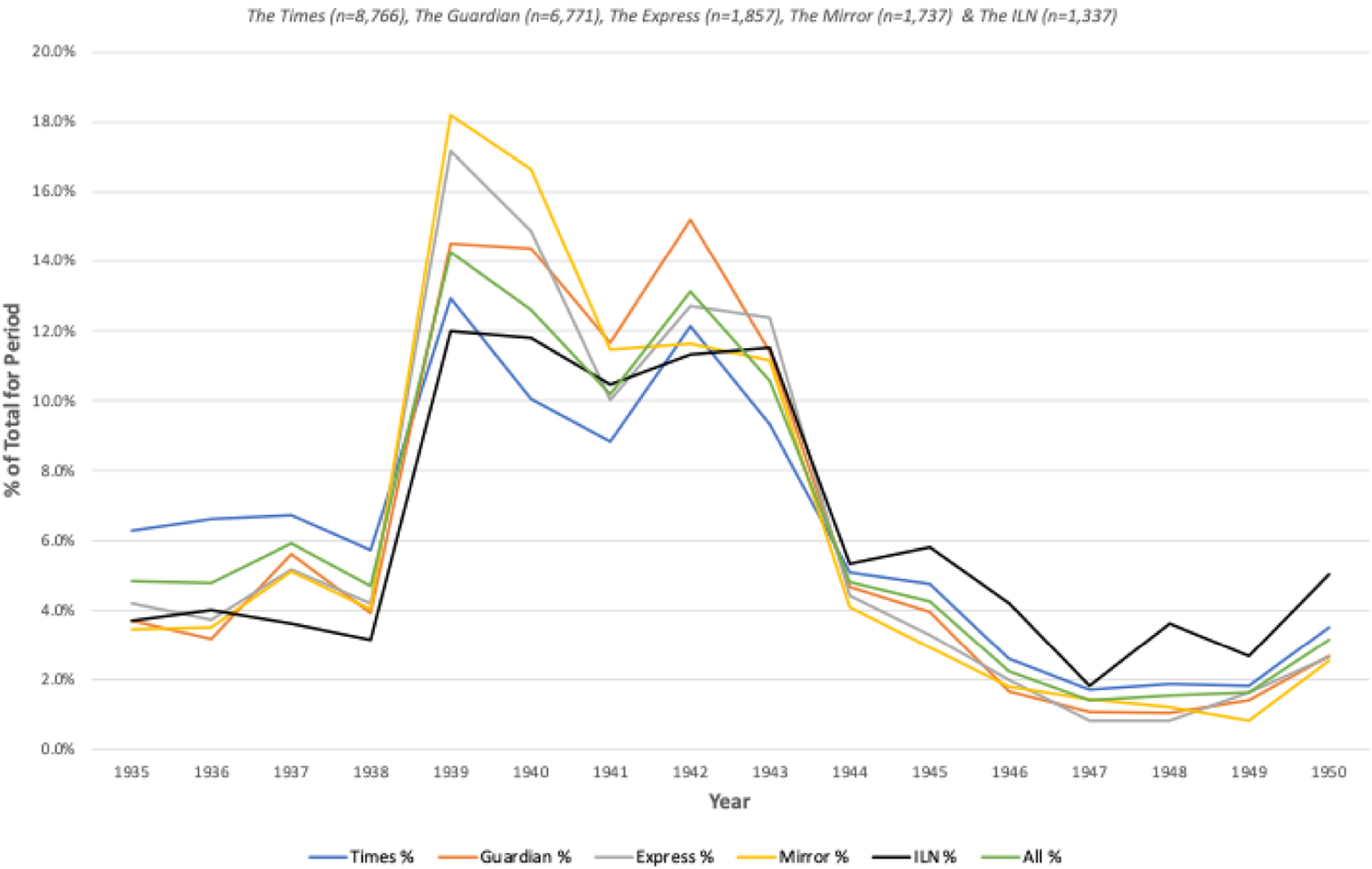
References to Submarines and Submariners in Selected Newspapers, 1935–1950.
In the detailed analysis of the content of the ILN's coverage of submarine warfare, a total of 1,003 unique articles were identified for the period 1939–1945. A sample of 387 (38.58%) were selected for close reading based on the requirement that the keywords were part of an ILN image caption or narrative or an article title. This represented the complete set of such articles. Dominant themes as far as Royal Navy submarine warfare were concerned were operations (58% of articles), submariners (38%), and technology (37%). 15 Research interest in this article focuses primarily on the ILN's illustrated reporting of RN submarine technology and personnel.
It is important to emphasise that all newspaper reporting was subject to censorship during the Second World War. 16 Of course, the ILN based its reporting around imagery, and many of the illustrations based on Admiralty reported events were proprietary. However, no evidence was found of any special relationship between what was reported about submarine warfare in the ILN and the Admiralty. Newspapers would often develop their articles based on the same officially released and approved material. The Admiralty's efforts to publicise the submarine service are therefore likely reflected in the general patterns of newspaper reporting seen in Figure 1. Overall, the levels and nature of the reporting observed strongly suggest that, as far as reporting of submarine warfare is concerned, the ‘Silent Service’ was perhaps not as silent as the moniker suggests.
Submarine Technology
The Second World War represented a departure from previous Admiralty doctrine regarding the use of submarines in wartime. In the years after the submarine's initial development, the Admiralty dismissed the craft as ‘the weapon of the weaker naval powers’. 17 However, the relative success of submarine warfare during the First World War gradually encouraged the Admiralty to view the craft as both proficient and reputable. This signified a marked change in both Admiralty and public attitudes towards submarine and submarine warfare from one of initial resistance to one of acceptance. Therefore, from the start of the latter conflict, the submarine was identified as a legitimate means from which to conduct naval military warfare. 18 This shift was reflected in the representation of the submarine service in the media, including in newspapers such as the ILN. In this section, where the ILN's portrayal of submarine technology will be evaluated, it will be argued that the ILN served a valuable didactic purpose in wartime by furnishing its readers with accurate descriptions of the principal aspects of submarine technology, at least to a level sufficient enough for them to grasp the fundamentals of the nature of submarine warfare and the British navy's capabilities for conducting it.
The Admiralty's initially ambiguous relationship with the role of the submarine in naval warfare can be witnessed by the less than positive representations of submarine technology in the ILN in the months leading up to the start of the Second World War. The pre-war coverage of Royal Navy submarine technology was primarily prompted by accidents, such as when the newspaper covered the sinking of USS Squalus on 23 May 1939 and HMS Thetis just one week later. 19 USS Squalus had suffered flooding, causing it to sink during diving trials, leaving 23 crew members dead. 20 HMS Thetis, meanwhile, a newly built submarine of the T-class design, was also performing diving trials when it sank due to flooding through the accidental opening of a torpedo hatch. Only four men escaped, using the Davis Submerged Escape Apparatus (DSEA) equipment, while others remained trapped inside the submarine when the escape chamber became defective. 21 Due to the timings required for printing, the next edition of the ILN, published just two days after the Thetis tragedy and on the very day that rescue attempts were abandoned, made no mention of it. In contrast, the comparatively successful rescue of 33 crew members from the Squalus the day after it sank was celebrated on the front page with a collection of photographs showing different aspects of the rescue operation, including the equipment used and how it worked. 22 To provide context for the public, the following three pages carried photographs from inside an L-class submarine with the accompanying narrative drawing attention to the fact that British submarines were equipped with DSEA. ‘This method’, the article noted, ‘enables the crew to escape through special hatches, wearing respirators attached to oxygen cylinders, the buoyancy of which rapidly carries them to the surface’. 23 A week later, as part of the ILN coverage of the Thetis disaster, how the escape process worked was illustrated using a cutaway diagram of a submarine lying on the seabed together with the sequence of steps for using an escape lock. 24
The loss of HMS Thetis instigated a Tribunal of Enquiry, which commenced on 3 July 1939 and reported on 31 January 1940, leading to further pictorial coverage in the ILN of submarine escape technology. 25 On 15 July 1939, for example, a series of annotated drawings (Image 1) depicted how Royal Navy submariners were trained in the use of the DSEA in specifically designed practice tanks. 26 In addition, a range of new safety measures that had been mentioned at the Tribunal was also portrayed in the ILN under the reassuring heading ‘Modern Submarine Provided With Suggested Life Saving and Salvage Devices’. 27 It is of interest to note that comparisons with German and Italian submarines were also made. On 5 August 1939, for instance, a sequence of photographs illustrated the German Navy's use of escape methods, while a series of drawings approved by Italian Naval Authorities depicted the techniques used by Italian submarines. 28 The similarities of the various breathing devices between all of the navies’ submarines were emphasised, seemingly to reassure the readers of the newspaper that British submarine escape technology was as good as that used elsewhere. Nonetheless, it can be assumed that the pre-war portrayal of the Thetis tragedy would have left readers of the ILN understanding that the chances of escaping from a stricken submarine were minimal, leading to a possible detrimental effect on recruitment. It is not surprising, therefore, to find that at the outbreak of the Second World War, the ILN switched focus to other aspects of submarine warfare technology.
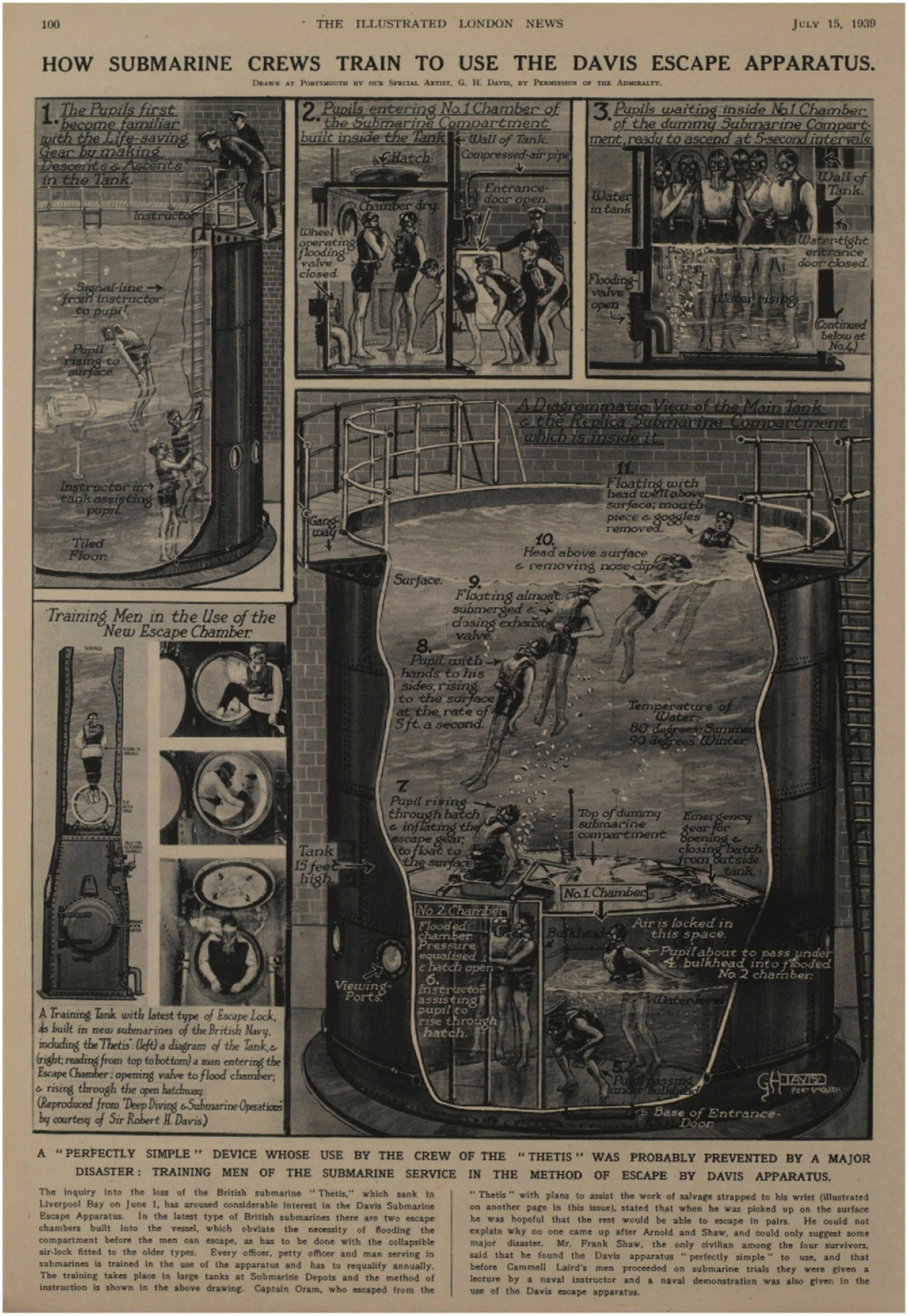
15 July 1939 ‘How Submarine Crews Train to use the Davis Escape Apparatus’. Used with permission.
In wartime coverage of submarine technology, the emphasis was on ‘Britain's Power at Sea’. 29 The first diagrammatic drawings appearing in the ILN of a British submarine type that actually saw service in the Second World War were not in fact published until 24 April 1943, when they featured in a series of three illustrated articles explaining different aspects of T-class submarines, one of the most common types used by the Royal Navy during the conflict. 30 Significantly, in terms of illustrating the service's might, the first in the series was a large annotated sectional drawing showing the ‘machinery, torpedoes, fighting gear and living quarters of a T-class submarine, together with a smaller, external “broadside view”’ (Image 2). 31 For these, and the other drawings in the series, it was claimed that they were based on sketches made on board a T-class submarine, by permission of the Admiralty, although no indication was given about which specific submarine was involved. Three variants of this type of submarine were produced and many were subsequently modified in the light of wartime experience and needs. 32 The narrative accompanying the sectional drawing guided the reader through the vessel starting from the steering compartment aft and ending in the forward torpedo compartment. The general construction, machinery and accommodation were explained, complementing the diagram's annotations. However, the distinctive feature of this series of drawings, when compared to the previous diagrammatic representations of the submarine found in the ILN, are the two pages that included depictions of the fighting tactics involved in using the submarine's gun and attacking targets with torpedoes. The sequence of events for a surface gun action is represented in five drawings starting with the detection of unescorted enemy supply vessels by periscope and ending with their destruction and the submarine diving, successfully evading the subsequent attentions of hostile aircraft. The action is depicted as taking place against ships supplying Axis forces in North Africa ensuring that, to quote from the accompanying narrative, ‘yet another batch of supplies will never reach the hard-pressed enemy forces in Tunisia’ (Image 3). 33 The article also noted that: ‘It is in the Mediterranean, in particular, that our submarine commanders have won fame for their gunnery exploits’. 34 The message was again one of superior technology and heroic efforts to attack enemy supply lines.
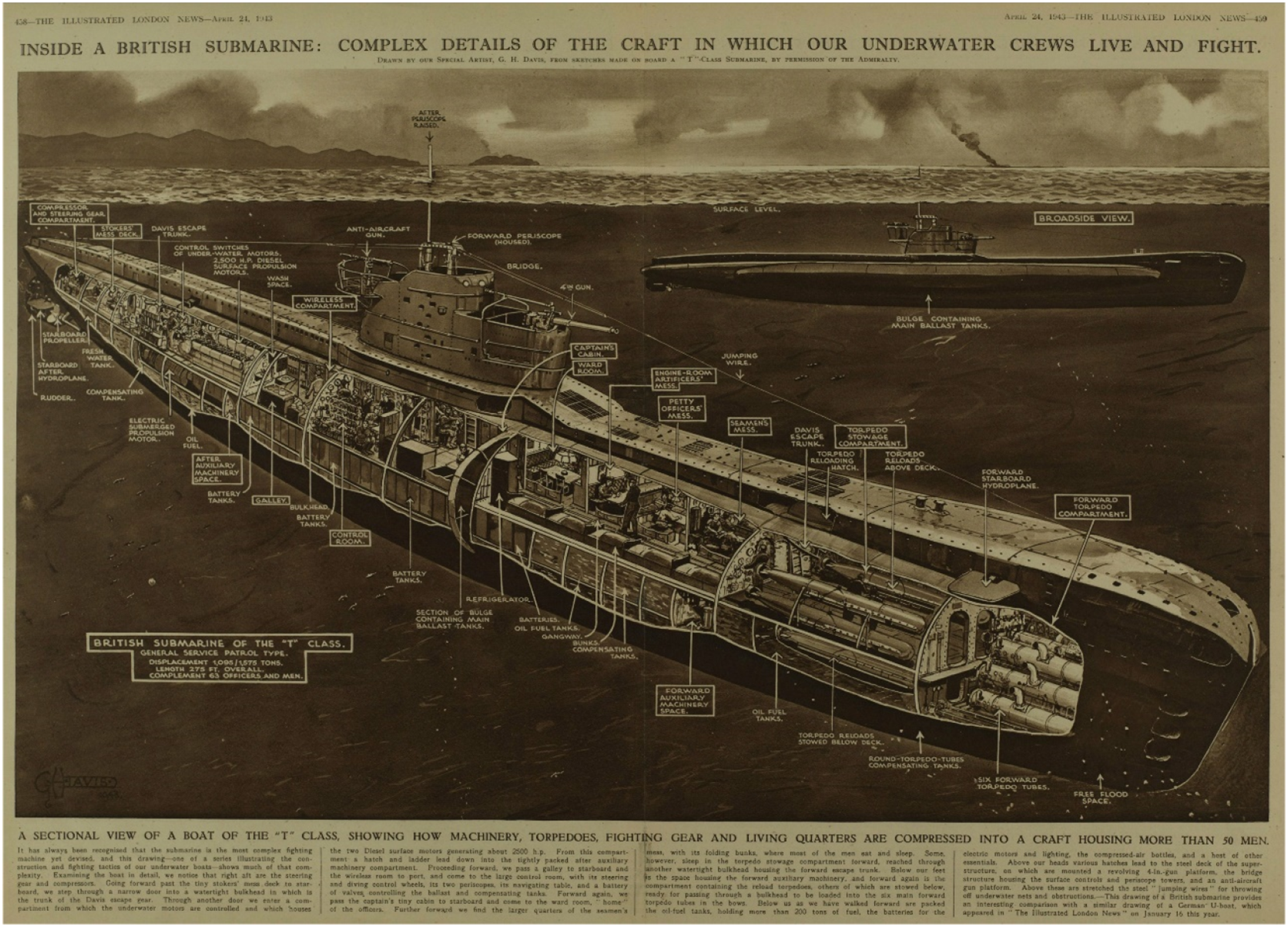
24 April 1943 ‘Inside a British Submarine: Complex Details of the Craft in Which Our Underwater Crews Live and Fight’. Used with permission.
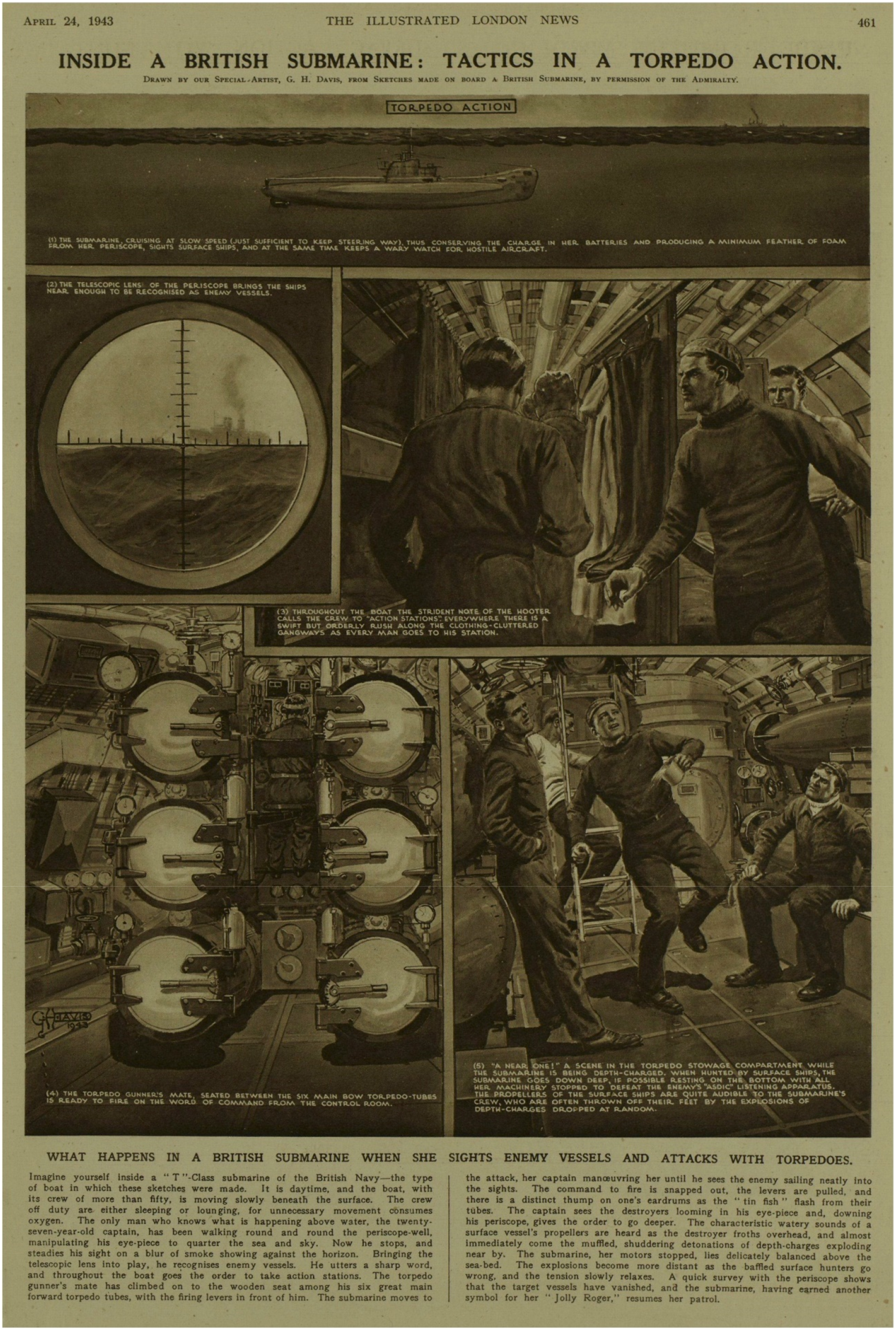
24 April 1943 ‘Inside a British Submarine: Tactics in a Torpedo Action’. Used with permission.
To further demonstrate the strength of the service, the principal weapon used by Royal Navy submarines to destroy enemy shipping – the torpedo – also regularly featured in the newspaper. This same feature article from 1943 asked the question ‘What happens in a British submarine when she sights enemy vessels and attacks with torpedoes?’. 35 An answer was provided in the form of a sequence of five captioned drawings showing views of a target through the periscope, men moving to their stations for an attack, the forward torpedo compartment containing the six internal torpedo tubes and members of the crew being thrown about during a counter-attack by depth charges. Although the article purports to depict the ‘tactics in a torpedo attack’, it did not address important questions such as how the submarine was directed to the location of the enemy, the protracted process of estimates and calculations required to arrive at a torpedo firing solution, or the mechanics and potency of the torpedo itself. It was evidently not important, or permissible, to give the reader a detailed description of tactics to portray the overall message of superior technology. Whilst no articles in the ILN gave the public information about the role of intelligence or the use of the British torpedo data computer, torpedo technology had been explained to the public during the early weeks of the war, prompted by the losses that the weapon had already inflicted on major British warships and merchant vessels. 36 While, in that November 1939 article, the specific make of torpedo forming the basis for the illustration was not stated, the details provided make it consistent with the most commonly used variant employed by the Royal Navy during the war, the Mark VIII 21-inch torpedo. 37 In addition to a clear diagrammatic explanation of the workings of a torpedo, the accompanying narrative emphasised the complexity of the weapon and the concomitant high cost: ‘as much as a very expensive motor-car’. This comparison provided the newspaper's readers with information that served to make the cost of a torpedo highly relatable. Although the article drew attention to the basic economics of torpedo warfare, it did not explain the complexities associated with a torpedo attack such as deciding on how many torpedoes to fire, determining the moment to fire, and the likelihood of success. This too was deemed unnecessary, or prohibited, information for the reader. The simple overall message of state-of-the-art superior technology was evidently paramount.
The torpedo and gun were not, of course, the only weapons used by submarines to attack enemy warships and supply vessels. Although a number of types of submarines were capable of laying mines, some were developed specifically for that purpose. The Porpoise-class of minelayers consisted of six submarines of which only one, HMS Rorqual, survived the war. 38 It was the Rorqual that featured in the most detailed explanatory drawing of a Royal Navy submarine to be published by the ILN during the conflict. It contained one external and three internal sectional views containing eighty-eight annotations of the submarine's layout and equipment. 39
The likely purpose of the portrayal of submarine technology in the ILN during the war, then, was to give readers an overall impression of the service's superiority. It highlighted a distinct advantage for Britain and the Allied powers, rather than providing a detailed and accurate description of that technology and its strategic uses. The importance of the messages portrayed is clear. They had a role in informing the public about submarines and explaining how they worked, but the underlying message delivered was that Britain had superior technology, substantial and tested safety procedures, and, as will be shown next, well-trained crew. Britain, it was suggested, had an advantage in submarine warfare, had celebrated a number of key successes, and was capable of winning the war. The messages were, therefore, partly about education and information, but undoubtedly, also partly about boosting morale and instilling a sense of pride and confidence in Britain's submarine warfare capabilities. 40
Royal Navy Submariners and Submarine Life
As well as portraying Royal Navy submarine technology as superior, the ILN also presented the personnel who worked for the service in a commanding light. In both pre-war and wartime editions of the newspaper, submariners were presented as an elite group of individuals who were mentally and physically strong. For example, in one pre-war article that illustrated the living conditions on board a submarine, the accompanying narrative portrayed submariners as ‘picked men, for on their efficiency depends the safety of the vessel’.
41
Two months into the war the newspaper again emphasised the distinctive qualities required of the submariner, stating that the ‘cramped existence inside one of these vessels’ called for ‘mental alertness and physical perfection’ because ‘the safety of all depends on each member of the crew’.
42
A few years later, in June 1942, another article that focussed on the living conditions submariners had to endure while onboard once again served to set them apart from others who served in the navy (Image 4): Submarine crews are picked men, and although it is said to be the most dangerous of all the Services, there is keen competition among officers and men to enter it. Existence is undoubtedly cramped inside these vessels, and conditions call for mental alertness and physical perfection, as opportunities for recreation are restricted; but despite these drawbacks the submarine is a miracle of the builder's ingenuity, and the officers and crew enjoy the maximum amount of comfort possible.
43
27 June 1942 ‘Life in a Submarine: Men of the Royal Navy Whose Gallant Work is an Outstanding Feature of the War’. Used with permission.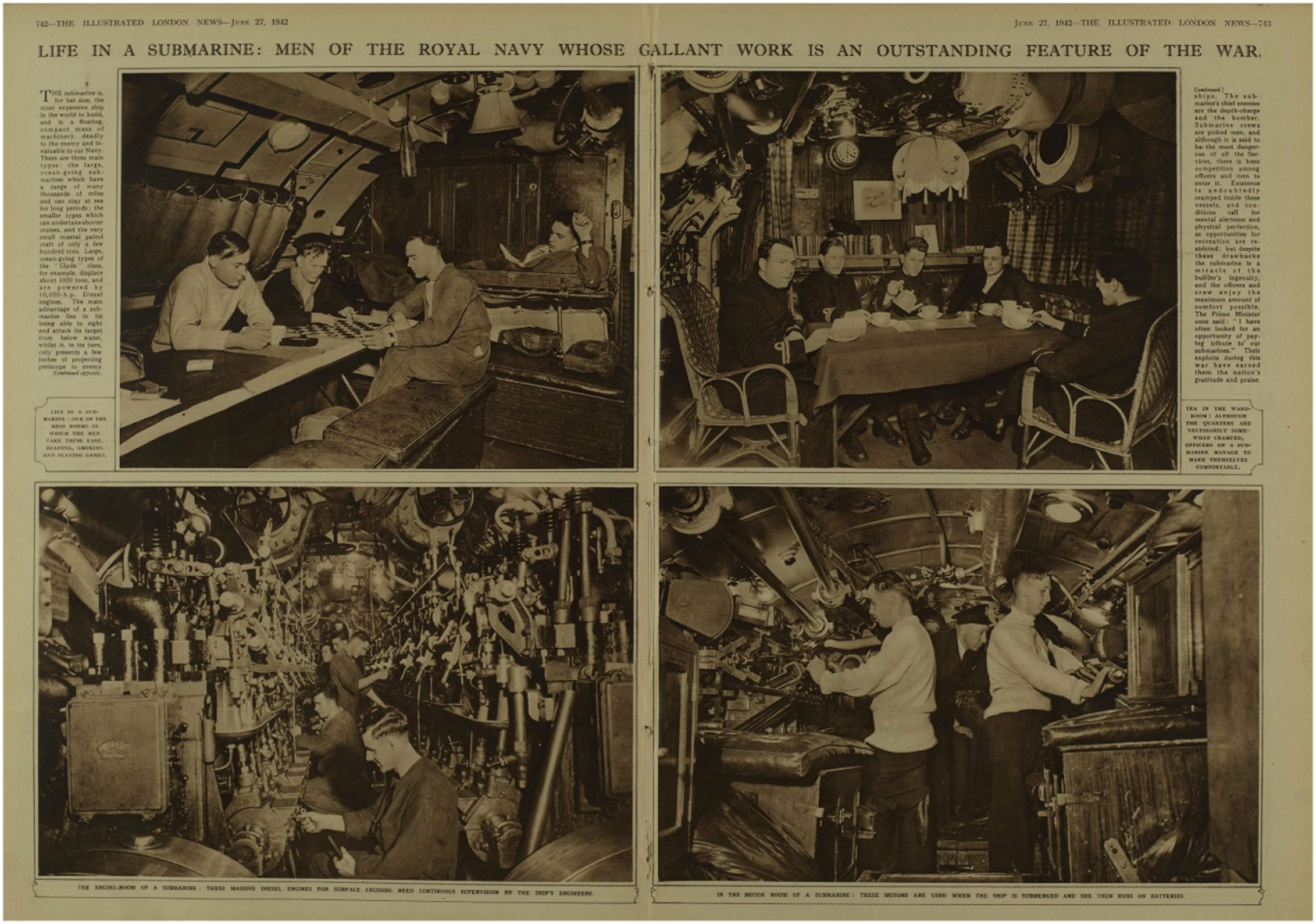
The depiction of the submariner as an elite character was reinforced in the ILN through its celebration of those personnel who were awarded the Victoria Cross. 44 During the war, five submariners who served in conventional submarines were awarded the medal, all for exploits in the Mediterranean. 45 The newspaper's recording of their achievements was predictably praiseworthy, particularly regarding those who survived to receive their awards in Britain. 46 Using captions such as ‘A Deed of Cold-Blooded Gallantry’ and ‘Extraordinary Exploits’, the ILN reminded its readers that the service was an extremely hazardous one in which only exceptional men operated (Image 5). 47 The numerous depictions of the Jolly Roger flag, which became emblematic of the collective accomplishments of submarines and their crews, also reinforced the submariner's special identity during the Second World War. The deployment of the flag for symbolising successful actions, which dated back to the First World War, was first used in the latter conflict by HMS Osiris following successful attacks carried out in the Mediterranean in 1940. 48 Thereafter, the practice became widespread, and the Admiralty began to produce and approve photographs for publication by newspapers. The service's use of the Jolly Roger success flag was first publicised by the ILN in an article published in early 1942 announcing the achievements of two submarines returning to Britain from Mediterranean deployments (Image 6). 49 The images reproduced in the article, which depicted members of the crews of HMS Talisman and HMS Utmost displaying their Jolly Roger flags, were actually official Admiralty photographs. 50 The ILN's reproduction of these images implies that the Admiralty became willing to accept the use of the Jolly Roger by submarine crews as symbols of their achievements and to sanction the use of images of them for publicity purposes. Indeed, similar images were deployed throughout the rest of the war, serving to demonstrate the submariners’ ability to succeed under extreme conditions. 51
Interestingly, while the ability to tolerate the living conditions on board submarines was a key aspect that the ILN emphasised, marking out the submariner as a cut above other seamen serving in the Royal Navy, the highly restrictive and uncomfortable nature of them was generally played down in the newspaper's coverage. On 1 April 1939, for example, the ILN used its regular ‘Britain's Power at Sea’ series to illustrate the different aspects of the living conditions on board an H-class submarine (Image 7). Through a series of six drawings the limited accommodation on board was mentioned with the note: ‘The highly complicated mechanism of a modern submarine imposes definite restrictions upon the living conditions of her personnel when at sea, whether it is of the “Patrol”, “Ocean-going”, “Minelaying”, “Sea-going” or “Coastal” type’. 52 However, the drawings themselves actually portrayed a sense of ample space rather than unduly cramped conditions. That the escape hatch was highlighted in one drawing also provides reassurance to readers that the crew had a chance of rescue should things go wrong, thus reinforcing the quality of technology on board as well as indicating what life on board a submarine was like.
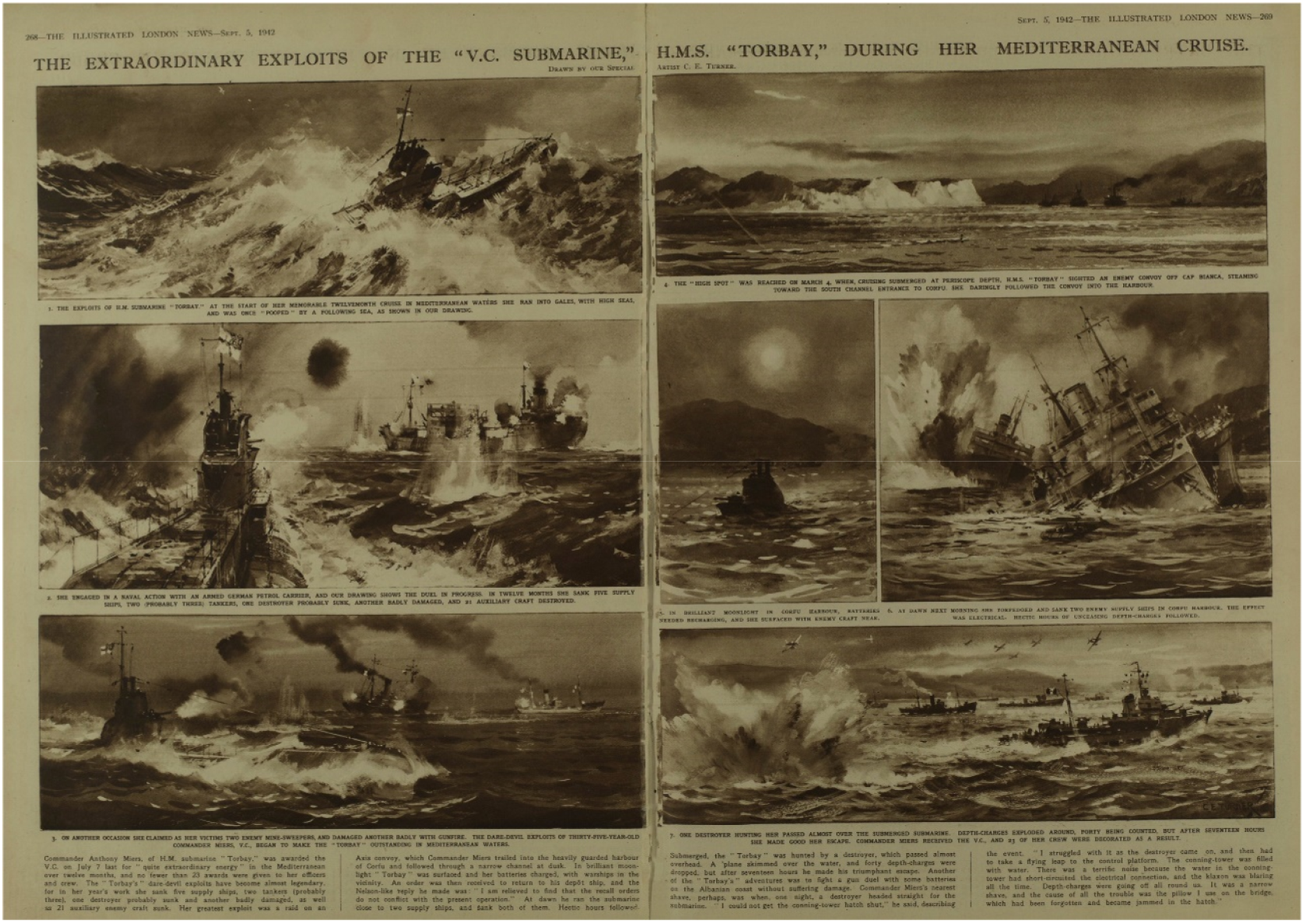
5 September 1942 ‘The Extraordinary Exploits of the “V. C. Submarine”, H. M. S. “Torbay”, During Her Mediterranean Cruise’. Used with permission.
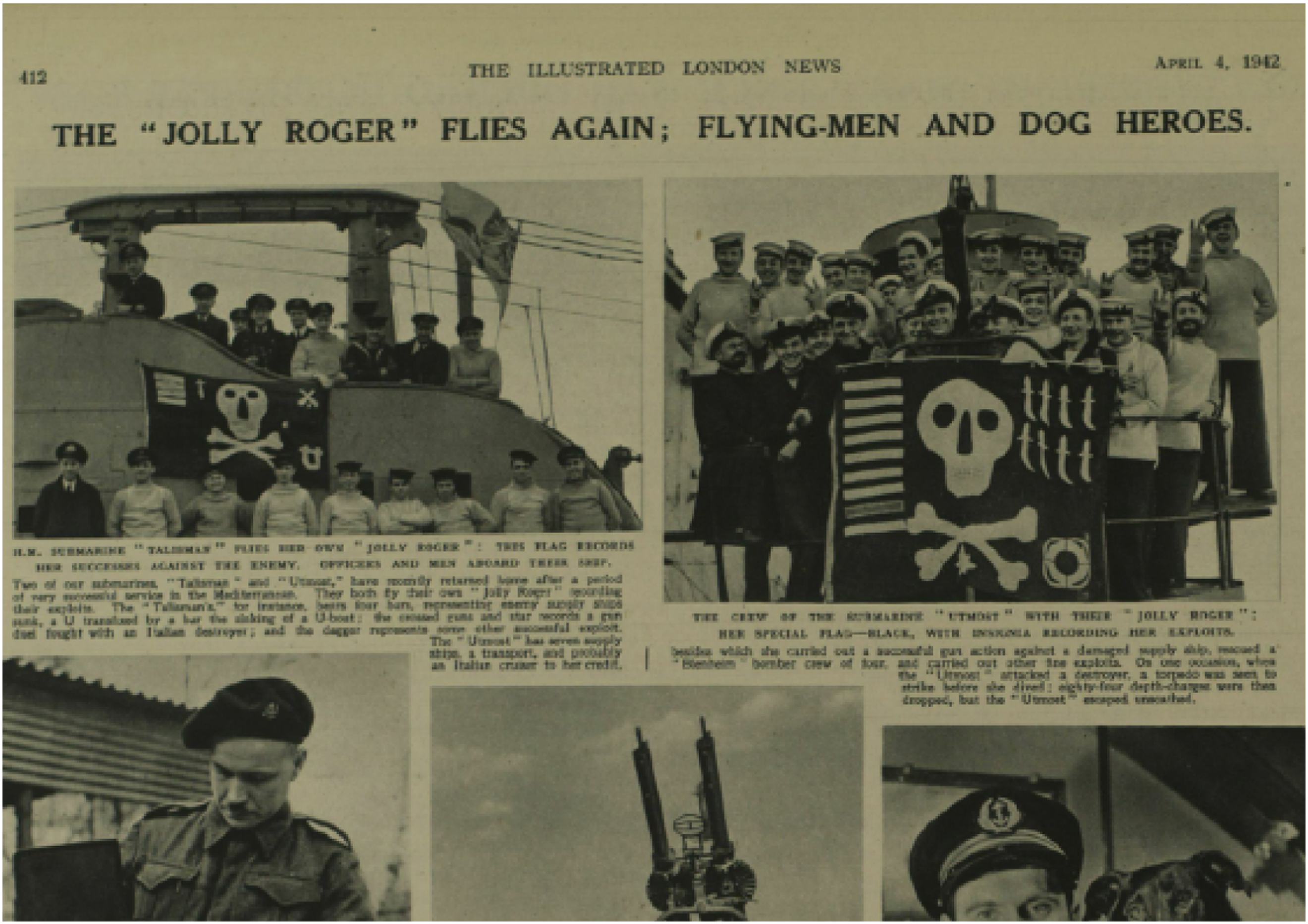
4 April 1942 ‘The “Jolly Roger” Flies Again’. Used with permission.
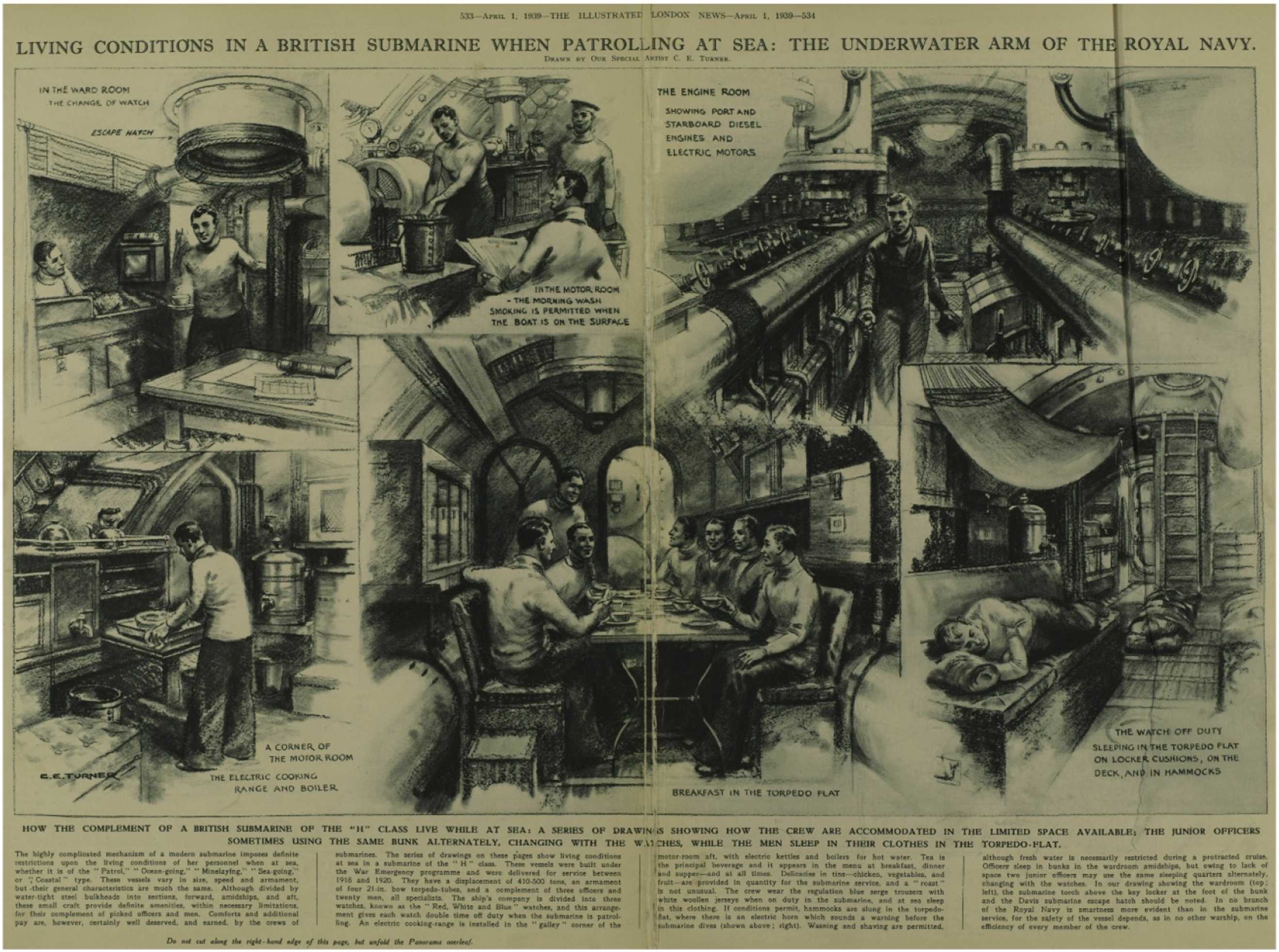
1 April 1939 ‘Living Conditions in a British Submarine When Patrolling at Sea: The Underwater Arm of the Royal Navy’. Used with permission.
In addition, this pre-war feature strongly conveyed the message that despite the space limitations on board, the crew still benefitted from ‘definite amenities’ such as electric cooking facilities and the provision of hot water for washing and shaving. Moreover, both the quantity and quality of the victuals available for those who served on board a submarine was also emphasised. ‘Tea is the principal beverage’, the feature-writer noted, adding ‘and it appears in the menu at breakfast, dinner and supper – and at all times’. 53 The author continued by outlining the other culinary benefits the service provided: ‘Delicacies in tins – chicken, vegetables and fruit – are provided in quantity for the submarine service, and a “roast” is not unusual’. 54 While rationing was yet to be introduced in Britain, the fact that these gastronomic advantages were mentioned demonstrates the importance the newspaper placed on the ability for submariners to be well-provisioned. 55
Alongside highlighting the benefits of food provisioning on board submarines, the newspaper also emphasised the more relaxed conditions among the crew when compared to other naval ships. For example, the drawings in this pre-war article conveyed an air of informality among the crew who were mainly presented going about non-operational duties. With the exception of the engineer, officers and able seamen were depicted wearing the same, implausibly clean, uniforms, without insignia, thus suggesting an environment with a lack of formality. 56 During the war itself, the ILN played down the challenging living conditions even more, instead emphasising the ample opportunities for recreation during a patrol, such as card playing and listening to music. 57 While the latter seems most unlikely to be permitted in close proximity to the enemy, the fact that it was mentioned reveals the lengths to which the newspaper went to underplay the difficulty of living on board a submarine. Indeed, the opportunity to partake in recreational activities continued to be highlighted as the war progressed. In June 1942, for example, one article included a photograph that showed ratings and officers relaxing in their respective mess rooms ‘reading, smoking and playing games’. 58 In another image in the same feature, five officers were shown taking tea in a wardroom that is replete with books, pictures, a decorative lampshade and wicker chairs – thus giving the submariners’ living space a homely theme.
One additional aspect that is notable in these depictions of life on board a submarine is the prevalence of images depicting service personnel smoking a cigarette. In one pre-war article, featuring an image containing a submariner smoking, readers were informed that ‘Smoking is permitted aboard a submarine when it is cruising on the surface’. 59 In an early wartime image, depicting submariners at leisure playing cards, it was again noted that smoking was ‘permitted when the submarine was on the surface’. 60 Later in the war, in another image that depicted submariners playing a game of draughts, three of the four men were smoking. 61 Time and again, then, the ILN used its articles to show readers that smoking, described by Richard Farmer as ‘a ubiquitous feature of everyday life for most Britons’, was permitted on board a submarine (when the craft was on the surface at least), reflecting the popularity and importance of the habit during the Second World War era. 62 The ILN's sanitised depictions of life aboard a submarine in these articles thus presented the men who served in the service as a privileged elite whose difficult living conditions were offset by these other, not insignificant, benefits.
Indeed, alongside highlighting the abundant food provisions and opportunities for leisure time, the ILN also remarked upon the pecuniary advantages of serving on a submarine. As if to again differentiate the ‘picked officers and men’ who served in the submarine service from their counterparts serving elsewhere in the navy, the ILN emphasised that these crews also received ‘additional pay’.
63
Submariners, then, were depicted in the ILN as an elite force who were well compensated for the conditions they had to endure while onboard. Moreover, the newspaper made it clear that the cramped conditions were only endured when the submarine was on patrol, noting in 1939 that: ‘in harbour the crew usually live aboard the mother-ship, where there is more room for recreation’.
64
During the war years, the beneficial living conditions for submariners when not at sea on operational duties were flagged up regularly. In December 1940, for example, an article featured ten photographs depicting the floating depot ships HMS Maidstone and HMS Forth (Image 8).
65
The title of the article, and some of the pictures illustrating it, made it clear that a submariner, when not on duty, could expect to enjoy the amenities typically found in ‘A First-Class Hotel’. Indeed, one picture caption triumphantly described sailors relaxing on the deck of the Maidstone as akin to being on ‘a cruising liner’.
66
28 December 1940 ‘A First-Class Hotel and Ship-Repair Yard: Submarine Depôt-Ships, Where Men Can Relax from Patrol Duty’. Used with permission.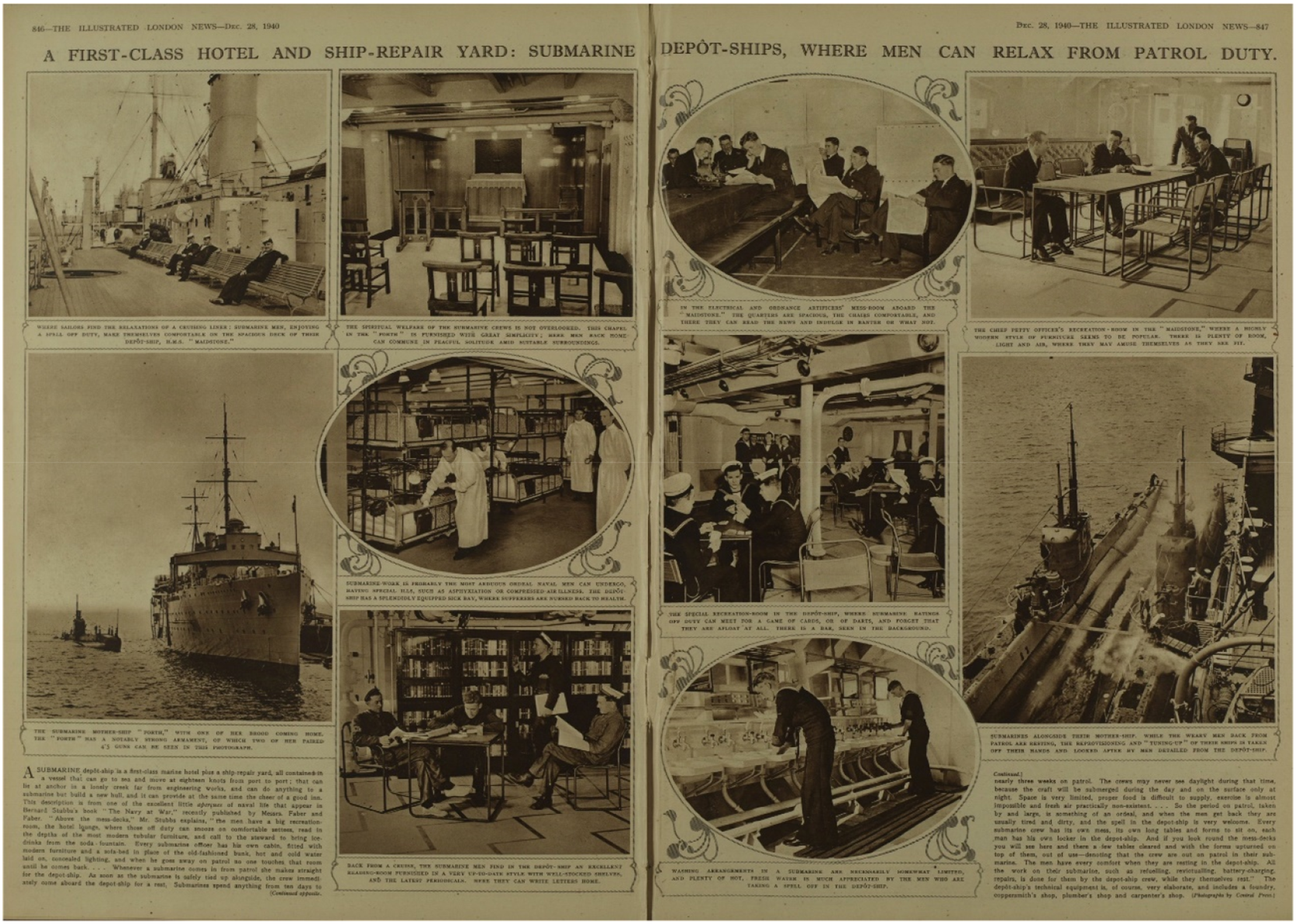
Interestingly, the narrative that accompanied these photographs offered a far less sanguine portrayal of a submariner's life at sea than those presented in the many other articles that the ILN published. Drawn almost entirely from Bernard Stubbs’ wartime book The Navy at War, the citation noted that: Submarines spend anything from ten days to nearly three weeks on patrol. The crews may never see daylight during that time, because the craft will be submerged during the day and on the surface only at night. Space is very limited, proper food is difficult to supply, exercise is almost impossible and fresh air practically non-existent […] So the period on patrol, taken by and large, is something of an ordeal, and when the men get back they are usually tired and dirty, and the spell in the depot-ship is very welcome.
67
Depot ships were working environments, of course, so the ILN's coverage of them also emphasised the superior quality of the technology available on them. In April 1940, for example, the newspaper included a feature that explained the importance and dual purpose of a depot ship: ‘When a submarine returns from patrol, its “mother ship” not only provides a home from home for its crew but takes charge of their boat and restores it to perfect condition’.
69
Most of the April 1940 article was concerned with the latter aspect, emphasising the important role played by depot ships in keeping submarines operational and describing the workshops, machinery and other facilities on board for doing so. An annotated cutaway drawing illustrated the internal and external works of such a depot ship. The narrative said comparatively little about the facilities enjoyed by submarine crews other than: It contains a modern hospital with X-ray rooms and an operating theatre, and amenities for the underwater crews also include sun-ray rooms to compensate for the long periods the men have to spend in artificial light and confined living quarters, and a post office for the dispatch of the outgoing and sorting and delivery of the incoming mail.
70
In areas where large floating depot ships were vulnerable to air attack, shore depots were established. Malta, for example, became a crucial submarine base during the Second World War, being the home of the Tenth Submarine Flotilla that became renowned for its operations against Axis supply lines to North Africa.
71
The shore depot HMS Talbot, which had been established on Manoel Island in a former quarantine hospital known as the Lazaretto, featured in an article published by the ILN in February 1943, although, understandably, the depot's precise location and name were not identified (Image 9).
72
The same dual purpose of its sea-going equivalents was described using similar terminology: The duties of such a base are to provide facilities for minor repairs, fuel and lubricating oils, water, victuals and stores, ammunition and torpedoes, and all the commodities needed to maintain submarines at sea. The base also ensures rest and recreation for the crews, with exercise and a change of diet in comfortable surroundings.
73
It would seem, then, that the ILN's positive portrayal of the submariner and their working conditions was made in an attempt to provide the service's personnel with a distinct identity, as well as enhance recruitment, or at least not hamper it. The recruitment of submariners may have been a prime purpose of the way submarine life was portrayed, in particular, because submarine losses were very high. The heroism of individuals and crews was celebrated in the ILN, reinforcing the idea of a submarine elite. Such messages were important, both for recruiting men to the submarine service and for informing the public that an elite group of people were serving their country in this way, and were valued for their contribution. A further key message was, therefore, one of respect for submariners and a reassurance that Britain had such a highly respected, elite and valued body of men who could be relied on to keep the country safe.
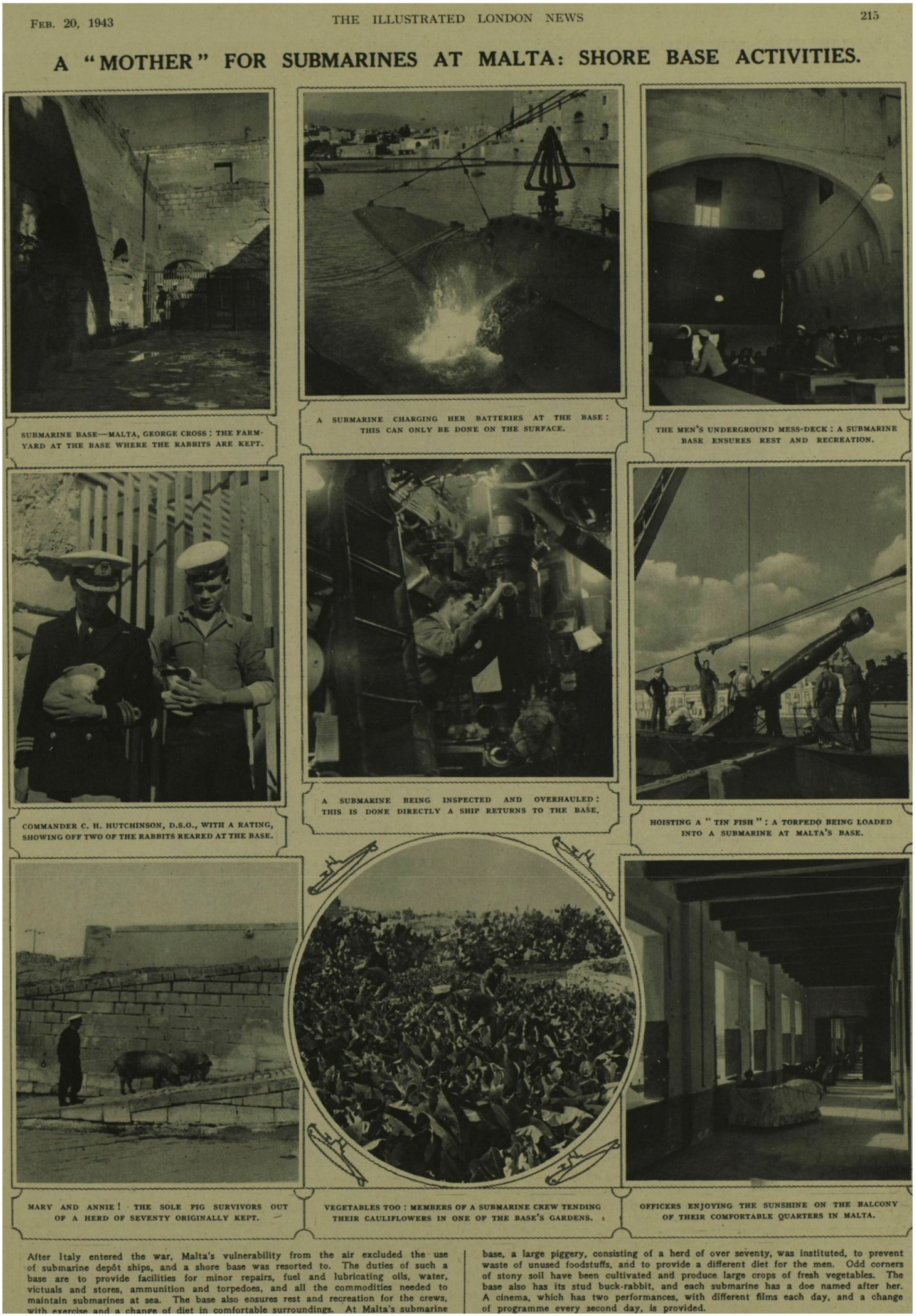
20 February 1943 ‘A “Mother” for Submarines at Malta: Shore Base Activities’. Used with permission.
Conclusion
In July 1945, the book His Majesty's Submarines was published for the Admiralty by the Ministry of Information. 76 The reading public was given accounts of the war exploits of British submarines and their crews together with high-quality photographic images to accompany the narrative. The press presented extracts from the book under catchy headlines such as ‘Valiant Work of Britain's Submarines’, ‘Undersea Epics’, and ‘Thrills of Undersea Warfare’. 77 The Manchester Guardian welcomed the book's revelations about ‘the most silent section of the “Silent Service”’, observing that ‘we hear almost more about the depredations of enemy submarines than about the achievements of our own’. 78 In the book itself, it was claimed that ‘to the layman the submarine is still a novelty, strange and little understood, and the Submarine Branch of the Navy is cloaked in mystery’. 79 Certainly, for many British citizens, a high degree of opaqueness still surrounded all facets of the Royal Navy submarine service during the Second World War. However, over the course of that conflict, as this article has shown, the Admiralty had done much to make the service's activities more visible to the general public. Indeed, along with the coverage in the ILN, another similarly Admiralty-approved book, Up Periscope, had been published in 1942, and, as a contributor to The Times noted, ‘books by various authors had done much to dispel the mystery’ of the submarine service ‘even before’ the start of the Second World War. 80 This latest book's claim that little was known about the service, repeated in press reviews, appears to have been little more than a clever marketing tactic.
While, as Redford has argued, reporting restrictions and controlled Admiralty communiqués may have presented the public with an incomplete or distorted view of Royal Navy submarines and their crews, this analysis of the ILN has shown that newspapers were one of the principal ways that people obtained information about the role they played in wartime. 81 Naval culture, as Rüger has argued, is ‘intrinsically linked to questions of power and the function of the fleet’. 82 The submarine service's portrayal in the ILN demonstrates the Admiralty's recognition of its importance as a cultural symbol. Indeed, despite the Admiralty's reluctance to work with the media, in particular using the ‘King's Regulations and Admiralty Instructions’ to prohibit serving officers and Ratings from giving press interviews, it certainly recognised the benefits of doing so. Moreover, the ILN's depiction of the submarine service's crew as elite men not only fed into notions of naval masculinity common from the Victorian era onwards, it enhanced them further. 83 While Barbara Korte's evaluation of naval heroism in popular magazines in the mid-Victorian period has outlined the importance of the navy as a heroic institution in that era, this article's evaluation of the ILN during the Second World War demonstrates that the heroism of the navy and its personnel, particularly in its submarine service, was heightened further in this period. 84
The ILN's portrayal of the submarine service and its crews during the Second World War, then, provided its readers with an overall impression of their superiority. Britain, the newspaper intimated, had a distinct advantage in submarine warfare, and was thus capable of winning the war. In that sense, while the messages provided in the newspaper performed a didactic role by educating and informing the British public about the service's wartime conduct, they could have also served a much greater role in helping to boost civilian morale at a time when the country was engaged in a battle for national survival. In that way, the ILN's coverage could generate not only pride but also confidence in Britain's submarine warfare capabilities. In short, by un-silencing ‘the most silent section of the “silent service”’, the ILN helped to reinforce the status of the submarine service in a crucial period in the Royal Navy's history.
Footnotes
Funding
The authors disclosed receipt of the following financial support for the research, authorship, and/or publication of this article: The rights for the images produced in this article were generously covered by the Centre for Port Cities and Maritime Cultures at the University of Portsmouth.
