




Abstract
Indian COIN operations during the Mizo civil war (1966–1986) are widely believed to have been effective, apparently paving the way for lasting peace. This article refutes this traditional stance. Indian COIN had serious limitations, struggling in an operational sense to conclusively defeat the MNF partly because of its broader inability to secure widespread local support. The peace that has defined the Mizo Hills since 1986 was forged despite Indian COIN in the early stages (1967–1970) of the conflict, as operations hindered the state's chances of military victory and created long-term resentment amongst the civilian population.
Introduction
‘Mr Chairman Sir, we have all seen the Army as against the [Mizo National Front]. They look like an elephant trying to chase a rat’. 1 This observation was provided during a minor council budget session in the Mizo Hills District (MHD) in the spring of 1967. It was put forth by a disillusioned citizen reflecting on the Indian state's attempts to defeat separatist Mizo forces in the ongoing civil war in India's northeastern borderlands. 2 This assessment provides a more accurate understanding of Indian counterinsurgency (COIN) operations in the early stages of the Mizo civil war (which ultimately lasted from 1966 to 1986) than the broad perception that persists today. This article will provide a revisionist argument about Indian COIN in the Mizo civil war that more closely mirrors the comments provided in the spring budget meeting than prevailing mythologies since.
The civil war began at the close of February 1966; it was initiated by the Mizo National Front (MNF), a separatist nationalist organisation aiming for independence for the Mizo nation. Initially, the Indian response was swift, and military forces quickly regained control of the major population centres of the MHD. But the MNF's shift towards insurgent tactics ensured the survival of separatist forces and the continuation of the war. In response, the Indian state embarked on an intensive COIN campaign from January 1967 until 1970. Its aim was to win the ‘hearts and minds’ of the civilian population, paving the way for operational victory against the MNF.
There is a widespread contemporary belief that the Indian campaign was effective. This article will refute this claim. COIN operations neither won civilian support nor dealt a decisive blow to the MNF. By allowing indigenous voices from within the archive more space than often afforded in Indian COIN research – and extending beyond exclusive focus on tactical or operational elements – this article will identify the serious limitations of COIN in the MHD. By 1970, civilian grievances against the state actually intensified while the MNF's insurgency persisted. Additionally, the control exerted by the Indian state in the MHD rested solely on a large – but unsustainable – military presence. India's COIN strategy in the early years of the war, therefore, did not pave the way for victory against separatist forces, contrary to popular belief.
This revisionist argument has important implications. On the one hand, the article engages in sustained archival analysis to create space for indigenous perspectives within the narrative, a key shortcoming in previous research. When reflecting on whether hearts and minds were won, civilian feeling on the ground revealed by the archive is an obvious – but overlooked – starting point. The fact that contemporary beliefs can abound about a successful COIN campaign, despite substantial evidence to the contrary, opens a clear research agenda about the suppression of indigenous voices and enactment of violence against indigenous communities in post-colonial states. On the other hand, it provokes a broader question about research into Indian COIN operations beyond the MHD, since the Mizo campaign is often considered a quintessential success story in a generally favourable history of state-led operations. If, as will be proven, the Mizo campaign should be subjected to greater scrutiny, then what other case-studies could benefit from the revisionist approach pioneered here?
To put forward this argument, the article first gives a brief overview of existing research on Indian COIN, identifying deficiencies in both data and methodology. Then, a summary of the early stages of the civil war provides the context for India's COIN strategy. The article subsequently provides a section outlining early problems in 1967, leading to widespread civilian animosity, followed by a further section up until 1970, identifying the persistent challenges the state had in defeating MNF forces militarily, whilst abuses against civilians persisted. It concludes by reflecting on the research avenues that emerge once the serious limitations of Indian COIN in the Mizo Hills are properly addressed.
Indian COIN in Global Perspective
When assessing global trends in COIN research, India's post-1947 operations have often drawn less focus than other campaigns. 3 This has been noted as something of a peculiarity, considering the ‘wealth of material’ provided by insurgencies that have contested the state in the subcontinent. 4 But, within the literature that does exist, a common narrative has emerged. Pioneered by ex-officials such as Kanwar Pal Singh Gill – and through outlets such as the Faultlines journal – this narrative provides a generally favourable appraisal of Indian military operations that can provide a template for global campaigns. 5
This positive framing is problematic; it is built on the premise of apparently successful campaigns in places such as the Mizo Hills. For instance, Bibhu Prasad Routray used the Mizo campaign to anchor a recent article, using it as one of four examples of ‘successful COIN operations’ to demonstrate how India's accomplishments with COIN rest upon the ability to adopt and enact good practices. 6 This belief is common in academic research. 7 It also resonates in public life. As Praveen Swami has suggested, ‘India's counter-insurgency thinking has cast Mizoram as a template for the successful resolution of conflicts’. 8 This article is not a specific critique of the aforementioned individuals; rather, it questions the entirety of research into Indian operations, if experiences like those in the Mizo Hills are properly analysed.
Nuanced research receptive to the ground-level realities of the Mizo civil war has been carried out by Nandini Sundar, through interviews with – and first-hand accounts of – civilians that lived through conflicts in the Mizo and Naga Hills. 9 But this research has yet to be properly incorporated into dominant narratives about Indian COIN in the MHD. Even within academic work more attuned to the oppression of civilians, notions of operational success still abound. 10 This article refutes the idea of an effective campaign, by demonstrating how civilian oppression had an active knock-on effect on operational success. The two went hand-in-hand, helping to explain why the substantial COIN effort in the early stages of war hindered the state's chances of victory.
Confronting two research lacunae provides a foundation for more sustained analysis. The first is the incorporation of extensive archival work, which has routinely been missing from previous research. The repositories in the present-day state of Mizoram – and wider northeast – provide much-needed multifaceted source material, including space for subaltern voices to form part of the narrative. The second research lacuna is the use of methodologies from the historiography on global COIN, especially scrutiny of prevailing norms and the deployment of research questions challenging conventional assumptions. The premise of a successful Mizo campaign is not tenable when similar approaches applied to the European powers’ wars of decolonisation are focused on Indian COIN.
To briefly summarise this relevant historiography, an upturn in interest in historical episodes of COIN followed from developments in the wars in Iraq and Afghanistan after the turn of the century.
11
This upturn coincided with – and augmented – an already emerging revisionist wave increasingly critiquing how norms of European, and especially British, campaigns unfolded in both theory and practice. As Paul Dixon suggested: The classic model of British counterinsurgency suggested that it was above all a political activity designed to win the ‘hearts and minds’ of the local population to the government side. This involved the use of ‘minimum force’, the primacy of the police and a coordinated effort across all fronts.
12
Widespread re-evaluations emerged about whether the ‘British way’ should be viewed as the gold standard in COIN that laid the groundwork for the publication of ‘practitioner guides’ in how to initiative effective operations. 15 Instead, revisionist arguments were put forth that ‘divide and rule’ was a better analytical frame than ‘hearts and minds’ to understand British experiences, whilst it was also suggested that maintaining legitimacy was the primary driver behind campaigns, taking precedence over other considerations such as humanitarian norms. 16 Ultimately, the revisionist wave of research confronted the widely held belief that the ‘British way’ was fundamentally different from that of states such as France and Portugal, thus challenging one of the cornerstones of traditionalist COIN literature. 17
This brief overview will be familiar to COIN specialists whose research has recently expanded in several directions, including contemplating ‘post-revisionism’, for such has been the dominance of the revisionist wave. 18 But, for the present article, an understanding of the methodological approach and key research questions of the revisionists provides a crucial starting point to re-evaluate the Mizo conflict.
By reflecting on global COIN scholarship, a clear research question emerges for Indian operations in the MHD: was Indian COIN in the Mizo Hills actually successful, or has it merely been portrayed this way, in the same vein as British operations? The central assertion of this article is that Indian COIN should likewise be subject to greater scrutiny, as significant limitations resulted in an inability to conclusively defeat the MNF, partly because of the struggles to win widespread local support. When relevant archival material is properly scrutinised, this argument becomes clear. By being receptive to subaltern voices within the data and reading along the archival grain, it leads one to question whether hearts and minds were actually won and whether military successes did follow, or whether this normative understanding has been pioneered despite evidence to the contrary. To reach this point of reflection, the context needs providing from the early stages of the civil war, to understand how India's COIN strategy was formulated and the environment in which it would take shape.
The Onset of War and India's COIN Strategy
The civil war that started with a district-wide takeover over of key population centres by separatist forces – at the close of February 1966 – soon descended into an irregular one, after a brief period resembling relatively conventional operations. In the wake of ‘Operation Jericho’ – as the MNF codenamed its district-wide attack – the state response was swift. Indian Home Minister Gulzarilal Nanda declared publicly that the MNF would be ‘crushed’ by a concerted military effort by the state. 19 Emergency legislation created for war in the Naga Hills in the 1950s was extended to the Mizo Hills on 2 March 1966. 20 After some brief fighting around the district capital of Aizawl 21 – where for a time only the Assam Rifles barracks was held by Indian personnel – state forces quickly regained the initiative. 22 The recapture of other key settlements, such as Lunglei and Champhai, by the Indian Army followed; its superiority in conventional battles became quickly apparent. 23
Commentators noted how a degree of order was re-established by the Indian security forces as March 1966 wound to a close. This is largely corroborated by the archive, as curfews were imposed and the large military presence in the district led to relative control in the major population centres of the MHD. 24 It would be overly simplistic to suggest this was a harmonious reassertion of state control as the MNF, for instance, kidnapped government officials and engaged in sporadic attacks. 25 In one example, an MNF offensive in the wider Champhai region led to the capture of substantial amounts of weapons and supplies. 26 Publicly, too, the Indian state had to contend with press reports about separatist bases in East Pakistan, and whether the government's international diplomacy had emboldened the Mizo separatist agenda. 27 Yet, overall, there was a degree of control regained by state forces by the close of March 1966.
This re-assertation of control enforced a sense of confidence within the ranks of the Indian Army and amongst its leadership in its capabilities to conduct conventional warfare in the MHD. A report at the end of June noted the ‘prompt and effective’ work of state forces in the early stages of war, alongside their consolidation efforts after these clashes. 28 There was a clear sense of self confidence, too, in this opening period in the Army's abilities to capture rebel forces and retrieve weapons and supplies. 29 In this increasingly militarised zone, the civil administration had given way to military control, leading G. G. Swell and Stanley D. D. Nichols Roy – members of the Lok Sabha who visited the MHD – to reflect how ‘one could smell fear, suspicion and insecurity in the air’. 30 These conditions could not persist indefinitely in a democracy, but in the early stages of war provided a clear degree of control for the state.
However, lingering doubts emerged about the limitations of the Army if they were unable to secure the MNF's quick surrender, as the ‘inadequacy of forces, lack of an organised intelligence and difficulty in getting [local] scouts/guides’ provided a degree of anxiety should the war drag on for a lengthy period. 31 Thus, despite the June report narrating how ‘MNF volunteers have been kept on the move by … armed forces since the middle of March … [and have been] harassed by the Army, leading a life of hunted fugitives’, the future was not as clear-cut as the Army's early victories against the MNF may have suggested. 32 And this was particularly important considering the evolving tactics of separatist forces.
By the summer of 1966 the MNF had begun to engage in archetypal insurgent operations.
33
This was clear to security forces, as it was noted how: The MNF has adopted a policy of confronting the Government and attempting to paralyze its functions… The adoption of the new policy [has] been dictated by… the realization that they are fighting a losing battle… Emphasis is now laid by [the] MNF more on the justness of their ends and ultimate victory and they have quietly stopped talking of the means of achieving their ends.
34
With insurgency came counterinsurgency. At first this was a relatively ad hoc affair, as administrative and supply centres were established, but they could only cover so much ground across a relatively vast region with difficult, mountainous and heavily forested terrain. 36 Discussions unfolded about airdrop of supplies for civilians as well as publicity campaigns, and for greater numbers of police in the district along with improvements to communications, medical provisions and water supplies. Ultimately, ‘these arrangements envisage[d] the replacement of the concept of loosely administered areas by an effective, helpful and confidence-inspiring administration’. 37 The difficulties of translating theory into practice would soon become apparent, but these ideas provided the basis for a concerted COIN strategy that would unfold from the beginning of January 1967, as covered shortly.
But, as 1966 progressed and conflict endured, problems facing Indian forces became clearer, due in part to a lack of provisions and infrastructure in the MHD but also because of the treatment of civilians. Examples of the former included inadequate facilities to detain captured separatists and an inability to reclaim more weapons from clashes than those lost to raids by MNF forces. 38 A clear example of the latter was the aerial bombing of Aizawl in the early days of the war, which did occur despite protestations to the contrary by Indian officials, but this was far from the only instance of civilian harm. 39 Echoes of colonial violence reverberated around the MHD as villages were burned indiscriminately, while harassment of Mizo citizens abounded and supposed separatist collaborators were arrested with little-to-no evidence. 40 Meanwhile, Chakma communities opposed to Mizo separatism – and, therefore, potentially useful to security forces – were afforded little support and exposed to MNF raids. 41 What this ultimately suggested was an environment ill suited to waging a COIN campaign, especially one seeking to win public support.
With these deficiencies in mind, talk turned towards a more rigorous strategy to confront the MNF's insurgency. A meeting in late August 1966 – that included state and district officials, Indian Army officers and high-ranking Assam Police personnel – involved discussions about the regrouping of villages to provide an environment more conducive to a COIN campaign. The minutes of the meeting noted how: There was a general discussion on the desirability or otherwise, of grouping villages in the Mizo District to facilitate more effective operation against [the] MNF. It was felt that this would not be desirable now unless it can be affected voluntarily. It was however agreed that the Deputy Commissioner, Mizo District and the Brigadier Commander may explore the possibilities of affecting this on a voluntary basis, beginning with the Chakmas in the Pakistan border.
42
Operation Security drew on other COIN operations globally in the 1950s to 1960s. An article in The Times, for example, identified the clear genealogy linking the Indian approach in the MHD to broader global trends: What the British did in Malaya and the Americans tried unsuccessfully in Vietnam is being attempted in the Mizo hills of Assam. The Eastern Command has begun what it has named Operation Security to evacuate people from areas subjected to raids and intimidation by Mizo rebels, and settle them in new villages under Army protection. During the operation, which is expected to take not more than six weeks, about … half the total population of the Mizo hills, are to be moved out.
43
The strategy was underpinned by the Indian Army's commitment to minimum force, enshrined in the Indian Army Act. 45 This dovetailed with the stated desire to win the hearts and minds of the Mizo populace. Interestingly, this aim did appear to be a genuine objective of Operation Security, at least in theory amongst senior staff. A letter circulated to all Administrative Officers, well into COIN operations, offered an insight into the stated ideals resonating around the higher echelons of military planning. It reminded Administrative and Security officials of the need to ‘inspire the confidence of the people and earn their trust’, noting how the ‘object … is to counter insurgency, with affection and trust of the people’. 46 India's COIN strategy had its flagship tactic of village grouping, alongside its theoretical basis of minimum force to win civilian support and, thus, pave the way for military victory. The problem came, however, with translating theory into practice.
A plethora of issues would plague Operation Security, rendering it a chaotic undertaking. Contrary to the estimations of the aforementioned article in The Times, which envisaged a 6-week period of operations, village regrouping unfolded in four waves across three years from 1967 until 1970, with around two-thirds of the MHD's population directly affected. By its completion, there was no great outpouring of support for the state from within the MHD, whose citizens widely resented security forces. Instead, control was premised on the large military presence in the district, something that was both costly and unsustainable, whilst the MNF remained active and potent.
Early Problems with Indian COIN
Defining ‘success’ and ‘failure’ in COIN campaigns can be problematic, providing a binary that does not capture the complexities of most conflicts. But the largely optimistic discourses surrounding Indian COIN in the Mizo civil war circulating today are untenable when judged against the archival findings revealed in the rest of this article. In the MHD between 1967 and 1970, judged against the self-stated aims of the Indian state – to engage in a COIN campaign in order to win local support and provide a pathway to military victory – a clear metric can be identified that points towards a chaotic campaign beset with problems.
First, Indian COIN operations hindered – rather than aided – efforts to win the support of the Mizo populace. Persistent offences against civilians committed by security personnel, combined with a lack of coordination between military and civil authorities and a general level of inefficiency, combined to prevent hearts and minds from being won. By 1970, resentment against state forces was palpable across the MHD. Second, largely due to the lack of coordination and organisation, alongside an inability to secure intelligence, Indian COIN did not defeat the MNF, who persisted with operations despite India's military presence in the MHD. Third, when control was exercised by state forces, this was conditional on the large security presence in the region. This could never be a lasting solution for peace.
This section will outline how the early stages of COIN unfolded, identifying that the breadth of offenses committed against civilians actively created a sense of animosity amongst the Mizo populace, before the next section moves onto the persistence of these issues unfolding alongside the durability of Mizo separatist forces.
Operation Security began in January 1967. 47 The first wave of village grouping was known as the Protected Progressive Village (PPV) scheme. It involved the designation of 18 PPVs, each of which was generally drawn from several smaller settlements into the nearest strategically advantageous position. Table 1 outlines the villages and population transfers that occurred.
Protected progressive village scheme, 1967. a
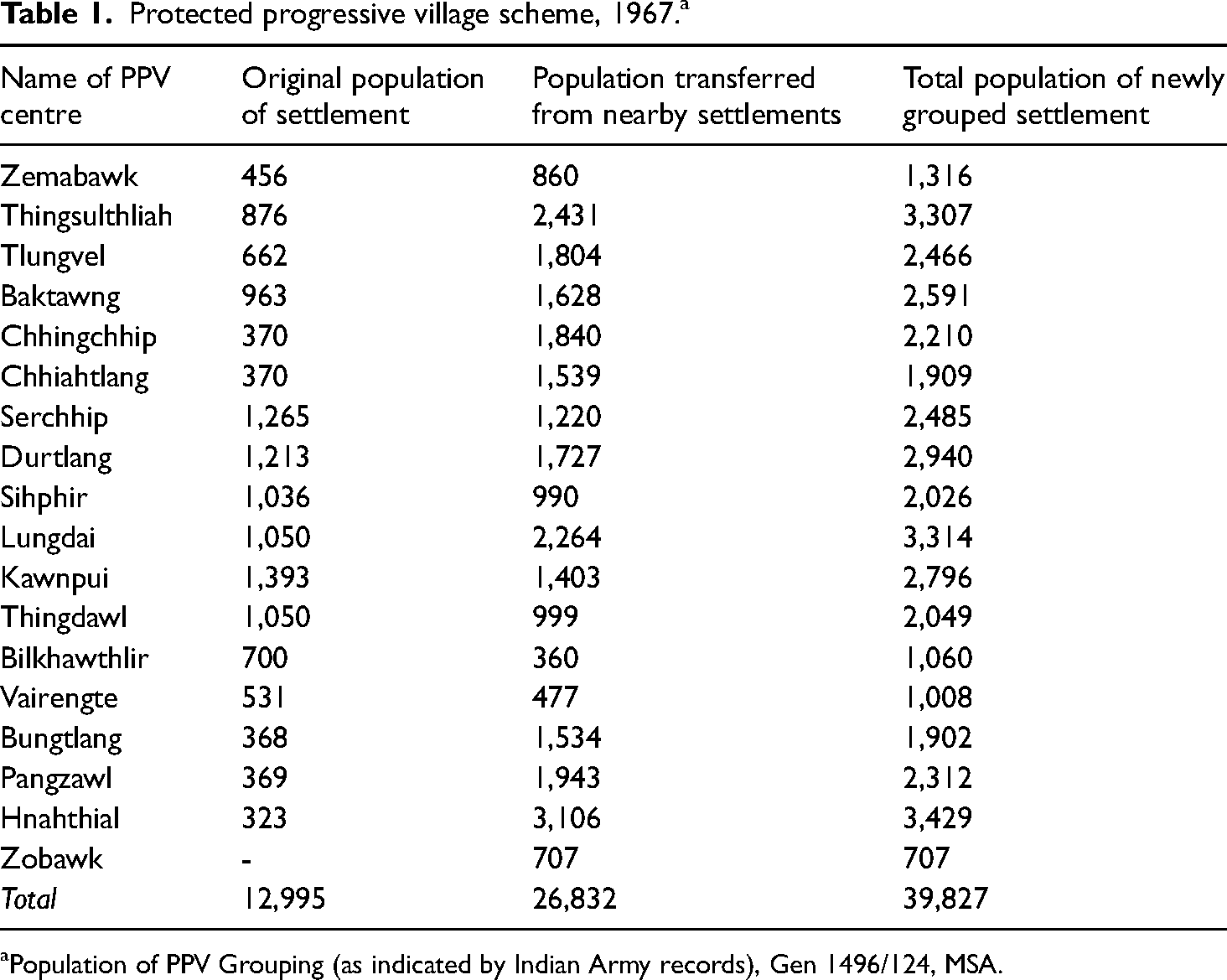
Population of PPV Grouping (as indicated by Indian Army records), Gen 1496/124, MSA.
The PPVs were all located close to the Aizawl-Silchar Road, the key transport route for security forces. Under the scheme – for instance – Kawnpui drew citizens together from three settlements: the original residents of Kawnpui plus those from Mualvum and Bualpui. 48 From the outset, the PPV scheme was beset with problems.
The actions of Indian security forces against Mizo civilians in the early stages of the conflict had provided a crucial backdrop for the PPV scheme. A letter to Bimalaprasad Chaliha – the Chief Minister of Assam (of which the MHD was still a part of at this time) – from the Aizawl Citizens Committee displayed the resentment against security forces felt within the district's major settlement: From the action taken by the Civil and Military Authorit[ies], it appears that all Mizos are under the influence of lawless elements [the MNF]. This concept may be removed from the minds of the authorit[ies] … Otherwise, indiscriminate arrests made by the authorit[ies] [will bring] about hatred towards the Government.
49
Poor coordination between civil and military authorities provided one problem that prevented effective COIN from unfolding. Indicators of this lack of cohesion were evident as Operation Security began without the knowledge of certain district officers, whilst the Mizo District Council – the regional administrative body – remained uninformed about security developments. 51 Compounding these problems in communication was a basic lack of infrastructure, a recurrent hindrance for development in the MHD since independence. 52 This meant a lack of accommodation for state officials, difficulties in securing both water and medical supplies, poor postal services and an inability to enact policies such as a proposed ID card scheme for the newly established PPVs. 53 Altogether, this environment provided significant problems for the unfolding of the PPV scheme.
Chaos and inefficiency were particularly problematic because these circumstances created a setting where excesses against civilians could take place without accountability or disciplinary action. The murder of Pu Khawpuia – a prominent local figure at village level – in the summer of 1967 was demonstrative of how violence unfolded, and provides evidence as to why resentment continued to build against security forces. On 15 July 1967, Khawpuia's house was raided by security forces, who were not interested in any potential links to the separatist movement, but the contents of Khawpuia's safe. Upon refusing to hand over the key to his safe, Khawpuia was shot and killed. 54 His murder was reported by Lalbuaia – head of the Mizo District Council – to Chaliha, but a recurrent theme in the archive is the lack of meaningful responses to such incidents. Similar occurrences that fell on deaf ears included rapes, beatings and theft in the Baktawng and Chhingchhip PPVs in early 1967. 55 Poor coordination and inefficiency was paving the way for violence against – and oppression of –civilians, and actively worked against the aims of Indian COIN.
Throughout the unfolding of the PPV scheme, and across 1967, this environment provided fertile ground for persistent abuses by security forces against Mizo civilians. The conduct of Army officials was repeatedly called into question. In one instance, several accusations of sexual assault went unheard as they were rebuffed by officials. 56 At Thangte village, which was not originally supposed to be part of village regrouping plans, security forces appeared anyway and burned down the settlement in an effort to force villagers to move. 57 Once more, pleas from villagers – this time about the dangers of travelling with young children and inadequate supplies – fell upon deaf ears. 58
A delegation from the Mizo Union, which had been the traditionally dominant political party in the MHD since independence, travelled to New Delhi to try and raise awareness about military conduct in the war. 59 During the visit, H. K. Bawichhuaka told reporters that village grouping was a mistake, claiming that more Mizos were opposed to the MNF than routinely presumed. 60 But, despite the attempts to bring attention to the excesses being committed by Indian forces, there is little evidence to suggest the delegation had any impact on wider public consciousness beyond the MHD.
Instead, violence continued, as demonstrated in late June 1967 following the arrest of a group of 12 separatists that included two women. The men were sent away to Aizawl, but the women were detained, and the following was reported: Consecutive 3/4 nights [of] cries … of the girls [were] heard by the neighbouring houses. It is believed that… Biaktluangi was raped by Major Sharma and [Deputy] S. P. Sehgal. It was common talk in the centre for a few days after the incident and was deeply resented by all sections of the local people.
61
India's COIN strategy was clearly beset with problems during the PPV scheme phase, as offences against civilians abounded. But, although the region had a long history with conflict and was mirroring previous trends in colonial warfare – something touched upon in the conclusion of this article – the inauguration of a COIN campaign was still a fairly new undertaking for the relatively nascent Indian state. 64 This line of thinking was evident in the reflections of Sam Manekshaw (GOC-in-C, Eastern Command). Though it was highly unlikely Manekshaw was aware of the extent of the ground-level offenses being committed, his wider reasoning at this stage of Operation Security was understandable. He stressed that initial opposition was to be expected; people were being forced from their homes. But he predicted things would soon ‘settle down’ as village grouping progressed, providing greater overall security and creating a platform for winning civilian support and, following that, the war. 65 This, then, was a critical phase. 1967 witnessed the onset of Operation Security with the unfolding of the PPV scheme but yielded little in turning public opinion. Subsequent operations were critical for securing civilian support.
After the PPV scheme, three further waves of village grouping followed until 1970. First, the Approved Centres initiative, then the somewhat ironically titled Voluntary Centres scheme and, finally, the Extended Loop Areas plan, as shown in Table 2.
Population changes within the grouped villages of operation security. a
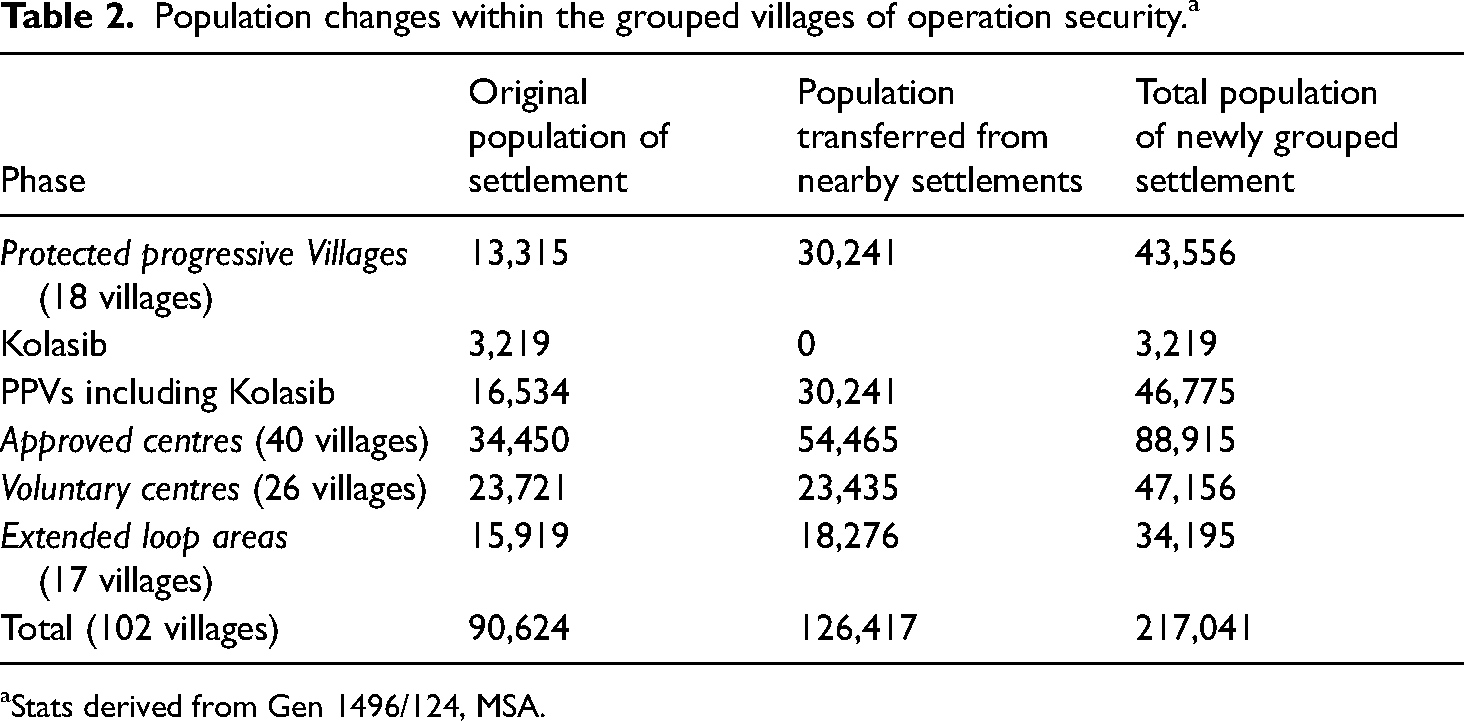
Stats derived from Gen 1496/124, MSA.
The statistics in Table 2 require some brief contextualisation. Census data prior to the war suggested the population of the MHD was 266,063 and by 1969 had risen to 316,950. 66 Thus, just under 70 per cent of the population were directly affected by the four waves of village grouping, which roughly aligns with C. Nunthara's 1981 estimation. 67 The sheer volume of civilians involved, alongside the financial outlay and number of troops deployed by the state, clearly demonstrated the Indian government's intentions to eradicate the separatist challenge within the MHD. 68 But the issues that plagued the state during the PPV scheme in 1967 would continue as its military strategy unfolded, ensuring this grandiose attempt to stamp out the MNF was actively hindered by ineffective COIN.
Persistent Issues with Indian COIN
Analysing the remainder of India's COIN strategy in the early stages of the war, from the conclusion of the PPV scheme until the end of village grouping in 1970, reveals a series of embedded trends. An inability to secure information networks – an issue prior to Operation Security – continued to hinder state-led COIN. Operationally, the MNF remained active as clashes and raids that had unfolded since 1966 rumbled on without any decisive victories. Finally, offences against civilians continued, ensuring the persistence of anti-state public opinion: a direct contradiction to COIN strategy. These trends – revealed through further archival analysis in this section – signify there was little tangible evidence that Indian COIN efforts in the early years of the war paved the way for victory and peace in the MHD.
The continuation of offences against civilians, which are outlined later, unfolded alongside an inability to secure information networks and tap into local knowledge which, in turn, hindered operational effectiveness. For civilians who were staunchly anti-MNF, the unorganised nature of COIN operations ensured that potentially useful ground-level contacts were squandered and left exposed to separatist forces in at least three ways. The first was demonstrated at Tlungvel, where citizens submitted repeated requests to the Indian Army for a security post to combat separatist operations. Though the pleas were rejected, a compromise was reached, whereby a volunteer force would undertake regular patrols and notify security forces in the event of a rebel attack. The MNF attacked Tlungvel on 5 January 1968, but there was no response to the warning from the local civilian patrol, resulting in 18 destroyed houses and an estimated Rs. 15,000 in damages. 69 More damaging than the material consequences was the psychological effect on pro-government civilians, who knew they could not rely on the Indian Army for their safety.
A second demonstrative episode was evident at Thingsulthliah, where an informant who had supplied background information on a rebel sympathiser was exposed soon after the latter was released from questioning. 70 Key information about the informant was leaked to the alleged sympathiser who was able to make open threats in the aftermath. There was a recurrent trend of failing to keep informants safe, as a similar instance arose in Kolasib. There, an informant named Lalsangzuali recounted how MNF fighters had captured her and ‘most unceremoniously cropped my … hair leaving me half-dead in shame and humiliation’. 71 Lalsangzuali subsequently refused to work with security forces. As with the instance at Tlungvel, a clear theme had emerged about the inability to keep informants safe, thus compromising information networks.
A third and final example of ineffective military operations affecting intelligence gathering and local networks was evident in the form of remuneration. Though plans were made for an annual fund to recompensate civilians who provided information about rebel movements, the incoherent and inefficient nature of COIN again proved problematic. 72 In the end, an ad hoc fund was cobbled together, but claims made to the fund – even when they led to successes such as the confiscation of firearms – resulted in lengthy delays in responses, even before getting to the payment stage. 73 The scheme was eventually pawned off on the civil administration. 74 Information networks and local support can be crucial in COIN campaigns; for both state and rebel forces, providing security for civilians in order to secure such support can have a sizeable impact on the outcome of conflicts. 75 Anoop Sarbahi's research has shown that the MNF successfully tapped into the pre-existent social networks of the MHD, with significant rewards. 76 But the archive demonstrates how, conversely for the state, the uncoordinated and chaotic nature of COIN resulted in an inability to secure similar ground-level support, despite several potentially fruitful avenues.
The struggles in securing civilian support or reliable local information networks had a knock-on impact on state-led military operations, as the MNF displayed notable resistance to the large security-force presence in the MHD. Throughout Operation Security, despite being on the backfoot, the MNF remained operational and potent. It maintained an ability to pressure civilians into not collaborating with the state. For instance, separatist forces warned civilians against partaking in Indian independence day celebrations in August 1968 and – in areas such as Kolasib – pressurised trade operations and extorted money from shopkeepers. 77 In an example of the latter, MNF messages were disseminated reading ‘give us fifty rupees otherwise your life will suffer’ followed by instructions on how to practically ensure payment. 78 Restrictions were also imposed on travel without MNF permission, on providing material support to state forces and even on the cooking of rice. 79 The MNF also persistently penetrated government positions and organs, as reports from April 1968 revealed. 80 But, most important, was its continued operational capacity.
Separatist forces continued to move across the Mizo Hills despite the large state military presence. The fluidity and ease of these operations engendered anxiety amongst administrative officials, especially those in remote areas of the district. 81 Strikingly, the archive reveals the consistency with which the MNF was able to maintain its operational capacity throughout COIN operations. Attacks on security forces, the civil administration and non-separatist civilians persisted with regularity, as reflected upon by Vidya Charan Shukla – minister in Indira Gandhi's cabinet – in the Lok Sabha. 82 Questions about the extent to which the MNF could continue to engage in operations led to further elucidation about ten such events unfolding in the first half of July 1968. 83 Raids across the international border in Burma in May and June were just some examples of the reality that the MNF were not being fundamentally incapacitated by India's COIN strategy. 84
A key aspect of the MNF's durability was its ability to exploit the northeast's borderlands, which were ringed by international boundaries. This tactical approach necessitated responses from anxious Indian forces, resulting in increased patrols. 85 Ultimately, although Indian operations did lead to consistent Mizo casualties, prisoners and surrenders, COIN operations and the intense military presence in the MHD did not fundamentally immobilise MNF operations. 86 This to-and-froing was a recurrent pattern that developed after the shift towards insurgent operations by the MNF in the summer of 1966 and persisted throughout the waves of village grouping enacted until 1970. 87 By the Autumn of 1970, reports about MNF operations – raiding security positions and operating across and beyond international borders – continued to reflect those of previous years. 88
The inability to either decisively defeat MNF forces or win hearts and minds was most clearly revealed over the course of two tours undertaken in the MHD in 1969 and 1970: the former conducted by the Mizo District Congress Committee (MDCC) and the latter a guided tour for MLAs. Together, they revealed the abject mood within the district and the limitations within India's COIN strategy in securing civilian support, as the uncoordinated, chaotic nature of operations still proved an insurmountable hindrance. For instance, structural issues that had hampered Operation Security from the outset remained, demonstrated by the working conditions available for staff. 89 It was further noted that the atmosphere in the grouped villages revealed ‘no sign of hope’ for the citizens within. 90
The contentions raised by the MDCC are corroborated by archival evidence on Operation Security by the close of the decade. In Tlungvel, for instance, violations by security forces continued in a similar guise to the way they had at the onset of COIN operations. Complaints were made about the conduct of Major Shekhawat, but Shekhawat himself sat in on complaints hearings; this clear obstacle to raising concerns about security force conduct led to a reluctance amongst Mizo citizens to disclose further details for fear of reprisals. 91 It was glaringly obvious to civilians that security forces on the ground had an environment to act with near impunity and, as demonstrated throughout this article, they took advantage of these conditions. The MDCC reflections of 1969 were also echoed by the delegation of MLAs that visited the district in 1970.
The MLAs who toured the MHD in 1970 presented their observations to the Assam Legislative Assembly, and the reflections were in obvious concurrence with the findings presented in this article. An overwhelming sense of discontent amongst the Mizo populace was detected, largely attributed to the haphazard and chaotic unfolding of Operation Security.
92
The following assessment was provided in correspondence between British officials in India: The report spoke of inadequate food supplies and totally inadequate water and health arrangements. All Mizos resented the nightly curfew and most still pined for their old, small and scattered villages … It was recommended that military pressure and administration should be replaced as far as possible by sympathetic civil administration.
93
Conclusion
In the summer of 1969, a U.S. State Department report provided the following reflections on the Indian campaign in the MHD: The Indians undertook a resettlement campaign and have relocated most of the Mizo population in areas that can be controlled by the Indian army. Although this campaign has no doubt caused much bitterness, it has apparently been effective.
96
By 1970, due to the way India's COIN campaign unfolded, a pattern had emerged whereby the MNF persisted with its separatist insurgency, whilst civilian grievances against the state – which were evident prior to the war – actually intensified. The conflict dragged on until 1986 precisely because Indian COIN between 1967 and 1970 had not secured the path towards either a quick victory or an enduring peace. This reality has been widely overlooked, with a general assumption that COIN must have been successful because peace was eventually secured in the MHD. In reality, peace was eventually secured despite the limitations of Indian COIN in the early stages of the war.
The revisionist argument presented here can only be a foundational platform for a more expansive study of the Mizo conflict. The impact of wider economic pressures on Indian efforts, the broader details of civil-military planning and decision making, and the geopolitical context in which Indian COIN took place all require further elucidation. Likewise, post-1970 conflict dynamics and the peace process which eventually secured a resolution to the conflict in the 1980s need to be incorporated into such a study. However, the subaltern-focused methodology in this article provides a clear platform for further research that rejects the notion of a well-coordinated and successful COIN campaign.
Meanwhile, the fact that this campaign could ever be considered a success, when faced with the breadth of archival material indicating otherwise, is in itself a notable point for reflection. On the one hand it suggests greater scrutiny of work on Indian COIN could be necessary, creating a clear research question for other case-studies: have other campaigns in India been misrepresented – or misunderstood – in the way the Mizo campaign has? A tripartite starting point would be to determine, first, whether similar levels of archival analysis have been conducted, second, whether global research methodologies have been incorporated and, third, whether subaltern voices have been afforded space within other narratives.
On a more general level, this article taps into a potentially much broader research agenda about the nature and persistence of violence against indigenous communities in post-colonial states, and the removal of such violence from popular narratives. It is worth noting that the intricacies of archival collection and organisation – and practical realities often preventing the recording of security force misconduct – suggest that for all the stories revealed by the archive, it is likely that many have gone unrecorded, raising further methodological questions about archival silences and how to best read along the archival grain. 97 But, despite these issues, there remains clear evidence of the extent of violence enacted in the MHD, leading to awkward questions about the continued nature of repression of indigenous communities in the world's largest democracy. Indeed, when reflecting upon the longer history of conflict within the northeast, tracing developments in colonial warfare and violence back to the nineteenth and early twentieth centuries, there are clear parallels between Indian COIN in the late 1960s and the ‘small wars’ of the British. This hints at a longer genealogy of conflict trends which are not neatly compartmentalised into separate colonial and post-colonial variants. 98
Ultimately, the revisionist argument put forth in this article leads to more questions than answers. But the uncovering of archival material has created a platform to conduct this research, whilst simultaneously taking an important step towards confronting mythologies that exist surrounding Indian COIN in the Mizo Hills. Allowing indigenous voices space within largely military-focused narratives has provided this platform and should be taken into account when conducting further research into state-led operations, and the violence that has followed, within post-colonial states.
Footnotes
Declaration of Conflicting Interests
The author declared no potential conflicts of interest with respect to the research, authorship, and/or publication of this article.
Funding
The author received no financial support for the research, authorship, and/or publication of this article.
