




Abstract
This article examines the development of Australian staff training across the interwar period. Focussing on the establishment of the Australian Command and Staff School in Sydney in 1938, this article argues that whilst still relying on British educational institutions, the Australian Army developed its own progressive form of officer education which reflected British and Dominion educational lessons from the First World War. By doing so, this article challenges our understanding of the interconnectivity of imperial forces and proposes a more nuanced, networked approach to officer training across the interwar period accounting for local defence priorities and national policies.
Recent historiography on the British Army and its relationship to its dominion counterparts highlights the close bonds and emphasises imperial interoperability. 2 They highlight differences in approach in relation to cadet training, largely as a result of the militia foundations upon which most dominion armies were based. 3 However, as regards the staff training received by middle-ranking officers of British and dominion armies, it emphasises that the training provided at British Army Staff Colleges at Camberley and Quetta, alongside the advanced training provided by the London-based Imperial Defence College (IDC), allowed dominion forces to ensure that ‘their professional cadres were still learning, forming, and training along British lines.’ 4 Although the fruits of this imperial interoperability have been proven across the course of two world wars, such analysis, although acknowledging the existence of diverging structures of officer education and training, misses a level of nuance only visible when focussing on one aspect of officer training across the empire. 5 Focussing on the Australian example, this article will re-examine some of our assumptions regarding dominion attitudes towards British-centric staff training. Emphasising divergent approaches to officer education more broadly, it will highlight the agency possessed by dominions in shaping their own staff training suited to their strategic needs within the broader umbrella of imperial interoperability. In addition, it will establish that following the First World War, the Australian General Staff was receptive to the recognition of the importance of continued and progressive staff training in times of peace. 6
It has been established that alongside the points of similarity between the British Army and the dominions in the first half of the twentieth century, there were many areas of divergence. Primarily this rested on differing strategic priorities, particularly in Australia and New Zealand – whose focus for much of the period remained firmly on the threat posed by Japan. Alongside this, the need to ensure social stability at home in the case of South Africa, to placate the largely non-British population by avoiding imperial entanglements, there were many areas in which dominion forces sought to retain a sense of individuality. Chief among these differences was how officers were educated and trained. British cadet training took place at RMA Woolwich (artillery and engineers) and RMC Sandhurst (infantry and cavalry). Both emphasised drill, with the former offering a technical education emphasising mathematics and science and the latter developing an increasingly education-centred curriculum at the expense of its military content. 7 Officers received the bulk of their tactical and technical training at regimental depots or at a number of post-commissioning courses held at specialised schools, followed by attendance for some at one of the Staff Colleges, with perhaps a course at the Imperial Defence College for those deemed suited for the highest commands. 8
Australian officer cadets experienced different conditions. Formal, centralised training for officer cadets began with the establishment of Royal Military College (RMC) Duntroon in 1911, which provided cadets with four-year courses, encompassing a broad range of technical training and general education following the West Point model, in line with the approach adopted by the Canadian Army in 1878. 9 Following this four-year course of instruction, a select few were then sent to British Army Staff Colleges, alongside frequent officer interchanges between imperial formations to gain practical experience of working with other imperial armies. 10 The emphasis on a broader course of instruction reflected key differences between British and dominion forces. Firstly, it reflected the militia basis of dominion forces and recognised that not all graduates of the dominion cadet colleges would join the army. 11 Secondly, it reflected an emphasis on formal education which did not exist in the British Army in the same period. Indeed, for much of this period, many senior officers believed that officers desiring a place at Staff College were demonstrating a marked degree of disloyalty to their regimental family. 12 Prior to federation, there had been extremely limited higher education for officers via an initial short-staff course, under Colonel Hubert Foster of the Royal Engineers, at the University of Sydney and established in October 1907. 13 This course aimed to ‘enable militia and permanent force officers to conduct staff work’. 14 Foster‘s ambitions extended beyond this to encompass a college to, ‘help militia officers to become more efficient as leaders of their men; second, train selected officers in staff duties, so as to ensure that there will always be enough available to furnish commanders and their staff for the forces’. 15 As a result, while remaining integrated within wider imperial structures, the dominions developed their own systems of training which included the provision of making a number conversant with lower-level staff duties, even if this was at a much lower level than their British counterparts. This pre-dated the experiences of the First World War, but it proved well-suited to the direction that military developments would take in the interwar period.
This article sets out the origins of imperial staff training and the developments in staff training over the First World War, and it then establishes the British attitude towards the role of the Staff College in this period. The article then examines the Australian approach to demonstrate why their different attitude toward the role of the Staff Colleges developed. It questions assumptions of a hierarchical British Imperial Army in favour of a more nuanced network of individual armies which, whilst integrated, served individual defence priorities. By doing so, it serves as a jumping-off point for more extensive mining of the archival record for those dominions not covered by this article. 16
The Origins of Imperial Staff Training 1905 to 1914
The establishment of an imperial basis for and understanding of staff training had its origins in the debates of the first decades of the twentieth century regarding the development of closer imperial military ties and the assumption of some of the burden of defence by the self-governing dominions. The importance of centralised systems of officer training in bringing the imperial armies together was established by, among others, the Chief of the Imperial General Staff (CIGS) in 1909, Field Marshal Sir William Nicholson, when he told the Imperial Conference of that year that, ‘education is the keynote of…the proposals [on an Imperial General Staff]’. 17 The aim was to disseminate British tactical and operational doctrine to imperial militaries by training imperial officers within the British staff system. 18 However, within this belief was the understanding that as dominion requirements grew, decentralisation of staff training was required. It was recognised that ‘if the self-governing dominions beyond the seas are ever to become self-contained in their military institutions, they themselves will…have to set up their own staff colleges’. 19 Consequently, although the British sought to establish a uniformity of thought between the imperial armies, the British desire for the dominions to become militarily autonomous entities opened the door to a diversification of institutional cultures within the overarching direction of British imperial policy. The desire to decentralise staff training to the dominions reflected the recognition that for them to expand in the event of war, the British and imperial armies would need to train more staff officers. 20 As will be demonstrated, this autonomy allowed Australia to sidestep the divisions and debates within the British Army in establishing their own junior staff courses. By doing so, the dominions were able to continue their practice of placing Camberley and Quetta graduates in key positions within their militaries as a ‘collective conduit’ for British methods, whilst utilising local staff schools to produce a body of trained staff officers for local organisation, training and operational planning. 21
Australia’s system of staff training was slow to develop, largely as a result of the fact that the establishment of the Commonwealth of Australia and the change from devolved state militaries to a single Australian Army, only took place in 1901 and a fully ingrained Australian Professional Force did not emerge until the passing of the Defence Act in 1903. RMC Duntroon, responsible for training officer cadets for the permanent forces only opened in July 1911 with Foster’s staff courses continuing separately as a series of week-long courses run by the Australian General Staff from May 1913. 22 Indeed as will be seen below, while Albert Palazzo notes that by 1920, ‘Royal Military College Duntroon had been producing staff officers for 9 years,’ formalisation within Duntroon’s curricula can only be seen from 1923. 23 It was on this basis that the Australian General staff would continue to develop and refine its practices in the wake of the First World War. This experience stands in contrast to British responses to the staff lessons of the First World War. As will be demonstrated, despite widespread recognition of significant problems with the post-war structure of British Army staff training and the existence of multiple proposals to ameliorate these issues, beyond the establishment of the Imperial Defence College to train senior officers of all three services, alongside civilian officials, in the ‘broadest aspects of Imperial Strategy, no changes were made until 1938 and this only after 20 years of resistance and vacillation on the part of the War Office.' 24
Staff Training and the First World War
Such analysis must be grounded in the changes to staff training which took place between 1914 and 1918. 25 With the closure of the Staff Colleges in 1914 and the wholesale rush to France of qualified staff officers, the relatively heavy losses suffered, when combined with the rapid expansion of the British Army led to a significant shortage of trained staff officers for junior staff posts. 26 By 1915, this shortage had begun to be mitigated through a ‘staff learner’ system, appointing potential staff officers to formation staffs to shadow existing officers and acquire the skills required to serve in junior staff roles. 27 In this period, officers selected for staff posts within the Australian Imperial Force (AIF) were chosen by the General Officer Commanding, Brigadier-General William Bridges (previously the first Commandant of RMC Duntroon), and his Chief of Staff, Major Cyril Brudenell Bingham White. Bridges and White’s decisions were largely based on war experience, as the first graduating class from Duntroon only graduated in August 1914. By 1915, a modified version of this system was in force with regimental officers largely, though not exclusively raised from the ranks, while many graduates of Duntroon were appointed directly to the staff. 28 These modifications demonstrated a recognition that staff work, even at the lowest level, in an increasingly technical and complex modern war, required a combination of sound military knowledge and staff-specific training.
The British Army first adopted similar lower-level staff training beyond an ad-hoc basis with the formation of two permanent schools at Hesdin, France and Mena House, Egypt in November 1916 and January 1917 respectively. 29 Even then, a condition of being appointed to a staff learner scheme was previous good service as a regimental officer. 30 This training was later formalised under the auspices of the War Office from the end of 1917, when the Hesdin course relocated to Cambridge University. This represented a reversal of the decision to close the Staff Colleges in 1914 and a recognition of the need for a continued provision of staff training in wartime. Furthermore, it showed that far larger numbers of officers trained in lower-level staff duties were required to oversee the complexities of modern war that became a feature of British thinking up to 1918. Such wartime expedients were short-lived. In March 1919, Field Marshal Sir Douglas Haig appointed a committee to examine the organisation of the staff based on the experiences of the war. 31 The committee reported that, ‘the outstanding feature of the evidence brought before us has been the success of the work of the Staff throughout the war. This points indubitably to the soundness of the general principles on which the Staff is organized and was trained before the war.’ 32 After the conclusions of the committee’s report were released, and three short courses were undertaken to clear the backlog of Staff College candidates caused by the war, both Camberley and Quetta reverted to a single 2-year course to fit officers for all levels of command and staff work. 33
The relative impact of this differing approach to staff work and training in the AIF can be identified in the response of some British officers at the time. In 1917, Major-General Guy Dawnay, then Brigadier-General, General Staff of the Egyptian Expeditionary Force, in a letter to his wife commented on his Australian GSO3: I asked for an Australian as GSO3; and have got a nice and very intelligent young fellow called Anderson. He is well grounded, too, as he was at Duntroon, the Australian Sandhurst, which has a most strenuous four-year course and is a most admirable education founded on West Point (USA) and Kingston (Canada). Every time one has an opportunity of making a comparison, one is struck by the comparative laziness and inefficiency of our English educational system!
34
Despite such sentiments, the British Army’s approach to staff training saw no alteration a result of its experiences in the First World War until the implementation of the recommendations of the Report on the Committee of the Military Education of the Army Officer in 1938. 35 Despite the recognition of significant problems with interwar British staff training in a number of internal memoranda, reports, professional journal articles and conference proceedings, the overarching structure of staff training in the British Army was allowed to atrophy despite a vocal sub-section of officers who called for reform. 36 The reasons behind this British failure to reform are many and varied, ranging from outright hostility to reform by a small number of key personnel, to the inability to settle on a mutually acceptable program for change. 37 Australia did not replicate this problem. Indeed, while they relieved heavily on Camberley and Quetta for their ability to prepare officers for senior roles, they continued to strengthen their own provision for training officers in basic staff duties. In doing so, Australia recognised that the progressive and regular staff training developed during the First World War, alongside the training provided by British Army staff colleges reflected a form of professional practice best suited to their future requirements.
British Interwar Debates
Over the course of the interwar period, Camberley and Quetta continued to exert a significant influence on the senior leadership of the British army. As David French has established, the percentage of officers appointed to senior posts who had graduated from Staff College rose from 47.7 to 100 by the mid-1930s. 38 Similarly, the importance of social connections and their role in developing circles of influence in the interwar army has also been highlighted. 39 Despite this, the structure of staff training in the British Army suffered from a number of significant failings with existing literature highlighting the lack of numbers trained and an overemphasis on training for higher-level posts. 40 Concerns regarding the existing provision were made clear by senior officers at the time with the Director of Staff Duties (DSD), Lieutenant-General A.R. Cameron noting that, in the event of any form of mobilisation, in order to fill all second and third-grade staff appointments, the army would require:
in addition to all p.s.c. officers already holding peacetime appointments: - (a) All p.s.c. officers of the R.A.R.O of suitable rank; (b) All students of the Senior Division at the Staff College; (c) All p.s.c. officers at Regimental Duty (less C.Os) or…an equivalent number of suitable non p.s.c. officers. 41
Additionally, there were serious questions being asked around the quality of officer gaining places at Staff College in the wake of examples of officers who despite having passed the course at Camberley, received highly unfavourable reports from their early staff posts. 42 The situation became so severe that at a staff conference in 1929 the CIGS, Field Marshal Lord Milne noted that, ‘The Staff College candidates are not right yet….The two points that have got to be considered are how to get the proper candidates and then how best to admit these officers to the Staff College.’ 43 A year later he was moved to the point of exasperation stating that, ‘Going through the recommendations by commanding officers, I am astonished at the casual way they recommend officers for the Staff of the Army, and I…would not have some of them on my staff at any price.’ 44 Thus, whilst clearly remaining central to the future development and operational control of the army, there were serious flaws embedded within the system.
Frequent proposals were put forward for significant structural alterations to address these problems along the lines of wartime innovations, namely the establishment of a two-tiered, progressive system of training comprising a junior and senior course of staff instruction divided by a number of years. 45 Responses to these proposals were largely negative, with Major-General Cameron noting that the existing system, although not perfect, ‘carried us through the late war’. 46 Other senior officers bemoaned the junior officer casualties of the First World War as having resulted in a qualitative dip that would recover in time. 47
The most significant change to occur prior to 1938 was the establishment of the IDC in 1927. Its remit was to fill a need for, ‘the training of a body of officers and civilian officials in the broadest aspects of imperial strategy’. 48 Andrew Stewart ably highlights how its first Commandant, Vice-Admiral Sir Herbert Richmond, established a course of instruction seeking tri-service solutions to tri-service problems whilst acknowledging the experimental nature of the course and navigating inter-service rivalries and scepticism. 49 The IDC was the result of a 1923 Committee of Imperial Defence (CID) sub-committee whose remit was to examine the possibility of creating a joint staff college for officers of medium rank in the three services with any proposals being required to reduce military expenditure. 50 At a meeting of the Chiefs of Staff sub-committee, the CIGS Lord Cavan, noted that, ‘I do not believe that any school but that of experience will guide officers of the middle rank…to the formation of correct and sound conclusions’. 51 In addition, he questioned the need for additional formal officer education, stating that, ‘I believe that such a scheme…would have been started long ago by the Germans – for instance – before 1914, and by the French and Japanese and Americans’. 52 This attitude represented a prime example of the hostile response to the expansion of centralised educational institutions within the British Army. This attitude was conditioned in part by the British regimental system which the army itself would later recognise as a barrier to innovation and change. 53
Underlying these responses was what Norman Dixon defined as the fostering of an anti-intellectual spirit. 54 However, such conclusions are undermined by alternative views on officer education from British officers advising dominion forces, the rapidity with which the British Army adjusted its structures of staff training in the First World War and the assimilation of civilian expertise in that war. 55 This was in contrast to the primacy of the regimental system, relying on cadet training and staff training as the only centralised training for officers to take place outside the battalion or regiment. 56 Whilst this more highly structured and progressive system of officer education had proven itself over the First World War, the immediate return to the pre-war system, following the Braithwaite Committee Report in 1919, reflected a failure to understand the shortcomings of existing structures of training as highlighted by the British experience of the First World War. As will be seen, the Australian Army took a different approach, incorporating wartime educational lessons considering their differing strategic and structural requirements whilst maintaining close links and extensive experience of interoperability.
The Australian Interwar Experience
In 1924, with the abolition of the Australian Imperial Force (AIF) and a return to a small instructional and administrative professional force and a mixed volunteer/compulsorily trained citizen militia, the Australian government sought to review its role, prioritising local defence. The Council of Defence 57 determined that army expenditure should prioritise the training of commanders and staff to ensure efficiency and the ability to expand to meet any emergent threats. 58 In line with this desire, the Australian Permanent Force (PMF) sought to pool its experiences of command and staff work through the formal establishment of the Australian Staff Corps (ASC) in October 1920. 59 This new corps, numbering 313 officers in 1921, declining to 244 in 1922, represented an effort by the Australian Army to make use of the organisational and operational lessons learnt throughout the war. 60 The Staff Corps represented a desire of the Australian General Staff to maintain distinct promotional lists of potential staff officers, ‘able to serve in any staff position.’ 61 Alongside the Australian Instructional Corps, and small units of gunners, engineers, ordinance, medical and service staffs, the ASC represented one part of the professional defence forces retained under the 1903 Defence Act. 62 As Jeffrey Grey has highlighted:
By 1938 it comprised principally those officers who graduated from the Royal Military College, Duntroon, and was intended to provide the army with professional officers trained in staff duties and the organisational and administrative qualifications needed in modern armies. 63
Similarly at a conference of senior officers it was noted that, ‘It is useless to train the rank and file unless there are both a scheme of organization into which to fit them, and competent Corps, Divisional, Brigade and Regimental Commanders and Staff to command and direct them.’ 64 Additionally, at the 1926 Imperial Conference, the Australian Prime Minister stated that, ‘[O]ur efforts in training are mainly centred on the production and training of leaders and staff officers.’ 65
To achieve this level of training among its professional officers, the Australian Army could not rely on the limited number of officers being sent through British Staff Colleges at Camberley and Quetta. Indeed, Delaney notes that between 1919–1939 only 61 Australian officers completed staff training at either Camberley or Quetta. 66 Instead, from 1923, the 1st Class at Duntroon (those in their final year of study) received training devoted to staff work in the field alongside their tactical training. 67 Whilst not as extensive as the curricula at Camberley or Quetta, the training provided at Duntroon gave Australian officers a basic understanding of staff work in the field not provided to their British counterparts at Sandhurst or Woolwich.
Such training does not suggest a dismissal of the value of British staff training to Australian officers. Throughout the interwar period, Australia continued to make use of the British staff colleges for training its officers. It emphasised that, ‘it is of paramount importance…that Australian officers should be afforded [to] the fullest possible extent the advantages of the higher staff training of the Camberley establishment’. 68 This training provided crucial contextual and advanced staff training added to the basic training in staff duties provided to Australian officers via Duntroon and through the regional short-staff courses overseen by the various army commands established before 1914. 69 With no formal higher-level educational establishment formed in Australia itself until 1938, the colleges at Camberley and Quetta retained their role as the primary provider of the majority of staff training for the Australian PMF.
The Australian government was keen to ensure that in the immediate aftermath of the First World War, Australian officers who were likely to play a key role in the post-war army gained the benefits of British staff training. The first two post-war courses at the Camberley Staff College aimed to distill the lessons of the war and apply these lessons to future practice as well as resolving a backlog in officers who would have ordinarily attended under peacetime conditions. 70 The Australian General Staff proposed five officers to attend Camberley, including the future AG, then Lieutenant-Colonel Carl Jess and Lieutenant-Colonel William Foster (later Director of Military Operations and Intelligence [DMO&I]). 71 That officers selected for these courses went on to hold key posts within the Australian Army reflected the emphasis on utilising British higher-level education and training to prepare officers for senior roles and to ensure their ability to co-operate and co-ordinate with their British counterparts.
The importance placed on this higher training received at Camberley was emphasised in 1922 when the War Office increased the cost to Australia of officers attending the college from a pre-war rate of £200, to a post-war rate of £700. 72 Although baulking at the prospect of these costs being retrospectively applied to those attending the college up to September 1921, the Governor-General, Henry Forster, agreed to the increase even though he noted that, ‘when transport expenses and special allowances…are taken into consideration, the Staff College courses are proving very costly to the Commonwealth Government’. 73 Furthermore, by this point Australian forces had developed their own pool of highly qualified, staff-trained officers who had largely replaced those British p.s.c (Passed Staff College) officers who had been crucial to the establishment and continued success of local training schools. 74 Thus, even when in severe financial straits, the Australian Government continued to see British staff training as a key element in its staff officer‘s military education.
It was not only the education at Camberley or Quetta that resulted in this continued insistence on sending officers from Australia to British Staff Colleges. Indeed, it offered an opportunity to broaden the knowledge of Australian officers more generally. One of the key methods utilised in this regard by the Australian General Staff was a system of reporting by officers attending staff college. 75 These reports contained lecture precis, papers relating to the various exercises and topics studied at the Staff College and a summary report written by the officer. 76 Interestingly, all the reports surviving in the archival record relate to the senior division at the Staff College. Given the relatively cohesive training provided by the RMC, this focus is unsurprising. It is also clear that the reports submitted by these officers served an important role in informing the General Staff of new developments or subjects of interest being taught at Camberley, with copies being sent to various key departments. 77 This process was not passive, and it did not simply compile and transfer records between staff departments. In October 1932, the future Chief of the General Staff (CGS) Colonel John Lavarack, then DMO&I, noted that certain lectures reported on by Captain Herbert Durant would be of interest to the Intelligence section and requested they be sent copies. 78 As a result, the Australian General Staff ensured that it obtained the most value from its graduates by utilising their experiences to inform future military developments. 79
Alongside this employment of the lessons taught at Camberley in the wider development of Australian Army‘s operational methodologies, the Australian General Staff sought to use the period officers spent abroad to gain a greater understanding of areas of military practice not covered by education at the Staff College, as well as to understand how administrative and support services operated. In one example, Lieutenant-Colonel Jess, during his period at Camberley in 1920 visited the Senior Officers’ School, Sheerness to ‘make a close study of the methods of this School with a view to advising the Defence Department in the matter on his return to Australia.‘ 80 Such investigations were not only the prerogative of the AMF; in June 1925, Wing Commander Richard Williams of the Royal Australian Air Force (RAAF) returned to Australia after undertaking a course of instruction in the United Kingdom, followed by a tour of Canada, the United States and New Zealand. During these visits, Williams visited the Air Ministry‘s Directorate of Organisation and Staff Training and Area Commanders in the United Kingdom, the Canadian Director of Air Services, both the US War and Navy Department, the Commanding General at Honolulu and the Director of Army Air Services, New Zealand. 81 Similarly, in 1933 Lieutenant C.T. Gamlin of the Australian Staff Corps was attached to the Royal Army Service Corps Training Centre to learn motor transport (MT) duties and broaden the experience and knowledge of the Australian Army Service Corps. 82 Much like the reports provided by officers studying at Camberley, the utilisation of this experience allowed the Australian General Staff to update its training and operational practices in light of best practice from a variety of sources. This, combined with the four-year course of instruction at Duntroon and the grouping of all PMF officers into a single professional Staff Corps establishes a post-First World War Australian institutional culture focussed on the development of centralised forms of officer education and training.
Furthermore, it is evident that although seeking to ensure imperial interoperability, the Australian Army was not willing to blindly follow British directives on the training and education of its staff. Throughout the interwar period, a significant problem in the British Army was that of ensuring that only the most suitable officers found their way onto the Staff College Selected List before undertaking the Staff College examination. It was noted by the CIGS, Field Marshal Sir George Milne, that some commanders were proposing unsuitable officers for the Staff College examination and that there should be some form of negative reporting on commanders who continued to do so. 83 In the British case, there was little oversight of this process, but by 1925, Australian commanders were responsible for placing officers on the list of names eligible for the Staff College examination, with Army Headquarters (AHQ) retaining the final say on who sat the examination. 84 As a result, the oversight provided by AHQ largely served to prevent these officers from taking up valuable places at Camberley and Quetta. Indeed, it was not always necessary for AHQ to step in, as divisional commanders were equally ready to if unsuitable officers were proposed. In March 1926, Major-General Julius Bruche, 1st Australian Division wrote to the Secretary of the Department of Defence Thomas Trumble requesting the removal of an officer who ‘was not qualified to sit for the Examination when his name was placed on the list’. 85
That this system prevented poor-quality officers sitting the Staff College examination is established by the Australian response to the 1931 alteration to King‘s Regulations regarding the Staff College Examination. It was decided that the Staff College selected list would be abolished, and officers would instead have their suitability for staff training added to their annual confidential report. Alongside these changes, officers would no longer be allowed to sit the Staff College entrance examination on more than three occasions. 86 The Australian General Staff rejected this idea on the basis that the existing Australian selected list had proven its worth in ensuring that suitable officers filled the limited number of vacancies on offer. 87 In doing so, the Australian General Staff bypassed British regulations and restricted access to only those officers suited to staff training and future high-level roles. Additionally, Australia became the first dominion to develop its own Command and Staff School, providing training to both militia officers and professional force officers in various levels of command and staff duties. This was not an attempt to replace British educational institutions, noted to be the ‘incubators of imperial interoperability’ 88 ; rather, it was to allow localised, progressive courses of command and staff training to be given to Australian officers.
The school opened in Sydney in July 1938, with the remit, ‘to develop and teach a system which, while taking note of the British Army system, will also be suited to our special conditions.’ 89 Historians have largely overlooked the importance of this development, with the principal references simply noting its establishment and the desire of the Australian CGS, Major-General John Lavarack to establish a school of tactical instruction in Australia. 90 The proposed college represented a crucial developmental stage in Australian staff training in the interwar period and serves as the clearest demonstration of a unique Australian Army institutional culture. In a memorandum written in November 1937, Lavarack identified the need for ‘commanders of all grades to take full advantage of the strategical and tactical situation as it changes throughout the course of the operations and in having a trained staff who are able to implement the decision of their commanders’. 91 After suggesting that tactical training based on British methods was too restrictive for Australian requirements, Lavarack proposed the establishment of a Command and Staff School which he believed would, ‘fill a long-felt want and is essential to the achievement of the policy of the [Military] Board in regard to the training of commanders and staffs, as well as to provide a sufficient number of tactical instructors for duty with units’. 92 Far from being a radical departure from existing institutional beliefs as the reforms instituted in Britain between 1938 and 1939, 93 the establishment of the Australian Command and Staff School represented the culmination of the policy instituted in 1924 emphasising the training of commanders and staff.
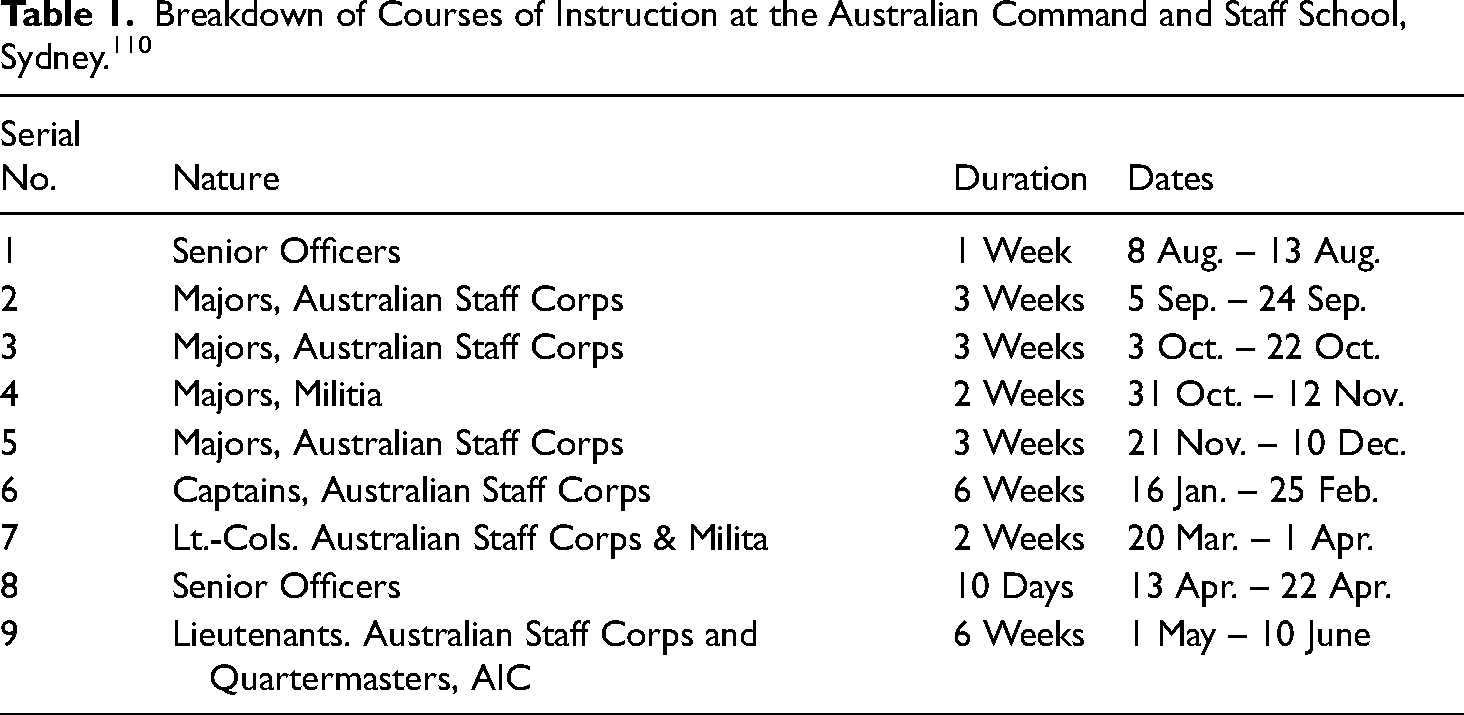
The courses provided training for both permanent officers and those of the militia, with courses running in serial and lasting between ten days and six weeks. (See Table 1 below). 94
Breakdown of Courses of Instruction at the Australian Command and Staff School, Sydney. 110
It was noted by the Minister of Defence that the school would fill a long-felt want within the army and its purpose was laid out as being:
To instruct commanders and staff officers of the various grades in minor strategy, tactics, staff duties and administration in the field.
In conformity with the principles laid down in the training manuals on these subjects to ensure uniformity of method in their application and a uniform standard of tactical thought throughout Australian Military Forces.
To give senior officers of all arms an opportunity of exchanging ideas on matters connected with the training and administration in the Australian Military Forces.
95
The organisation, armament and equipment of units and formations.
The tactical employment of all arms of the service, including co-operation with the Royal Australian Air Force.
The principles of training and systems to be adopted.
Staff duties, including co-operation between staff and troops.
Administration.
Movements, especially by rail and bus.
96
Military history and strategy.
Army organisation and administration.
Tactics.
Staff duties.
Maps and reconnaissance reports.
Field engineering.
Movements and quartering.
Mobilization
98
Each course was to comprise approximately 15 officers with permanent force officers receiving instruction in:
Those militia officers attending courses would receive a syllabus of instruction similarly based on that provided to Permanent Force officers.
97
Whilst undoubtedly less detailed than that of Camberley and Quetta, this curriculum followed broadly similar lines to that of the Junior Division of the Staff College which included instruction in:
As with other short courses established in Australia, the Command and Staff School was never intended be a direct replacement for British staff training. Instead, it served to allow Australian officers access to up-to-date training in a variety of operational and staff processes and establish uniform operational thinking across Australian military forces emphasising local strategic conditions centred on the defence of Australia and its role in securing regional security against potential Japanese hostility.
As with British examples, these proposals did not proceed completely unopposed, due to a dispute between two key figures. In the British case this disagreement was far-reaching and resulted in significant disruption to the progress of reform. In contrast, dissent in this instance came only from the Adjutant General, Major-General Carl Jess, and rested on a few minor points of language in the initial proposal which were quickly resolved. 99 Ultimately, despite the existence of some friction towards Lavarack‘s proposed establishment of the Command and Staff School, the school opened in August 1938, less than a month after the instructions for its implementation were sent out by the Military Board in July. 100 Thus, Lavarack had achieved his proposed aim in 10 months. That he was able to do so was partly the result of his own forceful personality within a small professional officer corps, but equally owed its success to the long-stated aim of the Australian General Staff and the Military Board to focus on the training of commanders and staff.
The effectiveness of this approach by the Australian Military Board is indicated by its response to the changes to staff training taking place in Britain in 1938. In February 1938, while discussions were taking place regarding the establishment of Australia‘s Command and Staff College, the Chief of the Imperial General Staff, Viscount Gort, sent a memorandum to the CGS’ of Australia, Canada, South Africa and New Zealand setting out the upcoming changes taking place in Britain and the justification for them. These changes entailed the division of the Staff Collage course into a Junior Staff Course and Senior War Course, the latter to be attended by a select group of high performing staff officers. 101 Australian officers being sent to Camberley would immediately progress to the Senior War Course, negating the need to return to Britain a second time. In contrast, British officers would take the junior course at Camberley, followed by an 8-year gap before undertaking the new War Course established at Minley Manor in 1938. 102 Gort also noted that, ‘although the age of British Service officers will gradually come down to “under 28” there will be no necessity for the age of Dominion officers to follow suit’. 103
Thus, although it entailed significant changes to the British structure of staff training, there was to be little direct impact on Australian training structures beyond the need to, ‘send to Camberley only officers we are convinced can absorb Minley in the following year and continue the present system.’ 104 Indeed, the biggest impact of these changes was felt by the Indian Army. With the reduction of the course at Quetta to 1 year, Lavarack believed that ‘we would get better value for our money if instead of sending anyone to Quetta, we sent an officer of about 15 years’ service abroad for regimental training and practical experience during collective training.’ 105 This policy adjustment would allow Australia to continue taking advantage of the training at Camberley and Minley Manor whilst also gaining additional regimental service, which many Australian officers struggled to obtain in the interwar period. 106 This proposal was never implemented as a result of the outbreak of war in September 1939 despite communications between both Lavarack and Auchinleck between March and December 1938. 107 Analysis of these changes within the Australian General Staff saw the senior course at Minley Manor identified as he most important for Australian officers attending courses in Britain. 108 It was noted that ‘the course at R.M.C together with subsequent employment in the Staff Corps and the increased age [Australian officers sent to Camberley at this point were generally in their mid-30s] makes the standard of staff training of our officers higher…than that of British Service or Indian Army officers’. 109 Whilst the testing of this view requires further research, the recognition that the Australian Army had adopted educational policies based on local requirements and the advantages this was perceived to give them over their British counterparts is of interest. It suggests that whilst still reliant on British institutions, the Australian Army had adopted measures based on its unique strategic requirements and local cultures which it believed negated any qualitative difference between its officer corps and that of the British Army.
Conclusions
This article the diverse educational requirements of the various dominion armies within the context of the British Empire. While equipped and organised along similar lines, following the same fundamental doctrine and able to fight alongside each other, it highlights the need for additional research into the nuances of officer education across the empire. Recognising the increased importance of wartime staff work, Australia pooled its professional experience into a Staff Corps and focussed post-war officer training on that of senior commanders and staff officers, ensuring the existence of a body of officers able to step into these roles in the event of the rapid expansion of the Australian Army for war. Making use of pre-war localised staff courses to train both militia and professional force officers, Australia was able to offer continued professional training and development in staff training, establishing a pool of locally trained officers for junior staff positions. Alongside this, they made use of British Staff Colleges to provide both higher-level staff training and the opportunity for selected officers to gain experience of British training establishments to help improve Australian local provision in key areas. This policy led to the ultimate establishment of the Command and Staff School in 1938 and the realisation that through extensive local training in staff work, Australia was capable of training large numbers of junior staff officers locally whilst still reliant on British colleges for higher level training. As a result, when it came to staff training, the dominions were able to take advantage of British training and methods whilst not surrendering local needs and requirements. Thus, the establishment of Australian staff courses represented a significant break from British methods by focussing on the creation of a pool of junior staff officers who were trained locally, and utilising Camberley and Quetta for its ability to train senior commanders and staff officers as part of the broader establishment of imperial interoperability.
Further research is needed to fully delimit the extent to which localised Australian training truly meant that Australian officers joined British Staff Colleges with more advanced knowledge than their British counterparts through an in-depth comparative analysis of curricula. However, what this initial foray highlights is that more attention needs to be paid to the nuances, local policies, and national priorities of the dominions within the broader context of an imperial army. It establishes a level of agency in the development of unique military institutions across among the dominions, whilst also ensuring that such cultures outwardly remained closely allied with that of the British Army. Whilst existing studies do acknowledge the development of localised educational practices across the dominions, the emphasis remains on the maintenance and development of a close-knit imperial army in the context of operational performance in the Second World War. By focussing on educational developments, this article expands our knowledge of imperial connectivity by highlighting the existence of significant divergence across the armies of empire which, whilst reflecting local priorities and attitudes towards officer education, did not significantly affect issues of imperial interoperability beyond the divergence of educational practices at a local level.
