




Abstract
This article examines the British army's short-lived Corps of Interpreters on the Western Front during the early stages of the First World War. It begins by establishing a benchmark for the regular army's French language capability in 1914. It then explores the interpreters’ recruitment process, employment, and the corps’ subsequent dissolution. Further insight into their motivation and suitability is then determined through a prosopographical analysis of their backgrounds and accounts of their employment. Overall, the article provides an important case study of the pitfalls of improvising military language capability during a crisis.
In September and October 1914, the British army hurriedly recruited, commissioned, and deployed nearly 200 French-speaking officers to support the British Expeditionary Force (BEF) in France and Belgium. Labelled semi-officially as the Corps of Interpreters, the organisation never really stabilised and by early 1915 it had been disbanded. 1 Its officers were then moved into other roles within the BEF or returned to their civilian lives. Unfortunately, this brief, fascinating, and unsuccessful experiment in the improvisation of military interpreting then became obscured and wrongly absorbed within the history of the Intelligence Corps, an organisation also created at the start of the war but with much greater longevity. 2 The erroneous historical conflation of the two organisations seems to have arisen because of an administrative decision to include the interpreters alongside intelligence personnel in the lists of those eligible to receive medals for service in 1914. 3 For later historians, this apparent synonymity was corroborated by the army's pre-war doctrine for organising such personnel. 4 But in the turmoil of 1914, things were not done by-the-book. This article restores the Corps of Interpreters’ historical independence and examines their contribution to what today would be called an army's language capability; ‘the ability to communicate with the populations, combatants, authorities and other actors in an area of operations’. 5
This inquiry also makes a contribution to the wider study of languages and war. Language scholars have noted that their military counterparts are generally ‘uninterested in languages’ whereas they have become ‘increasingly curious about war’. 6 Underpinning their interest is the idea that any war is an ‘intercultural space’ and also a ‘communicative space’, so examining these aspects can enhance our understanding of both war and warfare. 7 Within language research, particular attention has been paid to Western militaries’ experiences of using locally-hired, civilian interpreters in the Balkans in the 1990s and again in Iraq and Afghanistan over the following two decades. 8 These studies bring into focus the fundamental difference, first noted in the context of imperial history, between autonomous interpreting systems that use one's own personnel who learn the local language and heteronomous systems that employ foreign native speakers. 9 This, in turn, highlights the significance of interpreters’ loyalties or their perceived loyalties within conflict settings. 10 Also important is the institutional context because interpreters’ behaviours are ‘generally shaped by the institutions that recruit and employ them’. 11 In this regard, for militaries there seems to be a tendency to treat interpreters like a logistic enabler. It is also argued that, when combined with traditional translation discourses of them having to observe strict neutrality in their work, this has made it difficult to discern their personal agency. 12 Aggravating this situation is the extemporisation of military operations that has, historically, seen interpreters often thrown into their roles without prior training. 13
Regarding languages within the context of the First World War, the centenary of the conflict has acted as a catalyst for greater exploration. The scale of the war and its geographical spread means that it can be characterised as a multilingual environment, with numerous intercultural and communicative spaces. 14 The issue of scale also affects the militaries’ use of interpreters, with Franziska Heimburger arguing that ‘the First World War seems to be the first case in history of a mass deployment of military interpreters in coalition warfare’. She also observes, within the Franco–British context, that they had ‘no formal training’ and had to delineate for themselves the extent of their roles and duties. 15 Similarly, Chris Kempshall points to the significance of interpreters’ work in overcoming cultural and linguistic barriers. 16 Looking more specifically at the British army's relationship with the French language on the Western Front in 1914, coverage has often gravitated towards either end of the military hierarchy. At the bottom, there is the suggestion that, as regular or former regular soldiers, British ‘Tommies’ of this period were more comfortable speaking Indian languages than European ones. 17 The classic memoir example being of an old soldier trying unsuccessfully to communicate with a French barman in Hindustani. 18 At the other end of the spectrum, the variable linguistic competence of British generals when conversing with their French counterparts has been of considerable interest to military historians, especially when it aggravated or soothed problems of interallied command. 19 More pertinent to this article is the previous attention given to the French army providing their ally with uniformed interpreters. Arriving at the French Channel ports in August 1914, the British were met by over 500 men who were, in accordance with pre-war planning, attached down to battalion-level. 20 These interpreters were mainly reservist non-commissioned officers (NCO), many of whom had been selected because they worked or had lived in English-speaking countries. As well as fulfilling a command liaison function when in proximity to French units, they acted as a crucial interface between the British army and the civilian population, especially in relation to billeting and compensation for incidental damages. Unlike the British Corps of Interpreters, this heteronomous linguistic provision was successful and, as the BEF expanded through to 1917, the number of French army interpreters grew to around 3,000. 21
Methodologically, this study also responds to language historians’ calls for more detailed microhistories of ‘interpreters as people’, so as to understand individuals’ motives for undertaking the work, and their subsequent contribution at ‘the actual level of exchange’. The analysis also circumvents the ‘archival invisibility’ of interpreters that plagues historical inquiries within this field. 22 In the absence of any War Office interpreting policy files, evidence has been assembled from unit war diaries, India Office correspondence, contemporaneous newspaper reports, memoirs, school records, and the interpreters’ surviving personnel files. 23 In order to assess the Corps of Interpreters’ experiences and contribution from these sources, the article begins by investigating the baseline of the British officer corps’ French language capability on the outbreak of war. This section will also solve, at least for the French language in 1914, what Heimburger has called the ‘great mystery [that] surrounds the part played by the hundreds of qualified interpreters among the [pre-war regular] British officers of the First World War’. 24 The analysis will then move on to explore the interpreters’ recruitment and selection, employment, and the corps’ subsequent dissolution. By embracing prosopographical techniques to explore their backgrounds, additional insight is offered regarding their motivation and role suitability.
Army French
As Heimburger has explored in some detail, from the 1880s the British army encouraged its officers to gain competence in foreign languages. In the decade before the First World War monetary grants were given to officers who, usually after spending a couple of months in a country, could pass the oral and written examinations administered by the Civil Service Commission. 25 Therefore, when war came the Army List contained the names of 701 officers (regular, territorial, and retired) who were qualified as French interpreters, with 266 of them classified as first-class over second. 26 However, these raw numbers included officers who had qualified three decades earlier, which raises questions about their linguistic currency. 27 Studies into ‘language attrition’ suggest that even those who have achieved a high standard in a second language will see some degradation in their ability unless the skill is used regularly. This fading point is discernible around the five or six-year mark. 28 Therefore, even if some officers on home service could refresh themselves by visiting France, a more realistic cut-off for linguistic currency would be 1909 rather than 1887. 29 This leaves 240 officers, of whom 77 were first-class interpreters. 30 This formal capability amounted to only 1% of the army's regular and Territorial officer cadre on the outbreak of war. 31 Analysing the two largest groups (infantry and artillery) allows further insight. For the 119 regular officers within this sample, the Army List indicates which units they were serving with in August 1914. Of these, only 49 were in units that deployed to the Western Front before the end of October. Furthermore, almost 30% of these interpreters were killed or seriously wounded by that date and their distribution was random across the BEF with, for example, 1st Division having two and 4th Division ten. Looking more broadly at the infantry in August 1914, of the army's 145 regular battalions only 31 had at least one French interpreter who had qualified since 1909. There is, however, an indication that the army was seeking to increase the overall number of interpreters in the immediate pre-war period. From 1909 to 1912 around 30 French interpreters qualified per annum. It then jumped to 53 in 1913 and 76 in 1914. This shift coincided with a leadership change within Britain's General Staff and the refinement of preparations for the army's deployment to France. 32 Therefore, given that the BEF's formally-recorded language capability was growing but still rather limited, what about its officers’ latent ability to communicate in French?
Although many officers entered the regular army via the Militia, before the First World War the majority commissioned through the Royal Military College Sandhurst or the Royal Military Academy Woolwich. 33 Before reaching those locations, cadets had usually received a public school education which included French. 34 However, because these schools replicated their traditional methods for teaching Latin and Greek, the focus was normally upon written language. 35 During their initial military training cadets were then taught French and German by civilian native speakers. Sandhurst's French exams have not survived, but they are assumed to have been similar to German ones that ‘had a strongly military flavour’ and ‘would have been perfectly adequate to travel around Germany, or to converse’. Woolwich's teaching was similar, and in 1907 their instructor won a French government prize for his students’ attainment. 36 This progression from conservatively-taught schoolboy French to more vocationally-relevant army teaching suggests some underlying language capability for regular subalterns in 1914. 37 This pathway is illustrated by Geoffrey Snead-Cox who was bottom of his Downside French class in 1910. His father sent him to France ahead of the 1912 Sandhurst entrance exam, in which he came eleventh in French. He then qualified as a second-class interpreter shortly after commissioning. 38
At the next career stage, and although it was only taken by a self-selecting minority, the examination for entry to the staff college provides anonymised data on 863 language assessments taken by captains between 1909 and 1913. 39 Candidates were required to sit three-hour written papers for two languages and French was the overwhelmingly popular option, with 93% of candidates (Fig. 1) sitting it. The paper consisted of written translations to/from French, grammar, military terminology, and an essay. Additional insight is provided by one candidate's de-anonymised results. 40 Gerald Lea sat the exam unsuccessfully in 1907 and 1909. On those occasions, his percentage scores for French were in the low 60s. But in 1910 he got a Staff College place, scoring 74% in the French paper. In his final exams at Charterhouse in 1894, he had been at the top of the second quartile in French, which is similar to his positioning in the successful exam. 41 This implies additional practice before the third attempt and that his latent ability had been reflected in the earlier results. Such reliance on prior learning was later noted by the French examiner who observed that ‘candidates still believe in the fallacy that translating from French is so easy that it is not necessary to prepare for it’. 42 Overall, taking the evidence from both subalterns and captains, the picture of regular army officers’ French is a positive one. Beyond the one in a hundred with a formal interpreter qualification, there seems to have been a widespread basic knowledge of the language and perhaps also an inherent confidence that a sufficiency might be remembered when needed.
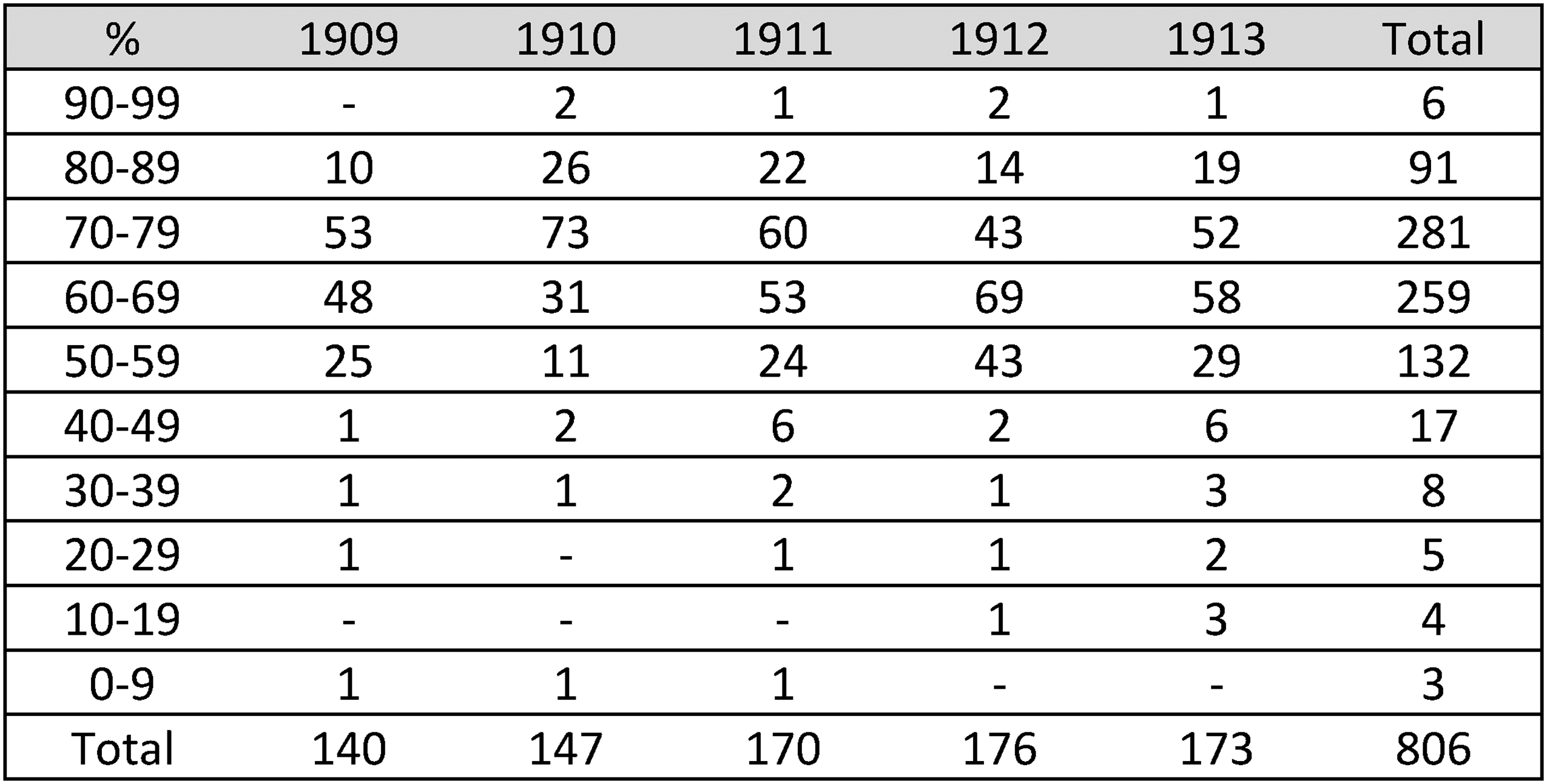
Candidates within mark bands in Staff College entry examination's French paper.
Improvisation
As already noted, the pre-war deployment plans for a BEF had included provision for French army interpreters who would join British units once they had crossed the Channel. In 1914, this link up occurred smoothly, the French personnel were successful in fulfilling their mission, and the small number of British officers with interpreter qualifications were presumably utilising their language skills within their war roles. So the obvious question arising is why the British decided to duplicate that language capability by creating their own Corps of Interpreters? The answer lies within the rather chaotic process by which Britain despatched a second wave of troops to the continent. This consisted of the 3rd Cavalry, 7th, and 8th Divisions formed, from late August to mid-September, of regular units recalled from imperial garrisons. 43 An Indian Corps was also on its way from the subcontinent, consisting of two infantry and two cavalry divisions. 44 These reinforcements would double the size of the original BEF, and all the new units would require interpreters to operate effectively. 45 However, the process of providing them was complicated by three factors; a likelihood that some British divisions would be deployed to Belgium, lack of staff continuity at the War Office, and the need to co-ordinate with the India Office to meet perceived additional requirements for their corps’ interpreters.
By mid-September, Belgium's war was going badly, with its forces having fallen back to the fortress of Antwerp. Increasingly besieged there by the Germans, their government appealed to Britain for assistance. 46 A political decision was taken to immediately despatch naval infantry and two of the newly-forming army divisions were also earmarked for deployment to Belgium. 47 In theory the Belgian army could have been asked, like the French, to supply interpreters. But lacking pre-war liaison and with a dislocated Belgian government, that was not a viable proposition in September 1914. 48 Therefore the British had to provide their own interpreters, which were, in turn, complicated by personnel changes at the War Office. The General Staff's officers had deployed en masse with the BEF, leaving their jobs to be backfilled by retired officers who had been recalled for war service. This disrupted continuity of work and degraded institutional memory at the very moment when the War Office's work was expanding exponentially. 49
Responsibility for providing interpreters fell to MO5(a), within the ‘special section’ of the Military Operations Directorate.
50
The problem landed on the desk of Captain Geoffrey Hoare, a pre-war director of a brewing company with earlier service as a reserve artillery officer.
51
Then in his mid-thirties and later described as ‘pushy and effective’ when working for his family's bank, in 1914 he impressed Major-General Charles Callwell, the new Director of Military Operations, as ‘a man with all his wits about him, but who sometimes positively frightened one by his unconventional procedure’.
52
He recalled specifically Hoare's approach to providing interpreters: “How many d’you want, sir?” I intimated that the authorized establishment was about seventy, but if we could find fifty under the circumstances we should have done very well. “I'll have them ready early tomorrow, sir,” he remarked, as if it was the most ordinary thing in the world […] Next morning the passages […] were congested with swarms of individuals, arrayed in the newest of new uniforms […] who were bundled off unceremoniously to regiments and batteries.
53
Callwell's post-war memory of this process is corroborated, to some extent, by the known dates of these men's appointments in September and October 1914 (Fig. 2). The task had also been made easier by the surge of patriotic volunteers who had earlier offered their services to both the Foreign and War Offices as interpreters. Indeed, in late August the War Office had to issue a communiqué stating that ‘the names already noted […] greatly exceeds the probable requirement’. 54 From the memoir accounts of the author Vyvyan Holland and the cartoonist Alan d’Egville, corroborated by other sources, it seems the volunteers were interviewed and medically examined at the War Office, undertook a Civil Service Commission language assessment at Burlington House, and were also required to supply character references. 55 If successful, they were commissioned, told to obtain uniforms from military tailors, and then hold themselves in readiness for call-up. 56
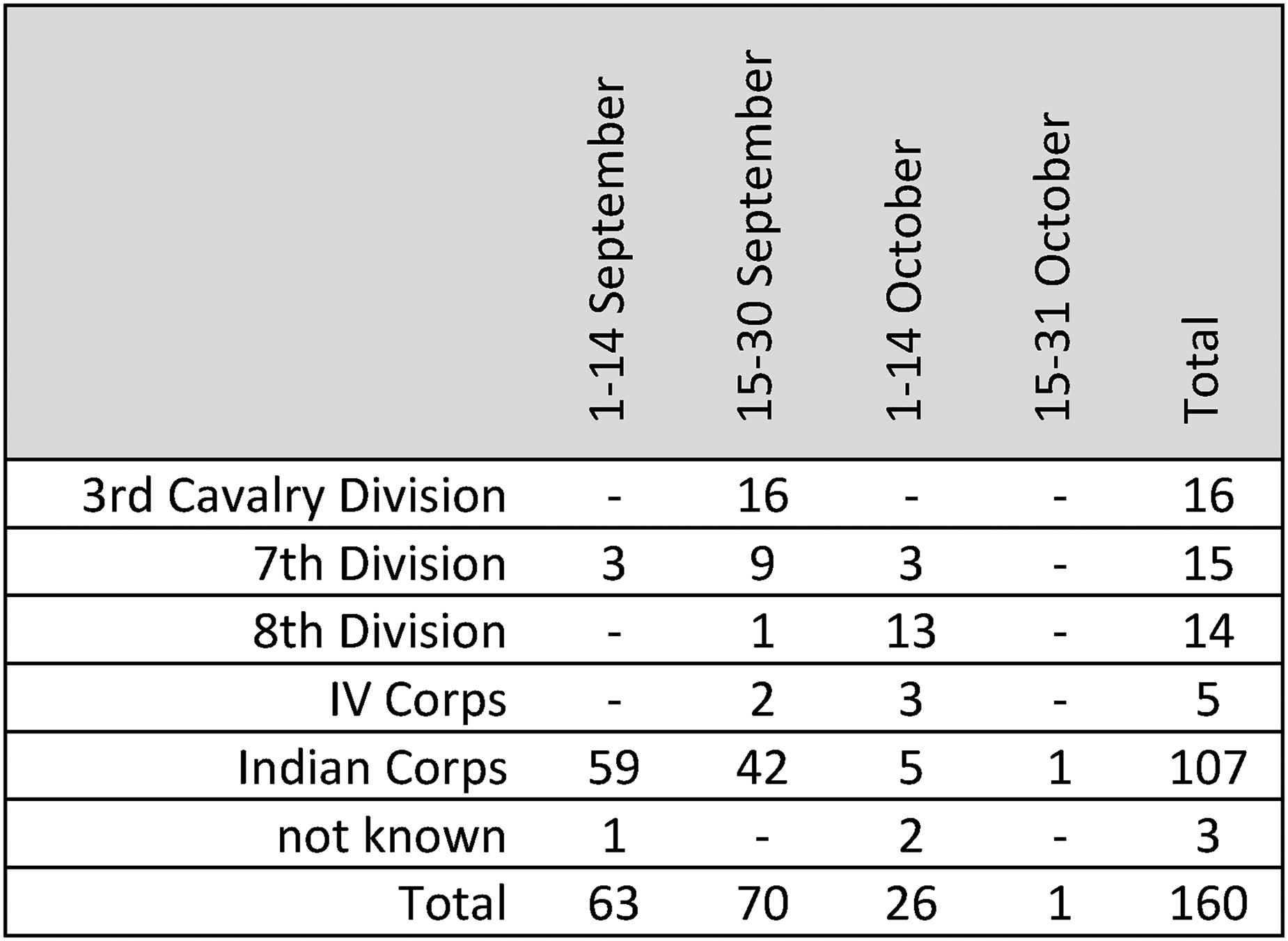
Known appointment dates to Corps of Interpreters, 1914.
As indicated by the dates and head-count in Fig. 2, the inbound Indian Corps was Hoare's main priority. This formation's needs were complicated by a desire to provide French-speaking interpreters with ‘recent knowledge of the Indian Army’ and a colloquial standard of Hindustani. The setting of that requirement presumably envisaged situations whereby Indian soldiers would be interacting with French soldiers or the local populace. To help achieve this end, the India Office in London seconded two civil servants to MO5 as language examiners. They also agreed that Indian Government officials, including Indian Army officers in political appointments, who were on leave in Britain could volunteer as Indian Corps interpreters. 57 That said, only a fifth of the more than a hundred interpreters who sailed from Southampton for Marseilles in mid-September can be said to have a clear connection to India. 58 Therefore, it appears that the requirement for men with Indian language experience did not fully manifest itself; perhaps due to the haste of their recruitment. Once they had departed for France, this group was commanded by Colonel Percival Marling, a retired officer, and holder of the Victoria Cross, who had been offered the job unexpectedly by a general he had known at Sandhurst. During their voyage to the Mediterranean, Marling organised training activities which included language lessons, boxing, and sword exercises. 59 Unfortunately, on arrival in the south of France they discovered that the French army had also assigned interpreters to the Indians. Both parties were then spread across the corps in mixed groupings and its headquarters lamented that a lack of consultation by the War Office had caused this duplication. 60
In contrast to the Indian Corps, whose interpreters had been recruited and despatched rather quickly, the men assigned to 3rd Cavalry, 7th and 8th Divisions had a more leisurely start to their war. Across September they joined their units in southern England, with their employment priority apparently being given to cavalry and cyclist units. 61 This mimicked the pre-war allocation of French army interpreters to BEF units, whereby a cavalry regiment would receive fourteen interpreters, as compared to an infantry battalion's two. 62 This distribution presumably envisaged mobile warfare and a greater need for interpreters with a reconnaissance screen seeking information from a local population. 63 However, when 3rd Cavalry and 7th Divisions landed in Belgian Flanders in early October the interpreters found their French to be of limited use because, as one of them pejoratively put it, ‘the language of the country was [Flemish] – a horrible mixture of bad Dutch and worse German’. 64
Eighth Division, which landed in France in early November, found its language provision more appropriate to their operational circumstances. 65 But, in bringing interpreters with them from England, they precipitated the demise of the Corps of Interpreters. Arriving in Le Havre, confusion had arisen as to whether the French army should also supply men to the division for interpreting duties. A fortnight later the BEF's Adjutant General (AG) decided to resolve this duplication of effort by dissolving the corps, ‘to send back to England all the British Officer interpreters […] and to stop the War Office from creating any more’. 66 Interpreters for all future reinforcements were to be supplied by the French. 67 The AG also pointed out to the War Office that he had not even known of the existence of a British Corps of Interpreters before mid-September, when told that over a hundred of them were setting sail to join the Indian Corps. The War Office seems to have raised no objections to the AG's decision and began informing already-commissioned interpreters in Britain awaiting orders, as well as new applicants, that their services were no longer required. 68
In November 1914, during the correspondence enacting dissolution, the AG had consulted with the BEF's Inspector-General of Communications (IGC). The latter's staff used the opportunity to highlight the importance of French language skills for officers on railway transport duties. 69 To meet this specific requirement, the logistics staff at the War Office had already, and completely separately from MO5's creation of the Corps of Interpreters, formed their own group of ultimately some fifty French-speaking ‘train interpreters’, mainly retired officers. 70 These men had arrived in France from late August 1914 and were commanded by Colonel Lionel Dunsterville, an Indian Army officer who would later find fame for exploits in the Caucasus in 1918. 71 The group came to be designated as train conducting officers (TCOs) and, informally, as a ‘Corps of TCOs’, until January 1915 when they were absorbed into the normal rail transport organisation. 72 In mid-December this language capability of the logistic organisation was augmented by eighteen recently commissioned French speaking Army Service Corps (ASC) officers, including two who had originally been selected for the Corps of Interpreters but had not deployed. Unlike their Corps of Interpreters and TCO counterparts these officers had received training in their military role between commissioning in October 1914 and their embarkation. 73
Interpreters
Using the aforementioned personnel files, supplemented by research in standard military-genealogical sources, it has been possible to identify 184 members of the Corps of Interpreters. 74 Regarding their general background, less than one in five of them (17%) were serving or former officers of the British or Indian Armies, either regular or auxiliary. These men retained their former rank and had an average age of 43. The remainder, who were newly-commissioned second lieutenants, had a similar age range (19 to 54) but were, on average, a decade younger. Details of parentage, education, and civilian occupation can be determined for 84% of the newly-commissioned interpreters. Of these, just over half came from the same social background as pre-war army officers; British descent, upper or upper-middle class families, private education, and either in a profession/high status occupation or living on their own means. 75 Generally, they had acquired French through their education and/or periods spent living in France. The other half (48%) differed from what might be called the officer class norm. Nearly all were ‘natural born British subjects’ through birth within the empire or, if elsewhere, to a British father. However, at least a fifth of this group was sons of fathers who had become British by naturalisation or were classified as aliens. Three were still aliens themselves (one Dutch, two Americans) and another three became British in adulthood (Swiss, French, Russian). Some were privately-educated and from prosperous backgrounds, but only one in ten was a graduate. Their occupations were generally less prestigious, but they were still employed in white collar roles. Many had lived in France for extended periods, but more for familial or employment reasons rather than education or leisure. Four of them were likely to have been bilingual in having at least one francophone parent. 76
The interpreters’ military status was envisaged as a non-combatant one. As the War Office explained to the India Office, their commissions were ‘merely to make them liable as officers to military law and to afford them the protection of the Hague Convention’. Furthermore, they would ‘in no circumstances […] take command of men’. 77 This policy was reflected in instructions issued by the Indian Corps, which told its units that their interpreters were not to serve in the front line, although those in cavalry units might need to be attached to a forward headquarters during reconnaissance missions. 78 Their secondary status was reflected in the interpreters’ clothing. Although ones with prior military service would have donned their old uniforms, those who were newly-commissioned wore only general service insignia. Some wore a white armband with ‘Int’ in black letters, and one sought to acquire, in violation of normal uniform conventions, the badges and buttons of the regiment to which he was attached. 79 The interpreters were also issued with revolvers; presumably for personal protection. 80 There are, however, examples of interpreters taking an active role in operations, such as Major Frank Norie, a former Gurkha officer, who was wounded and decorated while attached to a Gurkha battalion. 81 Another found himself in an infantry battalion officially as an interpreter, but in reality as a platoon commander. 82 Cecil Meares, previously an Antarctic explorer, also reported his active engagement in a firefight. 83 Overall, four officers were killed while serving with the Corps of Interpreters on the Western Front; all in October and November 1914. 84
A glimpse into the interpreters’ underlying motivation for this form of military service is offered by Vyvyan Holland. He later wrote that he had volunteered to interpret because he had been ‘looking around for something to do that would get me out to France before hostilities ceased’. 85 Alan d’Egville recalled a similar logic: ‘I had heard that it would take some months to get out to France if I joined a line regiment […] But interpreters were urgently needed. I would interpret’. 86 Those already in uniform similarly saw this role as a fast-track to the fighting. Ralph Hamilton, then commanding a Territorial artillery battery, had ‘hunted around to see in what possible capacity I could get out to the Front’ and was accepted as an interpreter for 7th Division. 87 Chance connections also eased this process. For example, George Calderon, an author in his mid-forties with a range of language skills, also wanted to ‘get to the front as soon as possible’. Advised in August 1914 to take riding lessons to make himself a viable candidate for interpreting, he was invited to accompany the Royal Horse Guards because the school's chief instructor had recommended him to the regiment's colonel. 88
Regarding their duties, during their divisions’ initial, mobile operations in September and October 1914, the interpreters found themselves carrying out command liaison between French and British units, conducting route reconnaissance, examining enemy prisoners or documents, searching for alleged spies, arranging medical assistance, supervising burial of the dead, and acting as guides and despatch riders. They also carried out billeting work and the requisition of local supplies.
89
Once trench warfare set in, these latter tasks came to the fore alongside other administrative duties. For example, in December 1914, George Vereker, a Foreign Office clerk in his mid-twenties, found himself as secretary and translator for a sanitation meeting with civic authorities.
90
The same month an anonymous interpreter attached to a cavalry unit outlined his varied portfolio: Assist mess president to rustle grub for officers’ mess […] Discuss all claims for damage to or goods supplied by inhabitants […] ride behind the colonel on the march and pick up the right and best roads, examining any peasants necessary en route […] find places for bivouacs, or assist billeting officer […] hang around the person of the colonel as general mouthpiece; assist various others by word of mouth or act of hand […] Galloper [for messages …] Find everything that's wanted […] water, wood, grub […] straw, hay […] Lead patrols […] and the last three days I have charge of the ration wagon and take up the day's rations from advanced base.
91
It is clear therefore that British interpreters were undertaking similar tasks to their French counterparts. However, it can be assumed that a native-speaking NCO would probably be able to navigate the socio-cultural nuances of rural northern France more efficiently than a middle-class British officer. 92
When dissolving the Corps of Interpreters in November 1914, in addition to the fact that they duplicated the interpreters provided by the French army, the BEF's AG justified his decision on the basis that they were: For the most part of little value, as they do not fulfil requirements of knowledge of the country, localities and inhabitants, nor of the laws and procedures of requisitioning [and] billeting […] and they cannot act as intermediaries between [British troops] and the civil population in a way which is entirely acceptable to both.
93
This perspective was endorsed by a Life Guards officer who recorded at the time that his unit's interpreter had been ‘very useful […] although not quite in the way intended’. More generally, he felt the dissolution decision was correct because: If we had been campaigning in China, no doubt interpreters would have been essential. But in France many have merely been a nuisance, for the majority are too old for subordinate rank, and also, never having done any soldiering, are usually hopelessly at sea. Some of them too were bad linguists, so there was little to justify their existence.
94
Poor discipline was also an aggravating factor in the AG's perception of the interpreters. A week after arriving in France, one of their number with the Indian Corps had noted in his diary that ‘unfortunately some of our fellows have not been able to behave’.
95
The AG provided more detail in his letter to the War Office: There has already been a certain amount of trouble caused by these gentlemen. Two have been tried by court martial for drunkenness; two were placed in arrest and ultimately sent to England […] and I am not convinced that [their] general conduct […] is such as will bring credit upon the service.
96
Up to mid-November 1914, when the AG sent this letter, across the whole BEF, only five officers had been dismissed for drunkenness. Two were from the Corps of Interpreters and a third was one of Dunsterville's TCOs. 97 Therefore it is unsurprising that the AG had taken an interest in the interpreters. He would also have been fully aware of the two who were arrested and sent home without a court martial. One of them was Nicolaas Kampers, a Dutchman who had fought for the Boers. Denounced as a bankrupt fraudster by previous business associates, his case had been referred to the counter-espionage staff at the War Office, prompting his recall to England and investigations that substantiated the accusations. 98 Another, and later, disciplinary case was that of Spenser Thornton, a stockbroker in his early forties. He was detained after loudly and publicly denouncing a British general as “quite incompetent” and suggesting he should be shot. When questioned, he asserted that ‘as an Englishman he [had] the right of free speech’. Taking the view that Thornton was ‘to all intents and purposes a civilian’ and that he ‘may not have realised the seriousness of his actions’, his superiors suggested that his ‘chattering [should] not be converted into a military crime’. He was, therefore, simply returned to England where he parted company with the army. 99 Dunsterville also noted additional disciplinary difficulties, with four of his men ‘sent home as useless’. 100
After the dissolution decision, units and formations in France were given the option of retaining the services of their former British interpreters. But with French army interpreters now written into Establishment Tables, these men had to be employed elsewhere. 101 As Fig. 3 shows, this attritional process then played out over almost two years as the former interpreters were either returned home or absorbed into other roles; the latter usually necessitating a change of military status and transfer to another cap-badge. Most of the departures from the Corps of Interpreters had occurred within six months, but a fair number remained with the Indians until their departure for Mesopotamia at the end of 1915. 102
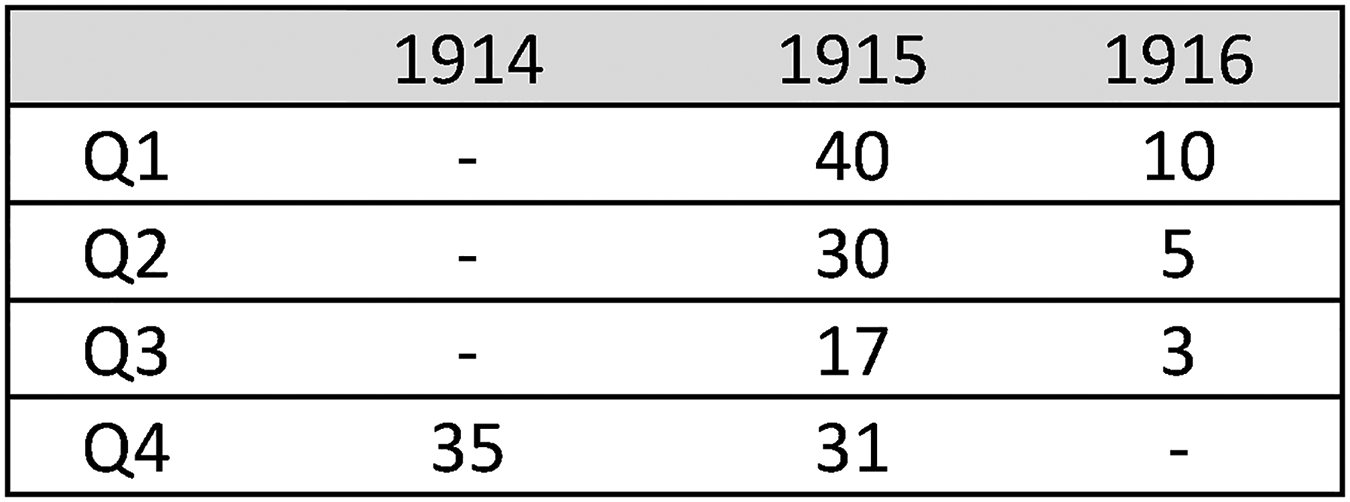
Known exit dates from Corps of Interpreters.
Some interpreters remained for lengthier periods with their original formations. For example, Douglas Uzielli, a stockbroker in his late 40s, made himself useful in 8th Division until 1918 by successively commanding a battery of improvised trench mortars, running a light railway and overseeing salvage work, before becoming an aide de camp to the divisional commander. 103 Similarly, in 7th Division, Harry Appleyard, a furniture manufacturer in his late 30s, transferred to divisional logistics where he remained until at least the end of 1917 as an ASC officer. 104 Others transferred to the regiments or battalions to which they were attached because they had, in effect, served a lengthy period of probation and were viewed favourably by their commanding officers. 105
A few took the dissolution badly. Leon Wilson, a 30-year-old journalist, protested that it ‘savour[ed] too much of disgrace’. Others were more stoical, like Reginald Dodgson, another young journalist, who reflected that ‘having no previous military experience I hardly deserve[d] a commission’. 106 However, as Fig. 4 shows, the overwhelming majority of the corps continued to serve in France. In particular, their language skills found a good home in transportation, supply, procurement, finance, and provost appointments. Those with business and legal experience, such as Arthur Herbert, a former railway director, were also suitable for negotiating land use, contracts, and claims with the French authorities. 107
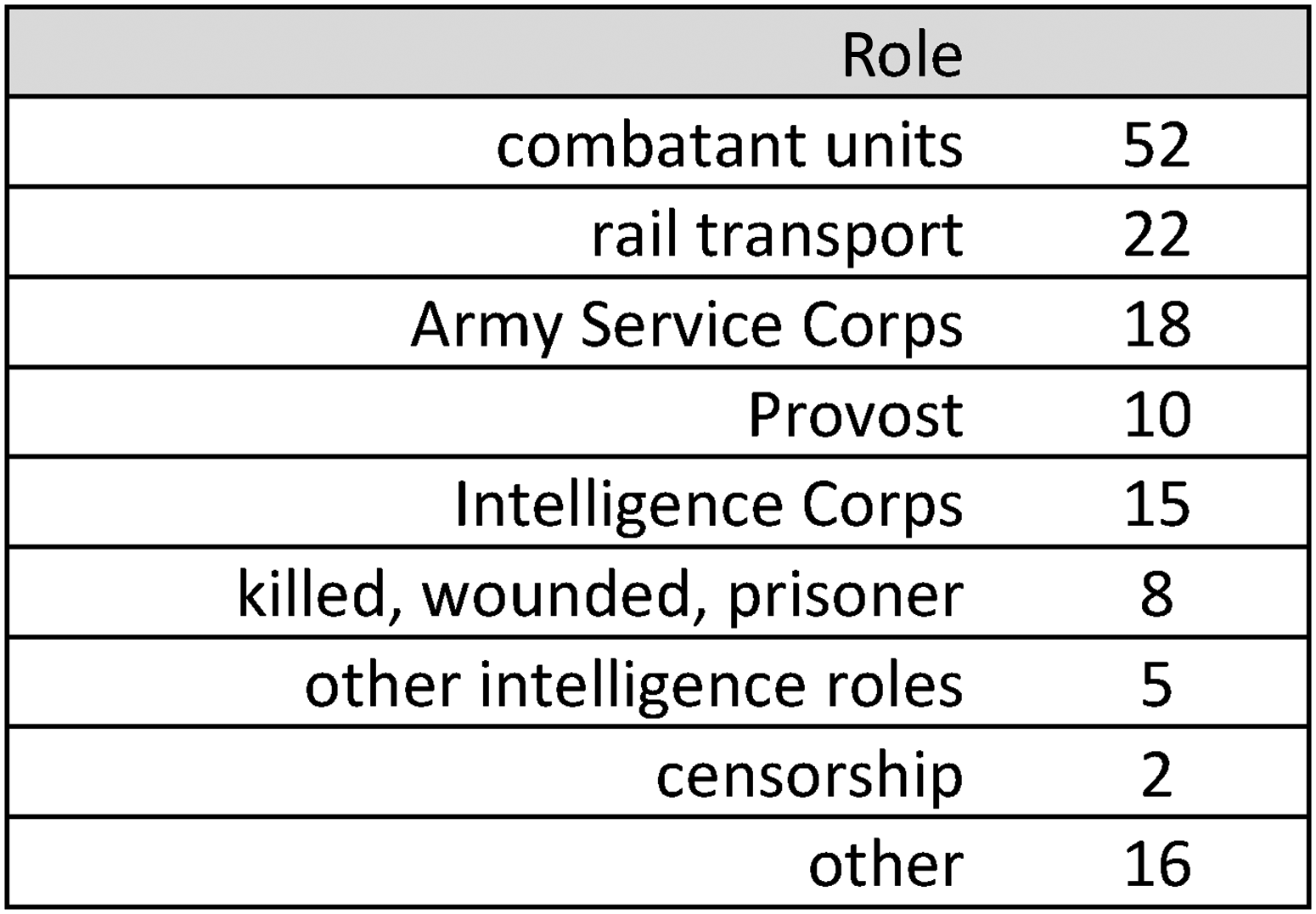
Subsequent commissioned employment of Corps of Interpreters.
The interpreters’ language skills were also a natural fit for intelligence and censorship; especially if they also had languages beyond French. One interpreter, however, was rather too keen to pursue a future in intelligence. At the start of the war Harold Darnton Fraser, a 30-year-old journalist, had tried unsuccessfully to join the Intelligence Corps and subsequently made it clear that he felt ‘his linguistic and other talents were wasted on the duties of a mere interpreter’. In January 1915, while serving with the Indian Corps, he ‘submitted a report purporting to have been dropped by a German agent’. This aroused his superiors’ suspicions and, after handwriting analysis at Scotland Yard, the counter-espionage authorities concluded that he had forged the document. He was arrested, returned to Britain, and dismissed. 108 Others made more successful entries into that world. These included George Bruce, a banker, who transferred directly into the Intelligence Corps and later specialised in running espionage networks. 109 Similarly, Walter Wilkinson and Philip Pipon, both of the Indian Civil Service, became intelligence officers focused upon countering any potential subversion of Indian soldiers. 110 Another example is William MacQueen, a student in his mid-twenties. After serving as an interpreter with 7th Division, he was recruited by the Secret Service and went to Rome as their liaison officer. He was subsequently removed from Italy by the British authorities for peculiar activities and an underlying mental health condition was later diagnosed. 111 In this instance, the hasty recruitment of interpreters in 1914 without proper background checks seems to have been the underlying fault. 112
Conclusion
The modern conceptualisation of language capability stresses the interdependence of understanding both languages and local cultures. 113 Fundamentally, the Corps of Interpreters provided the former but not the latter. In its pre-war planning the army had, consciously or unconsciously, recognised the need to have interpreters who could do both. Hence the considerable staff effort invested in sourcing them from the French army. However, in the crisis atmosphere of September/October 1914 a quick-fix was improvised when an Indian Corps was already on its way and newly-raised divisions were unexpectedly destined for operations in Belgium. This hasty choice seems to have been caused by some loss of institutional memory, with retired officers covering for the regulars who had gone off to war. But it was perhaps also exacerbated by Geoffrey Hoare's businesslike approach which seems to have been more can-do than the War Office's bureaucratic norms. The counter-factual of him consulting with the BEF and/or the French before acting may have resulted in French army interpreters going to Belgium with British units. But, equally, time was short and enthusiastic men with appropriate language skills were in abundant supply. Pitchforked into war without military training or even socialisation into the army's disciplinary norms, the Corps of Interpreters seem to have made themselves useful in the autumn of 1914. But it was in a manner that might be described as miscellaneous duties enhanced by their language skills, rather than in making a unique contribution within the intercultural space. The interpreters were clearly valued by their units and headquarters, but the low-level utility of the many was obscured, at least in the eyes of AG BEF, by the bad behaviour of a few. That said, accounting for 60% of officers’ drunkenness convictions in the first few months of the war was not a good look for the interpreters.
The wider context of the BEF's language capability is also important. As this article has shown, the latent French language skills of British regular officers were much greater than has been previously acknowledged. Although the distribution of those with a formal interpreter qualification was uneven across the BEF, most of the regular officer cadre had received some prior French language training. Furthermore, by November 1914, when the decision was taken to dissolve the Corps of Interpreters, these men had spent several months in France. Although not a conventional language immersion, it is fair to assume that their rusty Sandhurst or Woolwich French had been lubricated by interaction with the local population. Indeed, when facilitating the exit of their interpreter, an artillery unit reported that the ‘battery officers now know sufficient French to meet most requirements’. 114 In this situation, and given that the French army was more than willing to supply an optimal solution to units’ perennial challenges of negotiating billeting, requisitions, and damages, the Corps of Interpreters could only offer an incremental uplift to the BEF's overall language capability. 115 The negative picture is reinforced by the example of the TCOs, where availability and command of French were similarly privileged over suitability and utility. This contrasts with the approach taken by the ASC, albeit on a smaller scale, where French speakers’ military value was enhanced by professional training in logistics before their deployment. This model of specialisation enhanced by language ability can perhaps also be discerned in the eventual destinations of the erstwhile Corps of Interpreters. Some remained with their original units for extended periods making themselves generally useful, others transferred to combatant roles, but the majority were recycled within the military system into roles in which their language skills were needed, but a cross-cultural capability was not.
As well as highlighting an example of the utilisation of civilian expertise in total war, this article has also taken forward – in a modest way – the wider historiography of languages in war. By embracing the insights provided by prosopographical research, it has offered an exemplar of how further investigations might be conducted by approaching the subject more through personnel than policy. It is therefore worth highlighting, within the First World War's communicative spaces, that beyond the BEF other groups of men were recruited by the British army to act as interpreters. Their work encompassed Prisoner of War camps, as well as support to the forces in Egypt, Mesopotamia, and Salonika. 116 Future research into these examples might reveal additional nuance regarding the creation of language capability, especially for the Middle Eastern theatres where the intercultural dynamics were complicated by imperial contexts. 117 But whatever directions are taken, using the rich resource of personnel records should greatly enhance our understanding of interpreting in wartime.
Footnotes
Acknowledgements
Thanks are offered to Suzanne Foster (Winchester), Tim Halstead, Ben Hodges, Merlin Holland, Pamela Hunter (Hoares), Caroline Jones (Wellington), Christopher Kendall, Steve Parsons (Downside), Adam Prime, Harry Richards, Lee Richards, Catherine Smith (Charterhouse), and Andrew Weilandt for supplying source materials. Also to the ‘Secret Soldiers’ project volunteers, especially Antony Baxter, for sifting hundreds of potential Intelligence Corps officers and creating a ‘discards pile’ that included the interpreters.
Funding
The author(s) disclosed receipt of the following financial support for the research, authorship, and/or publication of this article: Initial research by the ‘Secret Soldiers’ project, which contributed indirectly to this article, was funded in 2017 by the ‘Everyday Lives in War' First World War Engagement Centre, based at the University of Hertfordshire which was itself funded by the Arts & Humanities Research Council.
