



Abstract
Unlike the French and English India, the Dutch East India Company did not shift to recruiting predominantly Indian soldier personnel for service in India, sepoys, from the 1740s onwards. Although Dutch Company (VOC) remained much more reliant on European recruitment, it did in fact also recruit sepoys in India. These soldiers remain little noted in the sources and the historical record. This article will explain why the VOC did not follow the French and English lead. The VOC’s late acceptance of sepoys as full-time soldiers meant it could not effectively compete with either French or English companies in India.
I Introduction
In the summer of 1768, Captain Sing Alap Alap was worried. The infantry company he commanded was about to be transferred from its current garrison in Bimilipatnam (Bheemunipatnam) in present-day Andhra Pradesh to Batavia (Jakarta), where the troops would be demobilized from the service of the Dutch East India Company (VOC). His company had been recruited on the Indonesian island of Madura in the summer of 1761 for service with the Company on Ceylon, where the VOC was engaged in a struggle with the kingdom of Kandy. 1 Upon arrival in Colombo, the soldiers had been ordered to deposit in the armoury the pikes and Kris with which they had been equipped back in Madura. 2 Instead, they were issued flintlock muskets. They took these weapons with them when serving on Ceylon during the war with Kandy and again when they were transferred to Negapatnam on the Coromandel Coast of India and thence to Bimilipatnam. 3 Their role in Bimilipatnam was to bolster the VOC’s garrison in order to bolster the Company’s position when negotiating a new lease on the town. 4 When a lease had indeed been concluded, the company was ordered to return to Java to be dismissed from the company’s service. But the pikes and Kris were property of the Madura sultan. If the troops arrived in Madura without them, the company commander would pay for their loss. He therefore requested the Coromandel Government to be allowed to stay on in VOC-service. 5 This request was granted, but only for the time it took for the VOC officials to figure out what had happened with the weapons. Nearly 5 months later, on 29 August 1769, the government of the Coromandel Coast reported to Batavia that the weapons had indeed arrived from Colombo and that they would now ‘not hesitate to disband the supernumerary native warriors’. 6 Indeed, the message was delivered by the vessel Vreedelust, which already transported 30 men, with the remainder of the company, which had been 211 men strong when recruited in 1761, to follow on the Vlietlust. In so doing, the VOC disbanded a company of infantry which had served in its army for 8 years and which gained considerable experience in the war against Kandy and its deployment in Coromandel. The company would not immediately be replaced, but during the 1770s, the VOC would be forced to hastily recruit new troops in Coromandel as the threat of Mysorean attack loomed large, raising the question why the VOC did not opt to retain the services of an experienced company.
This article will examine the recruitment of soldiers for the service of the Dutch East India Company in eighteenth-century India. It posits the question why the VOC did not follow the development of British and French practice where, from the 1740s onwards, small European garrisons and field forces were backed up by large numbers of locally recruited troops, drilled and armed and officered on European lines: sepoys. 7 The VOC did not follow this trend, continuing to rely far more heavily than either of its European rivals on recruitment of soldiers in Europe, incurring significant costs in the process. 8 Why did the VOC not follow the French and British lead and what were the consequences of the failure to do so for the military position of the VOC in South Asia? How did troops recruited in India relate to the troops which the VOC recruited in Southeast Asia, like Sing Alap Alap’s company?
The Dutch East India Company was for a substantial period of time the most significant European military power in Asia. From at least the fall of Malacca in 1641 until the outbreak of the War of Austrian Succession in Asia in the 1740s, the VOC employed more military personnel in the area than any of its European rivals and it made the most serious efforts to construct fortifications that could withstand regular sieges and at times employed substantial naval forces both in Europe and Asia. 9 Gerrit Knaap has convincingly argued that conceiving the Company as a trading firm is misguided, as most of the products sent to Europe were in fact acquired through taxation or land-rents enforced, ultimately by force. 10 While the VOC’s conquest of Java in the eighteenth century has been at the heart of a number of studies, these often focus on the company’s rivals, rather than the military system and grand strategy of the company itself. 11 These are in themselves of course fascinating and entirely valid approaches, but we are left with a few studies of the company’s military itself: how it was financed, equipped, trained, and recruited. In this general lacuna, the lack of studies on the military recruitment in Asia itself is most conspicuous, with the few studies there are focusing on the seventeenth century and Southeast Asia. 12 For the eighteenth century, the Company is often held to have been ‘pacified’, contenting itself with a commercial focus. 13 The tendency to underplay the military role of the Company is exacerbated by the personell administration, which is at the same time very a very rich and poor source, depending on the groups we are interested in. While the fates of individual European soldiers are well documented and individuals can be followed through the sources, this is not the case for the Asian troops, who were often not included in general statistics of the Company’s forces at arms. This article will argue that the Company did indeed recruit substantial numbers of soldiers in India, but these do not appear in the personnel files. 14 These considerations make it logical to focus on the soldiers which the Dutch East India Company recruited in Asia, with a special focus on the eighteenth century and on South Asia in particular. During this period, in this area, the French and later English East India Companies would make the transition to recruiting large numbers of soldiers in India, who were drilled and armed in European fashion. The VOC was late and hesitant to follow this development, raising the obvious question why this was so but also what the effects of its continued reliance on European soldiers were on the Dutch Company. The eighteenth century was a period of relative and absolute decline of the power of the Dutch company, with a number of notable defeats on the battlefields of India and Sri Lanka. Can this decline be attributed to the choices made in the composition of its forces? 15
Comparing companies: the VOC and the EIC
The idiosyncratic approach of the VOC to the composition of its armed forces in Asia can best be illustrated by a comparison with the other large European chartered company in Asia, the East India Company (EIC). In the English case, the development of the company’s military came later than in the Dutch case. Although the EIC had famously assisted the Persian Shah in the capturing of Hormuz in the 1620s and had during Josiah Child’s tenure had even waged war with the Mughal Empire. But on the whole, the EIC was a far more pacific organization than the VOC, which backed up its claims to a monopoly of the fine spices with forces and which waged an extensive on-and-off campaign against the Estado da Índia from at least the 1630s onwards. 16 The EIC maintained but few soldiers and its fortifications were not intended to resist full-blown sieges. 17 This would start to change from the 1740s onwards as the EIC became involved in what in Europe was styled the War of Austrian Succession and in Britain and its Atlantic colonies become known as the War of Jenkins Ear. In contrast to the Spanish Succession War, the EICs of France and England now became belligerents and were supported by their home governments with reinforcements of men, money, arms, and ships. The French company initially had the upper hand, as it enjoyed better support from its home government and had initiated a policy of recruiting soldiers locally, but arming and training them on European lines. 18
These soldiers, ‘sepoys’ could be recruited quickly in relatively large numbers and were accustomed to local climatic and dietary circumstances. During the British siege of Pondichéry in 1748, its garrison was composed of 1,800 European soldiers and Topasses, as well as 3,000 sepoys. 19 During post-war period, neither side reduced the armies they had amassed, but rather retained their troops and rented them out in service of ‘country powers’. 20 The collapse of Mughal imperial authority was both a cause and a result of these struggles and both French and English companies gained valuable experience. Compared to the pre-war establishments, both companies now maintained relatively large forces. De Bussy, during his campaign in the Deccan in the early 1750s had 5,000 to 8,000 men at his disposal. 21 Over the coming four decades, the number of troops at the disposal of the EIC too would only ever increase. When Robert Clive went to Bengal in 1757, he took with him an army of some 800 European infantry (both from the Company’s Madras Garrison as well as the 39th infantry regiment), and 1,200 sepoys. 22 By 1763, the EIC maintained 18,230 soldiers in India. Two decades later, the army in Bengal alone amounted to some 34,000 men organized in 1,000 men battalions. 23 By the mid 1790s, the EIC maintained an army of some 73,000 men in India. 24 The vast majority of these soldiers were Indian sepoys. The effectiveness of the individual soldiers and their units in this army had improved over time as well, to the point where British officers were worried they might be training these troops to eventually defeat the EIC itself. 25 To be fully effective, the European focus on infantry had to be balanced out by a credible cavalry component which could protect the supply lines of an infantry army on the move. 26
The composition and development of the VOC’s forces in the same area of operations provide a marked contrast to this shared Anglo-French story of local recruitment and increasing effectiveness of Indian-recruited infantry backed up by small contingents of both European infantry and naval power and locally recruited light cavalry. Even late in the eighteenth century, the VOC continued to rely far more heavily on European military labour. In December 1777, the VOC-garrisons on Ceylon, for example, amounted to 3,252 men, of which 2,422 were European infantry and artillerymen. The remainder was made up of 686 Oosterlingen (‘Easterners’, or ‘Malays’ from the Southeast Asian archipelago) like Sing Alap Alap’s troops a decade before, and 142 ‘free moors’. 27 In this quite typical peace-time year, when the Ceylon garrison was if anything slightly larger than usual, European troops made up nearly 75 per cent of the military labour force on Ceylon.
The reliance of VOC on European recruitment to fill its ranks is also apparent from the fact that its ships were much more heavily manned than either French or English Indiamen. During the 1730s, for example, the EIC would transport 14,788 men to Asia (both crew and passengers) on 154 voyages, or 96 men per ship on average. These numbers would steadily increase and by the 1760s, after the conquest of Bengal, the EIC would transport 24,471 men on 177 voyages, or 138 men on average per ship. 28 During these same two decades, the VOC transported 74,300 men on 375 voyages during the 1730s, or 198 men per ship on average, rising to 85,500 men on 292 voyages (292.8 on average) during the 1760s. 29 Asia-bound Dutch Indiamen in fact served as troop-transports, adding a range of logistical difficulties to an already tortuous passage. A large part of this difference will have been the need to supply the VOC’s Asian positions with European personnel, the largest category of which were soldiers. Maintaining a large force of European soldiers in Asia imposed considerable costs on the Dutch company. Yet, while the French and English companies shifted decisively to the recruitment of soldiers in India in the 1740s, the VOC did not follow suit. Since wastage levels for European troops were significant, recruiting soldiers who were already acclimatized to local conditions could be a considerably more efficient use of manpower. Yet, until the last decade of its existence, the VOC did not see the sepoys it recruited in India as a replacement of European troops, which it considered the mainstay of its forces.
II. Multiple militaries: recruiting Asian troops, conditions, and remuneration
But the VOC did in fact recruit military labour in Asia itself. Indeed, when approaching the sources one is struck by the wide diversity of military labour which the company drew upon. ‘Oosterlingen’, sepoys, Chegos (also chogans), Topasses, Lascorins, ‘Peons’ even a small contingent of African slave-soldiers in its small fort on Kharg in the 1750s. 30 All this raises a number of questions relating to the use of these Asian (and African) troops by the VOC. Why did the Dutch Company persist in its use of predominantly European troops while the costs are to us so obvious? This article will focus on the recruitment of soldiers described as sepoys and chegos, since peons, lascorins were often regarded more as police forces rather than soldiers fully capable of replacing European infantry in the field and the topasses were, by the late-eighteenth century merged with the European infantry, at least in Cochin. 31 It is important of course to note that the terminology used derives from the company itself, which recruited different types of soldiers based on its needs and on prejudices and stereotypes of the ethnic and social groups these troops derived from. Payment levels were not uniform, for example. During the war with Kandy on Ceylon in the 1760s, for example, European soldiers and soldiers recruited in Southeast Asia (‘Oosterlingen’) were paid roughly nine guilders a month, Lascorins recruited on Ceylon were not paid if they held accommadessans (land grants) or otherwise not more than 36 stivers per month (just short of two guilders). Sepoys were paid 7 to 7,5 rupees, valued at 30 stivers each so equivalent to some 10,5 to 11,25 guilders a month. 32 While recent research has argued that the Company paid its sailors of various origins roughly the same and they served in similar circumstances, this was not the case for the company’s soldiers. 33 Chegos only served in small numbers on the Malabar Coast, where the term was used to denote Hindu soldiers (‘heathen’ in the sources), in contrast to the term Malabari sepoy, who were by 1790 regarded as always being Catholic. In this article, I will use ‘sepoy’ in a non-specific sense to denote Indian soldiers recruited and armed to fight as European infantry. 34 Of course, the terms by which the Company distinguished between different types of recruits would not perhaps have been the terms used by the groups themselves, and the different pay levels and other privileges accorded to certain troops could lead people to identify as certain groups. For example, topasses were allowed to wear hats, whereas Malabari sepoys were only given a soft cap (muts). Chego officers were given boots, but Malabaris sepoy officers were given shoes. 35
The VOC’s preference to recruit European soldiers was not absolute. In case of crises or when the need arose to quickly increase the armed forces available to the company, the VOC quickly recruited more personnel locally. The best example of such a crisis is the war with Kandy on the island of Ceylon (Sri Lanka), between 1760 and 1766, when the Company’s position on the island had to be reinforced by the arrival of more troops from Batavia and Europe, as well as by recruitment in India in both Malabar and Coromandel. Thus, in March 1762, the VOC’s army on the island counted no less than 7,294 men, of which only 2,447 were European, though this was the single largest contingent. The remainder was made up of 2,387 ‘Malays and Javanese’, 1,526 sepoys from India, 723 Malabar and Colombo natives (likely topasses), 124 ‘moors at Colombo’, and 87 Batavian Christians. 36 But when peace was signed in 1766, the armed force was quickly reduced, though the European forces were kept roughly at the same level. In December 1769, of a total of 4,134 troops resorting under the Ceylon Government, 2,667 were European. 37 The retention of European troops was considered important enough to increase wages in January 1780. 38 One obvious answer to the question of why the VOC did not recruit more sepoys and did not retain them as part of its permanent forces is that the troops did not suffice in practice. Indeed, VOC reports are replete with complaints of the quality and behaviour of the sepoys, from complaining that they were poor marchers in Ceylon in 1764, to accusations of ill-discipline and cowardice in the face of the enemy in Malabar in the 1770s and Negapatnam in 1781. 39 But even this straightforward answer only raises more questions. For why did sepoys not suffice in Dutch practice, while equivalent troops did provide valuable services in both French and EIC service? This question forces us to re-examine the recruitment patterns, remuneration, and contractual conditions of service of these troops in comparison to European soldier to see if the VOC’s treatment of its sepoys as part of the problem.
Contracts for troops recruited in India are relatively rare. One exception is the series of concept contracts for Frenchmen to be recruited in Tranquebar for service on Ceylon in January 1765, which the VOC negotiated with the Frenchman Hugel (no first name was given). 40 Contracts for recruitment of sepoy or Chego troops are not available, but correspondence during the war with Kandy provides some different perspectives on the recruitment process. Interestingly, no standard procedure seems to have been followed. In some cases, mention is made of European officers recruiting in the VOC’s possessions at Negapatnam and Cochin. Interestingly, in at least some cases, French officers were used for this, likely using their prior experience in French service. 41 But in other cases, recruitment was left to sepoy officers themselves, making them in effect mercenary companies under their own officers. 42 The lack of written contracts might underline the fact that the VOC was a relatively unappealing employer with no contracts drawn up but relying on verbal agreements and correspondence with the recruiting officers. Alternatively, it might simply mean that locally drawn-up contracts were not considered important enough to copy and thus were not forwarded to Batavia or the Netherlands. Instead, the costs of the employment of locally recruited soldiers were copied in the general accounts of the VOC-commands in which they served. This is perhaps the more likely option, as the accounts make clear that the soldiers did not merely draw a salary, but were also awarded rice at a set amount. This would have required a contract that stipulated amounts and quality. The sources mention competition for recruitment in Coromandel with the EIC and with Hyder Ali in Malabar. 43
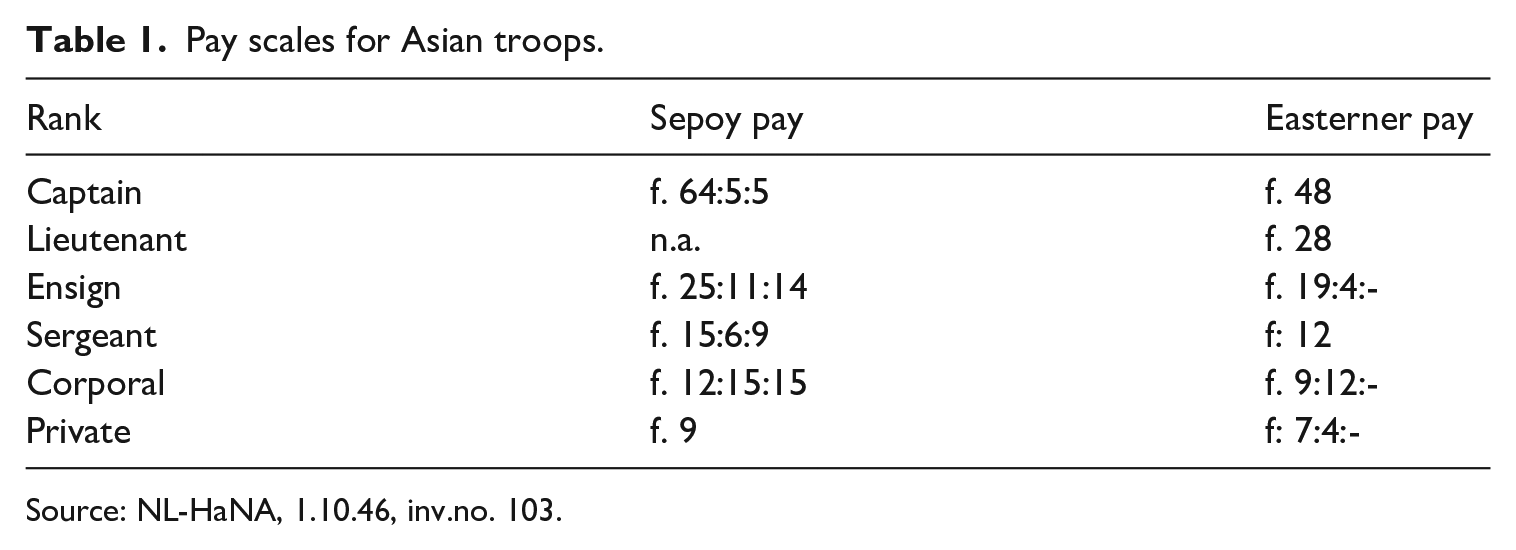
Competition for recruits could also help explain the relatively good remuneration which Indian-recruited sepoys received in Dutch service. Table 1 shows the salaries for equivalent ranks in sepoy and ‘Easterner’ companies in the middle of the 1760s, as recorded by Thomas Hope (1704–1779), the representative of stadtholder William IV on the VOC’s board.
Pay scales for Asian troops.
Source: NL-HaNA, 1.10.46, inv.no. 103.
Better pay for sepoys could reflect the fact that their capabilities were judged more favourably by the Company. Yet, this is unlikely, since the sources for Ceylon from the same period show many complaints of the fitness and drill of the sepoys. Perhaps more likely, then is the fact that sepoys recruited in India had alternative potential employers, so the VOC had to pay at least a salary that was not obviously inferior to Mysorean or EIC pay. In both sepoy and Easterner companies at this time, European ‘drill masters’ were provided and both types of soldiers were issued with flintlock muskets, so the difference in pay does not reflect a difference in style of combat.
The Company’s personnel and financial accounts also make an organizational division clear. Each VOC command had an approved number of different types of soldiers, in peace-time mostly European troops supported by soldiers recruited in Southeast Asia. But on some cases, more troops were recruited on short-term basis to supplement the approved garrison in times of acute crisis. These supernumerary troops are listed elsewhere in the account-books under the heading ‘extra-ordinary expenses’. In January 1780, Negapatnam was preparing for a potential Mysorean attack and had recruited additional troops. The accounts sent to Batavia that month registered that the Negapatnam garrison, besides the European troops, counted 130 topasses at 7,020 guilders a year (f. 4,5 a month per person) and 128 ‘warriors from Malabar’ at f. 5488:17:8 a year. 44 All these belonged to the approved garrison. But Negapatnam also spent 31.948 guilders, 19 stivers, and 8 penningen on (f. 31.948:19:8) the salaries of an unspecified number of sepoys. 45 The figures provided by Hope (Table 1), provided for a force of 1,531 men (including officers and subalterns) for a cost of f. 192809:1:4 a year. Using Hope’s figures as a basis, this would mean that Negapatnam had recruited some 250 sepoys for the garrison. These troops do not show up in the personnel files, as the personnel administration was not intended to actually account for all the personnel in VOC-service, but to make the accounts for which chamber paid for which personnel. Since Negapatnam was expected to pay these troops from its own accounts, they are not included in the personnel administration.
A consequence of the distinction between troops in regular service and the ‘supernumerary’ troops was that there was a constant pressure from Batavia to reduce troop levels. This dynamic of hiring and firing of troops can be studied in some detail in the correspondence between Coromandel and Batavia for the 1760s. In October 1761, the High Government noted in its annual letter to the Netherlands that Governor Van Eck of Coromandel had been authorized to recruit as many troops as he deemed necessary. The reason was the mounting crisis on Ceylon. Van Eck would be appointed Governor in Ceylon and would be reinforced in his command by 1,570 troops recruited on East Java (plus 130 European soldiers), as well as 2,000 Indian and 295 European troops sent from Cochin and Negapatnam. 46 Even as the war on Ceylon was escalating, the various VOC establishments on the Coromandel Coast were by no means peaceful or unthreatened. Although the collapse of French power had eliminated one threat to the Dutch company, both rising English power as well as the local states posed a threat to virtually all Dutch possessions on India’s east Coast, with the possible exception of Negapatnam itself. Prince Visia Ramarasu, the Mughal Regent who was de fact in charge of his own state in the Northern Circars had demanded a substantial gift from the VOC in Bimilipatnam, as well as deliveries of arms and gunpowder. VOC officials in Bimilipatnam had therefore recruited 50 sepoys to assist in defending the fort if necessary. But Batavia disagreed; though the troops could be retained for now, once the crisis had passed they were to be disbanded immediately. 47 The Coromandel Government was further lauded for ordering the dismissal of a total of 54 Peons at Jagganathpur who had been tasked with maintaining peace and order in the village. But recruitment for Ceylon continued. In the same letter, the High Government mentioned the transfer of two companies of sepoys as well as some French troops from Negapatnam to Ceylon. Their places in Negapatnam would be filled by new recruits, as the Coromandel Government was now complaining of the weakness of its garrison. 48 This was all the more pressing as the Nawab of Arcot Muhammad Ali Khan Wallajah was threatening to invade Thanjavur, which the VOC was treaty-bound to assist. 49 By December 1766, the Coromandel Government was requesting reinforcements from Ceylon: a 1,000 Europeans and a 1,000 Asian troops. 50 But Batavia demurred, remarking that if such numbers were necessary, it was to be avoided that too large a concentration of force would force the Company to choose sides in any upcoming local war. Predictably, the High Government ordered ‘The remaining Europeans as well as Malays and Javanese to be dispatched to either Jaffna or here [Batavia], and the Sepoys to be disbanded there [Negapatnam]’. 51 Sepoys were recruited only for so long as the crisis lasted, to be disbanded as soon as possible.
Raven-Hart provides valuable mentions of the inclusion of European drilmeesters (‘drill masters’) with the Asian infantry companies, proving that at this juncture, European non-commissioned officers (NCOs) were added to the structure of the sepoy and Eastern companies to improve their drill. 52 The war with Kandy proves interesting for another reason as well. It was here that company officers gained experience in commanding larger forces in the field. To this end, the 28 infantry companies were grouped into four battalions, each comprised six companies of fusiliers and one company of grenadiers. Van Eck and the Ceylonese Government had proposed reducing the strength of the companies to a 100 men, down from 175, but this was rejected by Batavia. 53 This battalion-level organization was seemingly extended to the sepoy and Eastern companies, but the organization was discontinued after peace was signed.
Besides recruitment policies and force-structure, there is another element which needs to be mentioned. John Lynn has argued that the EIC was so successful in integrating sepoys in its armies since it not merely recruited troops locally and armed them with European weapons, but it made use of a particular set of military values in India. 54 The question whether the VOC was able to integrate these (Hindu) sensibilities in its recruiting is difficult to answer, but on one point, it is clear that the VOC would inherently run into problems, at least when recruiting for service in other areas. Lynn argues that to foster existing concepts of jati, duty, honour, and loyalty in its troops, ‘the Company had a stake in allowing the sepoy to remain integrated into his original community as much as the demands of military service allowed’. 55 By allowing soldiers to remain in touch with, and part of, his home community, the EIC effectively made sure that its troops would fight well, to maintain their honour. This points to problems for the VOC. In the first place, this might have made service with the Dutch company, which could easily result in long-term postings in Ceylon or even Java unattractive to recruits with other options. 56 In addition, the short-termism of the VOC precluded it from fostering the kinds of military values from which the EIC profited, since all sepoy companies on Ceylon were disbanded after the peace.
In the VOC, there clearly was no conception of soldiers recruited in India – sepoys or others – as long-service professionals. The mainstay of the army was always considered to be the European soldiery. Sepoys were relatively expensive for the company, which meant they were dismissed as soon as possible. There was not, consequently, a great willingness to invest heavily in the training or officering of locally recruited troops. Sepoys were recruited as part of units, by officer-contractors who had made an agreement with the Company, rather than as individuals as in the case of the European troops. The units so raised fought under their own officers and subalterns, although supported by European ‘drill masters’. By the end of the eighteenth century, there is evidence that more European subalterns were permanently attached to what were then styled ‘native’ companies. 57 In most cases, the infantry companies so raised were not integrated into standing units of battalion of brigade level, although this was true for peace-time European garrisons as well. Consequently, whenever the VOC mounted a larger expedition or hard to undertake an offensive mission during the eighteenth century, the structure of its forces was a last-minute improvisation, with troops shipped in or lifted from garrison duties. Given the large quantities of weapons on stock in even minor VOC establishments in India, it is quite likely that the troops recruited by the VOC were equipped with VOC-issue muskets for the duration of their service, like the Madura Company of Captain Sing Alap Alap, rather than fighting with their own. 58 The repeated demands that ‘supernumerary’ troops be disbanded as quickly as possible are mirrored in the sources by the complaints about the performance of these troops in combat, a point worth elaborating by examining two battles in which the VOC used sepoys in India in the last quarter of the eighteenth century.
III. The problem of combat effectiveness: Chettua 1778 and Negapatnam 1781
The examples of European officers blaming their Indigenous subordinates for the failure of the missions which they had been put in charge of are numerous. But are these cases of Europeans blaming Asian troops simply a trope, an acceptable way to divert blame which all (Europeans) concerned would have understood as such, or do they actually belie a more structural problem with the combat effectiveness of the company’s Asian soldiers? This section will examine two cases of VOC-failure from the eighteenth century in which the Asian troops were blamed (at least in part) for failure: the failed siege of Chettuwa in Malabar in January 1778 and the loss of Negapatnam on the Coromandel Coast 3 years later. In both cases, indiscipline and a reluctance to fight among the Asian troops were blamed for failure. If the troops did not perform as expected, a good question is why they did not. In both cases, I argue, the short-termism of the VOC made success unlikely, if not outright impossible. In both cases, forces were assembled quickly out of garrison troops and new recruits without prior experience of fighting or even training together and were expected to undertake complex and dangerous operations against battle-hardened opponents. The ultimate cause of problematic behaviour among the company’s Asian soldiers thus stemmed from the contractual conditions of service, the length of service, and the apportioning of officers to the Asian troops. Ultimately, the decision by the VOC that Asian troops were never to be considered a structural part of its military but seen as auxiliaries or temporary forces is to blame for the relatively poor performance of its troops during the crises of the 1770s and 1780s.
Chettua, 1778
One example of the problematic combat effectiveness of the soldiers recruited locally is provided by the attempt to recapture the fort of Chettuwa (also spelled as Chettua/Chettuva/Chettuwa in the sources. Present-day Chowghat) in January 1778. Fort Wilhelmus at Chettuwa had been captured by Mysorean forces under Hyder Ali the year before. Hyder Ali claimed that the fort and the territory to the south of it, known to VOC officials as the ‘Conquest of Papponnety’, rightly belonged to the Samorin of Calicut, and since Calicut had been conquered by Mysore, the territories belonged to Mysore now.
59
The Mysorean conquest of the fort, which was accomplished by a protracted blockade and defeat of an attempted VOC amphibious relief, must be seen as but one prong in the ruler of Mysore’s diplomatic offensive intended to make the VOC grant free passage through its lands.
60
The real price was Travancore to the south, which had aided north Malabari kingdoms during the revolt against Mysorean rule in the 1760s.
61
In itself, this illustrates nicely the fact that quite often, even late in the eighteenth century, Asian states were primarily concerned with their direct neighbours, rather than the actions of Europeans. After some prevarication, the Council of Malabar had opted to take the offensive in January 1778, noting, It is to be considered whether, at this time in which the lands and fort taken from the Company are but weakly garrisoned, and there is but little force of the Nabab in these Mallabari lands, we should remain so passive, or whether we should not try to retake which was lost?
62
The timing is no coincidence: with war between France and Britain imminent, Hyder Ali’s attention was focused elsewhere than at Chettuwa and the VOC in Malabar.
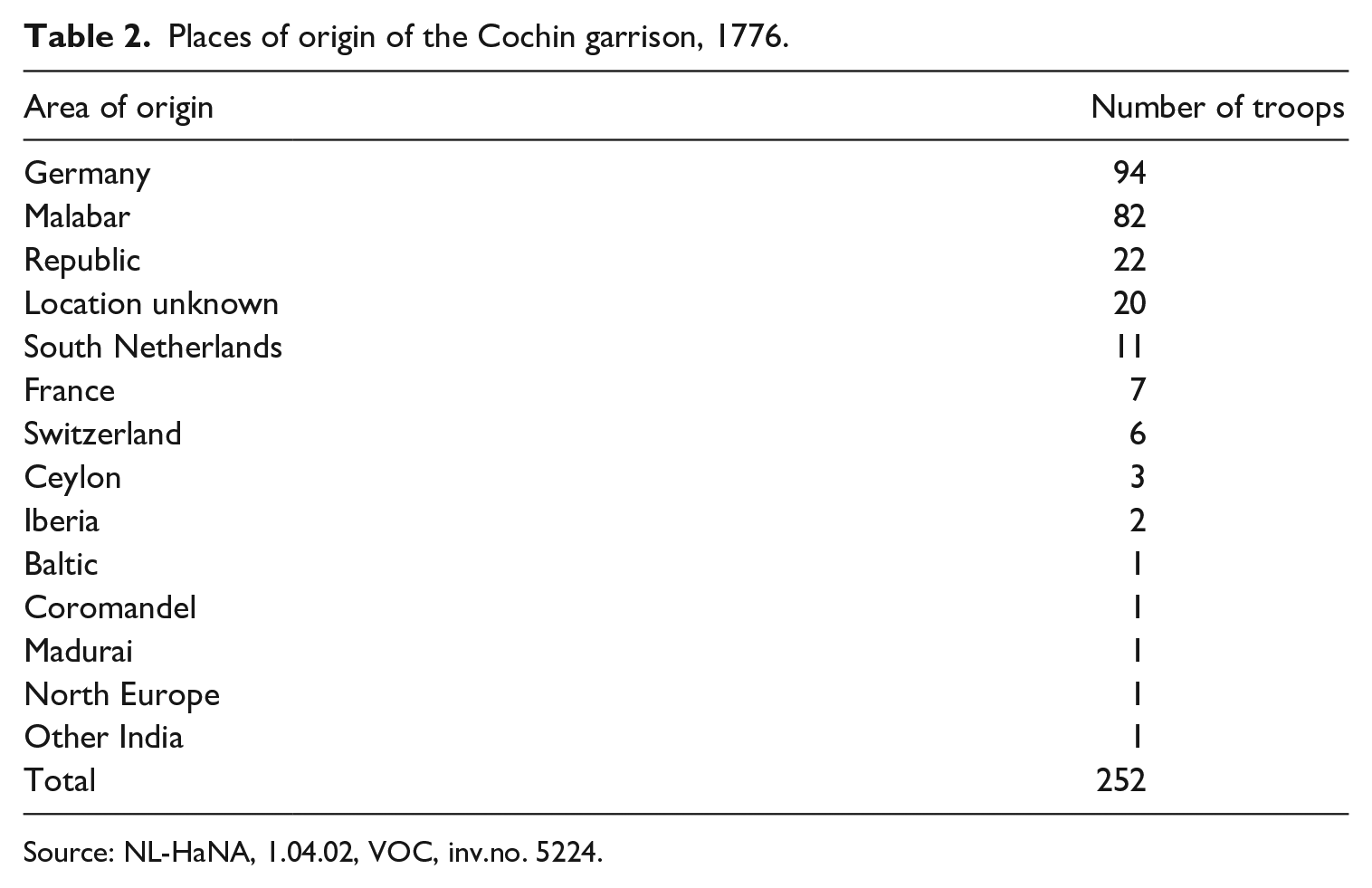
Command of the expedition was entrusted to Captain Christiaan Wolfarth, who was given a force of 13,000 men to accomplish his mission. This force was composed of nine infantry companies, three each of Europeans, Malays, and Sepoys, as well as an artillery detachment of nine canon in the eight to three pound range as well as two howitzers and a six-inch mortar. 63 It is likely that the troops for the expedition were raised shortly before or, in the case of the European troops, shipped in from Ceylon. The general muster rolls for Malabar for 1776 provide some information on the development of the VOC’s force in Malabar. In 1776, the Cochin garrison counted only 252 men, reinforced by 119 men from Colombo. The muster rolls for the company’s standing forces are interesting, for they provide not only salary information, but also show the provenance of the company’s soldiers. Grouped into regions, the data show that perhaps unsurprisingly, Germany was the main region of provenance for the European troops (see Table 2). More surprising is the fact that 82 soldiers gave places in Malabar itself as their place of origin, with Cochin itself being the place of origin for 54 soldiers of the European garrison of Cochin. Small numbers of soldiers originated from VOC establishments like Negapatnam, Tuticorin on the Madurai Coast, and Ceylon. The names of some of the soldiers indicate that these were probably Eurasians of (partial) Portuguese descent. It is quite likely that at this time, local recruits who would earlier have been classed as Topasses were now integrated with the European infantry.
Places of origin of the Cochin garrison, 1776.
Source: NL-HaNA, 1.04.02, VOC, inv.no. 5224.
Missing from these muster rolls is any mention of locally recruited sepoys or soldiers from the Southeast Asian archipelago, further underlining that the Company did not consider these troops part of its regular force whose names needed to be recorded in the muster rolls. Likely, the sepoys present at the attack on Chettuwa were part of a force of 500 men under a British officer which the Malabar Command had employed in 1776 because of a dearth of European troops. 64
The need to recruit other troops locally and form units distinct from the regular European infantry companies listed in the muster rolls was also addressed by Commander Moens in his Memorie van overgave of April 1781 written to instruct his successor. Reflecting on the need to recruit additional troops locally to reinforce the weak garrison of regular company troops, Moens remarked that if the same money had been spent earlier, the position of the company would not have deteriorated so much and it would actually have had a better chance of retaining more revenue-raising lands. 65 For service in Malabar, Moens preferred what he referred to as ‘native soldiers’, local Christians and chegos who were, in his eyes, more reliable and cost less than sepoys, who were wont to switch sides in conflicts depending on payment. 66 This again proved that sepoy units were poorly integrated into the company’s force-structure and could thus defect easily. But Moens did mention that from the fall of 1779 onwards, Malabar had become recruiting ground for sepoys intended for the Batavia garrison (see Image 1). In total, 190 men had been sent when Batavia requested 300 more to be recruited and forwarded. For his successor, Moens advised to go ahead with this recruitment, for if care was taken to recruit young and well-motivated soldiers, they could always replace older sepoys in the Cochin garrison if Batavia decided that it no longer required additional troops. Again, the suggestion is that in its dealings with its sepoy soldiers, the Company was less bound by contracts than in its relations with its regular European troops: ‘. . . granting their discharge to others who are less keen and not so young: which, as your Worship knows, can easily be managed with sepoys’. 67 Likely then, Wolfarth’s force consisted partially of European and Malay companies lifted from the Cochin garrison or shipped in from Colombo or farther east, and sepoy companies raised locally only shortly before. This force was now supposed to march north and retake Chettuwa.
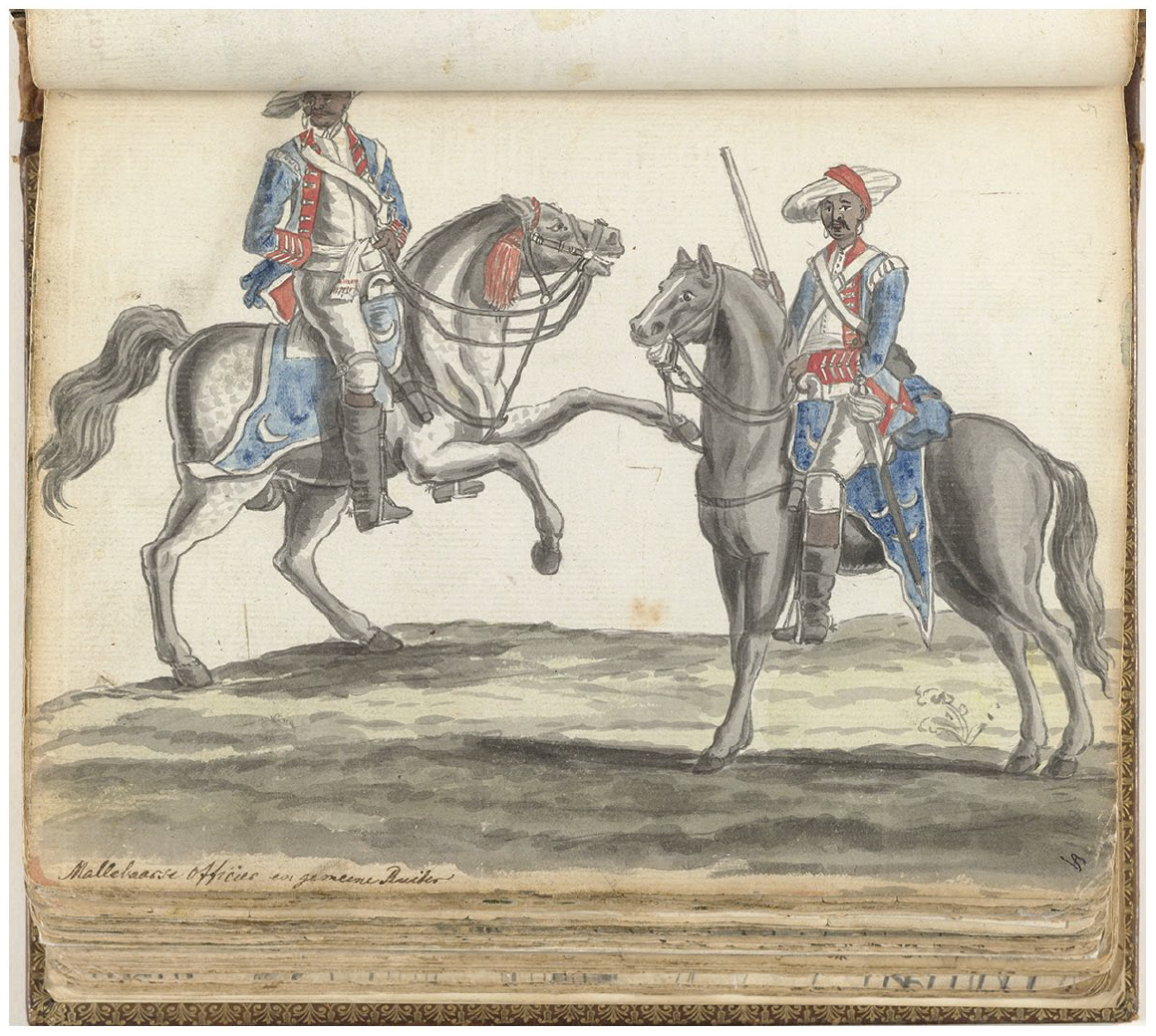
Malabari cavalrymen in Batavia, 1780 Source: Rijksmuseum, NG-1985-7-2-46.
The force of 13,000 men that had moved north from Cranganore in January 1778 was thus most likely a force that had been assembled after the abject failure of the attempt to relieve the siege of Chettuwa in November 1776. 68 The actual siege of Chettuwa lasted from 11 to 17 January and was commanded by Von Drieberg. The fort was first bombarded by the mortar and howitzer, and a storm attack was planned for the 15 January. The field pieces were too light to breach the walls and speed was of the essence, since the fort needed to be captured before Mysorean cavalry forces could be forwarded south in reply. The storm attack on the night of 15 January failed, however, and the following day, a cease-fire was agreed to bury the dead and care for the wounded. 69 During this day, a Mysorean advance party moving south tried to cross the river and the siege was broken up on 17 January. 70
Why had the attack failed after a propitious start? Von Drieberg squarely heaped blame on the non-European troops at his command. After he himself and the officers in charge of the two attack parties had been hurt, the troops simply refused to advance. This breakdown in discipline stalled the forward momentum and the attack failed. Taking Von Drieberg’s account at face value (ignoring the possibility that he ‘blamed the natives’ for his own failing), what could explain this failure? A hint is provided by the fact that Van Drieberg mentions the fact that he and the other officers in charge of the attack had been injured, leading from the front as they were. There is no mention of other (European) officers in the attack. The failure of the attack on Chettuwa suggests that the VOC sepoys and Easterners were but thinly officered, and these units came with their own officers and subalterns. The short time during which the sepoys units had been raised means that they cannot have had great familiarity with the European officers ultimately in charge of the operation. The lack of an organization level above the individual companies meant that the whole operation was vulnerable to disorder if the few higher officers were hurt or killed in action.
The fact that these units were always regarded as temporary sources of military manpower, to be reduced in strength when peace came and only raised during periods of acute crisis, precluded a more regular apportioning of officers and subalterns to these companies. Lack of long-term career prospects must have also dampened the readiness to risk life and limb for the VOC among these troops. The VOC’s parsimony and hesitance to offer benefits like pensions thus must factor heavily in the failure of its troops.
Negapatnam, 1781
The fortress of Negapatnam was the headquarters of the VOC-establishment on India’s East Coast, governing the VOC’s Coromandel Government. Coromandel was important for its cotton textiles, but unlike Ceylon or Malabar, it was not to any significant extent a ‘territorial’ Government. The VOC was mostly confined to its towns and forts and relied on Indian merchants to deliver textiles, sometimes from quite far inland. There had been some stillborn attempts to secure more territory and with it a tax-base, but these had always been refused by Batavia or made redundant by external factors. 71 But in the larger context of Anglo-French rivalry and the French alliance with Mysore, the Dutch forts, and especially Negapatnam could be very important indeed. The loss of Pondicherry in October 1778 and Mahé meant that French forces did not possess a safe base of operations from which they could contact their ally inland and supply him with weapons, soldiers, and money. 72 Negapatnam, with its citadel and city walls, ensconced far to the south of Madras in the productive delta lands of Tanjore could fulfil this role. War with Britain came quite unexpectedly for the VOC, forcing it to change its alliances at short notice. Until 1780, the VOC in Negapatnam had considered Mysore under Hyder Ali the more significant threat and was actually planning to bring the town into a state of readiness in expectation of a Mysorean descent on the area. But when Negapatnam was besieged in October to November 1781, Mysore would fight with the VOC as an ally and actually provided a significant number of soldiers to the town’s defence.
By the time of the siege, Negapatnam had a substantial garrison of 5,246 men, 4,200 of whom were sepoys. 73 Not all of these troops were company soldiers, 1,500 men were Mysorean sepoys send to the fortress to help defend it from the common enemy. But this still meant that Negapatnam had, at short order, recruited some 2,700 sepoys for service in the garrison. As late as January 1779, the garrison of Negapatnam had consisted of a total of 1,105 men, of which 1,068 served in the infantry. Of these, 618 were registered as being ‘Mohometans, sipoys and Topasses’. 74 The Negapatnam garrison underlines the fact that in times of crisis, VOC-garrisons could quickly increase well above peace-time levels. The performance of these recent recruits during the actual fighting was questionable, however.
The actual first line of defence of Negapatnam was not to be the ramparts of the town, but a line of field works further north, intended to keep troops approaching from the north out of range of the town itself. But defences at Coepang were abandoned without a fight on 21 October. VOC-troops retreated to a defensive line which had been constructed through Comerpalium, a village to the north of the city. 75 On the night of 29–30 October, this defensive line, too, was abandoned in face of attack and the troops retreated to the city itself. Counterattacks from the city on 5 and 10 November failed. Gijsberti Hodenpijl, who is the only scholar to study the siege of Negapatnam in any detail, noted that the second counterattack was conducted mostly by Hyder Ali’s troops, seconded by company sepoys and Malays, commanded by a sergeant who had been promoted to ensign just for the occasion. 76 In these circumstances, it is hardly surprising that the counterattacks failed and Negapatnam surrendered on 12 November. The different ways in which the fall of Negapatnam is dealt with in the respective British and Dutch historiographies is enlightening. While in the Dutch case, the fall of the town is more or less taken for granted, the British historiography is less assured of the outcome, taking the fall of a major fortress with a large garrison to an improvised force drawn mostly from the fleet and the Madras garrison rather than the EIC’s field forces as a major coup. 77 The weak leadership and short term of service for most troops involved on the Dutch side, as well as the mutual unfamiliarity of troops and European officers must have contributed to the failures of all counterattacks at Negapatnam.
Both on the Malabar Coast in the 1770s as well as in Negapatnam in 1781, the VOC was confronted with its short-sighted military posture. Raising short-term units intended to be disbanded at the earliest convenience did not result in units which were motivated to fight well for the Company. The realization that this was both expensive and ineffective lead to a post-war re-evaluation of the way the Company recruited soldiers in Asia, specifically sepoys.
IV. ‘Who are pretty successful with their sepoys . . .’
The report by outgoing Commander of the Malabar Coast Adriaan Moens reflects the realization that more could be had out of the sepoy soldiers than the VOC was getting. With some understatement Moens reflected, . . . how I have tried, on account of the notorious shortness of European soldiers, to get all I could out of the native troops, and especially out of the sepoys, or at least all that is got out of them by the English who are pretty successful with their sepoys in India.
78
By 1781, the EIC had indeed been ‘pretty successful’ in its use of sepoys in India and the VOC could hope for better results too, as long as it changed the way it employed these troops. This was not entirely a new realization. In his memorie for incoming Governor of Ceylon Van Eck of 1761, outgoing Governor Schreuder had already noted, ‘If only the Company, following English and French example, and not being deterred by mistaken economies, only made some more effort and not spare some expenses to attract competent personnel to its service . . .’ 79 But these sentiments did not yet prevail higher up in the hierarchy.
During the late 1780s and early 1790s, a specially formed Military Committee travelled through the VOC’s Asian possessions, providing advice on improving the state of defence of the VOC’s Asian empire. Its members were Dutch navy and army officers who worked outside the normal VOC-hierarchy. They would ultimately be demotivated by the poor provisions for defence and would ultimately rush their return to the Republic to argue for a thorough overhaul of the VOC’s organization. But their reports for the early stages of the voyage are exhaustive. One of the locations visited early on by the committee was Cochin, now in a high state of readiness due to the likelihood of a war between Mysore and Travancore in which the Company would become embroiled due to its control of the strategically crucial fort at Cranganore. Visiting Cochin from December 1789 to February 1790, the Committee noted that since the return of Tipu Sultan to Malabar, two additional sepoy companies had been raised and the total strength of the garrison stood at 1,706 men, of whom 541 were European. 80 The Committee members criticized the earlier approach to raise large numbers of men in a crisis, only to let them go once it had been abated. Only by making the Company an attractive employer could it motivate its troops to fight well. 81 This surely was the right conclusion, but reached half a century too late. Cochin and all of Ceylon would fall quickly in 1795–1796, with reportedly only the sepoy detachments in garrison at Colombo being outraged at being denied the chance to fight the English.
The reticence of the Dutch East India Company to offer good terms of permanent employment to soldiers recruited in India meant it would be easily eclipsed as a military power in the area by the French and English from the 1740s onwards. This was not due to an inherently more pacific nature of the VOC. The company was never ‘pacified’ and its military role and its army would remain crucial to its retention of its possessions in the area such as they were until the collapse of the Dutch state and then the Company in the mid-1790s. In times of crisis, the VOC was able to recruit soldiers locally quite quickly, raising an army of up to 12,000 men on Ceylon in the 1760s and garrisoning Negapatnam with some 5,000 men in 1781. Many of these troops are missing from the personnel administration of the VOC, leading researchers both to underestimate the total armed force at the disposal of the VOC as well as the VOC recruitment in India and Ceylon specifically. The inability or unwillingness to follow French and English examples and reimagine the recruitment and service of sepoys had important consequences. Whenever the VOC went to war during the eighteenth century, it had to improvise a field force, raising troops from garrisons and reinforcing them with new recruitment in the area. To forge these units into a coherent and effective force required time which was not always available. The lack of standing forces which could be credibly committed to anything but garrison duties meant that in the upheaval in South India in the second half of the eighteenth century, the VOC and its forces were not a significant entity in the considerations of either its European rivals or local polities. The insistence that troops recruited locally in a crisis were let go as soon as the crisis abated meant that the company was a poor employer and struggled to make its forces fight well or indeed at all. Poor officering, drilling, and training as units and units together made the VOC’s forces struggle in the face of the enemy. The inability of the VOC to see sepoys as anything other than temporary reinforcements of a force that was European at its core meant it could never credibly defend its interests in India. By the time the realization set in that this needed to change, it was already too late.
Footnotes
Author’s Note
Erik Odegard is now affiliated with International Institute for Social History, Amsterdam, The Netherlands.
Funding
The author(s) received no financial support for the research, authorship, and/or publication of this article.

1
National Archives of the Netherlands, The Hague (NL-HaNA), 1.04.02 VOC, inv.no. 3261, Coromandel Council to Batavia, 28 March 1769.
2
A Kris is defined by the Oxford English Dictionary as ‘A Malay dagger, with a blade of a wavy form’.
3
R. Raven-Hart, The Dutch Wars with Kandy, 1764–1766 (Colombo: The Government Press, 1964), p. 167.
4
For the fort at Bimilipatnam, J. Bos, ‘A Disastrous Project: C. P. Keller and the Fortification (Plans) of Bimilipatnam’, in Mapping Asia: Cartographic Encounters Between East and West, eds. M. Storms, M. Cams, I. J. Demhardt and F. Ormeling, (Cham: Springer, 2019), pp. 265–78.
5
NL-HaNA 1.04.02, VOC, inv.no. 2676, pp. 124–5, Coromandel to Batavia 3 April 1769.
6
NL-HaNA 1.04.02, VOC, inv.no. 2676, pp. 216–7, Coromandel to Batavia 29 August 1769.
7
J.A. Lynn, Battle: A History of Combat and Culture (Boulder: Westview, 2002), pp. 149–64.
8
The online database for the personnel on board the ships for the eighteenth century counts nearly 775,000 individuals. Searching for “soldaat” (soldier) still yields 229,000 individuals. https://www.nationaalarchief.nl/onderzoeken/index/nt00444?searchTerm=soldaat&activeTab=nt_sub_list_legacy (accessed 1 November 2019).
9
For the naval forces of the VOC in both Europe and Asia, see E. Odegard, ‘The Sixth Admiralty: The Dutch East India Company and the Military Revolution at Sea, c. 1639-1667’, International Journal for Maritime History 26:4 (2014), pp. 669–84; E. Odegard, ‘Merchant Companies at War: The Anglo-Dutch Naval Wars in Asia’, in War, Trade and the State: Anglo-Dutch Conflict, 1652–89, eds. D. Ormrod and G. Rommelse (Woodbridge: Boydell Press, 2020), pp. 230–247.
10
11
W. Remmelin, The Chinese War and the Collapse of the Javanese State, 1725–1743 (Leiden: KITLV Press, 1994); R. Vos, Gentle Janus, merchant prince: The VOC and the tightrope of diplomacy in the Malay world, 1740–1800 (Leiden: KITLV Press, 1993).
12
R. Raben, ‘Het Aziatisch legioen: Huurlingen, bondgenoten en reservisten in het geweer voor de Verenigde Oost-Indische Compagnie’, in De Verenigde Oost-Indische Compagnie: Tussen Oorlog en Diplomatie, eds. G. Knaap and G. Teitler (Leiden: KITLV Uitgeverij, 2002), pp. 181–208.
13
G.D. Winius and M.P.M. Vink, The Merchant-Warrior Pacified: The VOC (Dutch East India Co.) and it Changing Political Economy in India (Oxford: Oxford University Press, 1991).
14
G. Knaap, H. den Heijer and M. de Jong, Oorlogen overzee: Militair optreden door compagnie en staat buiten Europa, 1595–1814 (Amsterdam: Boom, 2015), pp. 197–201, present some cumulative data based on the personnel files. But from 1760 onwards, no ‘native’ soldiers are recorded until 1785, when there are 2,668 for all possessions in Asia. I will show in this article that there were substantial numbers of ‘native’ troops with the VOC in Asia in this period, making the totals presented by the authors incomplete at best. The same mistake is made by F. Lequin, Het personeel van de Verenigde Oost-Indische Compagnie in Azie in de achttiende eeuw, meer in het bijzonder in de vestiging Bengalen. Band II (Leiden: The Author, 1982), p. 349.
15
C. Wickremesekera, ‘European Military Experience in South Asia: The Dutch and British Armies in Sri Lanka in the Eighteenth Century’, in Chinese and Indian Warfare – From the Classical Age to 1870, eds. K. Roy and P. Lorge (London and New York: Routledge, 2015), pp. 289–301, 294, mistakenly mentions the figures for the 1764 Dutch invasion attempt against Kandy for the 1765 attempt, downplaying the size of VOC forces deployed and, especially, the role of Asian-recruited soldiers in the force.
16
K.N. Chaudhuri, The Trading World of Asia and the English East India Company, 1660-1760 (Cambridge: Cambridge University Press, 1978), pp. 110–1; J.R. Jones, The Anglo-Dutch Wars of the Seventeenth Century (London and New York: Routledge, 1996), p. 32.
17
G.J. Bryant, ‘Indigenous Mercenaries in the Service of European Imperialists: The Case of the Sepoys in the Early British Indian Army, 1750-1800’, War in History 7:1 (2000), pp. 2–28, 3.
18
Lynn, Battle, pp. 159–60.
19
G.J. Bryant, The Emergence of British Power in India 1600-1784: A Grand Strategic Interpretation (Woodbridge: Boydell Publishers, 2013), p. 43.
20
The Emergence of British Power in India Bryant, 1600–1784, p. 43.
21
J.M. Lafont, ‘Observations on the French Military Presence in the Indian States 1750–1849’, in Indo-French Relations: Indian Council of Historical Research, Monograph Series 2, eds. K.S. Mathew and S. Jeyaseela Stephen (Delhi: Pragati Publications, 1999), p. 200.
22
M.P. Singh, Indian Army under the East India Company (New Delhi: Sterling Publishers, 1976), p. 6.
23
R. Callahan, The East India Company and Army Reform, 1783-1798 (Cambridge: Harvard University Press, 1972), p. 6.
24
D.H.A. Kolff, Naukar, Rajput & Sepoy: The Ethnohistory of the Military Labour Market in Hindustan, 1450-1850 (Cambridge: Cambridge University Press, 1990), p. 178.
25
Bryant, ‘Indigenous Mercenaries’, pp. 6–8.
26
G.J. Bryant, ‘The Cavalry Problem in the Early British Indian Army, 1750-1785’, War in History 2:1 (1995), pp. 1-21, 8–9.
27
NL-HaNA 1.04.02, VOC, inv.no. 3585, fol. 606–607.
28
F.S. Gaastra and J.R. Bruijn, ‘The Dutch East India Company’s Shipping, 1602-1795, in a comparative perspective’, in Ships, Sailors and Spices: East India Companies and their Shipping the 16th, 17th and 18th Century, eds. J.R. Bruijn and F.S. Gaastra (Amsterdam: NEHA, 1993), pp. 177–208, 201.
29
J.R. Bruijn, F. Gaastra and I. Schoffer, Dutch Asiatic Shipping: Volume I, Introductory Volume (The Hague: Martinus Nijhoff, 1987), pp. 144.
30
W. Floor, The Persian Gulf: The Rise of the Gulf Arabs, The Politics of Trade on the Persian Littoral 1747-1792 (Washington: Mage Publishers, 2007), p. 126.
31
As mentioned in NL-HaNA, 1.01.50, Stadhouderlijke Secretarie, inv.no. 1913, p. 54.
32
R. Raven-Hart, The Dutch Wars with Kandy, 1764-1766 (Colombo: Government Press, 1964), p. 211.
33
M. van Rossum, Werkers van de Wereld: Globalisering, maritieme arbeidsmarkten en de verhouding tussen Aziaten en Europeanen in dienst van de VOC (Hilversum: Verloren, 2013), p. 282, mentions nearly equal pay for European and non-European sailors. In the case of soldiers, the pay scales differed more widely, as did other benefits like food allowances and issued uniforms as well as items as shoes and hats which conferred status.
34
The description of Chegos is made in: NL-HaNA, 1.01.50, Stadhouderlijke Secretarie, inv.no. 1913, p. 56. In an interesting aside, both Chegos and sepoys were barefoots, but chegos officers wore boots while sepoy officers had to content themselves with shoes.
35
NL-HaNA, 1.01.50, Stadhoudelrijke Secretarie, inv.no. 1913, p. 56.
36
NL-HaNA, 1.04.02, VOC, inv.no. 3052, fo. 2057.
37
NL-HaNA, 1.04.02, VOC, inv.no. 3262, fol 725.
38
NL-HaNA, 1.04.02, VOC, inv.no. 3541, missive Coromandel to Batavia, January 1780. fo. 420v.
39
R. Raven-Hart, The Dutch Wars with Kandy, 1764-1766 (Colombo: The Government Press, 1964), p. 70.
40
NL-HaNA, 1.04.02, VOC, inv.no. 3134, fol 53 v – 64v; Also see, Raven-Hart, The Dutch Wars with Kandy, pp. 49, 184, under ‘Free french Company’.
41
Raven-Hart, The Dutch Wars with Kandy, pp. 77, 82, 188 names Jean Francois Grenier, captain from French service employed by the VOC as ensign in 1762 to recruit sepoys because of his language skills. But despite service throughout the war, he was put at half pay after the war.
42
Raven-Hart, The Dutch Wars with Kandy, names several examples. pp. 216, Rodrigo, sepoy ensign privately raises a sepoy company at Cochin. pp. 147, Cochin to Coromandel, 26 October 1765, on recruitment by sepoy captain at Cannanore.
43
Raven-Hart, The Dutch Wars with Kandy, pp. 73, on Hyder Ali.
44
NL-HaNA, 1.04.02, VOC, inv.no. 3541, Coromandel to Batavia, 22-1-1780, 389 recto.
45
NL-HaNA, 1.04.02, VOC, inv.no. 3541, Coromandel to Batavia, 22-1-1780, 394 verso.
46
H. s’Jacob, Generale Missiven van Gouverneurs-Generaal en Raden aan Heren XVII der Verenigde Oostindische Compagnie Deel xiv: 1761-1767, band 1 (Leiden: Sidestone Press, 2017), pp. 24–5.
47
H. s’Jacob, Generale Missiven XIV: band 1, pp. 424–5.
48
Generale Missiven XIV s’ Jacob, : band 1, pp. 426–7.
49
Generale Missiven XIV s’ Jacob, : band 1, p. 427.
50
Raven-Hart, The Dutch Wars with Kandy, p. 151.
51
H. s’Jacob, Generale Missiven van Gouverneurs-Generaal en Raden aan Heren XVII der Verenigde Oostindische Compagnie Deel xiv: 1761-1767, band 2 (Leiden: Sidestone Press, 2017), pp. 1011–2.
52
Raven-Hart, The Dutch Wars with Kandy, p. 143, force return of 28 March 1765.
53
Gen Mis, 14 deel 2, 844.
54
Lynn, Battle, pp. 164–8.
55
Lynn, Battle, p. 168.
56
In Cochin in 1790, the sepoys and Chegos were described as living with their families as well. NL-HaNA, 1.01.50 Stadhouderlijke Secretarie, inv.nr. 1913, p. 57.
57
NL-HaNA, 1.01.50, Stadhouderlijke secretarie, inv.nr. 1913, p. 49. Memorie aangaande de possession op de kuste van Malabar.
58
This might explain the sometimes mystifying quantities of arms in minor VOC establishments without permanent garrisons. In August 1763, Palikol, with two European chefs and two writers, was found to possess 42 muskets and 54 swords. Gen. Mis. XIV, volume 2, 825., Van der Parra and Council to the XVII, 31 December 1765.
59
J. van Lohuizen, The Dutch East India Company and Mysore 1762-1790 (The Hague: Martinus Nijhoff, 1961), pp. 94–7.
60
H.K. s’Jacob, The Rajas of Cochin 1663-1720 (New Delhi: Munshiram Manoharlal, 2000).
61
Van Lohuizen, The Dutch East India Company and Mysore.
62
NL-HaNA, 1.04.02, VOC, inv.no. 3519, OBP Malabar 1778. 46r.
63
NL-HaNA, 1.04.02 VOC, inv.no. 3519, OBP Malabar 1778.50v.
64
F. van Dulm, ‘Zonder eigen gewinne en glorie’: Mr. Iman Wilhelm Falck (1736-1785), gouverneur en directeur van Ceylon en Onderhorigheden (Hilversum: Verloren, 2012), p. 178.
65
A. Galetti, J. van der Burg and P. de Groot, Selections from the Records from the Madras Government, Dutch Sources: The Dutch in Malabar, being a Translation of Nos. 1 and 2 (Madras: Government Press, 1911), p. 210, report Moens. Moens also decried the lack of concentration of the Company’s landed properties and revenue-yielding lands, which made defending them very problematic, report Moens, 207.
66
Galetti, van der Burg and de Groot, Selections from the Records of the Madras Government, p. 210.
67
Galetti, van der Burg and De Groot, Selections from the Records, p. 211.
68
For the failure, see Van Lohuizen, The Dutch East India Company and Mysore, pp. 96–7.
69
The VOC-forces had suffered 19 dead and 85 wounded in the attack on 15 January.
70
NL-HaNA, 1.04.02, inv.no. 3519, fol. 36–44.
71
Dulm, Zonder eigen gewinne en glorie, 216–251 discussed the plans by Govern Falck of Ceylon to agree an alliance with the EIC with the goal to strengthen the VOC’s position in South India immediately prior to the outbreak of the Fourth Anglo-Dutch War in 1780 (‘81 in Asia).
72
Bryant, The Emergence of British Power, pp. 285–6.
73
A.K.A. Gijsberti Hodenpijl, ‘De Nederlandsche bezittingen op de kust van Koromandel in 1780 en 1781’, De Indische Gids 44 (1922), pp. 339–40, gives 2,702 Sepoys in the VOC’s service and 1,500 Mysorean troops.
74
NL-HaNA, 1.04.17, Hoge Regering Batavia, inv.no. 335, Secret letters of Negapatnam to Batavia. Unfoliated. Letter of 15 January 1779.
75
Visible in the siege map of Negapatnam: British Library, Add MS 19820, map 39.
76
Gijsberti Hodenpijl, ‘De Nederlandsche bezittingen’, pp. 339–40.
77
Bryant, The Emergence of British Power.
78
Galetti, van der Burg and De Groot, Selections from the Records, p. 210.
79
NL-HaNA, 1.04.02, VOC, inv.no. 11303, pp. 92–93.
80
NL-HaNA, 1.01.50 Stadhouderlijke Secretarie, inv.no. 1913.
81
NL-HaNA, 1.01.50 Stadhouderlijke Secretarie, inv.no. 1913.