




Abstract
Scholars long have examined the early modern European business of war – the recruitment, supply, and payment of combatants by non-native contractors. With such attention on who conducted this commerce, however, scholars have ignored where the business of war took place. As Peter Wilson and Marianne Klerk recently have argued in this journal, war business was often conducted in politically autonomous cities. This article takes their findings further by showing how naval contractors and army victuallers conducted the business of war in substantially different spatial settings in one fiscal-military hub, Genoa, during one conflict, the War of Spanish Succession.
This article proposes that cities made a vital contribution to military resource mobilization during Europe’s wars of early modernity and, in turn, that the movement of men, money, and matériel played an equally important role in shaping early modern cityscapes. Traditionally, scholars have viewed early modern wartime supply through the concept of the ‘Fiscal Military State’ – the nexus of political institutions and social bargains necessary for Europe’s sovereigns to pay for recruitment, supply, transport, and facility upkeep. 1 In the past decade, however, a wealth of scholarship has shown how private contractors actually spent such revenues. From bankers and arms producers to the humble traders who made up the ‘tail’ of armies, the participants in these ‘Contractor States’ organized wartime industries not through formal, state institutions, but through personal connections and capitalist markets. 2
With such attention on who conducted this commerce, however, scholars largely have ignored where the business of war actually occurred. Rather than happening near the battlefield or in the capitals of Europe’s belligerents, much of the business of war was conducted outside of national boundaries, in politically autonomous cities. As Peter H. Wilson and Marianne B. Klerk recently argued, these ‘fiscal-military hubs’ were ‘characterized by the clustering of specific expertise and resources, which became centers from where states, semi-states, and non-state actors arranged the transfer of war-making resources’. 3 Hubs such as Amsterdam, Hamburg, Regensburg, Geneva, Danzig, London, and others contained both the individual experts (financiers, suppliers, etc.) and the physical facilities such as banks, stock exchanges, and freeports to supply war. This is not to suggest that scholars have overlooked the relationship between war and cities in these centuries; fruitful research has been conducted on military infrastructure (e.g. city walls) and urban arms production. 4 Yet, the consensus seems to be that following the Middle Age, cities had ‘less and less to do with the making of wars’, while, concurrently, war had less and less to do with urban structures as cities suffered the depravities of occupation and siege, but little else. 5
This essay uses a case study of one neutral city, Genoa, during one war, the War of Spanish Succession (1701-1714), to suggest a far tighter relationship between urban spatiality and early modern military supply. Genoa during this conflict offers an especially fruitful place for such a study. The decade-and-a-half, European-wide struggle over the Spanish throne between Louis XIV’s France and his opponents from the Grand Alliance of Great Britain, the United Provinces, Imperial Austria, and the Duchy of Savoy remains one of the best studied conflicts before the French Revolution. 6 So too have scholars examined Genoa in this period. Capital of a small regional state, the city had been governed since the mid-sixteenth century as an aristocratic republic under a biennially elected doge. Two collegi (colleges), the Senato and the Camera, made up of 12 governors and eight procurators, respectively, carried out financial and executive functions, while a brace of consigli (counsels), the 400-member Maggior Consiglio and the 200-member Minor Consiglio, exercised a legislative role. A raft of magistracies with more limited mandates handled territorial governance, port upkeep, and defence. 7 Individual studies of the republic’s army, navy, and diplomatic corps during the war have shown how the city’s oligarchs navigated the nominally neutral republic through the conflict. 8 However, historians to date have overlooked Genoa itself as a transportation and supply centre as well as the war’s impact on urban structures and spaces. This is a significant omission. Over the course of the conflict, tens of thousands of French, Spanish, Hessian, Prussian, Austrian, Irish, Swiss, English, and Dutch soldiers and sailors boarded onto and stepped off of dozens of vessels onto the ports and beaches of the Republic of Genoa (Map 1) on their way to and from battlefields in Spain, Italy, and Provence. Genoa served as a centralized military depot where recruiters, soldiers, generals, spies, diplomats, suppliers, financers, transporters, and others involved in war-making came together to meet the demands of the two belligerent coalitions. At each step along the way, native Genoese, resident foreigners (e.g. Huguenots and Jews), and non-resident contractors supplied these soldiers with war matériel, the vessels and mules needed to move these martial goods, and the facilities to store them. 9 Neither a consumer nor a supplier of war goods, Genoa linked German recruits with Spanish-Habsburg employers, Neapolitan grain merchants with French victuallers, and English paymasters with Turinese bankers. The city was, in the words of one English diplomat, ‘the place for such business’. 10
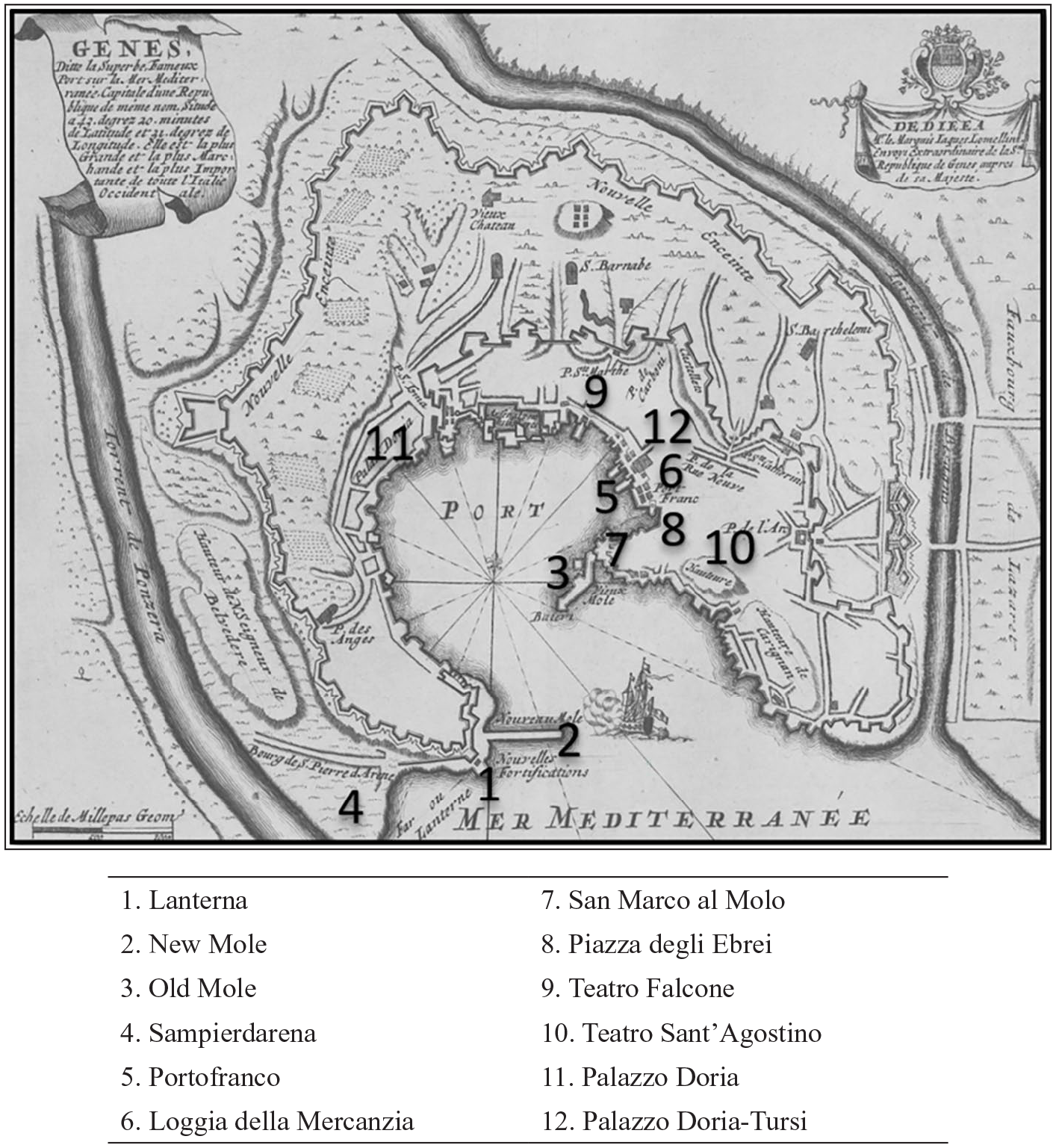
Map of eighteenth-century Genoa with key locations.
Place rests at the very centre of this article as these flows of people, animals, and objects travelled through, were shaped by, and themselves altered the cityscape of Genoa. But an urban, spatial turn in the study of early modern military supply has larger stakes beyond one city or one conflict. When Charles Tilly, John Brewer, and others first suggested in the 1980s that only an ever-larger state could coerce or convince their populations into fighting bigger, longer wars, they borrowed from a larger intellectual project to bring the state ‘back in’ to the centre of early modern social life. 11 In reacting to such statist views, proponents of the Contractor State privilege an alternative vantage point: the long-distance kinship, religious, or business network. These studies turn our attention away from hierarchies of bureaucrats and taxmen (and, implicitly, the sorts of ‘formal’ documents such state employees left behind) and towards ‘informal’ exchanges of gifts, news, and other acts of mutual obligation that knitted together transnational commercial networks. 12
But networks have limits. Networks are spatially unbounded and emphasize individuals, families, or co-religious groups rather than larger social settings like entire cities. 13 They further are unable to capture the multiplicity of business dealings in highly concentrated commercial centres like Genoa, nor can they account for the role that proximity to information and pre-existing expertise played in war commerce. Rather than sprawling and global, work on the historical geography of pre-modern financial markets in London and Amsterdam, for example, has turned our attention towards how different urban spaces structured, formalized, and routinized what Iain S. Black calls ‘the geographies of money’. 14 A similar spatial turn in the study of the business of war thus shifts our attention towards a different set of social interactions than the state or the network and, in turn, raises new questions. In what urban spaces – public or private, official or clandestine – did the business of war take place in Genoa? How were ‘fiscal-military elite’ from the war’s competing coalitions shaped by those spaces in which they worked and how, in turn, did they alter them over the course of the war? 15 Finally, how did Genoese civic authorities spatially delineate their city in order simultaneously to protect domestic commerce and keep war goods flowing? By taking a close look at the spatial-political geography of two war-time industries – naval contracting and army victualling – this article shows how Bourbon and Allied agents in Genoa conducted the business of war in substantially different social-spatial settings, the French drawing on an established Spanish network in the city alongside a small, but important, group of Jewish army suppliers in comparison with an ad hoc Allied network built around the city’s Huguenot community. Merging urban history with military history, this article draws on archival material from Genoa, Amsterdam, London, and Paris to explore the breezy piazze, crowded docks, and dark corners of an early modern city to see where the business of war actually took place.
I
It is best to begin with the raw numbers of soldiers transiting through Liguria (Map 2) during the War of Spanish Succession; only when we appreciate the scale of the problem can we understand why Europe’s belligerent powers turned to Genoese naval contractors and suppliers to fill the gaps (Table 1). Following the death of King Charles II of Spain in 1700, combatants rushed to dismantle Spanish-Habsburg possessions around the Mediterranean, crossing into and moving out of Genoese territory. Rather than travelling in one direction, however, waves of men, women, and children washed upon Liguria. First came Bourbon troops from 1701 to 1706 out of Toulon, Marseille, and Naples, preferring the safety of the beaches of Alassio, Vado, Savona, Sampierdarena, and Finale (controlled by the Spanish-Bourbons) over the danger of Alpine passes. 16 Following the defeat of the French at the Battle of Turin in 1706 and the subsequent evacuation of French troops from Northern Italy, German-speaking soldiers (Austrians, Hessians, Prussians) came next, embarking in Genoa’s ports for the conflict’s next flashpoint, Iberia. But Allied defeats at Almanza (1707) and Brihuega (1710) combined with shifts in the diplomatic climate brought an end to the war, resulting in mass evacuations in 1713 of these same Allied troops back through Sampierdarena to the German-speaking lands. 17 In addition, smaller bands of troops, dozens and hundreds rather than thousands, moved in all directions – 700 Neapolitan tercios passing through to Barcelona in 1702, 300 Germans deserting to Toulon in 1703, 450 Bourbon-employed Irish Jacobites sent to quell Provencal rebels in 1704, 200 English sailors set free from French imprisonment in 1705, and 600 luckless Milanese troops shipped out in July 1710 to protect Spanish-Habsburg Sardinia only to arrive late, turn back, fall prey to a French privateer, and arrive bedraggled back in Genoa 6 months later. 18 In total, over 140,000 military personnel – soldiers, sailors, prisoners, deserters, and camp followers – disembarked/embarked from the republic’s territory from 1701 to 1714, the equivalent of the entire population of Genoa boarding onto ships, sailing hundreds of miles, and disembarking, twice. 19
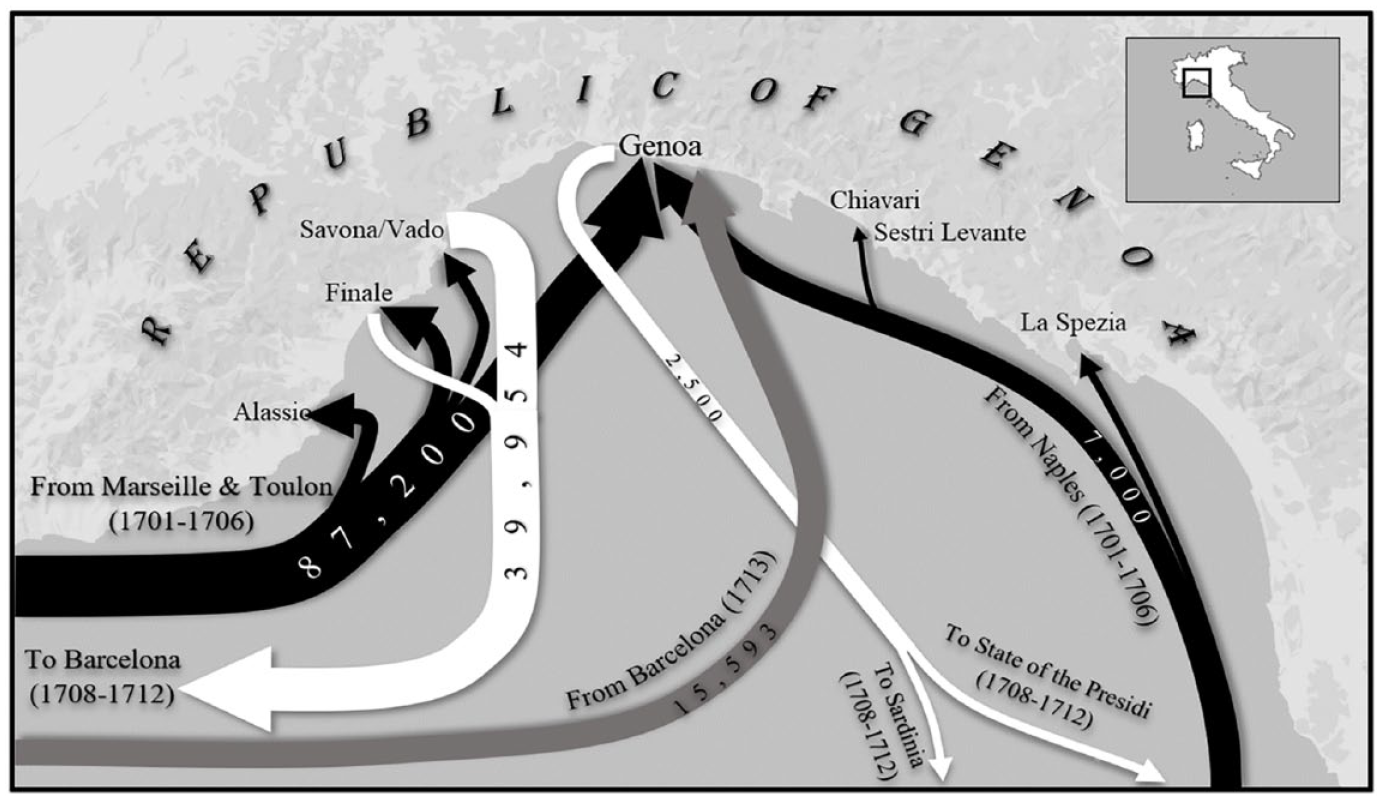
Bourbon and allied troop embarkations/debarkations in Liguria, 1701-1714.
Bourbon and allied military personnel in Liguria, 1701-1714.
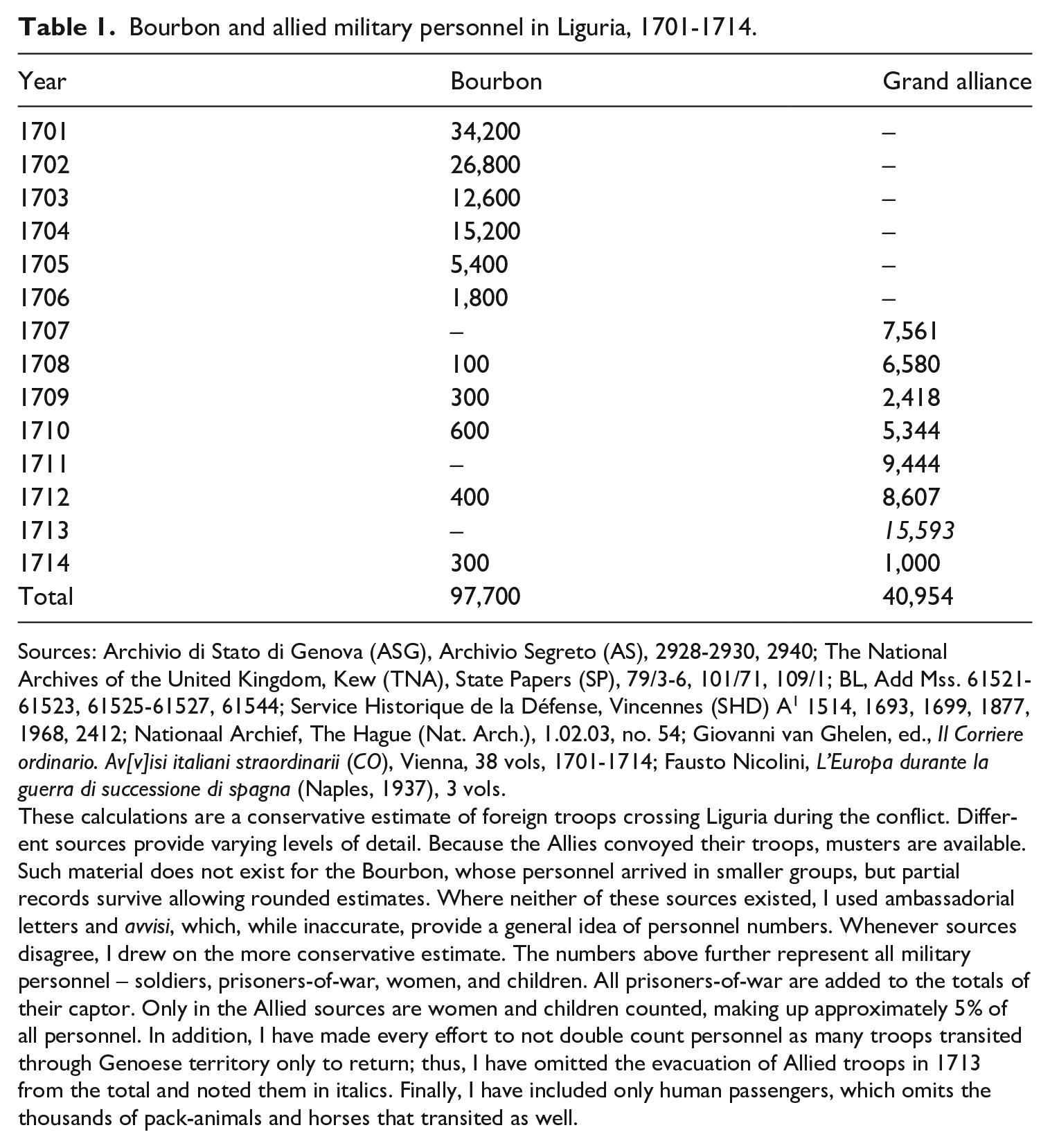
Sources: Archivio di Stato di Genova (ASG), Archivio Segreto (AS), 2928-2930, 2940; The National Archives of the United Kingdom, Kew (TNA), State Papers (SP), 79/3-6, 101/71, 109/1; BL, Add Mss. 61521-61523, 61525-61527, 61544; Service Historique de la Défense, Vincennes (SHD) A1 1514, 1693, 1699, 1877, 1968, 2412; Nationaal Archief, The Hague (Nat. Arch.), 1.02.03, no. 54; Giovanni van Ghelen, ed., Il Corriere ordinario. Av[v]isi italiani straordinarii (CO), Vienna, 38 vols, 1701-1714; Fausto Nicolini, L’Europa durante la guerra di successione di spagna (Naples, 1937), 3 vols.
These calculations are a conservative estimate of foreign troops crossing Liguria during the conflict. Different sources provide varying levels of detail. Because the Allies convoyed their troops, musters are available. Such material does not exist for the Bourbon, whose personnel arrived in smaller groups, but partial records survive allowing rounded estimates. Where neither of these sources existed, I used ambassadorial letters and avvisi, which, while inaccurate, provide a general idea of personnel numbers. Whenever sources disagree, I drew on the more conservative estimate. The numbers above further represent all military personnel – soldiers, prisoners-of-war, women, and children. All prisoners-of-war are added to the totals of their captor. Only in the Allied sources are women and children counted, making up approximately 5% of all personnel. In addition, I have made every effort to not double count personnel as many troops transited through Genoese territory only to return; thus, I have omitted the evacuation of Allied troops in 1713 from the total and noted them in italics. Finally, I have included only human passengers, which omits the thousands of pack-animals and horses that transited as well.
One of the few of these combatants who left a record of his journeys was Joseph Sevin, Comte de Quincy (1677-1749), and it is by tracking his movements in the city that we can begin to understand the spatial-political geography of naval entrepreneurship in early eighteenth-century Genoa. A French cavalry officer, Quincy arrived in Genoa in early 1704 to organize the transit of troops from Provence for the French theatre commander, the Marquis de Vendôme. Beginning in suburban Sampierdarena, Quincy followed what by that point was a routine itinerary for visitors, observing Genoa’s winding streets (‘the streets are very narrow’), port (‘the mole is a sight to see’), commercial spaces (‘its commerce makes it the most commercial city of . . . Italy’), palazzi (‘all the houses are built of raw marble’), and Doge’s palace (‘there is nothing singular or beautiful neither in the outside nor in the inside’). But interweaved throughout, Quincy takes his readers on a second, parallel historical tour of the city, travelling to the palace of Andrea Doria (‘on the door it is written in Latin that this palace was given to him as a present by the great Emperor Charles V and by the most invincible Francis I, King of France’), the Church of Santa-Annunziata (‘there is a chapel dedicated to Saint Louis where [there are] portraits of Louis XIV and the Queen’), and the Durazzo palace (‘the King of Spain was to stay here in 1702’). 20 Quincy’s merger of Franco-Spanish sites on one level reflects the Bourbon position in the city at that time. Genoa long had served as a centre of military transit as part of the ‘Spanish Road’ to the Low Countries during the Dutch Revolt (1567-1648) and Thirty Years’ War (1618-1648) as well as for Habsburg Milan and Naples in the Franco-Spanish War (1635-1659). 21 Indeed, it was the republic’s permission to allow Spanish reinforcements to traverse its territory during the War of the Reunions (1683-1684) that led to the brutal French bombardment of Genoa between 17 and 28 May 1684. 22
But Quincy’s account exposes an often overlooked urban political geography. To the trio of Bourbon locations, Quincy adds another, equally important building: the Palazzo Doria-Tursi: There is in [the Strada Nuova] a beautiful palace which belongs to the duke of Tursi, general of the galleys of the king of Spain. He was a young lord, at that time between twelve and thirteen years old. He received us very politely, and gave us refreshments.
23
As Quincy implies, the vital position in the Spanish navy of the Genoese-Neapolitan nobleman Giovanni Andrea Mariano Doria Del Carretto (1660-1742), Duke of Tursi, had its origins in 1528 when Andrea Doria and Emperor Charles V signed a far-reaching contract (asiento) for the management of 12 galleys for the Spanish crown. 24 Reaching 26 galleys at their peak in the 1570s, the asientistas de galeras from elite Genoese families such as the Doria, Centurione, Lomellini, Spinola, and De Mari subcontracted all aspects of galley administration for the Spanish navy including shipbuilding, financing, supply, and recruitment through a vast, personal network of subcontractors and go-betweens. Continuing this policy, the duke of Tursi used a Mediterranean-wide network of local agents at Naples, Toulon, Marseille, Finale, and elsewhere to perform all manner of essential military work in the War of Spanish Succession. He extradited Milanese prisoners, preyed on allied convoys, and protected other Genoese in Bourbon employ moving powder, specie, grain, and other war goods around the region. 25 Military transport was a vital part of his responsibilities as well, the duke’s gallies ‘being destined to cruze between [Genoa] & Toulon for the security of the French barks & Tartans that come from the Coast of Provence’. 26 Between 26 February and 18 March 1703, for example, 8,900 Bourbon soldiers and officers disembarked at Alassio and Diano in Liguria from 30 merchant ships, most contracted out of Toulon, Marseille, and Genoa. 27
That Quincy, in the city to assist with the transit of troops, then visited the Palazzo Doria-Tursi suggests how the duke’s home acted as a central, informal place for Bourbon commanders and captains to gather, socialize, and strategize. Indeed, Quincy visit is even more exceptional given that it breached the republic’s diplomatic etiquette. Since the second half of the sixteenth century, the communal government had established lists of privately owned palaces, the Rolli degli alloggiamenti pubblici di Genova (Lists of the public lodgings of Genoa), suitable for foreign visitors. Divided by the distinction of the guest (la sorte) and numbering 95 in 1664, these private residences served a public function, accommodating foreign diplomats and grandees through a lottery. 28 Tursi use of his private residence in such an outwardly partisan manner threatened then the republic’s larger diplomatic ritual order. A riot that erupted outside the duke’s palace just a few months before Quincy’s visit points further to the dangers of such a tight link between the palace and the Franco-Spanish cause. The ‘ugly imbrogle’ (as one British diplomat called it) took place in December 1703 when a handful of Savoyard officers found themselves abducted after a night of revelry. The unfortunate men, whose duke recently had switched from the Bourbon to the Allied camp, after having ‘dyned with the Emperor’s envoye had the curiosity to goe aboard a great Genoese ship in the New Mole, butt the French Residentt having orders . . . to seize them gave orders to the Duke of Tursi as they passed by his galleys to secure them, which was accordingly performed & about midnight they were sent away by sea to Finale’ and onward to a French prison. Immediately, the duke’s action sparked outrage: spurred on by the loud protests of the Austrian-Imperial envoy, the Genoese government sequestered Tursi in his palazzo, while a crowd assembled outside chanting anti-French and Spanish slogans before the duke fled to Milan, claiming he held himself obedient to the Bourbons alone. 29
The debacle with the Savoyards and the resultant unrest more concretely remind us that the business of war took place not only in terrestrial and fixed places but also in maritime ones. In this sense, the permanence of Tursi and his fleet mattered, the duke’s galleys, their decks and hulls, offering spaces for Bourbon military elites to do their work. For example, a nearly identical spat to the one in December 1703 occurred a year later when a gunner’s mate of the English sixth rate Newport, ‘so silly to go aboard [the Duke of Tursi] galleys in the port of Genoa’, was abducted, ‘chained to an oar, and treated like a slave’. 30 Immediately, the two sides launched into a diplomatic war of words. ‘The Duke of Tursi . . . has declared war upon us, even in the port of Genoa’, declared the English envoy to Savoy, Richard Hill, an accusation to which the duke responded by claiming that it had been the English who in fact had started the whole dispute after a Moroccan galley slave of his had escaped earlier in the year aboard another English ship in Genoa, the Lyme. 31 The situation only deteriorated further when the Lyme’s captain, Dolman, not only refused to return the Moroccan, but, after learning of the seizure of the Newport’s gunner’s mate, lured a third man, a Majorcan captain friendly with the duke, aboard the Lyme and arrested him in turn. 32 Despite feverish demands for the Englishman’s release, the duke kept the gunner’s mate for months, parading his prisoner around the port to ‘the great mortification’ of envoy Hill. 33 Hill eventually did ransom the man in March 1706 at the price of 100 crowns – a cost, according to him, only justified because ‘I wanted the port of Genoa for cleaning and victualling the Queen’s ships and for the cargo which I put aboard them’. 34 In the end, the entire mess had its origins in the quotidian circulation of the duke of Tursis’ galleys in the port, the freed gunner’s mate retelling how he had only been aboard the duke’s galley ‘to take a sight of her or else to buy a paire of stochings [sic]’. 35
II
The importance of personal, private/semi-private spaces for the functioning of naval entrepreneurship in Genoa can be drawn more sharply when we examine where Quincy’s opponents from the Grand Alliance recruited and hired captains during the second half of the war. Following the defeat of the French in northern Italy, the war’s chief Mediterranean battleground shifted to Iberia, a strategic change that turned the nearby Genoese-owned port of Vado/Savona into a vital transit centre linking the masses of German-speaking troops who made up the bulk of the Allied forces in Catalonia and the British and Dutch ships that transited these men. Yet even the two great maritime powers lacked suitable cargo room to manage this influx of men, and often turned to Genoese contractors to fill the gaps. 36 ‘Nobody received any orders about hiring of transports or making provisions for the embarkation’, complained John Chetwynd, envoy to the Duke of Savoy in Turin, in October 1707, adding how he and his Genoa-based brother, William, had arranged only enough transports to sail the 1,200 Italians the brothers believed were needed in Iberia, not the thousands more Austrian-Imperial and Palatinate troops that in fact arrived at the seaside. 37
Lacking an intermediary like the Duke of Tursi with decades-long personal connections, how did Chetwynd and others hire enough boats to transit these men? Where did they find naval contractors in Genoa and through what means? The first, and most obvious, place Allied agents looked for naval entrepreneurs was the Loggia della Mercanzia/dei Mercanti (the Loggia of Commerce/Merchants), the city’s merchant exchange. To find the Genoese vessels in December 1707 mentioned above, John Chetwynd hired an unnamed merchant (almost certainly the Huguenot Joseph Boüer, see below) conjointly with a naval officer who searched the city for available captains.
38
Short once more of cargo space for a unit of Austrian-Imperial horse two years later, Admiral John Leake sent his attaché, Colonel Croft, to rent as many ships as he could and deliver them to Vado for service to Barcelona, although he does not specify where in the city he found these captains.
39
That British and Dutch diplomats headhunted at the Loggia is evidenced further by the sorts of short-term, single-voyage contracts agents like Croft made with Genoese captains. The captains of the ships contracted in December 1707, for example, were furious when the convoy to which they were attached took extra time on its way to Catalonia on an (ultimately worthless) attempt to drum up support for an anti-Bourbon revolt on Sardinia, thus violating the terms of the captains’ agreements. William Chetwynd wrote Lord Sunderland in March 1708,
40
Their contracts being made to go straight for Barcelona . . . I hope your lordship will be pleased to send the Queen’s orders to authorize my joining with my Dutch friend in the necessary expense for the satisfying of those people.
As Chetwynd implied, Allied agents watched closely the Genoese market for naval transport. The next year, Admiral John Leake, charged with escorting 5,800 Italian and German troops, sent another attaché, J. Wardlaw, to Genoa to find vessels only for Wardlaw to discover at the exchange that the Genoese were charging exorbitant prices for military transport. ‘Many of your Serenity’s and Excellencies’ subjects have very unkindly refused to let their vessels, though otherwise unemployed’, while others ‘demand double the freight that has been usually paid’, Leake complained to the Doge and Senate of Genoa in an angry letter. 41 When Wardlaw finally induced some Genoese to take on troops, they demanded the British ‘pay the money down on the nail’ (that is, immediately), suggesting the absence of a well-established network of navy contractors in the city willing to work on Allied credit. 42
Openly public soliciting of naval contractors at the exchange had further disadvantages. A violent confrontation on the floor of the Loggia in August 1712 between one of the Allies’ agents and a local Genoese presents precisely this pitfall. The incident occurred when a certain Joseph Boüer ‘as he was walking upon the Exchange’ was confronted by a Genoese nobleman who came up and insulting him publickly so farr as threatening to shoot him through the head, in case he did not give up his pretensions to a ship which his Partner had bought, being a Prize which the Captain of one of Her Majesty’s ships had to sell to whom it seems this Gentleman had likewise apply’d with intention to buy it, but was outbid by Mr. Bouer.
43
Boüer was a well-known Allied employee. A merchant, Huguenot, and former British consul at Nice, Boüer had been employed by William Chetwynd for victualling and hiring Allied troop transports to Spain from 1707. 44 For his services, Boüer charged 4% commission ‘upon almost all the Expences for these Severall Imbarkations’, billing in July 1709 for transportation from Vado to Barcelona 19 lire per-man for 2,418 Allied soldiers. Boüer evidently fit this service into his normal commercial patterns; in addition to men, Boüer shipped out that summer ‘as much other merchandise as [he] should put on board and the ships could carry Gratis’. 45 Whether Boüer was at the Loggia the day of his assault to solicit naval contractors is unclear, although only 2 days later an Allied convoy including rented Genoese ships left Vado with over 2,000 German troops for Barcelona. 46 And while the Genoese Senato (under intense British diplomatic pressure) absolved Boüer of all wrongdoing, the verbal assault of an Allied agent on the floor of the exchange serves as a dramatic example of how Allied naval contracting diverged from that of their Bourbon opponents. 47
This is not to suggest that the British, Dutch, and Austrians worked only in public, impersonal spaces in the city. Much like Quincy’s trip in 1704, visiting Allied diplomats solicited naval entrepreneurs at social events. While Britain’s envoyès to Genoa - Lambert Blackwell, Mitford Crowe and Henry Newton - remained absent from the city during much of the war (thus the British reliance on the 27-year-old William Chetwynd), the residences of the Austrian-Imperial ambassador Carlo Bartolomeo Molinari provided just such a space. Some of the Genoese captains hired in late 1707 to carry the aforesaid troops to Barcelona, for instance, found employment at a banquet thrown by Molinari and attended by the commander of the Austrian-Imperial troops who had arrived ahead of his men to rent vessels.
48
Theatres offered another important, informal space of elite interaction, albeit a highly public one. The rival Durazzo and Pallavicino families owned and operated the city’s two best opera houses, the older Teatro Falcone and, after 1703, the Teatro Sant’Agostino, respectively, and officers were a common sight at performances such as the handful of Austrian-Imperial cavalrymen who watched a performance of La caduta dei decemviri in late 1701 or a group of Hessian officers awaiting embarkation to Iberia who took in one of the first performances of Turno Aricino in October 1707.
49
As and avviso noted a few weeks later:
50
Sunday night [the Doge] with his usual accompaniment went to enjoy the Opera, which ended Thursday with a great procession full of German officials who are found here waiting for the embarkation in order to hasten these ships for departure
British naval officers also took in the opera and may have used it to solicit merchant captains such as when Admiral John Jennings visited the city’s opera while preparing to escort 2,444 men and 720 horses from Vado in November 1711. 51 Yet the sort of socialization made possible at banquets and theatrical performances neither satisfied the Allied need for naval entrepreneurs nor built a nascent network of loyal captains like that Tursi possessed, and Allied agents continued to hire Genoese captains from the Loggia until the war’s end. 52
A look at another soldier’s passage from Genoa, that of the German mercenary Casimir von Schlippenbach (1682-1753), can help complete our picture of the different political geographies Bourbon and Allied agents worked in.
53
Employed by the Dutch, Schlippenbach arrived in Genoa almost precisely 5 years after Quincy in 1709 looking for passage to Barcelona. Once in the city, however, the hapless Schlippenbach learned of the unwillingness of English captains to transport German troops without written orders or a large sum of money. Stranded, Schlippenbach turned first to an English officer he had befriended in Milan who subsequently forwarded him onto the famed financier John Law (serendipitously in Genoa) and William Chetwynd, who ‘assured me that [a ship] was expected at any moment’. Upon the ship’s arrival 3 weeks later, Chetwynd attempted to introduce Schlippenbach to the ship’s captain, throwing a grand banquet ‘at the house of an important merchant’. Yet before Schlippenbach could ingratiate himself with the sailor, the party was ‘stormed by all kinds of people who wanted to do business with [the captain]’: There was the Marquis de Roffrano, postmaster of Lombardy (he paid the captain three hundred louis d’or for his passage); another marquis, the envoy of Modena (for two hundred louis d’or); and a baron, a diplomat from some German principality (hundred-fifty) . . . These passengers were allowed to eat at the captain’s table for that money.
Unable to pay such steep fees, Schlippenbach changed tack, insinuating to the captain the next day at another rowdy dinner (‘there was a lot of drinking’) that he possessed the proper paperwork and invited the captain to another banquet the next day at his residence. But Schlippenbach’s third dinner in as many days proved a disaster when the captain learned of the unlucky soldier’s lie, refused his invitation, was dragged to the banquet anyway by Law and Chetwynd, and plied with liquor on the hopes of letting Schlippenbach aboard. ‘I know what you are about but, God damn, I tell you I’ll have none of it’, the heavily intoxicated captain bellowed. Now utterly exasperated and hungover, Schlippenbach abandoned his efforts and went the next morning down to the Loggia dei mercanti, booking passage on a Dutch grain frigate. Yet, luckless as always, Schlippenbach once again abandoned his plans, the day before he left running into Law and the unnamed English officer from Milan who convinced him to stow away on the frigate dressed as a female servant rather than pay for his passage. ‘Goddamn’, his friend told him, ‘I don’t agree with your decision at all . . . Trust me . . . and don’t be afraid’. Indeed, the whole episode – the banquets, intermediaries, kind words–can be seen as a failed effort to build trust ‘on the fly’, something Quincy need not have done given the long Spanish roots in the city.
As Schlippenbach’s unfortunate journey attests to, military commanders had a range of options when seeking out naval transportation during the War of Spanish Succession. The coexistence of long-term asientisti, short-term commercial contractors, and state-controlled vessels is a useful reminder that at least in the early eighteenth-century Mediterranean admirals and generals chose to move their men neither out of an urge to strengthen top-down bureaucratic, state power nor through bottom-up personal connections, but due to complex, historically embedded practices. But, more importantly, such habits translated into divergent spatial relationships within Genoa as Bourbon and Allied naval contractors, intermediate agents, and state officials met, socialized, and made decisions in different sites in the city, the former operating in largely personalized, semi-private places and the latter in impersonal, market-driven ones. And while it would be going too far to say that friendships made in the theatre won or lost battles in the war’s many military theatres, the places in which Quincy and Schlippenbach looked for naval transit clearly differed. Neither stayed long, however, in the city, passing through to other places as soon as they could. What of more permanent residents? Where did they work? How did the political geography of the business of war differ when done for years rather than days? To these men, army suppliers, we now turn.
III
Raw statistics again provide a useful starting point. The War of Spanish Succession witnessed a substantial change in military logistics from the makeshift requisitioning of the seventeenth century to disbursed magazines in distribution centres filled by private contractors. 54 Throughout the war, army suppliers accumulated in Genoa military resources from across the region, warehoused them, and either hauled these goods up the Bocchetta pass to northern Italy or shipped them to Barcelona and elsewhere. Wheat from the Morea, Sicily, and North Africa stored in Genoa’s warehouses and baked in its ovens fed the war’s combatants. Swiss and Sardinian horses kept in the city’s stables, shoed by its cobblers, and saddled by its leatherworkers rode these men into battle, while an army of 522 mules hauled goods to and from the republic’s borders. 55 And bullets, cannon balls, and powder bought in Genoa maimed and killed soldiers in battles at Turin, Almanza, Barcelona, and dozens of other engagements. And while the transit of supplies through multiple private contractors makes it difficult to estimate precise amounts of commodity flows beyond those most dangerous (powder), easily smuggled (grain), or stolen (specie) (and thus well-regulated and archived), Genoa from 1701 to 1713 was awash with war goods. Between May and August 1705 alone, a fleet of over 50 ships unloaded for the French army in Lombardy 25,952 cannon balls, 23,980 pickaxe handles, 18,346 baskets of wheat, 8,600 rock hammers, 5,433 barrels of gunpowder, 1,800 pairs of shoes, 1,050 hoes and shovels, 482 bandoliers, 340 bales of cartridge paper, 313 bales of woollen goods, 116 barrels and 114 bales of musket shot, 40 cases of rifles, 24 cannon wheels, 7 barrels of nails, and 4 barrels of flints. 56 The city was equally important for Allied armies. Allied suppliers shipped through Genoa 56,654 mine of grain and flour, 30,600 mine of fodder and barley, 2,367 measures of wine, 2,150 mine of beans, 710 cantari of meat and lard, 640 cantari of cheese, 280 barrels of oil, and 30 pigs, 18 of which had been castrated. 57 The war’s armies had ‘landed all sorts of munitions, artillery, bombs, balls and other [things]’ in the city, observed a Genoese ambassador to Madrid. ‘The whole world has seen and pondered it’. 58 ‘[Genoa] is the place d’armes for the French armies in Italy’, sneered diplomat Richard Hill, ‘their recruits, their armies, their ammunition, their money, their provisions, &c., are all landed at Genoa’. 59
Wherever they came from and in whatever quantity, once military goods reached Genoa, they fell subject to the city’s particular political geography of piers, moles, warehouses, and other distribution facilities owned or rented by religious minorities, Jews and Huguenot. Numbering less than a few hundred, the Jews and Huguenot of Genoa took up military victualling for a range of reasons. To a degree, Genoa’s government promoted these men in order to portray an image of neutrality throughout the conflict. To accusations of the Austrian-Imperial ambassador Molinari that the Genoese allowed the Bourbons to ‘administer the magazines, acquire arms, and transit troops’, for instance, the Genoese responded that any restrictions on free trade would run ‘contrary to the commercial liberty of private firms’, which operated ‘by pure and simple trading without interference from the Republic’. 60 More saliently, as semi-permanent residents, Genoa’s Jews and Huguenots possessed skills beneficial to military victualling: extensive knowledge of the city’s customs regime, region-wide co-religious networks, and, most importantly, the infrastructure to organize and manage matériel. Again, there are two stories to tell, the first during the period of Bourbon supremacy from 1701 to 1706 when Jews played a key role, the second from 1707 to 1713 when Allied-employed Huguenot dominated. Jewish merchants supplied early modern European armies with all manner of war goods, and in Genoa during the War of Spanish Succession, French victualling fell to a network of Jews organized around Jacob Levi. 61 Scholars have found French Protestants in an equally central place in military logistics during these decades as a vast Huguenot international mobilized against (and, at times, supported) the Catholic Louis XIV. 62 Intertwined closely with British and Dutch merchants in the city due to their shared faith, Genoa’s Huguenot centred around the aforementioned merchant and agent Joseph Boüer, who connected directly to a larger network of co-religious procurers including the firm of Charrier & Grenouilleau, Turinese grain merchants and bankers, in addition to the Genoese-based firms of David André and Guilliame Boissier & Sons.
Neither Levi nor Boüer wrote down an itinerary of their movements like those Quincy and Schlippenbach produced. Yet as permanent Genoese residents, both left ample materials for us to reconstruct their mobility in the city. Much like the naval entrepreneurs examined above, Jewish and Huguenot victualers, although performing much the same work for their employers, worked in different spaces in Genoa. The location of their warehouses was of particular importance. Surviving records of French grain shipments (Table 2) from 1702 to 1706 show how French grain entering the city arrived far less often at a warehouse Levi owned at the freeport (portofranco) than at the outlying suburb of Sampierdarena where the Jewish merchant also rented warehouses from 1702.
63
‘Jacob Levi will rent a warehouse in Sampierdarena, and will be ready to be obliged for all the merchandise [of the French]’, noted a Genoese government report.
64
In the last 6 months before the French collapse in Italy alone, Levi transited through Sampierdarena 44,819 sacchi of grain, enough to feed over 30,000 personnel for 205 days.
65
Even after the French evacuation of the region, in fact, Allied diplomats worried that Levi continued to feed troops in Provence through his magazines. William Chetwynd squashed such a rumor in a January 1709 letter to his superiors:
66
As to what you mention about the French having settled a magazin (sic) at St. Peter d’Arena, I can assure your Lordship there is no such thing & had there ever been the least grounds for such a supposition, I fancy I should not have been wanting in my duty.
French army grain transited in Sampierdarena and Portofranco, 1702-1706.
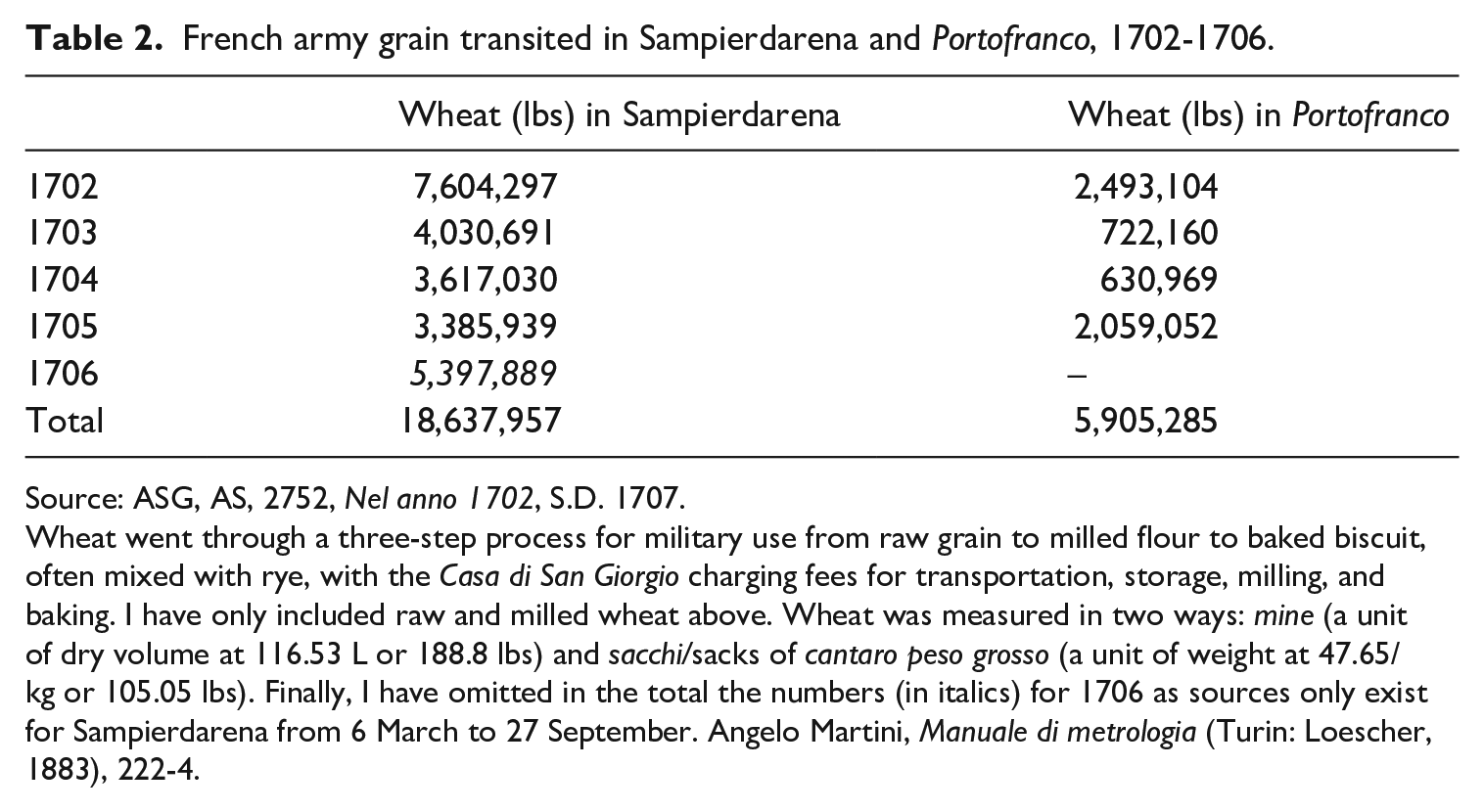
Source: ASG, AS, 2752, Nel anno 1702, S.D. 1707.
Wheat went through a three-step process for military use from raw grain to milled flour to baked biscuit, often mixed with rye, with the Casa di San Giorgio charging fees for transportation, storage, milling, and baking. I have only included raw and milled wheat above. Wheat was measured in two ways: mine (a unit of dry volume at 116.53 L or 188.8 lbs) and sacchi/sacks of cantaro peso grosso (a unit of weight at 47.65/kg or 105.05 lbs). Finally, I have omitted in the total the numbers (in italics) for 1706 as sources only exist for Sampierdarena from 6 March to 27 September. Angelo Martini, Manuale di metrologia (Turin: Loescher, 1883), 222-4.
No such evidence of warehouses in the western part of Genoa exists for the Allies. Rather, a comparison between, on the one hand, a list of bills of exchange drawn by Chetwynd for 100,000 mine of grain delivered in 1711 by Huguenot-Allied contactors with, on the other, surviving surveys of foreign-born merchants holding freeport warehouses can reveal a distinct Allied preference for the freeport over Sampierdarena. From 16 June to 5 December 1711, Chetwynd issued 42 bills of exchange totalling £60,095, s.6, d.2 to 10 payees including the firms of Joseph Boüer & [John] Teffier (£36,617, s.17), David André (£8,205, s.5, d.8), Guilliame Boissier (£2,500), Pierre Doirenne (£1,426, s.6, d.6), and a Messers Natte (£2,000) and Legard (£678, s.6, d.2). 67 Boüer, André, and Boissier all possessed extensive warehousing in the portofranco; a later record from 1714 to 1739 lists André holding two warehouses, Boissier four, and Boüer one. 68 Indeed, by mid-century a report from the Minor Council of Genoa noted how Protestant merchants had ‘formed a small republic well credited in the portofranco and in some way independent of the Republic’. 69 Stronger confirmation of this spatial separation between Jewish-Bourbon and Huguenot-Allied warehouses can be found in those moments when army contractors ran out of storage room and expanded into nearby spaces. The Genoese government permitted just such a request in 1702 when the French envoyè to Genoa, Louciennes, asked to rent out a palace of the Grimaldi in Sampierdarena because ‘it has more space to put wheat’. 70 Four years later, as the French were evacuating the remaining grain they possessed in the city, the Grimaldi magazines had 1,205 sacchi of grain in them, while the neighbouring warehouses of the Imperiali family had a further 2,680 sacchi. 71 Yet when 3 years later William Chetwynd was in need of warehousing space for 2,000 mine of fodder, he (or, more likely, Boüer) found it just outside the freeport at a storeroom near Chiesa di San Marco al Molo. 72
IV
It is worth drawing out the importance of the political geographies of Bourbon-Jewish and Allied-Huguenot army contractors in Genoa. Acknowledging these differences means paying close attention to how existing customs regimes, symbolic and legal geographies, business connections, and physical mobility shaped where religious minorities carried out war business. Although both possessed ample warehousing space, the portofranco and Sampierdarena operated under vastly different regulatory regimes. Begun to attract food to the city following harvest failures in the late 1580s, Genoa’s portofranco evolved by the early eighteenth century into a sprawling, tightly regulated 6,000 square/metre complex of bonded, duty-free warehouses. 73 Scholars interested in peacetime commerce have claimed the Genoese portofranco was ‘bedeviled by competing policy goals’ and ‘a missed opportunity in terms of international connections’. 74 Certainly, Genoa’s Huguenot suffered at times from these disadvantages as Genoese officials imposed with caprice transshipment, warehousing, and other freeport duties on the Allies. John Chetwynd, for example, bragged in early Spring 1708 that ‘the Queen will be pleased’ that he had obtained from the Genoese permission to load duty-free 5,000 sacks of grain for Catalonia only later for him to excoriate port officials for being not ‘just & reasonable’ when they imposed duty on biscuit for the English fleet later that autumn. 75 ‘The French were so far from paying anything of a duty for what was for the use of their troops that they never so much as asked the permission of the Republick for a free entry or transit’, he grumbled. ‘They made their magazines at St. Pietro d’Arena w(hi)ch are the suburbs of this place for the use of their Army, & acted in everything as sovereigns’. 76
But if the freeport’s guards and paperwork reduced Genoa’s commercial flows, such regulations were vital for the storage of military goods. Contraband or theft may have annoyed Genoese public authorities, but debilitated military logistics. Such was Jacob Levi’s predicament in Sampierdarena, which, as a suburb, fell outside the freeport’s controls. Lacking preexisting guidelines, the Genoese authorities and Levi struggled to make bespoke ones, regulating all aspects of the merchant’s magazines in the suburb from storage methods, to the size of the warehouses’ windows, to the number of keys needed to open its (locked-by-law) doors. 77 Yet throughout the war, duty-free wine and grain destined for the French army disappeared from Sampierdarena and into the black market. 78 Even worse, the warehouses exposed Levi to the threat of assault as they required him to pass from his apartment in the freeport-adjacent Piazza dell’Olmo (colloquially called Piazza degli Ebrei) through the neighbourhood of Molo where ‘the great part of the residents are mariners’ who ‘hold hatred against the Nation [e.g. Jews]’. 79 The inconvenience of the whole operation for Levi and his associates may explain why the French envoyè Louciennes repeatedly requested the Genoese government exempt Jewish army victualers from wearing the badge required for all Jews in the city. 80
Jewish-Bourbon and Huguenot-Allied warehousing differed due to a range of reasons. Bourbon and Allied supply chains mattered for one, the former requiring a constant flow of war goods from the beachfront at Sampierdarena and onto Lombardy, and the latter needing grain and other supplies to idle for months before German troops could assemble at Vado/Savona to embark in large convoys to Iberia. ‘As to the magazins (sic), it was impossible to have made them in [Vado] . . . without a good & continuall guard, which perhaps might not have been sufficient amongst so many good for nothing & ill-intentioned people’, John Chetwynd wrote his superiors about this very issue in June 1708. 81 Important too was the different legal and symbolic geographies of the freeport and Sampierdarena. Despite Quincy praising the suburb as ‘the most beautiful place in the city’, Sampierdarena lay legally outside of Genoa itself, and Genoese authorities, as already noted, were perfectly happy to shelter behind such ambiguity. 82 Again, a comparison with Huguenot suppliers in the second half of the war is useful. As the sources make clear, Genoese authorities let Allied suppliers use the freeport duty-free in these years partially because port officials were keen to monetize freeport duties to meet renewed Austrian-Imperial demands for Imperial taxes in the northern Italian states of the Reichsitalien. 83 The commercial backgrounds of Genoa’s Jews and Huguenot finally was a factor. On the Jewish side, Levi, Sacerdote, and other members of their network began their careers as dealers in wine and spirits. 84 In contrast, Genoese Huguenot worked in the long-distance grain trade before the conflict and already possessed extensive, Mediterranean-wide networks to move grain from as far away as Austria and the Morea through Genoa and onto Iberia. 85 How the war changed these commercial patterns remains to be seen. Surveys of the freeport before the war list only one Huguenot (Guilliame Boissier) as renting a warehouse in 1703, while at war’s end at least four can be found. Conversely, Levi appears to have neither continued in the grain trade nor renewed his warehouse in the freeport. 86 Such findings are important because scholars working on the business of war largely have claimed that army contractors built their war business upon existing commercial connections; at least in the case of Genoa’s Jews and Huguenot, the spatial patterns of army victualling suggest the reverse. 87
V. Conclusion
In recent years, scholars of early modern war and society have replaced the hierarchical, bureaucratic forms of state-sponsored military logistics with a more subtle Contractor State model by which the business of war largely took place within spatially unbounded, transnational, networked relationships. Employers, agents, and contractors have been presented as working in a world of paper – of letters, contracts, newspapers, and other forms of early modern information technology not unlike our post-modern, Internet age. Yet for all its vast, globe-spanning dimensions, much of the business of war in the War of Spanish Succession was still a face-to-face affair. Grouped in fiscal-military hubs, military elites moved through distinct urban spaces that shaped how they conducted their business while they simultaneously altered the places in which they worked. Rather than different bureaucratic cultures or personal networks, Allied and Bourbon naval contractors and army victualers experienced the business of war in Genoa differently because they fundamentally worked in different parts of the city, whether the Palazzo Doria-Tursi, suburban Sampierdarena, or the portofranco. The simple presence of military experts in the same place at the same time was no guarantee of similar behaviour. In this regard, the model of the fiscal-military hub, while useful, should be considered as a starting point for a larger understanding of the spaces in which the business of war took place.
Footnotes
Acknowledgements
I would like to thank John Condren, Michael Depreter, Aaron Graham, Jeanette Kamp, Caleb Karges, Katalin Pataki, Guy Rowlands, and Peter Wilson for their kind comments on earlier drafts of this essay. In addition, I would like to thank the two anonymous reviewers as well as the editors for their helpful comments. All translations and transcriptions are my own unless noted.
Funding
The author disclosed receipt of the following financial support for the research, authorship, and/or publication of this article: This paper draws on research conducted for the project The European Fiscal-Military System, 1530-1870, which is funded by the European Research Council (ERC) under the European Union’s Horizon 2020 research and innovation programme (grant agreement No. 787504).

1
John Brewer, The Sinews of Power. War, Money and the English state 1688-1788 (New York: Alfred A. Knopf, 1989); John Brewer and Eckhart Hellmuth, eds., Rethinking Leviathan: The Eighteenth-Century State in Britain and Europe (Oxford: Oxford University Press, 1999); Jan Glete, War and the State in Early Modern Europe. Spain, the Dutch Republic and Sweden as Fiscal Military States, 1500-1650 (London: Routledge, 2002); Rafael Torres Sánchez, ed., War, State and Development. Fiscal-Military States in the Eighteenth Century (Pamplona: EUNSA, 2007); Christopher Storrs, ed., The Fiscal-Military State in Eighteenth-Century Europe (Farnham: Ashgate, 2009); and Aaron Graham and Patrick Walsh, eds., The British Fiscal Military States, 1660-c.1783 (Farnham: Ashgate, 2016).
2
Roger Knight and Martin Wilcox, Sustaining the Fleet, 1793-1815: War, the British Navy, and the Contractor State (Woodbridge: Boydell and Brewer, 2010); Richard Harding and Sergio Solbes Ferri, eds., The Contractor State and its Implications (1659-1815) (Las Palmas de Gran Canaria: Universidad de Las Palmas de Gran Canaria, 2012); Stephen Conway and Rafael Torres-Sánchez, eds., The Spending of States: Military Expenditure during the Long Eighteenth Century. Patterns, Organization and Consequences, 1650-1815 (Saarbrücken: VDM Verlang, 2011); Jeff Fynn-Paul, ed., War, Entrepreneurs, and the State in Europe and the Mediterranean, 1300-1800 (Leiden: Brill, 2014); Rafael Torres-Sánchez, Military Entrepreneurs and the Spanish Contractor State in the Eighteenth Century (Oxford: Oxford University Press, 2016).
3
Marianne B. Klerk, ‘The “Fiscal-Military Hub” of Amsterdam: Intermediating the French War Subsidies to Sweden during the Thirty Years’ War’ in Economics of Allegiance: Subsidies, Diplomacy and State Formation in Europe, 1494-1799, eds. Erik Thomson and Svante Norrhem (Lund and Manchester: Lund University Press, 2020), pp. 213-33; Peter H. Wilson and Marianne B. Klerk, ‘The Business of War Untangled: Cities as Fiscal-Military Hubs in Europe (1530s-1860s), War in History. Epub ahead of print 3 December 2020. DOI: 10.1177/0968344520913583.
4
Martha Pollak, Turin, 1564-1680: Urban Design, Military Culture and the Absolutist Capital (Chicago: The University of Chicago Press, 1991); Yair Mintzker, The Defortification of the German City, 1689-1866 (Cambridge: Cambridge University Press, 2012), pp. 11-42; James Tracy, ed., City Walls: The Urban Enceinte in Global Perspective (Cambridge: Cambridge University Press, 2009), pp. 155-418; Martha Pollak, Cities at War in Early Modern Europe (Cambridge: Cambridge University Press, 2010). For the Italian arms industry see Ennio Concina, ed., Arsenali e città nell’Occidente europeo (Rome: La Nuova Italia Scientifica, 1987); Robert Davis, Shipbuilders of the Venetian Arsenal: Workers and Workplace in the Preindustrial City (Baltimore and London: The John Hopkins University Press, 1991); Luca Mocarelli and Giulio Ongaro, ‘Weapons’ Production in the Republic of Venice in the Early Modern Period: The Manufacturing Centre of Brescia between Military Needs and Economic Equilibrium’, Scandinavian Economic History Review, 65 (2017), pp. 231-42.
5
Christopher R. Friedrichs, The Early Modern City 1450-1750, 2nd ed. (New York: Routledge, 2013), pp. 292-3.
6
For an overview of the conflict see Matthias Pohlig and Michael Schaich, eds., The War of the Spanish Succession: New Perspectives (Oxford: Oxford University Press, 2017); and Katharina Arnegger et al., eds., Der Spanische Erbfolgekrieg (1701-1714) und seine Auswirkungen (Vienna, 2019).
7
Carlo Bitossi, ‘La Repubblica di Genova: Politica e istituzioni’ in Storia di Liguria, eds. Giovanni Assereto and Marco Doria (Rome and Bari, 2007), pp. 79-84.
8
Riccardo Dellepiane and Paolo Giacomone Piana, ‘Le leve corse della Repubblica di Genova: Dalla pace di Ryswick al Trattato di Utrecht (1697-1713)’, Atti della società ligure di storia patria (hereafter ASLSP), nuova serie, 36 (1996), pp. 427-46; Giovanni Assereto, ‘La guerra di Successione spagnola dal punto di vista genovese’, ASLSP, nuova serie, 51 (2011), pp. 539-84; Christopher Storrs, ‘Negotiating the Transition from Spanish to Austrian Habsburg Italy: Non-Spanish Italy and the War of the Spanish Succession (c. 1700-1713/14)’ in The War of the Spanish Succession, pp. 131-57.
9
I use the term here ‘resident-foreigners’ to express both the physical fluidity of these individuals, many of whom were recent migrants, as well as their exclusion from the governing class. See Andrea Zappia, ‘Per accelerare la venuta in città di persone molto ricche e poderose’. Gli ebrei a Genova tra aperture e resistenze (1654-1700), Viaggiatori. Circolazioni scambi ed esilio, 2 (2020), pp. 64-100.
10
British Library [hereafter BL], Add Ms. 61526, 190r-191r.
11
Peter B. Evans, Dietrich Rueschemeyer, and Theda Skocpol, eds., Bringing the State Back in (Cambridge: Cambridge University Press, 1985).
12
Francesca Trivellato, The Familiarity of Strangers: the Sephardic diaspora, Livorno and Cross-Cultural Trade in the Early Modern Period (New Haven: Yale University Press, 2009).
13
Bruno Latour, Reassembling the Social: An Introduction to Actor-Network Theory (Oxford: Oxford University Press, 2005); Andrea Caracausi and Christian Jeggle, eds., Commercial Networks and European Cities, 1400-1800 (Cambridge: Cambridge University Press, 2014).
14
Iain S. Black, ‘Money, Information, and Space: Banking in Early-Nineteenth-Century England and Wales’, Journal of Historical Geography, 21 (1995), pp. 398-412.
15
David Parrott, The Business of War: Military Enterprise and Military Revolution in Early Modern Europe (Cambridge: Cambridge University Press, 2012), pp. 213-4.
16
Guy Rowlands, ‘Moving Mars: The Logistical Geography of Louis XIV’s France’, French History, 25 (2011), pp. 492-514.
17
Henry Kamen, The War of Succession in Spain 1700–15 (Bloomington: Indiana University Press, 1969); A.D. Francis, The First Peninsular War, 1702–1713 (London: Benn, 1975); Agusti Alcoberro, ‘The War of Spanish Succession in the Catalan-Speaking Lands’, Catalan Historical Review, 3 (2010), pp. 69-86.
18
ASG, AS, 2928, Essendo stato rappresentato, 12/9/1703; TNA, SP 79/3/479r-v, 483r-v, 485r-486v, 681r, 690r, 699r-v, 79/5/94r-95r, 194r-197r, 79/6/40r-41r, 101/71/305r-v; CO Genoua, 16/9/1702, 23/9/1702, 12/4/1704, 19/4/1704.
19
The population of Genoa was ~ 70,000 in 1650. Carlo M. Cipolla, Before the Industrial Revolution: European Society and Economy, 1000-1700, 3rd ed. (London: Routledge, 1993), p. 282.
20
Charles Sevin, marquis de Quincy, Mémoires du chevalier de Quincy, ed. Léon Lecestre (3 vols. Paris: Librairie Renouard, 1898), I, pp. 361-5.
21
Geoffrey Parker, The Army of Flanders and the Spanish Road: The Logistics of Spanish Victory and Defeat in the Low Countries’ Wars, 2nd Edition (Cambridge: Cambridge University Press, 2004); Christopher Storrs, The Resilience of the Spanish Monarchy, 1665-1700 (Oxford: Oxford University Press, 2010); Manuel Herrero Sánchez, ‘Génova y el sistema imperial hispánico’ in La Monarquía de las naciones. Patria, Nación y Naturaleza en la Monarquía de España, eds. Antonio Álvarez-Ossorio and Bernardo J. Garcia Garcia (Madrid: Fundación Carlos Amberes, 2004), pp. 529-62.
22
Il bombardamento di Genova nel 1684, Atti della Giornata di Studio nel Terzo Centenario (Genova, 21 Giugno 1984) (Genoa: La Quercia, 1988); Carlo Bitossi, ‘1684. La Repubblica sfida il Re Sole’ in Gli anni di Genova, eds. Franco Cardini, Michel Ballad, Giuseppe Felloni et al. (Rome-Bari: Editori Laterza 2011), pp. 123-50.
23
Quincy, Mémoires, I, p. 362.
24
Luca Lo Basso ‘Una difficile esistenza. Il duca di Tursi, gli asientos di galee e la squadra di Genova tra guerra navale, finanza e intrighi politici (1635-1643)’, ASLSP, nuova serie, 51 (2011), pp. 819-46; Luca Lo Basso, ‘Gli asientisti del re. L’esercizio private della guerra nelle strategie economiche dei Genovesi (1528-1716)’ in R. Cancila, ed., Mediterraneo in armi (secc. XV-XVIII) (2 vols. Palermo: Quaderni – Mediterranea, 2007), II, pp. 397-428; Benoît Maréchaux, ‘Los asentistas de galeras genoveses y la articulación naval de un imperio policéntrico (siglos XVI-XVII)’, Hispania, 80 (2020), pp. 47-76; Benoît Maréchaux, ‘Business Organisation in the Mediterranean Sea: Genoese Galley Entrepreneurs in the Service of the Spanish Empire (Late Sixteenth and Early Seventeenth Centuries)’, Business History. Epub ahead of print 10 August 2020. DOI: 10.1080/00076791.2020.1798933.
25
ASG, AS, 2928, Se ne accuse la, 26/1/1701; BL, Add Ms. 61522/138r-v; 61523 131r-132r, 133r-134r; TNA, SP 79/3/458r, 460r-v; CO Genoua, 1/4/1702; Nicolini, L’Europa, I, Docs. 87, 269, 281, 316, 329; II, 581.
26
TNA, SP 79/3/458r, 460r-v.
27
ASG, AS, 2928, Sotto li 22, 26/2/1703; Ieri l’altro, 5/3/1703; Ieri l’altro, 8/3/1703; Nave S. Giacomo, 08/03/1703; Soldatesca Francese sbarcata, 21/3/1703.
28
George L. Gorse, ‘A Classical Stage for the Old Nobility: The Strada Nuova and Sixteenth-Century Genoa’, The Art Bulletin, 79 (1997), p. 315.
29
TNA, SP 101/71/338r-v, 340r-v, 342r-v; Assereto, ‘La guerra’, p. 555. Quincy met not with the duke himself, but his teenage son.
30
Richard Hill, The Diplomatic Correspondence of the Right Hon. Richard Hill, Envoy Extraordinary from the Court of St. James to the Duke of Savoy, 1703-1706, ed. William Blackley (London, 1845), II, p. 553.
31
Hill, Diplomatic Correspondence, II, p. 553.
32
TNA, SP 79/3/534r-v, 556r.
33
Hill, Diplomatic Correspondence, II, pp. 676-77.
34
Hill, Diplomatic Correspondence, II, pp. 691-93.
35
TNA, SP 79/3/524r.
36
Caleb Karges, ‘Britain, Austria, and the “Burden of War” in the Western Mediterranean, 1703-1708’, International Journal of Military History and Historiography, 39 (2019), p. 24.
37
BL, Add Ms. 61526/50r-57r.
38
BL, Add Ms. 61526/54r-57r.
39
TNA, SP 79/6/66r-67v.
40
BL, Add Ms. 61526/225r-226v.
41
Stephen Martin-Leake, The Life of Sir John Leake, Rear-Admiral of Great Britain (2 vols. London, 1920), ii, pp. 224-5, 232.
42
TNA, Treasury [T], 1/111, 4E-4F.
43
TNA, SP 79/5/570r-572v.
44
BL, Add Ms. 61526/62r-63v; 61527/110r-v; TNA, SP 79/5/372r-376v, 378r-v.
45
TNA, T 1/148, 6r, 8v; SP 109/1/43r-v.
46
TNA, SP 79/6/262r-v.
47
TNA, SP 79/5/570r-572v.
48
BL, Add Ms. 61521/123r-124r.
49
BL, Add Ms. 61521/107r-108r; CO Genoua 19/11/1707, Nicolini, L’Europa, III, Doc. 819; Margaret R. Butler, ‘Italian Opera in the Eighteenth Century’ in Simon P. Keefe, ed., The Cambridge History of Eighteenth-Century Music (Cambridge: Cambridge University Press, 2009), p. 220.
50
BL Add Ms. 61521/127r-128r.
51
TNA, SP 79/6/152r-153v; CO Genoua 26/10/1711, 21/11/1711.
52
TNA, SP 79/5/529r-v, 531r-v.
53
Casimir von Schlippenbach, Een oorlogsman van dezen tijd en beminnaar der sexe’ : de autobiografie van Casimir graaf von Schlippenbach, 1682-1755, ed. and trans. Hans Vogel and Marjan Smits (Amsterdam: Uitgeverij Augustus, 2007), pp. 79-86.
54
Karges, ‘Logistics’, p. 96.
55
ASG, AS, 2930, Nota de Mulatieri, 29/5/1713.
56
TNA, SP 79/3/519r, 577r, 607r; ASG, AS, 2928, Avendo I.llustrissimo, 25/5/1705.
57
ASG, AS, 2930, Nota delle vettovaglie, 17/03/1712. Weights and measures for mine and cantari may be found in n. 91.
58
Quoted in Assereto, ‘La guerra’, p. 554.
59
Hill, Diplomatic Correspondence, I, p. 464.
60
Quoted in Assereto, ‘La guerra’, p. 553.
61
Jonathan Israel, European Jewry in Age of Mercantilism 1550-1750 (London, 1985), pp. 127-34; Simon Schwarzfuchs, ‘Les Vittafano, Sanguinetti, et Levi au service du Roi de France’ in Mauro Peroni, ed., Una manna buona per Mantova = Man Tov le-Man Tovah: studi in onore di Vittore Colorni per il suo 92o compleanno (Florence: Olschki, 2004), pp. 539-93.
62
Herbert Lüthy, La Banque Protestante en France de la Révocation de l’Édit de Nantes à la Révolution (2 vols. Paris: S.E.V.P.E.N, 1959-61); J.F. Bosher, ‘Huguenot Merchants and the Protestant International in the Seventeenth Century’, The William and Mary Quarterly, 52 (1995), pp. 77-102.
63
ASG, Banco di San Giorgio, 183,00235. I want to thank Andrea Zanini for this reference to Levi’s warehouse in the portofranco.
64
ASG, AS, 2928, Note di quello, S.D. 1704.
65
66
BL, Add Ms. 61523/56r-57v.
67
Journals of the House of Commons (1711-1714) (London, 1803), pp. 553-4.
68
Eduardo Grendi, ‘Gli inglesi a Genova (secoli XVII-XVIII)’, Quaderni storici, 39 (2004), p. 262; Luisa Piccinno and Andrea Zanini, ‘Genoa: Colonizing and Colonized City? The Port City as a Pole of Attraction for Foreign Merchants (16th-18th centuries)’ in Giampiero Nigro, ed., Reti marittime come fattori dell’integrazione europea (Florence: Firenze University Press, 2019), p. 293.
69
Quoted in Grendi, ‘Gli inglesi’, n. 93.
70
ASG, AS, 2928, On demande qu’on, 21/4/1702.
71
ASG, AS, 2752, Nota di grani, S.D., 1706.
72
ASG, AS, 2930, Nota delle vettovaglie, 17/03/1712.
73
Giulio Giacchero, Origini e sviluppi del portofranco Genovese (Genoa: SAGEP, 1972); Thomas Kirk, Genoa and the Sea: Policy and Power in an Early Modern Maritime Republic (Baltimore & London: Johns Hopkins University Press, 2005), pp. 157-85; Antonio Iodice, ‘Il porto franco, diffusione di un modello economico: politiche, attori, ideologie, mito. Due realtà a confront: Genova e Marsiglia (1590-1817)’ (PhD Dissertation, University of Naples ‘Federico II’ and University of Aix-Marseilles, 2017).
74
Corey Tazzara, The Free Port of Livorno & the Transformation of the Mediterranean World, 1574-1790 (Oxford: Oxford University Press, 2017), pp. 235-6.
75
BL, Add Ms. 61526/149r-153r; 61527/144r-145r.
76
BL, Add Ms. 61527/146r-149r.
77
ASG, AS, 2928, La cura dell’impresa, 23/1/1704.
78
ASG, AS, 2928, Copia di lettera, 2/4/1704.
79
Rossana Urbano and Guido Nathan Zazzu, The Jews in Genoa (2 vols. Leiden & Boston: Brill, 1999), II, Docs 1171, 1294.
80
Urbano and Zazzu, Jews in Genoa, II, Docs. 1051, 1127, 1264.
81
BL, Add Ms. 61527/100r-100v.
82
Quincy, Mémoires, I, p. 361.
83
These contributions reached 5,000,000 annually by 1709. Peter H. Wilson, German armies: war and German politics, 1648-1806 (London: UCL Press, 1998) pp. 121-4.
84
Urbano and Zazzu, Jews in Genoa, II, Doc. 1051.
85
Aaron Graham and Michael Paul Martoccio, ‘Provisions, Passports and the Problems of International Warfare in Early Eighteenth-Century Northern Italy: A Micro-Historical Study’ (working paper, University of Oxford, Oxford, September 2020).
86
Grendi, ‘Gli inglesi’, p. 262; Piccinno and Zanini, ‘Genoa: Colonizing and Colonized City?’, p. 293.
87
Rafael Torres-Sánchez, Pepijn Brandon, and Marjolein ‘t Hart, ‘War and Economy. Rediscovering the Eighteenth-Century Military Entrepreneur’, Business History, 60 (2018), pp. 4-22.