




Abstract
This study aims to put the introduction of conscription in a new perspective by examining its effects on the careers and backgrounds of professional soldiers. It specifically considers the Dutch-speaking part of the principality of Liège in 1756–1815, and the service records of more than 2,000 men from this area. It argues that soldiers did become more representative for society at large, but this came at the cost of lowering the prestige attached to military service. Conscription effectively undermined the position of professional soldiers, without giving them proper compensation in terms of promotion or financial rewards.
Introduction
Few dates in military history can claim the symbolic resonance of 23 August 1793, the proclamation of the famous levée en masse, which required every male French citizen between the ages of 18 and 25 to join the army. 1 While this has traditionally been interpreted as a turning point between the professional armies of the ancien régime and the mass armies of the nineteenth century, military historians, notably John A. Lynn, have called the value of this perspective into question. Compulsory military service was hardly a new phenomenon in 1793. France reintroduced it for militia regiments in 1688 and other major potentates had used it for years to fill the ranks of their regular forces. In fact, the levée en masse and the subsequent Jourdan-Delbrel law (5 September 1798), which introduced regular conscription in the entire French Republic, should be seen as a shift in much longer cyclical processes of army recruitment, privileging either voluntary, and specialist, or compulsory, and general, army service. The appearance of conscript armies in Western Europe from the seventeenth century onwards is a reversal of an earlier tendency towards voluntary enlistment, starting in the late Middle Ages, and gave way again to smaller professional military forces in the last decades of the twentieth century. 2
However, attempts to study how these transformations from one form of military service to another affected the lives of the people who actually served in the army when these changes took place, remain relatively rare. The few works that examine such transformations, such as Samuel F. Scott’s The Response of the Royal Army to the French Revolution or John A. Lynn’s Bayonets of the Republic, focus on the French (Republican) army, which is traditionally seen as a symbol of the transition to modern, as opposed to ancien régime, armies. 3 The French experience cannot be considered typical or representative for other European countries, which also reorganized military service during the late eighteenth and early nineteenth centuries (Britain, Austria, Prussia, Spain). 4
Within this wider European context, it should be emphasized that the population of a mass of relatively small territories, mostly located within the Holy Roman Empire, experienced an even more radical change. In these areas a strict system of conscription, of French origin, replaced systems of military service in which taking up service in foreign armies was allowed, if not encouraged. Roger Dufraisne’s study regarding the German principalities on the left bank of the Rhine is noteworthy because it examines continuity and change in military recruitment after the French takeover in the 1790s. 5
This emphasis on foreign service is essential as it refers to another main element of distinction between ancien régime and nineteenth-century national armies. Prominent military historians, such as Alan Forrest, claim that the motivation and backgrounds of soldiers serving in the forces of the French Republic were completely different from their royal army predecessors, even though they did not conduct a systematic comparison that would justify such a claim. The latter supposedly enlisted predominantly out of economic necessity, while the soldiers of the French Republic were motivated by patriotic fervour. Joost Welten, in his study of the effects of the Napoleonic conscription on the rural community of Weert, also states that conscription brought men of better off backgrounds in the army because ‘professional soldiers’, a term that he does not define, enlisted because they did not have other social prospects. In this way, historians present the introduction of conscription as an improvement. 6
This article defends an opposite view and asserts that the institution of conscription significantly reduced the position of professional soldiers in both society and the army. It argues that the introduction of conscription in the Dutch-speaking part of the Prince-Bishopric of Liège, in 1798 and 1815, lowered the status of military service, without giving professional soldiers significant compensation in terms of labour conditions or promotion. The focus on professional soldiers is of particular relevance because these people constitute the main constant between different recruitment methods. The argument is based on the service records of more than 2,000 soldiers from the Dutch-speaking part of the Prince-Bishopric of Liège, more or less the current Belgian province of Limburg, who served during the period 1756–1815.
In this specific area changes in systems of military service were more abrupt than in most other European regions. The Prince-Bishopric of Liège was one of the last major centres of foreign recruitment in eighteenth-century Europe until its incorporation into the French Republic (1795) and did not introduce conscription at all. Its militia structures, founded in the sixteenth century, had fallen into disuse. It went through two different introductions of compulsory military service: in 1798, the Jourdan-Delbrel law, and in 1815, by the new Netherlands government. The change from one military system to another was therefore more substantial than in France or any other entity considered up till this point. The research starts at the beginning of the Seven Years War, the last major war of the ancien régime as far as the Prince-Bishopric is concerned, while ending in 1815 rather than 1814 or 1798 allows the examination of two distinctive systems of conscription as well as a failed attempt to combine voluntary and compulsory military recruitment (1815–18).
The choice for precisely the Dutch-speaking part is based on major differences between the ways the Dutch- and French-speaking parts of the Prince-Bishopric responded to the French takeover. Linguistic factors did have an important role in eighteenth-century military recruitment, with French-speaking men serving preferably in French-speaking units; the French army or the Walloon regiments of the Spanish, Dutch, and Imperial army. Dutch-speaking men preferably served in the Dutch army. The Prince-Bishopric of Liège also experienced a revolution of its own in 1789–91, an event that has more than a little in common with its more famous French counterpart. The Dutch-speaking communities did not receive this revolution with open arms and the city of Saint-Trond even tried to oppose it with force. As a result of this background, the former French-speaking part of the Prince-Bishopric, mostly incorporated into the French département Ourthe, proved to be far more willing to accept French conscription. Many volunteered to join the French army as early as 1792 and continued to do so during Napoleon’s regime. The département of the Meuse-Inférieure by contrast, which incorporated the former Dutch-speaking part of the Prince-Bishopric, quickly developed a reputation for having one of the largest percentages of draft dodgers in the whole French Empire. 7
Studying soldiers from the Dutch-speaking part of the Prince-Bishopric of Liège means examining an area that allowed foreign recruitment longer than most other European regions, but also proved to be particularly unwilling to accept French conscription. There can be no doubt, therefore, that this area is unrepresentative for general transformations. But this very exceptionality is what makes this area interesting to study. Soldiers from this specific entity, who could traditionally choose whether they wanted to become a soldier and in which army they wished to do so, now suddenly had to accept military service in a military force to which they had little or no affinity. In this way, investigating this area provides a unique opportunity to examine how the introduction of conscription changed the position of professional soldiers in society and in the army. 8
The argument starts with an explanation of the concept of ‘professional soldier’, before giving a brief outline of recruitment methods in order to demonstrate how military service transformed in the period 1756–1815. This provides a basis to consider changes in the geographical and social backgrounds of soldiers. Together, these two sections show how the position of professional soldiers changed within society at large. The next part, on the diverse motivations for becoming a professional soldier, serves an intermediary between the aforementioned segments and the final two sections on the position of professional soldiers within the army. Of the latter one considers opportunities to choose or negotiate labour conditions, the other chances of promotion. The conclusion brings the main argument to the fore again, namely that the introduction of conscription significantly deteriorated the position of professional soldiers in society and in the army.
The Concept of ‘Professional Soldier’
Military professionalism is a well-known concept in historical studies starting with Samuel Huntington’s classic The Soldier and the State. It is a modern construct, since neither eighteenth- nor nineteenth-century sources use the term, but there can be no doubt that notions of professionalism did exist (e.g. Hans Friedrich Flemming, Der Vollkommene Teutsche Soldat (Leipzig, 1726)). David J. B. Trim has more recently proposed an extensive definition of what ‘military professionalism’ in a historic context entails. He connects the traditional emphasis on a code of conduct with socio-economic issues. These are to a large extent theoretical works. Rafe Blaufarb’s book of the careers of French officers in 1750–1820 provides a more practical approach. Unfortunately, he also reinforces prevailing assumptions, especially apparent in Huntington’s work, that professionalism is a trait of commissioned officers, not the lower ranks. 9
On the other side of the spectrum is a growing amount of studies which consider military service as a form of ‘labour’. Peter Way published a pioneering article in which he emphasized the role of eighteenth-century British soldiers as proletarian wage labourers. Notions of labour have also provided new perspectives on the traditional military problem of desertion, which is now considered as a form of labour negotiation. Remarkably enough, few of these studies take military professionalism into account, preferring instead to see military service as one of the many options open to unskilled, young males looking for work. They consequently confirm the general impression that unemployment forces men into the army. 10
The very concept of profession entails a basic sense of identity and distinction versus other occupational groups. The adjective ‘professional’ associates adherence to a code of conduct typical for a specific occupational group with people who gain a livelihood through employment in this profession. Theoretically, a professional soldier is not just someone who gains an income through military service, but also serves as an example of proper conduct for his comrades. However, the military records that constitute the basis for this study rarely provide much information about questions of identity or professional behaviour. 11
The entry of a certain Heinrich Schmidtmann in the records of the Dutch Regiment Lewe van Aduard on 22 January 1789 is significant in this regard. He was a passementier by trade, someone who adds ornaments to clothing, had served 13 years in the Prussian army and deserted a week before his enlistment. After less than five months of service his unit chased him away. This man was a professional soldier in the way Christopher Duffy defines it in his Military Experience in the Age of Reason: a veteran soldier. The use of a name apparently given to him in the Prussian army, and his skill as a passementier, a trade that involved making or repairing military uniforms, also point to long military service. Nevertheless, this veteran must also have severely transgressed the military regulations for chasing away an offender was a very serious form of punishment; applied to only four soldiers among the almost 1,000 ancien régime soldiers whose service records are examined here. It meant that someone was considered unworthy to serve in the army. Those who stole from their comrades were invariably punished in this manner. Heinrich was a professional soldier in a sense that he re-enlisted, but hardly a model for others to follow. 12
Given that this Heinrich served in several armies one could ask whether the term ‘mercenary’ would be appropriate. This concept is as complicated at the turn of the eighteenth to nineteenth century as it is now. Definitions invariably include elements of fighting for monetary gain and serving a cause in which one has no direct interest. In historical research, the association of mercenary service with foreign-born soldiers is particularly strong. Some Enlightenment thinkers, such as Voltaire and Rousseau, also used the term mercenary or comment on it in a pejorative way, but their views were far from universally accepted. The Dutch writer Pieter ‘t Thoen for instance criticized the Dutch army, and especially its foreign elements, in press during the 1780s, part of a more general ‘Patriot’ movement against the Stadhouder. Several army officers published responses to his allegations, after which he lessened his criticism. Officials did use the Dutch equivalent of the word ‘mercenary’ (huurling) in the census compiled in the former Prince-Bishopric of Liège in 1795, but referred to day labourers rather than soldiers. 13
Because of the nature of the sources this article adopts a working definition of ‘professional soldier’, namely ‘a soldier who obtains his main income through military service and stays in the army of his own accord’. Re-enlistment is one of the few elements of military professionalism that the records do provide information about. The element of staying in the army avoids the administrative distinctions military personnel records make. Someone enters the army as a ‘volunteer’, ‘conscript’, ‘replacement’, or ‘substitute’, but this says little about individual willingness to serve. Because historians traditionally associate professionalism with commissioned officers, this study explicitly connects the concept of professionalism to non-commissioned officers and privates. The only officers included in this study are a handful of men who started their career as private soldiers.
The term volunteer refers throughout this study to men whom the military personnel records consider as having entered the army out of their own accord. To what extent these volunteers were professional soldiers, or even entered the army genuinely of their own accord, is an essential part of the argument. This article does not assume that professional soldiers were volunteers by definition or vice versa. It does not, however, systematically study men who entered the French army as conscripts in the period 1798–1813 for two reasons. First, tracing the careers of Napoleonic conscripts in an area even as small as this one is a nearly impossible task because of their sheer number (several hundreds each year), the diversity of regiments (which also changed each year), and the presence of large numbers of draft dodgers. Second, tracing this massive number of conscripts would have contributed relatively little to the study of professional soldiers because everyone had to stay in the army. The Jourdan-Delbrel law officially limited military service to five years, but in wartime soldiers had to serve indefinitely. For these conscripts, there is no unambiguous trait that could identify them as professional soldiers. Many letters of Napoleonic soldiers have of course been preserved, but these still represent only a fraction of the men serving in the French army at that time. The inclusion of the Netherlands army in 1815, volunteers as well as conscripts, serves as a corrective for this non-inclusion of Napoleonic conscripts.
The article is consequently based on an extensive examination of the Dutch-Netherlands, French, and Imperial (Habsburg) armies. The surviving records from the Dutch army, the stamboeken, from 1770 to 1795 and 1814 to 1815 have been systematically processed, while selections have been made among registers from the French (1757–86 and 1798–1814), Imperial (1766–94), and Batavian-Holland armies (1795–1806). The choice for these sources is based on a preceding study of various local archives, mostly notary acts and judicial records, which revealed a clear inclination for service in the Dutch army, a preference that was subsequently confirmed by the data obtained from these registers. 14 The article also supplements the basic information that the military records provide with these same local sources.
Military Service, 1756–1815
After establishing a working definition of ‘professional soldier’, we will now turn to the Dutch-speaking part of the Prince-Bishopric of Liège and examine how military recruitment changed in the period 1756–1815. This will provide a basis for subsequent sections. The essential characteristic of Prince-Bishopric in the context of this study is its emphasis on foreign recruitment in the 1756–95 (1797) period. Besides their own small army – one infantry regiment and a company of lifeguards – the bishops allowed five potentates to recruit soldiers. The Bourbons had privileged links with the bishops in the late eighteenth century and could recruit quite openly: the Spanish established depots to assemble recruits before they left for Spain from 1767 onwards, including one in Saint-Trond, and the French king even organized official Liégeois regiments. 15 The Emperor could, as the nominal head of the Empire, not be denied recruit access, while Prussian recruiters were just tolerated. The Dutch army constitutes a case on its own in this regard, because it was not particularly privileged yet provided the main destination for recruits from the Dutch-speaking part of the Prince-Bishopric. The high number of soldiers from this area relates to the presence of major Dutch garrisons, most importantly Maastricht, but also Venlo, Namur, and ‘s Hertogenbosch, while Dutch enclaves in the principality and soldiers on leave also had an important role in recruitment. 16
In the eighteenth century most states stepped up measures against foreign recruitment, as several studies have established for the Austrian Netherlands, and this caused considerable trouble for armies that heavily relied on foreign manpower. The French and Spanish would have had serious difficulties, if not found it impossible, to man the ranks of their foreign regiments if they had not been allowed to recruit in the principality. The same applied to the Dutch army, but men from this area primarily served in national, as opposed to foreign, regiments. The French takeover of the Southern Netherlands in 1794–5 did constitute a small disaster in terms of Spanish and Dutch manpower requirements. The emphasis on foreign service is important, not only because it connects the Prince-Bishopric of Liège to other, and more well-known, European states, but also because it shows that increasing difficulties in recruiting foreign soldiers could have facilitated the adoption of conscription. 17
Military recruitment in the Prince-Bishopric of Liège, because foreign recruiters dominated it, was somewhat different from the practices known from historical studies regarding the English or French army. There is almost no mention of musicians being used to attract recruits for example, recruitment being carried out by military personnel or civilians acting on their own or in small groups. Court records and notary acts suggest that prospective recruits negotiated the conditions of service, just as journeymen would do. They wanted to serve in a particular regiment, for a certain number of years, and discussed the height of their bounty. The councillors of Bilzen prosecuted Joes Heckman, grenadier in the Dutch regiment Oranje-Gelderland, in 1782 because he passed Johannes Baerten, who sought to enlist in his unit, to navy recruiters. This case is noteworthy because Joes clearly was a professional soldier, enlisting in 1765 and still being present with the regiment at the time of its disbandment, in 1795. Yet he must also have violated the accepted code of conduct for another soldier, as a certain Jan Thewissen from the Dutch regiment Stuart acted as a witness against him. 18
Many recruits from the Prince-Bishopric of Liège were not recruits at all, but deserters from foreign armies, only a minority of which were born in the country. A letter to a certain Fonis, a sergeant in the Spanish Walloon Guards, reveals that of 10 men recruited in August 1791 in Hasselt, Ordingen, and Saint-Trond, only one originates in the Prince-Bishopric (Tongres). The nine others come from the Austrian Netherlands (three), the Holy Roman Empire (four), France, and Ireland (one each). While desertion was hardly a commendable act in the eyes of military authorities, the decreasing opportunities for foreign military recruitment meant that they had little alternative. There were, however, major differences in the ways various armies could use these men: the Spanish, French, and Prussians were major recruiters, while the Dutch and Austrians seem to have lost far more men to desertion than they were able to recruit. Twenty-two of twenty-eight recruits for the regiment Royal-Liégeois assembled in Liège in 1788, who had seen military service before, had served in the Dutch army. Recruiters from the aforementioned kingdoms especially focused on the city of Saint-Trond, close to the Austrian Netherlands, and the hamlet of Smeermaas, just outside the walls of Maastricht. 19
These practices of voluntary recruitment continued in the period 1795–8, when the French government took over the Prince-Bishopric of Liège, but had not yet introduced conscription. Most men enlisted in the Batavian army, a close ally of the French Republic. The major change came with the introduction of the Jourdan-Delbrel Law (5 September 1798), which declared that all able-bodied men aged 20 to 25 could be called upon to serve. This law sent shockwaves through Southern Netherlands, especially the Dutch- and German-speaking parts, and led to a full-scale revolt that was put down violently. 20 After facing such fierce resistance, not only in the newly conquered territories, but in other parts of the French Republic as well, Napoleon considerably lowered demands: while initially only men who were incapable of serving were allowed to send a replacement, this option was now made available to everyone, and men who left for the army voluntarily were encouraged to do so. 21
Given the social unrest it is hardly surprising that this area provided a dramatically low number of men to the French army in the period 1798–9, about 166, including 25 replacements and five volunteers. Interestingly enough, a comparison of these names with earlier military personnel records reveals that several of these replacements and volunteers had served before. The records of the 112e demi-brigade, specifically created in 1803 to accommodate ‘Belgians’ who fought against France in the previous decade, confirm this. Twenty men from this area enlisted in this regiment and six of them were former soldiers. According to the records, they were all volunteers, but six recruits were réfractaires, men who had not fulfilled their conscription obligations, who enlisted to receive amnesty, another came to Maastricht in order to enrol in a hussar regiment and was passed on to this unit, and one man was a veteran of the Dutch Brigade in English service, who also had to enlist to escape punishment. 22
The case of the 112e regiment is in many ways exemplary for the manner in which the French government handled recruitment during the following decade. When war broke out in 1805, the number of réfractaires in the département rose again to alarming levels. Government repression was ruthless and continued to be expanded and refined in the following years. 23 The Jourdan-Delbrel Law did make provisions for volunteering, but given that manpower needs were primarily met by conscription, it was not really encouraged. Theoretically the only advantages a volunteer could benefit from were choosing his own unit and receiving one extra franc per day. More importantly, while before 1798 one had only to present himself at a military recruiter or the unit’s quarters to volunteer, volunteers in the period 1798–1813 had to present themselves at their mayor’s office and obtain the necessary paperwork: an act of voluntary enlistment, a testimonial of good conduct, a surgeon’s declaration that the recruit meets the physical requirements, and written parental consent in the case of minors. 24
Many volunteers were simply not aware of this procedure and presented themselves at a unit’s depot without these documents. A register of voluntarily enlistments of the community of Hasselt shows that several men from other departments who came to the city to enlist with the 3rd hussar regiment, obtained the necessary paperwork on request of the depot commander. The French gendarmerie did not show the same leniency and arrested Guillaume Hector, who wanted to enrol as a volunteer with the 7th hussar regiment at Roermond, because he did not have proof that he fulfilled his conscription obligations. Apparently, he had never been included on the conscription lists because he was born in London, but grew up with his uncle in Saint-Trond. His father, Laurentius, served with the Swiss Regiment de Meuron on the Cape in the period 1782–7. In this way, the newly introduced bureaucracy even prevented men from enlisting. 25
The number of réfractaires in the department de la Meuse Inférieure remained among the highest in the whole of France right up to the fall of 1813. Nevertheless, the French government seems to have been quite successful in turning these men into obedient soldiers. To what extent former réfractaires chose a life as professional soldiers is unclear. Few veterans of Napoleon’s army re-enlisted in the period 1814–15. There is one exceptional example: Mathieu Vanderhoedonx from Genk, a miller’s son, was a réfractaire of the class of IX (1800–1). His older brother, also a réfractaire, threatened to shoot any gendarme trying to take them away, and their father was tried, but not convicted, for the murder of a French gendarme. Mathieu did join the colours in 1804, not coincidently during the trial of his father, and rose to officer’s rank in 1813. He obtained a commission in the Netherlands army in December 1815 and eventually became a captain in the Belgian regiment d’élite (royal guard). His service record, published in the Annuaire de l’etat militaire de Belgique in 1866, claims that he enlisted in 1804 as a ‘volunteer’. 26
The years 1814 and 1815 were characterized by considerable confusion, with the Southern Netherlands to the West of the River Meuse initially assigned to the Austrians and territory to the East to the Prussians. To make matters even more complicated, the new Netherlands government claimed the return of territories lost in 1795, notably the strategic fortress of Maastricht. These three potentates all tried to raise new units in the newly conquered territories, in the same way as before 1798, that is by issuing bounties to volunteers, and experienced varying degrees of success. In practice, most men enlisted in the new Netherlands army, especially the regiment Luikerwalen, which recruited directly in this area. Following the Congress of Vienna, the Southern Netherlands in their entirety became part of the new Kingdom of the Netherlands and the Austrian- and Prussian-raised troops were incorporated into this army as well. 27
Nevertheless, major modifications took place from April 1815, when conscription, for the militia not the regular army, was again introduced in the Southern Netherlands. Crucially, during the first conscription year all men between the ages of 20 and 35 had to draw lots. The number of volunteers decreased dramatically and almost no new ones are recorded from this area for the rest of the year 1815. Of the 373 men who joined the Netherlands army in the period 1814–15 as volunteers, 173 joined the infantry, 68 the cavalry, 58 the artillery, 41 the miners, 31 the marechaussee, and two the artillery train. 28
The king’s wish to build up a new colonial army with as many native (Belgian-Dutch) volunteers as possible further deteriorated the situation as one could receive a second and higher bounty, up to four times as high, by transferring to the colonial troops. In 1818, the same year that France reintroduced conscription, it was finally decided to combine the infantry battalions of the militia and regular army and discontinue the payment of bounties for soldiers to transfer to colonial service. An earlier attempt to encourage conscripts to transfer to the regular army by making them serve together produced only three volunteers among the class of 1815 (which encompasses more than a thousand men). 29
Position in Society (1): Geographical Backgrounds
The previous section served as an overview of the general developments affecting military service in the period 1756–1815. We will now move on to the effects of these transformations on the position of professional soldiers in society at large. This first means questioning to what extent conscription changed their geographical backgrounds. A distinction can be made between either cities and villages or different geographical areas. In the area under consideration here there were only four cities (Saint-Trond, Hasselt, Tongres, and Maaseik), none of which reached 6,000 inhabitants around 1800, and a multitude of villages, of which eight also had city rights (‘towns’). 30 A division can also be made between Hesbaye in the south, densely populated and characterized by fertile clay and loam soil, and the Campine in the north, sparsely populated and known for its nutrient-poor sandy soil. The city of Maaseik and a string of villages next to the Meuse River are considered as a third and separate category. 31
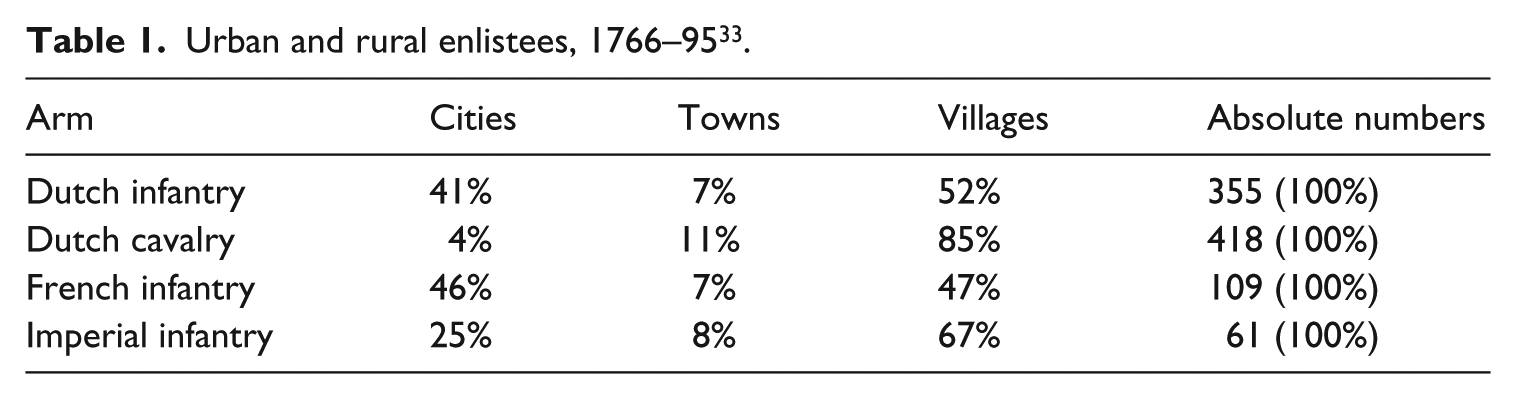
Tables 1 and 2 show that geographical backgrounds did influence men’s decisions to join the army. Historians have of course argued for many years that members of some communities were more likely to volunteer for military service, or for service in particular units. What is important here is that such geographical distinctions can be observed even in an area as small as this one. Peasants in the Campine not only had land of their own, but also retained access to common lands, which made them less likely to choose a mobile profession, such as soldiering. Horses were relatively rare, which explains why so few men enlisted in the cavalry. The over-representation of men originating from communities immediately adjacent to Maastricht, the only major garrison in the area, is also noteworthy. 32
Urban and rural enlistees, 1766–95 33 .
Enlistees according to geographical areas, 1766–95 (see note 31).
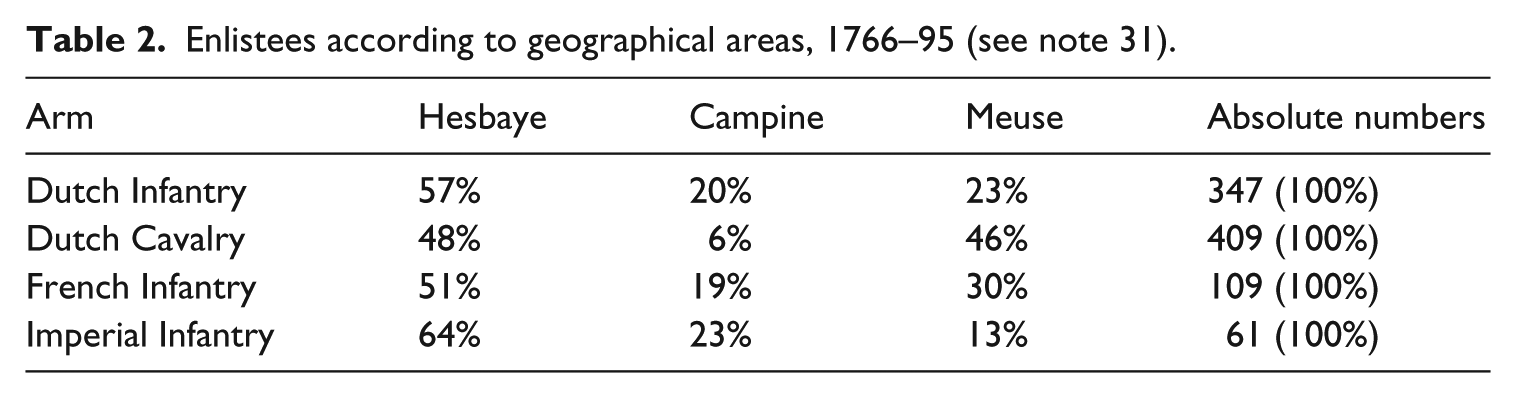
We know, from the famous thesis of André Corvisier as well as other studies, that men born in garrison cities were more likely to enter military service. The same applies to whole regions with a strong military presence (such as Alsace-Lorraine or the Southern Netherlands). These statistics show that a third distinction can be made as well. For even within regions with many garrison cities, a division can still be made between rural areas immediately adjacent to these garrisons and other settlements, which otherwise still provide a relatively high number of soldiers. 34
In this way, the introduction of conscription did make the army in general more representative of society at large in terms of geographical backgrounds, but whether professional soldiers also became more representative is doubtful. In 1805–6, when the département de la Meuse-Inférieure saw an exceptional number of draft dodgers, the canton of Bilzen, located next to the fortress of Maastricht, had not a single one, a fact that the justice of the peace attributed to the conscripts’ desire for military glory. In fact, the geographical backgrounds of volunteers for the Netherlands regular army in 1815 were similar to those from the ancien régime (24 per cent comes from the Campine, 40 per cent from Hesbaye, and 35 per cent from near the Meuse; see Table 3). The main difference lies within the contingent of conscripts sent to the National Militia. 35
Geographical background of replacements, substitutes and volunteers for the National Militia, 1815 36 .
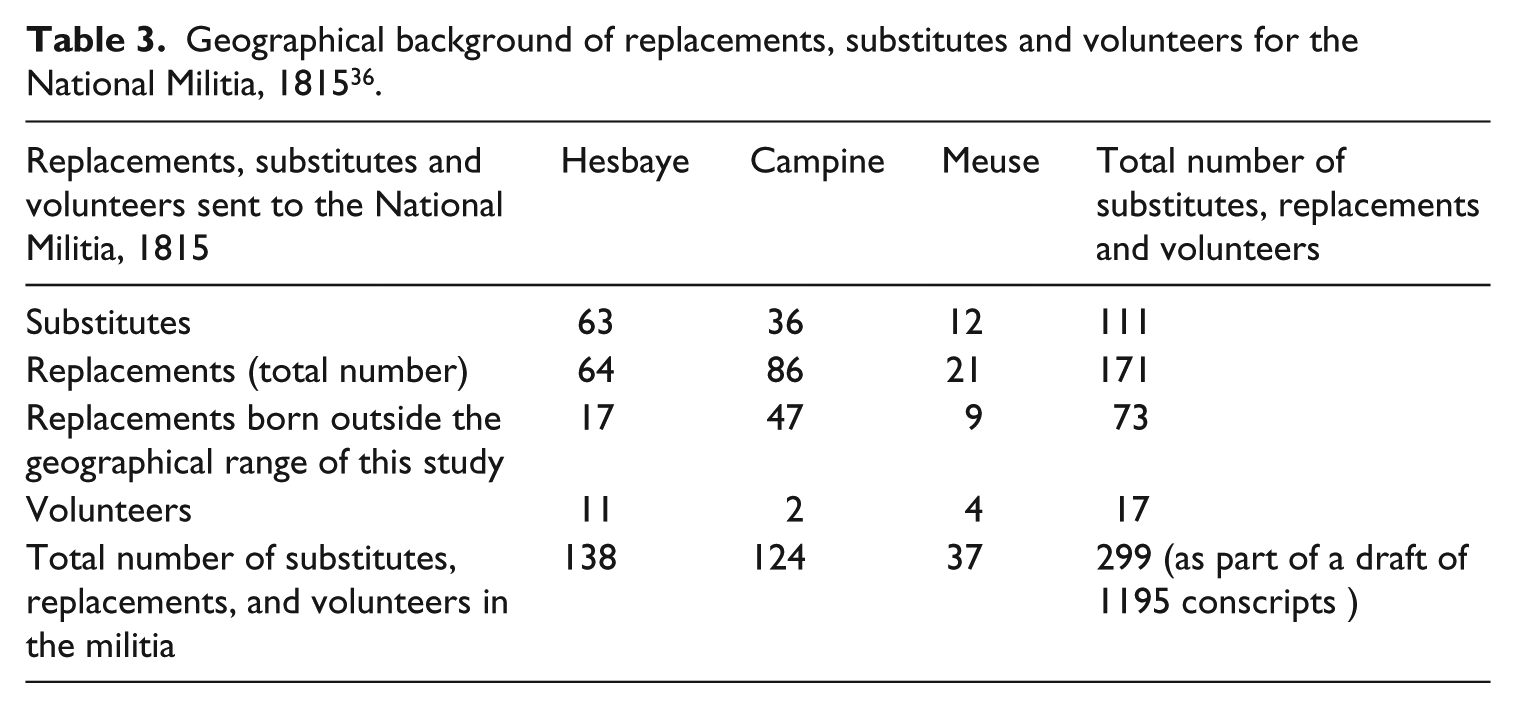
Communities in the Campine clearly tried to fill their militia contingent by attracting men from elsewhere. There were only a limited number of substitutes, men who exchanged lots and by definition came from the same community as the conscript they exchanged places with, and the great majority of replacements lived either in Hesbaye or other areas (mostly Diest, Maastricht, and Liège). In Hesbaye most replacements originated in local urban communities; Saint-Trond and Tongres. Conscripts from villages immediately adjacent to the Meuse River generally performed military service themselves or found a local man to serve in their place. Different attitudes towards military service, attitudes rooted in particular socio-economic structures and traditions, evidently did not change overnight. These geographical patterns of sending substitutes and replacements instead of conscripts could in effect still be observed in the Belgian army at the end of the nineteenth century. 37
Position in Society (2): Social Backgrounds
The previous section showed that geographical differences in military recruitment subsisted after two major introductions of conscription. Even though the army at large might have become more representative from a geographical point of view, the same did not apply to professional soldiers. This section now questions to what extent conscription actually changed their social backgrounds. This is especially important given that many historians claim that conscription brought men of well-off backgrounds into the army.
While military service personnel records do show clear patterns regarding the geographical backgrounds of soldiers, the same cannot be said for their social backgrounds. Most, but not all, personnel records of eighteenth-century armies only mention a soldier’s ‘trade’. This was not someone’s profession as such, but an indication whether he knew a particular skill, preferably one useful to the army (e.g. shoemaking, tailoring). Comparing these trades to conscription lists or nineteenth-century military records is of limited use because the latter wrote down a recruit’s profession far more accurately. In an agricultural society such as this research area, distinctions between a farmer and peasant, with or without land of his own, were meaningful, but most eighteenth-century records even fail to mention that someone gained a livelihood with agricultural work.
Rather than attempting a comparison on the basis of these trades, this study considers different sources to question traditional assumptions about eighteenth-century soldiers mainly enlisting because of lack of other employment. Notary acts from Tongres show for example that some soldiers owned considerable amounts of property, or came from families who did, but left the actual management of that property to others. Joannes Jonas, carabinier in the French cavalry regiment Royal-Picardie and veteran from the Seven Years War, briefly came to Tongres in 1773 to appoint a merchant to settle a conflict about an inheritance in his absence. Gilles Arckens, denoted as soldier in the Prussian army in 1777 and 1790, let his mother and stepfather manage the leasing of two houses inherited from his father. 38
Furthermore, if one compares lists of masters who served on the city council of Saint-Trond as representatives of their respective guilds with military registers on the basis of parish records, no less than eight guild masters had sons or nephews who served in ancien régime armies (van der Hucht, Aerts, Stas, Odendael, Steynen, Hector, Schevenels, and Recoms). Given that only a fraction of the men who entered military service in the period 1756–97 can be identified, this is a very significant number. At least one former soldier became a member of the city council himself; Nicolaas (H)Ector, a master tailor, served more than a decade in the Dutch regiment Oranje-Gelderland as a soldier and corporal. His younger brother Laurentius joined the Swiss regiment Meuron (see above). 39
These sources question the common assumption that conscription armies incorporated men of well-off backgrounds than volunteer forces, but due to their very variety they do not really provide unambiguous evidence how the social background of professional soldiers changed because of the introduction of conscription. Fortunately, there is one specific kind of evidence that can be found in abundance in military personnel records and allows a systematic comparison to be made: the soldiers’ height. Historians have used military records on multiple occasions to study the standard of living of past societies, but these studies take the military’s selection criteria insufficiently into account. The minimum height to serve in infantry units at the end of the eighteenth century was equal to or higher than the average height of a 20-year-old male in this area (1.62 m in 1798). Furthermore, cavalry and artillery units demanded even taller men. 40
On purely physical grounds it is therefore highly unlikely that ancien régime armies were predominately composed of men living close to or below the basic level of subsistence. Due to the introduction of conscription and wartime requirements, the French army lowered the required minimum height dramatically (from 1.625 m in 1798 to 1.488 m in 1811). The Netherlands government set the minimum height at 1.56 m in 1817. Even with these changes the French government still rejected 51 out of 967 conscripts from Saint-Trond for being too short, a significant part of a larger group of conscripts excluded on physical or mental grounds (15 per cent). Rather than incorporating those who could not find other employment, eighteenth-century armies seem to have enlisted men of more well-off backgrounds than their nineteenth-century counterparts. One could argue of course that official minimum heights do not necessarily correspond to the actual heights of serving soldiers and that the eighteenth-century volunteers were on average not taller than nineteenth-century conscripts. The information that the military personnel records provide disproves this. 41
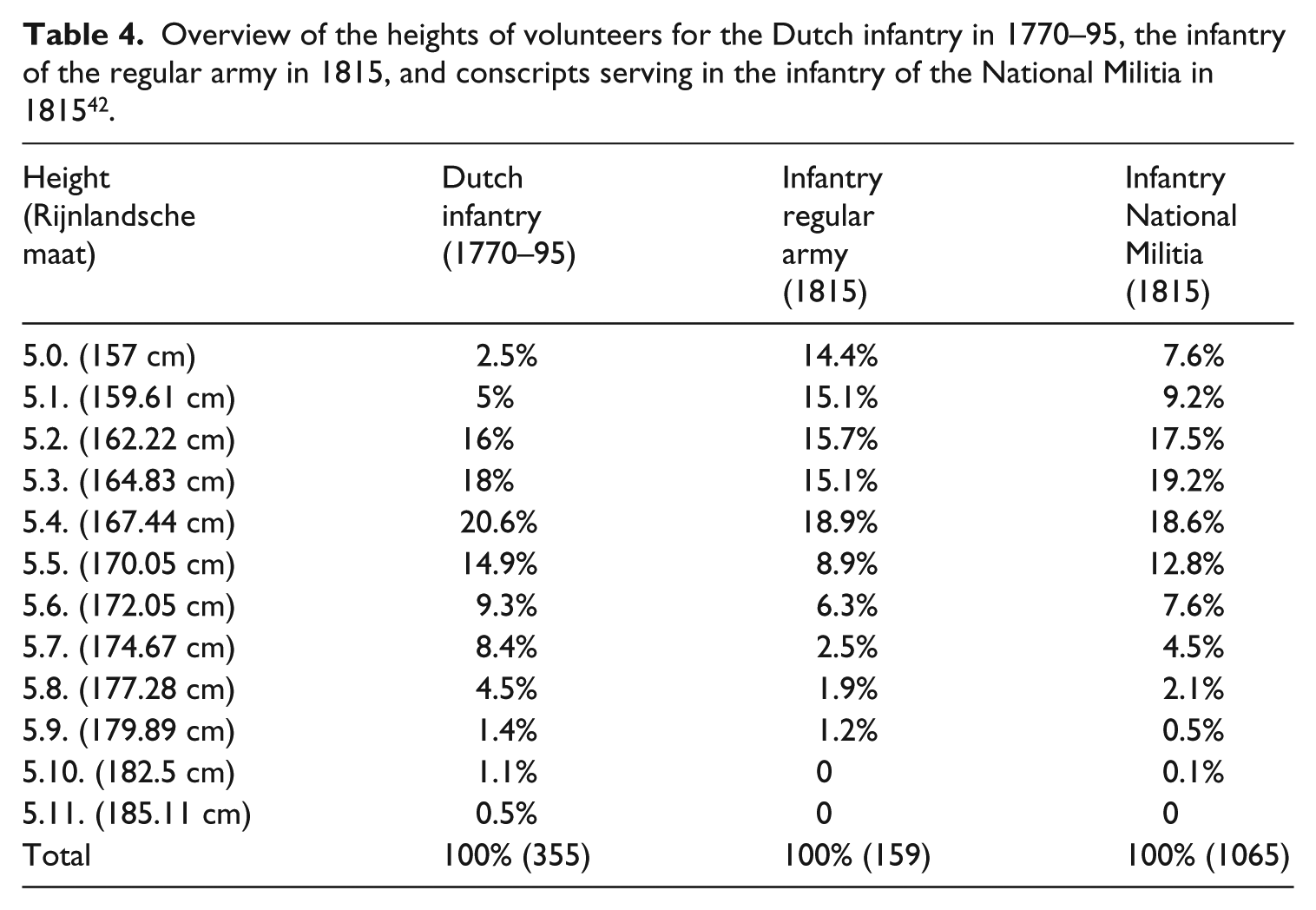
Table 4 shows that volunteers serving in the Dutch infantry before 1795 were on average significantly taller than both volunteers and conscripts in 1815. This is especially noteworthy because the militiamen of 1815 were on average older than both groups of volunteers, as they were mostly 19 to 35 years old, while the majority of volunteers were teenagers (57 per cent of volunteers for the Dutch infantry in 1770–95 were younger than 19). The short stature of volunteers in 1814–15 can be explained by the fact that most enlisted in 1814 and early 1815, at a time when the majority of able-bodied males still served in the French army, as well as by their young age. Also, almost half of the volunteers for the Dutch infantry (41.5 per cent) in 1770–95 did indeed not reach the minimum length of 1.67 m.
Overview of the heights of volunteers for the Dutch infantry in 1770–95, the infantry of the regular army in 1815, and conscripts serving in the infantry of the National Militia in 1815 42 .
Motivation
Given that the introduction of conscription did cause significant changes in the social backgrounds of soldiers, although not in the way traditionally claimed, one might wonder to what extent the motivations of professional soldiers altered after the introduction of conscription. If soldiers of the late eighteenth century came from relatively well-off backgrounds instead of the poor and unemployed, their motivations have to be re-evaluated as well. Studying motivations on the basis of military service records is of course much more problematic than the aforementioned geographical or social backgrounds, but if they are combined with other sources, it is possible to get a broad idea about incentives for becoming a professional soldier.
While military personnel records do not provide any information on what motivated individual men to enlist, it is possible to examine patterns. More than 60 per cent of the men who joined in the Dutch army before 1795 did so in the winter and spring, when agricultural workers found it particularly difficult to gain employment. In the Dutch cavalry, where recruits came from predominantly rural backgrounds, only 8 per cent of recruits enlisted during the summer months. Table 5 likewise shows that military service was an activity of young and unmarried men, enlisting in their late teens or early twenties.
Age of recruits in the Dutch infantry and cavalry, 1770–95. As far as recruits above the age of 22 are concerned, a distinction is made between veterans, men who served before, and actual recruits (r.) 43 .
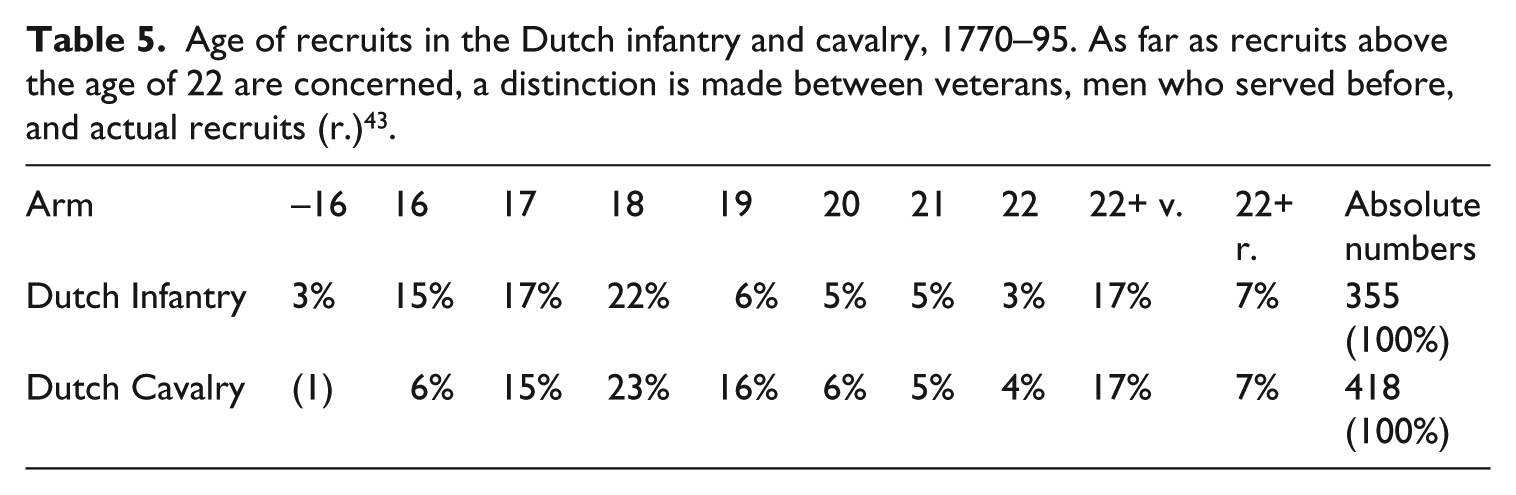
These patterns do confirm the importance of socio-economic factors, but one should be careful about assuming that these men enlisted because they could not find other work. All armies under consideration here, except for the Prussians, strongly discouraged marriage among their own soldiers and refrained from enlisting married men. Moreover, officers preferred young men because younger bodies are more adaptive to the strain of military service. The particular age structure, and length of service, of soldiers was also connected to the dominant marriage and labour pattern of the time, in which young men showed great mobility in their quest for labour and labour experience, and generally married in their late twenties. 44
Military service in fact offered real prospects for some men to enhance their skills and future employment opportunities, aside from traditional guild or household structures. Three passports, preserved in a family archive, give a unique insight into the military service of Francius Coenen from Saint-Trond. The first passport is a proof of discharge from the Dutch regiment Oranje-Gelderland in 1785. The stamboek of this unit indicates that he enlisted in 1779, was 17 years old and a whigmaker by trade. At that point he must still have been an apprentice, or possibly a journeyman. His second passport shows that he left for the Republic again in June 1786. This passport calls him master wigmaker and trader in hair; a fully independent entrepreneur. The third passport indicates that he enrolled in the Dutch army again, in the regiment De Bons in 1788, and returned to his native city in 1795. 45
David Hopkins’s study about the relationship between peasants and soldiers in eighteenth-century Lorraine, as expressed in popular culture, supports this view. These tales and images portray becoming a soldier as a vocation, a career choice with strong connotations of manhood and nobility. Common infantrymen still wore sabres at the end of the eighteenth century, a weapon with little practical value but reminiscent of medieval swords. All soldiers had colourful uniforms and wore their hair long and in a tail, thus mimicking wigs, and in elite units sporting a moustache was mandatory. Their appearance defined them as fighting men. When the high bailiff interrogated a burglar during the famous ‘Goat Rider’ trials, which involved large parts of this research area in the last decades of the eighteenth century, the felon identified two of his accomplishes as soldiers because they stood straight. Most people at that time, especially in agricultural societies, walked bended because of the hard labour on the fields. These external distinctions were defining characteristics of the military as a profession and gave them prestige. 46
The introduction of conscription constituted a major turning point in this regard, because it effectively made a particular life choice obligatory for all young males. This implies the development of new forms of status and the changing of old ones: conscription reinforced the association of military service with manhood and uniforms from the Napoleonic Wars were even more extravagant than their forbearers. Antoon Beertz, who transferred from a former Dutch cavalry unit to the chasseurs of Napoleon’s Imperial guard, wrote to his parents in 1812 that he wears a uniform ‘as beautiful as that of an officer’. 47 Yet it is uncertain to what extent these measures really improved the position of professional soldiers. They might just have compensated for the loss of status brought about by conscription. In terms of socio-economic incentives, serving as a replacement or substitute for a conscript did provide a major new opportunity. These monetary rewards could be very substantial, especially towards the end of Napoleon’s regime, and for that reason undoubtedly also involved people who would otherwise have had no interest to serve in the military. 48
The 125 men known to have enlisted as volunteers in the period 1798–1813 deserve to be examined separately because such enlistments involved a complex administrative procedure, for comparably few rewards. To what extent could these men be considered as professional soldiers ? Table 6 shows that almost half these volunteers (57) wanted to enlist as hussars, a type of unit that reached the height of their popularity during the Napoleonic Wars because of their dashing uniforms and reputation for bravery. Another 25 wanted to join the compagnie de réserve, the prefect’s own guard, originally drawn from conscripts who were part of the army reserve.
Volunteers for the French army in the period 1798–1813, divided according to the kind of unit they choose to serve in 49 .
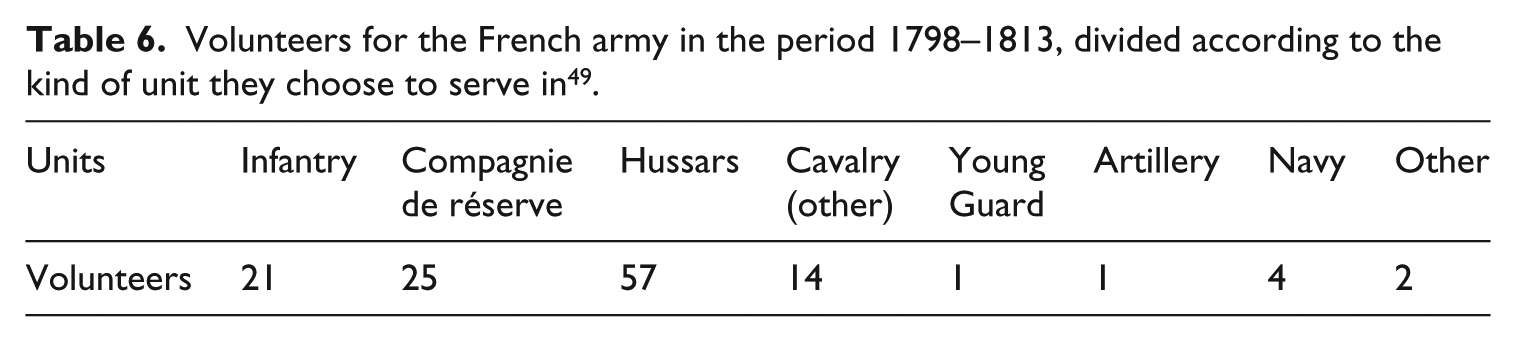
Many of these men, and particularly in these two groups, were already part of the army reserve. In other words: they probably enlisted as volunteers because this way they at least got a chance to serve in a unit of their choosing. Whether these men had any more inclination to serve in the army than the average conscript, is unclear. The example of Seraphin Jean Mathieu Broux from Hasselt is significant because of its very exceptionality. He received a discharge from the French army with a pension in 1811 because of a wound on his foot. He volunteered for the artillery in august 1811, but was sent back, possibly because of this wound. Undaunted, he signed a new engagement for the 54e infantérie de ligne on the same day. The Contrôles of this unit reveal that he was sent to the artillery after all by order of the Minister of War. 50 Still, it does seem that professional soldiers constituted a significant group among these volunteers because several re-enlisted in the Netherlands army in 1814–15 and one would even become an officer in the post-1815 French army. Of the 42 men from the municipality of Tongres who enlisted as volunteers in the Netherlands army in 1814–15, five had earlier volunteered to serve in the French army. 51
In practice, being acquainted with a (former) professional soldier seems to have had a major role in motivating prospective recruits. Paul Kleehammer, a Napoleonic conscript and one of the few men from this the area examined in this article, the former Dutch-speaking part of the Prince-Bishopric of Liège to receive the Légion d’Honneur, was born in Kanne in 1789 as the son of a French recruiting sergeant. He became a sergeant himself, in the French royal guard. His younger brother, Jean-Gerard, enlisted as a volunteer in the French and Netherlands army. 52 One of the last, and also one of the youngest, volunteers for the French army (11 June 1813) was 17-year-old Chretien Hyacinth Barthels from Tongres. His father, Lambert Guillaume, possibly allowed him to volunteer as a minor because of his own experiences. He had abandoned his law studies at the University of Louvain around 1780 to enlist in the French army against the wishes of his parents. His aunt and uncle subsequently gave him a loan to buy off his passport and fund the rest of his studies. 53
Assessing individual motivations for entering military service in a historical context remains difficult because the evidence is to a large extent circumstantial. However, this section does show that entering military service in the late eighteenth century cannot be reduced to unemployment or lack of other prospects. Rather than raising the status of military service, conscription necessitated the development of new incentives, and the changing of old ones, to compensate for its compulsory character. Still, it is telling that even here continuity could be observed and that familiarity with ancien régime veterans motivated at least a few Napoleonic soldiers.
Position in the Army and Society (1): Negotiating Labour Conditions
Examining professional soldiers’ geographical and social backgrounds, as well as potential motivations, revealed that eighteenth-century soldiers were significantly taller than the average male and were more likely to come from specific geographical areas. The institution of conscription therefore not only made the army more representative from a social point of view, but at the same time brought about a decline in the status of professional soldiers in society at large. The following part builds on this understanding and considers how conscription changed the position of professional soldiers within the army. This first means examining labour conditions.
The standard term of enlistment in the Dutch army, at any point during the 1756–1815 period, was six years, often with a few months added because officers gave discharges at specific intervals. Teenagers who were still too small and/or weak to serve, but could be expected to grow, often had to enlist for a bit longer, such as eight years, to compensate for the fact that they were of little use in their first years of service.
Table 7 demonstrations that almost half of the new enlistments in the Dutch infantry left their unit within the first year of service, generally by deserting. Only a minority, less than 20 per cent given the presence of numerous teenage recruits, renewed their initial engagement. These numbers serve as a clear indication that even in a supposedly all-volunteer force such as the Dutch army in the late eighteenth century, professional soldiers constituted a distinct minority. Still, one should be careful when interpreting these numbers: desertion figures were very high (95 per cent of the infantrymen and 20 per cent of the cavalrymen deserted in the same period) and few men were willing to continue serving with the same unit, but that does not mean that professional soldiers did not leave their units prematurely.
Length of continuous service in the same unit in the period 1770–95 (in months) 54 .
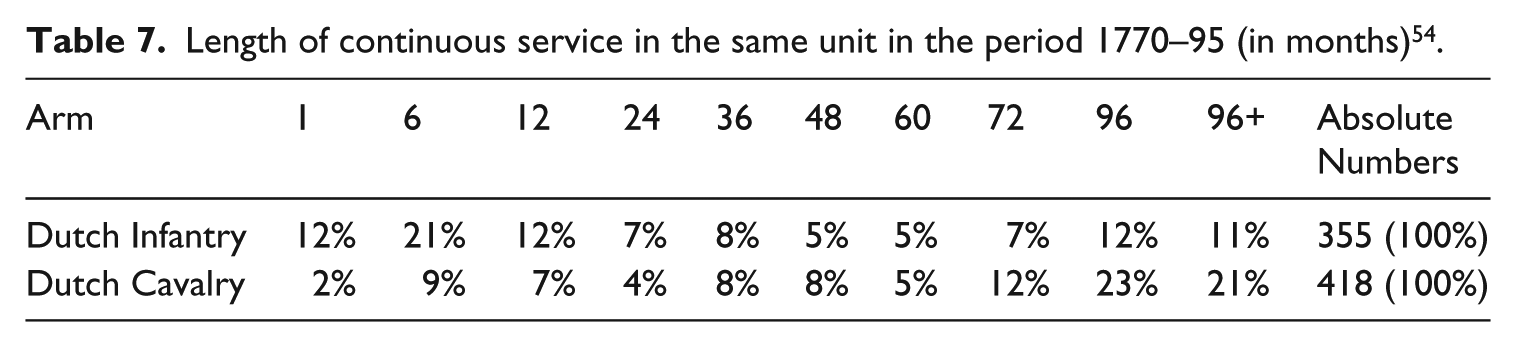
Trained soldiers were in high demand, especially when they were well built and a bit taller than usual. This gave professional soldiers in particular some freedom to choose or negotiate their conditions of service. It was for example not uncommon to enrol in a particular regiment, leave after serving out the initial enlistment term, and then join another regiment. At that point most of these men chose to re-enlist in the same unit. Taking up service with another army is not that much different, but here recruitment could be far more aggressive: to the point of actually encouraging soldiers to desert. It is otherwise difficult to see how Gilles Honincks and Johannes Jochems, both grenadiers in the garrison of Maastricht, could have enlisted in the French regiment Berwick on 5 June 1777, when the stamboek of the regiment Oranje-Gelderland indicates that they deserted from the barracks on the eleventh. A systematic comparison of the personnel records shows that of the 109 soldiers who served in the four foreign regiments of the French army whose records have been examined, two Irish and two German, 13 had served earlier in the Dutch army. 55
While desertion is generally interpreted as the opposite of professionalism, their service records show that many of these men were actually good soldiers. Their side-switching should be seen as part of their freedom to choose and negotiate their labour conditions. A disproportional number ended up in elite units, such as the grenadiers, and Gilles Honincks even became a sergeant. The military registers provide only one example of a soldier who enlisted in three armies: Jacobus Kelle(n)s from Althoesselt served as a soldier and corporal in the French army and as a soldier of the Prince-Bishopric of Liège. He left both services with a passport, joined the Dutch regiment van Dopff in 1781, and then deserted after only four months of service. He enlisted again in the French regiment la Marck in 1785, and received a promotion to corporal in 1786. Remarkably, his younger brother also served in the regiments van Dopff and La Marck, but not at the same time. 56
The most spectacular examples of serving in different armies do actually not date to the late eighteenth century, but to the Napoleonic Wars and have everything to do with the political turmoil and large-scale incorporation of prisoners of war into one’s own army. Johan van Hoek from Maaseik served in no less than five armies during the 1790–1815 period: the Dutch, the Imperial (Habsburg), the Spanish, the French, and the Dutch (Netherlands) again. The first of these transfers happened after the so-called Rassemblement of Osnabrück, which united soldiers still loyal to the Stadhouder, and especially its disbandment, which left them without employ. A Jan van Hoek, also from Maaseik, joined the Imperial hussar regiment Esterhazy at this time. The transfers to the Spanish and French army originate in the French government’s infamous selling of Imperial prisoners of war to the Spanish crown in the period 1798–1800 and the massive incorporation of Spanish prisoners of war into the French army after 1808. There were in fact three other soldiers from this area who enlisted in the Netherlands army in 1814–15, but had been serving in the Spanish army before the French invasion. The wanderings of Johan van Hoek are also not unique: Jan van der Hucht from Saint-Trond ended up in the Danish regiment Kopenhagen after serving in the Dutch army, the navy, and an Imperial infantry regiment. 57
Marriage did seem to have been an important reason why professional soldiers left the army. Jacobus de Welmaker from Stokkem deserted from the Dutch regiment van Hardenbroek after four years of service, came back after two months, and even re-enlisted for another four years in exchange for permission to marry. The stamboek does not note, however, that his wife stayed with the regiment. This might very well have been a condition for his officer’s consent. Eighteenth-century officers were very reluctant to allow their soldiers to marry because this would entail a financial obligation of the state versus these women and any resulting children. Apparently they often considered these financial considerations to be more important than keeping good soldiers in the army. It inevitably compelled soldiers to make a choice. Jan van Hees from Linkhout, who served in the Imperial regiment Murray, renewed his vows before a notary in 1787 and gave the usufruct of all his possessions to Anna van Utrecht, pregnant with his child, until he got permission to marry or left the army. 58
The main issue is that this agency of professional soldiers, already quite limited, became even more constrained after the introduction of conscription. Not only did governments lose most of their incentives to encourage men to volunteer, they now had a far more efficient repressive apparatus at their disposal: the gendarmerie or marechaussee. Small numbers of men continued to enlist in the Batavian and Holland army, right up to the incorporation of the Northern Netherlands in the French Empire (1810), but avoiding service in the French army became increasingly difficult. Besides, those who did join the French army found out rather rapidly that officers did not appreciate their ‘foreign’ service, as illustrated by a complaint made by a certain J. Vliegen in 1811. The French military rewarded veterans with a distinctive mark on their uniform, one chevron for every four years, and higher pay. He felt entitled to these distinctions given that he had joined the French army in 1807, but his commanding officer refused to reward a réfractaire who had enlisted in the Batavian army. 59
The straightjacket (potential) professional soldiers were confronted with did not end with the French regime. Two volunteers from 1814–15 were taken from the regular army to fulfil their militia obligations: one had enlisted in November 1815, when still eligible for militia service, the other signed up in 1814 under a false name and was serving as a sergeant when forcibly transferred in 1825. 60 Replacements for their part experienced even more constraints because of their reputation: they were repeatedly singled out and received heavier punishments than ordinary conscripts. The high compensations awarded to replacements undoubtedly attracted men of dubious character and gave this category as a whole a bad name. 61
Position in the Army and Society (2): Chances of Promotion
Despite the increased constrictions professional soldiers saw themselves confronted with, one might argue that the introduction of conscription at least offered a higher chance of promotion. By showing that professional soldiers did not receive increased chances of promotion, or comparable financial rewards, this section adds the final element to the argument that conscription lowered the status of professional soldiers in the army and in society without giving them significant compensation.
The sources examined here effectively indicate that governments bestowed relatively limited rewards upon these men and, moreover, that these rewards had very little to do with the introduction of conscription. Table 8 gives an overview of the number of privates reaching commissioned rank, divided according to their date of enlistment and promotion. Given that the Côntroles of Napoleon’s army have not been examined systematically, the number of men enlisting and reaching officer’s rank in the period 1798–1813 might be slightly under-represented, but this does not affect the general pattern, as the new Netherlands government compiled a list of commissioned officers who had served in Napoleon’s army in 1814–1815. 62
Overview of privates reaching officers’ (commissioned) rank 63 .
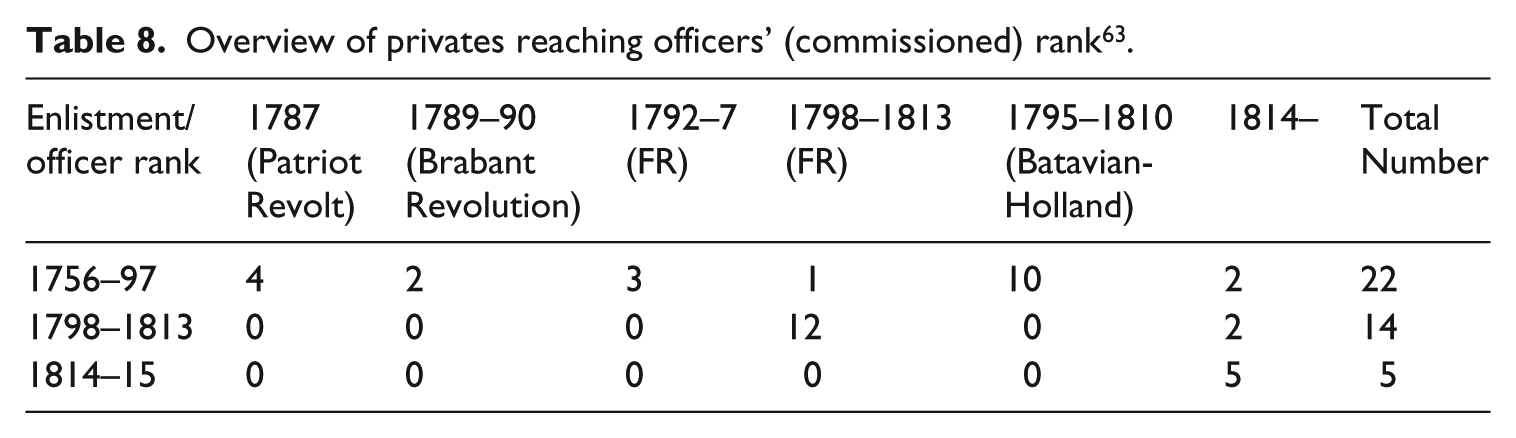
Veterans of the ancien régime clearly had a higher chance of promotion than their counterparts enlisting after 1798. Moreover, their promotion occurred almost entirely in volunteer structures: the Batavian-Holland army never introduced conscription and the two veterans becoming officers in 1814 both served in the regular army. They received promotions because of political turmoil, resulting in the loss of a considerable part of the officer corps and/or their long service. The three men who rose above the rank of captain – Willem Lambrechts (colonel), Gilles Collinet (chef de batallion), and Wijnandus Brepoels (lieutenant-colonel) – all became officers in the period 1787–9.
The relatively open character of the commissioned ranks in the period 1787–95 is important, but also ended quite rapidly. The French Directoire and later Napoleon made increasing efforts to ensure that the education of the officer’s corps was placed on a more secure footing, while simultaneously ensuring that officer candidates came from more well-off social backgrounds. This de facto implied that officers’ ranks would be closed off from promotion from below. Most of these men enlisting after 1798 became officers in 1813–14, after the disastrous Russian campaign. It is also typical that soldiers who enlisted before 1798 and became officers were generally speaking of more modest backgrounds than those enlisting after 1798. In the first group farmers owning land of their own, skilled artisans (e.g. a button maker), and other middle groups (a merchant’s and miller’s son) predominated, but it also comprises (basket) weavers and a mason. The soldiers who enlisted after 1798 and became officers include no less than five members of noble families and several others who could be identified as members of the urban or rural elite. 64
Although military service did offer real chances of social promotion, there was always a limit to it. Most of these officers continued to be responsible for essentially the same tasks they would have performed as non-commissioned officers: administration, instruction, and discipline. They became regimental adjutant, regimental quartermaster, riding instructor, grenadier lieutenant, or standard-bearer, the same ranks often reserved for promoted rankers during the ancien régime. It is likewise remarkable how many of these men served as company quartermaster at some point during their careers. This indicates that one’s educational background was a key consideration when it came to securing a commission. Several of the officers commissioned during Napoleon’s reign were also promoted in or to units with few French speakers (48e and 127e de ligne, 3e étranger). Finally, it should be mentioned that their offspring often followed a military career as well and experienced far fewer difficulties, being sons of serving officers. 65
Promotion to non-commissioned officer was a more realistic endeavour, especially after 1814. In the Netherlands militia system officers sent conscripts on leave after basic training and only ordered them to rejoin their unit during annual manoeuvres. Volunteers, replacements, and substitutes remained permanently with their unit, which gave them a higher chance of promotion (7.6 per cent of conscripts, 14 per cent of substitutes, 11.2 per cent of replacements, and 40 per cent of the volunteers reached non-commissioned rank). Conscripts were only eligible for staff functions if they relinquished their leave. It is unclear if the same possibilities existed in Napoleon’s armies because during armed conflicts everyone had to stay with the colours. The diary of Johannes Wagemans from Godsheide for example, who served in the period 1812–14 as a soldier, corporal, and sergeant, provides no indication that he had any interest to serve in the military. He did not even mention his promotions; they can be derived from the context. On the other hand some professional soldiers did not want such a promotion because they felt that it entailed increasing possibilities for comparably few rewards. 66
Aside from non-commissioned rank, a transfer to a veteran company, a guard unit, or the gendarmerie/marechaussee could serve as a reward to professional soldiers. These transfers have fairly little to do with conscription and it is also unclear to what extent professional soldiers really benefited from them. Many old soldiers did of course transfer to veteran or garrison units, but the so-called regiment of ‘Red Lancers’, of Dutch origin, was the only French guard unit to accommodate men from this area in significant numbers. The Kingdom of the Netherlands did not create guard units before 1829. 67
In these circumstances it comes as no surprise that ancien régime veterans constituted the most stable part of the Netherlands army in 1815, although one of them might have deserted to go back to the French forces. 68 Of the 372 men serving in the Netherlands 1815 army, 52, or 14 per cent, had enlisted before 1798. Given that subsequent classes of conscripts dwarfed the number of men enlisting before 1798, this is very considerable. They also include several men who would have understood the real meaning of the term fire-eater (mange-fer, ijzervreter). Early modern tales depicted soldiers as men who feared no one, not even the devil, because they ‘ate’ fire or iron. Willem Vroonen served in the Dutch cavalry since 1785 and was left for dead on the battlefield in 1809, after being wounded by five lance strokes and a bullet in the left arm, but survived. When the aforementioned Jan van der Hucht enlisted in the Dutch army in 1814, 64 years old, he could not only claim to have survived the sinking of his warship, but also sported a scar on his lip from a sabre cut he received in 1793. 69
Considering the regular army as a whole, only 22 per cent of the volunteers of 1814–15 stayed in the army after their initial engagement of six years (17 passed to the colonial troops, 31 re-enlisted in their own unit, and 23 passed to other units). An unknown number returned to civilian life only to re-enlist as a replacement or volunteer for a different unit. In the militia, the situation was even worse. Of the more than one thousand conscripts, substitutes, and replacements who entered the militia in 1815, two conscripts and one substitute joined the regular army before 1819, seven left for the colonies (one conscript, three replacements, two substitutes, and one volunteer), and another six stayed with their own units (five conscripts and one substitute). Of the last, one-half became commissioned officers (including two nobles), the other half non-commissioned officers. 70
The situation effectively worsened to such an extent that even non-commissioned officers started to leave the army, discouraged by their slim chances of promotion. Laurentius Stassens, the only soldier from this area serving below commissioned rank to receive the Military Order of William for his role in the Waterloo Campaign, left the army as adjutant in 1820. The family Devoet, an impoverished noble family from Hoesselt, counted no less than four volunteers in the period 1804–15, all aspiring to reach commissioned rank. One died in French service and the three others left the Netherlands army as non-commissioned officers by 1819 at the latest. 71
Conclusion
This study considers how the introduction of conscription in the Dutch-speaking part of the Prince-Bishopric of Liège changed the position of professional soldiers in the army and in society. It shows that soldiers’ backgrounds in general did become more representative of society at large, in both a geographical and social perspective, but this was not in the interest of the soldiers themselves. In effect, rather than raising the social status of the military, conscription diminished it, as revealed by the drastic lowering of average heights. Men from the Campine joined the regular army as volunteers without difficulty in 1814 and early 1815, but sent replacements in large numbers when faced with militia service. The volunteer armies of the ancien régime, briefly restored in 1814, were more adapted to local socio-economic structures and also offered prospective recruits more freedom to choose and negotiate the conditions of their service.
The introduction of conscription reduced the proportion of professional soldiers, already a minority in the army, even further. More importantly, it removed many incentives to reward professional soldiers for their particular attitude towards military service. Officials no longer needed to fear a lack of prospective recruits and even had a more efficient disciplining apparatus at their disposal. Professional soldiers by contrast were faced with a restricted number of options and little or no compensation for their loss of autonomy and status. A disproportional number of privates reaching commissioned rank were ancien régime veterans and their promotion had very little to do with conscription. The massive exodus from the Netherlands army, combined with a lack of volunteers, comes as little surprise therefore, and forced the assimilation of regular army and militia in 1818.
The representativity of this case study can of course easily be called into question, given the radical break between the ‘mercenary’ recruitment of the ancien régime and the introduction of conscription in the former Prince-Bishopric of Liège. The fact that the French government was responsible for its introduction, in an area that not only resisted the French takeover, but also sent a disproportionate number of soldiers to the Dutch army, only serves to confirm this exceptionality. Nevertheless, the main object of this article is not to pose the experiences of this area as typical for the introduction of conscription in general, but to question common assumptions about the supposed improvements brought about by conscription, in terms of motivation and soldiers’ backgrounds, and the validity of conclusions, which are biased towards the example of France. States all over Europe introduced or expanded conscription one way or another during the eighteenth and nineteenth centuries. There exists no such thing as a universal path. What we really need to do is question how these diverse developments affected the lives of professional soldiers, who are the main constant between different military systems, and attempt to find similarities and differences.
Footnotes
Funding
This research received no specific grant from any funding agency in the public, commercial, or not-for-profit sectors.
1
That is provided that he is capable of bearing arms and is unmarried or a widower without children. Jean-Paul Bertaud, La révolution armée. Les soldats-citoyens et la Révolution Française (Paris, 1979), pp. 113–43; Annie Crépin, Révolution et armée nouvelle en Seine-et-Marne, 1791–1797 (Paris, 2008), pp. 271–305.
2
M. S. Anderson, War and Society in Europe of the Old Regime, 1618–1789 (London, 1988), pp. 111–31; John A. Lynn, Giant of the Grand Siècle. The French Army, 1610–1715 (Cambridge, 1997), pp. 382–93; John A. Lynn, ‘The Evolution of Army Style in the Modern West, 800–2000’, The International History Review 18:3 (1996), pp. 505–45.
3
Crépin, Révolution et armée nouvelle; John A. Lynn, The Bayonets of the Republic. Motivation and Tactics in the Army of Revolutionary France, 1791–1794, 2nd edition (Boulder, 1996); Samuel F. Scott, The Response of the Royal Army to the French Revolution. The Role and Development of the Line Army, 1787–1793 (Oxford, 1978).
4
See the edited volume Donald Stoker, Frederick C. Schneid, and Harold D. Blanton (eds), Conscription in the Napoleonic Era. A Revolution in Military Affairs? (New York, 2008).
5
Roger Dufraisne, ‘Les populations de la rive gauche du Rhin et la service militaire à la fin de l’ancien régime et à l’époque révolutionnaire’, Revue Historique 231:1 (1964), pp. 103–140.
6
Alan Forrest, Soldiers of the French Revolution (Durham, 2003; 1990), pp. 27–35; Lynn, The Bayonets of the Republic, pp. 44–57, 169–77; Joost Welten, In dienst van Napoleons Europese droom. De verstoring van de plattelandssamenleving in Weert (Leuven, 2007), p. 355.
7
Francis Balace et al. (eds), Fastes militaires du pays de Liège (Liège, 1970); Richard Boijen, ‘De conscriptie te Sint-Truiden tijdens het Franse bewind, 1795–1814’, Belgisch tijdschrift voor militaire geschiedenis 20 (1973), pp. 111–46, 127; Louis Leconte, Les événements militaries et les troupes de la révolution liégeoise 1789–1791 (Liège, 1932), pp. 170–91; Th.Vandebeeck and J. Grauwels, De Boerenkrijg in het departement van de Nedermaas (Maastricht, 1961); René Wilkin, ‘Le remplacement militaire dans le département de l’ Ourthe’, Bulletin de l’Institut Archéologique Liégeois CXII (2001), pp. 249–89.
8
Alexandre François Cavenne, Statistique du département de la Meuse Inférieure (Maastricht, 1802), p. 95.
9
Rafe Blaufarb, The French Army, 1750–1820. Careers, Talent, Merit (Manchester, 2002), pp. 1–11, 194–201: Samuel Huntington, The Soldier and the State. The Theory and Politics of Civil–Military Relations (Cambridge, MA and London, 1957), pp. 11–18; David J. B. Trim, ‘Introduction’, in The Chivalric Ethos and the Development of Military Professionalism, ed. David J. B. Trim (Leiden, 2003), pp. 20–35.
10
Jeannette Kamp, ‘Between Agency and Force: The Dynamics of Desertion in a Military Labour Market, Frankfurt am Main 1650–1800’, in Desertion in the Early Modern World. A Comparative History, ed. Matthias van Rossum and Jeannette Kamp (London and New York, 2016), pp. 49–72; Peter Way, ‘Class and the Common Soldier in the Seven Years War’, Labor History 44:4 (2003), pp. 455–81; Erik-Jan Zürcher, ‘Introduction. Understanding Changes in Military Recruitment and Employment Worldwide’, in Fighting for a Living. A Comparative History of Military Labour 1500–2000, ed. Erik-Jan Zürcher (Amsterdam, 2013), pp. 11–42.
11
Trim, ‘Introduction’, pp. 20–35.
12
The Hague, Nationaal Archief (henceforth NA), 1.01.19 Raad van State, inv. nr. 1955, Stamboek 1st battalion Lewe van Aduard, company A; .L. Dorreboom, ‘Gelijk hij gecondemneert word mits deezen’. Militaire strafrechtspleging bij het krijgsvolk te lande, 1700–1795 (Amsterdam, 2000), pp. 187, 211; Christopher Duffy, The Military Experience in the Age of Reason (New York, 1988; 1987), p. 95.
13
Hasselt, Rijksarchief (henceforth RAH), Volkstelling gemeente Heers, 1796 (copy); Pecry Sarah, Mercenaries. The History of a Norm in International Relations (Oxford, 2007), pp. 52–67; Michael Sikora, ‘Söldner- historische Annäherung an einen Kriegertypus’, Geschichte und Gesellschaft: Zeitschrift für historische Sozialwissenschaft 29 (2003), pp. 210–38; P. J. H. M. Theeuwen, Pieter ‘t Hoen en de Post van den Neder-Rhijn (Hilversum, 2002), pp. 226–31, 276–7, 291–3, 299, 643.
14
The tables published in this study are based on the following personnel records: NA, 1.01.19 Raad van State, inv. nrs. 1949–50, 1952–8, 1962, 1965, 1968, 1973, 2017, 2023–4, 2028; 2.13.09 Stamboeken onderofficieren en minderen na 1813, inv. nrs. 10–14, 70, 94, 120–3, 172, 175, 199, 227, 254, 279, 305, 308, 317, 330, 343, 356, 369, 371, 382, 396, 435, 437–9, 441, 444, 446–9, 460, 464, 470, 475, 482, 489, 494, 502, 503, 508, 514, 528, 533, 552, 555, 566, 575, 597, 620–7, 677, 684, 685, 688; Vienna, Kriegsarchiv (henceforth KA), AT-OeStA/KA Personalunterlagen (Pers), 18. Jh.-20. Jh., 4903, 4907, 4911, 7138, 10. 552, 10.553; Vincennes, Service Historique de la Défense (henceforth SHAT), Contrôles de troupe de l’ancien régime, 1 Yc 140, 1 Yc 305, 1 Yc 446, 1 Yc 872, 1 Yc 1064.
15
Brussels, Algemeen Rijksarchief (henceforth ARB), Sécrétairerie d’Etat et de Guerre, inv. nr. 802; Georges de Froidcourt (ed.), Lettres autographes de Velbruck, prince-évêque de Liège 1772–1784 (Liège, 1954), I, nr. 128; Etienne Hélin, ‘Les Liégeois au service des puissances étrangères’, in Fastes militaires du pays de Liège, ed. Francis Balace et al. (Liège, 1970), pp. 17–23; Eugène Poswick, Histoire des troupes liégeoises pendant le XVIIIe siècle (Liège, 1893).
16
M. Ponthir, ‘Récruteurs à Liège en 1781’, Bulletin de la Société Royale Le Vieux Liège 5 (1958), pp. 241–8.
17
Thomas Glesener, ‘La estatalizacion del reclutamiento de soldados extranjeros en el siglo XVIII’, in Soldados de la Illustracion. El ejercito espanol en el siglo XVIII, ed. Manuel-Reyes Garcia Hurtado (Coruna, 2012), pp. 237–62; Joseph Ruwet, Soldats des régiments nationaux au XVIIIe siècle (Brussels, 1962), pp. 25–6, 254–70; Christopher J. Tozzi, Nationalizing France’s Army. Foreign, Black, and Jewish Troops in the French Military, 1715–1831 (Charlottesville, 2016), pp. 39–44, 221–5; H. L. Zwitzer, ‘De militie van den staat’. Het leger van de Republiek der Verenigde Nederlanden (Amsterdam, 1991), p. 46.
18
NA, 1.01.19, 1958; RAH, Schepenbank Bilzen, inv. nr. 414 Lawsuit against Joannes Heckman; SAT, Notaris A.E. Hamelars, act September 8, 1784 (microfilmnr. 1608718) Testimony of Lambert Bils and Peter Houbrix; Jozef Brouwers, ‘Soldatenwerving in de vrije rijksbaronnie Pietersheim’, Limburg XLIX:4 (1970), pp. 180–94; André Corvisier, L’armée française de la fin du XVIIe siècle au ministère de Choiseul: le soldat (Paris, 1964), I, p. 269; Fernand Duchateau, ‘Het boek van Debruyn, een kroniek van de achttiende eeuw in Sint-Truiden’, in Sint-Truiden in de achttiende eeuw, ed. Fernand Duchateau (Sint-Truiden, 1993), p. 236; Maurice Ponthir, ‘Triste fin d’un recruteur (1754–1757)’, Bulletin de la Société Royale Le Vieux Liège 8 (1972), p. 123.
19
In the case of the Swiss cantons, it is also well established that deserters constituted a significant part of new recruits. Brussels, Archives of the Army Museum (henceforth BMA), Fonds Ancien Régime, Prinsbisdom Luik, II/46–52 Regiment Royal-Liégeois (copies), List of soldiers absent on recruitment, Oktober 9, 1788; RAH, Kleine Familiearchieven, inv. nr. 1934 (microfilmnr. 1713094); Letters to a certain Fonis; Brouwers, ‘Soldatenwerving’; Rudolf Gugger, Preussische Werbungen in der Eidgenossenschaft im 18. Jahrhundert (Berlin, 1997), pp. 76–9; Jürgen Kloosterhuis, Bauern, Bürger und Soldaten. Quellen zur Sozialisation des Militärsystems im preussischen Westfalen, 1713–1803 (Münster, 1992), I, p. 133; François Ravaisson-Mollien and Louis Ravaisson-Mollien (eds), Archives de la Bastille. Documents inédits. Règne de Louis XV, 1765 à 1769 (Paris, 1904), p. 186; Michael Sikora, Disziplin und Desertion. Strukturprobleme militärischer Organisation im 18. Jahrhundert (Berlin, 1996).
20
Roger Darquenne, La conscription dans le département de Jemappes, 1798–1813. Bilan démographique et médico-social (Mons, 1970), pp. 55–73; Alan Forrest, Conscripts and Deserters. The Army and French Society during the Revolution and Empire (Oxford, 1989), pp. 43–73; Grauwels and Vandebeeck, De Boerenkrijg, pp. 23–64.
21
Annie Crépin, Vers l’armée nationale. Les débuts de la conscription en Seine-et-Marne, 1798–1815 (Rennes, 2011), pp. 115–42; Darquenne, La conscription, pp. 71–106; Welten, In dienst van Napoleons Europese droom, pp. 94–9, 202–13.
22
The number of 160 men, based on a list in the prefect’s archive, is incomplete as systematic overviews of volunteers, available for Hasselt and Tongres show another six volunteers who are not included on this list. RAH, Archief van de stad Hasselt, inv. nr. 439 Acts of voluntary enlistment; Maastricht, Regionaal Historisch Centrum Limburg (henceforth RHCL), 03.01 Frans Archief, inv. nr. 602 Registre des incorporations. Recrutement; 605 Recrutement Enrôlements volontaires. Letters to the prefect regarding Adrien Smolders; 725 Police Militaire, Letter of Jean Steuckenberg; SHAT, 21 Yc 800; Stadsarchief Tongeren (henceforth SAT), Nieuw Regime, inv. nr. 312/a Lists of Conscripts with acts of voluntary enlistment.
23
Forrest, Conscripts and Deserters, pp. 187–218; Darquenne, La conscription, pp. 307–38; J. R. Elting, Swords around a Throne. Napoleon’s Grande Armée (New York, 1997), pp. 429–38, 112–23; Marc Lebrun, ‘Révolution, Empire et mauvais soldats’, Revue Historique des Armées 244 (2006), pp. 112–23; Welten, In dienst voor Napoleons Europese droom, pp. 293–6, 346–52.
24
Darquenne, La conscription, pp. 161–3; Alain Pigeard, La conscription au temps de Napoléon, 1798–1814 (Clamecy, 2003), pp. 260–1.
25
NA, 1.04.02 Archief van de Verenigde Oostindische Compagnie, inv. nr. 12326 Betaalrollen Regiment de Meuron; RAH, Archief Hasselt, inv. nr. 349; RHCL, 03.01, inv. nr. 605 Recrutement Letters to the prefect concerning Guillaume Hector (29 February–26 April 1812); Guy de Meuron, Le régiment Meuron, 1781–1816 (Lausanne, 1982), pp. 40–64.
26
His brother must also have joined the French army at some point because he came back in 1814 as a sergeant-major. RHCL, 04.01 Provinciaal Bestuur van Limburg, inv. nr. 122; Annuaire de l’ état militaire de Belgique 17 (1866), p. 311; Richard Boijen, ‘De conscriptie te Sint-Truiden tijdens het Frans bewind, 1795–1814’, Belgisch Tijdschrift voor Militaire Geschiedenis 20 (1973), pp. 111–46; A. Remans, Een rechtsgeding tegen Genker Brigands (Hasselt, 1960), pp. 7, 9, 17, 30–6.
27
Louis Leconte, ‘Les bataillons wallons liégeois en 1814’, Carnet de la fourragère 53:10 (1953), pp. 440–78; W. Ubachs, ‘De Nedermaas niemandsland 1814–1815’, Publications de la Société Historique et Archéologique de Limbourg 100 (1964), pp. 149–226.
28
Herman Amersfoort, Koning & kanton. De Nederlandse staat en het einde van de Zwitserse krijgsdienst hier te lande 1814–1829 (The Hague, 1988), pp. 66–107; F. C. Spits, De metamorfose van de oorlog in de 18de en 19de eeuw (Assen, 1971), pp. 174–86.
29
Bossenbroek, Volk voor Indië, pp. 26–35.
30
Borgloon, Bilzen, Herk-de-Stad, Beringen, Peer, Bree, Hamont, and Stokkem.
31
François Alexandre Cavenne, Statistique du département de la Meuse Inférieure (Maastricht, 1802), pp. 12–17; J. F. R. Philips, J. C. G. M. Jansen and Th. J. A. H. Claessens, Geschiedenis van de landbouw in Limburg 1750–1914 (Assen, 1965); P. J. H. Ubachs, Handboek voor de geschiedenis van Limburg (Hilversum, 2000), pp. 24–5, 316; J. H. M. van Wieland, Kleine atlas voor de geschiedenis van beide Limburgen (Leeuwaarden; Maastricht, 1989), p. 21.
32
The current communities of Lanaken, Bilzen, Maasmechelen, Riemst, Bassenge, and Zutendaal.
33
KA, AT-OeStA/KA Personalunterlagen, 18. Jh.-20. Jh., inv. nr. 4903, 4907, 4911, 10. 552, 10.553; NA, 1.01.19, inv. nrs. 1949–50, 1952–8, 1962, 1965, 1968, 1973, 2017, 2023–4, 2028; 2.13.09; SHAT, Contrôles de troupe de l’ancien régime, 1 Yc 140, 1 Yc 305, 1 Yc 446, 1 Yc 872.
34
Corvisier, L’armée française, I, pp. 387–448; Jean Chagniot, Paris et l’armée au XVIIIe siècle (Paris, 1985), pp. 313–35; Philips, Jansen, and Claessens, Geschiedenis van de landbouw, pp. 93–6; Ruwet, Soldats, pp. 41–50; Wouter Slob, Het paard in de landbouw (Doetinchem, 1967), pp. 106–24; Eric Vanhaute, ‘Rich Agriculture and Poor Farmers: Land, Landlords and Farmers in the Eighteenth and Nineteenth Centuries’, Rural History 12:1 (2001), pp. 23–6, 30; Zwitser, ‘De militie van den staat’, pp. 48–50.
35
Welten, In dienst van Napoleons Europese droom, pp. 356–8, 211 (attachments).
36
NA, 2.13.09, inv. nrs. 121–3, 464, 533.
37
Agnes Hertogs, ‘De militaire vervanging in Limburg, 1866–1909’ (MA thesis, University of Leuven, 1982), pp. 47–58, 111–19; Bernard Schnapper, Le remplacement militaire en France. Quelques aspects politiques, économiques et sociaux de recrutement au XIXe siècle (Paris, 1968), pp. 113–56.
38
SAT, Notariaat, Notaris L. J. Dawans, act 22 September 1777 (microfilmnr. 1619046); Notaris Jan Willem Lousberghs, act 15 March 1773 (microfilmnr. 1618831); Notaris Peter Slegers, act 21 March 1790 (microfilmnr. 1632382); Notaris L. Wilmots, act 4 January 1788 (microfilmnr. 1619240).
39
NA, 1.01.19, inv. nr. 1958; N. Simenon, ‘Suppliques adressées aux abbés de Saint-Trond’, Bulletin de la Commission Royale d’Histoire (1904), pp. 550–1; François Straven, Inventaire analytique et chronologique des archives de la ville de Saint-Trond (Saint-Trond, 1886–95), V, pp. 402–514.
40
The minimum heights are 1.63 m for the Imperial infantry, 1.67 m for the Dutch, 1.68 m for the French and 1.70 m for the Prussian. Jean-Paul Aron, ‘Taille, maladie et société: essai d’histoire anthropologique’, in Anthropologie du conscrit français d’après les comptes numériques et sommaires du recrutement de l’armée 1819–1826, ed. Jean-Paul Aron, Paul Dumont, and Emmanuel Le Roy Ladurie (Paris, 1972), pp. 229–62; Roderick Floud, Kenneth Wachter, and Annabel Gregory, Height, Health and History. Nutritional Status in the United Kingdom, 1750–1980, 2nd edition (Cambridge, 2006), pp. 1–27; Wolfgang Hanne, ‘Anmerkungen zur Körpergrösse des altpreussischen Soldaten’, Zeitschrift für Heereskunde LV: 354 (1991), pp. 43–7; W. J. M. J. Rutten, ‘De levensstandaard in Limburg van de Franse tijd tot aan de Eerste Wereldoorlog. Een analyse van de lichaamslengte van Limburgse lotelingen’, Studies over de sociaal-economische geschiedenis van Limburg 40 (1995), pp. 138–47; Ruwet, Soldats, pp. 67–76; Zwitser, ‘De militie van den staat’, p. 57.
41
Aron, ‘Taille, maladie et société’, pp. 227–9; Boijen, ‘De conscriptie te Sint-Truiden’, pp. 135–8; Lynn, The Bayonets of the Republic, pp. 46–9; Pigeard, La conscription, pp. 135–6, 143, 167–70; Rutten, ‘De levensstandaard in Limburg’, pp. 132–4.
42
NA, 1.01.19, inv. nrs. 1949–50, 1952–8, 1962, 1965, 1968, 1973, 2017, 2.13.09, inv. nrs. 10–14, 70, 94, 120–3, 172, 175, 199, 227, 254, 279, 305, 308, 317, 330, 343, 356, 369, 371, 382, 396.
43
NA, 1.01.19, inv. nrs. 1949–50, 1952–8, 1962, 1965, 1968, 1973, 2017, 2023–4, 2028.
44
Beate Engelen, Soldatenfrauen in Preussen. Eine Strukturanalyse der Garnisonsgesellschaft im späten 17. und im 18. Jahrhundert (Münster, 2005), pp. 53–68; Jean Steinauer, ‘Des migrants avec des fusils. Le service étranger dans le cycle de vie’, in Gente ferocissima. Mercenariat et société en Suisse XVe–XIXe siècle. Solddienst und Gesellschaft in der Schweiz 15.–19. Jahrhundert, ed. Norbert Furrer et al. (Zürich and Lausanne, 1997), pp. 117–25.
45
NA, 1.01.19, inv. nr. 1958, company O; RAH, Kleine Familiearchieven, inv. nr. 1877 (microfilmnr. 1713093) Passports of Francis Coenen.
46
Ilya Berkovich, Motivation in War. The Experience of Common Soldiers in Old-Regime Europe (Cambridge: Cambridge University Press, 2017); David M. Hopkin, Soldier and Peasant in French Popular Culture, 1766–1870 (Suffolk and New York, 2003), pp. 134–58, 168–74, 185–94, 221–36, 347–52; Daniel Roche, La culture des apparences. Une histoire du vêtement XVIIe–XVIIIe siècle (Paris, 1989), pp. 218–44; François van Gehuchten, Bokkenrijders, p. 208; Sandro Wiggerich, ‘Der Körper als Uniform. Die Normierung der soldatischen Haartracht in Preussen und in der Bundesrepublik’, in Staat Macht Uniform. Uniformen als Zeichen staatlicher Macht im Wandel? ed. Sandro Wiggerich and Steven Kensy (Stuttgart, 2011), pp. 161–74.
47
RHCL, 03.01, inv. nr. 723, Letter of 6 May 1812; Jean-Paul Bertaud, Quand les enfants parlaient de gloire. L’armée au coeur de la France de Napoléon (Mayenne, 2006), pp. 42–50; 166–202, 249–50, 395–403; Hopkin, Soldier and Peasant, pp. 158–74, 185–94, 347–52, Michael J. Hughes, Forging Napoleon’s Grande Armée. Motivation, Military Culture and Masculinity in the French Army, 1800–1808 (New York, 2012), pp. 192–228.
48
Maureau, ‘Le remplacement militaire’, pp. 121–43; Welten, In dienst van Napoleons Europese droom, pp. 421–3, 464–84; Wilkin, ‘Le remplacement militaire’.
49
Men volunteering for the 112e demi-brigade and the chasseurs d’Arenberg have not been included because enlistment for these units did not have to follow the same complex administrative procedure described above. RHCL, 03.01, inv. nr. 602, 604, 607, 609, 610.
50
RAH, Archief Hasselt, inv. nr. 349, Acts of voluntary enlistment of Seraphin Jean Mathieu Broux, 1 August and 18 September 1811; SHAT, 21 Yc 453, nr. 6764.
51
Sander Govaerts, ‘Tongerse soldaten in de slag bij Waterloo, 18 juni 1815’, Bulletin. Verzameling van Opstellen over Tongeren en omgeving, forthcoming.
52
AN, Archives de la Légion d’Honneur, 1402/49 Paul Kleehammer; NA, 2.13.09, inv. nr. 684, nr. 18; RAH, Parish Records Kanne, f. 199r.; RHCL, 03.01, inv. nr. 604, nr. 423; Brouwers, ‘Soldatenwerving’, pp. 191–3; Tozzi, Nationalizing France’s Army, pp. 42–3.
53
RAH, Schepenbank Bilzen, inv. nr. 871 Gichtregisters 1778–83, f. 551 r.-556v.; SAT, Nieuw Regime, inv. nr. 312/a, act of voluntary enlistment 11 June 1813; SHAT, 20 Yc 21 Répertoire alphabetique des grenadiers tirailleurs de la jeune garde.
54
NA, 1.01.19, inv. nrs. 1949–50, 1952–8, 1962, 1965, 1968, 1973, 2017, 2023–4, 2028.
55
NA, 1.01.19, inv. nr. 1958, company H; SHAT, 1 Yc 140, first battalion, company grenadiers and company colonelle, second battalion, companies O’ Doyer and Paston; 14 Yc 127, nr. 183.
56
NA, 1.01.19, inv. nr. 1953, first battalion, companies A and F, second battalion, company A; 1 Yc 446, first battalion, company grenadiers, second battalion, companies Weinheim and Beusdall.
57
NA, 2.13.9, inv. nr. 15, nr. 866; 121, nr. 708; 175, nr. 872; 356, nr. 159; 441, nr. 148; 447, nr. 110, 156; 449, nr. 265; 457, nr. 75; 459, nr. 219; 684, kleine staf; Hermann Büschleb, Westfalen und die preussischen Truppen, 1795–1802. Ein Kapitel Militärpolitik und Landesgeschichte (Osnabrück, 1987), pp. 127–31; J. F. Fischer, De Delft. De dagjournalen met de complete en authentieke geschiedenis van ‘s lands schip van oorlog Delft en de waarheid over de zeeslag bij Camperduin (Franeker, 1997), p. 390; Robert W. Gould, Mercenaries of the Napoleonic Wars (Brighton, 1995), pp. 43–5, 104; Jean Morvan, Le soldat impérial 1800–1814 (Paris, 1999), II, pp. 377–405.
58
According to the personnel records of the Dutch army (1770–95) only 8 per cent of the infantrymen and less than 4 per cent of the cavalrymen originating from this area were ‘married’, that is had their wife with them in the regiment. NA, 1.01.19, inv. nr. 1958, company D; RAH, Kleine Familiearchieven, inv. nr. 4277 (microfilmnr. 1714196, item 4); Dorreboom, ‘Gelijk hij gecondemneert word mits deezen’, p. 235.
59
RHCL, 03.01, inv. nr. 410 List of soldiers of the département Meuse-Inférieure serving in foreign armies, 1808–11; 711, Letter of the sous-préfect of Hasselt to the préfect (9 August 1811) and letter of J. Vliegen to the sous-préfect (21 July 1811).
60
NA, 2.13.09, inv. nr. 317, nr. 172; 555, nr. 673; SAT, Nieuw Regime, 312/b, Conscripts of the year 1816.
61
Luc de Vos, Het effectief van de Belgische krijgsmacht en de militie-wetgeving, 1830–1914 (Brussels, 1985), pp. 59–73; Schnapper, Le remplacement militaire, pp. 48–57; Teunisse Ingeborg (ed.), Onderdaan in Oranje’s oorlog. Dagboek van een Amsterdamse schutter ten tijde van de Belgische Onafhankelijkheidsoorlog (1830–1832) (Zutphen, 2002), p. 100; Joost Welten and Johan De Wilde, Met Napoleon naar Moskou. De ongelooflijke overlevingstocht van Joseph Abbeel (Leuven and Kampen, 2011), p. 13.
62
This table does not include so-called vélites, sons of well-off families who served in Napoleon’s Guard until they received a promotion to (non-)commissioned officers in a line regiment, nor gendarmes d’ordonnance and gardes d’honneur.
63
A list of these officers and their service records is provided in Sander Govaerts, ‘IJzervreters. Het profiel van de beroepssoldaat uit Belgisch Limburg, 1756–1815’ (MPhil thesis, University of Amsterdam, 2014), pp. 136–46.
64
Blaufarb, The French Army, pp. 166–83, 194–201; Morvan, Le soldat impérial, II, pp. 443–50.
65
Corvisier, L’armée française, I, pp. 142–3, II, pp. 784–91; Bernard Deschard, L’armée et la Révolution (Paris, 1989), pp. 113–15; William Serman, Les origines des officiers français, 1848–1870 (Paris, 1979), p. 217; Peter H. Wrong, ‘The Officiers de Fortune in the French Infantry’, French Historical Studies 3:9 (1976), pp. 401–2, 412–13, 424–5.
66
Ferdinand Spoor from Mechelen-aan-de-Maas enlisted in the Dutch army in 1797. He served as a corporal in the 3de regiment karabiniers of the Netherlands army since 1815 and was demoted in 1818 at his own request. NA, 2.13.09, inv. nr. 507, nr. 661; Amersfoort, Koning en kanton, pp. 78–9; Willem Bevaart, De onderofficier in het Nederlandse leger, 1568–2001 (The Hague, 2001), pp. 61–2; A. Smeets, ‘Dagboek van J.L. Wagemans van Godsheide, soldaat in het leger van Napoleon I’, Limburg 24 (1942–3), pp. 128–38, 177–83, 224–31.
67
SHAT, 20 Yc 161; Kurt Bayer, Grundlagen und Problemen der Preussisch-Deutschen Berufssoldatenversorgung des XIX. Jahrhunderts (Potsdam, 1938), pp. 18–24; Bertaud, Quand les enfants, pp. 142–57; Jean-Pierre Bois, Les anciens soldats dans la société française au XVIIIe siècle (Paris, 1990), pp. 73–97; Clive Emsley, Gendarmes and the State in Nineteenth-Century Europe, 2nd edition (Oxford, 2002), pp. 56–77, 155–72, 236–8; Ronald Pawly, Les lanciers rouges (Erpe, 1998); Isser Woloch, The French Veteran from the Revolution to the Restauration (Chapel Hill, 1979), pp. 262–94.
68
Leonard Steynen from Veulen, a soldier in the 3de bataljon van linie. His unit’s records note that he ‘remains behind’ on 20 June 1815, but his name was only officially removed on 31 December of that same year. He re-enlisted in the colonial depot on 3 August 1817 as part of a group of French deserters. NA, 1.01.19, inv. nr. 1958, company N; 2.01.15, inv. nr. 2, company nr. 2, nrs. 40, 47, 66; 2.13.9, inv. nr. 317.
69
NA, 1.01.19, inv. nr. 2024, company G; 2.01.15, inv. nr. 66, f. 49; 2.13.09, inv. nr. 448, nr. 49; Bahro Steffi, ‘“… En de soldaat trok de wereld in”. Afgedankte soldaten in het geheugen van de Europese sprookjes’, Volkskunde 111:4 (2010), pp. 421–39.
70
NA, 2.13.09, inv. nr. 121, 122, 123, 464, 533.
71
NA, 2.13.09, inv. nr. 464, nr. 53, 71, inv. nr. 470, nr. 955, inv. nr. 684, nr. 130; RHCL, 03.01, inv. nr. 604, nr. 101, 133, 500; Bevaart, De onderofficier, pp. 59–66.