




Abstract
Danish polymath Niels Stensen journeyed to the Dutch Republic (1660) to further his medical studies. While staying with Blasius in Amsterdam, he made an important discovery in the anatomy of the parotid duct: the ductus Stenonianus. Blasius later took credit, leading to a dispute won by Stensen. Realising he could learn little in Amsterdam, Stensen moved to Leiden University (July 1660). Here, he studied under renowned professors Sylvius and van Horne and became friends with talented fellow students Swammerdam, Ruysch, and de Graaf, who significantly contributed to anatomy and reproductive medicine. Stensen discovered various anatomical and physiological aspects, leading to his doctorate from Leiden. Here, he met Spinoza and maintained correspondence with him. Stensen left Leiden (1664), spending time in Paris, and moved to Florence (1666), joining the Accademia del Cimento. His interests expanded from anatomy to geology; he converted to Catholicism (1667), was ordained as a priest (1675) and became bishop. His ecclesiastical duties took him to Germany, where he lived a life of asceticism, dying in 1686. His remains were moved to Florence and buried in the Basilica of San Lorenzo. Stensen's journey reflects a commitment to knowledge and spirituality, making him a figure of intellectual and religious significance.
Keywords
Early years in Copenhagen
Niels Stensen, latinised to Nicolas Steno, or Nicolaus Stenonius (Figure 1), was born on 11 January 1638 in the Danish capital Copenhagen.1–3 He grew up as a sickly child in relatively prosperous conditions. His father, Sten Pedersen, was a goldsmith and court jeweller from a family of Lutheran ministers in Skåne (now in Sweden). His father died in 1645, after which his mother's subsequent husbands continued the goldsmith business. At the age of 10, Niels attended the Gymnasium, where the foundation was laid for his knowledge of mathematics and languages. Besides Danish, Stensen acquired knowledge of German, Dutch, French, and Italian, plus Latin, and later in Leiden, he also learned Greek, Hebrew, and Arabic. The young Niels narrowly survived the plague epidemic that ravaged Copenhagen between 1654 and 1655.
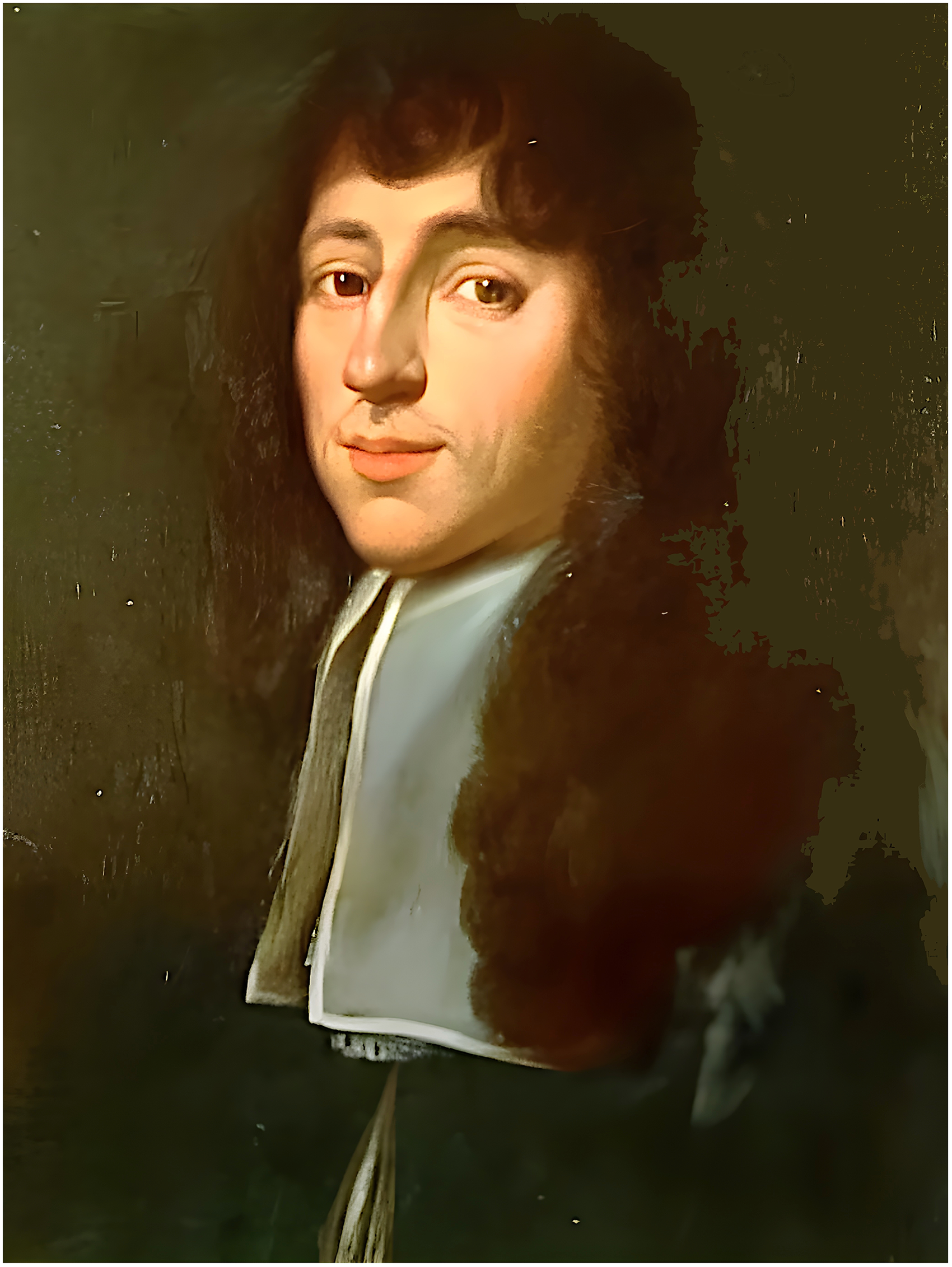
Niels Stensen (1638–1686), part of a series of images of prominent persons connected to the Court of Ferdinand II and Cosimo III, Grand Dukes of Tuscany. The portrait is unsigned, but most likely painted between 1666 and 1677 by Justus Sustermans, a Brabant painter who mainly worked in Italy. Source: Gallerie degli Uffizi, Florence, Italy.
Niels Stensen began his medical studies at the University of Copenhagen in 1656. During the war with Sweden and the siege of Copenhagen from 1658 to 1660, university education was interrupted, and he, like other students, had to participate in the city's defence. Under the guidance of Thomas Bartholin (1616–1680), Bartholin's brother Erasmus (1625–1698), and the anatomist and botanist Simon Paulli (1603–1680), he eagerly researched natural sciences and anatomy. Another of his teachers was Ole Borch (1626–1690), an enthusiastic and inquisitive lecturer whom Niels would often meet during his later stay in Leiden. 4 Stensen's studies during these disastrous years must have been a period of intense intellectual activity. The best evidence we have for this is a notebook from that time consisting of nearly 100 densely written pages. It is entitled ‘Chaos’, perhaps due to its mixed content. Discovered in 1946, it is now in the National Library in Florence. It shows that he had read about 100 scientific works by around 80 authors.
Via Amsterdam to Leiden
Because Denmark was at war with Sweden, the 23-year-old Niels left for the Dutch Republic in early 1660 to continue his medical studies there. On 20 March 1660, Niels arrived in Amsterdam and took lodging with the physician Gerardus Blasius (Figure 2(a)). Gerard Blasius van Oostvliet had grown up in Denmark when his father was active there and had studied medicine in Copenhagen. Blasius was about to become a professor at the Athenaeum Illustre of Amsterdam, an institution that, although not a full university, offered a kind of preparatory course for further study in theology, law, or medicine at renowned Dutch universities like Leiden, Utrecht, or elsewhere.
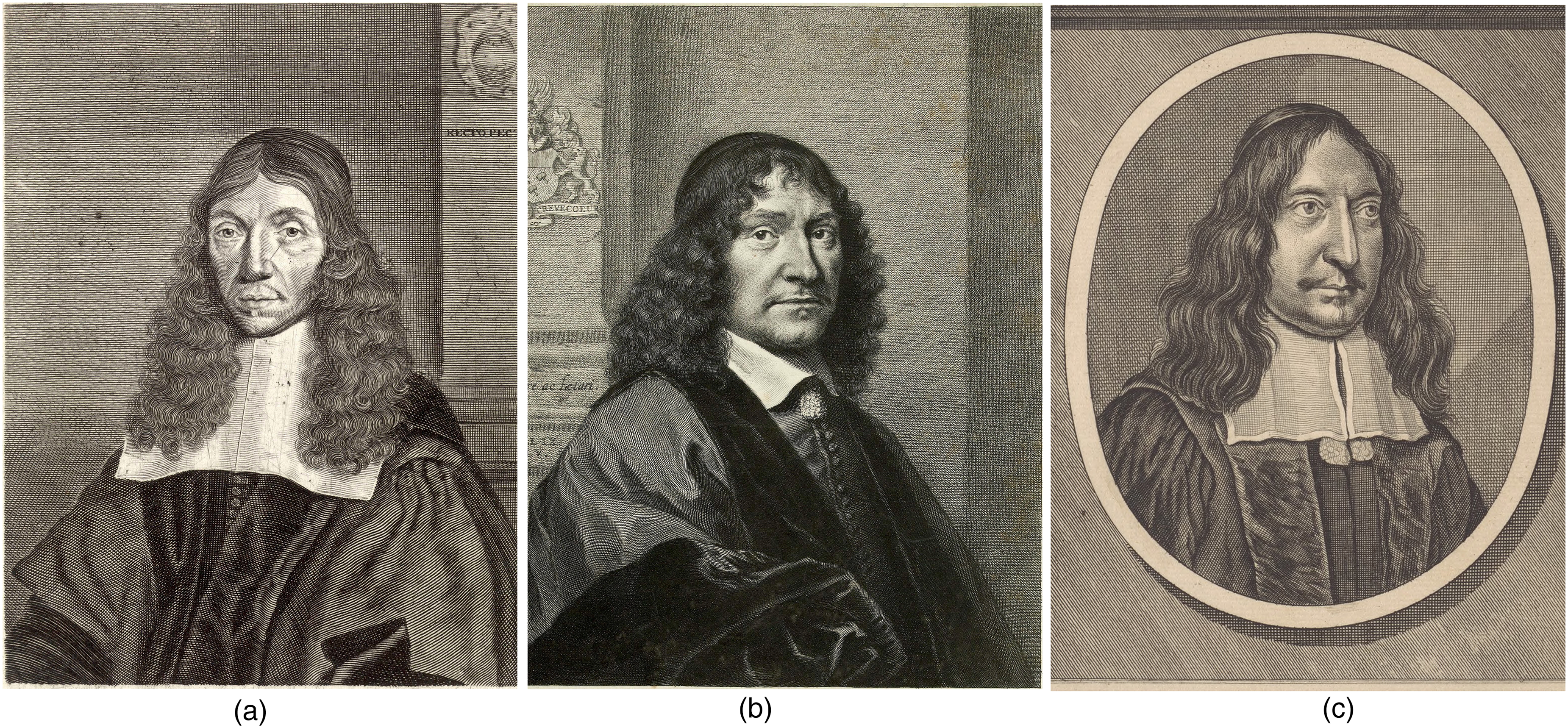
(a) Gerrit Leendertsz. Blasius or Gerardus Leonardus Blasius (1627–1682) was an anatomist and one of the first Amsterdam professors of medicine (1660). He is considered one of the founders of comparative anatomy. Between 1649 and 1682, he published 30 books, including 13 annotated editions of other authors and several introductions to medicine. Source: Rijksmuseum Amsterdam. (b) Franciscus de le Boë, or Sylvius (1614–1672), was a professor of medicine. He is considered one of the founders of modern clinical chemistry. He founded the first university chemical laboratory in Europe in Leiden. He made Leiden University world-famous with his teaching in iatrochemistry (literally: ‘doctor's chemistry’), and through his enthusiasm, he attracted numerous students from many countries. Source: Leiden University Libraries. (c) Ioannis van Horne, or Hornius (1621–1670), was a professor of anatomy and surgery. He developed refined anatomical preparation techniques and published several books on surgery. His atlas of myology is considered very influential. Source: Leiden University Libraries.
Soon, while dissecting a sheep's head in the anatomy room in the former St. Ursula convent, Niels made an important discovery: the parotid duct, 5 which is still known today as ductus Stenonianus. However, Blasius paid little attention to his student's discovery but later claimed it as his own. In the following years, an unpleasant priority dispute unfolded, which Stensen won. Gerardus Blasius had a habit of taking credit for others’ work. Niels soon realised he could learn little in Amsterdam and decided to move to Leiden, where he would stay for almost four years.
Leiden University
On 27 July 1660, Niels Stensen enrolled at Leiden University, 6 which was founded in 1575. In the seventeenth century, Leiden University stood out among European institutions. While most other universities were focused primarily on teaching, Leiden distinguished itself by fostering original and groundbreaking research alongside offering lessons from some of the era's top professors. Niels Stensen's time in the Dutch Republic occurred during the peak of the Dutch Golden Age, shortly after the nation gained independence through the Peace of Westphalia in 1648. This period was a remarkable experiment in Europe, as most other countries were governed by absolute monarchs with enforced religious conformity. At the same time, the Dutch Republic was led by merchants and technocrats who embraced a practical approach of religious tolerance and pluralism. Jonathan Israel 7 even calls it ‘Europe's greatest wonder of cultural diversity’ and ‘the then-philosophical centre of the world’. At Leiden University, the anatomical lessons were performed in the theatre of the Collegium Medico Practicum, which was built by Petrus Pauw (1564–1617) and extensively used by Iohannes van Horne (1621–1670). The ‘school’ concentrated on so-called Anatomia Nova: the smaller structures of the body, such as the lymphatic system, blood vessels and ‘chylvaten’. It was thought that the essential secrets of life were situated here. 8 At that time, especially influenced by the ideas of René Descartes, thoughts and the soul were supposed to have an anatomical substrate.
Leiden professors
At that time, there were a little over 400 students enrolled annually in Leiden, 9 many of whom were foreigners. Fifteen professors provided education, four of whom were associated with the Faculty of Medicine. The most renowned among them were François de le Boë (Sylvius) and Iohannes van Horne (Hornius).
Sylvius
Franciscus de le Boë (Figure 2(b)) was a physician and anatomist, Latinised as Sylvius (1614–1672). Sylvius was a proponent of Descartes’ theories. He studied at Dutch and German universities and earned his doctorate in 1637 in Basel (Switzerland). Afterwards, he practised in Hanau and Amsterdam. In 1658, Sylvius became a professor of medicine in Leiden. He believed that chemical processes play a crucial role in the human body and understood that studying these processes could enhance diagnosis and therapy quality. In 1669, he established the first university chemical laboratory in Europe at the University of Leiden. Sylvius can be considered one of the founders of modern clinical chemistry. He made the university world-famous with his teaching in iatrochemistry (literally: ‘medical chemistry’), attracting many students from various countries with his enthusiasm. According to Stensen, Sylvius was an enthusiastic anatomist, a gifted orator, and had keen observational skills.
Hornius
Iohannes van Horne (Figure 2(c)), also known as Hornius (1621–1670), was born in Amsterdam into a Flemish merchant family. His father, Jacob, was a Dutch East India Company director. Educated at the University of Leiden, Van Horne transitioned from literature to medicine, studying in Utrecht. He then travelled through Europe, attending classes in Padua and Naples and visiting Montpellier and England. He received an honorary doctorate from the University of Basel. Upon returning home, he became an anatomy instructor at the University of Leiden and, in 1651, an extraordinary professor of anatomy. In 1652, he became a professor of anatomy and surgery. Van Horne developed fine anatomical preparation techniques and was the first to describe the human muscular system. He published several books on surgery, but his atlas of myology (the study of muscles), known only from a manuscript, is considered highly influential. The manuscript was thought lost until it was rediscovered in Paris in 2016 in the Bibliothèque interuniversitaire de santé. 10 The work was groundbreaking due to its meticulous artistic illustrations and instructions, inspired by his talented students Niels Stensen and Johannes Swammerdam.
Leiden friends
An average of 40 students per year enrolled in the Faculty of Medicine in the mid-seventeenth century. 9 The community was small, and communication lines were short. Students frequently encountered each other: during lectures in the Academy Building, at practicals in the Hortus Botanicus and the anatomical theatre, while attending Sylvius’ daily bedside teaching at the municipal hospital, and at debates and other academic events. During Stensen's stay in Leiden, several notable students studied there, some of whom later became famous. The students must have known each other quite well.
Johannes Swammerdam11,12
Johannes Swammerdam (1637–1680) was the eldest son of Jan Jacobsz Swammerdam, a wealthy Amsterdam pharmacist who owned an impressive collection of curiosities. Swammerdam enrolled at the University of Leiden on 11 December 1661, just a year after Stensen. In a letter to Thomas Bartholin dated 5 March 1663, Stensen described Swammerdam as a ‘very intelligent young man and very diligent in anatomical exercises’. Stensen became close friends with Johannes Swammerdam. The two friends worked intensively together during their student years in Leiden and their later stay in Paris. They continued to keep each other informed of their respective research even afterwards. They also engaged in ongoing discussions about philosophy and religion, which continued until Swammerdam's premature death from malaria in 1680. Johannes Swammerdam's significance lies in his groundbreaking contributions to entomology, his rejection of erroneous scientific theories, and his methodological advances in microscopy and dissection.
Frederik Ruysch
Frederik Ruysch (1638–1731) was born in The Hague (Figure 3). After attending the Latin school in Gouda, he was apprenticed to a pharmacist in The Hague. Ruysch enrolled at Leiden in September 1661, where he made friends with Niels Stensen. Frederik Ruysch was a brilliant anatomist, physician, and botanist and became famous for his unique anatomical preparations. He collected human body parts, embalmed and displayed them in dioramas. He was particularly adept at injecting a special mixture of wax and colouring agents into the blood vessels, allowing him to make intricate anatomical structures visible. This technique made him a pioneer in the preservation and exhibition of anatomical specimens, attracting widespread attention. Only a few of his original specimens remained in the Netherlands at the Anatomical Museum in Leiden; the majority were contemporary bought by Tsar Peter the Great and brought to the Kunstcamera and the Military Medical Academy in Saint Petersburg. 13 Ruysch's skills and dedication to his work earned him numerous accolades. His remarkable contributions to anatomy, medicine, and botany solidified his reputation as one of the most influential scientists of his time.
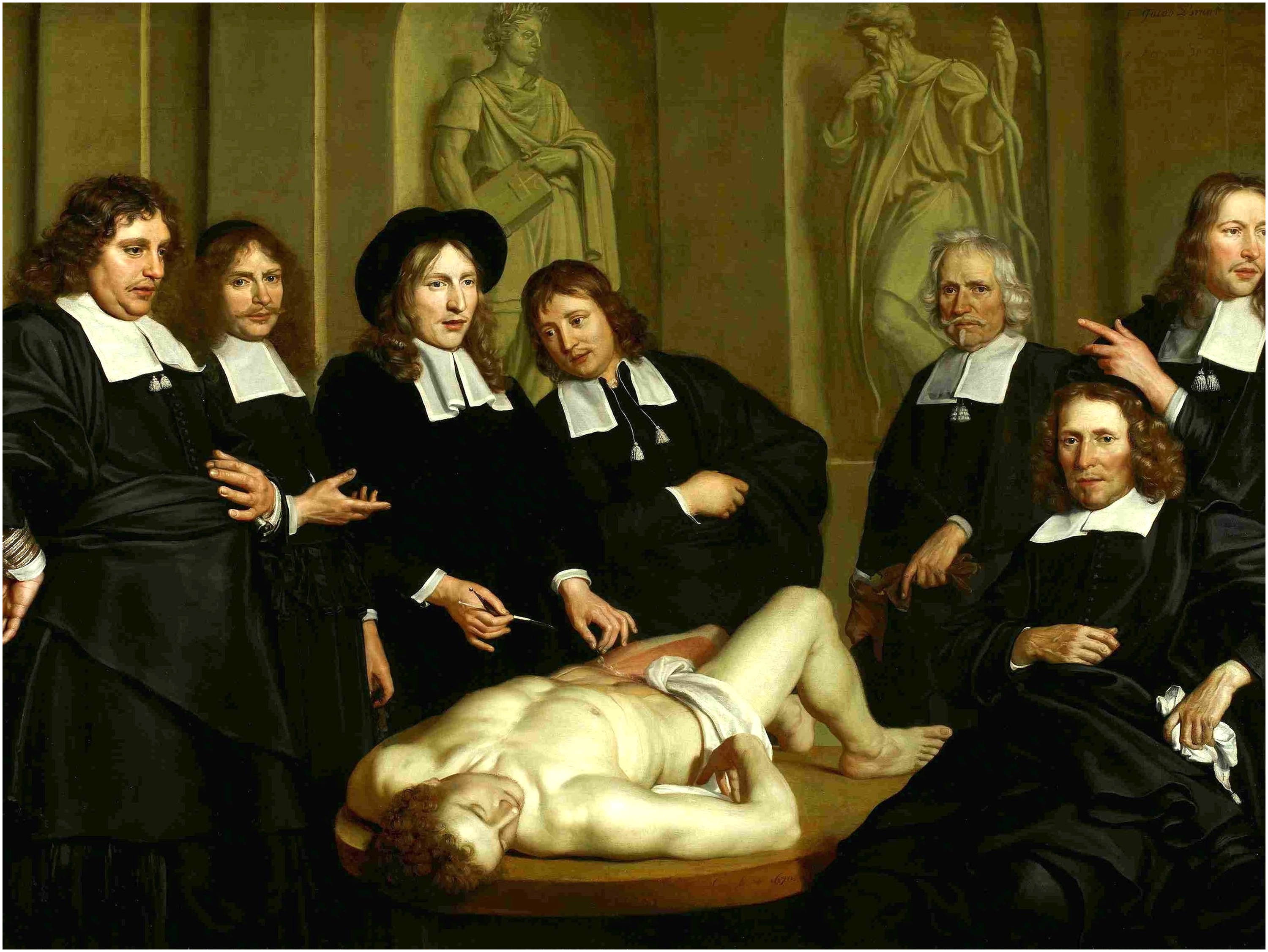
The anatomy lesson of Niels Stensen's fellow student Frederik Ruysch (1638–1731), painted by Adriaen Backer in 1670. Source: Amsterdam Museum.
Reinier de Graaf
Reinier de Graaf (1641–1673) was the son of Cornelis Maertensz de Graaf, carpenter in Schoonhoven and Catharina Reyniers van Breenen. He studied medicine in Utrecht and Leiden, where he registered on 5 April 1663. He then left for Angers in France, where he obtained his doctorate in medicine in 1665 with an anatomical study of the pancreas. In 1666, he returned to the Netherlands, where he established himself as a physician in Delft. He soon also started working for the Leiden professor Sylvius. He is known as one of the pioneers of the science of reproductive medicine and is the discoverer of the ovarian follicles, 14 later named after him, in the discovery of which Stensen and Swammerdam were also involved.
In 1664, De Graaf published his Disputatio medica de natura et usu succi pancreatici in Leiden, on the secretion of the pancreas, which was highly appreciated. In this work, he not only emphasises the discovery of the ductus salivales by Stensen but also speaks of him as amico meo integerrimo (my best friend), which indicates that they were already friends at that time. In 1670, when Stensen returned to the Republic, he visited Reinier de Graaf in Delft, where the latter worked as a general practitioner. Both friends could greet each other as co-religionists, since De Graaf was a Catholic, which, despite the relatively tolerant climate in the Republic, excluded him from possibly succeeding Sylvius as professor in Leiden. De Graaf died in 1673 at the age of only 32.
All this illustrates how the brilliant quartet of fellow students (Stensen, Swammerdam, De Graaf, and Ruysch) developed new techniques and ideas between 1661 and 1664 under the supervision of their mentors, but also in mutual collaboration and individually. In addition to the formal anatomical lessons in the Theatrum Anatomicum, they made numerous discoveries while dissecting and vivisecting an endless series of animals. They often conducted these practices at home on their own, which was undoubtedly not always appreciated by other residents. Fundamental research was the goal. It was not part of the professor's job description nor a requirement of the university curriculum. The desire for knowledge, religious zeal, a sense of honour, and the desire for recognition (and the hope for some form of patronage) were the underlying motivations. This kind of research was expensive. The objects for dissection, such as dogs, rabbits, frogs, and ducks, could be picked up from the street or fished out of the canal, but instruments, devices, and experimental setups often had to be specially made, not to mention the costs involved in making illustrations and anatomical preparations. In the city of Leiden, a substantial number of instrument makers had their studios around the Theatrum, where not only medical instruments were produced but also designed to fulfil the demands of Anatomia nova.13,15 Publishing research findings was not the primary objective; social and religious factors held equal significance. However, those seeking recognition would benefit from making their discoveries public. Drawings had to be made, engravings based on these, books written, illustrated, published, and distributed (all cost items). Stensen's first disputation in Leiden was provided with engravings, which were not only exceptional but must have cost him quite a bit of money. During his time in Leiden, Stensen also published his ‘Observationes Anatomicae’ (1662 5 ) and ‘De Musculis et Glandulis Observationum Specimen’ (1664, dedicated to the Danish King Frederik III 16 ). This latter publication is often considered his dissertation, based on which he was awarded his doctorate with honours in absentia. The dedication to the Danish king should be seen as a disguised, but ultimately futile, application for an academic position in Copenhagen.
Stensen meeting Spinoza
Benedictus de Spinoza (1632–1677) was born in Amsterdam as Baruch d’Espinoza, the son of Jewish parents who had fled from Portugal. 17 He received a Jewish religious education. At home, he spoke Portuguese and learned Dutch, Spanish, Hebrew, and Latin, the language in which he would later write. He was interested in philosophy and, early on, expressed critical views on traditional Jewish positions. At the age of 23, he was excommunicated from the Jewish community, which meant even his family could no longer associate with him. He was forced to leave Amsterdam and moved to Rijnsburg (near Leiden) and later to The Hague. He earned his living by grinding lenses for glasses and microscopes. During Spinoza's stay in Rijnsburg between 1660 and 1663, the Lutheran-raised Stensen met the ‘atheistic’ philosopher Spinoza. Spinoza regularly attended the public anatomical demonstrations in the Theatrum Anatomicum, where he saw Stensen at work and exchanged thoughts with him. Niels had great admiration for his ‘Tractatus theologico-politico’. Totaro 18 has extensively reported on the meetings between Stensen and Spinoza. Even after both left Leiden, Stensen and Spinoza continued to correspond. Spinoza died in 1677 in The Hague from a lung disease (tuberculosis?), possibly aggravated by his work as a lens grinder (silicosis). Although his ideas were considered dangerous in the seventeenth century, his work gained much international appreciation in the centuries that followed. His ideas about freedom of thought and expression have been important for modern society.
Departure from Leiden
Due to family circumstances, the sudden death of his stepfather and subsequently his mother, Niels had to leave Leiden at the beginning of 1664 to arrange his affairs at home in Copenhagen. As he had effectively completed his medical studies in Leiden, evidenced by several groundbreaking publications5,19 and their public defence on 18 October 1663, he requested the Senate of the university to grant him his doctorate. On the recommendation of his promoter, Jan van Horne (Hornius), and wholeheartedly supported by Professor Sylvius, he was awarded the doctorate with honours in absentia on 4 December 1664, a unique occurrence in the history of Leiden University. His diploma was sent by mail to his lodging address in Paris.
From Leiden via Paris to Florence
In 1664, Niels Stensen began his great European scientific travels. First, he visited Johannes Swammerdam, who had left for Paris to visit the famous Melchisédech Thévenot (1620–1692), the wealthy French author, scientist and diplomat. The two friends would stay with Thévenot for almost a year, partly at the same time as Christiaan Huygens (1629–1695). In Paris in 1665, at the home of Thévenot, Stensen gave an impressive demonstration of the anatomy of the brain, in which he argued that the pineal gland, contrary to Descartes’ claims, was not the seat of the human soul. 20
After a year at Thévenot's residence, Stensen travelled through the South of France to Tuscany. On the recommendation of Thévenot, Niels was warmly received in Florence by Cardinal Leopoldo de’ Medici (1617–1675), the younger brother of Grand Duke Ferdinando II (1610–1670), and invited to become a member of the world's first academy entirely devoted to experimental science, the Accademia del Cimento (Academy of Experiments). This academy's motto was ‘provando e riprovando’ (trying and trying again). In the service of the Grand Dukes, Stensen broadened his interests from human and animal anatomy to the anatomy of the Earth, a science that would later be known as geology.
In the service of the church
In 1667, Niels Stensen decided to convert to Catholicism. During the late 1660s and early 1670s, Stensen conducted pioneering geological research across Europe. In 1667, he identified shark tooth fossils as biological in origin, providing early empirical support for the organic nature of fossils. 21 His 1669 treatise established fundamental principles of stratigraphy – original horizontality, superposition, and lateral continuity – forming the basis of modern geological science. 22 Additionally, his observations on the constancy of interfacial angles in crystals laid the groundwork for crystallography. In 1675, he abandoned scientific practices to devote himself entirely to his ecclesiastical duties, and he was ordained a priest. Two years later, in 1677, Pope Innocent XI (Benedetto Odescalchi, 1611–1689) ordained him as titular bishop of Titiopolis and apostolic vicar of the northern missions. He performed his ecclesiastical duties in various cities in northern Germany, such as Hanover, Münster, Hamburg, and finally Schwerin, the capital of the state of Mecklenburg. Here he went through a period of self-imposed poverty and religious asceticism, which brought him to a state of deep misery. He died exhausted and in abject poverty on 5 December 1686, at the age of 48.
At the explicit request of Cosimo III (1642–1723), the Grand Duke of Tuscany, Stensen's remains were transferred to Florence and interred in the Basilica of San Lorenzo, also the final resting place of the Tuscan Grand Dukes. The tomb of Niels Stensen is currently located in a separate side chapel, the so-called ‘Capella Stenoniana’.
Stensen's key contributions to medical science 19
Discovery of Stensen's (parotid) duct
In 1660, while working in Amsterdam, Stensen made one of his most famous anatomical discoveries – the parotid duct, now known as Stensen's duct. 5 This duct is the excretory duct of the parotid gland, which transports saliva from the gland into the mouth. This discovery was crucial in understanding how salivary glands function and how bodily fluids are secreted, opening new doors to studies of digestive physiology.
Studies on glands and secretions
Stensen advanced knowledge about the glandular system, including his studies on salivary, lacrimal, and sweat glands. 5 Amongst others, he argued that tears are produced by the lacrimal glands and not by the brain. His anatomical research contributed to a better understanding of how various exocrine glands (glands that release their secretions through ducts) operate. These investigations laid the groundwork for understanding the physiology of secretion, which was critical in medical research for years to come.
Contributions to muscle physiology and function, and dysfunction of the heart
Stensen was also a pioneer in the study of muscle physiology 16 (Figure 4). He disproved the long-held belief that muscles functioned by inflating like a balloon, arguing instead that muscles contract by shortening their fibres. He showed that when a muscle contracts, it does change its form but not its volume. By doing so, the heart functions as a pump for blood circulation, and it is not just the seat of the soul or the generator of body warmth. His anatomical insights contributed to the modern understanding of muscle contraction, which is essential for fields like physiology, kinesiology, and sports medicine. Stensen was the first to describe a congenital malformation of the heart, which we now refer to as the tetralogy of Fallot. 23
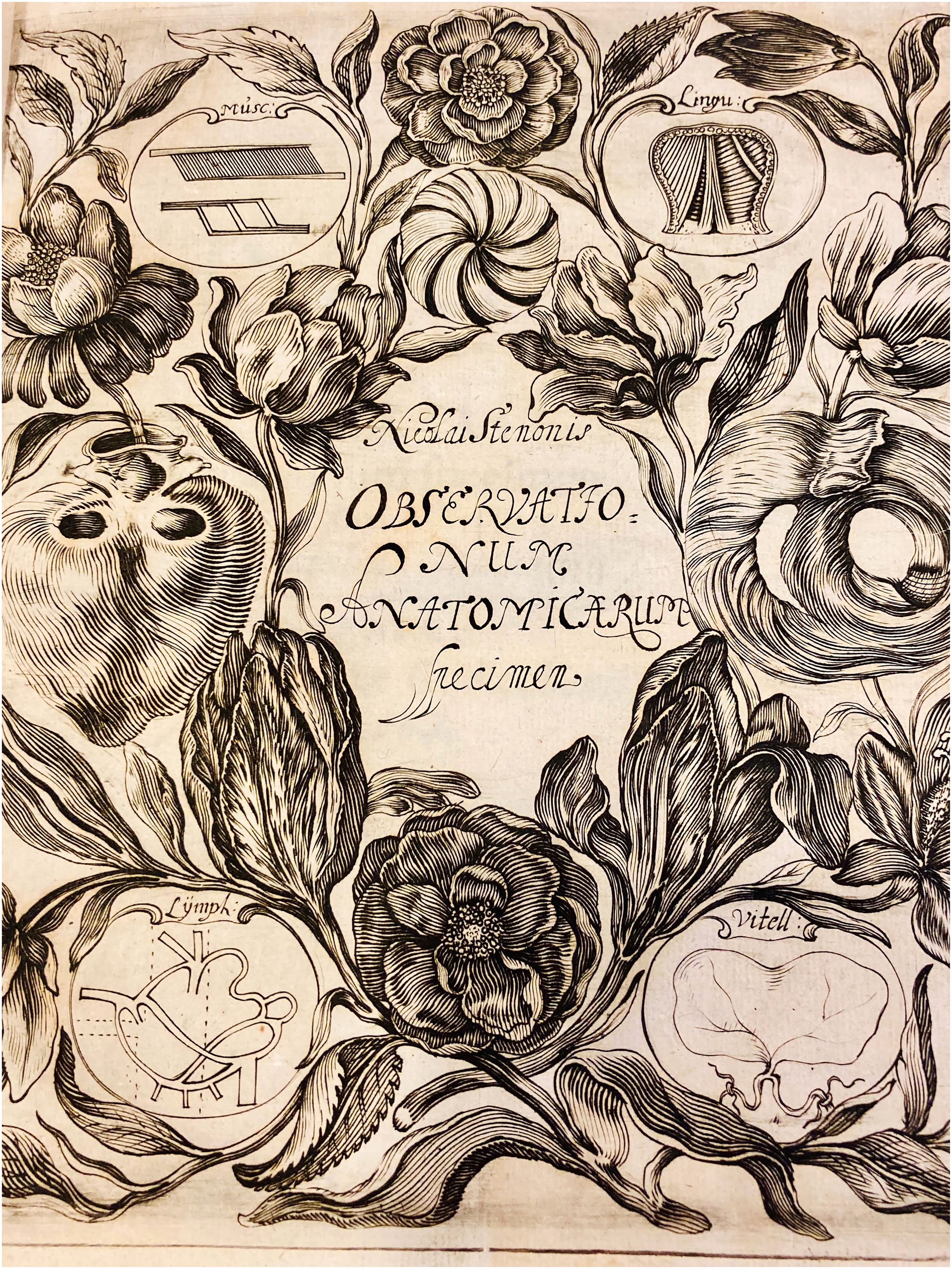
Frontispiece from: Nicolai Stenonis, (1664): De musculis et glandulis observationum specimen: Cum epistolis duabus anatomicis. Matthiae Codicchennii, Hafniae, considered his doctoral dissertation. Source: Leiden University Libraries.
Advances in reproductive biology
Stensen contributed to the understanding of reproductive anatomy by identifying the ovaries as female gonads, responsible for producing eggs. His research clarified the role of the ovaries in reproduction, shifting away from earlier misconceptions. Stensen was the first to introduce the terms ovum, ovarium, and oviduct. While Reinier de Graaf 14 is credited with the discovery of ovarian follicles, Stensen's work on the female reproductive system laid the foundation for such discoveries and helped advance the understanding of human reproduction.
Neuroanatomy and brain research
Stensen conducted detailed dissections of the brain, contributing to early knowledge of neuroanatomy.20,24 His careful anatomical descriptions of the brain and cranial nerves provided a basis for future studies on brain function and neurological processes.
Conclusion
Niels Stensen was a distinguished seventeenth-century polymath whose contributions significantly advanced medical sciences, particularly through his pioneering discoveries in anatomy and physiology. His impact on understanding medicine, especially in the areas of glandular function, muscle physiology, and reproductive biology, was profound. His ability to integrate various disciplines, along with his contributions to the natural sciences, especially medicine and earth sciences, 25 has solidified his legacy as one of the most influential figures of his era.
Footnotes

Consent of publication
Consent for the publication of the images has been obtained.
Author contributions
The authors conducted the data collection, data management, and writing.
Funding
The authors received no financial support for the research, authorship, and/or publication of this article.
Declaration of conflicting interests
The authors declared no potential conflicts of interest with respect to the research, authorship, and/or publication of this article.
Data availability
The datasets generated and/or analysed during the current study are available from the corresponding author upon reasonable request.