




Abstract
The famous French scientist, Emile Roux, was previously discovered to have been secretly married to an English woman, Rose Anna Shedlock, one of the first women medical school students in Britain and Europe. Emile and Rose most likely met while in medical school in Paris, although for very different reasons, neither graduated. It was previously suggested that Rose left medical school after only a few years, although we present new evidence that that she was still a medical student four years later when she would have been near completion. Regardless, Rose moved back to England prior to taking her qualifying exams, where we found she lived at a girl's boarding school where one of her sisters was head mistress. In the following year, Emile travelled to London where he and Rose were married in a quiet civil ceremony. Soon after the wedding, Emile returned to Paris where he began working as an assistant to Louis Pasteur. In a tragic twist of fate, Rose died a year later in Madeira, which we have now noted was within days of when Emile performed his breakthrough experiments that led to the creation of vaccines in the laboratory.
Introduction
Earlier work by the medical historian Neil McIntyre detailed both the death of Rose Anna Shedlock (c1850–1878) and her previously unsuspected marriage to Emile Roux (1853–1933),1,2 who later became famous for making major breakthroughs in the development of vaccines in the laboratory.3,4 We expand on McIntyre's work by adding additional background material for context, and by presenting newly discovered information that provides additional insights into the lives of these two individuals. This study follows up on an earlier fictionalized account of the role of Emile in the discovery of vaccines which uncovered numerous original source materials. 5
To understand the nature of the relationship between Rose (which is how she signed her name)6,7 and Emile, it is necessary to address the complex and unconventional paths which brought them together. As proposed by McIntyre, 8 it is highly likely that they met while in medical school in Paris. Both had overcome difficult circumstances and were essentially parentless at the time of entering medical school. Emile's mother was alive, but he did not live with her, 9 while both Rose's mother 10 and father 11 had already died.
To fully comprehend Rose's amazing accomplishments, it is important to understand both her personal circumstances and the status of women in medicine at the time. Although Rose was born in England, she lived in France for several years while her father was working there as an engineer helping to build a railroad. 12 However, by 1861 Rose was living in London with her two brothers and four sisters, and her father was listed as an independent minister.13,14 Due to her mother's death and her father's illness, the census of 1871 shows that Rose and her two younger siblings were living without a head of household in Croydon, although she already considered herself a medical student. 6 Rose's older brother was married at this time, while her three older sisters were living together, with the two older ones employed as school mistresses. 15 Somehow, despite these turbulent changes in her life, at the age of 21, Rose moved to Edinburgh, where she began medical school. 16 How Rose obtained the resources necessary for medical school is unclear. It would have been very expensive, and her father had left less than £4000 in his will, which had to be split between his seven children (Figure 1).
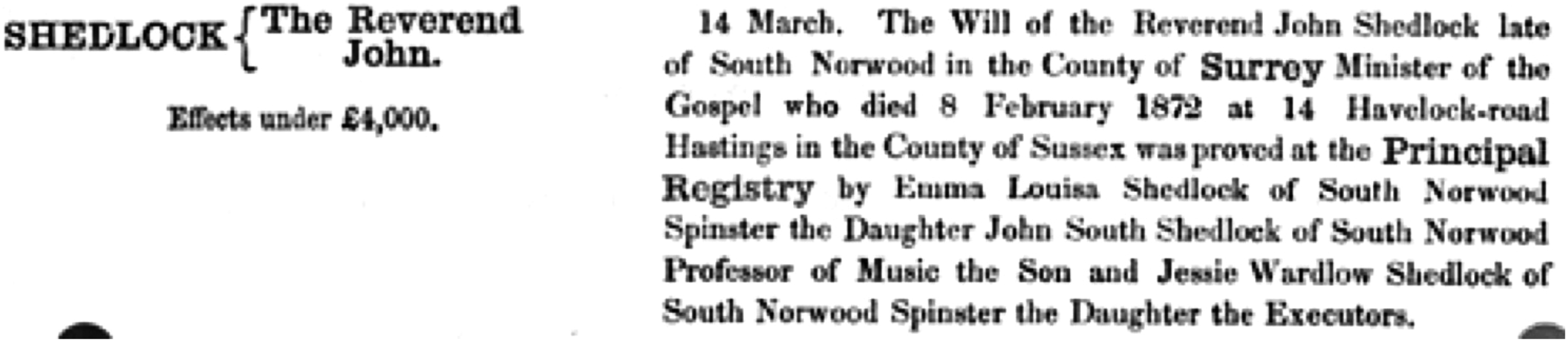
Record of the will John Shedlock, father of Rose Anna Shedlock. 11
At the time Rose entered medical school in 1871, there were only two women licensed to practise medicine in England, Elizabeth Blackwell (1821–1910) and Elizabeth Garrett, later Garrett Anderson (1836–1917). Although born in England in 1821, Blackwell's family moved to the United States, where she was the first woman to receive a medical degree. Accepted to Geneva College in New York, Blackwell faced daunting challenges, having to sit separately from the men, and being denied entry into laboratory courses. 17 None-the-less, she graduated and went to New York City where she started the Women and Children's Clinic with her sister. Blackwell eventually returned to England in 1868.
Having been rejected from several medical schools, Garrett secured private medial tuition and, having satisfied the requirements to take the examinations for the medical licence offered by the Society of Apothecaries, passed and qualified for her apothecary licence in 1865.18,19 As a result, although she did not have the status of an M.D., she became the first woman to qualify as a medical practitioner in Britain. However, the Society of Apothecaries changed the rules afterwards to make it impossible for any other women to follow her lead. Determined to be a physician, and denied access to medical school in England, Garrett enrolled in medical school at the University of Paris, where she graduated in 1870, the first woman to do so.20,21 Although Garrett was admitted into the British Medical Association in 1873, as with her experience as an apothecary, the rules were subsequently changed to prevent any other women from obtaining a licence to practice medicine in Britain. 22
Hoping to follow in the footsteps of her mentor, Elizabeth Blackwell, Sophia Jex-Blake (1840–1912) applied to medical school in Edinburgh in March of 1869. Undaunted after being rejected because she was just “one lady,” she advertised for other women to join her in a second attempt. Along with four other women who answered her inquiry, in November of 1869, Jex-Blake and the other women applicants were admitted into medical school at the University of Edinburgh.23,24
Despite constant harassment, riots, and having to be escorted to class, in subsequent years, more women were admitted to medical school in Edinburgh, including Rose in 1871, eventually reaching a total of 29. Finally, at the end of 1871, Jex-Blake, Edith Pechey (1845–1908) and Isabel Thorne (1834–1910) completed the requirements for the first half of their training and passed their qualifying exams. However, rather than being a breakthrough for women in medicine, their success set in motion a series of events resulting in the expulsion of all women medical students from the University of Edinburgh, as is described in more detail below.25,26 Some of the professors who would be teaching them in the second half of their training refused to conduct separate classes for women. As a result, Jex-Blake wrote a proposal to the Academic Senate requesting special lecturers for women if professors refused to teach them. In addition to refusing her request, in November of 1871, the Academic Senate voted to recommend to the University Court that the 1869 regulations allowing women to be admitted into medical school be rescinded. Refusing to give up, Jex-Blake wrote a petition to the University Court, co-signed by nine other women medical students, including Rose, to attempt to force the university to allow women to abide by the 1869 agreements. Although the women won their court case in July of 1872, the university appealed the decision, and in 1873, it was concluded by the Lords of the Appellate Court that the medical school did not have the authority to admit women, which could only have been granted at the highest levels at the university. As a result, Rose and all other women medical students were dismissed from medical school.
Jex-Blake, along with Garrett as co-founder, then started the London School of Medicine for Women with the help of Pechey and Thorne.27,28 Blackwell agreed to give lectures. Despite not being a recognized medical school with no official degree, there were 14 students at the beginning, growing to 23 by the end of the first year.
Instead of joining Jex-Blake, in 1873, Rose and two of the other women medical students in Edinburgh, Anna Dahms (1848–1917) and Annie Reay Barker (1851–1945), chose to enter medical school at the University of Paris.29–31 Upon graduation, they would still not be able to practise medicine in Britain, but at least they would have an official medical degree.
Jex-Blake later immortalized the courage of the women who fought with her during this time, calling them the “Edinburgh Seven.” 32 However, as has been pointed out,33,34 more than seven women were involved, who Jex-Blake purposefully failed to mention for personal reasons. Among these were Rose, Dahms, and Barker, who Jex-Blake blamed for not joining her at the London Medical School for Women. Ironically, Jex-Blake herself later left the London Medical School for Women because she could not get a medical degree, and attended medical school in Bern, Switzerland.
Emile's path to medical school and his research career was also far from ideal. Like Rose, Emile was on his own when he entered medical school. His father having died, he was required to live with his older married sister. 35 Like his father, Emile's brother-in-law was a school principal and a strict disciplinarian. To escape, Emile joined the army at 17 years of age to fight in the Franco-Prussian War (1870–1871). However, because France surrendered shortly afterwards, he was spared the fate of his two older brothers, who were killed. With little family support, Emile enrolled in college in Claremont-Ferrand, and eventually entered medical school there in 1872. While in medical school he worked as an assistant in the laboratory of Emile Duclaux (1840–1904), a collaborator of Louis Pasteur (1822–1895). This experience in research would change his life. However, after two years in medical school, his money ran out. Emile was therefore forced to join the Army Medical School, where they paid his way in exchange for ten years of service as a physician in the army.
Emile moved to Paris in 1874 to attend the Army Medical School, where he is likely to have met Rose. Although they were in two different medical schools, they lived in the same area of Paris, and would have shared classes and clinical rotations. The Army Medical School utilized Val-de Grace as its hospital-an elegant building that was originally an abbey built for Benedictine nuns by Queen Anne of Austria (1601-1666). However, the army medical students took classes at the University of Paris (Sorbonne) along with the Paris Medical School students, and performed clinical duties at Hotel Dieu, which was the hospital used by the Paris Medical School.
In her book on her uncle's life, Mary Cressac (1898–1969) mentions that her aunt told her how Emile was very much enamoured by an English woman. As has been previously pointed out, 36 Cressac suggested that this woman was named Mary, and that he met her in Duclaux's laboratory. However, as McIntyre concluded, this would have been impossible, since Duclaux was not in Paris at that time. It is therefore likely that while relating this story long afterwards, Emile's sister confused Emile's love with an English woman named Agnes Mary, (1857-1944) who worked with Duclaux, and eventually became his second wife.
Rose and Emile therefore shared a similar fate, in that neither completed medical school at that time, although Emile did eventually complete his thesis and get his degree much later for his work on rabies. Emile was the first of the two to leave medical school. There is some doubt as to the circumstances and timing, it is clear that despite completing all of his other requirements and passing his exams, Emile received a letter of dismissal in August of 1876 for failing to complete his thesis. . It seems likely that this failure to complete a thesis was done on purpose, possibly to avoid the ten years of obligation in the army, or to avoid being separated from Rose, or both.
There are different accounts regarding the timing and circumstances of Emile's dismissal from medical school, and as to how he supported himself prior to joining Pasteur's laboratory. In her book, Emile's niece claimed that at the time of his dismissal in 1877, Emile was arrested for insubordination along with a fellow student, Edmond Nocard (1850–1903). 37 However, as pointed out by McIntyre, a letter of dismissal from the director was dated August 1876. 38 McIntyre also questioned whether Nocard was involved. In agreement with this conclusion, we noted that Nocard never attended the Army Medical School, and at the time of Emile's dismissal was a professor of veterinary medicine at the National Veterinarian School of Alfort, located in Paris.39,40 Emile did mention in a eulogy he gave for Nocard that they became acquainted in 1876. 41 However, this was the year that Nocard's young wife died in childbirth,40,42,43 so Emile and Nocard may have met as a result of her hospitalization.
As with Emile, the exact circumstances as to why Rose failed to graduate from medical school are unclear. Whether she completed her classes and clinical requirements is open to question, although she did not receive her degree, and therefore never took her qualifying exams or wrote her thesis.
As McIntyre previously pointed out, documents were located showing that Rose was in Paris Medical School at least two years, with the last documentation of her being a student in 1875. 29 However, these records were incomplete, at best, and no official enrollment lists were available. Upon further investigation, we found that Rose had signed a letter to the University of London in July of 1877 congratulating the Chancellor and Senate for allowing women who had completed medical school to take exams in Britain. 7 This letter begins: ‘We, the undersigned women, who are engaged in the practice and study of medicine,’ was also signed by many other women British medical students and physicians, including Blackwell, Garrett, and Jex-Blake. Rose listed her address as 42, Rue des Ecoles, Paris, which is very near the University of Paris. Thus, Rose was still living in Paris and was still considered a medical student in July of 1877. This would have been at the end of her fourth year in medical school, and it seems likely she would have been near the completion of her classes and clinical rotations. The other two British women she started medical school with in Paris, Barker and Dahms, had already graduated, as shown by the fact that they both gave their titles as MD on this letter. However, neither Barker nor Dahms showed LKQCPI after their names, indicating that they had yet to take their licensing exams at Kings and Queens College of Physicians in Ireland. Therefore, neither had yet been licensed to practice medicine in Britain, although both were licensed the following year. 44 Licensing of women had just become possible in January of that year. The House of Commons had passed the Medical Act 1876. Starting January of 1877, colleges in Britain were allowed to let women take the exams to become physicians, 45 but it did not require them to, and most universities were still refusing. However, King's and Queen's College of Physicians in Ireland had agreed to let women graduating from other medical schools take their exams there to receive a medical licence to practice in Britain.
Sometime in the year following this letter, and prior to her marriage in August of 1878, Rose moved to London, living at Elm Tree Lodge, as shown by the address on her marriage certificate. 46 Why Rose moved to London is unknown. It is possible she did not complete her classes and clinical requirements due to her tuberculosis and moved to London to be near her brothers and sisters. However, it is also possible that she completed all of the necessary requirements, and moved to London to be near her family while she studied for her exams and wrote her thesis. In London, she would have had access to the library and facilities at the London School of Medicine for Women.
McIntyre proposed that Elm Tree Lodge was a boy's school, and that she might have been a schoolmistress, as were two of her sisters. The census of 1881, 47 just two years after Rose's death, though clearly demonstrates that Elm Tree Lodge was a girl's boarding school with Rose's sister, Jessie, listed as school mistress. Twelve girls, ages 11 to 18, were listed as scholars. In addition, there were six employees, including a cook and governess, as well as one visiting teacher. Importantly, one other woman, Anne Hornsby (1849–1941), was living there with no job title, suggesting that she was an unemployed boarder. Research on her background showed that she was born in India, and that her parents had died, her father in India, and her mother later in England. 48 Hornsby's presence therefore suggests that an unmarried woman could live at Elm Tree Lodge without being employed there. Hence it seems possible Rose moved into the Elm Tree Lodge to be with her sister Jessie without being employed in a teaching capacity. This possibility would be consistent with her death certificate, which still listed her profession at the time of her death as “Student of Medicine.”
Why Rose and Emile decided to get married is unknown, as is why they chose to keep it a secret. McIntyre previously questioned whether they may have married because Rose was pregnant. 8 That possibility was probably suggested to him because of the strong association between register office weddings and pre-marital pregnancy. Historian John Gillis (1939–2021), for example, claimed that the register office was primarily used by ‘pregnant brides and runaway couples’ in the period between 1850 and 1914, although the evidence he cited in support in fact related to a later period. 49 More recent research has demonstrated the wide range of reasons why couples might have chosen to get married in a register office. 50 For Emile, an atheist, and Rose, a feminist, a civil ceremony would have been a logical choice. The simple words prescribed by statute for use in register offices did not have the same patriarchal connotations as the Anglican Book of Common Prayer. Bride and groom said essentially the same words, with no reference to the bride having to ‘obey her husband. 51 Just the year before, the journalist Florence Fenwick Miller (1854–1935)—a fellow-student of Rose's at Edinburgh—had also chosen to be married in a register office, and also to keep her maiden name. 52 In any case, in view of the new evidence that Elm Tree Lodge was a girl's boarding school, it seems highly unlikely that a pregnant unmarried woman would have been allowed to live there, as she undoubtedly would have been seen as a bad influence on the young girls. It seems more likely that the decision to get married was because of Rose's deteriorating health, which is likely since she died a year after her marriage. Emile may have felt compelled to marry Rose out of love, which would be consistent with the stories later told by Emile's sister of how he was very much enamoured of an English woman. 36
Whatever the reason, their decision to get married was not made in haste. It would have required considerable effort, planning, and expense on their part. Emile would have had to travel to London from Paris, which was not simple in those days, requiring a train to Calais, a ferry to Dover, and another train to London.
The importance of secrecy is evident from the fact that Emile and Rose chose to be married by a superintendent registrar's licence, rather than the cheaper certificate. Paying for a licence meant that the notice of the intended marriage did not have to be displayed in the register office. It also cut the waiting period between giving notice and the licence being granted to just one day, 53 as compared to 21 days for those marrying by certificate. Once the licence had been issued, the wedding could take place immediately.
It would have been possible for Rose to have given notice of their intended wedding at her local register office so that they could have married upon Emile's arrival in London. Only one of the parties had to give notice. Moreover, while the licence could only be granted by a superintendent registrar of the district where one of the parties had been resident for the previous 15 days, such a licence could authorize a wedding in a different district. Rose's home in Finchley was within Barnet registration district, and so it was to the superintendent registrar of Barnet that she would have had to give notice. This would have required a ten-mile round trip to his office, which was hardly convenient, but had the advantage that she was unlikely to be seen by anyone she knew going into the office.
The alternative would have been for Emile to give notice after establishing the necessary 15 days residence. The residence for Emile listed on their marriage certificate was 21 Parish Street, Southwark. 46 This was a very unsavoury part of London at the time, on the south side of the Thames river near London Bridge. Next to his lodging at 23 Parish Street was a pub named Black Eagle Tap. 54 Across the street was St Olave's Union Workhouse, which was one of the worst workhouses in London. 55 As described in the novels by Charles Dickens, workhouses were where the poor were forced to work for their keep, including children who were separated from their families.
It is possible that this workhouse was also the location of the office of the superintendent registrar for the district, that is, the register office where Emile and Rose married. Indeed, most scholars who have written about register office weddings have claimed that the register office was always in the workhouse. 56 However, while some were, others clearly were not. 57 While the office of superintendent registrar was often combined with that of clerk to the Poor Law Board of Guardians, whether or not his office was in the workhouse might depend on whether he held any other professional role. In the case of St Olave, the 1875 plan of the St Olave workhouse does clearly show an office next to the board room. 58 In the 1871 census, William Benjamin Hurst, the superintendent registrar who attended Emile and Rose's wedding, was living in Bermondsey with his wife, eight children, and mother-in-law, and no other profession was listed for him. 59 It is more likely that his office was in the workhouse than at his home.
There are a variety of reasons why Rose may have decided on the St Olave Southwark district of London as a place for Emile to stay and for them to get married. Certainly not for her convenience, since Southwark is far across London from her home at Elm Tree Lodge in Finchley. But it may have been convenient for Emile, since the boarding house was walking distance from the first train stop in London when coming from Calais. Expense would have been another factor, since at the time, Emile was living on what little money he made from odd jobs, and Rose may have had no job at all. Finally, Southwark would have provided the secrecy that they appear to have sought. Rose was living with her sister in a girl's boarding school, and it would clearly have been a scandal if it were discovered that she was visiting a Frenchman, much more getting married to one.
The identity of the witnesses who signed the marriage certificate is also significant. One of them had the same last name as the Superintendent Registrar, and upon investigation turned out to be his son. 59 This strongly suggests that no friends or family were present to witness Emile and Rose's wedding.
Emile may also have had reasons for keeping the marriage secret, since shortly after their marriage, Emile was to begin working with Duclaux in a laboratory he shared with Pasteur.60,61 As has been noted by Pasteur's nephew, Adrien Loir (1862–1941), who worked in the Pasteur's laboratory, Pasteur was a germaphobe, and avoided shaking hands and carefully wiped down his dinnerware when eating out. 62 Emile may have therefore not wanted Pasteur to find out that he was married to someone who had tuberculosis, as it might jeopardize his new position.
Following their marriage, it is clear that Emile returned to Paris without Rose, since he was living in a room in the laboratory and no one ever learned of his marriage. Whether Emile visited Rose again in London after their marriage is unknown. However, as discovered by McIntyre, 63 sometime in the next year, Rose traveled to Madeira, where she died. At the time, Madeira was known to have sanitariums for people with tuberculosis, so it seems that Rose is likely to have gone there for her health. Interestingly, we noted that the person who signed her death certificate was the same Anne Hornsby mentioned above that was living at Elm Tree Lodge in the census of 1881, two years after Rose's death. 64 Rose may have therefore met Hornsby at the Elm Tree Lodge, and Hornsby accompanied her to Madeira, either as a friend or paid attendant. How Rose was able to afford to live in Madeira is unclear. Her probate record showed that she had less than £200 at the time of her death. 65 (Figure 2) Interestingly, Rose is listed as ‘spinster’ on her probate record, consistent with the evidence that she kept her marriage a secret from those who knew her.

Probate record of Rose Anna Shedlock. 65
In a tragic twist of fate, the famous experiments conducted by Emile that resulted in the discovery of the method of making vaccines in the laboratory were initiated within days of Rose's death. The exact circumstances regarding these experiments were not well documented. This was because Pasteur did not allow anyone in his laboratory but himself to keep a notebook, and Pasteur was away at the time that Emile initiated these experiments. Normally, Pasteur would have returned from his summer vacation by this time, but he was delayed due to ill health and the marriage of his daughter. As has been discussed, the circumstances of these experiments have been the subject of a myth relating to the serendipity of science. According to this myth,66,67 one of Pasteur's helpers, sometimes said to be Emile, and sometimes Charles Chamberlain (1851–1908), neglected to correctly culture the chicken cholera bacteria over the summer. When this person eventually injected chickens with bacteria from this old culture, the chickens did not die. Later, when a new virulent batch of the bacteria was prepared and injected into these same chickens, along with additional chickens, the chickens that had been previously injected with the bacteria from the old culture did not die, while the other chickens did. Supposedly, upon observing this, Pasteur immediately realized that they had discovered a method to attenuate bacteria for the production of a vaccine.
In fact, this myth is partly true. Although not documented at the time, as has been pointed out
The dates of the initial experiments conducted by Emile in the fall of 1879 were not noted by Pasteur. However, in his note on March 4, 1880, Pasteur did mention that on October 28, 1879, Emile started a bacterial culture from one of the two dead chickens that died. Thus, extrapolating back (two days for the initial culture, eight days for continued culture, three or four days for the chickens to die), these experiments would have been started on October 14 or 15, five or six days after the death of Rose.
How or when Emile learned of Rose's death is not known. Clearly, Emile must have been in close contact with Rose at the time of their marriage, as it was necessary to work out the details of his stay in London. It seems likely therefore, that they may have continued their correspondence while she was in Madeira, either by mail or by telegraph. It may have been possible therefore that Rose asked Anne Hornsby to contact Emile upon her death. If so, Emile may have learned of Rose's death during the time that he was conducting these famous experiments.
Footnotes
Declaration of conflicting interests
The authors declared no potential conflicts of interest with respect to the research, authorship, and/or publication of this article.
Funding
The authors received no financial support for the research, authorship, and/or publication of this article.
