




Abstract
The lawyer and physician Paolo Zacchia (1584–1659) was the chief physician at the Vatican and an important advisor to the papal court. He is considered a founder of the field of forensic pathology, and the influence of his masterwork, Quaestiones medico-legales, spread throughout Europe. In this essay, we focus on one of Zacchia's consultations, first published posthumously in 1661. Emerging from a cause for beatification, the case features the intriguing medical notion of one disease curing another. Zacchia was to determine if a young man's recovery from epilepsy was miraculous or not. We will briefly review Zacchia's career, examine his argument and the sources on which he based his reasoning in this case, trace the status of the disease-versus-disease notion to the present, and demonstrate that this consultation represents a rare, if not the only example of syphilis being the curative agent – rather than the disease cured.
Trained by Jesuits in both law and medicine, Paolo Zacchia (1584–1659) served as chief physician in the Vatican and as advisor to the papal court during the reign of two popes: Innocent X and Alexander VII.1,2 A prominent consultant and educator, Zacchia was predeceased by his spouse, Terrenzia Cossi, and left no descendents. His will is preserved in the Archivio di Stato, Rome. 3 Although he may have had Jewish origins, he was a devoted Christian, and his funeral was a grand affair in the Chiesa Nuova (Santa Maria in Vallicella) of Rome. 4 He published three books. Two were short works in Italian: Il vitto quaresimale (1637) a disquisition on Lenten lifestyle, and De’ mali hipochonrdriaci (1639), analysis of a physical not mental disease. The third book, begun in 1621 and growing in further editions, was his master work in Latin, Quaestiones medico-legales (also Quaestionum medicolegalium) (Figure 1). Zacchia's great influence in forensic medicine has attracted scholarly attention, especially in Germany and Italy, where he is viewed as a founding “father.”5–9 The journal of the Italian society for forensic pathology bears his name, Zacchia: Archivio di medicina legale, sociale, e criminologica. Partly because most of his work remains untranslated and possibly because he served the Roman Catholic church, Zacchia is less well known in the English-speaking medical world. Only recently has the anglophone literature begun to take stock of his significance, situating his life and portions of his work in the broader context of early modern medicine, religion, and jurisprudence.10–17
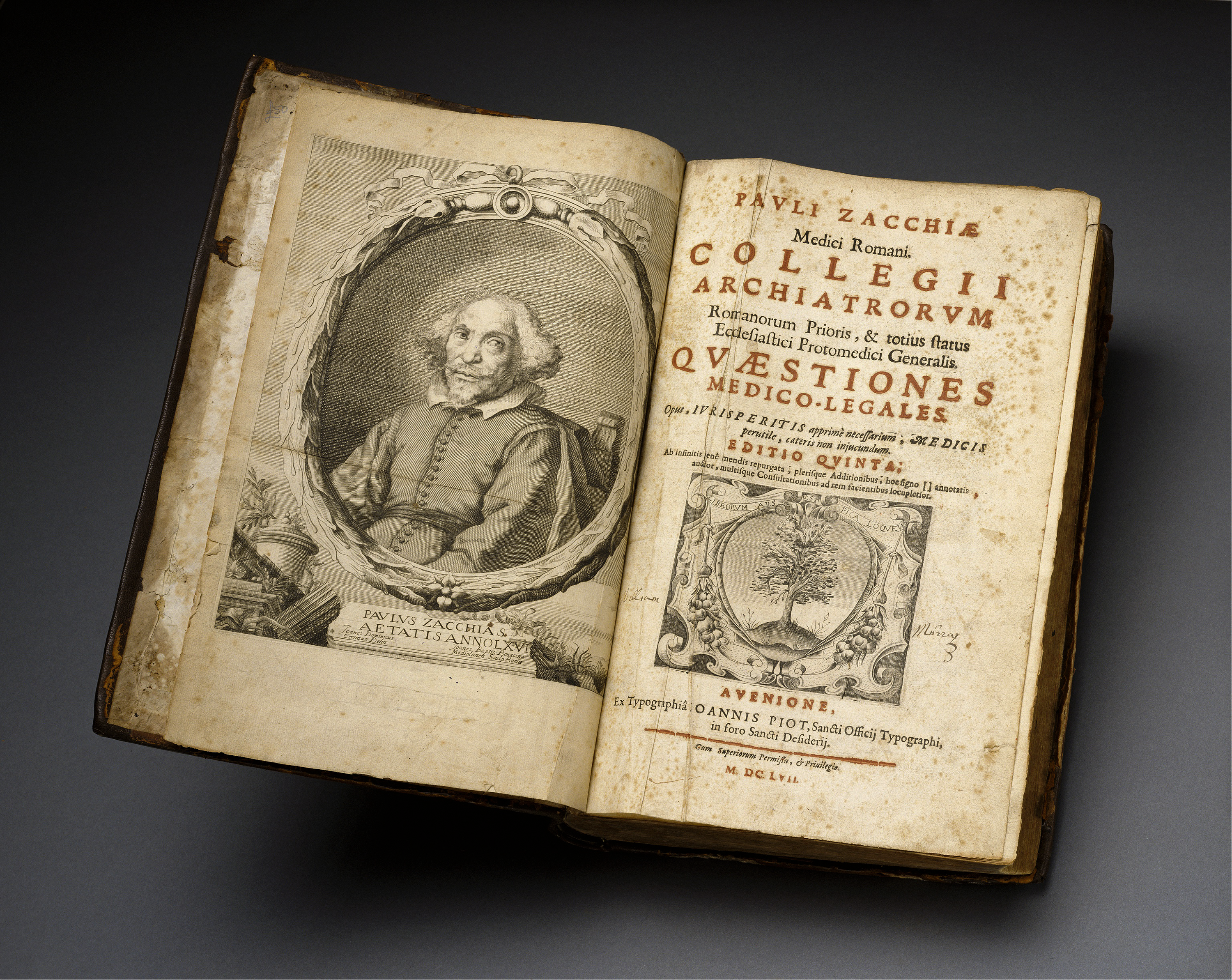
Frontispiece portrait of Paolo Zacchia and title page of the 1657 Avignon edition of his Quaestiones medico-legales. Courtesy National Library of Medicine, Bethdesda, MD.
Zacchia's monumental treatise on forensic medicine, Quaestiones medico-legales, appeared in successive editions during and after his life from 1621 to 1789. By 1661, it contained 85 consilia (consultations), each one illustrating applications of wisdom contained elsewhere in the book. Like case studies in today's medical literature, consilia represent individual patient histories, in which the theoretical, practical, and clinical observations of authors could be applied, contemplated, debated, and tested. With roots in antiquity, they pervaded scholarly writing from the thirteenth to the sixteenth centuries. Several distinguished historians have developed a robust and still growing literature on their origin, forms, and uses in both the law 18 and medicine.19–23 In his study of Giambattista Morgagni, Saul Jarcho observed that investigating an author's consilia could open a window on a much larger work by demonstrating the theory in action. 24
Zacchia's consilia address various medico-legal questions of health, death, homicide, paternity, inheritance, and sexuality; fifteen consilia concern possible miracles worked by candidates for sainthood. Some of his consilia have been examined, collectively or as individual case studies, by historians.25–37 In them, Zacchia cited more than 250 authors from antiquity to the seventeenth century and he included numerous cross references to other parts of the treatise. 38 In 2008, we began an online, open-access project to translate all the consilia into English, hoping that they might raise awareness of this little-known physician and enable greater access to his Quaestiones. At the time of writing, 61 of the 85 consilia have been either translated or adopted for future translation; 24 are still looking for volunteers. 39
In this essay, we focus on Zacchia's Consilium LXXX, first published posthumously in 1661. Emerging from an anonymous cause for beatification, it features the intriguing medical notion of one disease curing another. Zacchia was consulted to determine if a boy's recovery from epilepsy had been a miracle, or not. We will examine the sources on which Zacchia based his reasoning, trace the status of this idea today, and demonstrate that this consilium represents a rare, if not the only example of syphilis being the curative agent – rather than the disease cured.
That a systemic condition might prevent or protect a person from another disease has considerable currency today. The best-known example is the protection offered by prior infection with cowpox virus (vaccina) against smallpox (variola), the dairy maid's observation exploited by Edward Jenner (1749–1823), which led to vaccination and the eventual eradication of smallpox in 1979. 40 Now, especially in the field of genetics, a relative evolutionary advantage against infectious pathogens has been invoked to explain the persistence of nefarious alleles that, in the homozygous state, can cause serious disease. Thus, for example, we have evidence that two blood disorders—sickle hemoglobin and thalassemia—protect against malaria, or that the iron storage condition, hemochromatosis, protects against plague.41,42
By contrast, observations that a new disease can not only prevent but reverse and even cure another already present have become rare. Nevertheless, as we will show, such reports date back to antiquity and were transmitted for centuries. The closest analogy in our time may be the observation that the metabolic changes owing to pregnancy (which is not a disease!) can sometimes favorably affect chronic conditions, such as arthritis. 43
Zacchia's Consilium LXXX: a summary
In mid-seventeenth-century Italy, a boy, named Michael, suffered from periodic seizures. They began at age seven, followed phases of the moon, grew worse with overeating, and steadily increased in severity. When the lad was fifteen, his desperate family consulted a holy man who instructed him to fast, to say a Hail Mary, and then to eat an apple, which the man had blessed. The boy did as he was told. But at around the same time, he had “dallied with a maidservant” and contracted a severe dose of the “French pox.” Large swellings in his groin opened and oozed pus for a lengthy period. Nevertheless, following both the religious rituals and the venereal disease, the boy was free of his seizures “for many years.” After the holy man died, his devotees presented this story as a miracle in the cause for his beatification. The lawyer-physician Paolo Zacchia was asked to examine the case. He eventually decided that the recovery was natural—not a miracle. He supplied a variety of reasons, but relied, in particular, on the ancient notion that one disease can cure another. He wrote, “For it is a common experience that one disease is a remedy for another.” 44
Who was the would-be saint? Miracles are needed for beatification or canonization. Whenever Zacchia refuted the miraculous nature of a cure, he did not identify the candidate for sainthood, knowing full well that other more convincing cases might be brought forward. He indicated that the “same man” had appeared in another consilium, in which he was said to have prayed successfully, “while he was alive” at an unspecified date, for the miraculous revival of a boy thought to have drowned in an unspecified river–a recovery that Zacchia also rejected as a miracle. 45 In that consilium, reference was made to the 1656 plague in Rome. The fact of the beatification process, which cannot proceed before a candidate's death, and the phrase, “while he was alive” in the present consilium, imply that the man had died before 1659 when Zacchia himself died and certainly by 1661 when the case was published. This chronological window suggests five seventeenth-century holy men who were not beatified (or canonized) until later: Robert Bellarmine (1542–1621 beat. 1923; can. 1930), Pietro Casani (1572–1647, beat. 1995), Joseph Calasanz (1557–1648, beat. 1748; can. 1767), Vincent de Paul (1581–1660, beat. 1731; can. 1737) and Andrea Bobola (1591–1657 beat. 1853; can. 1938). Among men who have been beatified or declared venerable, no other candidates stand out. For location in Rome and reputation for miracles, the most plausible candidates seem to be Casani or Calasanz; however, many causes for beatification are begun without ever resulting in success. The holy man's identity must remain a mystery.
Zacchia's argument and sources
Then as now, producing evidence of a natural cure was sufficient to refute the possibility of a miracle in the canonization process. 46 Zacchia made no comment as to whether or not Michael's venereal disease had been treated medically; however, elsewhere in his consilia, he cited Girolamo Fracastoro (1478–1553) and the treatment of syphilis with mercury and guaiacum. 47
To refute the miraculous aspects of Michael's recovery, Zacchia set up several plausible arguments in favour of a natural, durable cure. He offered three reasons why the seizures might not have been incurable. First, the boy had reached puberty—an age when spontaneous remissions might occur, and the trigger had been external from overeating, which the lad had curbed having previously struggled to do so. Second, the fever could have removed it by a sort of coction or heating. And third, the oozing buboes could have, by copious evacuation of “rotting humours,” cleansed the “malignant humours stimulating epilepsy.” Zacchia concluded: “Therefore this disease could be overcome by means of medical—which is to say natural—assistance and by nature itself, not requiring a divine power intervening specially for its removal. And so vanishes every hint of a miracle; for when nature works by itself, the effect is never to be reckoned as miraculous, as is plain, because a miracle is an effect independent of a natural cause, either in itself or in the chain of events.” 48
Zacchia's works display astonishing erudition. Some editions of his Quaestiones provide a list of more than one thousand authors cited within. 49 In his consultation on Michael's putative miracle, Zacchia cited several ancient authors. Hippocrates and Aretaeus were invoked to establish the difficulty of curing epilepsy once it had become chronic, although they had observed that some sufferers grew out of it spontaneously at puberty. 50 Zacchia also cited several passages from Galen on the curative power of quartan fever (a form of what is now malaria). In the Commentary on Epidemics 1, 3.4, Galen cited Hippocrates’ Epidemics 1.24: “the quartan … also fends off other serious diseases.” 51 He also wrote, “we see epilepsies stopping when quartans are attacking for a long time, but you know already about how this happens from what is written in On the Differences of Fevers and On Crises.” 52 It is interesting that in this section, Galen parsed the Hippocratic passage about “other serious diseases” (νοσημάτων ἑτέρων μεγάλων) simply as “other diseases” (καὶ ἄλλων νοσημάτων), although he carried on immediately to refer to epilepsy specifically. When Galen discussed a similar passage in Epidemics 6, he explained that “the serious disease” is a technical term for epilepsy specifically. 53 Wesley D. Smith's translation of the Epidemics 6 gives this same passage as “People seized with quartan fevers are not seized with epilepsy. If they have it already and a quartan fever supervenes, they are cured.” 54
Zacchia also cited Avicenna's Canon, where it is written, “one disease is the treatment for another, such as a quartan, by which sometimes epilepsy is cured, and gout, and varices, and pain of the joints” (trans. Lehoux). 55 Other uncited sources lend credence to Zacchia's claim that the beneficial effects of quartan fever were well known—a “common experience.” The popular 1560 vademecum of Jodocus Lommius, Observationes medicinales, which appeared in many editions and translations into the late eighteenth century, included a similar passage: “Persons labouring under a Quartan [fever] are neither afflicted with Madness, nor Melancholy, nor a Leprosy, nor Convulsions arising from Repletion. Besides, if these Disorders have previously rag’d, they are generally terminated upon the approach of a Quartan. Some Physicians also assert that no Person can die of a Quartan, except by his own or his Physician’s Fault.” 56 The last line came, like so much of Lommius, directly from Celsus.57,58
Beyond Zacchia
We tend to think of diseases as immutable entities. In fact, they are also elaborate ideas about suffering—concepts—to explain symptoms, and they are conditioned by science and culture. Although histories are usually written about single diseases, physician-historian Mirko Drazen Grmek invented the neologism, pathocoenosis, to describe the constellation of diseases prevalent in a specific time and place.59,60 He wrote, “Two diseases belonging to a single pathocoenosis can be in a state of symbiosis, antagonism, or indifference to each other.” 61 In Consilium LXXX, Zacchia can be said to have discussed a sub-population-level pathocoenosis involving two diseases: one ancient and one relatively new. Invoking many venerable authors, he asserted that antagonism between diseases was capable of prevention or cure.
The ancient notion that one disease could cure another persisted for at least two more centuries beyond Zacchia. It may have slipped into the general view of the healing power of nature. 62 It is found in the works of the early nineteenth-century French alienist, Philippe Pinel (1745–1826). He wrote that unnamed “ancient and modern physicians” described cures of inveterate insanity by various other diseases, including “jaundice, phlegmonic eruptions, varicose swellings, hemorrhoidal evacuations, by quartan fever, etc.” 63 Pinel later went on to describe three cases of insanity cured by other diseases, two of which he had witnessed personally and one drawn from the sixteenth-century author, François Valleriola (1504–1580).64,65 Pinel also cited Zacchia on the difficulty of curing complicated insanity. 66 In this context, it is important to remember that epilepsy was considered to be a disorder of the mind, akin to, if not a form of mental illness. Indeed, Pinel classified epilepsy as a variety of alienation mentale, along with hypochondria, mania, melancholia, sleepwalking, rabies, tetanus, and muscular weakness. 67
In 1841, surgeon and apothecary William James West (1794–1848) of Tonbridge, Kent, wrote to the Lancet to describe seven months of convulsions in his infant son that had resolved following an acute fever. He was convinced that the initial ailment was a previously unrecognized disease sui generis, the rare type of infantile spasms now called West syndrome.68,69
Only with the work of the English neurologist John Hughlings Jackson (1835–1911), in the 1860’s and 1870’s, was epilepsy given a firm anatomical basis as a neurological disorder and gradually teased away from psychiatric conditions to become an organic disease of the brain with distinctive manifestations.70–72 It is perhaps significant that the late nineteenth-century colonies for epileptics still tended to be run by psychiatrists.73–75 Nevertheless, the newly appreciated anatomical nature of epilepsy enhanced interest in physical treatments.
William P. Spratling (1863–1915), director of the Craig Colony for Epileptics in New York state, reviewed the research that had been conducted from 1899 to 1902 on epilepsy and concurrent diseases. Recognizing that Hippocrates had described benefits with malaria (quartan fever), he found that his own experience revealed only a few instances of mild improvement following several infections, including malaria, erysipelas, measles, and typhoid. Spratling also noted that, rather than helping, sometimes the febrile illness triggered status epilepticus. Given this evidence, researchers agreed that “the chances for improvement are too uncertain to warrant the utilization of bacterial products in the practical therapeutics of epilepsy, as has been proposed.”76–78
The separation of mental illness and epilepsy would be consolidated with the advent of electroencephalography in the 1920’s and effective drugs, phenobarbital (1918) and phenytoin (Dilantin, 1938). 79 Indeed, epilepsy could be a cause of mental distress and illness, but it was no longer a mental illness. Therefore, the apparent leap by psychiatrist Julius Wagner-Jauregg (1857–1940) to the use of fever—and malaria in particular (although he used the tertian form not quartan)—in treating an organic disease of the mind seems less jarring: it emerged from well-established tradition. For this research, which began in 1888, he was awarded the Nobel Prize in 1927.80–82 Wagner-Jauregg himself cited ancient sources that had recognized the benefits of periodic fever against epilepsy and psychosis, and he relied on his own clinical observations. 83 He experimented with other fever-inducing toxins, such as erysipelas and tuberculin, but by 1917, he settled on the malaria parasite because it could be easily eliminated with treatment after allowing a few cycles of periodic fever. The method became standard therapy for neurosyphilis in many centers until it fell into disuse with the advent of penicillin in the 1940s. Cohort studies have confirmed that Wagner-Jauregg's fever therapy “worked.” For example, patients treated over a three-decade period between 1924 and 1954 at the Vincent Van Gogh Institute for Psychiatry, in Venray, Netherlands, tolerated the therapy well and lived longer than others. 84
The success of Wagner-Jauregg's method and other documented recoveries following various fevers led to considerable fascination with generalized “pyrotherapy,” on one hand, and therapeutic infections, on the other. We find traces of both today. As recently as 2016, when a case of psychosis improved following bacteremia, discussants speculated on the mechanism of action, recognizing that the fever and/or the antibiotics and/or the infection could have been responsible for the cure. 85
Reports of naturally occurring fever provoking cures of epilepsy have recently emerged from China, 86 Italy, 87 and Japan.88–90 They describe temporary and permanent remissions of West syndrome and other childhood seizures following infections with high fevers in clusters of up to 25 patients. The authors insist upon the striking coincidence in timing, but caution against the logical fallacy of post hoc ergo propter hoc, because—as Zacchia had observed—youths can outgrow seizures. They also remark on the paradoxical nature of the observation, as convulsions are far more frequently provoked by high fevers rather than cured. The “curative” pathogens were proven or presumed to be viruses, including varicella (chicken pox) and rotavirus (gastroenteritis). While these observations have not resulted in trials to deliberately generate fever for managing epilepsy, they foreshadow the recent use of localized sterile heat against epilepsy: MRI-guided, induced hyperthermia, or laser interstitial thermal therapy (LITT), which deliver temperatures of around 43°C to precise areas of the brain.91,92
Examples of deliberate use of infectious agents to “treat” other diseases abound. The dubious legend that tapeworm diet pills were widely marketed for weight loss may well be overblown. 93 But the more euphemistic “helminthic therapy” is now being investigated in clinical trials for immune-modulation in managing allergic and autoimmune conditions, based on the observation that regions of the world with high parasitic infection rates display low incidences of those diseases.94,95 Similarly, fecal microbiota transplantation to restore the normal gut flora, first proposed about thirty years ago, has become more prominent owing to the rising incidence of Clostridium difficile infection. 96 Granted the bacteria used in the procedure are not supposed to be pathogenic and normally do not produce disease, although recent reports warn that it is a possibility. 97
Nevertheless, syphilis seems not to have been used in that way, although it has been deliberately inoculated for experimental purposes rather than cure. 98 These experiments begin with a famous inoculation by John Hunter (1728–1793), possibly leading to his own or another's death.99,100 They continue through the misguided attempts to “prevent” syphilis with inoculation of wetnurses by Joseph-Alexandre Auzias-Turenne (1812–1870) and of prostitutes by Albert Neisser (1855–1916); far from immunizing the subjects, the inoculations caused the disease and sent the researchers to court.101,102 Vulnerable female prisoners were injected with syphilis by Japanese authorities at Unit 731 in Manchuria and by Nazi doctors at Ravensbrück concentration camp; they sought information about the disease for protecting their own troops or creating bioweapons.103,104 Prisoners were similarly used in the United States, and an American study, conducted between 1946 and 1948, entailed deliberately infecting 700 otherwise healthy Guatemalan men and women with syphilis—not to heal them of any other condition—but with the stated goal of assessing the effectiveness of penicillin as a treatment; at least 83 people died. 105 Since the 1950s, whenever epilepsy and syphilis are mentioned together in current medical literature, it is usually to portray the former as a consequence of the latter.
Conclusion
In the pathocoenosis of the COVID-19 pandemic, disease-on-disease antagonism has become familiar, usually to emphasize how a pre-existing condition, such as diabetes, obesity, cardiorespiratory disease, or immunocompromise, increases vulnerability to the SARS-CoV-2 virus. Aside from the preventative conditions in evolutionary genetics, statements regarding how one disease might cure another are rare.
Paolo Zacchia's Consilium LXXX exposes the vitality and durability of what was once a “well-known” idea that one disease can indeed cure another, especially epilepsy, and it invited us to trace that history into our own time. What is distinctive—if not unique—in Zacchia's analysis of Michael's case is that it was syphilis, acting in the place of traditional quartan fever, that might have effected the cure of his seizures. As far as we can determine, this may be the only example of a cure ascribed to naturally occurring venereal disease. It also reminds us of the exquisite observational powers of our predecessors for noticing phenomena that continue to be relevant to human physiology and medicine, even if they are no longer allowed to occur. The advent of specific treatments for control of quartan fever (late seventeenth century, purified in 1944), epilepsy (twentieth century), and syphilis (mid-twentieth century) has led to what Ray and Schulman have called a “Pavlovian treatment response”: all diseases are treated when diagnosed. They observe that the situation has engendered a debate over whether or not untreated fever might actually be beneficial. 106 The result is that it has become rare to allow any disease to run its natural course, let alone two. Therefore, it is no longer “a common experience” to observe how one disease might cure another.
Footnotes
Declaration of conflicting interests
The authors declared no potential conflicts of interest with respect to the research, authorship, and/or publication of this article.
Funding
The authors received no financial support for the research, authorship, and/or publication of this article
