




Abstract
Although many fields of endeavour emerge owing to the coalescence of the work and observations of numerous individuals, there is usually one seminal event that unites and acts as a catalyst to stimulate and advance the process. Such was the case with Alexander Ure. Up to this point it had been speculated that chemicals taken into the body may undergo bio-transformation, akin to the digestion of nutrients, but no unequivocal and quantitative experiments had been performed before those of Ure. Following his observations the subject began to flourish; to him may be attributed the beginnings of xenobiochemistry and the field now known as drug metabolism.
Alexander Ure
Alexander Ure (1808–1866), named after his paternal grandfather, a cheesemonger, was born in Glasgow, Lanarkshire, Scotland, to parents Andrew Ure (1778–1857) and Catherine Monteath (1783–1845). He was the eldest of their five children who included his twin brothers Andrew (1810–1842) and George (1810-?), sister Ann (1812-?) and step-sister Katherine (1818–1903). His parents had married in 1807 but divorced in 1819, after which his father did not remarry, but immersed himself in work and eventually moved to London in 1830 establishing himself as a ‘consulting chemist’.1–5 His ex-wife, Alexander's mother, fell on harder times, being sued for insolvency in the 1840s and incarcerated in a debtors’ prison. 6
If Alexander was born at home it would have been at 87 Glassford Street or 40 Hutcheson Street, both in the older part of central Glasgow. His father, Andrew tended to relocate quite frequently (1803 Trongate, 1805 Argyll Street, 1806 Glassford Street, 1809 Hutcheson Street, 1813 John Street, 1818 Cochran Street, 1819 Bath Street, 1823 Renfield Street), all areas surrounding the Anderson Institution in John Street (it changed its name in 1828 to Anderson's University and moved to George Street; it was later to become the University of Strathclyde) where he had been appointed Professor of Natural Philosophy in 1804 following the resignation of George Birkbeck (1776–1841). He was involved also in the foundation of the short-lived Glasgow Observatory located on Garnet Hill, being initiated in 1808 but was demolished in the 1830s (some say a few years later). Indeed, he was appointed the first Superintendent and Observer and frequently lodged at the Observatory from 1809–1813. Andrew finally settled at 2 Wellington Place south of the Clyde before leaving for London in 1830. After short spells in rented accommodation in Howland Street and Keppel Street and then at 21 Finsbury Square, he moved to 13 Charlotte Street Bedford Square after attaining the property in the summer of 1832 from James Montague, a jeweller who had been declared bankrupt a few months earlier (February 1832).4,5,7 There are undoubted parallels between Alexander's career path and that of his father and it is highly probable that his father's patronage and influence via contacts within the profession aided Alexander considerably.
Alexander attended the University of Glasgow from 1824 obtaining his first degree (MA) in 1828.1,8 He was a Resident at the Glasgow Royal Infirmary in 1830 and 1831, taking the appointment of House Surgeon for the latter year (1831).9,10 His next mention is at Edinburgh University where he gained his medical degree (MD) in 1832 after appropriate examination and the defence of his inaugural dissertation entitled, ‘De Cranii Noxis’ (skull injuries).11,12 In the early 1830s he moved to London to live with his father at 13 Charlotte Street Bedford Square (now the section of Bloomsbury street between Bedford Square and Great Russell Street). He lectured on pathology and pathological (morbid) anatomy at the North London School. Confusingly, this was not the North London Hospital (founded 1834) or Medical School in Gower Street (renamed University College Hospital in 1837) but at a private dwelling at 20 Charlotte Street Bloomsbury.13,14
At that time in London medical men would offer courses, a series of lectures and demonstrations, and charge a fee from their students. Certificates issued on successful completion could be a passport to entry into the newly-formed medical colleges or recognition of learning when pursuing a medical degree. The texts of his articles during the middle to late 1830s indicate that patients from other medical professionals (e.g. Dr Roe. Dr Bureau-Riofrey, Mr Caesar, Mr Duffin, Mr Pettigrew) were sent to him from several hospitals in London for consultation.15,16 This suggests he was engaged in private practice during this time, presumably at 13 Charlotte Street Bedford Square, following his relocation from Glasgow to London. He moved around London (13 Charlotte Street Bedford Square 1833–1848; 24 Bloomsbury Street 1849–1852; 13 Henrietta Street, Cavendish Square 1853; 18 Upper Seymour Street, Portman Square 1854–1866), but always remained within the same area, populated with professional individuals. Throughout the 18/19th centuries and especially during the Victorian era (1837–1901) many professions, particularly apothecaries and the medical fraternity, were desperate to limit practitioners to those who were adequately qualified by establishing learned societies to oversee certification, appointments and maintenance of standards. Ure was elected to the Royal College of Surgeons (member 1834, fellow 1843) and the Royal Medical and Chirurgical Society of London (1846). He also joined several other institutions that were being established in London around this period, including the Pharmaceutical Society of Great Britain (initiated 1841, his father Andrew a founding member) and was President of the Harveian Society of London (instigated 1831) in 1857. 17
In 1836 he applied for the post of surgeon at the Free Hospital (founded in 1828 by William Marsden (1796–1867) in Greville Street Hatton Gardens; now the Royal Free Hospital) and although considered the favourite he was unsuccessful and the position went to John Gay (1812–1885). 18 He subsequently found engagement at the Westminster General Dispensary being elected surgeon in 1844 (January 18th) following the resignation of George Simpson (1805–1867). Here he practiced alongside the senior surgeon, Robert Wade (1798–1872) with Thomas Copeland (1781–1855) acting in a consultative role. Later, he was successful in his application to work at the new Paddington and Marylebone Hospital (now St Mary's Hospital, Paddington). Founded in 1845, it opened its doors to patients in June 1851. The initial staff list was completed by March of that year and Alexander Ure was amongst the three surgeons selected (with William Coulson (1802–1877) and Samuel Lane (1802–1892)).19,20 In 1866 he was additionally appointed as the first consulting surgeon at the newly opened London Infirmary for Epilepsy and Paralysis (later to become the Maida Vale Hospital).21–23 Unfortunately, his latter endeavours were cut short by his untimely death. His final years had been plagued with increasing ill-health, as he never fully recovered from a serious riding accident three years earlier (1863) whilst acting as regimental surgeon with the London Scottish Rifle Volunteers.18,24
Alexander Ure died on June 13th 1866 at 18 Upper Seymour Street, Portman Square (close to the Marble Arch, at Tyburn) and was buried in the Terrace Catacombs in Highgate Cemetery West, Swain's Lane, London. His father, Andrew Ure, is buried very close by in the same catacomb. .The tablet covering his loculus bears the inscription, ‘Alexander Ure F.R.C.S. One of the Senior Surgeons of St Mary's Hospital Paddington. Eldest son of the late Dr Andrew Ure F.R.S. Died 13th of June 1866’. Alexander did not marry but had a daughter later in life, Florence Marian Ure Hartnell (born January 8th 1856; baptised February 16th 1856 at Brompton Holy Trinity), with Hester Hartnell (1834–1877), but the executor of his estate was his recently widowed step-sister Katherine Mackinlay (née Ure). His death certificate states that Katherine was present at his demise and that the immediate cause of death was a diseased liver, although this was not certified via post-mortem. By the end of July 1866 the lease on his dwellings had been reassigned and his possessions, including an extensive library of 1200 books, had been auctioned.25,26
The crucial experiment
Amidst his other medical obligations, Ure had a particular interest in bladder stones and their removal. At that time the major source of relief was surgical, either attempting to crush the concretions with various sounds inserted via the urethra (lithotrity, lithotripsy) or the opening of the urinary bladder (perineal lithotomy), all procedures fraught with problems. 27 Thought had been given to dissolving stones within the bladder but the search for a suitable non-noxious medium was elusive. The idea of using chemicals introduced into the body to dissolve or prevent the deposition of insoluble deposits also applied to the widespread and debilitating ailment, gout. If a means could be found of preventing uric acid from precipitating in joint tissues, by combining it with another substance to yield a water-soluble product, then the problem could be relieved. Ure's particular interest in gout may have been prompted by his father's predicament. Andrew complained of pain in his right side, thigh and leg after any physical exertion, a problem that beleaguered him for the last three decades of his life. Hindsight suggests that this may have been a misdiagnosis and that a damaged or herniated intervertebral disc lesion may have better explained the malady. 4
Ure explored many chemicals that he hoped would bring about the dissolution of ‘calculous concretions’ but all with little avail.28,29 His express intention was to find a therapeutic agent that could be administered safely to patients and would modify the excretion of urates, preferably to the much more soluble hippuric salts which he knew were excreted in the urine of some animals. Up until the isolation of hippuric acid from horse urine in 1829 by Justus von Liebig (1803–1873), and also for some considerable time thereafter, the confusion between benzoic acid and hippuric acid had led to much puzzlement as to the identity of what had actually been isolated from urine (Table 1). In a paper written by Ure but read on Tuesday, January 26th 1841, by BC Brodie (Sir Benjamin Collins Brodie (1783–1862), a leading physiologist with an interest in the diseases of bone and joint), experiments were described that Ure had undertaken upon himself and on patients with gout during the preceding summer of 1840. 30 As was stated, if one scruple (1.3 g) of benzoic acid was ingested one hour after a meal and the subsequent 0–2hr urine (5 or 6 ounces; c. 140–170 ml) was collected, about 15 grains (1.0 g) of hippuric acid could be isolated (c. 51% yield). He described his product as ‘a copious precipitate of beautiful rose-pink acicular crystals’. No trace of benzoic acid could be found in the urine and he speculated that, ‘the remainder must have made its escape by some other emunctory, probably the skin’. Also, a similar result was obtained if ammonium benzoate or potassium benzoate were ingested. 30 He had shown that a foreign compound (benzoic acid) orally administered to man could in some way combine with endogenous material (now known to be the amino acid, glycine) and be voided from the body in this chemically altered form by means of the urine. Reproductions, transcripts or summaries of the contents of this paper and reiteration of the results in different guises appeared in many other periodical articles of the time.31–35
Timeline of key events reported in the literature surrounding the discovery of the xenobiotic conversion of benzoic acid to hippuric acid in man.
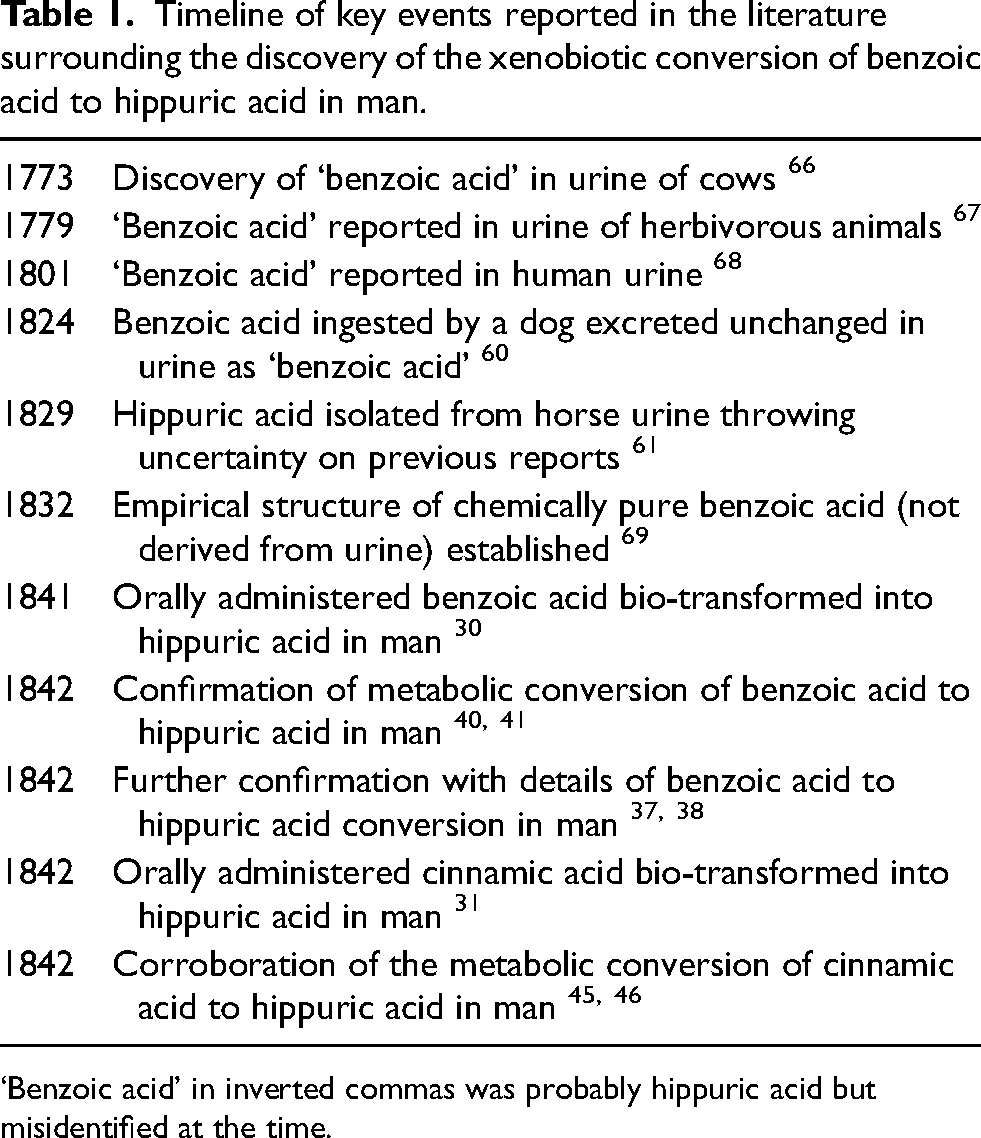
‘Benzoic acid’ in inverted commas was probably hippuric acid but misidentified at the time.
A name that many associate with glycine conjugation is that of Wilhelm Keller (1818-?; a pupil of Liebig at Giesen, matriculated 1840, emigrated to Philadelphia, US, c. 1848). 36 He published a paper a year later in 1842 on the conversion of benzoic acid to hippuric acid describing experiments undertaken in the laboratory of Friedrich Wöhler (1800–1882) in Göttingen. After ingesting several separate doses of benzoic acid (31 grains; 2 g), hippuric acid was unequivocally identified in the subsequently voided urine.37,38 Keller acknowledged Ure's prior discovery at the beginning of his second paragraph, ‘Die neuerlich publicirte Angabe von Ure; dass er in dem Harn eines Patienten, der Benzoësäure eingenommen halte, wirklich Hippursäure gefunden habe…’ (The newly published statement of Ure that he had found hippuric acid in the urine of a patient who had taken benzoic acid…) but takes task with Ure's supposition that uric acid was involved in the formation of the hippuric acid, ‘er scheint sich vorzustellen, dass die Harnsäure zur Umwandlung der Benzoësäure in Hippursäure verwendet werde’ (he appears to imagine that the uric acid is used to convert the benzoic acid into hippuric acid). 37
A note at the beginning of Liebig's book on ‘Animal Chemistry’, added by William Gregory (1803–1858) who had translated the author's manuscript from German, states, ‘…there has been added, at the end of the Appendix, an interesting paper by Keller, confirming the very important observation of A. Ure, junior, as to the conversion of benzoic acid into hippuric acid in the human body; a fact which I perceive, by the Philosophical Magazine for June, has also been confirmed by Mr Garrod, probably at an earlier period than by M. Keller.’. 39 The individual to whom Gregory was referring was Alfred Baring Garrod (1818–1907), an English physician who at this time was working at University College Hospital (North London Hospital) and was to become a distinguished rheumatologist and lauded expert in gout. Garrod's paper, read at a meeting of the Chemical Society of London on January 18th 1842, states that he had repeated Ure's reported experiments, swallowing between one scruple to just over half a drachm (1.3–2.0 g) of benzoic acid and isolating hippuric acid (c. 60% yield) from the subsequent 0–3 or 0–4 h urine.40,41 He also explained Ure's finding of the apparent lack of uric acid in the urine which led to Ure's assumption that it was involved in this metabolic transformation. He found minute crystals of uric acid at the bottom of reaction vessels and, by the use of a microscope, uric acid adhering to the crystals of hippuric acid. This, he states, gave rise to the observation that under Ure's conditions hippuric acid on chemical treatment (akin to the murexide test) gave a rose-pink/purple colouration; a characteristic of uric acid but not of hippuric acid.40–42 Interestingly, three-quarters of a century later it was reported that the ingestion of benzoic acid, but not hippuric acid, decreased subsequent urinary excretion of uric acid. 43 In this respect, the essence of Ure's hypothesis was correct, but not by the direct chemical combination that he envisaged.
Apparently this conjugation reaction was not restricted to benzoic acid. Ure's paper citing cinnamic acid appeared in the June 1st 1842 edition of the ‘Pharmaceutical Journal and Transactions’ periodical in which he described an experiment that was undertaken on Wednesday April 20th 1842. Cinnamic acid that had been obtained via the processing of cinnamon water was acquired from a Mr John Bell (1774–1849), a well-known chemist and druggist, at 338 Oxford Street London. One hour after breakfast, one scruple (1.3 g) of cinnamic acid was ingested and hippuric acid was identified subsequently in the following 0–3 h urine (c. 4.5 ounces; 125 ml). 44 The transformation of cinnamic acid to hippuric acid was also announced by other workers later in 1842.45,46 It was not appreciated at the time that cinnamic acid initially underwent β-oxidation to yield benzoic acid and it was this that was subsequently conjugated with glycine.47,48 It was shown later that other compounds such as chlorobenzoic acid and the methoxybenzoic acids (anisic acids) could be recovered from the urine as their appropriately substituted hippuric acid derivatives. 49
However, these initial reported observations of Ure appeared to be not without controversy, something that Ure was used to. Several years earlier a dispute had been played out within the pages of the London Medical and Surgical Journal regarding the use of zinc chloride as an escharotic in the treatment of skin cancer and claims as to who had been the first to introduce it into British medical practice.15,16,50–55 Perhaps to offset a repeat performance, Ure posted a somewhat grandiose letter; ‘Gentlemen – In the present agitated state of the scientific world as to the conversion of benzoic acid into hippuric acid, I take leave to refer your readers to a recent paper of mine upon the subject, in the twelfth number of the “Pharmaceutical Transactions”.’ The editors attached a footnote explaining that, ‘we regret that we cannot calm the agitation of the scientific world until next week, when we shall publish the substance of Mr Ure's paper’. 56 Actually, little seemed to follow, although there were a few dissenters who could not find hippuric acid in the urine. 57 Maybe as a reflection of the earlier zinc chloride debacle and perhaps being ‘out-of-favour’, the London Medical Directories of 1845 and 1846 included alongside Ure's academic and professional data a tart sentence stating that he ‘claims to have discovered the conversion of benzoic acid into hippuric acid in the human body’.58,59
Epilogue
Alexander Ure was the first person to demonstrate and record in the literature that a foreign compound administered to a human was subsequently excreted in a chemically altered form. That a bio-transformation had taken place as it journeyed through the body. Even Wöhler, a prolific and influential German chemist of the time and working in a similar field, acknowledged Ure's seminal and prior discovery.60–65 Ure himself did not seem to appreciate the fundamental importance of his findings or perhaps he was in the wrong medical environment for its significance to be recognised. His later papers dealt with his more pressing medical issues and his interests appeared to diversify.
Extensive investigation by others followed and by the end of the 19th century most of the pathways of foreign compound metabolism had been uncovered. Upon this broad foundation, influenced by Ure's work, has grown the discipline of xenobiochemistry, essential within the drug development field and, indeed, in any circumstance where chemicals and humans come into contact. The debt owed to Ure is immense. It should not be forgotten that the first human xenobiotic bio-transformation experiment to be reported in the literature took place in London, England, and was undertaken by an inspired and inquisitive medically qualified man pursuing a cure for his patients.
Footnotes
Acknowledgments
The authors are indebted to the following Institutions for access to previously unpublished data: Camden Local Studies and Archive Centre; City of Westminster Archive Centre; Imperial College Healthcare NHS Trust Archive (St Mary's Archives); Kings College London, Library Services and Archives; London Metropolitan Archives; Queen Square Archives; Royal College of Physicians London, Library, Archive and Museum; Royal College of Physicians and Surgeons of Glasgow, Archive and Library; Royal College of Surgeons of Edinburgh, Library and Archive; Royal Society of Medicine London; Sage Publications, London; University College London Library Services, Archives and Bloomsbury Project; Wellcome Library, Wellcome Trust Collection.
Declaration of conflicting interests
The author(s) declared no potential conflicts of interest with respect to the research, authorship, and/or publication of this article.
Funding
The author(s) received no financial support for the research, authorship, and/or publication of this article.
