




Abstract
During the late 19th and the early 20th century there was an unprecedented development in medical research. Tissue and cell culture rapidly developed into areas with many contributing scientists. The same is true for tissue transplantation. When these achievements are described afterwards in a historical context and a mainline development is constructed, there are researchers whose pioneering work is forgotten. The present paper attempts to correct this and to present a correct description of the start of tissue preservation and transplantation. We have traced relevant original publications in international journals between 1870 and 1920. The traditional view is that Alexis Carrel was the first He received a Nobel Prize 1912 for his work on vascular suture and the transplantation of blood vessels and organs. The same year he published an article on human skin storage and transplantation. This was more than a decade later than Carl August Ljunggren (1860–1934) who 1898 published his pioneering but long forgotten work on human skin preservation and transplantation, and with a vision of tissue banks. Our article contains a brief biography of Ljunggren, and further reconstructs the processes that resulted in the lack of awareness today of his achievements.
Introduction
Today cell and tissue culture has many applications in human biology and has greatly facilitated progress in e.g., regenerative medicine, where it is the basis for cell therapy, tissue engineering and tissue transplantation, processes making it possible to replace or regenerate human tissues and organs and restore their functions.1–3 Cell culture in a broad sense, growing of cells, generally outside their natural environment, includes the cells of interest being isolated from living tissue, and subsequently maintained under carefully controlled conditions where they are grown in media specifically selected for the chosen cell type. In tissue culture, pieces of tissue are transferred to an artificial environment where they survive and function. The concept of using tissue culture for subsequent human transplantation is not new, it started already at the end of the 19th century. The development of current diversified and sophisticated methodologies has from its onset required contributions of researchers from many different fields3–7 but who took the first steps?
The attention rightly goes to those that made the breakthrough, not to those that were close. But history of medicine is not an exact science, and it is possible that researchers have published the breakthrough before those that today are considered to be the first How does this happen? One possibility is that the researcher might have been unaware of the breakthrough paper. This could e.g. happen when the original publication was in a language that he could not master. A more sinister possibility is that he knew of the publication but chose not to refer to it and the true pioneer is forgotten by the scientific community. Does this happen in real life? We think that we can present a case where this actually happened.
The Nobel laureate Alexis Carrel is often considered to be the first modern transplantation surgeon. 8 His preservation and transplantation of skin around 1910 is today considered as the pioneering work that paved the way for future development in the field.5,6 There were however other, today forgotten pioneers who had taken the initial steps. Recently Kohlhauser et al. 3 presented an extensive review of skin grafting from the time of the Egyptian Empire (1500 BC) to today, and Ambrose 6 revisited the often complicated early history of tissue culture. In the present article, we have focused on a pioneer not mentioned by them, Carl August Ljunggren, whose 1898 publication on human skin culture and transplantation was a major step forward. His results were not referred to in Carreĺs corresponding publications a decade later. Our study will address the following questions: Was Carrel unaware of Ljunggreńs study? Who was Ljunggren? The 1898 paper was Ljunggreńs only publication in the area. Why did he not continue his research?
Material and methods
We have collected publications from 1870 and onwards that we considered relevant for the topic of our publication, starting with publications referred to in current historical reviews. The reference lists of these publications led us to new publications with their reference lists. This was continued until we felt that we could not find any further relevant publications. The selected original publications spanning the time 1870–1920 are those considered key references for our topic. All publications were read in their original languages (English, German, French, and Swedish). The translation to English in the present paper has been made by the authors.
Results
Keeping cells and tissues alive outside the body
The German cell physiologist Wilhelm Roux is usually given the credit of being the first to succeed in keeping tissues alive outside the body for longer periods. In 1885 he transferred pieces of chicken embryos to “physiologic salt solution” (he did not give the composition) and could keep the specimens alive for some time (exact times are not given). In his 112 page article he spent four lines on the subject. 9 In 1887 Julius Arnold published an article 10 on mitosis of leucocytes in salamanders. He put small pieces of elder pith in lymph sacks or abdomens of frogs. The porous pith was rapidly invaded by leucocytes. The elder pieces were then taken out and transferred to water where living and dividing leucocytes could be observed by vital microscopy for up to five days. Carl August Ljunggren, a Swedish surgeon, cultured human skin specimens in vitro and then used them for transplantation in patients. By performing transplantation experiments he showed that skin specimens kept in sterile ascites fluid were alive even after 3 months. Biopsies from the cultured and then transplanted skin showed mitotic activity. The results were published in Deutsche Zeitschrift für Chirurgie 1898. 11 Unfortunately, his technique and visions for its future use seem to have had only minor impact at the time of publication.
A major breakthrough in cell culturing occurred in 1907 when Ross Granville Harrison described the hanging drop technique to mount frog embryonic tissues. 12 The aim of his research was to investigate the embryonic development of nerves. This technique made it possible to follow the development of living tissue in the microscope. Harrison's specimens usually survived for one to four weeks. A comprehensive article in the field was published in 1910. 13 Harrison has been called “the Father of cell culture” and his achievements made him nominated for the Nobel prize in medicine fifteen times between 1913 and 1941 (https://www.nobelprize.org). Had it not been for World War I, he would have been awarded14,15 the prize in 1917. A recent study 7 has underlined that Harrison had contemporaries who also contributed to the development of cell culture, and even suggested that Montrose T. Burrows should receive the credit for being the first to establish and maintain true tissue cultures. Another contemporary was Leo Loeb 16 who from 1897 to 1903 had worked on a project where he embedded epithelial tissue from guinea pigs in agar and then implanted the agar pellets back into the host He later stated 16 that he had also attempted to culture tissue in vitro, but lack of necessary facilities had stopped him from pursuing this further.
The world-famous and scientifically proliferative French-American, Alexis Carrel, and Montrose T. Burrows published an article 17 in 1911 where they used Harrison's hanging drop method, or a modification that permitted larger specimens, to culture various tissue specimens from chicken rat, and dog. The specimens survived in a plasma medium for 5–20 days without any evidence of cell death. They referred to Ljunggren's article but since they made no attempts to retransplant tissues, they did not discuss the results of his transplantation experiments.
Transplantation of cultured skin and blood vessels
All studies mentioned above, except Ljunggren's, were performed in order to study basic cellular mechanisms and no attempt was made to use the cells or tissues for transplantation. Acute transplantation of autologous and even homologous skin shavings for treatment of e.g., burns had been described previously18–21 but, to the best of our knowledge, nobody had tried to culture or store tissues for longer periods of time for future transplantation before Ljunggren. Thus, Ljunggren's 1898 publication was a milestone, paving the way for using cultured skin for human transplantation. Half of the specimens were transplanted to skin free wounds in patients. Most of the specimens were rejected, but a limited number of the transplants (see Figure 1) seemed to be viable for longer periods; in one case even after two and a half years. Ljunggren used sterile ascites as culture medium but suggested that other substrate media should be tested. His tissue cultures were kept at room temperature, but he pointed out that lower temperatures might decrease cell metabolism, and thereby prolong the viability in vitro of the transplants. He also suggested that the substrate medium should be changed at regular intervals to prevent the accumulation of harmful metabolic products. To the best of our knowledge, this article was the first to describe that tissue from humans could be kept for long periods in vitro, creating, as Ljunggren suggested, a kind of tissue bank with samples available for use when needed.
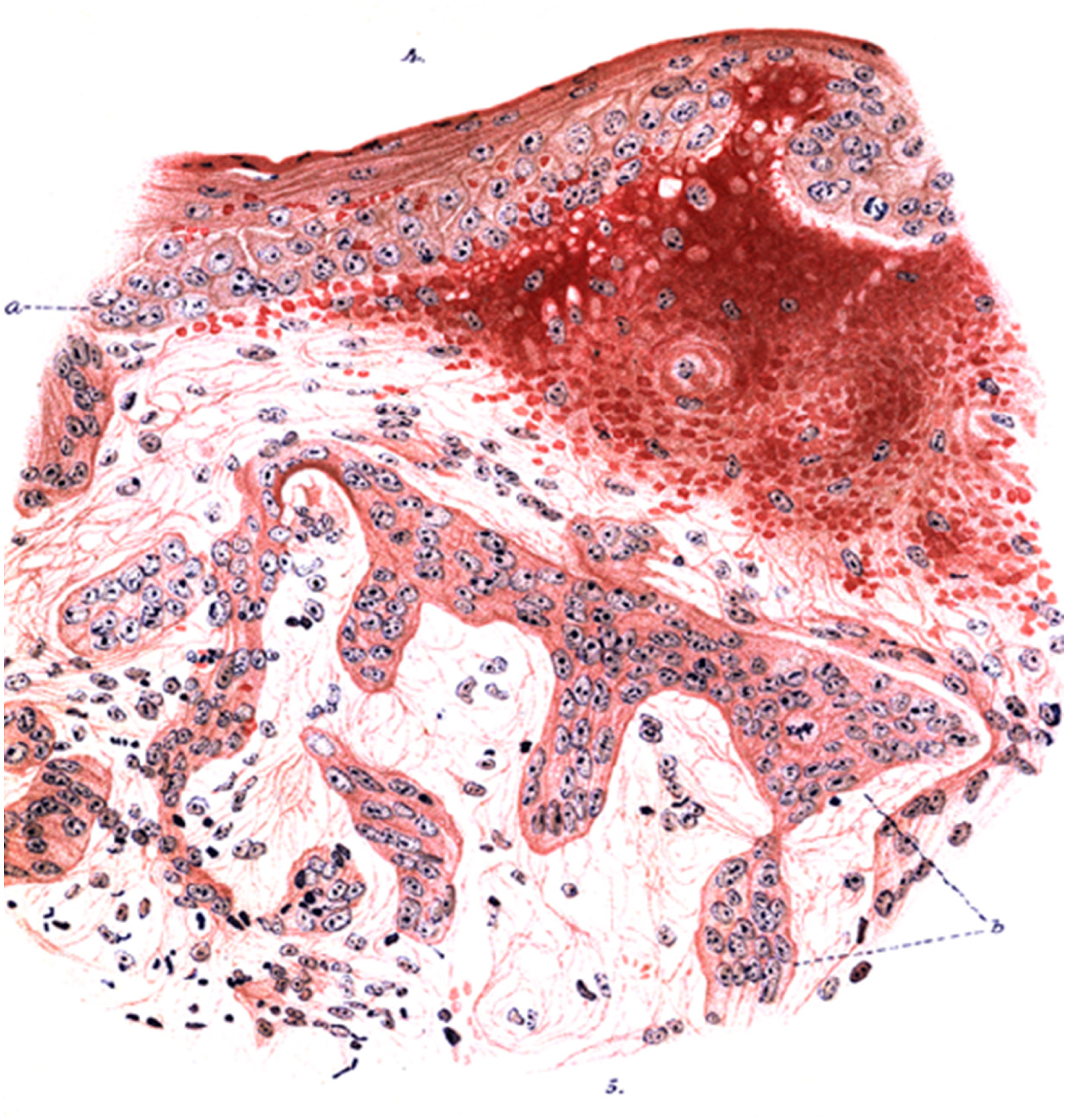
An illustration from Ljunggren's 1898 paper, showing the microscopical appearance of a biopsy from a skin specimen that had first been kept in ascites fluid for a week, and then transplanted for nine days to a patient in the midst of an amputation wound. Note the well preserved nuclei. According to Ljunggren mitotic activity could be seen at higher magnification. This is probably the first drawing in the history of medicine of a cultured and transplanted human allograft. It was first published in Nordiskt Medicinskt Arkiv, and then in the Deutsche Zeitschrift für Chirurgie. Permission to publish is granted by Wiley Co.
In 1910 Alexis Carrel performed a related series of experiments 22 in animals. He extirpated segments of carotid artery from dogs and stored them at 0°C in Locke's solution or in a confined humid environment for periods up to six months. He aimed at keeping the specimens alive in a state of minimal metabolism, which he called “latent life”. He did not investigate if the specimens could survive at room or body temperature. The segments were then transplanted to the carotid artery in other dogs. The carotid segments developed several degenerative changes, e.g., loss of smooth muscle cells and lymphocyte infiltration. In a follow-up article 23 from 1911, Carrel prolonged the life of cultured tissues by repeated washing and passage into new media, as Ljunggren had suggested, but there was no reference to the paper by Ljunggren. In 1912, Carrel kept the specimens in either Locke's solution or petroleum jelly, and stored skin specimens from a stillborn child for almost six months at 3°C (“latent life”), with preserved histology. 24 Skin grafts were transplantated to two patients with chronic skin ulcers. He states that “most of the grafts took”. No follow up time was given, however. Carrel did not refer to Ljunggren's publication, which may seem remarkable since the article was known by Carrel (see above) and several of Carrels’ technical approaches were already described or suggested by Ljunggren (Figure 2).
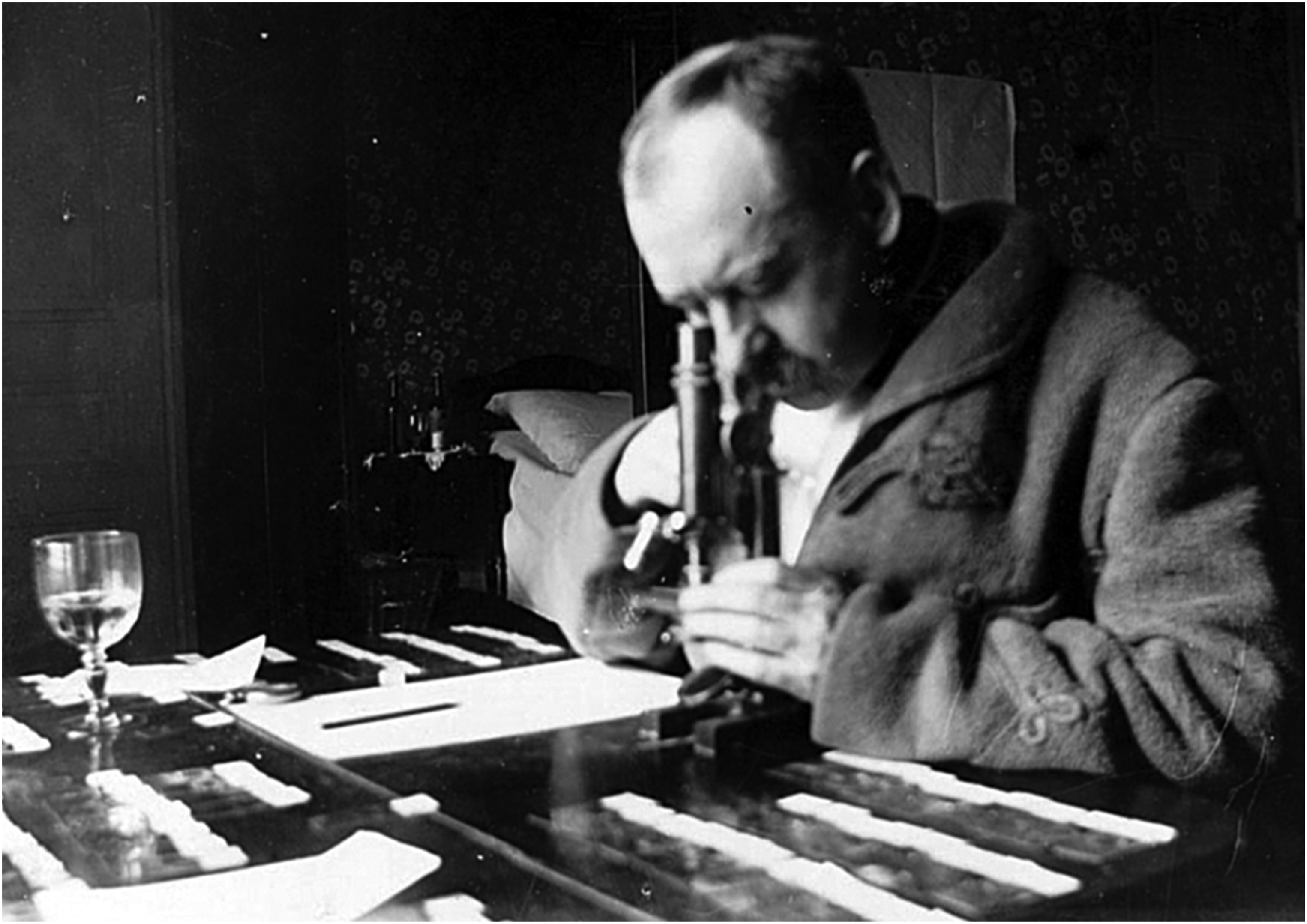
Carl August Ljunggren examining skin specimens around 1900 (permission from the southern Swedish society for the history of medicine).
For a modern reader, it is surprising that not all of the skin transplants in Ljunggreńs and Carrel's studies were rejected with time, as they were allografts. In no case were the donor and the recipient the same. Ljunggren had no idea of the existence of a host versus graft reaction. In his study, the skin transplants that survived for a long period seems to be on the same arm wound but no information is provided that donor and recipient was the same person. Neither Ljunggren, nor Carrel, took host reactions against the graft into account to explain why grafts did not take. Carrel's article 24 was presented in the Section of Surgery at the 63rd Annual Session of the American Medical Association, Atlantic City, June 1912. During the discussion afterwards, 24 John Staige Davis reported that Erich Lexer had stated at the German Surgical Congress 1911 that skin allografts were never successful and that none lasted longer than three weeks. Davis reported, however, that he had seen a number of permanently successful skin allografts. There were thus claims by several authors including Ljunggren and Carrel that allograft skin was accepted by the recipient and survived, that are difficult to reconcile with todaýs knowledge of host versus graft reaction.
The first who suggested host versus graft reaction was probably Georg Schöne5,6,25 who worked in Paul Ehrlich's lab in Germany. He found that skin allografts were rejected, and a second skin graft was rejected even faster. In 1912, the same year as Carrel's publication, Schöne published a monograph where he described that the body's immune system was responsible for transplant rejection, a phenomenon he called “Transplantationsimmunität” (transplantation immunity). Carrel was not far behind. In 1912, Ragnvald Ingebrigtsen a Norwegian guest researcher in Carrel's laboratory, tried to investigate in cats whether similar blood group in donors and recipients led to a better survival of the grafts, but his results were inconclusive. 26
Ljunggren's 1898 article in some detail
The German title of the article 11 was “Von der Fähigkeit des Hautepithels, ausserhalb des Organismus sein Leben zu behalten, mit Berücksichtigung der Transplantation” which we translate as “On the ability of the dermal epithelium to maintain its viability outside the organism with special reference to transplantation”.
Ljunggren's first aim was to maintain skin specimens viable for prolonged time outside the human organism. From patients undergoing surgery, he took specimens of thoroughly desinfected skin. Every piece had a diameter of about two centimeters and was transferred to tubes containing ascites fluid from one patient who was drained at two-week intervals. The fluid was kept at room temperature. In this manner he kept 40 skin specimens for periods between two days and up to six months. Two thirds of the tubes remained sterile. Sterile specimens that had been stored between two days and three months were evaluated histologically. A weakness in his study was that his specimens were stored at room temperature, and not at 0°C. Even if he lived before the invention of the electrical fridge, he could have stored his tubes on ice. Were the cells viable? He claimed that he could show that pieces stored up to three months had, in their basal layers, well preserved stainable nuclei and cytoplasm structures. He thought that this indicated that the cells were alive. Ljunggren ultimate test to see if the epithelial cells that were stored in this way could still be alive after three months was by transplantating the specimens to patients. He put 22 specimens on either fresh or chronic, granulated wounds, devoid of remnants of epithelium. They were always put in the center of the wound, with a few centimeters distance from the edge of the patient's own epithelium to avoid the risk that the latter would grow under the transplant. Every skin specimen could be studied individually. Of the 22 transplants, six did not take. Of the remaining 16 that attached, three became necrotic with time. Histological examination of these showed that the tissue had been transformed to a cell-free detritus. In two other cases the transplants were absorbed by the wound tissue. The other 11 grafts grew and produced skin. The oldest of these transplants had been stored in ascites for one month. They were transplanted to a big arm wound. Even after 18 months the skin seemed to be viable. To further investigate whether the transplants consisted of living tissue, Ljunggren took biopsies from skin that had been transplanted eight and nine days previously. He could see in his microscope that there was a lively cell proliferation in the transplants, in both their basal layers, and out over the surrounding wound. Ljunggren had thus clearly shown that skin could retain its viability for prolonged periods in vitro when kept in ascites.
Ljunggren and his contemporaries
There is no known correspondence between Ljunggren and his contemporaries working with tissue culture and transplantation. Harrison does not refer to Ljunggren in his 1907 or 1910 articles.12,13 This is not surprising since Harrison's approach to the field was from a basic scientist's view. It is, however, evident that Carrel (and Burrows) were well aware of Ljunggren and his research. A reference to Ljunggren is found in only one of the articles by Carrel on tissue transplantation referred to in the present article (Carrel and Burrows 1911 17 ) but this reference shows conclusively that Ljunggren's study was known to him. Also, 27 when Carrel visited Stockholm 1912 to collect his Nobel prize, he asked Einar Key, later professor of surgery at the Karolinska hospital, if he knew anything about a dr Ljunggren whose results had had some impact on his own research. Key answered: “Yes I know him very well, he is married to my sister Elise”.
A short biography of Carl August Ljunggren
We have not found a biography of Carl August Ljunggren in English. The following is based on the biographical notes in Swedish by Alfred Flaum 27 and the autobiography 28 by the son Einar Ljunggren (1968) who became Professor in Surgery at the Sahlgrenska University Hospital in Gothenburg. Carl August Ljunggren was born 1860 in Lund, south Sweden. He studied medicine at the university in his hometown. In 1893 Ljunggren applied for and was given the position as hospital doctor (most hospital had only one doctor) at Trelleborg, a small town south of Lund, with 3000 inhabitants and a huge rural hinterland with a population of about 40,000. Despite the heavy work load (he was for many years the only doctor at the hospital) he performed research. In 1894 he defended his thesis about jaw tumors. He then began the project presented in his paper, namely to see if it was possible to keep human skin specimens viable outside the body, and if it was possible to transplant the dermal grafts to patients. He presented his results in 1897 at the 12th international medicine congress in Moscow, Russia, and he had a full paper published in 1898. The choice of German as publication language was natural. It was not until about 1940 that English took over as the leading publication language among Swedish surgeons. 29 The Deutsche Zeitschrift für Chirurgie (German Journal of Surgery), where he published his article, was one of the leading German surgical journals at that time. However, the article did not seem to have been much noticed, and its clinical potential was not understood. In 1897 Ljunggren applied for the vacant position as Professor of surgery at the Lund University Hospital, a position that would have given him opportunities to expand his research. His results on skin transplantation was used as a merit, but the evaluation board was not impressed. Ljunggren did not get the position, which in 1899 was given to a competitor. Ljunggren, dispirited, continued to work at the hospital in Trelleborg, but due to an increasing workload he had to abandon research. Ljunggren retired 1926 and died 1934.
Discussion
Ljunggren's scientific contributions
Ljunggren provided conditions for survival of his skin grafts in vitro, and he tested if prolonged survival was possible in his culture medium. He found that the skin specimens were viable up to six months. He had thus developed a method for prolonged survival of human specimens outside the body. Ljunggren's specimens were kept at room temperature, but he discussed if a lower temperature might improve their survival. He also envisioned that a more suitable medium for tissue survival than ascites fluid could be developed. He further suggested that regular changes of the medium might prevent accumulation of metabolites harmful to the specimens. He understood the necessity of sterility and succeeded by meticulous sterile conditions to avoid bacterial growth in the majority of his cultures in a pre-antibiotic era. The viability of his specimens was checked histologically.
Acute transplantation of skin was not new. 3 Reverdin, 18 Pollock, 21 Thiersch, 19 and Loeb 20 had accomplished that during the previous decades. The novelty in Ljunggren's experiments was that he transplanted cultured skin grafts, the first example on how to create a tissue bank. Both Ljunggren and Carrel had visions of future tissue banks. Ljunggren suggested 1898 that it would be advantageous for the surgeon to have a store (German:Vorrat) of skin at hand for transplantation while Carrel 1912 wrote 24 : “A supply of tissue in latent life would be constantly ready for use”.
Why were Ljunggren's results overlooked
Around 1900 there were three major scientific languages, English, French and German, available for most researchers. A language issue therefore does not seem probable as a reason for the limited impact of Ljunggren's study. In fact, the American pioneers in cell culture were influenced by German science 7 Both Harrison and Burrows had been guest scientists in Germany, and Loeb was born in Germany.
One possible explanation is that Ljunggren's article was too clinical and that the interest of contemporaries working in the field of tissue culture was mainly focused on basic physiological mechanisms. Results published in a journal of surgery, even if it was one of the major, could therefore easily have been overlooked. The only way to find relevant articles was to scroll through a number of journals, or to get a hint from someone who knew of your interests.
The leading character in tissue culture and transplantation in the decades to come was Alexis Carrel who received the Nobel prize in 1912 “in recognition of his work on vascular suture and the transplantation of blood vessels and organs”. Carrel and Burrows knew about Ljunggreńs publication (see Carrel and Burrows 1911 17 ) but referred to it only in their Introduction as one out of several examples of previous publications. They did not refer to Ljunggren's results or visions. In Carrel's other publications from 1910, 1911 and 1912, given in our reference list, and where he was the sole author, it is difficult to understand that he did not refer to Ljunggreńs work. These articles by Carrel are by their content linked to Ljunggreńs results and suggestions. In one article from 1912 24 Carrel even used human skin grafts in the same manner as Ljunggren, and with similar results. It is documented in the literature5,8 that Carrel was accused by contemporaries for not giving appropriate priority to the work of others. Has the omission of Ljunggren's 1898 paper a similar explanation?
Today Ljunggren is almost forgotten. He is e.g. not mentioned in two major books5,6 on the history of transplantation or in the extensive overview by Barker and Markmann. 25 Carrel's impact among researchers and laymen at the time was tremendous 8 and it may be fair to assume that if Ljunggren had been referred to by Carrel in a proper way, he would have had a different position today in the history of medicine. Unfortunately, Ljunggren did not get an opportunity to continue his research. He did not get the Chair of Surgery in Lund in 1899 that he applied for, and eventually it was not possible to combine his position at a small rural hospital with research. Of course, we only speculate when we think that more time for research would have resulted in important studies. Perhaps nothing would have come out. It is certain, however, that with his load of routine work, he did not have a chance.
What is there to learn from Ljunggren's case today?
Why is it important to acknowledge Ljunggren's leading role in the early development of tissue culture, transplantation and tissue banking? Does it matter today that he did not get the attention by his contemporaries that he was entitled to? One answer to these questions is given in the following quotation from Journal of Cell Biology (permission to quote granted by the Journal), written by the British pathologist Henry Harris in his 2008 editorial
30
“Standing on Boveri's shoulders” about the German cell biologist Theodor Boveri: “Regrettably, it can hardly be denied that you can become a competent scientist without giving a thought to the history of your chosen subject. But the history is there all the same, and if you have only the foggiest idea about what was done before you entered the field, you will have no way of assessing the significance of your own work, and you will certainly overestimate its originality and its importance. Worse still, you may occasionally find that your bright idea was someone else's half a century ago, and that arguments in which you are currently engaged were raging long before you were born, and sometimes with greater acuity. That can be an embarrassment when someone else draws the fact to your attention”.
Those who work with skin culture and transplantation and skin banking stand on Ljunggren's shoulders, but few are aware of it.
Summary
The present review shows that the history of transplantation of viable human tissue after storage for prolonged time in vitro did not start with Alexis Carrel's famous experiments around 1912 but more than ten years earlier with the studies of Carl August Ljunggren, a surgeon at a small rural hospital in southern Sweden. Furthermore, Ljunggren was the first to suggest the start of tissue banks.
Footnotes
Authors contributions
The authors have contributed equally in all sections of the publication.
Declaration of conflicting interests
The author(s) declared no potential conflicts of interest with respect to the research, authorship, and/or publication of this article.
Funding
The author(s) received no financial support for the research, authorship, and/or publication of this article.
Institutional review board statement
Ethical review and approval were waived caused by exclusive use of data from the literature.
