




Abstract
Franz Tappeiner (1816, Laas – 1902, Merano) was an Austrian physician and anthropologist. He studied at the universities of Prague, Padua and Vienna and in 1846 he moved to Merano. Tappeiner investigated the transmission of pulmonary tuberculosis in animal models and he dealt with public health. As an anatomist, he performed thousands of craniometrics measurements, creating a huge skull collection later donated to the Natural History Museum in Vienna. In 1878, Tappeiner turned to archeology and palaeoanthropology, with the aim of clarifying the origins of the Alpine population of Tyroleans. He was also active as a botanist.
Franz Tappeiner (7 January 1816, Laas – 20 August 1902, Merano) was an Austrian physician and anthropologist (Figure 1 and Figure 2), born in the rural area of Vinschgau Valley as the son of a local farmer. He studied at the universities of Prague and Padua, completing his medical education and receiving his doctorate in 1843 in Vienna. 1
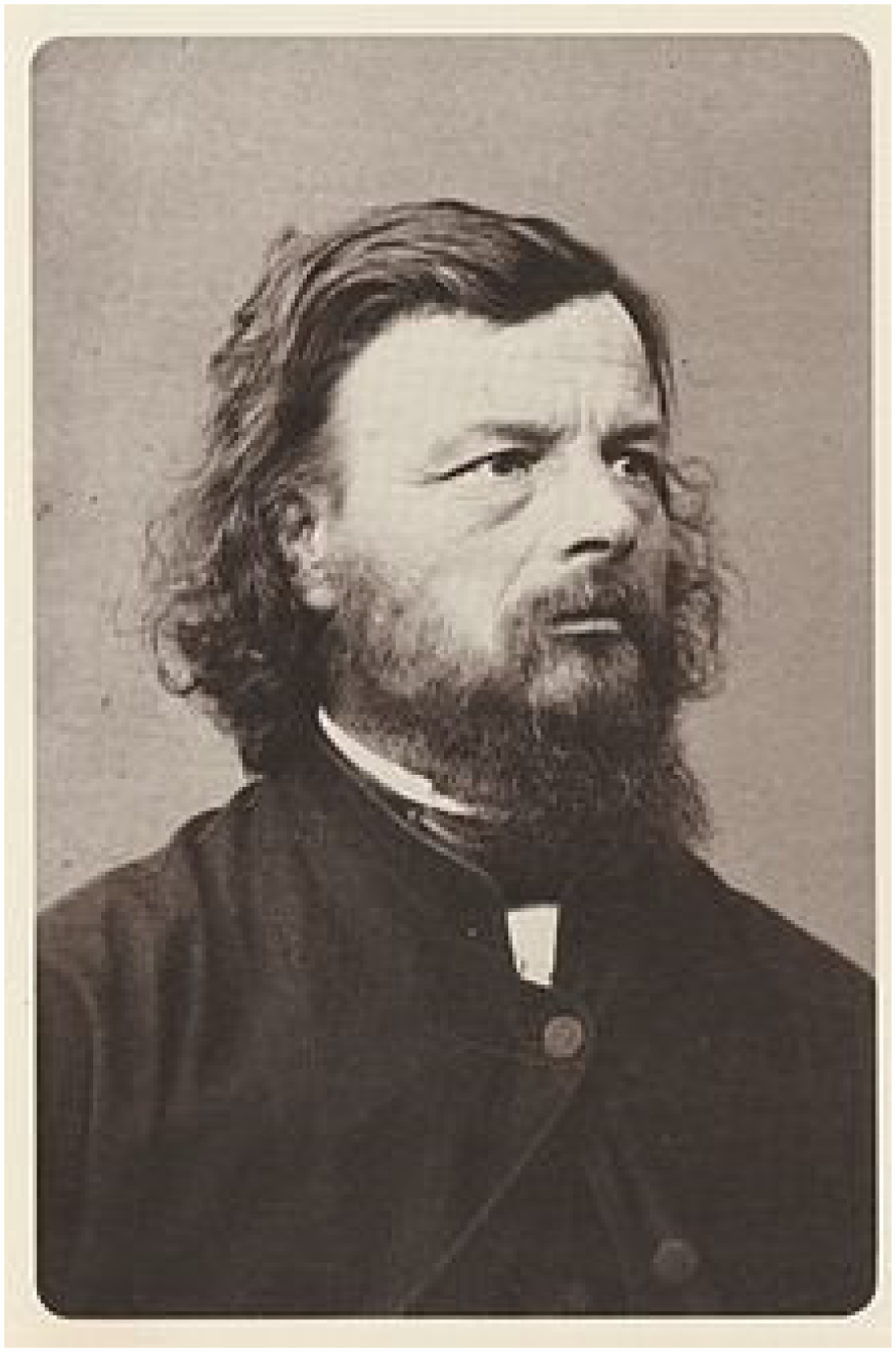
Portrait photography of Franz Tappeiner (1816–1902) by Lorenz Bresslmair (1834–1882).
In 1846 he moved to Merano, South Tyrol, where he stayed for the rest of his life, devoting himself to his medical practice and activities to promote public health through sanitary regulations, increased awareness towards personal hygiene, fresh-air and water treatments, and the development of adequate healthcare infrastructures. 1 Thus, Tappeiner contributed to turn Merano into one of the most renowned destinations for holidays and cure among the rich Austrian bourgeoisie and aristocratic families. 1 In 1848, he run for the Frankfurt National Assembly supporting liberal ideas, but was not elected. In 1850 he was involved in the activities of the “Kurkomittee” (health committee), an association of physicians and politics aimed at improving the welfare and health conditions of Merano. 1 As an example of his involvement in public health policy, Tappeiner was deeply enganged in the cholera epidemic of 1850, by making the citizens aware of the precautions that needed to be taken to reduce the risk of contagion. 1 Among his last contributions to the improvement of welfare of Merano, in 1891 he proposed the creation of a promenade located halfway up the mountain above Merano, financing its realisation. The promenade, named after its founder by the city council, was initially intended as a quiet and place of refreshment and relaxation for patients and citizens alike, and is still in use and very popular. 1 In 1898, as an acknowledgement for his achievement in research and public health activities, he was bestowed with the title of noble “von Tappeiner” by the Emperor Franz Joseph (1830–1916). 1
Besides his main activity as a physician, Franz Tappeiner was active in research until the final days of his life. His last article was published in 1901, and Tappeiner passed away one year later at his residence, the castle Reichenbach residence, in Obermais (Merano). 1
While still a student in Prague, he was deeply interested in botany, collecting botanical specimens from all over Tyrol. After his attempts to pursue a scientific career in the botanical field failed, he donated his herbarium (including 3624 plant species) to the Tiroler Landesmuseum Ferdinandeum in Innsbruck. 1
In 1877, in the Anatomical and Pathological Institute of Munich led by the German pathologist Ludwig von Buhl (1816–1880), Tappeiner investigated the transmission of pulmonary tuberculosis in animal models, by exposing dogs to sputum of phthisic patients affected by this disease.2,3 He was therefore able to demonstrate that phthisis and tuberculosis were the same disease, which could be spread through inhalation.
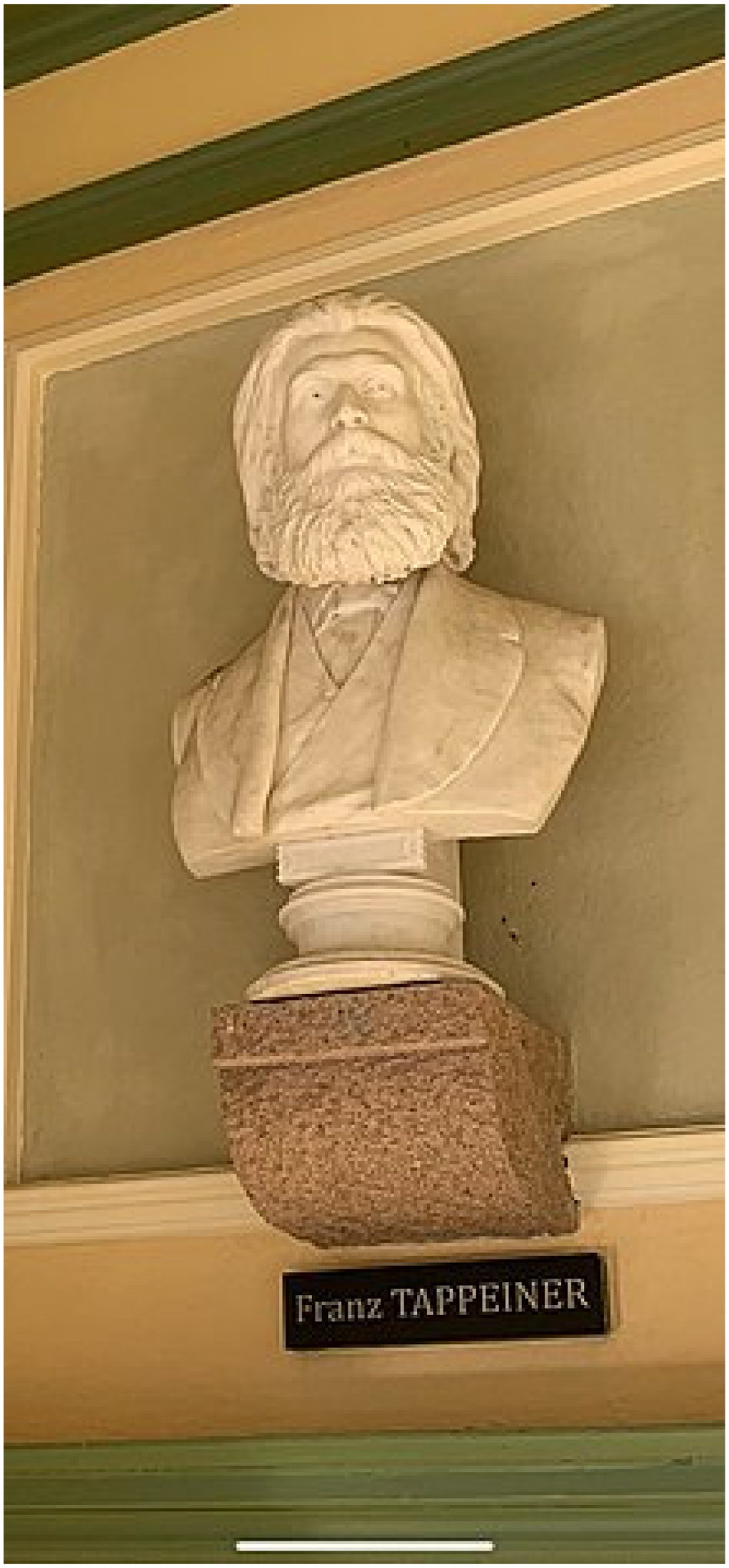
Bust of Franz Tappeiner along the winter promenade of Merano.
One year later the same experiments were independently carried out by Rudolf Virchow (1821–1902) in Berlin, yielding the same results.4,5
These studies were groundbreaking and preceded by 10 years the discovery of the tuberculosis bacillus by Robert Koch (1843–1910) in 1882.
In 1878, after the death of his wife the noblewoman Mathilde von Tschiderer (married in 1847), Tappeiner turned to archeology and paleoanthropology, with the aim of clarifying the origins of the Alpine population of Tyroleans. His research activities were supported by Rudolf Virchow and by the Viennese Anthropological Society, which was founded in 1870 with the pathologist Carl von Rokitansky (1804–1878), a former professor of Tappeiner, as its first president. 6
Tappeiner carried his field research in Tyrol (Ötztal and Schnalstal) and in the Seven Municipalities (Sette Comuni) through extensive skull measurements in ossuaries (data were collected on 4935 skulls) and in vivo (craniometrics assessments of 3185 heads). 7
Tappeiner performed the craniometrics measurements according to the classification system proposed by the Swedish anatomist Anders Adolph Retzius (1796–1860), the founder of craniometry and one of the fathers of physical anthropology. With Retzius, a pioneer in morphology and histology, craniology became a distinct branch of anatomical science. 8
Tappeiner adopted the cephalic index (the ratio of maximum width measured as biparietal diameter multiplied by 100 and divided by the maximum length of the skull measured as occipitofrontal diameter), which was also described and popularised by Retzius.
Accordingly, he classified classifying skulls into:
- dolichocephalic (i.e. skulls longer than expected, relatively to its width) - brachycephalic (i.e. skulls shorter than typical for its species) - mesocephalic (mixed type).
His huge collection of skulls is now held in the Anthropological Department of the Natural History Museum in Vienna.
Tappeiner had observed that, despite having blond hair and blue eyes, Tyroleans frequently had skulls wider than Germans (brachycephaly). 7
In his view, they therefore constituted a distinct population, dating back to the ancient Rhaetian people (Raeti), mixed with the Romans; as a consequence of this lineage, Tyroleans had to be legitimately considered as truly indigenous people of the area they populated. 9
These anthropological observations supported the special political status of Tyrol, emphasising its connection between the ancient Roman Empire and the Habsburgs, and consequently the racial and cultural independence from, and the superiority over, the barbarian Germans.10,11
Tappeiner argued that since it was not possible to infer the intelligence from the size of the skull alone, the only practicable criterion was the comparison between the craniometrics measurements and the tangible expressions of human intellect as manifested in cultural artifacts.12,13
However, he also recognised that the cranial capacity was particularly important to indirectly estimate the size of the brain; in the lack of cultural artifacts, it was the only way to evaluate the degree of cultural development of humans. 13 As he explained: « I consider the measurement of the capacitance to be particularly important to judge the value of the skull, because from this we can rightly infer the size of the brain. The human brain is the best the best yardstick to measure its spiritual activity. [Das Hirn des Menschen ist der beste Gradmesser seiner geistigen Thätigkeit]». 13 It comes as no surprise that as an anthropologist he focused entirely on skull measurements to determine and evaluate racial characteristics. He therefore performed a study to measure the cranial capacity of 918 skulls from Tyrol and found that their strong brachycephalic shape was associated with a noticeably large capacity. 13 Although he did not go as far as to draw any conclusions about the meaning of this finding, it nonetheless bolstered the presumed racial superiority of the Tyrolean population.
In the 1896 essay entitled “The European Man and the Tyroleans” (Der europäische Mensch und die Tiroler), Tappeiner supported the view that the Aryan, “the White Man”, was naturally predestined to prevail in the struggle for survival (Kampf ums Dasein), and to dominate the world: «As a result of the primordial better disposition of the brain, the Aryan, “the white man”, seems to be determined by nature to be victorious in the struggle for existence all over the world». 12 According to his craniometrics analyses, the peculiar brain characteristics of the Aryan had resulted in an advantageous biological position and cultural superiority over other races. As a consequence, the other races would be on the way to extinction, unless they had opted for an advantageous mixture with the Aryan race, which would have regenerated them. 12
According to Tappeiner, the population living in the Trentino region was characterised by a perfect Germanic biological continuity; from a racial point of view, therefore, all Tyroleans, without exception, were to be considered homogeneous.
In his last publication entitled “My anthropological worldview” (Meine Anthropologische Weltanschauung), he opposed Charles Darwin's theory of evolution, claiming that the first human being appeared in Europe as a prehistoric white man. 14
He also claimed that «the mixing of the coloured races with the white Europeans could produce an extraordinary, striking, real achievement of perfection [Vervollkommnung]». 14
In this regard, he clearly differentiated from more extreme racial theories held by other anthropologists who abhorred miscegenation and favoured racial hygiene.
The anthropological research of Tappeiner should be interpreted as a positivistic attempt to legitimate the presumed racial superiority of the Aryans and to preserve the territorial organisation of South Tyrol and Trentino regions.
It hence provided a pseudoscientific basis against the claims of Italian irredentism, which promoted the annexation to Italy of territories inhabited by Italian indigenous population, but retained by the Austrian Empire after Third Italian War of Independence in 1866.
Besides Tappeiner, Carl Toldt (1840–1920), professor of human anatomy in Vienna, 15 and Moritz Holl (1852–1920), professor of surgery at the Innsbruck University, used the results of their craniometrics analyses with the same aims. 16 Although devoid of any scientific validity and imbued with fin-de-siècle racial prejudice and ideologies, Tappeineŕs contributions to morphological anthropology represent fascinating historical documents that accurately reflect the cultural and political background of his time.
In reviewing “The European Man and the Tyroleans”, Rudolf Virchow wrote: “What he offers us is not just the quintessence of his anthropological knowledge: it is also the confession of his anthropological faith”. 17
Although enthusiastic and devoid of extremely racial connotations, the anthropological faith of Tappeiner was cloaked by a fallacious aura of rational objectivity, verifiability and scientificity, 16 and as such did not stood the test of time.
Footnotes
Acknowledgments
Funding sources: this research did not receive any specific grant from funding agencies in the public, commercial, or non-profit sectors.
Declaration of conflicting interests
The author(s) declared no potential conflicts of interest with respect to the research, authorship, and/or publication of this article.
Funding
The author(s) received no financial support for the research, authorship and/or publication of this article.

Supplemental material
Supplemental material for this article is available online.