




Abstract
Role models play an important role in firing the imagination of medical students and residents, and when it comes to attracting and sustaining under-represented minorities in fields such as medicine, the inspiring stories of minority physicians can make an especially important contribution. One such physician was Granville Coggs, an Arkansas native who overcame a stutter, served among the Tuskegee Airmen during World War II, graduated from Harvard Medical School, became the first black physician at Kaiser Hospital, established the San Antonio Breast Evaluation Center, and won gold medals as a senior track star.
Role models play an important role in firing the imagination of medical students and residents, and when it comes to attracting and sustaining under-represented minorities in fields such as medicine, the inspiring stories of minority physicians can make an especially important contribution. One such physician was Granville Coggs (Figure 1), an Arkansas native who overcame a stutter, served among the Tuskegee Airmen during World War II, graduated from Harvard Medical School, became the first black physician at Kaiser Hospital, established the San Antonio Breast Evaluation Center, and won gold medals as a senior track star.1–5
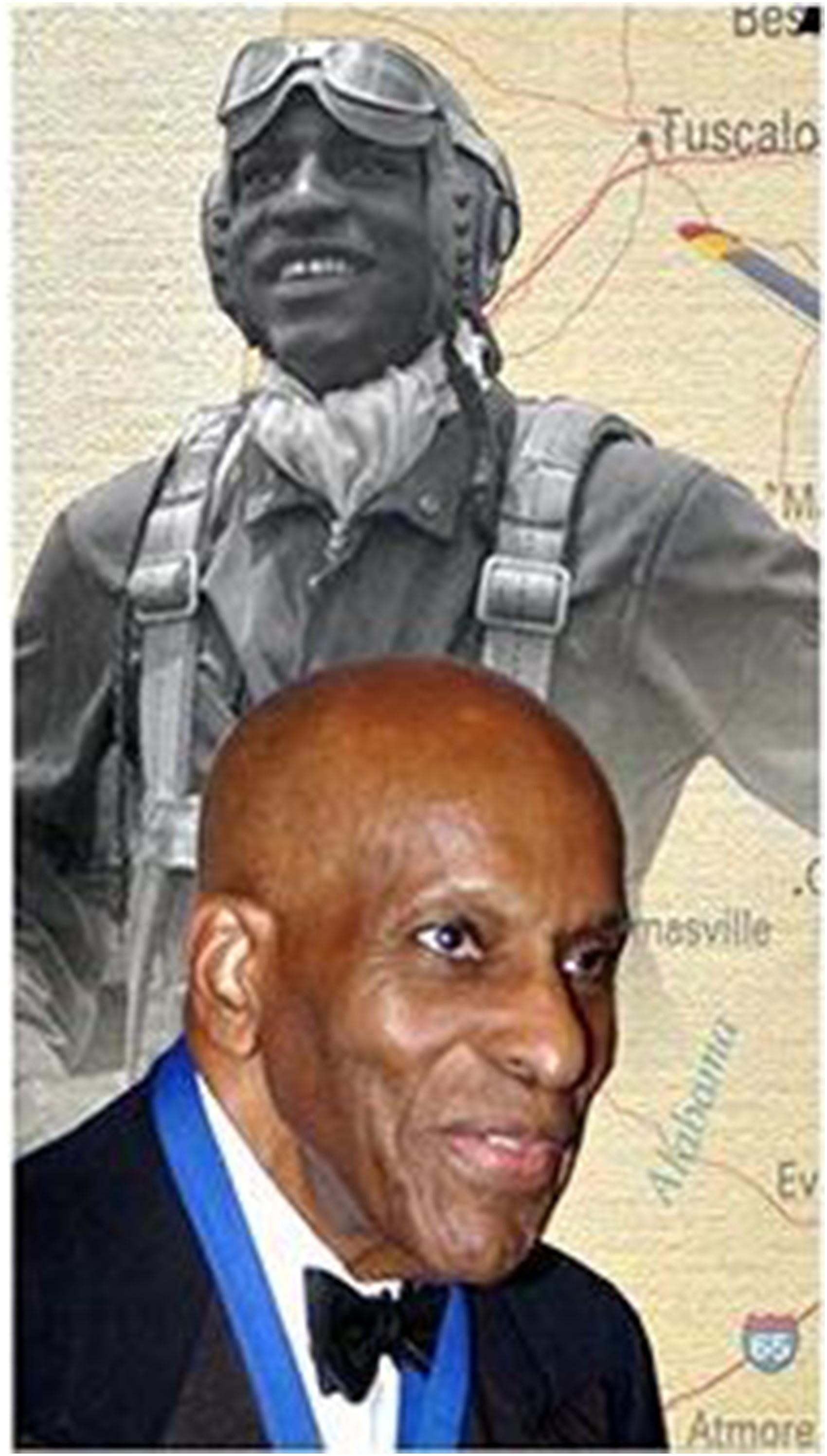
Granville coggs. Seen in uniform in the background, and after retirement in the foreground.13.
More important than any of Coggs’ achievements is a philosophy that he expressed in 2012 when he reflected back on piloting his first solo flight in Tuskegee, Alabama back in the 1940s: I’ll never forget the moment when my wheels lifted off the runway and I realized that I was actually flying an aircraft by myself. For black people all over the South back then, such an accomplishment seemed almost unthinkable. But there I was, headed toward the clouds and feeling very proud of myself because I knew I was proving what so many black people had been saying for so many years in this country: “If you just give us a chance, we can meet every challenge that comes our way – and we will succeed.”
6
Granville Coleridge Coggs was born in 1925 in Pine Bluff, Arkansas, the grandson of slaves and the youngest of his parents’ five children. 1 He was raised in segregated Little Rock, where his father served as president of Arkansas Baptist College, a historically black college, from 1937 to 1955. Growing up in a home without running water, Coggs recalled his delight on receiving a chemistry set for Christmas as a child, despite warnings from his brother that he would blow up the house. As he approached graduation from high school in 1942, he decided to take the SAT. When he arrived for the exam and asked where to sit, the proctor smirked, “Sit anywhere you want. You ain't gonna pass anyway.” Coggs not only passed but also achieved the highest score of any of the test takers in the room.
Recalling the racism of the day, Coggs said: Growing up black in Arkansas in the 1940s, we knew we were going to have to struggle if we wanted to achieve anything. Really, that was all we heard at the family dinner table – the idea that if you were black in America, in those days, par wouldn't be good enough. You had to be better than par. That was my father's message to us, for sure. “For us, par won't get the job done,” he said. “We have to excel. And there's only one way to do that: through hard work. We have to outwork everybody else.”
6
Coggs entered Howard University, but the US entry into World War II after the bombing of Pearl Harbor led him to enlist as a volunteer in the Black Army Air Corps. 7 The Tuskegee Airmen were the first black military aviators in the history of the US armed forces. 8 During the 1940s, many southern states were still in the throe of Jim Crow laws, and the military itself was segregated. When Eleanor Roosevelt visited the Tuskegee Institute's civilian pilot training program, she became convinced that blacks could fly aircraft, and on her return to Washington she told her husband so. 9 The Tuskegee Airmen program was born soon after. After training at Tuskegee, Coggs served from 1943 to 1946 as a pilot, missing out on combat due to the war's end in 1945. 1 It was not until the 1950s that the military was formally racially integrated.
While at Tuskegee, Coggs met his future wife, Maud, who was planning to attend the University of Nebraska. He applied as well, and in August of 1946 they were married, beginning classes the next month. Coggs paid for most of his education through the GI Bill, graduating near the top of his class with a degree in chemistry and gaining election to Phi Beta Kappa and Sigma Xi honor societies. While he was there, he got to know the Chancellor at Nebraska, who took the young man under his wing. When he learned that Coggs planned to attend medical school, encouraged him to “settle for nothing but the best” Said Coggs, He took a liking to me, and he often asked about my studies and my future while I was serving him dinner at the University Club. And when I told him that I wanted to attend medical school, he told me flat out: “I really think you should aim for Harvard, and not take second best”
6
Coggs applied to 12 medical schools, gaining admission to 11. He decided to attend Harvard, relying on $500 from the GI Bill and a $330 scholarship from the school. 10 Accustomed to multiple-choice examinations, Coggs struggled at first with Harvard's essay questions, but soon caught on and graduated in 1953.
Coggs decided to pursue residency training in radiology, completing his training at the University of California Hospital in San Francisco in 1958, where he became the first black physician on staff at Kaiser Hospital. 11 Coggs then joined the faculty at UCSF, taking charge of the mammography program. During this time, both First Lady Betty Ford and Vice President Nelson Rockefeller's wife Happy spoke publicly about their breast cancer diagnoses, increasing the visibility of the disease and its treatment. 12 In 1972, he established the ultrasound division at UCSF. 13 While living in San Francisco, Coggs and his family became the first blacks to move into an all-white community in the Bay Area, which generated considerable resistance. 5 In support, the developer offered to buy back the homes of any families who were opposed to the integration.
After moving to San Antonio, in 1983 Coggs established the San Antonio Breast Evaluation Center, that same year giving a presentation at the annual meeting of the Radiological Society of North America on community-based, multimodality breast diagnosis. 1 In 1985, Coggs retired from the US Air Force Medical Reserve as a Lieutenant Colonel, and in 1989 he retired from the University of Texas Health Science Center San Antonio, where he had served on the faculty. In 1993, he invented and patented a device for x-ray guided breast biopsy.1,14 He continued radiology practice in the community and at Brooke Army Medical Center, where he served as special advisor on diversity to the commander. 5
In 1994, at nearly 70, Coggs found that he was having difficulty staying awake during his long commute to his job in Kennedy, Texas. 1 His wife, a life-long athlete, suggested that he start running, thinking that better physical conditioning might help. Within a few months, Coggs began to enjoy his morning runs, and he eventually earned gold medals in the 400 M, 200 M, and 100 M races at the San Antonio Senior Games. As running became an integral part of his daily routine, he found himself adopting other healthier habits. A long-time ice cream lover, he got rid of the desserts in his house and began consuming a wholesomer diet containing more fruits and vegetables.
Coggs was also an avid musician and speaker. He played the “gut bucket,” a stringed instrument that uses a wash tub as a resonator, since 1956, when a Harvard classmate gave him one. He also played the flute and the electric bass guitar, and he enjoyed vocal performances with the San Antonio Master Singers. Late in life, he memorized Lincoln's Gettysburg address, as well as “Invictus,” a poem favored by Nelson Mandela, both of which he enjoyed reciting at speaking engagements. 15
Coggs received many honors. In 2001, he was inducted into the Arkansas Black Hall of Fame. 16 In 2007 he was among the Tuskegee Airmen who received the Congressional Gold Medal from President George Bush. 17 He also joined the Tuskegee Airmen at the Inauguration of President Barack Obama, where he was among three Airmen interviewed on the Good Morning America television program. 1 In 2010, he was one of the Tuskegee Airmen who participated in the 2010 Rose Bowl Parade. And in 2011, he was invited to Skywalker Ranch to meet with other Tuskegee Airmen prior to the release of George Lucas’s 2012 film “Redtails,” one of the Airmen's nicknames.
When Coggs was 81, he attempted to audition for the television program, “American Idol” but was told that he was 53 years over the age limit. 18 When he died of pneumonia in 2019 at the age of 93, he and his wife had been married for 73 years. 19 He was survived by two daughters. The oldest, Anita, said of her father, “He was an extraordinary man and an exceptional role model. Not just for our family and our community, but for the country and African American history.” 18 Although Coggs was confronted with overcame many obstacles, including racism, he never lost his sense that life is a blessing. “Really, whenever I think about it,” he said, “I realize that I’m the luckiest man I know.” 6
Granville Coggs serves as enduring inspiration to all physicians, regardless of their race. When faced with discrimination, he refused to give up and instead resolved to work harder. When the country faced a war, he not only volunteered to serve but chose to become one of the military's first black pilots. When many people thought him unqualified because of his race, he rose to levels of distinction in his academic and professional performance. And even when advanced in years, he continued to learn, develop, and excel, and to lead a well-rounded life. His example reminds each of us to combat prejudice in all forms, to promote the pursuit of excellence wherever we find it, and despite the obstacles and setbacks we confront, to give count our blessings.
Footnotes
Declaration of conflicting interests
The author(s) declared no potential conflicts of interest with respect to the research, authorship, and/or publication of this article.
Funding
The author(s) received no financial support for the research, authorship and/or publication of this article.
