



Abstract
Salomón Hakim (1922–2011) was a Colombian neurosurgeon and brain scientist This biography examines the social and cultural background through which he emerged as an inquisitive and multi-dimensional surgeon-scientist, and his lifelong contributions to the specialty of neurosurgery. With empirical knowledge in applied medical physics, electronics, electricity and chemistry, he understood the paradoxical phenomenon of symptomatic hydrocephalus with normal cerebrospinal fluid pressure. This ultimately led Hakim to describe in exquisite detail the physics of the cranial cavity and brain hydrodynamics. His name is intertwined with the identification of the entity of a syndrome which had not previously been addressed in the medical literature: Normal Pressure Hydrocephalus (Hakim's syndrome). Additionally, he designed and built various models of valved shunting devices to treat the condition (eg the Hakim programmable valve). Through his selflessness and cogent work, Hakim left a legacy and intellectual heritage that has allowed many colleagues worldwide to save thousands of lives who would be otherwise condemned to oblivion.
Keywords
“Perplexity is the beginning of knowledge”, Khalil Gibran
Introduction
This paper tries to collect the story of Doctor Salomón Hakim (1922–2011), Colombian neurosurgeon and scientist who, through selflessness and dedication, left a legacy that has allowed many colleagues to improve the quality of life of thousands of patients around the world, who would otherwise be condemned to oblivion. This is possible after the identification of the entity of Normal Pressure Hydrocephalus (Hakim's syndrome) and the invention of the Hakim programmable valve. This biography examines the social and cultural background through which he emerged as an inquisitive and multi-dimensional surgeon-scientist, and his lifelong contributions to the specialty of neurosurgery.
Background
Hakim's parents, Jorge Hakim and Sofía (née Dow), were born in Batroun, Lebanon, a small coastal city site of Greek and Roman ruins a few kilometers north from Beirut. Jorge and Sofía were both raised under strict Catholic upbringing in a country were Catholics were a minority and were subjected to rejection and persecution ever since the Mount Lebanon and Damascus civil conflict that started in 1860.1,2
The Hakim couple is yet another example of the many young Lebanese Maronite Catholics who were forced to emigrate after the long-standing persecution of this community in Lebanon and Syria by the Ottoman Empire. At the time, Europe was under enormous political tension, so most of these immigrants fled to America (the term includes the whole continent), especially South America. They arrived in Cuba in 1921, where Alejandro Dow, Sofía's father, had emigrated 2 years before and already owned a jewelry and sugarcane crops. Some weeks later, they took another ship and arrived in Puerto Colombia on the northern coast of Colombia, where some family members had already established themselves and the Lebanese colony was significant. It is estimated that between 10–30.000 Syrio-Lebanese immigrants arrived in Colombia between 1880 and 1930. 3
Early life
Soon after their arrival in Puerto Colombia, the young couple moved to Barranquilla where Jorge met another Lebanese immigrant, Julio Traad. Young Jorge Hakim associated with Traad and started trading goods in Barranquilla and all along the ports of river Magdalena. Salomón Hakim was born in Barranquilla on June 4th 1922. Syrio-Lebanese immigrants that arrived in Colombia held an Ottoman passport and travel document; this is the reason why in Colombia they are collectively known as Turks. Turks very soon became well-known traders on the coast and ports along river Magdalena; in fact, they dominated the business and therefore their markets and fairs coined prices throughout the country. Still today, Turks are known for their abilities as businessmen. However, for Jorge Hakim the only important thing was education, so as the trading business grew the family moved yet again in 1923 to Ibagué, a small city west from Bogotá and very near Girardot (the last port on the river's bank). Ibagué steadily grew as a rich city, strategically located near the river and the capital, with temperate weather and good elementary schools. There was also a well-known music school, the Conservatory of Ibagué, founded by music scholar Amina Melendro.
Salomón spent his early childhood in Ibagué. There he learnt Arabic at home, Spanish at school and music theory at the Conservatory. From an early age he trained in playing the piano under Melendro's mentorship, studying classic European composers as well as local folk music. Music would be a hobby that would accompany him well into his elder years. His father, by then a modest businessman, although not a trained doctor, had learnt folk remedies from his grandfather and owned a pharmacy in Batroun before migrating to America (the term refers to the whole continent), thus he had interests in medicine, chemistry and was interested in physics. Salomón's father was his main mentor and inspiration.
One day, after lunch, Jorge took four toothpicks, bent them by half and placed them on the table as a star. Then he spilled a drop of water on the toothpicks and they straightened. He showed young Salomón how dry wood can be bent, but if hydrated it can return to normal position. He taught him basic principles of physics whilst sitting at the dinner table. Another day, after dinner, Jorge took a match, lit it and placed a strip of orange peel in front of it. He had built a small blowtorch; he explained to his son that certain plants accumulate energy that comes from the sun and produce high-energy natural oils that are flammable. He taught his young son principles of chemistry.
Inspired by his father's simple but brilliant experiments, Salomón Hakim showed a curious spirit from an early age. When he was a boy, he took a pentode from his father's workshop and broke it to inspect it. His parents never scolded him, instead always promoted his curiosity. When he was 10, he measured the temperature of hens and learnt it was 39°C. He gathered his savings and bought materials to build a wooden incubator and 30 eggs. Despite the household cook's warning that eggs must have been hatched in order to have a viable embryo, he decided to incubate those eggs in his home-made incubator. The thermostat did not work, but his mother backed him preparing Mfarakeh for lunch and dinner. Though his mother could be critical, she was always supportive and patient, and she taught him her own principles for success based on her religious beliefs: respect for others, honesty and hard work. Based on his inspection of the pentode in his father's workshop, he built a home-made radio using tubes - this was the first radio transmitter in Ibagué. Salomón and his brothers, Alejandro and Ernesto, also grew close to Eduardo Kairuz, physician of Lebanese descent, who looked after their health and development and also invited them on certain occasions to surgeries. This possibly contributed to the fact that all three Hakim sons were later inclined for healthcare professions.
Around the age of 12, Salomón was sent for high school to Bogotá's Colegio Mayor de San Bartolomé. It is the oldest private school in Colombia, founded by Archbishop of Bogotá, Bartolomé Loboguerrero S.J. under the sponsorship of the Society of Jesus (SJ). 4 The SJ has been a prominent and influential order in Colombia since the Spanish colony. Bogotá is a city located on the highest point of the eastern Andean chain at 2600 meters above sea level. It is the third highest capital city in the world only behind La Paz and Quito. Countries on the tropic do not have seasons, hence, the mean temperature all year-round in Bogotá is 7–13°C. Salomón was an intern without friends or family in this large, cold and, for him who grew up in Ibagué, a strange city. At night, school interns would be shut in the dormitories, so Salomón developed the habit of late-night readings. The precarious transport system did not allow Hakim to go to Ibagué and visit his parents, so he spent weekends at school. He met Father Celestino Redín S.J., a young priest who was also his physics and chemistry teacher at school. Redín taught Hakim basic principles of electricity and they developed a very close relationship that became friendship.
Hakim's curiosity in physics and the natural sciences, ignited by his father at home, was therefore further nurtured. He missed his family, especially his father, so using his savings he built a primitive radio station using two 6L6 vacuum tubes, which allowed him to speak with his father on a daily basis. Father Redín gave Hakim a copy of the physics lab key so he could spend further hours on his experiments including at weekends. Father Carlos Ortiz S.J., the school's headmaster, initially did not approve, but Redín interceded arguing that those keys were better taken care of under Hakim's custody than himself.
When he turned 17, Hakim underwent an electronics exam at the Communications Ministry and received formal instruction on the subject. He now was able to teach back to father Redín, who did not have any knowledge in that field. He built small radios made of galena (lead sulfide) and sold them to his classmates. He once proudly said they were a prototypic version of walkmans. Months before graduation he became president at the school's Science Society. There he participated in many science fairs. In one of them, he saw for the first time a frog's heart still beating during a dissection. His interests in physics, chemistry and electricity seem to be slowly converging in what he would always later call the “world's largest lab: the human body”.
Medical school
Hakim passed the state exams and entered medical school at Universidad Nacional de Colombia in 1944. There he was an evident outlier. He always insisted that his knowledge on physics, electricity and electronics made a huge difference in comparison with his peers. During his years at medical school, he was a physiology tutor and assistant until his graduation. Years before graduation he was appointed tutor of medical physics at different private and public medical schools in Bogotá.
On a certain occasion during his psychiatry attachment, he saw that the only available device for electroconvulsive therapy (ECT) owned by a local psychiatrist was a very simple machine consisting of a transformer with a voltage-controlling panel, an electric circuit and a condenser with an electromagnet. He said “it was a great paraphernalia with tubes and condensers with no function, they only increased the size”. 1 He designed his own ECT device, tested it on dogs and after successful results showed it to Miguel Jiménez, director at a local psychiatry asylum. He was hired as ECT technician for $100 pesos monthly. Neither Hakim nor Jiménez knew that they later would become family, than just a hired technician and the asylum director. He built other ECT devices and sold them to other psychiatrists at $80. Almost 50 years later, when he was interviewed after being granted the Premio Nacional al Mérito Científico (National Scientific Merit Award), he confessed “there was no scientific rationale behind the device. I do not know if it was appropriate or inappropriate, but I do know that I would not do it again even if I was offered the biggest fortune”. 1
A few months before graduation, all students gathered for a farewell cocktail. One of Hakim's professors praised all students but when it was Hakim's turn he said: “Who are you? Where do you come from? This is for Colombians; you are an intruder”. Hakim could only insinuate a smile to hide his wrath and humiliation. 1 This probably would be one of the many reasons why Hakim said in his late years, he was convinced physicians should migrate and learn from others to go back and contribute in the scientific progress of their countries.
He finished medical school in 1948 with a laureate thesis on “About rhythmical movements in Biology. Experimental study” where he studied the mechanisms on heart contraction. When asked about his thesis he once said “I liked the heart, but I found it a fool organ. I decided I wanted to study a more complex system that was related to electricity and discovered it was the central nervous system (CNS). I was into Neuroscience, because the CNS is similar to electric circuits, they are small wires that transmit”. 1
In 1949, after 4 years of relationship he married Ivette Daccach, daughter of Camilo Daccach, another Lebanese businessman. Salomón sold his car and together with his mother's savings gathered $600 USD. At the time, there was no option to train as Neurosurgeon in Colombia, and Boston, USA had become an important destination for medical trainees amongst Colombians, so Hakim decided to migrate to Boston to study Neurology and Neurosurgery. The young couple arrived in New York City on November 1949, where one of his mother's brothers lived. Many years after that, he still recalled his uncle's telephone number: Hackensack 2994. From NYC he took a train to Boston, every day with less money and eating poorly. He went to the consul's house but he was not there, instead Hakim encountered the consul's wife who helped him reach Jorge Anzola, a Colombian gastroenterologist working in Boston whom he had met in Bogotá a few years earlier. Anzola helped Hakim meet with Gilbert Horrax, the eminent Neurosurgeon who had worked for 17 years alongside Harvey Cushing and who was the Neurosurgery Lab chief at Lahey Clinic. Horrax said he would accept him as a Neurosurgery trainee under one condition; he had to improve his English. Hakim studied the language and was admitted.
Training abroad
The years in Boston were not easy. Life was expensive for a young couple with a modest salary and few savings, nonetheless, being the son of a businessman and immigrant, he devised opportunity in every difficulty. At the time, the official dollar exchange rate was $1.50 pesos, but $3 pesos on the streets, he instructed his brother to buy $300 official dollars; he would sell half the amount on the streets to then buy official dollars. 1
During his training in Boston, he spent time at Massachussets General Hospital (MGH) where he met James Poppen, considered by many as one of the most prominent and skilled surgeons. Hakim later said during an interview “I once attended Poppen during an operation and I thought it was easy. But then I assisted another surgeon in a similar case and I found it very complicated. Poppen made it look easy”. 1 When one sees skilled surgeons, it is not easy to identify critical parts of a procedure which happens with less skilled surgeons. Once Hakim learnt the critical aspects of a procedure, he went back to Poppen to see how he would perform these steps, demonstrating the pursuit of technical excellence.
First years as a neurosurgeon – Between Bogotá and Boston
After two years in Boston, he returned to Bogotá and worked in Alejandro Jiménez's office, also Neurosurgeon and son of the aforementioned Miguel Jiménez. Jiménez was a renowned physician in Bogotá and helped Hakim in his first years. They divided by half all earnings, even though Jiménez had a larger patient quota. Even some years later when Jiménez became Health Minister, he invested his salary on their office. They worked in many local hospitals. Hakim's youngest sister, Laurice, was their surgical nurse and later married Jiménez. They first published a case series of neurocysticercosis in 1954, followed by a paper published by Acta Neurochirurgica titled “Drainage of the cerebrospinal fluid into the spinal epidural space: A new technique for the treatment of hydrocephalus”.5,6
After Torkildsen published his first paper on his CSF shunting technique, Hakim and his team described the ventriculo-epidurostomy, which emulated the idea and device but intended to reduce operating time. However, the technique failed because epidural fat occluded the tube.6,7 Hakim then thought that the solution was to shunt CSF to the jugular vein instead of the epidural space using a valved device. After some preliminary surgical trials, Hakim returned to the USA to study Neuropathology. He spoke to Raymond D. Adams, a consultant Neurosurgeon at MGH who Hakim had met earlier in Bogotá and was accepted as a Neuropathology trainee. Tuesdays and Thursdays were scientific session days presided by Edward Richardson, Neuropathology Lab chief, Adams and Clara Edwards, a Hungarian immigrant who was the lab assistant. Every case had 80–100 laminae. During these years Hakim published many works on brain cancer, Huntington's disease, diabetic neuropathy and others.8–13 These abilities would be determinant later during his career. Hakim would describe Edwards as a harsh person, almost unapproachable. One day, Hakim, although he had the money, asked Edwards for 1 dollar to have lunch. The next day Hakim returned the same 1-dollar bill as he had hoped to achieve Edwards’ trust; from that day on they had a close working relationship. In fact, when Richardson retired, Edwards proposed Hakim as his replacement.
First cases with the special clinical syndrome of symptomatic hydrocephalus with normal CSF pressure
He traveled back to Colombia in 1957 and established again a team with Jiménez, however, he traveled to Boston on a regular basis to visit patients, attend Adams’ scientific sessions and keep up with his research. One day, a teenager named Fernando Anaya was a victim of a car accident and came to the emergency room at Clínica Marly. One of the interns noted that one of the patient's pupils was dilated, which indicated probable presence of an intracranial haematoma. Anaya underwent surgery to drain the haematoma. The pupil returned to normal size and his vital signs stabilized, nonetheless, he could not speak or obey orders, and had no sphincter control. Anaya's father took him to Hakim's outpatient clinic. At first, Hakim thought it could be a case of residual intracranial haematoma. He admitted him and ordered a brain angiography that, to his surprise, did not disclose a haematoma. Instead, there were rather abnormally enlarged lateral ventricles (ventriculomegaly). Hakim practiced a lumbar puncture (LP) and the opening pressure was 130 mm H2O, which is a normal value. Hakim was bewildered, as he could not understand why the opening CSF pressure was normal with such large ventricles. He decided to extract more CSF for analysis. Anaya recovered all his mental faculties and sphincter control, which was even more confusing for Hakim. A few hours later, during a ward round, a medical student called Abel Ramírez asked Hakim a question: “Why did Anaya improve? Why, despite having normal opening pressure, did he improve after extracting CSF and taking the system to a subnormal closing pressure?”. This question enlightened Hakim. He immediately thought of Pascal's law and the transmission of fluid-pressure principle that states: a pressure change at any point in a confined incompressible fluid is transmitted throughout the fluid such that the same change occurs everywhere.
14
Which is the same to say that pressure (P) is force (F) divided by area (A):


Every time Anaya underwent a lumbar puncture his symptoms improved, but with time they worsened again. The idea of a valved device that Hakim had years before was now more necessary than ever. Abel Ramírez, the medical student who had asked Hakim the enlightening question, sadly died prematurely a couple of years later due to a myocardial infarction. But Hakim never forgot his contribution through his insightful questions.
Development of CSF draining devices
The main principle here is the diversion of excess intracranial CSF. The search for an effective draining system is not recent. The first documented ventricular puncture was performed by Le Cat in 1744.15,16 During the XVIII and XIX centuries different techniques and devices were used. Eventually all failed because aseptic conditions were poor and there was a high rate of infection, and materials were not adequate. Torkildsen described the ventriculo-cisternostomy procedure in 1938, after spontaneous cure of a case of hydrocephalus due to rupture of the fourth ventricle. It was a popular method for treating obstructive hydrocephalus until 1970. 7 Vannevar Bush of the Massachusetts Institute of Technology (MIT), in collaboration with paediatric neurosurgeon Donald Matson, were possibly the first to develop a magnetically operated valve around 1950. The exact date of the first implant is not known, but by 1957 approximately 18 magnetic valves had been implanted at Harvard Children's Hospital in Boston. These devices worked temporarily, but with poor results in the medium and long term, so the project had been abandoned.
The first effective draining devices
A long-sought biocompatible material was silicone, an inorganic polymer derived from polysiloxane (sequence of oxygen and silicon atoms) whose properties include being inert, malleable, resistant to high temperatures and stretching. Silicone has its origins in World War II, like many other inventions, because a material that resisted high temperatures, mechanical stress and provided electrical insulation for aircraft construction was urgently needed. In 1946, a silicone tube was implanted to repair a bile duct. In 1956, it was used as a CSF drainage device by Holter and Pudenz and thus became the ideal material for different valve designs. 15
In 1957, Hakim designed his first valve using silicone and twin valves adhered to stainless steel tubes and synthetic sapphire. This valve was implanted successfully on Anaya who recovered without the need of further interventions. Hakim traveled to the USA to present his device, but at first, the patent committee was reluctant. At the time, valves controlled flow whereas Hakim's device controlled pressure. Hakim noted that the committee's chief, Denton Truluk, had a pack of Camel cigarettes on the table and although he did not smoke, asked Truluk for a smoke in the interval. They had a small talk and after that, Truluk voted in favour of Hakim's device which helped Hakim obtain the patent of a fixed-pressure device. Again, Hakim used his abilities to gain people's trust Some say that tobacco makes friends. This device was first successfully implanted in 1964 in Colombia.
In 1965, after treating similar cases as that of Anaya, Hakim published his paper “The Special Clinical Problem of Symptomatic Hydrocephalus with Normal Cerebrospinal Fluid pressure: Observations on Cerebrospinal Fluid Hydrodynamics”.17,18 This paper has been sometimes wrongly attributed to Adams, because back then names appeared in alphabetical order, but it is clear now that Hakim was the main intellectual source. The publication of this paper was paradigmatic, because this aspect of hydrodynamics had not been addressed previously. He explained that the larger the ventricles the less pressure was required to generate brain dysfunction. Furthermore, he introduced the concept of reversible dementia that could be treated with surgery and opened a whole new horizon of scientific research. He emphasized the fact that all presented cases had symptomatic hydrocephalus with normal opening CSF pressure on LP and the rapid recovery of neurologic functions after taking CSF pressure to subnormal values. He described a syndrome of ‘normal’ pressure hydrocephalus with progressive dementia, gait instability and incontinence that in advanced cases produces akinetic mutism, pyramidal and extrapyramidal symptoms, which eventually lead to coma and death. Nevertheless, after implantation of a ventriculo-atriostomy, these patients showed dramatic and unexpected improvement. Since this first publication, Hakim explained the hydraulic press effect and the fact that patients who have been subjected for longer to the phenomenon would show slower improvement and, in some instances, partial improvement.19,20
A second generation of devices intended to solve the problem of overdrainage in the upright position. Kuffer and Strub designed a piston-based system in 1969, but it never became popular and the same happened with some successive designs. Hakim introduced another valve that could be operated magnetically and percutaneously in 1973 [92]. In that same year, he introduced a self-regulating device, yet the first patented self-regulating valve was that of Sainte-Rose in 1984 (Cordis Orbis-Sigma). Portnoy later designed his anti-siphon device patented by Schulte in 1973 (Heyer-Schulte ASD). 15 This is a flapping membrane mechanism that closes progressively when subjected to the weight of a hydrostatic column in the distal catheter. These mechanisms failed because they are highly susceptible to external tissue pressure. In 1975, Hakim patented the first anti-gravitational device. 15
In 1976, Hakim published the paper “The physics of the cranial cavity, hydrocephalus and normal pressure hydrocephalus: mechanical interpretation and mathematical model” in Surgical Neurology. 21 This paper was praised by editor-in-chief Paul C. Bucy who in an editorial letter emphasized the importance of Hakim's work. The paper was much longer than what the journal usually accepted and was extremely technical, but represented an enormous contribution to neuroscience.
By 1977, Hakim's eldest son Carlos had studied mechanical engineering at Andes University in Bogotá and was beginning his postgraduate degree in biomedical engineering. Salomón and Carlos Hakim, a father-and-son collaboration, together developed low-pressure, medium-pressure and high-pressure devices. 22 They developed the principle that treating hydrocephalus is not just about draining ventricles. It is a dynamic phenomenon in which the larger the ventricles, the lower the device opening pressure should be to balance total force applied to the brain ventricles.
On that same year Hakim traveled to Boston and visited his old professor James Poppen and handed him a couple of samples of his device. Poppen saved them without major notice in his desk. Sometime after that, he encountered a case of obstructive hydrocephalus that after several interventions showed no improvement. Poppen recalled the devices Hakim had given him and implanted one of them. That woman recovered completely so he wrote a letter personally to Hakim asking for a dozen of them.
Improvement of original designs and development of the programmable device
Carlos Hakim, was now a post-doctoral candidate at MIT where he was working on the physics of hydrocephalus. In his thesis “The physics and physicopathology of the hydraulic complex of the Central Nervous System” 23 he questioned some aspects of his father's original theory. He observed that long-standing dilated ventricles did not return to normal size because the brain was not as elastic as Salomón had proposed, rather plastic. Carlos also concluded that both CSF and venous pressures exerted forces on brain tissue, but venous pressure depended on CSF pressure because veins are submerged within the subarachnoid space where CSF flows. He was now intrigued by the fact of overdrainage complications, the so-called siphon effect, based on the theory that CSF was overdraining in the upright position. He studied hydrocephalus-induced experimental models in dogs (animals who are not usually in the upright position). He found the canine venous system was different to that of humans and quite surprisingly a very similar phenomenon happened in human babies who usually lie on their backs before they are able to hold an upright position. On the other hand, he demonstrated that when a human is in the upright position, pressure within the cranial cavity turns so negative that it neutralizes the siphon effect in the draining device. The reason is that human jugular veins collapse when the individual is in the upright position because their thin walls do not resist external pressure which is greater than their intraluminal pressure. Now both Hakims, father and son- physician/empirical physicist and biomedical engineer- understood that in order to maintain the brain's hydrostatic pressure, both CSF and venous pressures had to be equal and that the venous pressure depended directly on CSF. They needed to design a programmable valve that would fit all patients without the need of new interventions. Carlos told his father they needed to learn the microtechnology used by Swiss horlogers (watchmakers).
Coincidentally, Salomón was invited by Colombian President Julio C. Turbay to a business trip in Switzerland. He met Luc Tissot and Hakim told him about his work and new ideas. The Swiss horloger was immediately struck with interest, seeing an opportunity of entering the biomedical field and responding to the increasing competence of Japanese watchmakers. Soon, both Hakims and Tissot formed a company that they baptized Medos. After some years of very hard work and constant travelling from Boston where he was finishing his post-doctoral thesis, to Switzerland to develop a new valve, Carlos finally introduced their programmable system in 1984, the Medos-Hakim valve with 18 positions (between 30- and 200-mm H2O). This device was first implanted in Colombia and was approved for commercialization in 1989. It demonstrated superiority over the other available designs and entered Europe in 1990. 8
Eventually Johnson & Johnson (J&J) manifested their interest in this model, so after negotiations J&J would recognize both Hakims as patent holders, give them the license to design and produce their devices, and bought the manufacturing headquarters in Switzerland, obtaining permission to distribute the product. J&J helped Hakim recover his name that had been used by Cordis Corporation. Hakim described this alliance as “a dream-team because Swiss have a very advanced micromechanical technology and very importantly are not under the heavy, sometimes unpractical surveillance and regulation of the US FDA. This does not mean it is easy, but Swiss are more practical when it comes to requirements. Samples would be designed and improved by Carlos in MIT labs which he describes as first-class and samples would be tested in Colombia where obtaining tissue specimens is relatively easy. It is the perfect combination”. 1 Today it is distributed by J&J as the CodmanR HakimR programmable valve system.
Legacy, impact in science and the community
By 1996, Hakim had more than 25 patents on his name in various countries including USA, Switzerland and Colombia. 1 By 1999, at least 127 valve models were available, most with rudimentary designs of unidirectional pressure gradient systems constructed with ball and cone (13 models), diaphragm (> 35) and slit (> 50) (48). To date, more than 60 have never been evaluated by independent laboratories and around 40 were only studied in one or two specimens, so their value is eminently anecdotal. 15 Compared to other high-tech devices in the biomedical industry, such as pacemakers, most valves are imprecise, unsafe, outdated and cheap. The average cost for a conventional device is $600 USD. Assuming an average device lifespan of 10 years, this equates to a cost of 17 US cents/day. The total amount of all devices sold in the US by 1995 was $20.8 million or 8 cents per capita.15,23 All devices implanted by Hakim were of their own design and manufacture, his programmable device has demonstrated superiority systematically.
Still today, more than 50 years after the first description of the disease, there is lack of consensus on diagnostic criteria and therefore, lack of awareness amongst the medical community. There is an enormous effort from some research groups, including the Hydrocephalus Center of Excellence at Fundación Santa Fe de Bogotá and others, to raise awareness.24–28
Epilogue
Sometimes, within the name you find the man. Salomón was the wisest king of Israel in the Book of Kings of the Old Testament. Hakim is an Arabic word for wise or sometimes physician. Salomón Hakim is the name of a wise physician, a polymath, a man with an eclectic thought who went through life in a gentle way. Every person who knew him agrees that it was not only his intelligence and thorough methodology, but his generosity and humility that characterized him. A man who, although was permanently working, always had time to listen and explain with simple and cogent examples the most complex problems of medical physics. Another part of his legacy lives through his sons and nephew who are also practicing Neurosurgery, helping his lessons prevail by repeating Salomón Hakim's phrase “the key to success is always doing everything as if you were in your honeymoon”.1,22
Hakim's contributions are an everyday encounter for everyone working in medicine, and his story reminds us that science does not come with age or accumulating titles; rather, scientific demeanour is a way of thinking, the capacity of seeing differently. Moreover, Hakim's story shows how anyone can do science, like that boy who built radio stations at school and who would later design CSF shunting devices. Facts are easy, the hard part is understanding the path that led people there. Hakim always said that the valve was only the result of many years of studying the physics of brain hydrodynamics, which was the thing he felt most proud of. This man described to exquisite detail his understanding of the paradoxical phenomenon of symptomatic hydrocephalus with normal CSF pressure. Furthermore, he proceeded towards a solution and designed and built devices to treat this disease.
This man's story also reminds us that we all belong to a society that needs more humility, more creativity and scientific thought. And this can be achieved through patient and inspiring education. Children and young students need to be inspired to do things differently at home and at school. Amongst those young people around us, one can be the medical student who asks the clever questions or the one who will come out with spectacular solutions. Hopefully, medical schools and post-graduate programs for medical graduates will continue to emphasize the importance of not necessarily knowing the answers but of formulating the right questions and solving problems, which is essentially the basis of scientific thought.
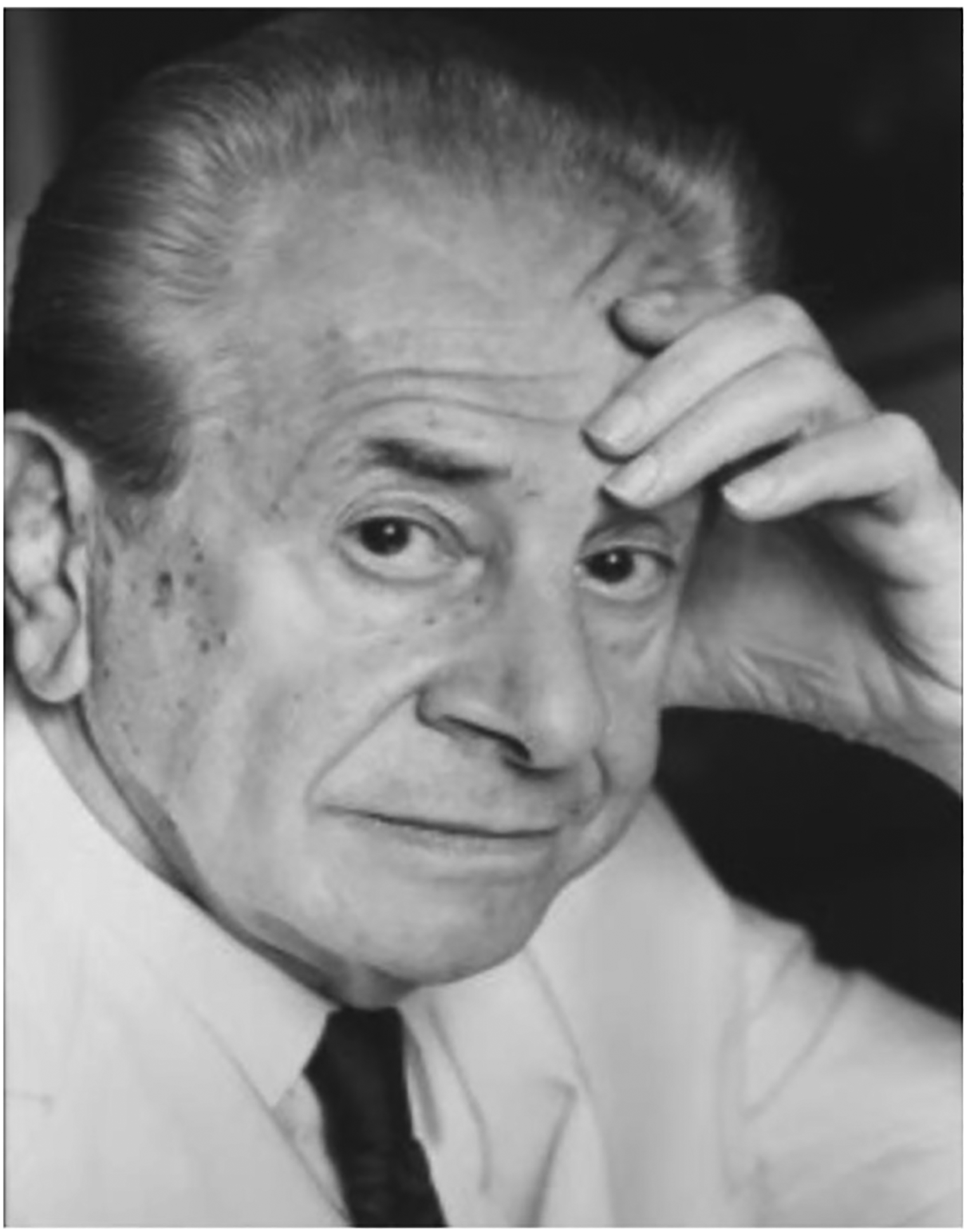
Salomón Hakim (1922–2011), Colombian neurosurgeon and scientist who described normal pressure hydrocephalus or Hakim's syndrome and designed one of the first CSF shunting devices for its treatment.
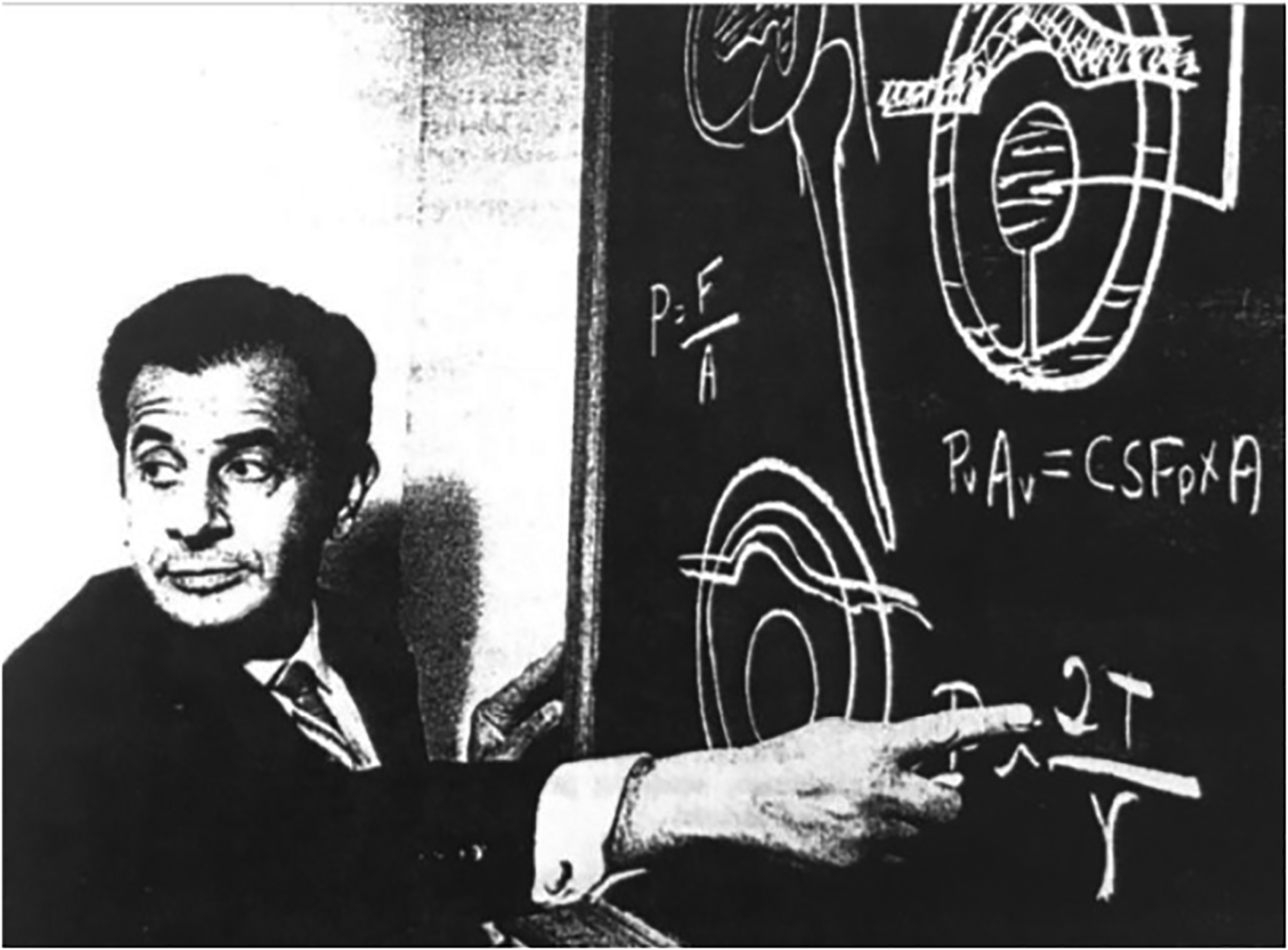
Salomón Hakim (ca. 1950), lecturing on medical physics.
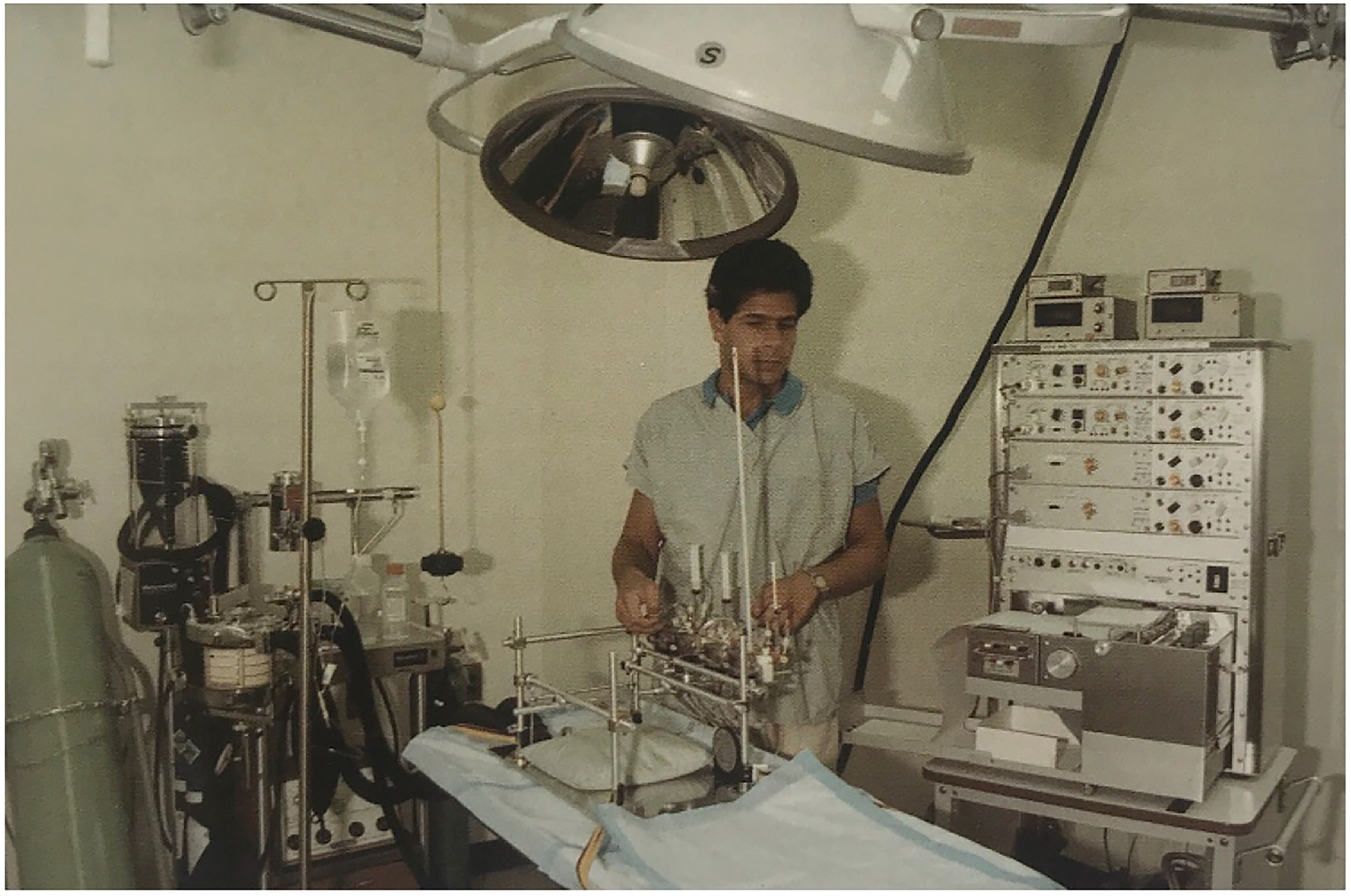
Carlos Hakim (ca. 1980), working in the lab at MIT.
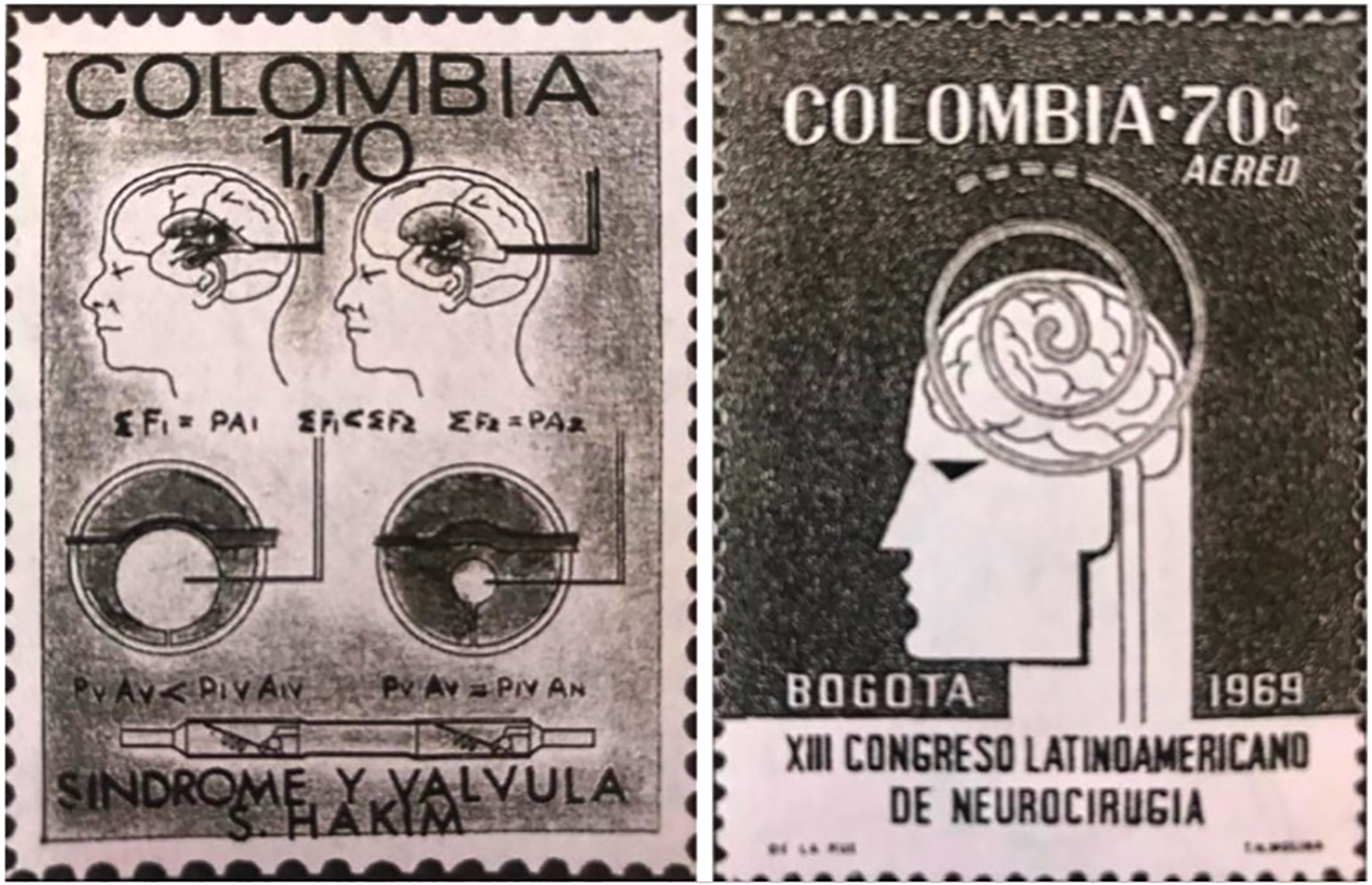
On the left, the preliminary stamp design by Colombian national post office rendering homage to hakim. On the right, the official and final design that was printed and circulated promoting the XIII Latin American Neurosurgery Congress that was held in Colombia in 1969.
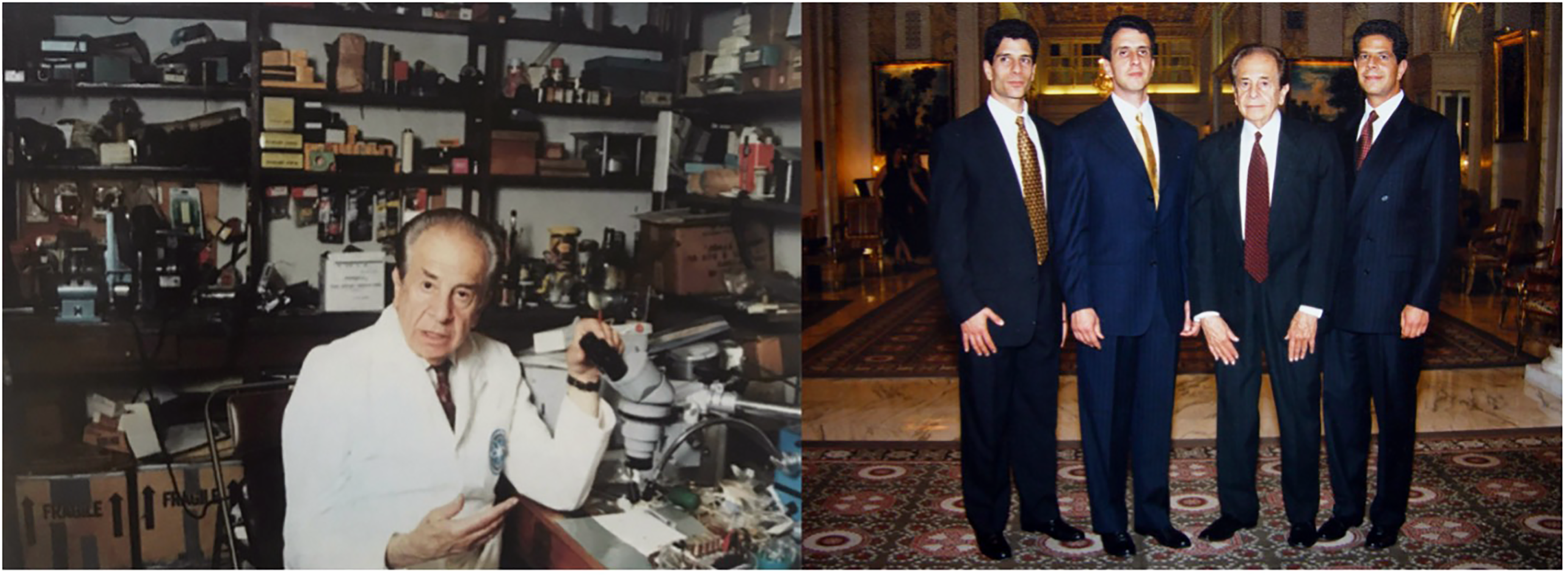
On the left, S. Hakim (ca. 1996), in his garage lab. On the right, (from left to right): Rodolfo, Fernando, Salomón and Carlos Hakim.
Footnotes
Acknowledgements
All figures in this paper have been provided by Professor Fernando Hakim from the Hakim family archive. The first author (DJV) would also like to acknowledge and express his immense gratitude towards Professor Fernando Hakim because of the endless generosity in sharing family teachings and knowledge.
Declaration of conflicting interests
The author(s) declared no potential conflicts of interest with respect to the research, authorship, and/or publication of this article.
Funding
The author(s) received no financial support for the research, authorship and/or publication of this article.

Supplemental material
Supplemental material for this article is available online.