




Abstract
The Scottish doctor Robert Erskine (1677–1718) became Chief Doctor of Russia and personal physician to Tsar Peter the Great. Extensive archival material documents his remarkable career. From schooling in the village of Alva and apprenticeship to an Edinburgh apothecary, he went on to study medicine in Paris and Utrecht and was admitted to the Royal Society in London. Recruited into the service of the Tsar, to whom he became a trusted friend and counsellor, Erskine played a central role in the modernisation of Russian medicine, pharmacy and natural science in the early 18th century. His untimely death at age 41 was marked with a state funeral in St Petersburg. Some historians in Russia assert that in their country, the development of medicine and the natural sciences took place without the transitional stages of iatrochemistry and iatrophysics which characterised the shift in scientific thinking throughout Europe in the early modern period. This study of archival records shows that Erskine held iatrophysical and iatrochemical views in common with his European contemporaries. His influence ensured that Russia was thoroughly involved in European developments in science and medicine in the 18th century.
Introduction
As experience of the current pandemic shows, governments, especially in times of need, attach considerable importance to the search for innovative and effective treatments for disease. It is hardly surprising then, that in the past, Russian Tsars, having regard for their own well-being and the defence of their country, often invited foreign physicians to Russia in the hope that they would bring with them the latest medical expertise. Following his visit to England in 1698 as part of his tour of Western Europe, Peter the Great was keen to develop relations between Russia and Britain. In particular, he wished to organise educational and scientific institutions in Russia, similar to Cambridge, Oxford and the Royal Society.
1
Sometime around 1705, Peter invited the Scottish physician Robert Erskine, recently elected Fellow of the Royal Society,
2
to the Imperial Court, eventually appointing him Arkhiatr (Chief Doctor) of Russia
3
– a role in which he made an immense contribution to the development of medicine, pharmacy and the natural sciences in his adopted country. By the time of his early death in 1718, Erskine left behind in his new homeland:
a unique library covering a wide range of scientific and medical subjects; a medical herb garden, which became the Botanical Garden of the Russian Academy of Sciences; a new network of pharmacies, hospitals and medical schools; a medicinal spa at Polyustrovsky near St Petersburg, which laid the foundation for balneotherapy; the first Russian museum – the Kunstkamera – housing an extensive collection of medical and scientific exhibits.
4
Scholarly interest in Erskine exists in both Russian 5 and English languages – the latter including an early paper by Paul, 6 more recent detailed studies by Appleby7,8 and Collis 9 and passages in books by Cross 10 and Hughes. 11 However, despite his far-reaching influence on science and medicine in Russia, Erskine's life and work are not widely known in his country of adoption and – apart from a weathered memorial plaque in his birthplace – still less in his native Scotland.
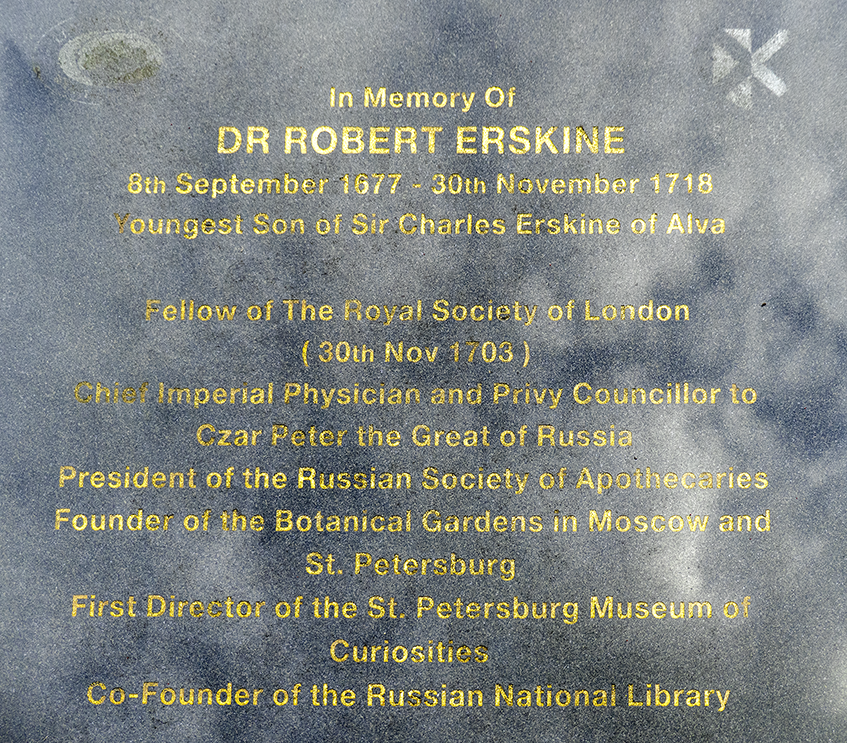
Memorial plaque to Erskine in his birthplace, Alva, Clackmannanshire, Scotland. (Photo by the authors.)
Such information as can be gleaned about him paints a picture of a man highly regarded by his contemporaries for his professional expertise, for the sympathetic way he dealt with his subordinates in the Tsar's service 12 and for the care he showed to his patients. 13 As well as being a pioneer in the science of his day, he was a talented organiser, and played an important role in advising the Tsar, managing the health of the army, and developing pharmacy in Russia. 14
Erskine: His background and education
Robert Erskine, the sixth of at least 13 children of Sir Charles Erskine and Christian Dundas, was born in Scotland, in the Clackmannanshire village of Alva. 15 Although the eminent Russian medical historian Mirsky writes that the date of Erskine's birth is uncertain, it must surely have been shortly before 8 September 1677, the date of his baptism as given in Alva parish records. 16 Noteworthy relatives included Sir George Erskine of Innerteil (1570–1646), (a cousin of Robert's grandfather), who was a prominent alchemist, Chief Justice of Scotland and a confidante of King James VI of Scotland and I of England. 17 John Erskine, sixth Earl of Mar (1675–1732), (Robert's cousin), who led the Jacobite rebellion of 1715; 18 and another relative, the Scottish writer and freemason Chevalier Andrew Ramsay (1686–1743) 19 were also said to have practised alchemy. 20
Growing up in a family of the Scottish nobility, young Erskine is likely to have been schooled at home. 21 It seems he received an exemplary education, and his later career suggests that he acquired fluency in several European languages.
Medical services in the medieval and early modern period were provided by three main types of practitioners – although in practice there was overlapping and blurring of their roles. Broadly, physicians diagnosed illness and prescribed medications, apothecaries prepared and dispensed medications, and surgeon-barbers performed physical interventions such as bloodletting and amputation. 22 Erskine received training in all three disciplines – something that was to prove significant for his later career.
While he was still in his teens, Erskine was apprenticed to the Edinburgh surgeon–apothecary Hugh Paterson. The indenture document defining the terms of Erskine's apprenticeship is held in the National Library of Scotland.
23
Indenture document for Erskine's apprenticeship. Courtesy of the National Library of Scotland.
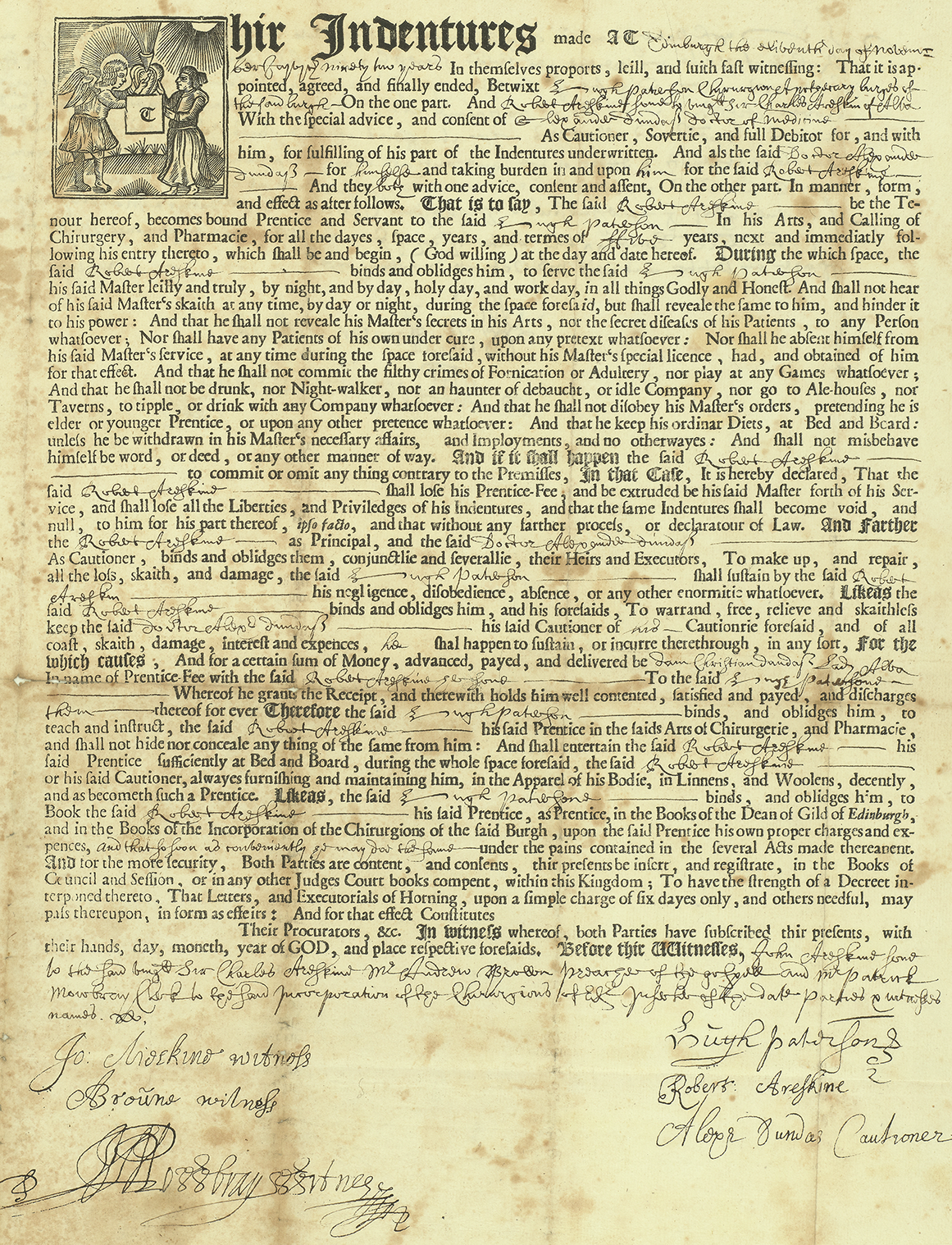
A transcription of the original English is available in Robert Paul's “Letters and Documents relating to Robert Erskine” 24 and there is a Russian translation in a recent article by Mustafin and Sanatko. 25
The indenture is signed, not by Erskine's parents but by the young man himself, on 11 November 1692 in Edinburgh, in the presence of several witnesses. If his date of birth was ‘circa 1674,’ as stated in the Royal Society's on-line record, 26 then Erskine would have been 18 years old at the time. Paul's reckoning, based on Alva Parish records, that Robert began his apprenticeship in Edinburgh at the age of 15, seems more likely to be correct. 27 The countersignatory is Erskine's maternal uncle, the eminent physician Alexander Dundas, 28 who agrees to act as guarantor of his nephew's compliance. Under the terms of the apprenticeship agreement, Erskine becomes Paterson's student and servant for a term of 5 years. Erskine undertakes to serve his master loyally and honestly, day and night. He promises that he will not criticise his master, nor listen to anyone who speaks ill of him; he will not reveal the secrets of his master's profession and will not divulge information about the diseases of his master's patients; he will not treat patients of his own without his master's approval; he will not be absent without permission, will not gamble, or frequent alehouses, or visit houses of ill-repute. If he fails to keep these rules, the agreement becomes null and void, the apprentice forfeits all his rights and privileges and loses the support of his guarantor. If Erskine should cause any damage to his master's property, Dundas, as guarantor, promises to compensate Paterson.
For his part, Paterson promises “… to teach and instruct [his apprentice Erskine in the] arts of chirurgerie and pharmacie and shall not hide nor conceale any thing of the same from him.” Paterson will provide Erskine with board and lodging for the entire period of study, but Erskine is to provide his own clothes and make sure he is always appropriately dressed. At the same time, Paterson promises to register Erskine as his apprentice with Edinburgh's professional guilds of apothecaries and surgeons.
The indenture document has a postscript dated five-and-a-half years later, on 14 June 1698, in which Paterson certifies in the presence of witnesses that Erskine “honestly and faithfully” served his apprenticeship as a surgeon-apothecary and is now free to make his own way in life.
After his apprenticeship, Erskine moved to Paris 29 to take up medical studies under the celebrated anatomist Du Verney, and then to Utrecht, where he obtained the degree of Doctor of Medicine. In his doctoral dissertation, Erskine shows evidence of having been influenced by the dominant scientific ideas of his day – alchemy, iatrochemistry and iatrophysics. 30 The latter two schools of thought marked a gradual transition, influenced by the Enlightenment of the 17th and 18th centuries, away from the magical, esoteric beliefs of alchemy and towards a more rational form of science. If iatrochemists such as Paracelsus and Van Helmont reduced all normal and pathological phenomena in the body to chemistry, then iatrophysicists – Descartes, Santorio, Borelli, Boerhaave and others – saw them in terms of mechanics. 31 Erskine's student notebook shows that he was already collecting books on iatrochemistry and iatrophysics and he had clearly taken note of the teachings of Jacob Le Mort, 32 who had himself studied under the iatrochemist Johann Glauber and followed the iatrophysics of Descartes. 33 Above all, Erskine, like many of his contemporaries, was influenced by the great English physicist, mathematician and alchemist, Sir Isaac Newton (1643–1727), whose foundational work “Philosophiæ Naturalis Principia Mathematica” (The Mathematical Principles of Natural Philosophy), first published in 1687, formulated the basic laws of natural philosophy (physics), including the law of gravity and the three laws of motion. 34 It may have been partly Erskine's influence that led to Newton's work appearing in Russia. 35
Erskine's dissertation, Dissertatio medica inauguralis circa oeconomiam corporis humani (Inaugural Medical Dissertation on the Economy of the Human Body), dated July 1700, is devoted to the subject of human functional anatomy.
36
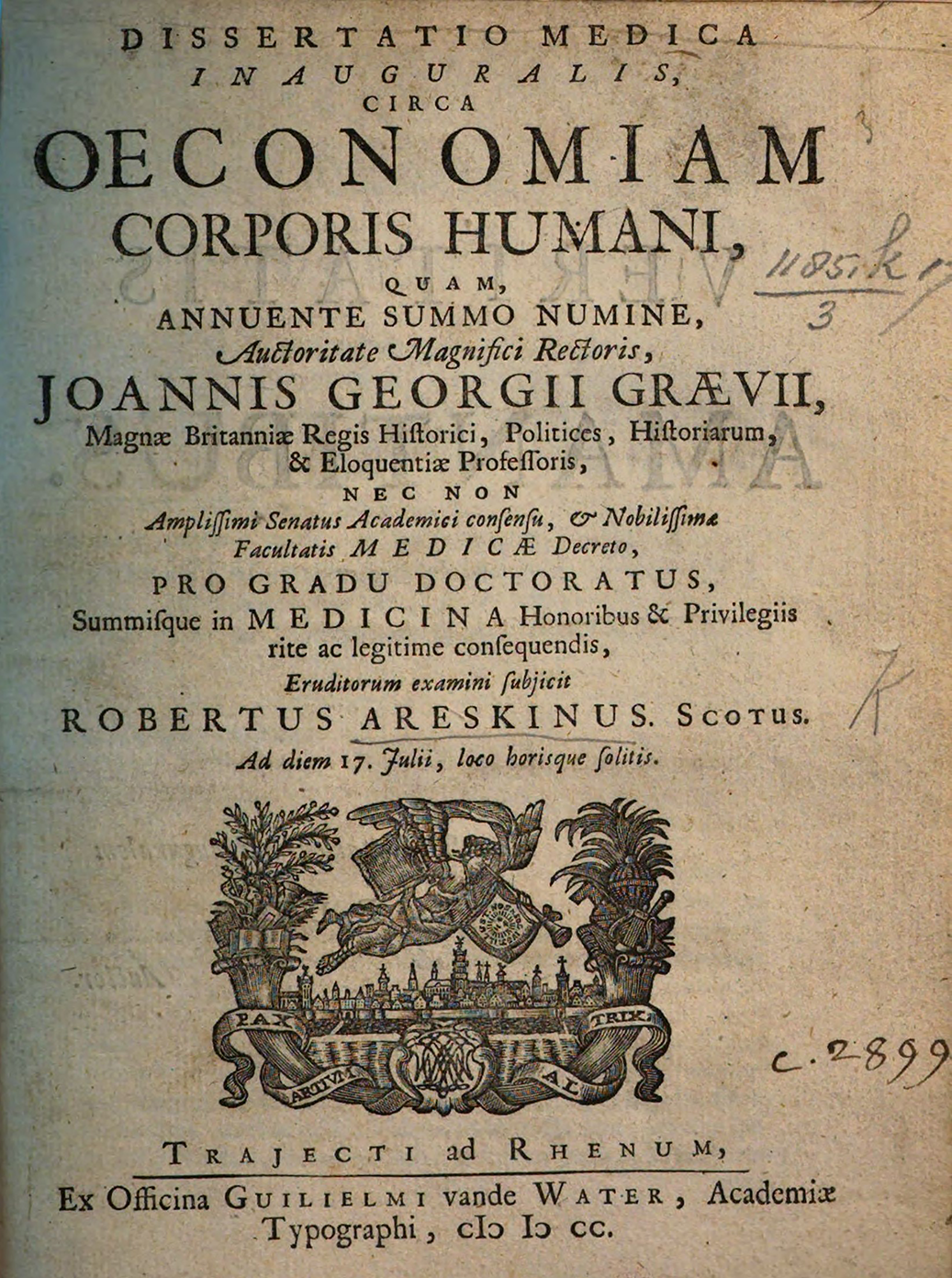
Title page of Erskine's doctoral dissertation. Courtesy of the British Library, digitised by the Google Books project.
An English translation by one of us (CW) from the original Latin is available from the authors.
In summary:
Chapters 1–24 deal with the anatomy of the reproductive system. Chapters 25–28 put forward his ideas about the origin of the embryo. Chapters 29–54 are devoted to foetal development, birth and infant nutrition. Chapters 55–91 deal with human anatomy in general, muscle function, ophthalmology, the respiratory and digestive systems and offer explanations for human ageing and death.
Erskine recognised that science needs to be based on rigorous and reproducible experimental evidence: in the opening chapter of his dissertation, he declares his intention to “… explain all things in an ordered geometric manner … suppressing, so far as I am able, every trace of anything which cannot be demonstrated other than through the evidence of my own eyes or through experiments.” 37
At the same time, he asserts that the human body is a mechanical device (chapters 54 and 55), underscoring his commitment to iatrophysics, in which both the human body and its individual parts are compared to various mechanical devices. For example, the French iatrophysicist René Descartes (1596–1650), in his 1648 treatise La description du corps humain, had likened the life of the body to the action of clocks and other mechanical devices; and according to the Roman iatrophysicist Giorgio Baglivi (1668–1707), the arm acts as a lever, the chest is similar to a blacksmith's bellows, the heart is a pump, and the glands are sieves. 38
Consistent with iatrophysical views, Erskine compares the function of the musculoskeletal system with the workings of a clock (chapter 58), explaining that interstitial fat acts as a lubricant in the same way as oil eases the movement of wheels in a clock. He compares the human peripheral nervous system with strings (chapter 62) and likens the cardiovascular system with its valves and blood vessels to pipes with valves and gates (chapter 64). Describing the musculoskeletal system, (chapter 56) Erskine alludes to Newtonian mechanics: “Where greater force is required, the muscles are furnished with a multitude of fibres which are inserted afar from the fulcrum or centre of motion, and in this way their power is increased. Where such force is not required, but the part has to traverse a longer space, then the fibres are longer and are fewer in number, as in the axiom: ‘Quantity gives force and length gives motion’.
This statement can be considered as an attempt to explain the anatomy of the human musculoskeletal system in terms of Newton's second law.
39
In Erskine's axiom, ‘quantity’ refers to muscle fibres and therefore to muscle mass. A greater quantity of muscle fibres is able to create a greater force with the same acceleration; reduction in their length leads to the movement of parts of the body. In his description of the functioning of the cardiovascular system (chapter 65), Erskine makes an analogy with Newton's third law:
40
… the left ventricle of the heart … distended … and once again contracting, impels the mass of blood with the very greatest of force … into the aorta. The aorta, which equally is enlarged, contracts by its own elastic force and duly disperses the blood into the brain, the arms, the liver, the intestines, the legs and all parts of the body. It is this reciprocal contraction and dilation which causes the pulse.
Iatrochemists were particularly interested in the study of digestive processes, as well as the reproductive and other glands. They distinguished between ‘acid’ and ‘alkaline’ diseases. In essence, iatrochemistry attempted to move the older humoral theories of pathology onto a more scientific (chemical) basis. In Erskine's descriptions of the physiology of the reproductive glands and the processes of digestion, he follows the traditions of iatrochemistry (chapters 63 and 72). He compares the seed of animals and the seeds of plants and concludes that their essence is similar (chapter 12): From what we see clearly in the seeds of plants it can be deduced what the seed of animals is like. The seeds of plants are nothing other than the plants themselves which are said to be produced and born out of them, and there is nothing in the plant which is not in the seed.
41
Erskine's doctoral dissertation shows that he was influenced by the rational ideas of Newton's natural philosophy while remaining a proponent of alchemy, iatrochemistry and iatrophysics. This is hardly surprising – it was true of almost all natural scientists and physicians of the time. Even Newton himself, colossus of rational science though he was, continued to espouse alchemy. 42
Erskine: His achievements in Russia
In 1704, after a period as an anatomist in a London Hospital, 43 Erskine travelled to Russia, initially in the service of Prince Menshikov, rising quickly to become court physician to Tsar Peter the Great, who appointed him Arkhiatr of Russia, a position he held until an illness led to his untimely death in 1718.
It was Erskine who was instrumental in setting up pharmacies in Russia modelled along the lines of British apothecaries – and of course, they had an alchemical slant. The Russian word for pharmacy, apteka (in some other Slavonic languages, apoteka), testifies to their origin. It is also no coincidence that workers engaged in the preparation of mineral and plant-based mixtures in Russia at the time of Erskine were called alkhimisti (alchemists) and their miracle-working medicines were called exactly what they were called by alchemists everywhere else – eliksiri, directly from the Medieval Latin elixir, meaning ‘the philosopher's stone’ – the magical substance believed by alchemists to convert base metal into gold, cure diseases and prolong life. 44
This is hardly surprising since, as we have noted, Erskine grew up in a family that included relatives who were alchemists; he began his professional education in the pharmacy of an Edinburgh apothecary; and he studied at universities in Paris and Utrecht. At every stage of his education, therefore, he was exposed to the prevailing scientific philosophies – alchemy, iatrochemistry and iatrophysics. As late as 1714, when he was at the height of his influence in Russia, Erskine records in his medical notebook the alchemical formula for a panacea by the Harvard alchemist and friend of Robert Boyle, George Starkey. 45 Naturally, Erskine brought these influences to bear in his service of the Tsar, whether organising Russian military healthcare, collecting specimens for Russia's first natural history museum, or selecting books for the library. Erskine's book collection consisted of over 2300 volumes, of which at least 287 were alchemical and iatrochemical works by 157 authors. On his death, his library was bequeathed to the Russian nation and formed part of what would eventually become the Library of the Russian Academy of Sciences. 46
The archives of the Russian Academy of Sciences in St Petersburg contain an extensive collection of Erskine's correspondence, including 40 letters to Erskine from 19 English and Scottish correspondents, among them the prominent British doctor Archibald Pitcairne, 47 along with photocopies and microfilm of letters to Erskine from other leading figures of the time, such as Prince Menshikov and the Dutch apothecary and pioneering zoologist, Albert Seba (1665–1736) who, in 1711, sent Erskine an ounce of the newly discovered element phosphorus for alchemical experiments. Later, Erskine procured from Seba an extensive collection of rare specimens for Peter the Great's Kunstkamera. 48
Erskine's influence in Russia went well beyond medicine and the natural sciences. The Tsar clearly held him in high esteem, making him a Councillor of State in 1716. 49 Erskine was suspected of using his position to persuade the Tsar, on behalf of the Jacobites, 50 to ally himself with Charles XII of Sweden against George I of Great Britain in favour of the Pretender. Letters between Swedish diplomats were intercepted suggesting that Erskine might act as agent to win the Tsar's support. 51 The idea that Erskine might have harboured Jacobite sympathies is at least plausible: notwithstanding his Fellowship of the Royal Society in London, Erskine may have regarded himself as Scottish rather than British; his doctoral dissertation clearly identifies him as ‘Scotus;’ he had joined the Tsar's service 2 years before the Acts of Union of the English and Scottish Parliaments; his cousin John, sixth Earl of Mar, led the Jacobite rebellion of 1715, in which his older brother, Sir John Erskine was also involved. Erskine's nephew, in a letter to Sir John dated September 1716, tells how the Tsar dined with Erskine on the latter's birthday (evidence of the close friendship between the Tsar and Erskine) and adds that “the Czar has … undertaken to get your affair done” – apparently alluding to the Jacobite/Swedish plot. 52 The Tsar categorically denied all knowledge of the affair 53 and strongly defended Erskine's innocence – a denial which was accepted by King George. 54
Erskine suffered an unidentified illness in 1718 and died in December of that year, aged 41, at a medicinal spa at Olonets, north-east of St Petersburg. His will, a copy of which is held in the National Library of Scotland, provides for some of his effects to be sold, “and the money for them to be given to orphanages, hospitals and almshouses in Scotland” and to the poor of St Petersburg. The Russian State inherited his books and surgical instruments, while his own mother and members of the Tsar's immediate family received personal bequests.
At Erskine's state funeral, the Tsar himself, accompanied by hundreds of mourners, followed the cortege to the interment in the Lazarevkoye Cemetry at St Petersburg's Alexander Nevsky Monastery. In a mark of the esteem in which he was held, Robert Erskine was laid to rest next to the grave of Peter's sister, Natalya Alexeyevna. 55
Erskine in his historical context: European influence on Russian medicine in the early modern period
Erskine was by no means the only Briton who influenced the development of medicine and natural science in Russia. During the reign of Ivan the Terrible (1530–1584), after the establishing of diplomatic relations between Russia and England in 1557, many physicians and apothecaries from both England and Scotland began to visit Russia. 56 Of these, many were affiliated with the Royal Colleges of Physicians in London and Edinburgh, or with Britain's principle scientific body, the Royal Society. 57 Notable examples include James Frencham, apothecary to Ivan the Terrible; Arthur Dee, who served Tsar Michael Romanov for 14 years and wrote a treatise on alchemy; and Samuel Collins, who served Tsars Aleksei and Fyodor III and wrote to Robert Boyle at the Royal Society about “The Present State of Russia.” 58 James Mounsey, in the reigns of Elizabeth I and Peter III, was the last bearer of the title Arkhiatr and brought medicinal rhubarb seeds from Russia to Britain. In the reign of Catherine the Great, John Rogerson, a graduate of Edinburgh was her ‘Body Physician’; Aberdeen graduate Thomas Dimsdale used the technique of variolation to inoculate the Empress and other members of the nobility against smallpox; and near the end of the eighteenth century, another Scot, James Wylie, presided over what was to become the Military Medical Academy in St Petersburg.
Prominent Russians who visited British universities in the early 18th century included Prince B.I. Kurakin (1676–1727), several members of the Blumentrost family, P.V. Postnikov (1676–1716) and Yakov Brius (1732–1791, James Bruce, of Scottish descent), 59 who in turn brought back to Russia their experience gained in Britain and elsewhere in Europe. 60 Some of these were involved in the Neptune Society which met in the Sukharev Tower in Moscow and whose members included Peter the Great himself. At meetings of this society, the Tsar and his associates made plans to transform the state and were also said to have practised alchemical arts. 61
In February 1713, the Royal Society in London created a ‘Committee for Russia’ which reflected growing interest in Russian medicine and science among the Society's members. Isaac Newton, Edmund Halley, James Petiver, Richard Mead and John Arbuthnot took part. 62 Sloane, Woodward, and Galli formulated questions on the state of affairs in various areas of Russian life. Some Russian papers have studied the correspondence of the Committee for Russia. 63 Several letters asking questions about Russia are unsigned. Letters with detailed replies are written and signed by Sir Charles Whitworth, British Ambassador to Russia 1704–1712 and author of “An Account of Russia as it was in 1710.” 64 These documents make clear that early 18th-century British scientists showed considerable interest in the state of Russian knowledge in the fields of geography, mathematics, astronomy and medicine.
Two notable Russian works which record the activities of foreign doctors in Russia at that time 65 are Lipsky's historical overview of the St Petersburg Botanical Garden, 66 and Chistovich's history of the first medical schools in Russia. 67
From the 16th century onwards, many physicians from Western Europe visited the Russian imperial court, bringing with them the prevailing ferment of ideas drawn from the esoteric worldview of alchemy and the nascent scientific rationalism of iatrochemistry and iatrophysics. 68 A detailed review of the contribution of other nationalities is beyond the scope of this paper, but undoubtedly there was extensive contact throughout the early modern period between members of Russia's scientific and political elite and their contemporaries in Western Europe. The careers of Arend Claesen van Stellingswerfft, Nicholas Bidloo and Herman Kaau-Boerhaave (all from the Netherlands), and the Portuguese Antonio Ribeiro Sanchez illustrate the point.
Discussion
Despite the well-documented exchange of personnel and ideas, it is asserted in Russian textbooks 69 and occasionally by other commentators 70 that alchemy, iatrochemistry and iatrophysics – such prominent features of thinking throughout Europe in the early 18th century – did not feature in the development of scientific understanding in Russia. Is the case of Russia an anomaly? It would seem unlikely: Russia has long been involved in developments in both Europe and Asia.
The laws of science are universal, operating in all countries and amenable everywhere to observation and investigation. 71 It is self-evident, however, that understanding is not achieved all at once. We suggest that the acquisition of understanding can be thought of as a three-stage process. To begin with, on encountering a new phenomenon, our understanding of it is chaotic. Later, we begin to look at the phenomenon from different points of view, perhaps breaking it down into its constituent parts to study them in isolation. The third stage of understanding involves synthesising a unifying concept of the whole that can be validated experimentally.
Alchemy, iatrochemistry and iatrophysics were 18th century examples of the second stage of the process. Even Newton's Laws of Motion were only part of the picture, as we now understand it. And in the 21st century, we have our own examples of partial understanding: how can we unify quantum theory and general relativity?
The development of understanding has continued (though not always at the same pace) throughout history – however much religious authorities or political rulers or military powers might have tried, for their own reasons, to suppress the process, or even to deny that it was taking place. From our vantage point, the irrationality of alchemy and the imperfection of iatrochemistry and iatrophysics may look foolish, but like the Laws of Motion, they were stepping stones on the path to clearer understanding. As Newton acknowledged in his celebrated comment to Hooke, “If I have seen further, it is by standing on the shoulders of giants.” 72 It is therefore no shame for Russian historians of science to acknowledge that their country went through similar stages to the rest of Europe in the development of scientific understanding. 73
Conclusion
At the beginning of the 18th century, the Scottish physician Robert Erskine became the Chief Doctor of Russia, exerting a far-reaching influence on the history of medicine and the natural sciences in his adoptive country. Erskine was an outstanding example of the many scientists of the time who played their part in Russia, and who ensured that developments in medicine and the natural sciences were linked with similar developments in other countries. In Erskine's Russia, as in Western Europe, the esoteric beliefs of alchemy and the transitional ideas of iatrochemistry and iatrophysics co-existed with and gradually gave way to emerging, rational, experimental science.
Footnotes
Acknowledgement
The authors thank Professor David Bebbington, Emeritus Professor of History at the University of Stirling, for his helpful advice in the preparation of this paper.
Declaration of conflicting interests
The authors declared no potential conflicts of interest with respect to the research, authorship and/or publication of this article.
Funding
The authors received no financial support for the research, authorship and/or publication of this article.
