




Abstract
The human face reflects a person's character and emotions, both in health and disease. Charles Bell, published in 1806 Essays on the Anatomy of Expression in Painting in which he stressed the importance of understanding anatomy when studying art. He concluded that emotions were revealed in facial expression and that these expressions were only to be found in humans, not in lower animals. Charles Darwin in 1872 published The Expression of the Emotions in Man and Animals, where he acknowledged Bell’s contribution to facial expression especially the role of the nervous system, but questioned Bell’s conclusion, that animals were incapable of showing emotions through facial expression. Darwin reasoned that human facial expressions reflected emotions, some from our primeval state, some from habit but most were universal and controlled by an involuntary nervous system, described by Bell, and now known as the parasympathetic system. This paper explores Bell’s contribution to the understanding of facial expression. We conclude that his understanding of neuroanatomy along with his artistic ability enhanced our comprehension of human facial expressions, although his theological interpretation of the reason for facial expressions and emotions needs to be seen more in the context of nineteenth century Natural Theology.
Introduction
The human face reflects that person's character and emotions, in both health and disease, and the study of a patient’s facial expression is one of the cornerstones of clinical medicine. Students are taught to observe patients in order to evaluate their clinical status and explore the underlying medical conditions which often are portrayed in the face. Thomas Sydenham (1624-1689), an English physician who prized observation in clinical practice, stated that when describing a disease it was important to study the patient closely ‘For the appearance or outward look of a disorder often changes with the method of cure’. 1
Facial expression itself has long been studied, including by the Swiss theologian Johann Caspar Lavater (1741-1801) who, in 1789, published Essays on Physiognomy 2 in five volumes containing numerous drawings of different forms of facial expression. In that period physiognomy, the study of facial features or expressions, became part of the process of recognition of the human character and was achieved through examining the skull, the fixed part of the face. Lavater emphasised the uniqueness of the individual and differentiated ‘between the fixed parts, the physiognomy or character of the face, and the flexible parts, the pathognomy or expression of the face’. 3
Charles Bell, surgeon, anatomist, artist and teacher, published in 1806 Essays on the Anatomy of Expression in Painting 4 in which he stressed the importance for the artist of both knowing and understanding anatomy when studying art. Bell concluded that anatomy was the basis of Design by God and that expression, attitude and movement of the human body were the grammar of the language the artist had to learn. Bell emphasised that the painter must not just reproduce an image but needs to use his own creative powers in order to understand and depict the true nature of his subject. Charles Bell explored in detail the principles of facial expression that were based on his own extensive observations of anatomical dissections. He concluded that the expression of passions and emotions was revealed in facial expression although he was also of the view that these expressions were only to be found in humans and not in lower animals. He posited that facial expressions were inspired by the Divine Creator.
Charles Darwin (1809–1882), who had attended Bell’s anatomical lectures and read his work, in 1872 published The Expression of the Emotions in Man and Animals 5 following his earlier works On the Origin of Species in 1859 and The Descent of Man and Selection in Relation to Sex in 1871. Darwin acknowledged Bell’s contribution to ideas of facial expression especially in relation to the function of the nervous system, but he questioned Bell’s conclusions. Darwin based his own analysis partly on data collected in response to a questionnaire exploring natives’ expression which was distributed to colleagues around the world and partly on his understanding of Evolution. In his book Darwin disagreed with Bell about the involvement of a Divine Creator in facial expression and also indicated that Bell was wrong, in that animals were capable of showing emotions through facial expression.
This paper examines Charles Bell’s contribution to the understanding of facial expression, particularly his perception of the role of the nervous system in human emotions as well as his views on the purpose of human facial expression. By way of contrast we also explore Charles Darwin’s interpretation of human expression as, since significant works have been published dealing with Darwin’s observations, notably by the American psychologist Paul Ekman, 6 Charles Bell’s contribution to our current understanding of facial expression compared to that of Charles Darwin’s has gone largely unnoticed; in this paper we attempt to rectify this situation.
Charles Bell and the anatomy of facial expression
Charles Bell was born in Edinburgh, the son of a clergyman in the Episcopalian Church of Scotland. Bell was taught painting during his youth by David Allan (1744-1796) and at Edinburgh University Bell studied medicine. For training in anatomy and surgery Bell was apprenticed to his elder brother, the surgeon John Bell (1763-1820). In 1804 Charles Bell left Edinburgh for London, where he taught anatomy in Great Windmill Street. He was involved in the founding of the Medical School at The Middlesex Hospital in 1834 and of the University of London in 1836. In 1836 Bell was invited back to Edinburgh to the Chair of Surgery at the University. In 1840 he travelled to Europe visiting Rome (where John Bell had been buried in 1820), Florence, Bologna and other Italian cities in order to enhance his knowledge of art. Essays on Anatomy and Expression was republished posthumously in 1844 under the new title of The Anatomy and Philosophy of Expression as connected with the Fine Arts. 7
The Design Theory
Throughout his life Charles Bell was heavily influenced by the Design Theory which supported the view that nature was the result of a process of Design by God and that man was unique because of his direct relationship with the Creator. Bell wrote one of the eight Bridgewater Treatises, which were commissioned by the Earl of Bridgewater to provide scientific evidence for the power wisdom and goodness of God, his being on the fourth, The Hand. Bell also wrote an appendix to William Paley’s (1743–1805) book Natural Theology, 8 published in 1802 which was written in response to David Hume’s (1711–1776) Dialogues Concerning Natural Religion.
Art and anatomy
In Anatomy and Philosophy of Expression, Bell described expression as a means of giving charm to the most ordinary face. He regarded the face as being capable of depicting emotions including contempt, pride, suspicion and jealousy, as well as pain, pleasure, joy and laughter. He advised painters not merely to copy a figure but to be creative especially when studying the differences between youth and age, sickness and health. Developing his ideas of expression further, Bell thought it impossible to paint perfection, and that the very idea of representing The Divinity was absurd. Bell concluded ‘inherent imagination could not result in the idea of perfection and that any attempt to portray perfection was acquired by the artist'. 9
Bell argued that the ‘union of anatomy and painting are the true form of art’ 10 and that through the study of anatomy it could be seen how these emotions were able to be controlled and modified, reflecting this relationship between the mind and the body. Anatomy, Bell inferred, was a science that gave the artist the ability to really observe the human body and all its emotions and he believed that the human body was the high point of all creation. This interpretation was of importance to Bell because it allowed him to relate human anatomy to emotions and thus to facial expression, applying his view that emotions were unique to man and were derived directly from God.
To be able do this Bell declared that the artist needed to know about the facial muscles which produce expression, particularly their function. Bell argued that humans have certain facial muscles specifically designed by God for the purpose of expanding the range of human expression; he suggested for example that different smiles had different meanings, depending on the context. He also analysed the idea of the human face in the act of devotion and concluded that when a man expresses his devotional feelings he does so with his eyes raised to heaven, with the purpose of praising God. In this view of the special nature of muscles Bell echoed Paley's belief that body parts were designed specifically to fulfil certain functions, 11 failing to take into account the opinion of Erasmus Darwin (1731–1802) (later to become Charles Darwin's grandfather) that there was variation in structure and then inheritance of those characteristics which were naturally selected over time and which conferred distinct advantages to the organism. 12 Indeed, Bell’s views on the act of facial expression would appear to be intensely spiritual: ‘It is in short, of man alone that we can with strict propriety say, the countenance is an index of the mind, having expression corresponding with each emotion of the soul’. 13 By this means Bell connects the soul, the influence of God and facial expression.
Facial expression in man and animals
Controversially Bell concluded that lower creatures lack a similar ability for facial expression as man because they simply do not have the appropriate facial muscles. Animals, Bell stated, have instincts that allow them to express rage and fear, and they can respond to sounds since they have certain facial muscles which are specific for this. But, Bell argued, emotion as shown in facial expression was a function unique to Man, essentially because he believed that man and animals are created by God independent of each other. 14 Bell concluded that rage was demonstrated particularly by altering the angle of the mouth along with drawing together of the eyebrows (Figure 1). 15 For this to take place Man had distinct muscles; the triangularis oris or depressor anguli oris that depresses the angle of the mouth and the corrugator supercilli that draw the eyebrows together (Figure 2). 16 Loudon notes that Bell did not himself produce all the drawings in Anatomy of Expression but that some of these were drawn by David Wilkie (1785–1841), a Scottish artist who achieved international recognition for his highly original paintings of events and episodes from contemporary life. 17
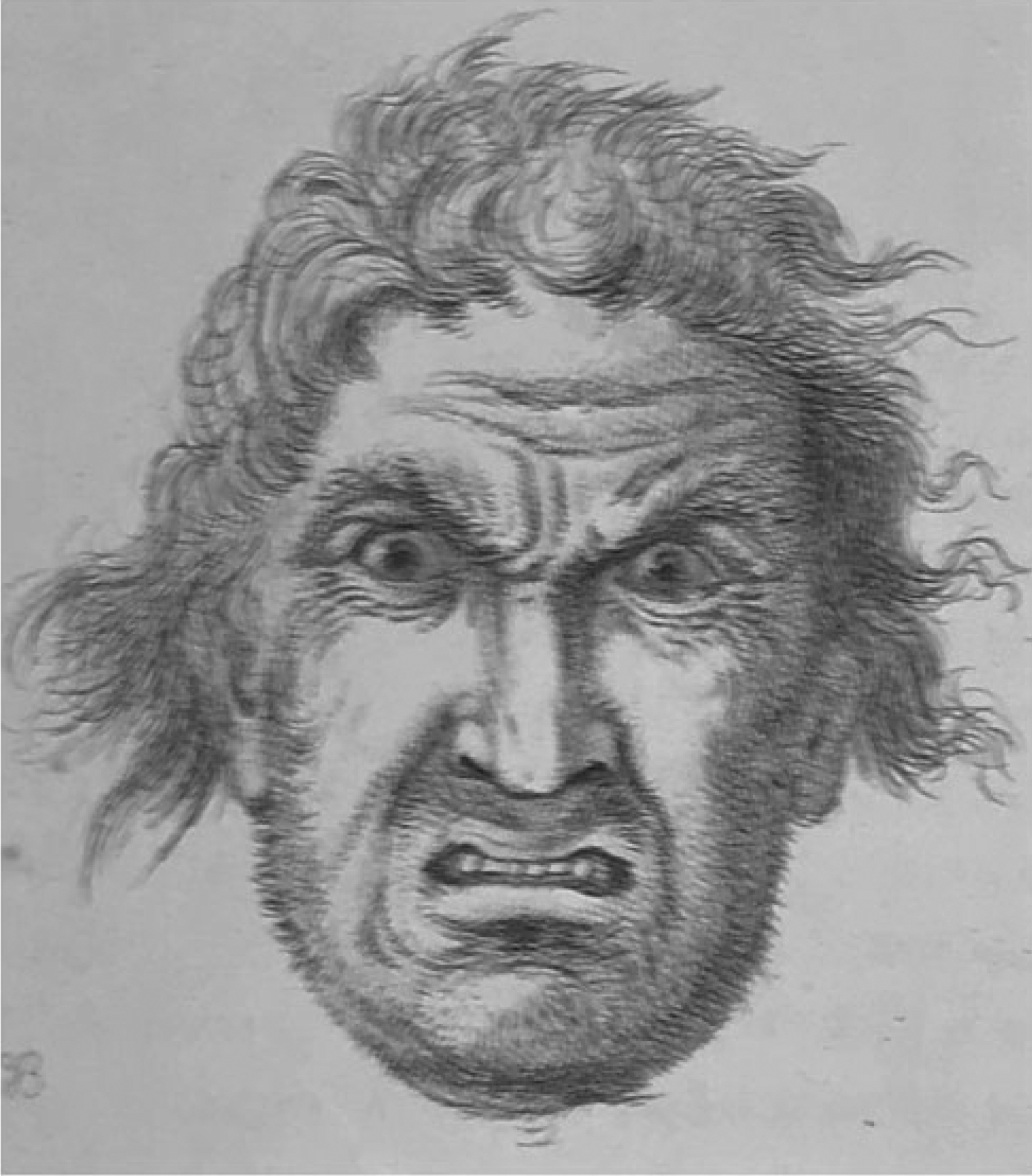
Rage, showing contraction of the brow and depression of the mouth, flaring of the nostrils, and staring of the eyes.15
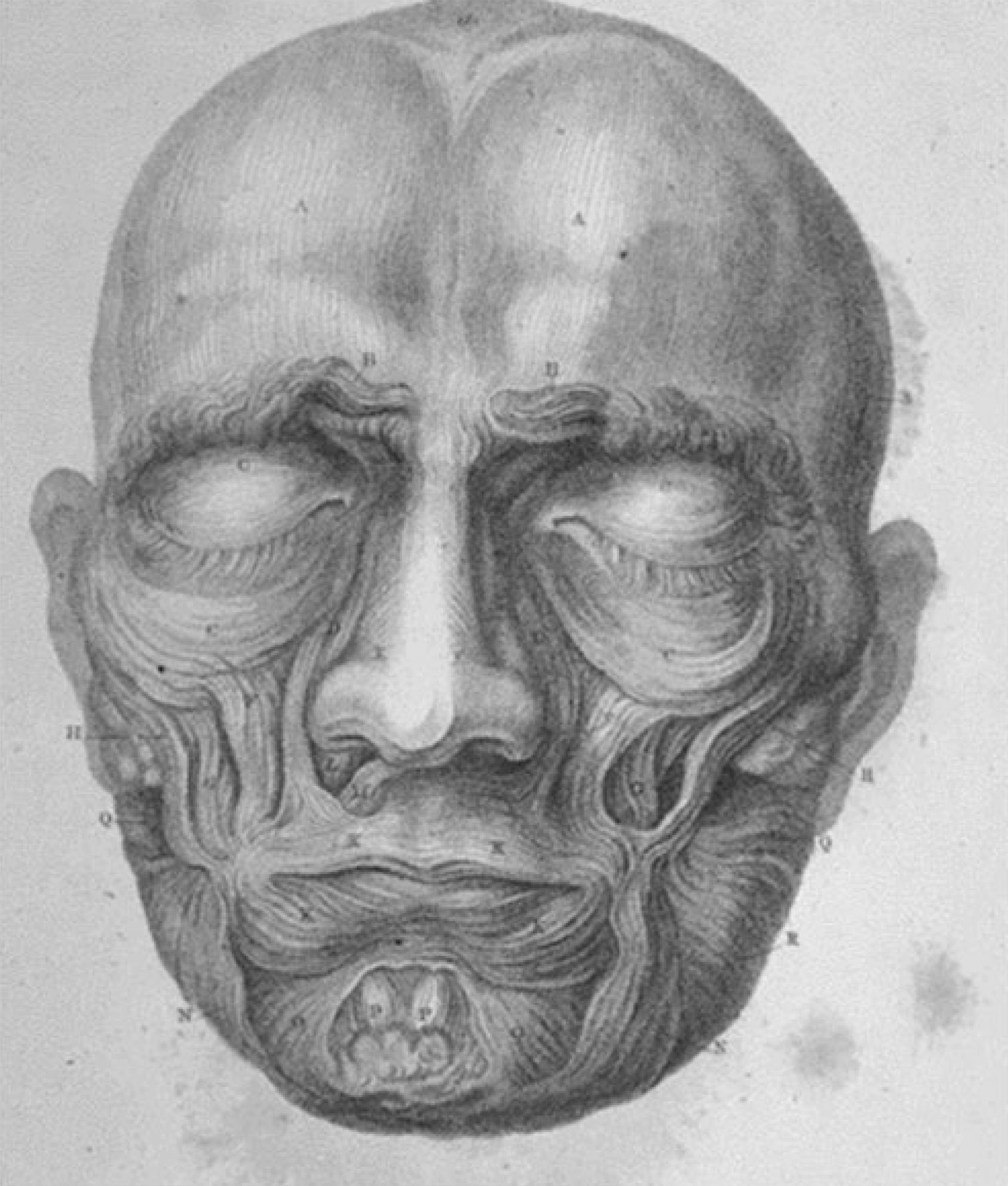
The muscles of the face as they appear in a front view, after careful dissection in which the skin and fat are removed16 and which shows the corrugator supercilli muscle which furrows the brow and the triangularis oris which depresses the angle of the mouth.
Bell also discussed the importance of the combined movement of muscles, for example the nostrils are often involved in expression as are the cheeks in order to produce the overall effect. 18 Furthermore Bell argued that the forehead acts as a tablet to reflect human thought and on which emotions are written. The eye also has a major part in expression and combined with the eyebrows reflects the thoughts of the mind. The eye, Bell commented, was the first of our senses to awake and was the last to close, and the eye ‘is indicative of the higher and holier emotions … of all those feelings which distinguish man from brutes’. 19
The involuntary nervous system
In his lifetime Bell made many major contributions to our current understanding of human neurology which were fundamental to his concepts of human emotions. He argued that the nervous system was actively involved in human expression when he explored the relationship between the brain and the nerves. Bell wrote that not all emotions were under the direct control of the person’s will; he described this area of involuntary control which he labelled the respiratory nervous system, now known as the parasympathetic system. Bell concluded that this system came into action when emotions were expressed. For example, in rage not only were the muscles of the face involved but the heart rate increased as did the rate of breathing, and gastrointestinal and bladder function was disturbed. 20 Bell described this part of the nervous system as being directly connected to the medulla oblongata in the brain and from which nerves pass to the various organs within the body. 21
Bell came to the conclusion that anatomy was ‘the examination of that structure by which the mind expresses emotion, and through which the emotions are controlled and modified’. 22 This belief, when applied to exploring the relationship between mind and body, shows that, although Bell championed the involvement of the Creator in human emotions, his detailed knowledge of neuroanatomy led him to believe there was also a physical structural relationship between facial expression and human emotions. It is apparent therefore that Bell did not perform his neuroanatomical studies primarily in order to identify the brain as the centre of the soul but he undertook his dissections as an anatomist and physiologist to understand the nervous system in order to demonstrate its true structure and function.
In The Nervous System of the Human Body, a series of papers read in London at the Royal Society, Bell described other important aspects of neuroanatomy. On 28 May 1821 in a seminal paper Bell discussed the role of the fifth cranial nerve (trigeminus or fifth nerve of Willis) and the seventh cranial nerve (portio dura) which he labelled as the respiratory nerve of the face. 23 In the third edition of his book Bell stated that the fifth nerve was both motor to the muscles of the jaws and sensory to the face but that the seventh nerve was purely motor in function. 24 It is now known that the seventh facial nerve contains ‘preganglionic parasympathetic axons of neurones with their somata in the superior salivatory nucleus’, 25 this nucleus being involved in the control of the salivary and lacrimal glands. 26 In a paper read at the Royal Society on 2 May 1822 Bell discussed the role of the seventh cranial nerve in respiration and concluded that it also supplied those muscles that produced the facial expressions of smiling and laughing. 27
Alexander Shaw (1804–1890), a Scottish surgeon and Bell’s brother-in-law, wrote an Appendix in the third edition of the Anatomy of Expressions and outlined Bell’s contributions to neuroanatomy. Listed among these was his definition of the anterior spinal nerve roots as motor and the posterior spinal nerve roots as sensory. Shaw also wrote that Bell did identify motor function of the fifth cranial nerve and more important that there was a respiratory system distinct from the sympathetic system, consisting of a series of nerves and ganglia distributed to the viscera of the chest and abdomen and which are involved in respiration. 28 Michael Aminoff, neurologist, discusses the dispute that arose between Charles Bell, François Magendie (1783–1855) French physiologist and Herbert Mayo (1796–1852), anatomist, concerning the original contributions to understanding the role of the anterior and posterior spinal nerve roots and the true functions of the fifth and seventh cranial nerves. 29 Aminoff records that in 1824 Bell, aware of the work of both Mayo and Magendie, rewrote his earlier paper where he had not identified any motor function of the fifth nerve in order to correct this. Aminoff argues that Bell’s claims to originality were undermined by his failure to publish his findings. 30 Of particular relevance was that Bell's publication was limited to one hundred copies of a tract, printed privately. 31 It is clear though that Bell did describe the existence of the anterior and posterior spinal elements along with function of the fifth and seventh cranial nerves.
Later the surgeon Gordon Taylor (1879–1960) who was also a biographer of Charles Bell, writing in 1954 on Bell’s achievements, concluded
There can be no doubt that Bell discovered the function of the anterior spinal roots, but to me it seems equally sure that at first he had no clear idea as to the function of the posterior roots; the truth of Magendie’s claim to priority of discovery of the posterior roots function must be intransigently upheld. 32
Carin Berkowitz, historian, in 2015 writing in her book Charles Bell and the Anatomy of Reform analysed this controversy and put it into context; she notes that in that period the Napoleonic Wars had just ended. There was disagreement between the French who were vivisectionists and the British who, on the whole, were antivivisectionists which, combined with the influence of Natural Theology, particularly as promulgated by Paley in England compared to secular France, led to distrust between the two countries. Berkowitz clarifies Bell’s position, putting forward the balanced view that Bell was not behaving dishonestly but was responding to events of that period. 33
Bell made further contributions to neuroanatomy. In 1822 he described a nerve which arose from the anterior column of the cervical nerve roots fifth, sixth and seventh, which he named the spinal accessory nerve (superior respiratory nerve of the trunk). This nerve innervates the serratus anterior muscle and is involved in respiratory function, particularly moving the ribs 34 and, now known eponymously as the long thoracic nerve of Bell, is well illustrated in his engravings. 35
The final common pathway
In another example of his understanding of neuroanatomy Bell noted that a unilateral facial palsy due to seventh nerve paralysis, in which the patient has partial loss of expression with inability to frown or close the affected eyelid but with retention of sensation, smell and taste, resulted in the condition now known as Bell’s palsy. 36 Current views of the cause of this condition include a viral infection, compression of the nerve within the facial canal in the skull, and occasional injury during parotid gland surgery. On the other hand, Bell probably did not know about the bilateral innervation by fibres, from higher centres in the cerebral hemispheres, of the neurones that control the muscles of the upper face but not those of the lower face. Hence the terms upper motor neurone facial weakness and lower motor neurone facial weakness, the former resulting from higher damage and the latter from damage to the facial nerve or its nucleus. Later Charles Sherrington (1857-1952) named this the ‘final common pathway’ 37 from brain via the spinal cord to the muscles. Hence the upper face is not spared in Bell’s palsy (a lower motor neurone palsy) but may be spared in an upper motor neurone lesion. The exact pathways involved in the manner in which thoughts and emotions are generated perhaps in the brain is therefore not clear, nor is the control of facial movements in this process understood fully, but magnetic resonance tractography might in due course delineate these pathways by imaging.
Lucy Hartley, English scholar, when writing in her book Physiognomy and The Meaning of Expression in the Nineteenth Century, states ‘The originality of Bell’s thesis lies in his positioning of the nervous system as central to any understanding of the expression of emotions’. 38
Beauty and realism in expression
When writing on beauty Bell reflected on the ideals of the ancient Greeks but considered that painting The Deity only ended in disaster. Bell argued that the idea of perfection cannot be the result of pure imagination, ‘whatever conceptions [the artist] may entertain [of perfection] must have been acquired’. Bell concluded that beauty is derived from nature and that any idea of beauty comes from nature which in the artist’s mind then produces perfection, 39 demonstrating Bell’s adherence to Natural Theology and the Design Theory.
Later Bell’s aim of demonstrating the importance of the role of anatomy in expression and reflecting realism motivated the painters of the pre-Raphaelite Brotherhood, 40 as did his oil paintings of wounded soldiers at the Battle of Corunna (1809) and watercolours from Waterloo (1815) that depicted real life and nature as they were seen. The Pre-Raphaelite Brotherhood (PRB), a group of painters, poets and art critics formed in 1848, rejected the Mannerists (late Renaissance) approach in their paintings and proposed that reality, not idealism, was the goal of the artist. Hence they were able to represent facial expressions including a smile in their paintings.
Hartley suggests that the very idea of expression in the Brotherhood paintings is based on its naturalness: The basis of PRB art lies in the ordinary conditions of life and through dutiful attention to the various forms of nature that very ordinariness becomes extraordinary and exemplary.
41
Charles Darwin and expression of the emotions
Charles Darwin had read both Bell’s 1806 and 1844 editions on facial expression and was impressed by the descriptions of the role that anatomy and physiology played in expression: He [Bell] may with justice be said, not only to have laid the foundations of the subject as a branch of science, but to have built up a noble structure. His work is in every way deeply interesting.
43
When I had read Sir C Bell’s great work, his view, that man had been created with certain muscles specially adapted for the expression of his feelings, struck me as unsatisfactory. It seemed probable that the habit of expressing our feelings by certain movements, though now rendered innate, had been in some manner acquired. But to discover how such habits had been acquired was perplexing in no small degree.
44
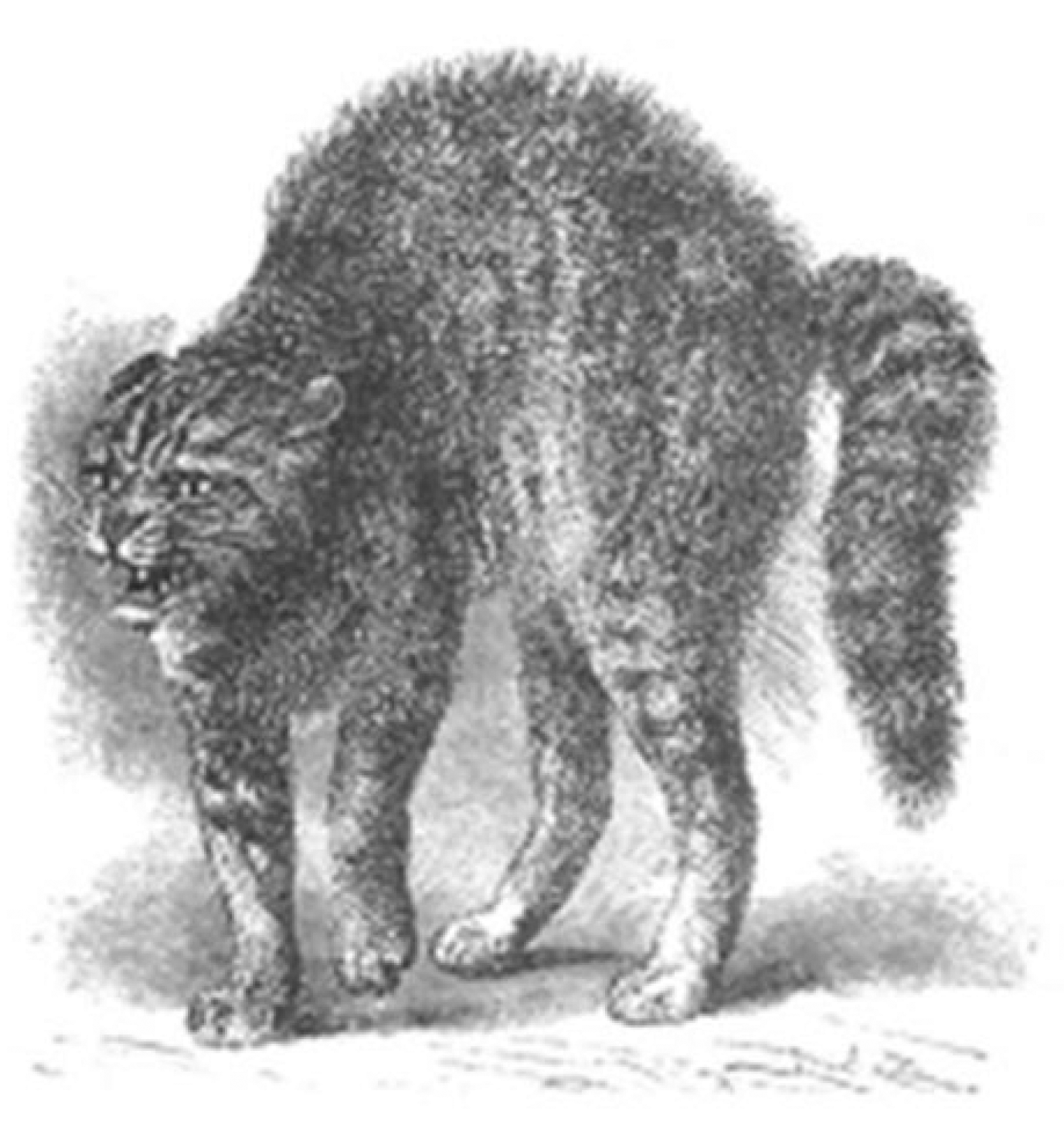
Cat terrified by a dog, from life by Mr Wood.45 Showing the animal arching its spine, baring its teeth and its hair standing on end.
Darwin argued that animals responded to being attacked and that certain muscles are under the control of the will. He concluded from his study of animals in general that there was a similarity in expression in all animals and these had gradually evolved. However, Darwin also reasoned that there were certain innate actions of expression found in animals which were the direct result of the involvement of the nervous system. These expressions included the act of trembling of the muscles, notably when the animal demonstrated fear, anger or rage. Darwin stated that in both cats and dogs there is every reason to believe that the gestures of hostility and affection are innate or inherited, for they are almost identically the same in different races of the species and in all the individuals of the same race, both young and old’.
46
Darwin’s principles of expression
In 1867 in order to study human expressions and to see whether they were innate or instinctive and whether they were universal, Darwin circulated to different observers around the world a questionnaire consisting of sixteen questions, 49 with the request that they particularly observe natives who had had little communication with Europeans. He also emphasised that the observers should respond with real evidence rather than just recall memories from their experience. He received 36 replies 50 which formed the basis of his book Expression of the Emotions in Man and Animals.
From the responses to his questionnaire, Darwin developed three principles of expression: 49
The first were Serviceable Associated Habits, these were ‘certain complex actions of direct or indirect service to the individual and which occurred under certain states of the mind in order to relieve or to gratify certain sensations or desires’. 51 Darwin explained that whenever the same state of mind is induced, there is a tendency through force of habit and association for the same movements to be performed, though he thought they may not be of the least use. These habitual actions were inherited and reflected the brain’s ability to respond to various external stimuli, and it has been suggested that these reflex responses represented the last vestige of primitive reactions acquired from man’s ancestors. 52 An example of serviceable associated habits is a man scratching his head when perplexed. Darwin also gives an example when he writes ‘I noticed a young lady earnestly trying to recollect a painter’s name, first looked to one corner of the ceiling and then to the other corner, arching on eyebrow on that side, although, of course there was nothing to be seen there.’ 53
In relation to the second principle, Antithesis (or in opposition) Darwin proposed that in certain circumstances there were habitual actions which he concluded were of service to the individual. For example, he suggested that when a directly opposite state of mind was induced, there was a strong and involuntary tendency to perform a movement which is of a directly opposite nature. Such movements though were highly expressive, for example the action of shrugging of the shoulders when a person is feeling helpless.
The third principle. ‘Actions due to the constitution of the nervous system, independently from the first of the will and independently to a certain extent of habit’ 51 involves direct involvement of the nervous system. Darwin stated that this action was innate and was therefore independent of the individual’s will. The third principle is not that different from Bell’s concept which proposed that the expression of emotions was outwith the control of any voluntary action but were under the control, Bell suggested, of the respiratory nervous system.
Darwin found remarkable uniformity in the answers to his questionnaire, which led him to the conclusion that there was a degree of universality in facial expressions. This then lent support to his belief that human beings had descended from a common progenitor 54 and today universality of expressions of emotions in species is widely accepted. 55
Crying and blushing
In other areas of the emotions, Darwin explored the ability of humans to cry which he considered was not a reflex action and was acquired after several months of life. This is borne out by the fact that secretion of tears can be controlled, for example in societies where it is considered unmanly to cry or in actors during an emotional scene. Darwin noted though that animals do cry, giving an example of the Indian elephant which wept in captivity. 56 He went on to conclude that laughter was analogous to weeping, observing that anthropoid apes laughed especially when they were tickled under the armpits, but he considered this to be a reflex or innate action. 57
Both Darwin and Bell explored the act of blushing, produced by dilatation of blood vessels of the face, neck and chest. Blushing is an involuntary reaction experienced by all human beings and appears to be an emotion rather than an instinct, although it is usually related to attention from others. Bell’s view was that blushing only occurred in humans and that it was a spiritual action reflecting the individual’s shame or pleasure and that it was designed by the Creator. 58 Darwin observed that blushing had no direct benefit to either the blusher or the beholder and was of the opinion that it was an action under the direct control of the nervous system. Although Darwin noted that monkeys redden with passion, he agreed with Bell that the act of blushing was peculiar to humans: ‘It would require an overwhelming amount of evidence to make us believe that any animal could blush,’ 59 although it must be said that it would be difficult to observe blushing in furry or scaly animals. Overall, Darwin concluded that blushing was not only involuntary but that any wish to actively restrain it by exerting self-control actually increased the tendency to blush. 60 Hartley concludes that
With blushing, then, we are presented with a rather distinctive emotional experience: the process by which the sensory and motor nerve cells are connected occurs as a direct result of attention on a specific part of the body, usually the face.
61
Conclusions
Charles Bell identified the importance of the nervous system in the expression of human emotions. His seminal contribution to the involvement of the respiratory nervous system in emotions and the frequency with which the whole body was involved in certain emotions is fundamental to our current understanding of the topic. Bell concluded that there was both order and design in the human body and these were reflected in the range of human expressions. There were certain nerves which induced motion, nerves which subserved sensation, and spinal nerves which were coordinated with neurones in the medulla oblongata. These sympathetic and respiratory nervous systems controlled the organs of the body, notably those of respiration, circulation, the intestine and micturition – all of which come into play when human emotions are displayed.
Darwin’s major contribution on the other hand to the study of emotions and facial expression was his use of deductive methods as well as observation. He reached the conclusion that certain human facial expressions had evolved from nonhuman primate facial expressions. He also concluded that there was strong evidence that some facial expressions were universal throughout the human species. Intriguingly, Ekman asks if facial expressions are universal, does that mean they are innately determined? 62 Did Darwin for instance believe that facial expression was important for survival and was it central to evolution? Darwin identified the association of certain emotions with specific expressions and he concluded naturally that this was probably by a process of gradual evolution from non-human primate species. Darwin, as Paul Ekman argues, was however limited in his analysis of human emotions by his reliance on information gathered in his questionnaire by others. 50 However, Darwin’s observations on his own children and on how animals showed their emotions, combined with his vast experience in observing animal species across the world, along with his overriding understanding of evolution, clearly contributed a great deal to his conclusions. Darwin applied the principles of natural selection to account for the evolution of emotional expressions.
It is true that Darwin admired Bell’s work and fully acknowledged the importance of the nervous system in facial expressions, especially because it applied the sciences of anatomy and physiology to emotional expression, and this methodology appealed to Darwin the naturalist. However, central to Darwin’s study of expression was his rejection of Bell’s explanation for the true reason for the expression of emotions, namely that they were designed by God. Bell who relied on his detailed knowledge of neuroanatomy, his understanding of art and how it should be depicted realistically, strongly believed in the influence of the Creator on human expression.
Hartley asks the problematic question ‘What in fact are expressions for?' 63 Bell would probably have answered that the purpose of emotions was to show man’s uniqueness in distinction to animals and his devotion to God. Darwin would probably have answered that they simply reflected our evolutionary process, although fully recognising that several expressions no longer have any obvious benefit. This is the central difference in approaches to facial expression, Bell as a Creationist and Darwin as an Evolutionist. The question whether only emotions and facial expressions are found in man and not in animals has not been resolved in this paper and to our mind still remains an open and intriguing question.
Currently, facial recognition is becoming one of the methods used for observing people, by applying automatic facial recognition algorithms. In 1978 Paul Ekman developed the Facial Action Coding System which has been used extensively to measure facial movements. Based on this system law enforcement agencies have studied the faces of criminals. Ekman introduced various terms for facial recognition including ‘micro expressions’ which are very fast facial movements lasting less than one-fifth of a second, and ‘leakage’ which reveals an emotion that a person is trying to conceal. 64 However, there are obvious drawbacks to applying facial recognition measurements as facial expressions change and the appearance of someone in a rage may have no relationship to their placid self when the rage has subsided sometime later. This makes facial recognition difficult to interpret and questions its overall value.
Perhaps though even more problematical was the need for face covering due to the Covid-19 pandemic. The mask obscures facial expression except perhaps through the corrugator supercilli muscle connecting the eyebrows, along with the movement of the forehead and eyes. The loss though of other parts of facial expression must surely affect how humans react and relate to each other. The Times newspaper explored the relationship between facial expression, muscular contracture and an individual’s apparent trustworthiness, asking how this is judged? Their conclusion was that trustworthiness is mainly judged by facial expression and that a gentle indulgent smile will instil a sense of trust, 65 which is clearly obscured by facial covering.
Charles Bell, with his beliefs in both God and Science, brought order to the understanding of neuroanatomy. His adherence to the principles of Natural Theology may have oversimplified his interpretation of the reasons for the importance of facial expression. However, his defining of the respiratory nervous system far outweighs to our minds any theological illusions. This puts Bell in a league with William Harvey (1578-1657) and William Hunter (1718-1783) and, indeed, even Charles Darwin himself, as someone who was a significant contributor to medical knowledge. As Carin Berkowitz writes in Charles Bell and the Anatomy of Reform ‘He [Bell] had taken a muddle of work by previous anatomists and made it clear and simple'. 66
It is our contention that Charles Bell’s description of the involuntary nervous system, which is involved in controlling emotions and facial expression, assisted Charles Darwin in making his seminal observations on this topic. For, without Bell, Darwin might not have been stimulated to study this subject and his longlasting contributions to the understanding of human emotions may never have been written.
Footnotes
Declaration of Conflicting Interests
The authors declared no potential conflicts of interest with respect to the research, authorship, and/or publication of this article.
Funding
The authors received no financial support for the research, authorship, and/or publication of this article.
