




Abstract
Nikolay Ivanovich Pirogov, one of the greatest Russian surgeons of the 19th Century, was convinced of the importance of deploying nurses to care for the casualties of war. With the support of Grand Duchess Elena Pavlovna, sister-in-law of Tsar Nikolas I, Pirogov realised the idea during the Crimean war when Russia became the first country to send female nurses to the battle front. Later in the 19th century, large numbers of Russian women trained as nurses under the auspices of the Russian Red Cross, founded in 1867. In peacetime, their expertise was extremely valuable.
Keywords
Introduction
In the mid-18th century in Russia, a limited role developed for women in the general care of patients in civilian hospitals. 1 In the Pavlov Hospital in Moscow and the Mariinsky Hospital in Saint Petersburg, 2 wives of sick soldiers and soldier’s widows worked as ward orderlies but were also allowed to admit patients, examine sick women and administer simple treatments. Under the influence of Nikolay Ivanovich Pirogov and the Grand Duchess Elena Pavlovna, several women’s Communities were formed whose members cared for the poor and sick.3,4 During the Crimean War, Russia became the first country to send well-trained female nurses to the battle front. After the Crimean and later the Russo-Turkish Wars (1877–1878), large numbers of women throughout Russia trained as nurses under the auspices of the Russian Red Cross and the number of women involved in medical care increased substantially.
Nikolay Ivanovich Pirogov, a medical reformer
Nikolay Ivanovich Pirogov
5
(1810–1881) (Figure 1) became a medical student at the University of Moscow when only 13 years old.6–8 After graduating in May1828 he, as an excellent graduated student, was sent on a state scholarship to the prestigious postgraduate university of Dorpat to specialise in surgery and applied anatomy.9–11 In March 1841, he was appointed Professor of Surgery and applied Anatomy and head of the new Department of Hospital Surgery in the Imperial Medico-Surgical Academy in Saint Petersburg. Here he developed his managerial skills that were to become invaluable during the Caucasian and especially the Crimean Wars.
Nikolay Ivanovich Pirogov in the 1850s, photograph, Artist unknown, Image No. 20293 Military Medical Museum of the Ministry of Defence of the Russian Federation, Saint Petersburg. Reproduced with their permission.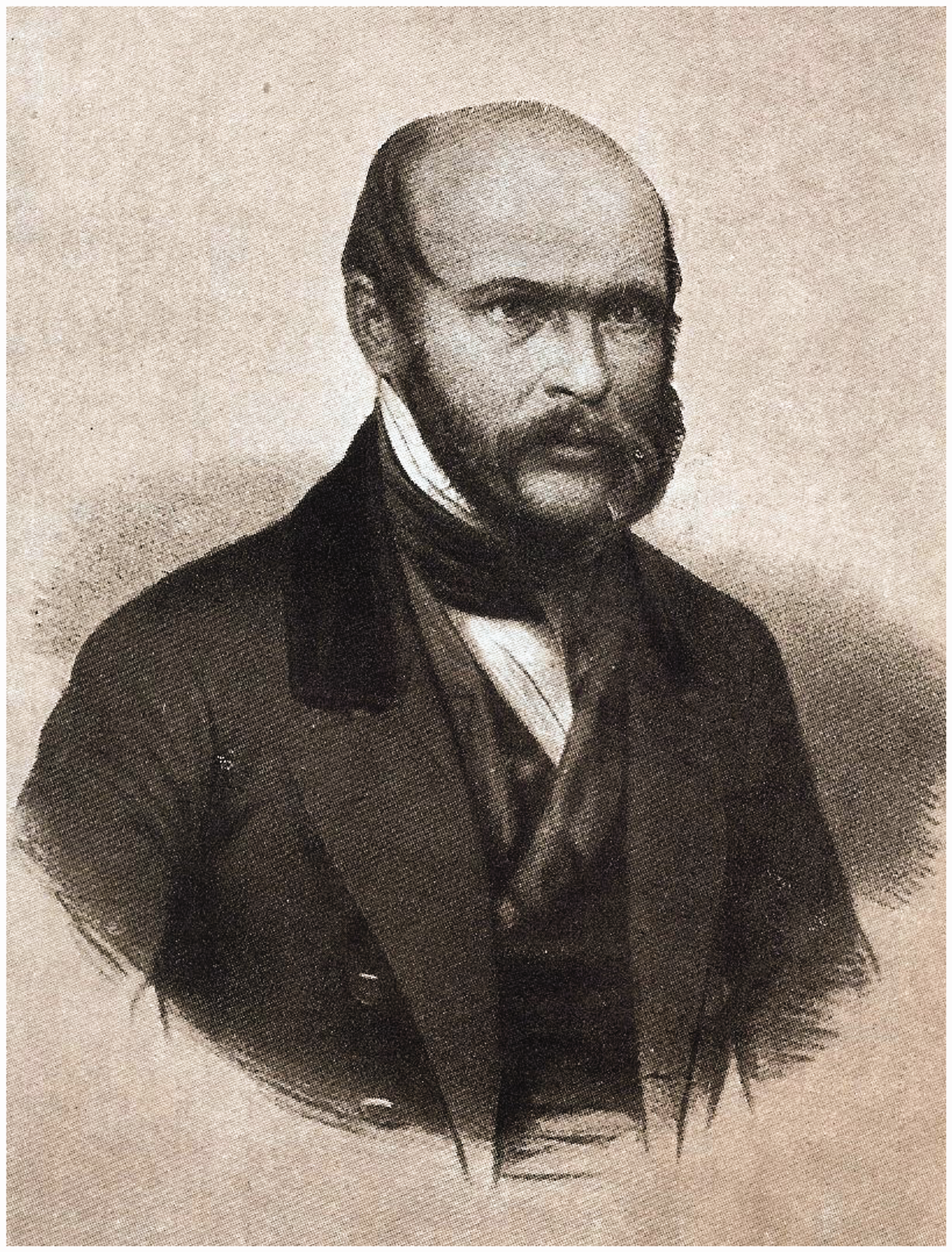
Grand Duchess Elena Pavlovna
Elena Pavlovna was born Princess Friederike Charlotte Marie von Württemberg on 7 January 1807 in the small southern German duchy of Württemberg. She died a Russian Grand Duchess in 1873.12,13 (Figure 2) She married Grand Duke Mikhail Pavlovich Romanov, the youngest son of Tsar Paul I and Tsarina Maria Fyodrovna in 1823. As the required first step towards her new identity as a Romanov, she was received into the Russian Orthodox Church and was given the name Elena Pavlovna; Elena as this was the closest saints feast in the Orthodox calendar to her birthday.
Grand Duchess Elena Pavlovna Romanova – van Württemberg, lithography by L. Noel of the portrait of F. Vinnergalter, 1863, Image No. 2549, Military Medical Museum of the Ministry of Defence of the Russian Federation, Saint Petersburg. Reproduced with their permission.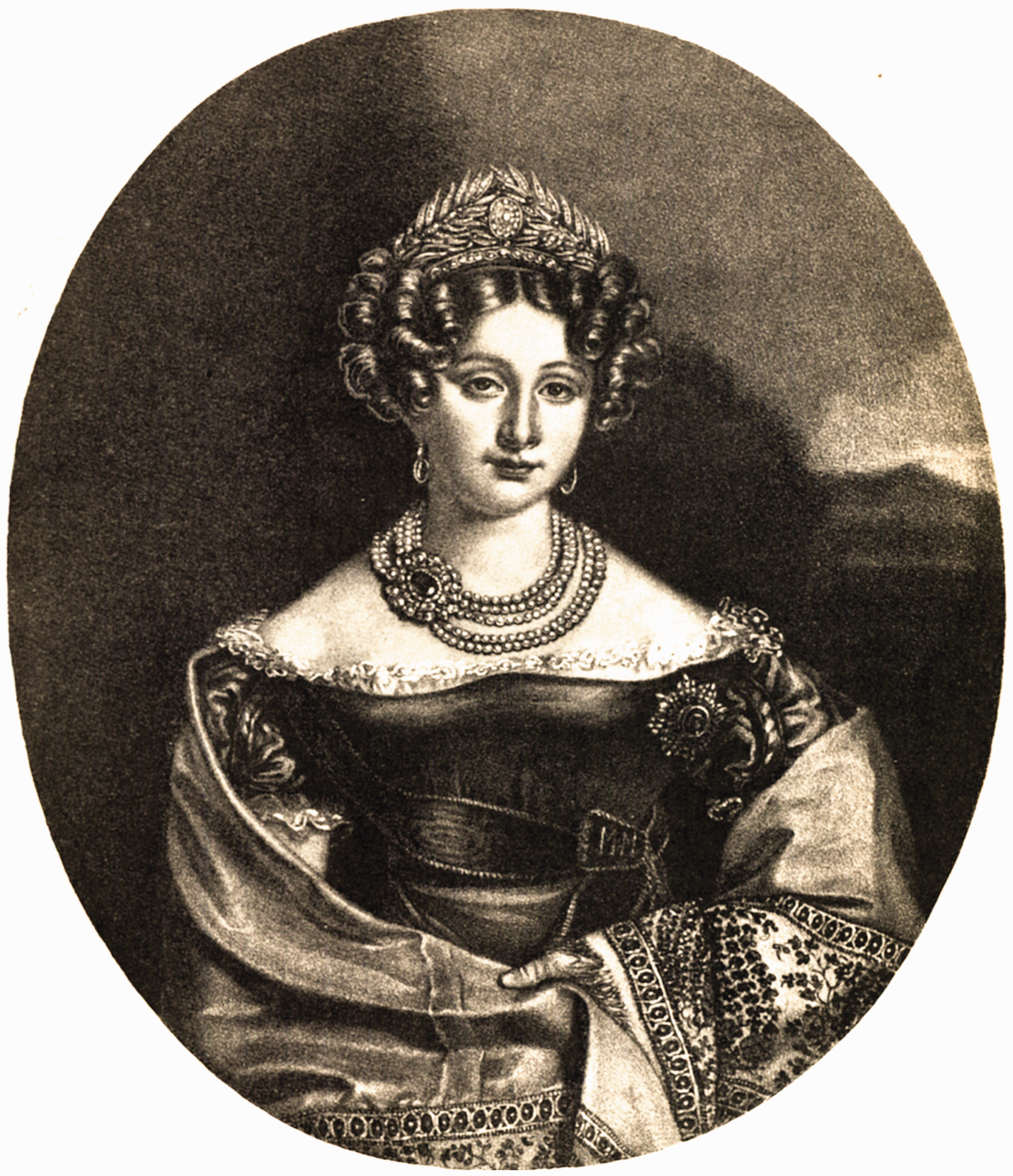
As sister-in-law of Tsar Nikolas I, she had easy access to him and the highest circles of Russian and European society. She was a close friend of Pirogov’s second wife, Baroness Aleksandra Bistrom. In 1828 after the death of her mother-in-law, Elena Pavlovna inherited the Mariinsky hospital. 14 After her own death in 1873, all her charities were merged into a single Foundation named after her, including among others St. Elena college for girls, the Exaltation of the Holy Cross Community and the Mariinsky hospital.9,14,15 Her first remarkable and entirely voluntary contribution to the Russian national cause was the creation of a community of nurses in 1854 shortly after the start of the Crimean War. Elena Pavlovna made very significant contributions to Russian society: in social welfare, medicine, science, music and the emancipation of the serfs, and she played a prominent role in the establishment of the Russian Red Cross.
Crimean War (1853–1856)
Nikolay Pirogov first met Elena Pavlovna in 1848 when, on his return to Saint Petersburg from the Caucasian War, she invited him to the Mikhailovsky Palace to learn more about the conflict and his involvement.12,13 She showed considerable appreciation of his work and shared many of his ideas for managing the casualties of war. By the outbreak of the Crimean War, they had come to know and respect each other and a long-lasting friendship had developed. During that war, she enabled the surgeon Nikolay Pirogov to transform Russian medicine and rescue untold numbers of wounded soldiers. It was then that Pirogov, with the support of Grand Duchess Elena Pavlovna, achieved his goal of giving women a significant role as nurses in civilian and military hospitals, and at the battlefield. 16 Nikolay Pirogov declared that the honour of introducing women’s role in healthcare belonged largely to her. 17 The role of Elena Pavlovna is extensively discussed in the book of M. Soroka and Ch.A. Ruud. 18
From the Crimean War soon reports reached Saint Petersburg of the untold numbers of wounded waiting in the open air, untreated and covered in blood-soaked greatcoats.16,19 During a visit to Paris in 1837, Nikolay Pirogov observed how women were involved in the care of hospital patients. He described his thoughts in his Sevastopol letters
16
I am forced to admit that at one moment in my life when, during a visit to a Paris hospital in 1837, by accident I saw women caring for patients. This was when I came to appreciate, more intuitively than by experience, the great significance of women participation in healthcare. Of course, women working in hospitals was not a new institution. Roman Catholic countries and later Protestant countries had established a role for women in the welfare of the sick. The participation of women was also accepted in Russia, where the compassionate widows worked in the Mariinsky Hospital. But up to now women have never been deployed in a theatre of war. The idea to send in force an organized group of women to the battle field was very risky. Nevertheless, the exceptional circumstances of the war and the distance to the war zone strengthened my resolve to form a group of educated nurses, and a few weeks later, they were sent.
16
At a meeting early in October 1854, Pirogov and Elena Pavlovna discussed ways of helping the army in Sevastopol.
12
Pirogov blamed many unnecessary deaths and complications on the chaotic accumulation of the wounded at the dressing stations. To prevent it, he wanted to introduce immediate triage of the wounded, but this would require considerable paramedical personnel close to the line of action. During their conversation, it transpired that they both had considered that women would be ideal for filling this role.12,19 The Grand Duchess told Pirogov of her plan to establish the Holy Cross Community of Nurses.12,16 Pirogov immediately gave his wholehearted approval. He believed that the female presence in the military hospitals would improve the moral atmosphere and curb hospital administration’s neglect of their duties, because women would be volunteers and therefore independent of officialdom. The following day the Tsar granted his consent to the Grand Duchess’ plan and appointed Pirogov by Imperial degree the overall head of the army medical services. Pirogov wrote later about his meeting with Elena Pavlovna: I had never seen the Grand Duchess in such an emotional state as on that day. With tears in her eyes … she said ‘Why didn’t you come to me sooner? Your request would have been granted and my plans would have been realised long ago … it is necessary to prepare quickly for departure because another large battle will likely take place within days.
12
In October 1854, Elena Pavlovna founded the Holy Cross Community of Nurses, a volunteer organisation.13,20,21 The volunteers underwent a short (few weeks) intensive training at the St. Petersburg Imperial Medico-Surgical Academy and other hospitals before they were sent to the Crimea, enabling them to lend support to surgeons working at the battlefront. They even attended operations carried out by well-known doctors, formers pupils of Pirogov.14,20,22 The Community was a unique organization as the nurses worked in military and civilian hospitals. The only other comparable Russian women’s organisation at the time was that of the Compassionate Widows, founded by Elena’s mother-in-law, Tsarina Maria Fyodrovna, but its members only worked in civilian hospitals. Maria Fyodrovna opened shelters in St Petersburg in 1803 to provide a home for impoverished widows of the nobility and their unmarried daughters. In return these ladies cared for the sick in her hospital for the poor.
In the autumn of 1854, Elena Pavlovna made an appeal to Russian women to train as nurses, and she turned her Mikhailovsky Palace in the centre of St. Petersburg into a military medical back office.14,20,22 Soon volunteers began to arrive at the Mikhailovsky Palace. They represented all sections of society. Although most were well educated and included the wives, widows or daughters of the nobility, landowners or military officers, there were also nuns from nursing orders and women from the poorer classes with limited education. The Grand Duchess paid expenses, but the work was unpaid; the volunteers were motivated by a sense of ‘patriotism and self-sacrifice’. The volunteers committed themselves to practice charity, kindness and to obey their superiors. They were not permitted to accept payment or gifts from the patients. These precautions were considered necessary because they would be working among thousands of men.
The Mikhailovsky Palace became a collecting point for the materials and medicines to be shipped to the Crimea. It received gifts such as drugs, bandages and linens, and many cash donations for the war effort.9,14 The Grand Duchess’ ladies-in-waiting even took on duties as seamstresses and together with volunteers made uniforms for the nurses.
The availability of charitable funds stimulated the formation of several other nursing communities, including the first secular Societies of Compassionate Widows, Sisters of Mercy and the Community of Compassionate Nuns of the Ascension Convent.9,14 Their establishment was the most important step in the development of medical education for women in Russia. Although Elena Pavlovna was deeply religious and while she based the objectives of her Community on Christian principles she made it clear from the onset that it should be a secular institution with no direct link to the orthodox Church.16,20 The name simply reflected the importance of their religion to most Russians. This contrasts with the suggestion by Elizabeth Murray that the community’s founding charter had a clear religious dimension. 23
When the Grand Duchess announced her plans for the community of nurses, there was scepticism and downright opposition from the military authorities, who were concerned that the presence of women in military hospitals would undermine military discipline.12,20,24 Fortunately, the Tsar’s authorization quelled resistance from the military. The Holy Cross Community of Nurses founded by Elena Pavlovna was a unique organization, both in its mandate, by ignoring man-made sectarian difficulties and because from its foundation it worked among others in military hospitals. After the Crimean War, it became the starting point for the Russian Red Cross founded with Elena Pavlovna’s support in 1867.12,13,24
The Grand Duchess demonstrated her organising ability by recruiting personnel, raising money and sending supplies to the war zone. Even the good external relations of Elena Pavlovna also were invaluable. When she learned that many soldiers in the war zone were suffering from malaria and there was a threatening shortage of quinine, the only treatment for malaria, she persuaded her brother, August of Württemberg, to buy at her expense a large quantity of quinine from Britain and have it shipped to Russia, despite the war ongoing between the two countries. 13
Another collaborator of Nikolay Pirogov and Elena Pavlovna was Ekaterina Bakunina, who had joined the Holy Cross Community of Nurses in December 1854. Ekaterina Bakunina was born in Saint Petersburg, where her father was the governor.15,25 She decided to become a nurse when she became aware of the tragedies of the Crimea War. Relatives and friends strongly opposed the idea, but she persevered. Grand Duchess Elena Pavlovna supported her and invited her to stay at her Saint Petersburg Palace.
She began her training as a nurse in the Second Landforce Hospital of the Imperial Medico-surgical Academy (now the Military Medical Academy named S.M. Kirov). Under the guidance of Dr. Chartoraev, she was taught how to bandage and care for wounds. She carried out day and night duties and during ward rounds assisted with changing patient’s bandages. After completing her training, she prepared herself for battlefield conditions by attending surgical operations by Dr. Nemmert, a pupil and successor to Pirogov as Professor of Hospital Surgery and Applied Anatomy at the Medical-Surgical Academy in Saint Petersburg. On one occasion, after a night shift, Bakunina was resting in her room when there was a knock on her door. It was Elena Pavlovna; she came in, sat down and with great interest asked how she had spent the night and how the shift had affected her. Until her departure for the Crimea, she often talked to the Grand Duchess. Bakunina became entrusted with the detachment of nurses who went to the Crimea.
The siege of Sevastopol
For most of the year 1854, the city of Sevastopol was under siege by the allied forces with constant bombardment from land and sea, with mounting casualties on both sides.16,19 By October 1854, there were close to 17,000 wounded in the Crimea, both Russian and other nationalities, most of them in Sevastopol and its surroundings. The grounds around the city became the main battlefield, where the Russian army suffered huge losses. The sick and wounded were treated in a network of dressing stations and field hospitals, which was made difficult by the continuous bombing of the city. When Pirogov arrived in Sevastopol, he was confronted with a medical situation of catastrophic proportions. The wounded were kept in the same rooms as patients with typhoid, and those who had undergone surgery were nursed adjacent to patients with gangrene. There was a severe shortage of virtually everything: beds, medical equipment, dressings and medicines. Pirogov wrote that he and his team “… often would work for 10 days from morning to night operating on those who should have undergone emergency surgery immediately after injury, but did not get the care for 2 - 3 weeks …” 16
On 5 November1854, the first group of nurses were invested in the Mikhailovsky Palace chapel. 18 The following day they left for Sevastopol, arriving in the Crimean Peninsula on 30 November. They were followed shortly thereafter by a regular flow of new female staff.17,26,27 Most were well educated, speaking several languages, and could interpret for the foreign wounded prisoners. The nurses provided aid to the wounded in the immediate vicinity of the combat zone. This contrasted with the nurses under Florence Nightingale, who were stationed in hospitals in Scutari, nowadays Üsküdar, near Constantinople, to which the wounded were ferried by ship, a journey that took about eight days from Balaclava. 28 During quiet times about 7000 and during intensified battles up to 13,000 casualties could be received at the field hospitals and first aid stations each day. The assistance of the nurses under such extreme situations was invaluable, with each nurse responsible for 100 to 200 casualties. 19
In December 1854, three other groups totalling 88 nurses from Saint Petersburg and Moscow, among them senior nurse Aleksandra Pavlovna Stachovich, started to work in the hospitals in Simferopol and Sevastopol and supported their colleagues.16,22,29 On 13 and 17 January1855, another two groups of nurses arrived, one led by Ekaterina Mikhailovna Bakunina. Pirogov trained the new arrivals to assist in operations and to care for the patients after surgery and distributed them among the various military hospitals. Due to the excessive workload, many of these nurses became exhausted and caught infectious diseases, from which some died. Twelve nurses committed suicide because they were no longer able to perform their work. 4
On 21 January 1855, Ekaterina Bakunina and her nurses began working in a part of Sevastopol that was under heavy attack. Bakunina was particularly popular with the nurses and the medical staff, to the displeasure of Stachovich, Matron of the Holy Cross Community. She was jealous of Bakunina and accused her of corruption to Elena Pavlovna.
16
This false accusation led to the dismissal of Stachovich. Pirogov called her “… The worst fishwife produced by the world …”
16
Ekaterina Khitrovo, formerly head of the Compassionate Widows of Odessa, was appointed by Elena Pavlovna as Matron of the Community of Nurses on 17 October 1855 after the dismissal of Aleksandra Stachovich, but Khitrovo insisted on the condition that it was only for the duration of the Crimean War.
30
Pirogov asked Khitrovo to take charge of monitoring the hospital management, the accounting systems and the stocks. In 1854, while still in Odessa, at the request of Elena Pavlovna, she taught widows in preparation for their move as nurses to the Crimean War. They arrived in the spring of 1855 and were sent to hospitals in Gerson, Nikolaev, Perekop, and Sevastopol. In a letter to his wife, Pirogov wrote that “… Khitrovo and Bakunina are the pillars of the organisation of women’s aid. Bakunina despite her education is prepared to work as a ward orderly during the transports of the sick. Khitrovo as an experienced woman keeps me posted about the internal affairs and activities. Every evening we discuss the daily reports of our work …”
16
Elena Pavlovna and Pirogov considered that Bakunina should take over the leadership of the community since they considered her the only person who could uphold its original mission. In a handwritten note to Bakunina – a mark of special attention – Elena Pavlovna wrote “… Dear Ekaterina Mikhailovna! Do you want to console me and the community in the enormous loss we have sustained? Will you accept the difficult position of the superior for a year? …’ 18 Bakunina accepted and in February 1856 was appointed Matron of the whole community as successor of Ekaterina Aleksandrovna Khitrovo, a post she held until 1860. After her appointment, she visited all the military hospitals in the Crimea and became an example of patience and tireless work for all. 16
After the war, Bakunina and Pirogov remained good friends.15,16,29 In 1859, Bakunina went to Germany and France to study the role of nurses in those countries. On her return, she disagreed with Grand Duchess Elena Pavlovna on several issues, including the future of the Sisters of Mercy, and left Saint Petersburg. She also had doubts about her own mission in healthcare, although Pirogov advised her to follow her intuitions and to keep her options open as he wrote “… you are almost a doctor yourself … not by education but by enormous practise”.15,16 She decided to establish her own nursing community “Kazitsyna” in a hospital in the Tver Province, remaining there until her death in 1894.
Pirogov as the senior medical authority
Because of a constant flow of nurses, Pirogov finally had sufficient female staff.
19
In March 1855, Pirogov took upon himself the overall management of all first aid posts and hospitals. Because of the complex work load, he decided to form the nursing staff into specialised groups. He divided them into bandage masters helping surgeons, pharmacy assistants preparing drugs and supervising their distribution and housekeepers taking care of clean linen and the sick also supervising the doctors and the administrative staff. Pirogov’s confidence in the nurses allowed them to show their full potential. He was unstinting in their praise. He wrote ‘The women bore superhuman strain without a murmur, with the greatest selflessness and resignation. Their conduct towards the surgeons and their assistants was exemplary; their treatment of the patients was of the kindest and all their activities … cannot be qualified other than noble’.
16
… Each evening Khitrovo and Karzova come to see me with schemes to catch the hospital thieves … Karzova is simply tireless, spends days and nights in the hospital, cooks for the patients, changes dressings, does everything. Despite all her efforts we failed in finding out why the chicken soup prepared with 90 chickens for 360 patients lacked the proper taste. When the sisters do the cooking their soup tastes much better even though they use fewer fowl. It is a pity: the amount assigned is such that one could feed the patient well, yet they get no nourishment at all …
16
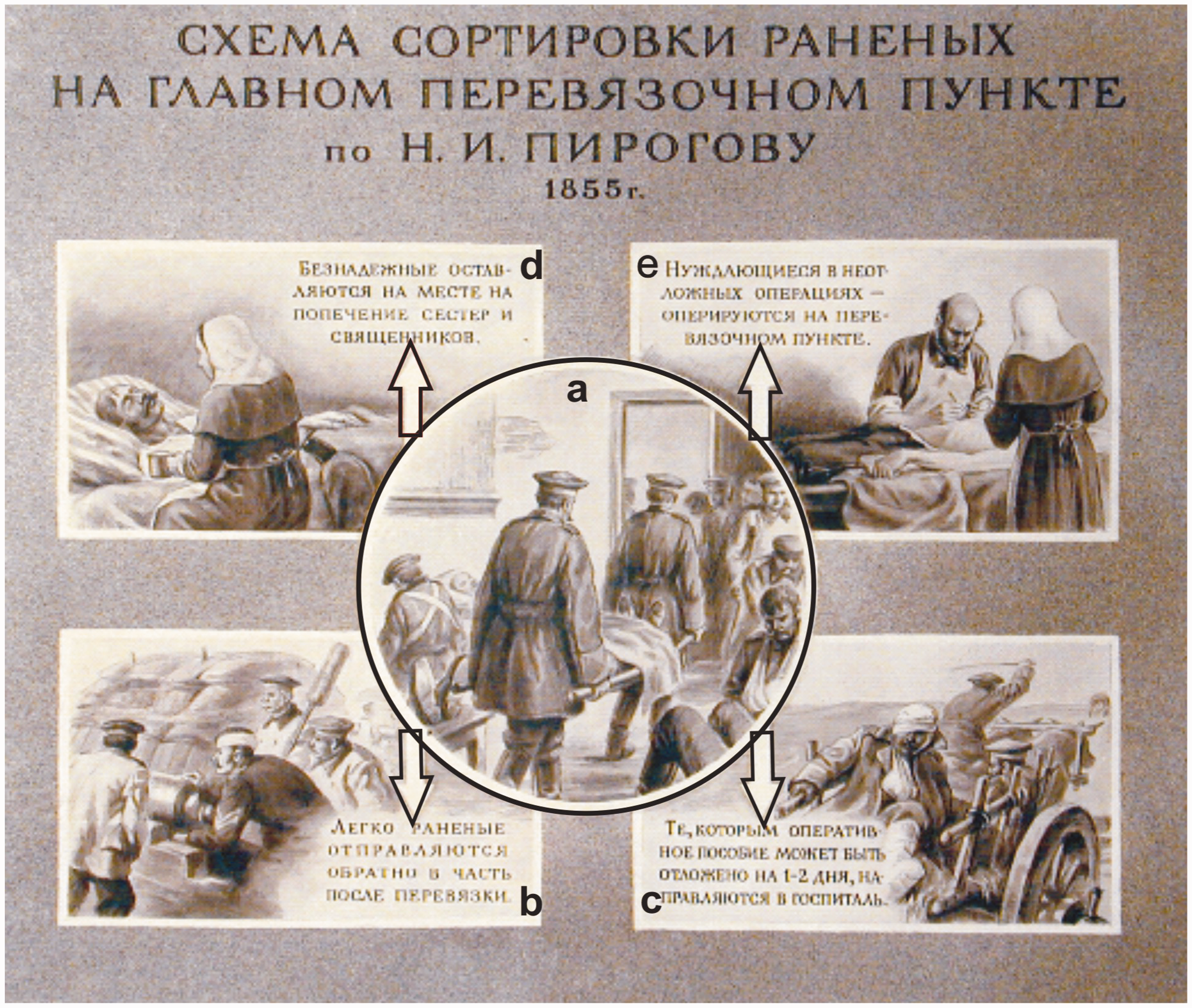
To deal with the massive influx of injured, Pirogov adopted and modified the use of triage earlier used by the French military surgeon Dominique-Jean Larrey in the management of mass casualties.9,16,19 Pirogov divided the medical facilities into three sections: dressing stations right at the front, a flying brigade, and emergency field hospitals some distance behind the front.9,16,19 (Figure 3) The doctors and nurses were allocated into six groups:
The first four groups were responsible for carrying out triage and the management of patients according to their allocation by the triage team. Pharmacy assistants were responsible for supplying drugs. The house keepers served meals to patients able or allowed to eat.
Triage scheme for the wounded at the main dressing station by NI Pirogov, 1855. (a) Wounded arriving at the dressing station. (b) The walking wounded with only minor injuries are returned to their unit after treatment. (c) Those requiring non-urgent surgery (within one to two days) are transferred to the hospital. (d) Those whose wounds are so severe that they are unlikely to survive are cared for by nurses and priests. (e) The severely wounded needing emergency surgery are operated on by N.I. Pirogov, Poster, 1950. Image No. 38010, Military Medical Museum of the Ministry of Defence of the Russian Federation, Saint Petersburg. Reproduced with their permission.
In the spring of 1855, when the fighting intensified, the management changes introduced by Pirogov proved their worth. The personnel knew now how to perform triage with an improved outcome for the patients with fewer severe casualties as a result. They also were less exhausted, with less disease and improved job satisfaction. The escalating violence made it necessary to evacuate the wounded and transfer them to the building of the Noble Assembly in Sevastopol.
19
(Figure 4) This became the main dressing station, where Pirogov now spent most of his time. The ballroom was filled with beds and tables for bandages, and the billiard room was converted into an operating room, whose floor soon became covered in blood. In the dance hall, hundreds of amputees were nursed and in the great hall instead of dance music, the groans of the wounded were heard. Ten doctors and eight nurses worked vigilantly, alternating day and night, operating and caring for the wounded. In one period of 36 h, 7 surgeons performed 58 major operations, with the assistance of Ekaterina Bakunina. One day a bomb blew a corner of the room away, where Bakunina was assisting in surgery. Fortunately, she and the surgical team stayed unharmed.15–17 Other nurses assisted in minor surgeries, monitored the medicines, the pharmacy stock and kept an account of the personal belongings and money of the soldiers, given to them for safe keeping.
Pirogov at the main dressing station in 1855, oil on canvas, artist M.P. Trufanov, 1960, Image No. 60743, Military Medical Museum of the Ministry of Defence of the Russian Federation, Saint Petersburg. Reproduced with their permission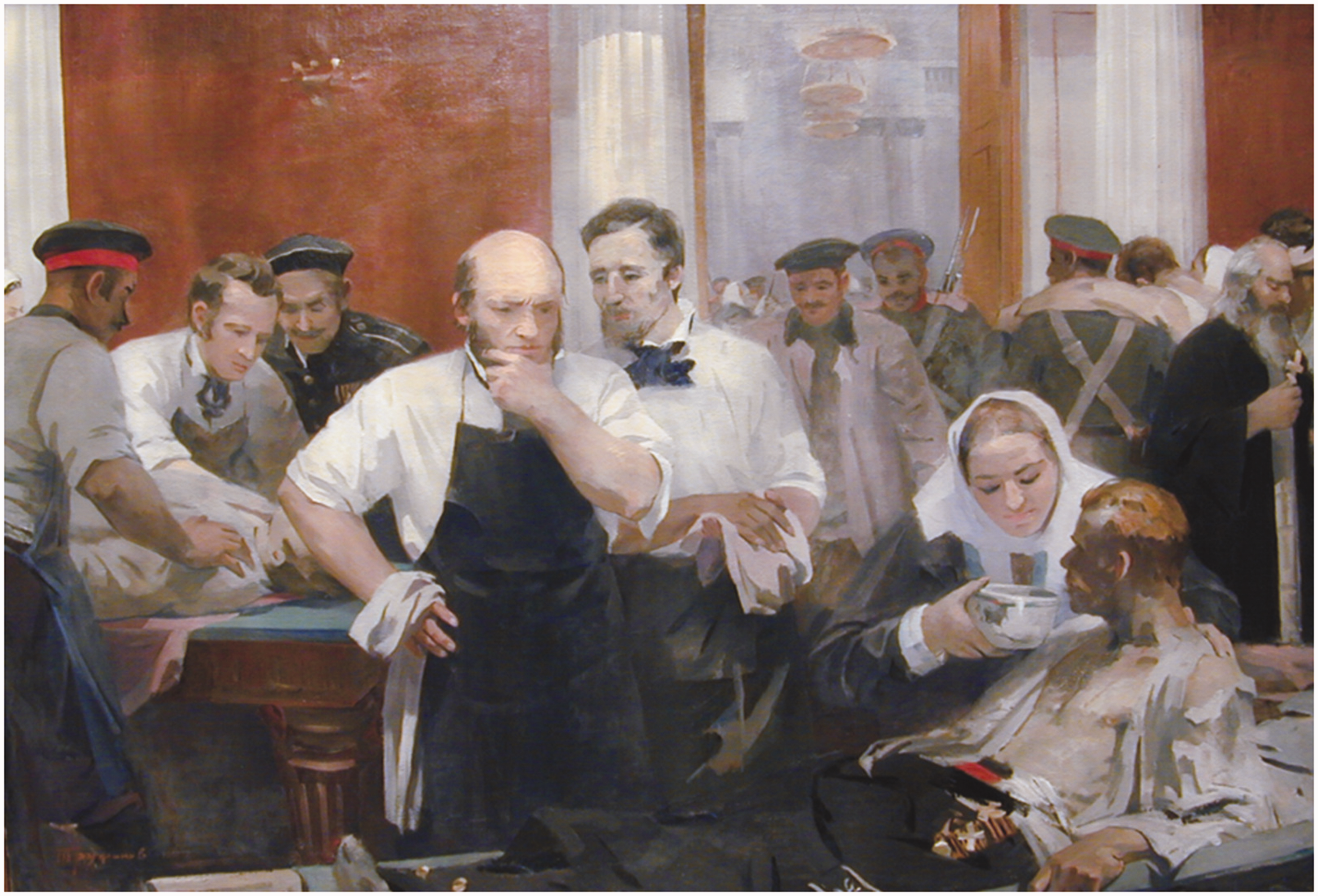
On 23 May 1855, Pirogov returned to St. Petersburg for six weeks. He wanted to “… contribute something to change the military-medical affairs in Sevastopol for the better …” 16 He was also exhausted and wanted to satisfy his family about his health. But above all, he was deeply upset by the disorder and the most egregious abuses of the administration. Immediately on his return, he submitted a note to the Minister of War About the organization of the care for the wounded, in which he outlined several organizational changes in the management of the military medical service that he felt were needed to improve the treatment of the wounded and sick. Not waiting for an answer, he and a group of newly recruited doctors, among them Sergey P. Botkin, returned on 28 August 1855 to the war zone.16,33
Convoys of the wounded
During his return journey to the Crimea, Pirogov saw at first hand the poor conditions of the transport of the wounded. 19 Back in the Crimea, he created departments responsible for transportation staffed by nurses, with Ekaterina Bakunina in charge of the convoys for the sick and wounded to hospitals outside the Crimea. Uncomfortable farm carts were used for transport, with each cart carrying three or four soldiers. Together the carts would form a convoy with about 500 injured soldiers. The journeys lasted six or more days, often under the most severe weather conditions: heavy rain and temperatures of −20℃. By the end of 1855 Ekaterina Bakunina had led four such convoys.
Peace negotiations to end the hostilities began in September 1855 and on 18 March 1856, the warring parties signed a peace treaty in Paris. 34 Persistent rain during that winter made it cold and damp in the military hospitals. The nurses wore soldiers' boots to enable them to attend to the sick and wounded. Typhus, malaria, scurvy, dysentery and cholera were prevalent. Every day between 10 and 20 of the wounded died. In the same period, 17 of the 202 nurses died from typhus. After the peace, 158 nurses received an award, such as the gilded cross and bronze medals; 68 were decorated with the medal ‘For the Defence of Sevastopol’ and awarded pensions.16,29
After the Crimean war, the nurses received from society the social recognition they deserved, and this resulted in the establishment of still more nursing Communities. They were treated as heroes, praised by the authorities and public alike. 24 Their actions in the Crimea and the subsequent public recognition went a considerable way to establishing public acceptance of nursing and more generally the role of women in Russian society. The members of the Holy Cross Community of Nurses continued their nursing work after the Crimean War. 35 The Holy Cross Community of Nurses are regarded as the model for the Russian Red Cross nursing societies, which were established from 1867 onwards, to provide nurses for times of conflict and emergency.24,29 In 1867, Tsar Alexandre II signed the Treaty of the Geneva Convention. The Russian Red Cross developed rather fast. Over time, all the already exiting communities with it nurses and the newly created communities after the Crimean War joined the Russian Red Cross. In 1877, seven Russian Red Cross Communities existed and together they permanently employed 279 Sisters of Mercy. In 1898 existed 65 Communities and employed more than 2800 nurses. 24 In peacetime, their expertise was extremely valuable during the famine and the cholera epidemics in 1891–1892. They were almost entirely responsible for the deployment of nurses to civilian and military hospitals, medical centres and other care institutes.24,29
After the Crimean War Pirogov resigned from the Imperial Medico-Surgical Academy, thereafter he devoted his time to advancing the cause of medical education 9 and also put much effort in his work for the Russian and International Red Cross.36,37
Conclusion
Significant advances in the participation of Russian women in healthcare took place in the 19th Century as their role became more structured and better organised. The Crimean war was a major stimulus for the further participation of women in healthcare, largely due to the initiatives of the surgeon Nikolay Ivanovich Pirogov and the Grand Duchess Elena Pavlovna. The assistance of nurses under such extreme situations was invaluable. Seventeen Russian nurses died, and those who survived continued their nursing careers and became the foundation for what later became the Russian Red Cross, established in 1867.
Footnotes
Acknowledgments
The authors are grateful for the immense and generous help and support they received from Mrs. Liudmila B. Narusova, President of the Anatoly Sobchak Foundation, for allowing access to the archives of museums and libraries in Saint Petersburg. We are also very thankful to Prof. Dr. A.A. Budko, director of the Military Medical Museum in Saint Petersburg, for his kind support and enthusiasm. We wish to express our special thanks for the help of the late Mr. Anton N. Gubankov, former head of the Cultural Department of the Ministry of Defence of the Russian Federation. Unfortunately, Anton was killed in a plane crash on 25 December 2016. Without his help and support our task in researching the material for this article would have been immensely more difficult. He will be sadly missed.
Declaration of conflicting interests
The author(s) declared no potential conflicts of interest with respect to the research, authorship, and/or publication of this article.
Funding
The author(s) received no financial support for the research, authorship, and/or publication of this article.