




Abstract
Roy Lee Moodie was a geologist whose interest in ancient disease was stimulated by his finding of pathological change in some of the fossils that he studied, including many from the Rancho La Brea site in California. He occupied teaching positions in Chicago, Dallas and Santa Monica and in 1928 began an acquaintance and a correspondence with Henry Wellcome who was then in the United States and appearing before the Senate Committee on Foreign Affairs. Moodie persuaded Wellcome to sponsor his palaeopathological work and the following year he was appointed palaeopathologist to the Wellcome Historical Medical Museum (WHMM) at a salary of six thousand dollars a year, the first person to hold such a title and the first and only occupant of the title at the WHMM or its successor organisations. He published extensively from 1915 until his death in 1934, including his great compendium Paleopathology; an Introduction to the Study of Ancient Evidences of Disease, and the collected papers of Sir Marc Armand Ruffer. He is perhaps best remembered or, at least, most widely quoted for attributing the beginnings of palaeopathology to a publication of Esper in 1774 although the passage in which he did so contained two major errors that have been perpetuated in the literature ever since, the authorship of the publication and the diagnosis of the lesion that he supposed began the study of disease in antiquity.
Introduction
Roy Lee Moodie was born in Bowling Green, Kentucky in 1880 and received his undergraduate training in geology at the University of Kansas, graduating AB in 1905. While there he came under the influence of Samuel Wendell Williston (1851–1918) and accompanied him in the year of his graduation on a trip to Willow Creek, Wyoming to dig up fossils. Williston was appointed Professor of Palaeontology at the University of Chicago in 1902 whither Moodie followed him to undertake his postgraduate studies, graduating with a PhD in 1908. Details of his life thereafter are somewhat sketchy although it is known that he held teaching positions in zoology and biology before taking up the post of Professor of Anatomy at Baylor University in Dallas in 1913. Evidently he did not linger long in Dallas as the following year found him at the University of Illinois College of Medicine where first he was Instructor in Anatomy and then Associate Professor. The fact that he took a more junior post to move to Chicago suggests that his time in Dallas had not been very satisfactory although we do not know why. He had a sabbatical year in Southern California in 1923 and finally moved to California in 1928 when he became Professor of Palaeontology at the University of Southern California College of Dentistry, taking up residence in Santa Monica. His sojourn in California provided him with the opportunity to study fossils from the famous site of Rancho La Brea which is situated on the Santa Monica Plain and he published a long series of short articles between 1926 and 1933 on the dental and skeletal pathology of several species found at the site.
Moodie was, in fact, a prolific publisher and a great synthesiser; his Paleopathology published in 1923 1 is a vast compendium of what was then known about the subject, copiously illustrated and referenced. The book was not without its critics however and George Sarton (1884–1956) said that the author tended to be ‘digressive’ and that some of his diagnoses were uncertain 2 while the normally courteous and reserved Percy Stocks (1880–1974), who was then working as a medical statistician in Karl Pearson’s laboratory at University College London, was much more scathing. ‘[T]he book is spoilt by much repetition and much fanciful deduction from insufficient evidence’ he wrote, while Moodie’s suggestion that certain fossils showed the animals died from poisoning on account of backward curves to their necks ‘rather tempted us to laughter’. 3 In the book, Moodie perpetrated an error concerning the beginnings of palaeopathology that has been quoted widely but never corrected until now.
The beginnings of palaeopathology
The widely held view that the discipline of palaeopathology began in 1774 with the publications of Esper’s account of a lesion seen in some fossil cave bear bones found in caves in Bavaria takes its origin from a note on page 62 of Moodie’s Paleopathology where he wrote The earliest reference in paleontological literature of the pathological nature of fossil bones was by EJC Esper (1742–1810), Professor at Erlangen, in 1774 as cited by Goldfuss. Esper described on the lower half of the femur of a cave bear (Ursus spelaeus) what he regarded as an osteosarcoma.
1
Dass es der Rest von einem osse Femoris, und zwar ab der untere Theil desselbigen ist, zeigt sich von slebst. Nur muss ich sagen, dass die grosse Dicke von c. genen d. ein Callus ist, mit welchem die Natur einem Bruch dieser Röhre wieder geheilt.
5
Illustration of the lesion in a fossil cave bear femur in JF Esper’s 1774 publication. A line has been drawn between the points c and d referred to by Esper as the site of callus around a healed fracture. There seems very little in this illustration to support the view that the bone was fractured, still less that is was the site of an osteosarcoma as stated by Moodie.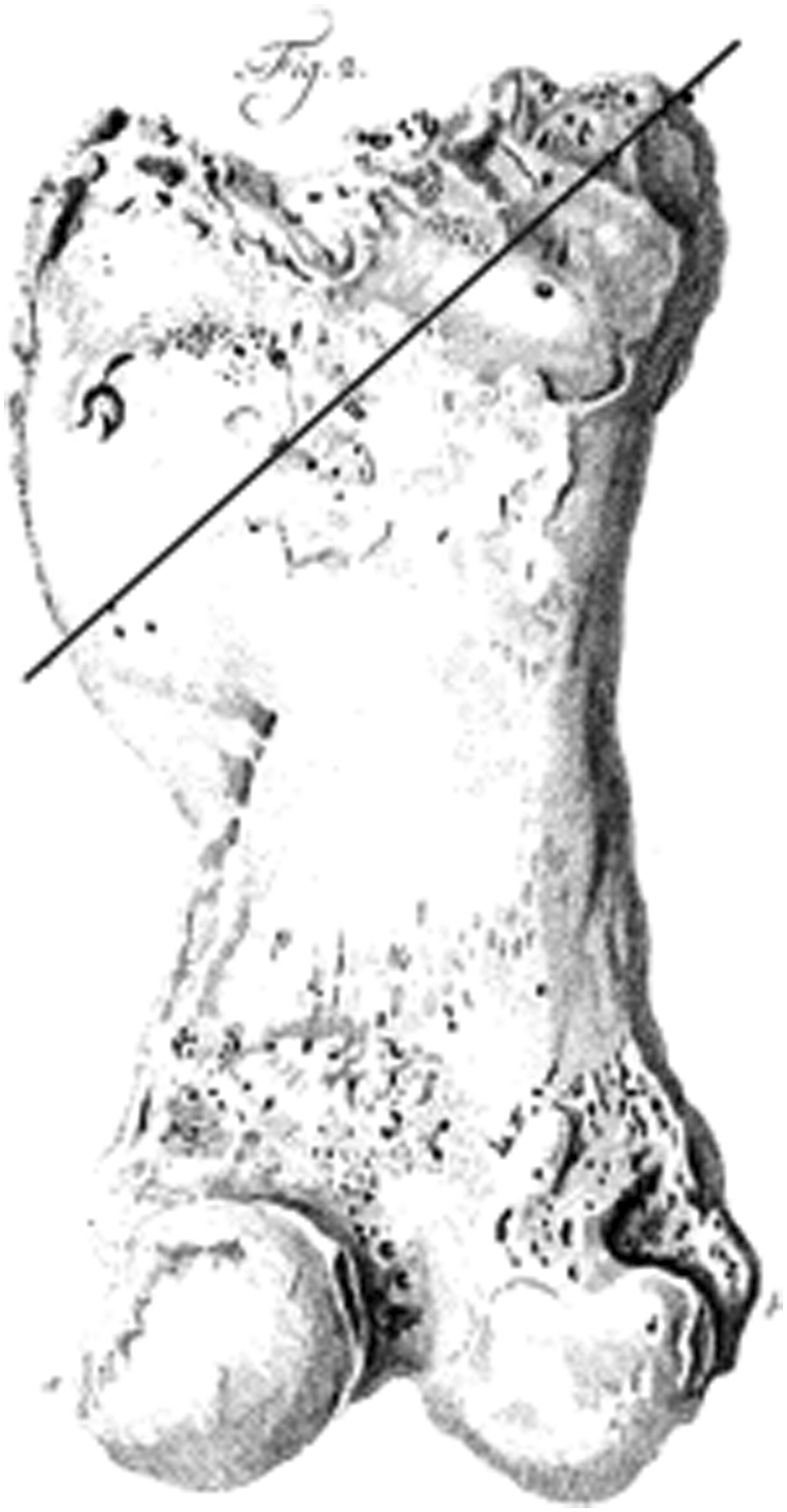
Georg August Goldfuss (1882–1848), Professor of Zoology at Erlangen and to whom Moodie refers, did indeed mention Esper, and gave the correct reference to Esper’s book (p. 144) and writes (p. 276) Esper giebt (tab 14 F2 s74) die Abbildung einer Hüftknochens, welcher spuren eines Bruches zeigt, den ein Callus wieder verband
6
Esper provides the illustration of a hip-bone, which shows traces of a break, which a callus has connected again.
That otherwise impeccable historian, Henry Sigerist (1891–1957), ascribes the work to the younger (EJC) Esper 7 while Douglas Uberlaker identifies the correct Esper and questions the diagnosis of osteosarcoma but still considers Esper’s publication as the event that inaugurated palaeopathology as a scientific discipline. 8
Erwin Ackerknecht (1906–1988) fails to identify which Esper was the author, contenting himself to say that ‘The first observations on a pathological fossil bone were published by Esper in 1774’ but he does infer that the Esper in question referred to the lesion as a ‘sarcoma’. 9
Arthur Aufdeheide and Conrado Rodriguez-Martin allow Johann Friedrich to be the author (although they spell his second name incorrectly) but go on to state that he correctly diagnosed an osteosarcoma, 10 while Marc Micozzi repeats both errors, author and diagnosis. 11
Apart from the error in authorship, there is also the not inconsiderable problem that Esper could not, at the time, have used either the term ‘sarcoma’ or ‘osteosarcoma’. The former was not introduced into medical parlance until 1804 by John Abernethy (1764–1831), the English anatomist and surgeon, and the latter not until 1805 by Alexis Boyer (1757–1833) who was personal surgeon to Napoleon Bonaparte.
There is little doubt that Esper described what he thought was a healed fracture although the illustration he provided is not very convincing (see Figure 1). There also seems to be some doubt as to whether all of those who wrote after Moodie had read the original; Moodie himself certainly had not, as he confessed to Henry Wellcome in a letter written in 1931:
12
In 1774 one EJC Esper, a professor in one of the schools, possibly a medical school at Erlangen, published a pamphlet [sic] in which he described what he took to be an osteosarcoma on the lower half of a cave bear femur. This was probably a healed fracture. I have never seen the pamphlet but it should be possible to secure a copy.
The first palaeopathologist
In the century and a half between the publication of Esper’s book and Moodie’s reference to it, the main pre-occupation of those who were interested in human remains was in the morphology of the skull and in determining cranial capacity (as a surrogate for brain size) with the intention of ranking what were then thought of as the various races of mankind in order of brain size and thus, by inference, in order of intelligence, anticipating that this would demonstrate the primacy of the white European races.
Palaeopathological work was not entirely eclipsed, however, including, in the latter part of the nineteenth century, admittedly a minor contribution made by probably the most important pathologist ever to enter the field, Rudolf Virchow (1821–1902). Virchow was much more interested in anthropology than in palaeopathology and published over a hundred papers on the former, many dealing with the morphology of the skull. His first mention of palaeopathology occurs in a footnote to a paper of 1870 in which, as a throwaway remark, he states that ‘while in Balve, I saw a dorsal vertebra of a cave bear which had been greatly deformed by… spondylitis deformans’ by which he meant that the vertebra showed the presence of marginal osteophytes. He did not return to the pathology of the cave bear until many years later in a publication that dealt with lesions which he thought were analogous to human osteoarthritis and which he referred to as cave-gout (Höhlengicht). Famously he also wrote about the Neanderthal skeleton that he considered was afflicted by osteoarthritis and by rickets, and of exostoses and hyperostosis in Pithecanthropus (Java Man). Despite Sarton crediting him with fathering the discipline, it is doubtful in the extreme that he would ever have described himself as a palaeopathologist nor did he ever express any particular interest in the subject. 14
On the other hand, it is possible, even likely, that Marc Armand Ruffer (1859–1917) would have so described himself, had he ever been asked. After qualifying in medicine at University College London, Ruffer worked at L’Institut Pasteur with Pasteur and Metchnikoff before becoming the first Director of the British Institute of Preventive Medicine in 1891 and subsequently accepting the Chair of Bacteriology in the Medical School in Cairo in 1896. There he came into contact with Grafton Elliot Smith (1871–1937), Professor of Anatomy in Cairo, who, with Frederik Wood Jones (1879–1954) and later Douglas Derry (1974–1961) examined the bodies excavated by George Reisner (1867–1942) before the flooding of the Nubian Cemeteries by the raising of the Aswan Dam in 1907. Ruffer specialised in the histological examination of mummified tissues and published several papers between 1910 and 1919, some appearing after his death at sea in 1917. 15 He also thought he had coined the term ‘palaeopathology’ in a publication of 1913 but, in fact, he had been anticipated by 20 years by Robert Wilson Schufeldt (1851–1934) who used the term in a paper on fossil bird bones published in Popular Science Monthly in 1893. 16
Ruffer’s papers were collected together after his death, at the instigation of his widow, and published with a short biographical sketch by Moodie that was an adapted and enlarged version of an obituary published earlier by Fielding Hudson Garrison (1870–1935); this volume was one of Moodie’s most important contributions to the subject. 17 Elliot Smith reviewed Moodie’s Antiquity of Disease and the Ruffer volume in 1923 and found Moodie’s account of how work had started in Egypt ‘quite fictitious’ and gave his own version which, characteristically, did little to underplay his own part in it. According to Elliot Smith, he asked Ruffer whether he could detect tubercle bacilli in a psoas abscess found in a mummy from among the Priests of Amun with tuberculosis. ‘This’, he wrote, ‘started Sir Armand on the work’. 18
It was Moodie, though, on whom the official title of palaeopathologist was first bestowed. Moodie was appointed palaeopathologist by that inveterate collector of medical and other curiosities, Henry Wellcome (1853–1936) whom he seems to have met and begun to correspond with early in 1928, probably when Wellcome was in America giving evidence to the Senate Committee on Foreign Affairs in support of the Gorgas Memorial Laboratory Bill that was approved in April of that year. On 2 March 1928, Moodie wrote to Wellcome to ask whether he would give him five thousand dollars a year for five years in order that he could continue his research studies on the diseases of ancient Peruvians, based on a study of their mummies. Wellcome took his time to consider the offer but then, sometime in 1929, seems to have made him a better offer since Moodie wrote (on 9 October) ‘I am now ready to undertake the work that you outlined yesterday, devoting my entire time to your work’; well, perhaps not all his time since he made it clear to Wellcome that he wished to retain his Professorship at the College of Dentistry. Wellcome offered to put Moodie on the Staff of the Wellcome Historical Medical Museum (WHMM) at a salary of six thousand dollars a year but seems to have neglected to mention a starting date and Moodie had to write to ask when ‘you wish my new, and very happy, appointment to begin?’ Wellcome replied on 21 October enclosing Moodie’s first monthly cheque following up with a cable that told him tersely that the appointment had begun on the first of that month.
Having received and accepted the offer, Moodie quickly became concerned about his title; he enquired about this in a letter of 27 November 1929 but he had still not heard from Wellcome by the following March. The matter was now getting somewhat urgent as Moodie wished to display his new position on the title page of his forthcoming book on the radiography of some of the Egyptian and Peruvian mummies in the Field Museum in Chicago. Despite this, he had to wait until 5 June 1930 before Wellcome replied to say that he authorised the use of the title of Palaeopathologist to the WHMM, London. Moodie was much relieved but, nevertheless, still managed to get the position wrong on the title page of his mummy book (Roentgenologic Studies of Egyptian and Peruvian Mummies 19 ) where he is described as Palaeopathologist to the Wellcome Historical Museum, London (no Medical).
Moodie’s principal duties for Wellcome seem to have been to provide the WHMM with specimens, books, pamphlets, photographs, X‐rays and manuscripts that he posted to London with great regularity – some two hundred packages arrived in London from him by the end of 1931, for example. Among the specimens he sent to London was the cast of a tumour from a phytosaur which, he says, he wished to be ‘sectioned by a lapidary so I can reach some conclusion of the kind of tumor it is’ (4 March 1931). The traffic was achieved at some considerable expense; in November and December of 1930 alone Moodie invoiced Wellcome for $714.49. To help with the work, Moodie had employed an assistant, James McPherson who, after working with Moodie for four years in a part-time capacity, left in 1931 to set up his dental practice, having qualified presumably at Moodie’s dental college. Moodie fired off another letter to Wellcome asking for permission to employ another student from the college (Chester FitzSimmons) at a salary of $40 a month; there is no trace of Wellcome’s reply – if there ever was one.
The flow of correspondence from California to London generally seems to have been somewhat one-sided and, in particular, Wellcome or, more likely, his administrators were not always very assiduous in sending Moodie his monthly salary. ‘I need your help’ he wrote to Wellcome on 17 February 1931, ‘I am nearly out of money’. One wonders whether the dental job was still paying. When cheques do arrive Moodie is both relieved and grateful: ‘I never cease experiencing a thrill of gratitude to you and your kindness’ (31 July 1931) he writes rather obsequiously. The letter requesting the ‘pamphlet’ by Esper has been referred to above; with it Moodie enclosed a bundle of a thousand bibliographic reference cards, ‘carefully typed relating to the study of Paleopathology’ and a photograph of his single storey house (which is still in the file of correspondence). Moodie’s appointment was unfortunately rather short for he died in 1934 at the age of 54 following a fall on a cement floor, only two years before his benefactor, and his much valued title died with him for the Museum has never appointed a successor.
Comet for a season
Moodie’s death marked the beginning of a stagnant period in palaeopathology and it was not until the late 1950s or 1960s that there was anything like a revival in its fortunes. Lawrence Angel (1915–1986) considered that what he called the modern period of palaeopathology was ushered in by three events – the publication of a symposium on palaeopathology held in Washington in 1965 and edited by Saul Jarcho, the publication in 1967 of Diseases in Antiquity (edited by Don Brothwell and Andrew Sandison), and the founding of the Paleopathology Association by Aidan and Eve Cockburn and other colleagues in 1973. 20
Moodie himself is nowadays a somewhat peripheral figure in the history of the subject and seldom referred to, unless it is to repeat his reference to Esper. His publications, which averaged six a year from 1918 to his death in 1934, were wide-ranging, covering everything from extinct animals to Peruvian mummies and subjects as diverse of the cusp of Carabelli to the fossilisation of red blood cells. His Paleopathology, although now somewhat dated in its interpretations and diagnoses, nevertheless provides generally an adequate account of the development of the subject up to the 1920s and is valuable for its references, including many in the early French and German literature, while the book on X-raying mummies represents an important contribution to this aspect of the study of human remains, again with some useful historical notes. Of the collection of artefacts and specimens that he made for Henry Wellcome there seems to be no trace and perhaps these items were included in the many that were sold or otherwise disposed by Wellcome’s trustees after his death. Perhaps he was merely a comet for a season, illuminating the field only briefly, but he deserves to be better remembered, not simply because he initiated an error about the beginnings of palaeopathology that has reverberated through the palaeopathological literature, but for being the first true palaeopathologist, at least by title.