




Abstract
This study presents an optimization framework to enhance the thermal buckling temperature of a variable angle tow (VAT) laminated composite plate. A finite element model is formulated using first-order shear deformation theory and eight-nodes iso-parametric elements. The developed model is validated by comparing the results of the present model with the existing benchmark solution. A genetic algorithm is employed to optimize the fibre’s path using MATLAB. The effect of geometric and material characteristics, such fiber orientation, aspect ratio, boundary conditions, material anisotropy, and thermal expansion coefficients is extensively examined. The results show that finite element-based optimization can improve the critical buckling temperature by up to 111.76%. These insights are valuable for the efficient structural design of variable-angle tows composite plates, offering potential benefits for various engineering applications.
Keywords
Introduction
Composite material consists of two or more distinct constituents combined at a macroscopic level, resulting in enhanced characteristics such as a high strength-to-weight ratio.1,2 Common composite systems are carbon fiber-reinforced composite, glass fiber-reinforced composite, carbon nanotube reinforced composites, and metal- or ceramic-matrix composites. Compared to traditional metals, laminated fiber-reinforced composites offer superior weight efficiency, specific strength, and stiffness. 3 These materials typically contain straight, unidirectional fibers with uniform orientation within each ply. This leads to a constant stiffness of each layer, limiting the use of typical composite materials under specific conditions, such as those containing holes. 4 With gradual advances in Automated Fiber Placement (AFP) technology, 5 VAT composites exhibit superior mechanical properties and design capabilities compared to constant-stiffness composites (CSC) with straight fibers. Structures made up of layers of fiber-reinforced composite materials with different fiber orientations within each layer are referred to as Variable Angle Tow (VAT) composite laminates. Lozano et al. 6 publish a review paper to discuss the various manufacturing aspects of the VAT composites. In conventional laminates, the fibers in each layer of are usually aligned in one direction, whereas the fibers of VAT laminates are arranged at various angles within the same layer. It results in improved mechanical properties. The fiber orientation of VAT laminates can change within a single layer either continuously or discretely. Automated Fiber Placement (AFP) machines is capable of precisely control the insertion of fibers at varying angles. In VAT laminates, by varying the fiber orientation within each layer can exhibit specific mechanical properties in different direction such as stiffness, strength and fatigue resistance. 7 The smooth variation of fiber orientations can help distribute stresses more evenly throughout the structure, reducing the chance of delamination and improving overall durability. This will allow researcher to optimize the performance of the laminate for specific loading conditions and design requirements.
For structural parts used in high-speed aircraft, rockets, and spacecraft, where thermal loads are generated by aerodynamic and solar radiation heating as well as nuclear reactors and chemical plants, which are frequently exposed to high temperatures throughout their service lives. 8 The top and bottom surfaces of skin panels have quite different temperatures, which can create significant thermal gradients that cause substantial deflections and compressive strains. When the temperature reaches certain critical values, these effects can cause buckling in the panels. It results in structural failure if the temperature continues to rise beyond the critical point. Therefore, understanding and analysing the thermal buckling behaviour of composite laminates under thermal loads has become the major design criteria for efficient and optimal usage of these materials in structural applications. 9 Mondal et al. 10 investigates the impact of hygro-thermal effects on the free vibration and flutter characteristics of a smart variable stiffness composite laminate. Yan and Zhang 11 used modified legendre expansions to predict quadratic through-thickness displacement distributions in 1D CUF models for aerothermal-elastic stability analysis of curvilinear fiber laminates. Gong et al. 12 developed a theoretical model to study the aero thermoelastic flutter of VAT composite plates on elastic foundations in supersonic flow, validating it with numerical calculations. Polit et al. 13 studied an extended finite element model with 3D structural buckling responses of constant- and variable-stiffness composite curved beams. Lal and Markad 14 investigated the thermal buckling of SMA embedded sandwich structure. Evran 15 computed the buckling behaviour of laminated composite for different orientation and found a better orientation of laminated composite. Theoretically and experimentally examined the buckling behaviour of carbon nanotube reinforced composite by Raphael et al. 16
When the structure loses its elastic stability due to a rise in thermal stresses, thermal buckling takes place. Over the years, thermal buckling investigations have been conducted on straight fiber composite or conventional composite plates. Chen and Chen 17 investigated the thermal buckling behaviour of laminated composite plates under uniform temperature changes using Galerkin method. Thangaratnam et al. 8 first attempt to determine critical buckling temperature of a straight fiber composite plate using FEM for various boundary conditions and the laminates. Following this work, several other analyses were conducted using FEM to look at thermal buckling. Among them, Shiau et al. 18 emphasized on how the material’s mechanical and thermal property ratios influenced the critical buckling temperatures. In order to determine how various factors affect buckling at both uniform and non-uniform temperatures, Chen et al. 19 used the thermalelastic Mindlin plate theory. Chen and Chen 20 also explored the impact of temperature-dependent mechanical properties on thermal buckling behaviour using the FEM.
In recent years, researchers have concentrated on the thermal buckling study of VAT plates. Some of the latest studies in this area include: Li et al. 7 conducted a thermal buckling analysis of VAT laminates under uniform temperature using the first-order shear deformation theory (FSDT). Zhang et al. 21 explored a finite integral transform approach for the new exact thermal buckling analysis of fully rotationally restrained composite rectangular thin plates. Khaniki et al. 22 used the differential quadrature method to find the buckling response of a non-uniform beam with nonlocal strain gradient. Nguyen and Phung 23 study the bending, vibration and buckling behaviour of the functionally graded composite plate. Liang et al. 24 investigated a reduced-order solution for the thermo-elastic geometrically non-linear response of simply supported thin-walled structures subjected to pure thermal loading. Bracaglia et al. 25 proposed a study on the thermal buckling of Variable Angle Tow (VAT) composite plates using higher-order theories. Manikam et al. 26 employ FEM and FSDT to illustrate how various laminations and material factors affect the critical buckling temperature. Duran et al. 27 investigated the buckling responses by varying the fiber orientation. Venkatachari et al. 28 and Oliveri et al. 29 studied the thermo-mechanical buckling and postbuckling characteristics of VAT plates. However, these researches did not evaluate the impact of temperature-dependent material properties. Abdalla et al. 30 studied buckling capacity of composite laminates with curved fiber as compared to straight fibers. Nie and Chen 31 study the thermomechanical buckling behaviour of VAT composite laminates with elastically constrained edges and provide an analytical solution. Dash et al. 32 establish a semi-analytical model to study the instability properties of VSLC plates and shallow cylindrical shell panels under non-uniform thermomechanical stresses. Chandrakar et al. 33 using an FSDT-based FE model and an RBFN surrogate, it analyzes thermal buckling, damage effects, and failure probabilities for different laminations and boundary conditions.
Numerous studies have been conducted on optimizing laminated structures for thermal buckling analysis with constant stiffness by various authors, such as: Kamarian et al. 34 employed the firefly algorithm to optimize the stacking sequence of composite plates under thermal buckling conditions. Singha et al. 35 utilized a GA to enhance the buckling temperature of laminated composites, considering ply orientation angles and plate thickness as design parameters. Spallino and Thierauf 36 also adopted a GA-based approach to maximize thermal buckling stress in such laminates. To improve the critical thermal buckling capacity, Topal and Uzman 37 applied the Modified Feasible Direction (MFD) method for stacking sequence optimization and examined the influence of aspect ratio, thermal expansion mismatch, material anisotropy, and boundary conditions. Despite extensive research on optimization for VAT composites, most studies38–42 have primarily addressed buckling due to mechanical loading. IJsselmuiden et al. 43 optimized VAT laminates for maximum buckling load by manipulating lamination parameters. Guenanou and Houmat 44 aimed to maximize the fundamental frequency through a layer-wise optimization of the stacking sequence. Belbachir et al. 45 introduced an advanced shear deformation theory to analyse the buckling behaviour of laminated composites. Meksi et al. 46 assessed the buckling characteristics of functionally graded composite plates under thermal conditions. Hosseini et al. 47 explored both buckling and post buckling responses of graded composite beams exposed to thermal environments. Sager et al. 48 applied metaheuristic techniques for multi-objective optimization of laminated composites. Kiarasi et al. 49 analysed the buckling response of sandwich structures under hygro-thermal loading. Seghier et al. 50 examined the buckling behaviour of steel beams using finite element methods and later optimized the results using least squares and metaheuristic algorithms.” The VAT Plate’s thermal buckling optimization has not received much research. Among these for VAT fiber composite plates with gap/overlap free design, Zhou et al. 51 developed an optimization problem aiming to maximize the thermal buckling temperature. The objective of Duran et al. 27 investigation was to find out which material model could withstand the critical buckling temperature. In a symmetric linear orthotropic laminate, Acar et al. 52 looks at the best spatially changing fiber paths. The result reveals that when uniform thermal loads are applied, the critical buckling temperature increases. Zhao et al. 53 investigated the thermal buckling analysis and optimization of stiffened composite panels with variable angle two (VAT) laminates and curvilinear stiffeners. Duran et al. 27 used the FE approach and classical lamination theory to determine the critical buckling temperature of VAT laminates.
The available literature on thermal buckling of VAT Plate is limited. Given the limited research on the thermal buckling of VAT laminates, further research in this area is essential, particularly focusing on the optimal design of VAT plates. Most existing studies on the optimal design of composite plates have focused on constant-stiffness laminates with straight fibers. Even in the case of VAT plates, optimization has predominantly been performed under mechanical loading. To the best of the authors’ knowledge, there is currently no published research addressing the optimal design of VAT composite plates subjected to thermal loads, particularly considering different aspect ratios, boundary conditions, degrees of material anisotropy, and thermal expansion properties. This study explores the influence of these factors on the optimal design. VAT laminates, due to their variable stiffness, introduce additional design parameters, making the optimization process more complex and demanding advanced techniques. Among the most effective approaches for optimizing VAT plates under thermal loading is the GA.54,55 In light of this, the current work proposes a novel finite element-based optimization framework utilizing GA to determine the optimal curvilinear fiber paths in VAT composite structures.
Theory and formulation
Variable angle tow plate fiber orientation
A VAT composite plate is considered, with its length, width, and thickness represented by a, b, and h, respectively. In general, fiber orientation in VAT plate varies across the surface and can be a function of the x and y coordinates. In this study fiber orientation varies linearly with only x, from
The fiber orientation (θ) at a distance x from the fiber’s origin is represented by the following equation
55


Figure 1 depicts the fiber configuration in a square VAT lamina. The fiber path rotation angle in this study is zero. The fiber orientation of single VAT composite layer represented by Schematics diagram of VAT laminates composite square plate. Variable Angle Tow laminates composite plate with 

Problem formulation
The objective of this work is to enhance the critical buckling enhance the critical buckling temperature of the composite plate by optimizing the fiber path in each layer. The fiber orientation in each layer of the Variable Angle Tow (VAT) laminate is considered as a design variable. Specifically, the fiber path for each layer is defined by two parameters, denoted as
Mathematical formulation of the optimization problem
The optimization problem is formulated as follows:
With respect to design variables:
Subject to design Constraints:
Manufacturing Constraint (Maximum Curvature): A constraint is imposed to keep the maximum curvature of the fibre of each lamina within the limit of 3.28 m-1 10
The curvature

The curvature constraint is essential from a manufacturing feasibility standpoint. In VAT composites, fibers are steered along curved paths. However, excessive curvature can lead to tow wrinkling or breakage, poor bonding with the matrix, manufacturing errors or fiber misalignment. To avoid such issues, a limit is placed on the maximum allowable curvature,
Displacement field
FSDT is used to formulate the mathematical model for buckling analysis of plate. The displacement fields at any position from mid-plane are expressed as
56


The strain field of VAT composite plate is represented as:

The plates in-plane strains are
The strain vector in matrix form:


The resulting stress-strain relationship for the k
th
layer of the VAT Composite plate having uniform temperature rise,
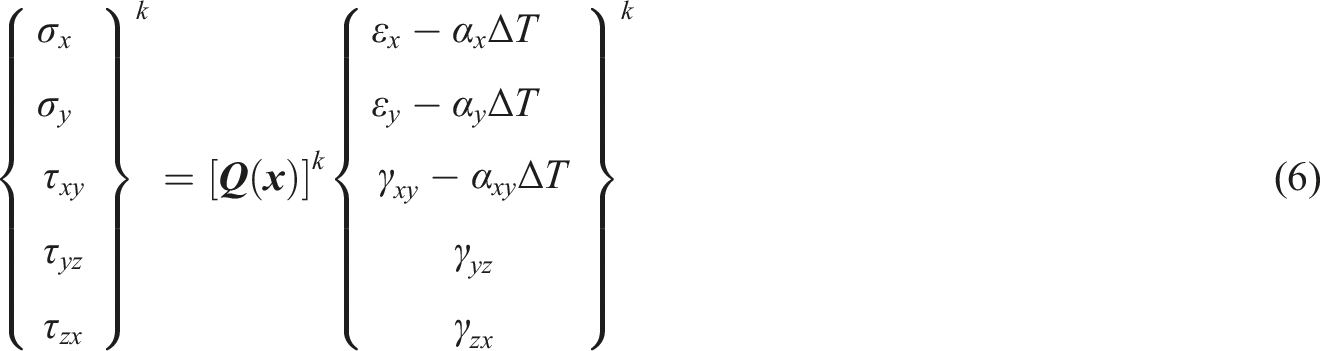

The transformed stiffness matrix varies with respect to x. The k
th
layer changes the transformed stiffness matrix (










For change in temperature, the component of forces and moments is represented as:


The coefficients of these matrices are determined as:




Here,
The force and Moment are computed as:

FEM formulation
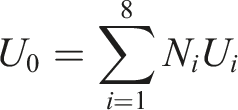
The FE model is built on an eight-node isoparametric element, each with five degrees of freedom. The quadrilateral element’s shape function in natural coordinates



The displacement fields are interpolated as follows:


Energy equation
The total potential energy U pertaining to VAT plate for thermos-elastic analysis can be expressed as:

The strain energy for the VAT plate subjected to uniform temperature is:

The thermo-elastic governing equation is obtained as:

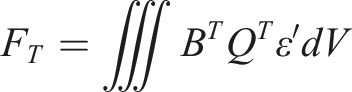
The following standard eigenvalue problem is obtained as:

The element stiffness matrix is
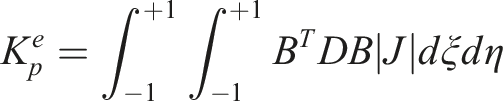


The composite plate’s elastic and geometric stiffness matrices are calculated using numerical integration. Gaussian quadrature is used for obtaining the integration needed for the computation of the stiffness matrix for the composite plate. The thermal buckling analysis has been modelled as a conventional eigenvalue problem. To get the critical buckling temperature

Optimization using GA
This section describes a global finite element (FE)-based optimization technique for optimizing the critical buckling temperature of Variable Angle Tow (VAT) composite plates. A GA is employed to determine the optimal fiber tow angle by assessing several design configurations and choosing the one that results in the maximum thermal buckling temperature. Figure 3 presents an integrated optimization framework that combines Genetic Algorithm (GA) and Finite Element Method (FEM), both implemented in MATLAB, to maximize the thermal buckling resistance of composite structures. The process is divided into two main stages. In the first stage, a parametric finite element model is developed to perform thermal buckling analysis. This includes the application of thermal loads and boundary conditions, and the computation of the critical buckling temperature, which serves as the objective function for optimization. In the second stage, the GA module initiates the optimization by generating an initial population of design variables. Each design candidate is evaluated based on its fitness, which is determined through the FEM analysis. If the optimal result is not achieved, the algorithm proceeds with selection, crossover, and mutation operations to evolve the population. This iterative process continues until the convergence criteria are met. The integration of GA with FEM enables an efficient and automated approach to identify optimal design parameters that enhance the thermal stability of composite laminates. Flow chart of the finite element-based optimization.
For determining the critical buckling temperature, the first step is to build a parametric model of the FEM code using the design variables in MATLAB. The MATLAB FEM Code accepts a new set of design variables produced by the GA optimization tool with each iteration. The optimization process terminates when the best and mean fitness values converge. The finally optimized VAT plate is obtained through this iterative optimization method. In the GA optimum search, a sufficiently large population and generation are employed to prevent local optimization outcomes. To acquire convergent findings, many GA search trials were conducted with distinct beginning populations. The crossover and mutation probabilities are set at 0.8 and 0.04.
Results and discussions
The developed FE model is used to analyse the optimal VAT Plate design for the critical buckling temperature. The optimal VAT fiber orientation for each layer is determined for various plate aspect ratios, boundary conditions, variation in thermal expansion coefficient and variation in Young’s modulus. The four-layers symmetric VAT plate is identified by
Numerical validation
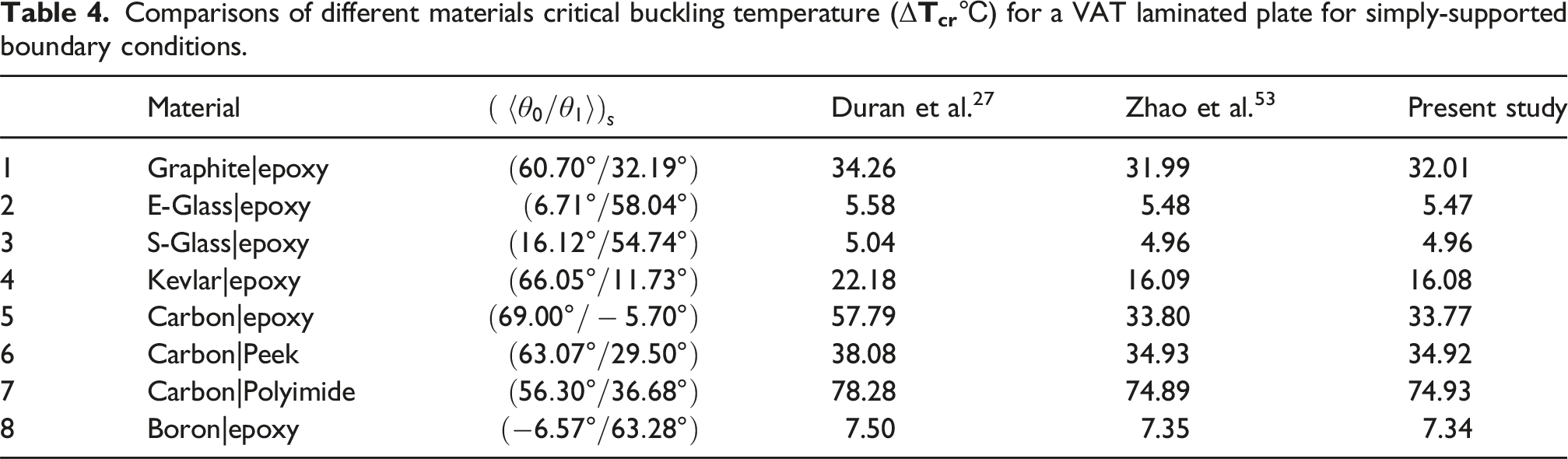
The finite element findings are first compared to the existing literature for straight fiber and then VAT fiber to determine the correctness of the present FE code.
Validation of straight fiber
Critical buckling temperature (


Thermal buckling mode shape for straight fiber. (a) Angle-ply
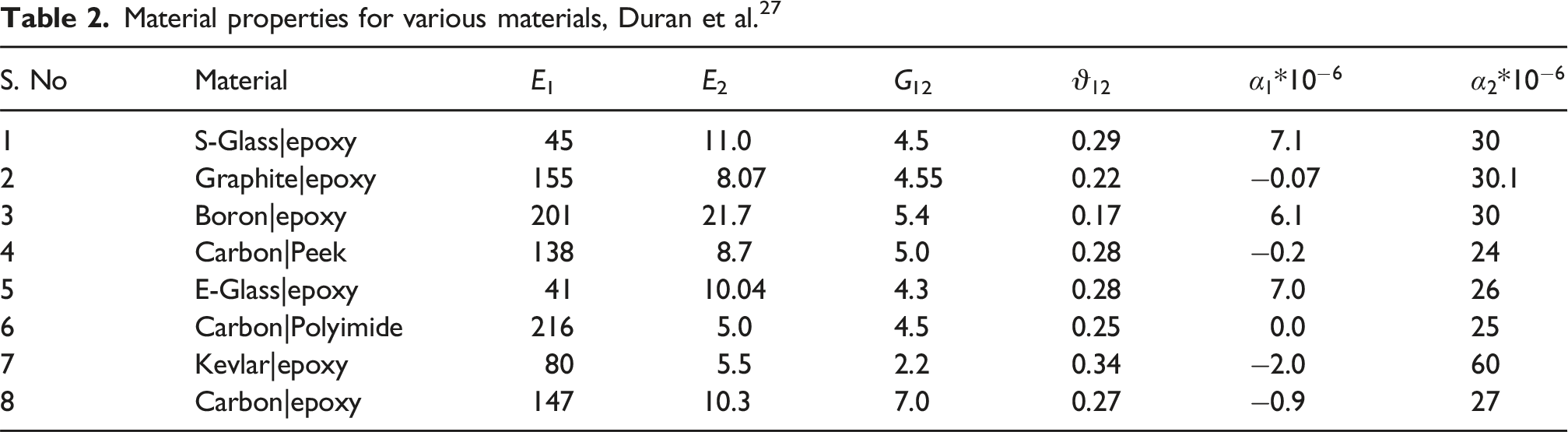
Validation of VAT laminated plate
Material properties for various materials, Duran et al. 27
Convergence studies of critical buckling temperature (


FE meshed model of VAT Plate.
Comparisons of different materials critical buckling temperature (

First and second thermal buckling mode shape for VAT Plate with laminate
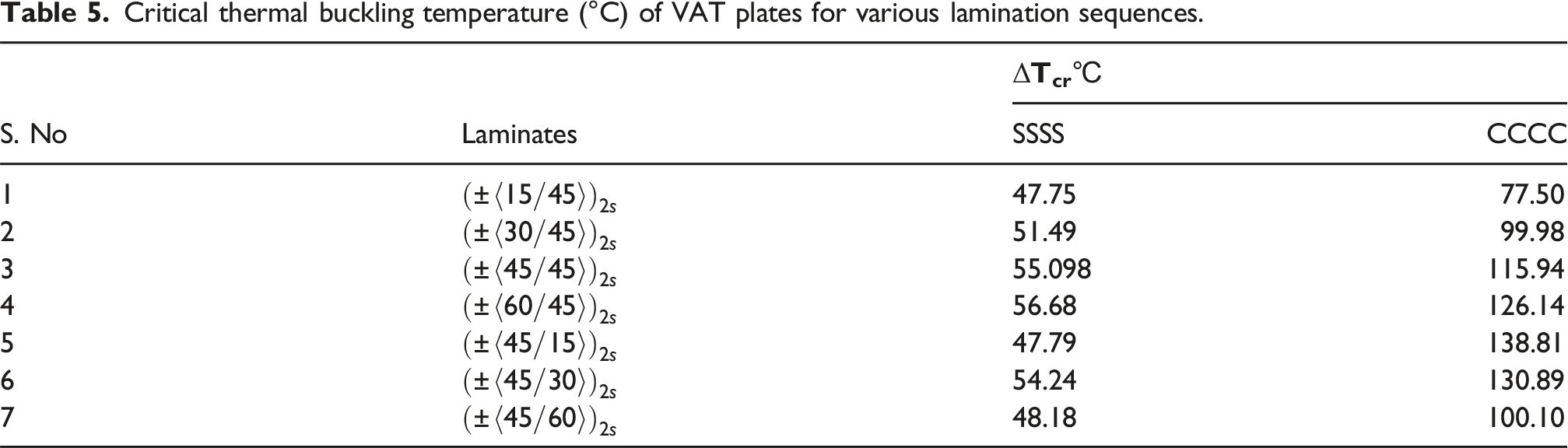
Numerical result
Critical thermal buckling temperature (°C) of VAT plates for various lamination sequences.

First thermal buckling mode shape for VAT Plate with laminate
Influence of laminate layers on the VAT Plate’s critical buckling temperature
Critical buckling temperature

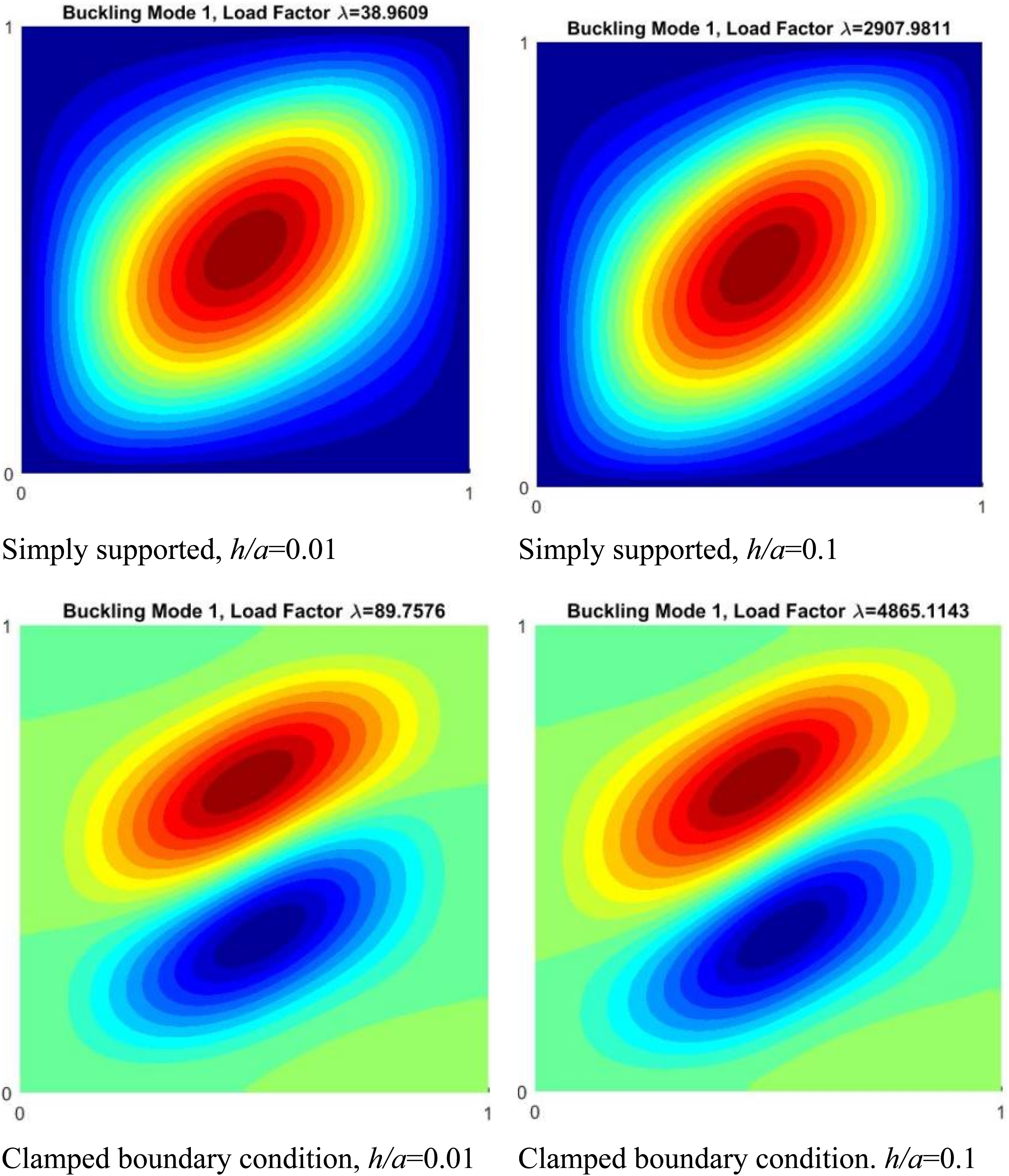
First thermal buckling mode shape of VAT Plate.

Variation of critical buckling temperature with respect to plate aspect ratio (a/b = 1 to 4).
Influence of the Young’s modulus ratio (E1/E2)
Critical buckling temperature of square laminated plates with a/h = 125.

Optimal result
In this section, GA is used to determine the optimal fiber angle distribution
Validation of optimal results
Comparison between the present FEM-based optimization results, and Duran et al. 27 results.

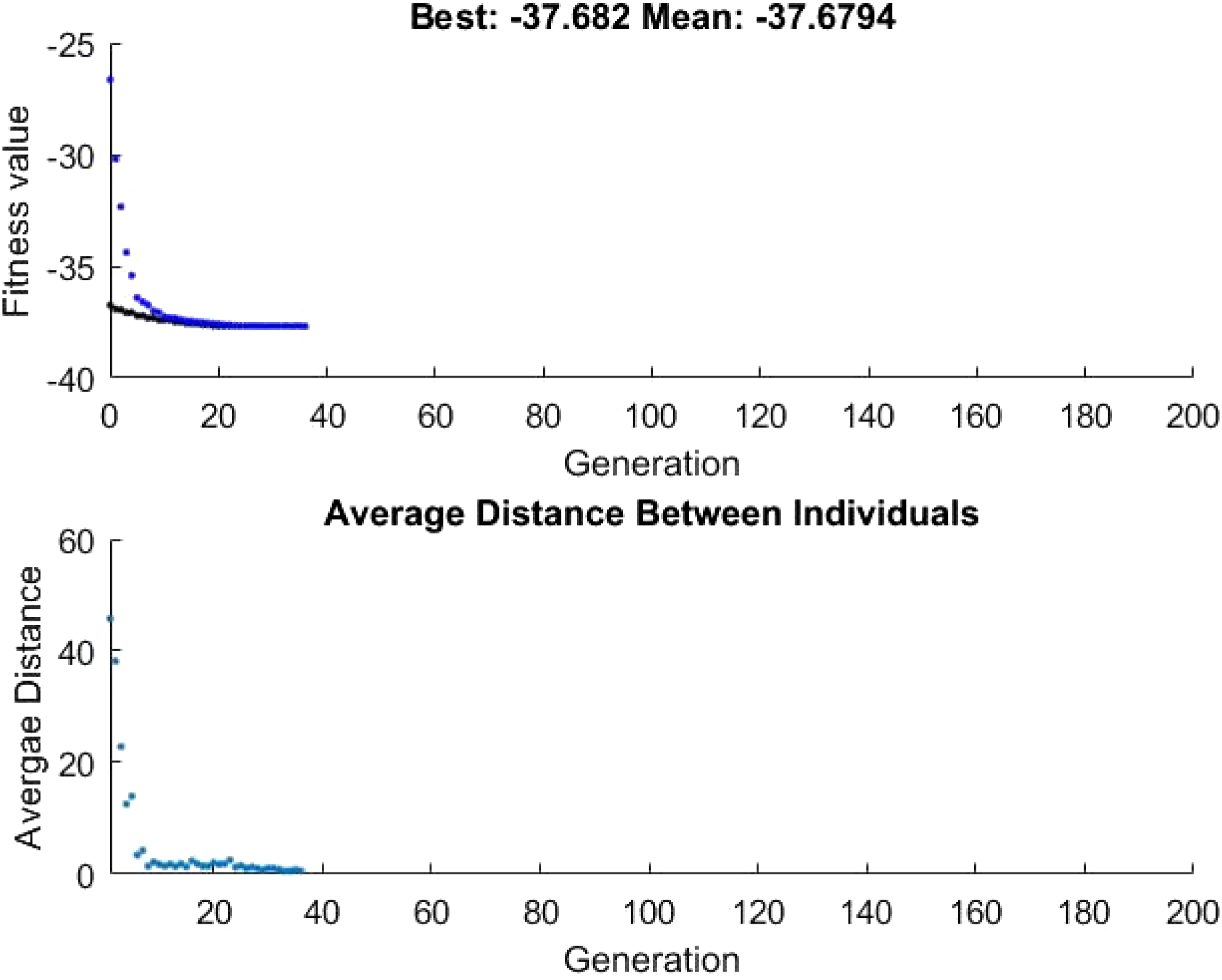
GA optimization iteration history plot for objective function.
Optimal result for various aspect ratio of VAT plate
In this study, optimal results are investigated for various aspect ratios (a/b = 1,1.5.2.2.5,3) of simply-supported and clamped VAT plates with a/h = 125, where h is the total thickness of the plate. The optimum VAT plate results are then compared to a Constant Stiffness Composite (CSC) plate with straight fibers. For CSC Plate,
Optimal result for eight layers

Optimal result for eight layers
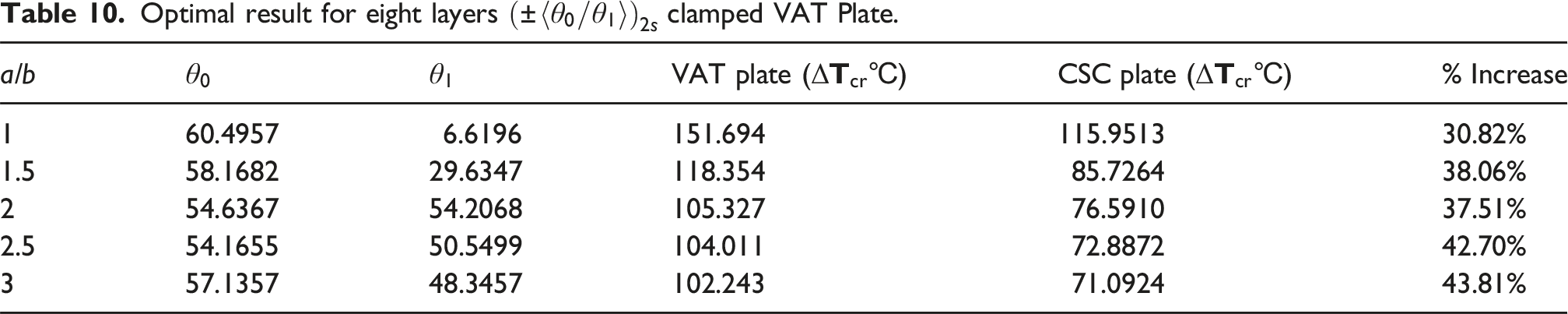
Similarly, Table 10 highlights the behaviour under clamped boundary conditions, where the VAT plates again outperform CSC plates. The improvement in critical buckling temperature is recorded as 30.82%, 38.06%, 37.51%, 42.70%, and 43.81% at the corresponding aspect ratios. These results confirm that VAT design significantly enhances thermal stability under both boundary conditions, with especially higher gains observed as the aspect ratio increases.
Optimal result for four layers
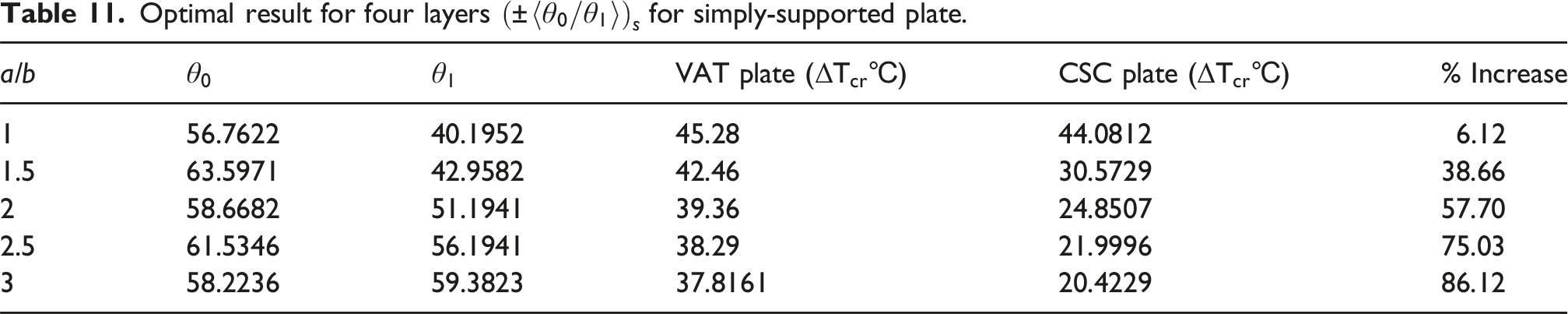
Interestingly, although the critical buckling temperatures differ significantly between VAT and CSC plates, the buckling mode shapes remain identical, indicating that the nature of deformation does not change, only the threshold at which it occurs.
Furthermore, both VAT and CSC plates show a decreasing trend in critical buckling temperature with increasing aspect ratio, as seen in Tables 9 and 11. This trend is more noticeable in shorter plates (lower aspect ratios) due to their higher structural stiffness, which allows them to resist thermal loads more effectively. As the aspect ratio increases and the plate becomes longer, the overall stiffness reduces, leading to a lesser capacity to resist buckling, and thus a lower critical buckling temperature. This explains why shorter plates exhibit higher thermal buckling resistance in both VAT and CSC configurations.
Figures 11 and 12 illustrate the comparison of critical buckling temperatures between optimal VAT (Variable Angle Tow) plates and CSC (Constant Stiffness Composite) plates under simply supported boundary conditions for eight-layer and four-layer laminates, respectively, across different aspect ratios. These results clearly demonstrate the effectiveness of VAT design in improving thermal buckling resistance over traditional CSC plates, with the benefit becoming more pronounced at higher aspect ratios and for thicker (eight-layer) laminates. Comparison of critical buckling temperature of optimal VAT Plate with reference CSC Plate for Eight layer. Comparison of critical buckling temperature of optimal VAT Plate with reference CSC Plate for four layers.

Optimal result for various material anisotropy
Influence of the degree of orthotropy on optimal critical buckling temperature of a simply-supported plate.

Influence of the degree of orthotropy on optimal critical buckling temperature of a clamped plate.

Optimal results for various thermal expansion
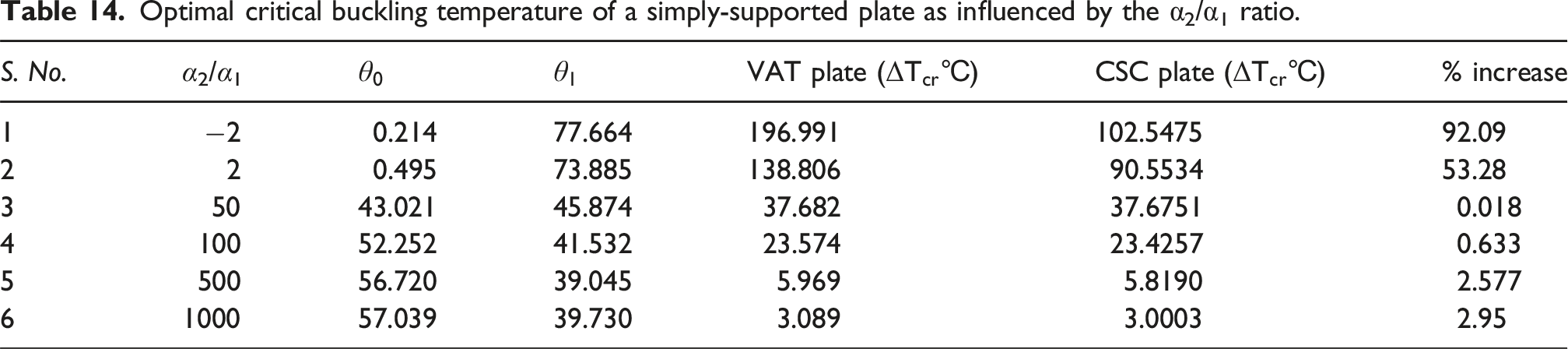
Optimal critical buckling temperature of a simply-supported plate as influenced by the α2/α1 ratio.
Optimal critical buckling temperature of a clamped plate as influenced by the α2/α1 ratio.

Conclusions
This study presents an optimization framework for enhancing the thermal buckling performance of Variable Angle Tow (VAT) laminated composite plates by considering the fiber orientation within each lamina as a design variable. The critical buckling temperature was computed using finite element analysis based on First-Order Shear Deformation Theory (FSDT) with eight-node isoparametric elements. The optimized VAT configurations demonstrated significantly higher thermal buckling resistance compared to conventional Constant Stiffness Composite (CSC) laminates. Specifically, for a plate with an aspect ratio a/b = 3, the critical buckling temperature increased by 111.82% for an eight-layer laminate and by 86.12% for a four-layer laminate. The increase in critical buckling temperature in VAT laminates is due to their ability to spatially tailor stiffness and thermal expansion, resulting in a more uniform stress distribution and improved resistance to thermal buckling.
Parametric studies revealed that increasing the number of layers improves the critical buckling temperature, while a higher aspect ratio leads to a reduction. Higher aspect ratio has lower stiffness and resistance to thermal-induced buckling due to increased flexibility and slenderness. Furthermore, the thermal buckling resistance increases with a higher stiffness ratio (E11/E22) and decreases with a higher thermal expansion ratio (α2/α1). These findings highlight the effectiveness of fiber path optimization in tailoring the mechanical and thermal responses of laminated composites.
The enhanced performance of VAT plates is attributed to their ability to spatially vary stiffness and thermal properties, enabling improved stress distribution and delayed thermal buckling. The results provide valuable insights for the structural design of high-performance composite components subjected to thermal loads, particularly in aerospace and energy sectors.
Future research should address experimental validation of the optimized configurations, integration of fiber curvature manufacturing constraints, and extension to multi-objective design problems that consider both mechanical and thermal loads. Additionally, the incorporation of advanced manufacturing techniques such as automated fiber placement (AFP) will be essential to realize the full potential of optimized VAT laminates in practical applications.
Footnotes

Funding
The authors received no financial support for the research, authorship, and/or publication of this article.
Declaration of conflicting interests
The authors declared no potential conflicts of interest with respect to the research, authorship, and/or publication of this article.
Data Availability Statement
The data that support the findings of this study are available on request from the corresponding author.