



Abstract
In this paper, the structure and surface properties of a mechanically activated filler based on rice processing products were studied. The particles of the natural filler were mechanically activated on a vibrating and planetary ball mill with different impact times and abrasion forces. The particles of the filler were characterized by laser diffraction, scanning electron microscopy and X-ray phase analysis. To study the possibility of using rice production waste in rubber products, model elastomeric compositions were made on laboratory rollers according to a standardized method with a complete replacement of industrial low-strength carbon black. It was determined that the mechanical activation of a natural filler in a planetary mill leads to an improvement in the physical-chemical parameters of the particle surface (the average size of the aggregates decreases by 2.2 times, the specific external surface increases by 3.1 times), increases the interfacial interaction of the filler with rubber (up to 33.9%), increases the Mooney viscosity values of rubber mixtures, increases resistance rubber to premature vulcanization (by 23.1%–61.5%) and leads to the production of vulcanizates with higher elastic strength indicators.
Introduction
It has long been known that the use of elastomeric compositions of carbon black and silicon dioxide in formulations leads to a significant improvement in the properties of rubbers compared to the composition without filler due to the reinforcing effect.1–3 The degree of this effect depends on the volume content of the filler in the mixture, the morphology of the particles and their dispersion, which together determines the interactions in the “polymer-filler” and “filler-filler” systems. However, the use of carbon black has now become an urgent problem due to its petroleum origin and various adverse effects related to human health and the environment. 4 Compared with carbon black, silicon dioxide particles are less compatible with unsaturated, hydrocarbon rubbers and tend to form a filler-filler grid due to hydrogen bonds and silanol groups present on the surface of the particles.5,6 Due to the needs of the rubber industry and the necessary environmental protection, consistent studies are being conducted to identify other types of fillers.
Fillers of plant origin are becoming an alternative to composites containing synthetic fillers.7–10 Extensive research on natural fillers is primarily related to the advantages of their potential application in many industries.11–15 In addition, composite materials filled with natural fillers represent an alternative to constantly running out of non-renewable traditional sources. 16 It is also quite important to reduce the cost of finished products while maintaining the basic operational properties of materials. 17 Fillers of plant origin are used in such industries as construction, oil refining, automotive, aerospace, and aviation.18–27
Research on the use of rice husk ash in elastomeric compositions and polymers has increased in recent years, and a number of compositions have been made by using rice husk ash in formulations based on styrene butadiene rubber,28,29 epoxidized natural30,31 and natural rubbers32–34 and ethylene propylene rubber. 35 Due to the high polarity of the rice husk ash, there is a problem of poor interaction between the natural filler and the ash, which inevitably leads to low amplification capacity.
To solve such problems, a certain alternative is to modify the surface of natural materials. In general, modification methods can be divided into physical, based on adsorption modification of the surface, and chemical, associated with a chemical change in the surface during certain chemical reactions on the filler surface. Processing or modification of the surface properties of natural materials usually increases their adhesive properties, but at the same time affects the physical and mechanical properties of polymer composites. Previous studies 36 have shown that chemical treatment is considered one of the most commonly used methods of surface treatment of agricultural materials.
Thus, i 37 , rice husk ash was treated with benzenediazonium salts in various media in order to change the hydrophilic properties of the surface, which in turn increased the mechanical properties of a composite based on natural rubber. In 38 , a rare-earth binder was used to solve the problem of the interaction of rice husk ash and the polar matrix of rubber, which reduced the polarity of the natural filler and improved the interaction of ash particles with the rubber phase. In 39 , the modification of rice husk ash in a mill in an ethanol medium was investigated, followed by the addition of bis-(γ-triethoxysilylpropyl)-tetrasulfide (Si69) to increase the surface activity of the test material. However, it should be noted that chemical modification has disadvantages, including technological ones. In the case of chemical activation, the required amount of activating agent is usually several times higher in weight than the carbon-containing precursor. 40
The main advantage of physical modification, compared with chemical modification, is a directed change in the physical properties of the filler surface by converting their supramolecular structure under various physical influences, such as mechanical activation of the surface, grinding, radiation treatment, and others, without changing their chemical structure. 41 There are many technological and scientific research papers42,43 on mechanochemical effects. Mechanical activation of materials in various types of mills is a widespread grinding process. 44 However, the mechanical and physical processes occurring in such devices are still the subject of numerous studies.45,46 Most of this work focuses on optimizing the grinding process, a process that aims to maximize the specific surface area of a solid with minimal energy consumption.
Thus, the authors of47,48 crushed (mechanically activated) rice husk ash in a vibrating mill from 60 to 120 min in order to increase its pozzolanic activity. However, for the use of rice husk ash in production, a long grinding process is economically inefficient due to a sharp increase in its cost. For this reason, the purpose of this work is to study the effect of mechanical activation of rice husk ash in a short period of time (from 1 to 5 min) on its physical and chemical characteristics of the surface (average size of aggregates, specific external surface, sorption volume), as well as to determine the dependences of changes in the interactions of ash with rubber matrices and the basic properties of model elastomeric compositions depending on the type of grinding.
The novelty of this work lies in the fact that for research we used a carbon-silicon filler, the surface of which was not chemically modified by functional groups. In addition, no binding agents were introduced into the formulation of the rubber compound. Therefore, in order to establish the direct interaction of a carbon-silicon filler with a polymer matrix, model rubber mixtures were studied, which, according to GOST 14925-79 and TU 38.30313–2006, contain only rubber and a vulcanizing system.
Materials and methods
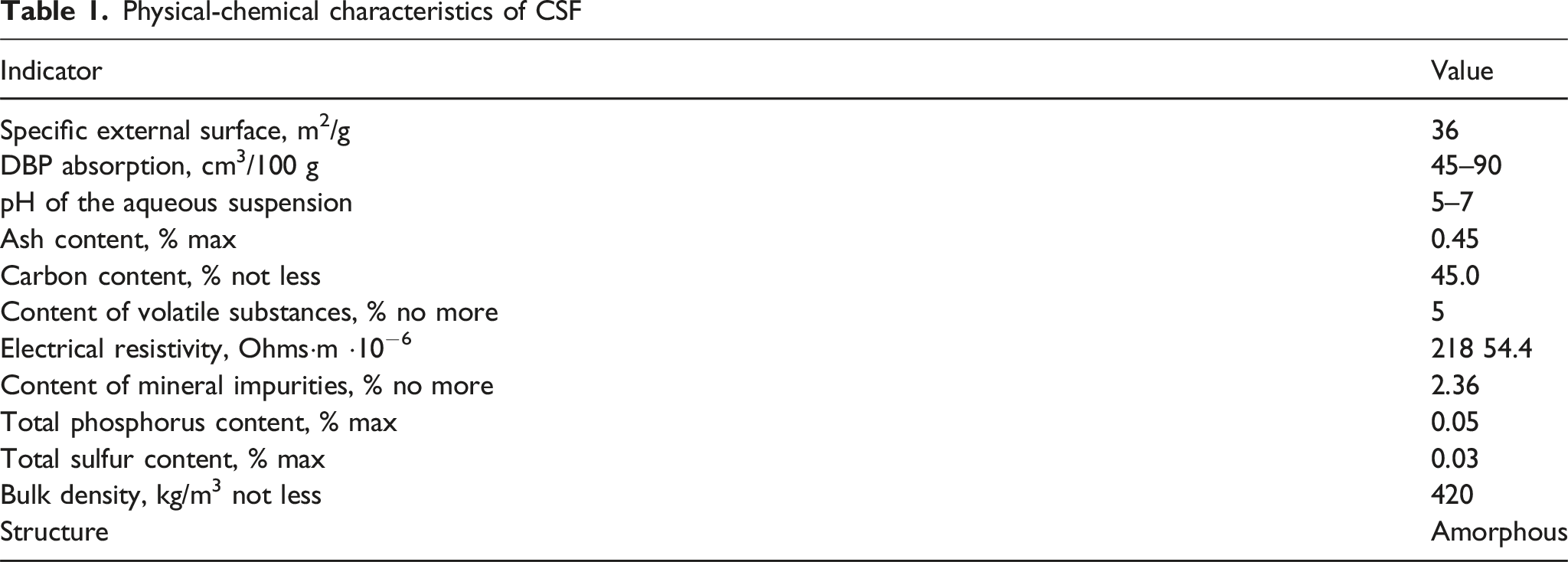
Physical-chemical characteristics of CSF
Formulations of model rubber compounds based on general and special purpose rubbers.

The production of model rubber compounds was carried out in accordance with GOST 14925-73 50 for SKI-3 and according to TU 38.30313–2006 51 for BNKS-18AMN. The comparison samples were model elastomeric compositions filled with a commercial filler – low-strength carbon black of the N772 brand according to ASTM D1765-03 - Standard Classification System for Carbon Blacks Used in Rubber Products. The classification according to the ASTM D1765 standard is based on the ability of some grades of carbon black to change the vulcanization rate of rubber compounds. Depending on what the stamps are assigned the letter indexes “N” (with a normal vulcanization rate) and “S” (with a slow vulcanization rate). The following digital index is the number of the brand group according to the average specific surface area. The last two digital indexes were selected when approving the brand.
Mechanical activation of the CSF was carried out on a PM100 planetary ball mill in a 500 mL glass using zirconium dioxide balls with a diameter of 3 mm for 1, 2, 3, 4 and 5 min. The glass was filled with 1/3 carbon-siliceous filler. The ratio of rotation speeds is 1: −2 and was 250: −500 r/min.
A similar mechanical activation of the CSF was performed on a laboratory vibration mill with a rotation speed of 1450 r/min and a deformation amplitude of 4.2 mm. The glass was filled with 1/3 carbon-siliceous filler.
The laser diffraction method used to determine the particle size distribution is based on the analysis of a diffractogram obtained when particles are exposed to monochromatic radiation. The particle size of the studied fillers was determined using the Analizette 22 MicroTec laser particle size analyzer (Fritsch GmbH, Germany). The measurement range is 0.1–600 microns. 52 The error of this method is no more than 5%.
The morphology and structure of the surface layers of the samples were analyzed using a scanning electron microscope S–4800 (Hitachi, Japan). The structural analysis of the sample was determined using the EDX Quantax-200 fluorescence spectrometer (Bruker, Germany). 53
The chemical composition of the CSF surface was studied using a scanning electron microscope JSM–5610 LV with the chemical analysis system EDX JED–2201 (JEOL, Japan). The phase composition of the CSF was determined using an X-ray diffractometer D8 Advance Bruker AXS (Germany).
The content of bound rubber in the model rubber mixtures was determined by extraction of an unvulcanized rubber mixture for 24 h at room temperature in a solvent (toluene). A sample of a rubber compound weighing 1.0 ± 0.25 g was weighed on an analytical balance and placed in a solvent bottle. After the expiration of the experiment time, the solution with the rubber mixture was filtered and placed to remove the solvent in a thermal cabinet for 24 h at a temperature of 60 ± 1°C. The sample was then weighed. Based on the data obtained, the bound rubber was calculated. The bound elastomer is an insoluble fraction, which is obtained after processing an unvulcanized mixture for 24-48 h. 54
In the course of the research, the Mooney viscosity of rubber mixtures was determined on the MV 2000 shear disc viscometer in accordance with GOST R 54552-2011. 55 The Mooney viscosity of rubber compounds is defined as the degree of resistance to rotation of a cylindrical metal rotor immersed in a sample placed in a test chamber.
According to the kinetic curves of the vulcanization process obtained on a rheometer of the ODR 2000 brand according to GOST 12535-84, 56 the parameters characterizing the vulcanization and rheological properties of rubber compounds were determined. Vulcanization of elastomeric compositions based on special-purpose rubber BNKS-18AMN was carried out at a temperature of 160°C for 30 min, and for general–purpose rubber SKI-3 - at 153°C for 30 min.
The strength and deformation parameters of elastomeric compositions were evaluated according to the parameters of conditional tensile strength and elongation at break. The tests were carried out in accordance with GOST 270-75. 57 Shore A hardness of elastomeric compositions was determined according to GOST 263-75 on a DIGI-TEST hardness tester. 58
Results and discussion
The carbon-silicon filler is a composite that includes carbon-containing (47.26%) and silicon-containing (50.38%) parts, and there is also a certain amount (2.36%) of metal impurities (Na, Mg, K, etc.). The silicon-containing part of this material is in an amorphous state. The structure of the investigated filler is a grid of woven fibers due to plant origin (Figure 1(a)) with admixtures of amorphous silicon and inorganic compounds in the form of agglomerates consisting of layered formations with a developed internal pore system (Figure 1(b)). As is known,
59
silicon formed during the natural evolution of rice husks is distributed in the material in the form of monosilicic acid, which moves to the outer shell of the husk, where, as a result of evaporation and concentration, it turns into a cellulose-silica membrane. SEM image of CSF at different magnifications: а - ×1000, b - ×6000.
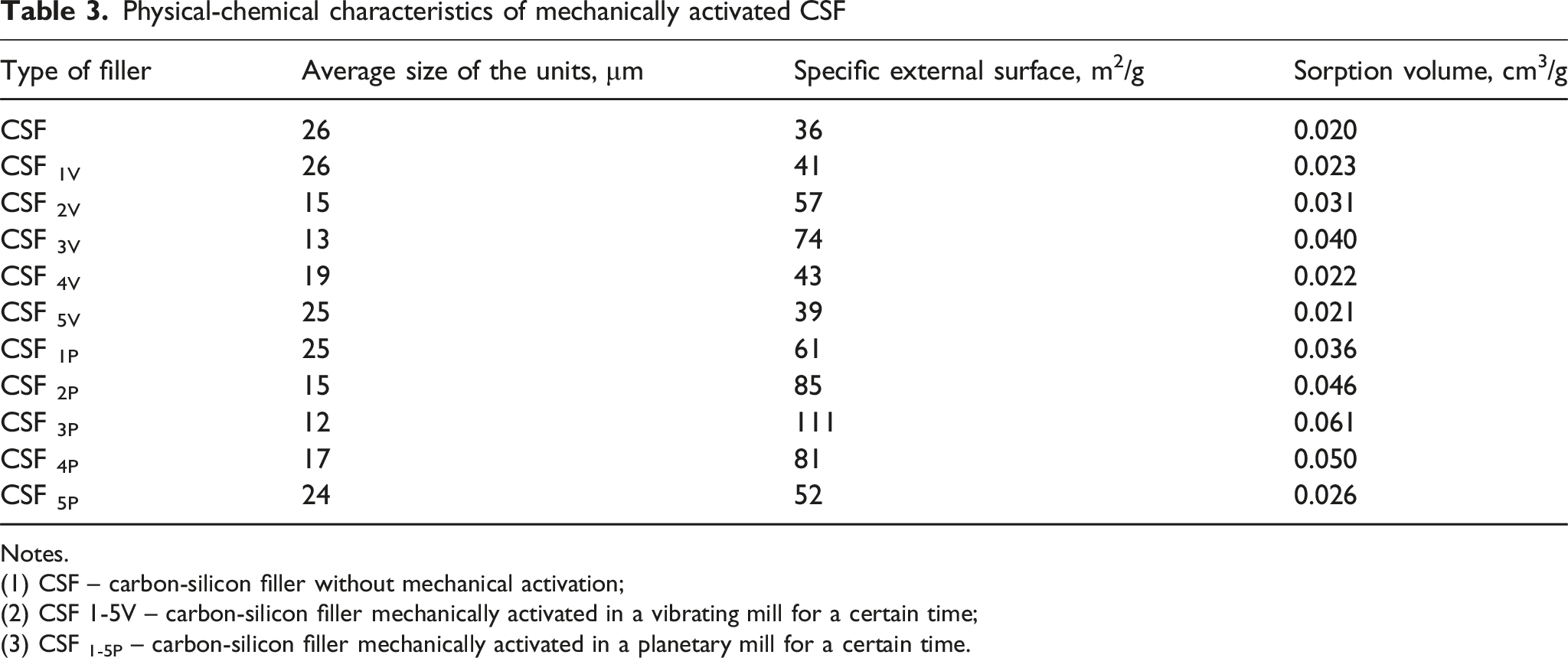
Physical-chemical characteristics of mechanically activated CSF
Notes.
(1) CSF – carbon-silicon filler without mechanical activation;
(2) CSF 1-5V – carbon-silicon filler mechanically activated in a vibrating mill for a certain time;
(3) CSF 1-5P – carbon-silicon filler mechanically activated in a planetary mill for a certain time.
Table 3 shows that mechanical activation on a vibrating mill for 3 min leads to a 2 times decrease in the average size of the units. In accordance with this, the specific external surface increases (from 36 m2/g for CSF without mechanical activation to 74 m2/g for CSF treated for 3 min). Similarly, the sorption volume of the filler changes. A further increase in the processing time at the vibrating mill leads to an increase in the average size of the unit after it reaches the minimum value at 3 min of processing, a decrease in the specific external surface and sorption volume. The established nature of the change in the properties of CSF during mechanical activation in a vibrating mill is associated with the agglomeration of filler particles due to the increased temperature developing during rotation of the grinding cup, 60 which contributes to the agglomeration of carbon-siliceous filler particles. An almost similar nature of the change in the properties of the CSF was revealed in the case of mechanical activation at a planetary mill. However, in this case, the average size of the unit after processing for 3 min on this type of equipment decreases by 2.2 times, and the specific external surface increases by 3.1 times.
The determination results of bound rubber in model rubber mixtures based on rubbers of different polarities filled with the studied CSF and carbon black are shown in the Figure 2. Dependences of changes in the content of bound rubber in elastomeric compositions for various purposes on the duration of CSF mechanical activation: a - rubber mixtures based on BNKS-18AMN, b - rubber mixtures based on SKI-3.
The determination results of bound rubber in the studied elastomeric compositions using CSF with different surface mechanical activation times showed that compositions based on general and special purpose rubbers containing carbon-silicon filler without mechanical activation, as well as mechanically activated for 1 min using grinding equipment, completely dissolved in the solvent used, which may indicate the absence of durable the bonds between the filler and the rubber at the interface of the two phases. An increase in the time of impact and abrasion forces on the CSF to 3 min increases the interfacial interaction of the investigated filler with rubber and leads to an increase in the values of bound rubber in compositions based on BNKS-18AMN with CSF processed in a vibrating mill to 29.5% and on a planetary to 33.9%. In the case of elastomeric compositions based on SKI-3, a similar nature of the change in this indicator was revealed. The data obtained are consistent with the results of studies on changes in the specific external surface and sorption volume of the CSF during mechanical action.
It is worth noting that the values of the index of bound rubbers in elastomeric compositions based on both BNKS-18AMN and SKI-3 containing CSF mechanically activated in a planetary mill for 3 min actually reach the values of a similar indicator of rubber mixtures filled with low-strength N772 carbon black. The revealed nature of the dependence of the formation of a carbon-rubber gel on the time of mechanical activation of the investigated filler is due to both an increase in the interfacial interaction between the polymer and the CSF due to an increase in the specific surface and increase the adsorption capacity of the CSF, and the chemical and physical processes of rubber interaction with the filler fibers. 61
The composition of the rubber compound must provide the required technical properties of the rubber, but the mixture must be technologically advanced in manufacturing and processing. The plastic-elastic properties of rubber compounds characterize their behavior when forming blanks of products before vulcanization. To assess the quality of rubber compounds in production and to study the molecular structure of elastomeric compositions, a Mooney viscosity study is used. 62
Figure 3 shows the results of a Mooney viscosity study of model elastomeric compositions based on polar (BNKS-18AMN) and nonpolar (SKI-3) rubbers filled with carbon black and CSF. Dependences of the change in viscosity according to the Mooney of rubber mixtures based on rubbers for various purposes on the duration of CSF mechanical activation: a - rubber mixtures based on BNKS-18AMN, b - rubber mixtures based on SKI-3.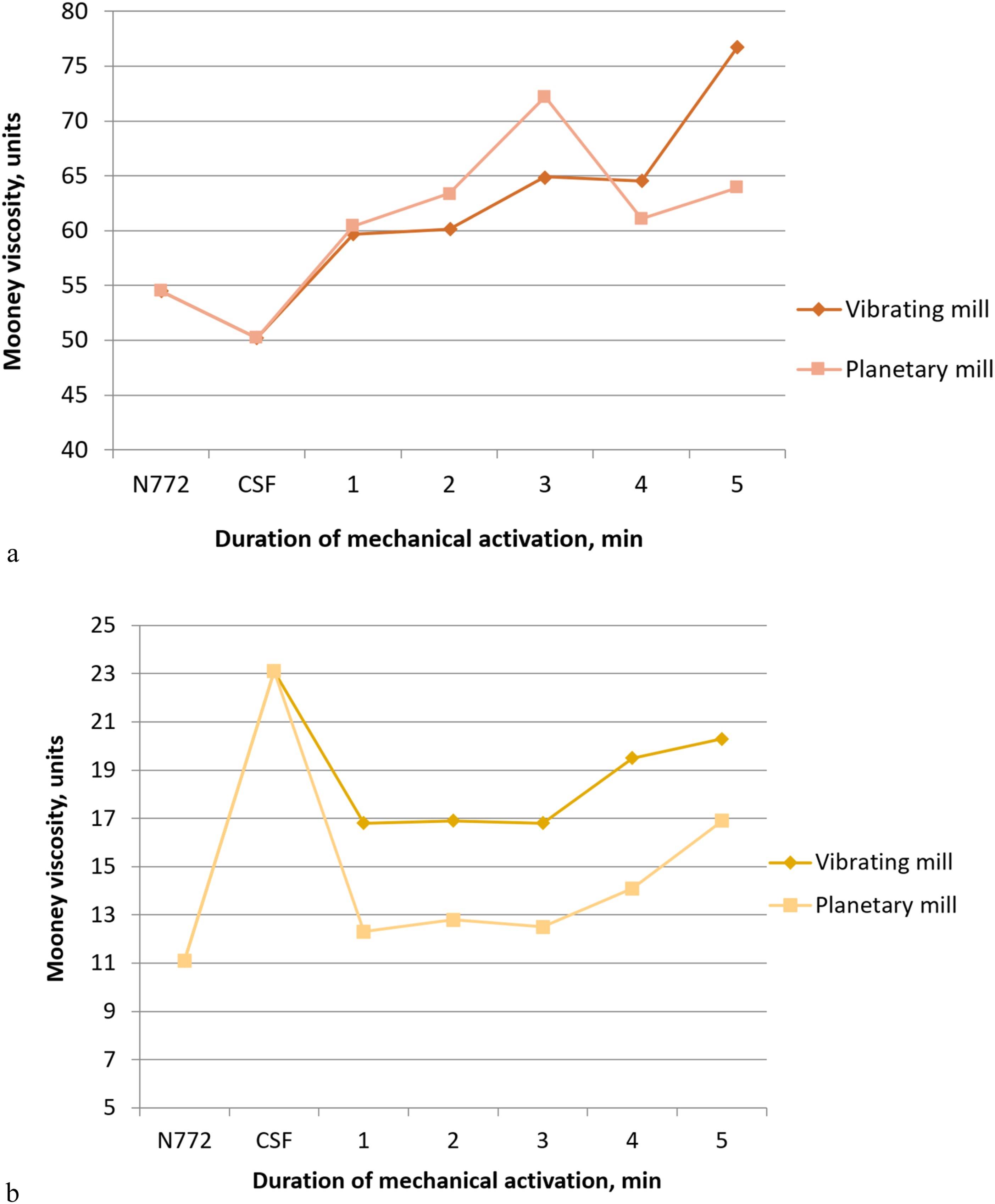
The Mooney viscosity determination of model rubber compounds based on BNKS-18AMN showed that the introduction of the studied mechanically activated CSF leads to an increase in viscosity by 9.5%–40.7% compared with mixtures with low-strength N772 carbon black. A similar character of the change in viscosity according to Mooney was determined for SKI-3-based rubber compounds containing mechanically activated CSF. Thus, the viscosity value of a rubber mixture with N772 carbon black is 11.1 units, and rubber mixtures with mechanically activated carbon is in the range of 12.3–20.3 units. The revealed character of the Mooney viscosity change is probably due to an increase in the interfacial interaction at the interface between the surface of the CSF and polymers due to the presence of fibers in the filler structure that actively interact with rubber macromolecules, thereby preventing the flow of elastomer during deformation. 63
Rheological properties characterize the behavior of polymer systems during deformation. They define dependencies linking stresses, strains, and strain rates. These dependences obtained at different temperatures and deformation modes for polymers of different molecular weights and polymer systems of different compositions provide valuable information about their properties, structure and structural transformations; they are of crucial importance when considering problems associated with the processing of systems of this kind. 64
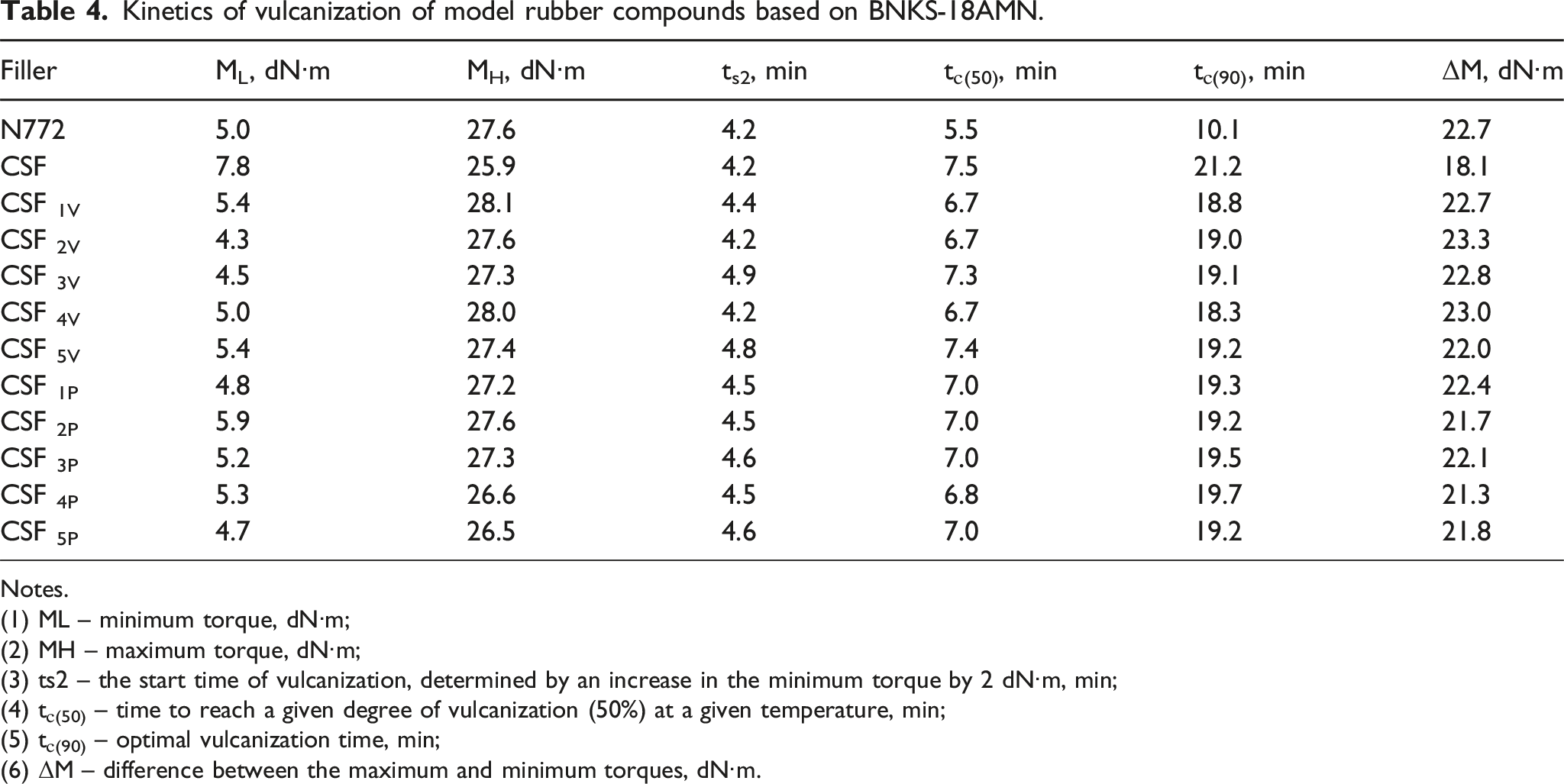
Kinetics of vulcanization of model rubber compounds based on BNKS-18AMN.
Notes.
(1) ML – minimum torque, dN·m;
(2) MH – maximum torque, dN·m;
(3) ts2 – the start time of vulcanization, determined by an increase in the minimum torque by 2 dN·m, min;
(4) tс(50) – time to reach a given degree of vulcanization (50%) at a given temperature, min;
(5) tс(90) – optimal vulcanization time, min;
(6) ΔM – difference between the maximum and minimum torques, dN·m.
The analysis of the results showed that the introduction of a new filler without mechanical activation into the composition of elastomeric compositions based on BNKS-18AMN leads to an increase in the time to achieve the optimal vulcanization time by 1.8–2.1 times compared with rubber mixtures with carbon black of various brands, which is probably due to the adsorption of components of the vulcanizing system due to the high porosity of the carbon-silicon surface it will require further adjustment of the composition of the vulcanizing system when using the CSF. At the same time, the determination of the difference between the maximum and minimum torques (ΔM), which indirectly characterizes the crosslinking density of the polymer, revealed that the use of mechanically activated CSF in elastomeric compositions makes it possible to obtain rubbers characterized by almost identical values of ΔM.
Kinetics of vulcanization of model rubber compounds based on SKI-3.

It has been found that rubber mixtures with CSF mechanically activated in a vibrating mill have similar values of the ts2 index compared with compositions containing carbon black. In the case of using mechanically processed CSF in elastomeric compositions at a planetary mill, the resistance to vulcanization of SKI-3–based rubber compounds increase by 23.1%–61.5% compared with mixtures with N772 carbon black. It has been determined that the introduction of CSF into rubber mixtures has an effect on certain stages of the vulcanization process. Thus, the use of CSF in mixtures based on SKI-3, both without mechanical activation and treated, leads to an increase in the time to achieve the optimum vulcanization to 31.3% compared with mixtures with carbon black. The revealed character may be related to the physical-chemical properties of the surface of the carbon-silicon filler. Since during the mixing process, adsorption of the components of the vulcanizing system on the surface of the CSF can occur and, as a result, a decrease in the rate of interaction of the components of the rubber mixture with each other and thereby an increase in the duration of the induction period: the longer it is, the better for conducting the technology. The studied CSF has an acidic pH (Table 1) of the aqueous suspension of the filler, which also leads to a slowdown in the vulcanization and sub-vulcanization of rubber compounds. 65
Elastic-strength characteristics of the studied rubbers.
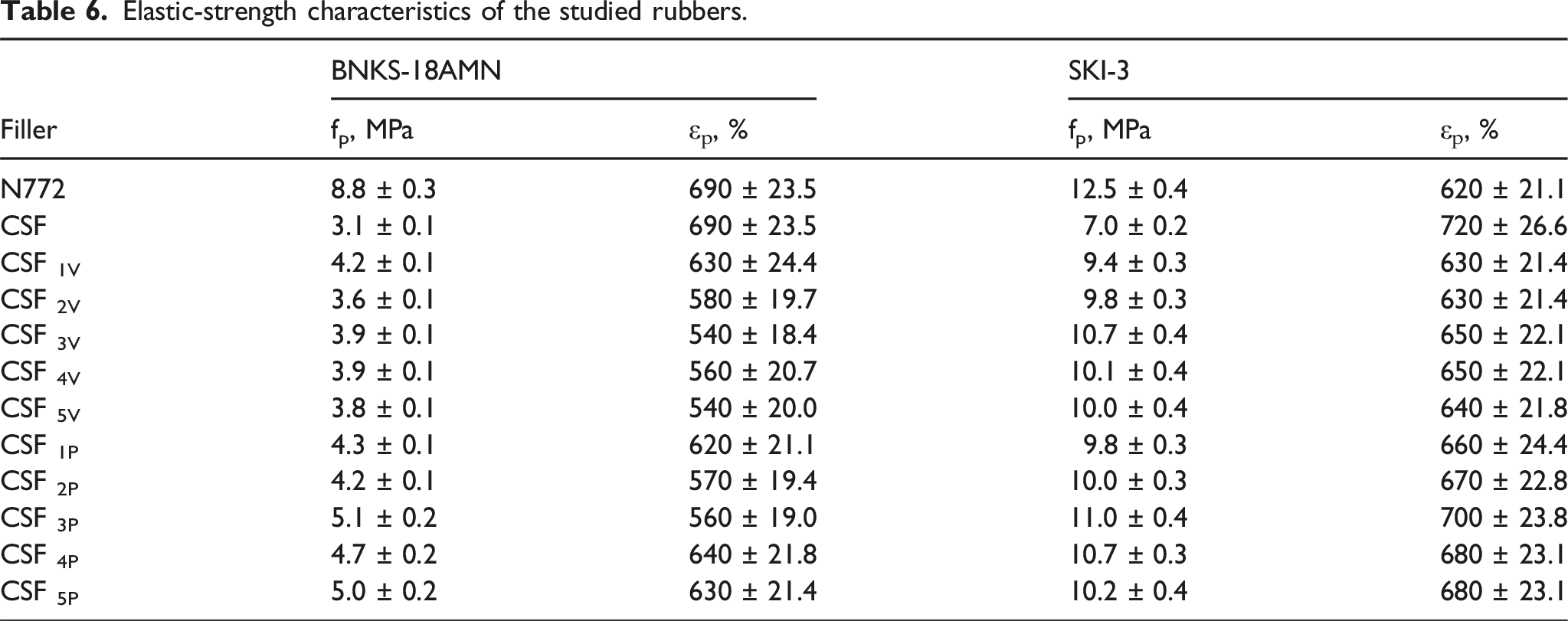
The research results have shown that the use of CSF, including mechanically activated, in elastomeric compositions based on non-crystallizable polar rubber BNKS-18AMN leads to a significant decrease in the strength properties of rubbers, which indicates that this filler can be used in formulations of rubber mixtures only with partial replacement of the main filler, or in products from which high strength characteristics are not required, i.e., according to the reinforcing properties, the CSF can be attributed to inert fillers or diluents. It was determined that in the case of processing of the CSF in a planetary mill for 3 min, the resulting vulcanizates are characterized by the highest value of elongation at break, compared with other vulcanizates containing the CSF processed in vibrating and planetary mills under different modes. This may be due to the production of CSF with a certain particle size and the nature of functional groups that contribute to the formation of a vulcanization structure that provides a satisfactory complex of elastic properties of vulcanizates
It was revealed that the use of CSF without mechanical activation of the surface in model elastomeric compositions based on crystallizing nonpolar rubber SKI-3 leads to a decrease in the index of conditional strength of rubbers by 44.0% compared with vulcanizates with N772 carbon black, which may be due to the peculiarities of the formation of the structure and nature of cross-links during vulcanization. It has been established that the use of mechanically activated CSF in the composition of compositions based on SKI-3 leads to the production of vulcanizates with higher deformation and strength characteristics compared with a composition containing CSF without mechanical activation. In this case, the highest values of deformation and strength indicators are characterized by rubber containing CSF subjected to mechanical activation for 3 min.
Conclusion
Based on the study of the properties of model rubber mixtures of non-crystallizing special-purpose rubber BNKS-18 and crystallizing general-purpose rubber SKI-3, it was found that it is most advisable to use carbon-silicon filler mechanically activated in a planetary mill for 3 min as part of formulations of industrial elastomeric compositions, since in this case the resulting product has the least change in rheological, vulcanization and deformation and strength properties of elastomeric compositions in comparison with carbon-silicon filler, obtained with other technological parameters.
Footnotes
Author contributions
Valeria Bobrova: Investigation, Software, Writing – original draft. Andrei Kasperovich: Conceptualization, Writing – review & editing. Sergey Efremov: Project administration, Supervision, Funding acquisition, Methodology. Sergey Lezhnev: Resources, Visualization. Sergey Nechipurenko: Validation, Data curation. Evgeniy Panin: Formal analysis.
Declaration of conflicting interests
The author(s) declared no potential conflicts of interest with respect to the research, authorship, and/or publication of this article.
Funding
The author(s) disclosed receipt of the following financial support for the research, authorship, and/or publication of this article: This research was funded by the Science Committee of the Ministry of Education and Science of the Republic of Kazakhstan (Grant No AP19679452).

Data Availability Statement
All data used in this study are available from the corresponding author upon request.