



Abstract
Blade coating is a widely used technique for achieving smooth surfaces by applying a protective fluid layer from the blade onto the moving substrate. Under the blade coating phenomena, the impacts of MHD, velocity slip, and heat distribution of the third-grade fluid for both planar and exponential coaters are taken into discussion. Lubrication approximation theory is employed for solving nonlinear equations, while the numerical method known as the shooting technique is utilized to characterize pressure, pressure gradient, velocity, and heat distribution. Numerous parameters including the slip parameter, third-grade fluid, coating thickness, and MHD are numerically investigated to show the effect on fluid flow and shown in several graphs and tables. The results prove the viscoelastic nature of fluid along with MHD and viscous slip to be controlling parameters of pressure and blade load which lead to varying coating thickness, which may help in achieving improved substrate life and efficient coating process.
Introduction
During blade coating, a fluid is distributed over a fixed blade onto a moving substrate, resulting in the formation of a thin coating layer. This process is widely used in industries where accurate coating control is essential, such as paper manufacturing, film production, flexible packaging, coating in food, fiber, metal coating, and many more. Blade coating is used in laboratories for development and research purposes on a smaller scale. Before scaling up for mass production, it allows researchers to optimize and test the formulation and methods. In the field of paper and packaging technology, the development of a coating machine for applying an oil-phase emulsion to paper for wrapping bread represents an important innovation. The coating machine was initially created by Trist 1 to cover oil-phase fluid on paper that was used to cover up bread. In 1950, this blade coating procedure was developed, also this coating machine coated a selected substrate with a speed of at least 20 m/s. Booth 2 demonstrated the relationship between butter coating weight and blade angle when applied to toast surfaces. The knife serves as the blade angle, and the butter represents the coating material. When the angle of the knife changes, we can control how the coating material is applied to the surface concerning the substrate. To study the viscoelastic effect on flow and manufacturing factors, Greener and Middleman 3 examined the idea of viscoelastic fluid in the procedure of blade coating by using the perturbation technique. Hwang 4 utilized the power-law model’s laminar flow in relation to the blade coating phenomenon. Sinha and Singh 5 investigated cavitation effects in a roll-coating representation of a power-law fluid. The contact between the needle and the surface was observed by Sullivan 6 using a microscope. Sullivan and Middleman 7 examined viscous and viscoelastic liquids experimentally and theoretically using a rigid blade over a rotating roll and used three methods, namely, dip, blade and slot coating, separately. Rose et al. 8 presented a study of power-law fluid analysis employing both exponential and planar coaters. Quintans et al. 9 discovered the blade coating theory to analyze the coating method of nematic fluid crystal and visual layers and Ericksen–Leslie terminology was used to create a numerical representation for this procedure. Giacomin et al. 10 investigated a Newtonian fluid-based flexible blade coating process. Siddique et al. 11 developed a Williamson fluid representation for the study of blade coating. Rana et al. 12 examined the viscoplastic effect at the blade coating process using the Casson fluid model. Sajid et al. 13 gave the perturbative analysis of the third-grade fluid model in the blade coating process with the solution provided up to first order. Shahzad et al. 14 utilized lubrication theory to numerically explore the Oldroyd 4-constant model in the context of the blade coating technique. Wang et al. 15 identified the viscous fluid model and investigated the influence of magnetic field (MHD) in the elastic coater form. Khaliq and Abbas 16 recently used the Simplified Phan-Thien-Tanner (SPTT) model to investigate the viscoelastic impacts during the blade coating studies. The blade coating process for Johnson-Segalman fluid using plane coater under lubrication approximation theory was reported by Kanwal et al. 17 Abbas et al. 18 studied the blade coating process to report the rheological implications of Rabinowitch liquid. The reverse roll coating model was theoretically investigated by Abbas et al. 19 in the case of the Prandtl fluid model. Recently, a research article by Hanif et al. 20 reports on the non-isothermal study of Sisko fluid rheology in the blade coating process.
The study of non-Newtonian fluid flows is essential because they are used in many industrial and manufacturing processes, like the extrusion of metallic sheets and the rolling of polymer films. Many fluids employed in technological and industrial fields possess a non-linear relationship between strain rate and applied stress, called non-Newtonian fluids which can be characterized by their respective constitutive expressions. The grade n fluids have attained significant interest in recent years in the class of non-Newtonian fluids. Among these, the third-grade fluid model accounts for the comprehensive depiction of these fluids, exhibiting both shear thinning and thickening effects. Conditions like temperature, shear rate, and other variables determine its viscosity or flow behavior. Massoudi and Christie 21 performed a numerical investigation of the pipe flow of a third-grade fluid in a case where viscosity is temperature-dependent. Hayyat et al. 22 used the homotopy investigation process to provide an analytical result of the essential equations for flow and temperature. Santra et al. 23 suggested a slip situation for the fluid-lubricant boundary layer. Ellahi and Afzal 24 described the solution when third-grade fluid saturates the porous media. With the use of third-grade fluid, Siddiqui et al. 25 examined the wire coating. In wire coating analysis, without a magnetic field, Shah et al. 26 measured the third-grade fluid as the coating material to obtain an analytical solution, using the perturbation method. A third-grade representation was used by Sajid et al. 27 in flat blade coating, and basic equations were solved using perturbation and numerical methods. Sajid et al. 28 investigated the effect of magnetic field and slip condition on the blade coating method. The shooting technique was used to explain the system numerically.
The physical-mathematical framework known as MHD examines the motion of magnetic fields in electrically conducting platforms, such as liquid metals and plasma. Using MHD, we get the relations between the outer magnetic field and the magnetic fluid particles in the blood. The MHD theory was created by Hannes Alfven, who was awarded a Nobel Prize for it. Youn and Lee 29 explored the movement of a two-dimensional micropolar fluid within a vertical porous plate, studying its behavior under the influence of a magnetic field. Sajid et al. 30 investigated the wire coating method, utilizing MHD Oldroyd 8-constant fluid. By finding an unstable convective flow, Azam et al. 31 explored the effects of heat transfer in a different manner.
This study aims to observe the behavior of a non-isothermal third-grade fluid in the blade coating technique incorporating the impacts of variable blade wall slip and MHD on the final coating thickness and flow behavior under lubrication theory. Heat transfer characteristics are also considered with viscous dissipation. The current research is arranged as follows: The section on the mathematical representation contains the governing equations, mathematical method, and simplification. The method of problem-solving is described in the paragraph according to the solution. The analysis findings are detailed in the results and discussion section, while the final portion offers conclusions derived from the attained data.
Mathematical model
Consider a two-dimensional, non-isothermal, and steady flow of a third-grade fluid in a cartesian coordinate system between the fixed blade and a moving substrate. A substrate is moving in a plane with velocity Blade coater geometry.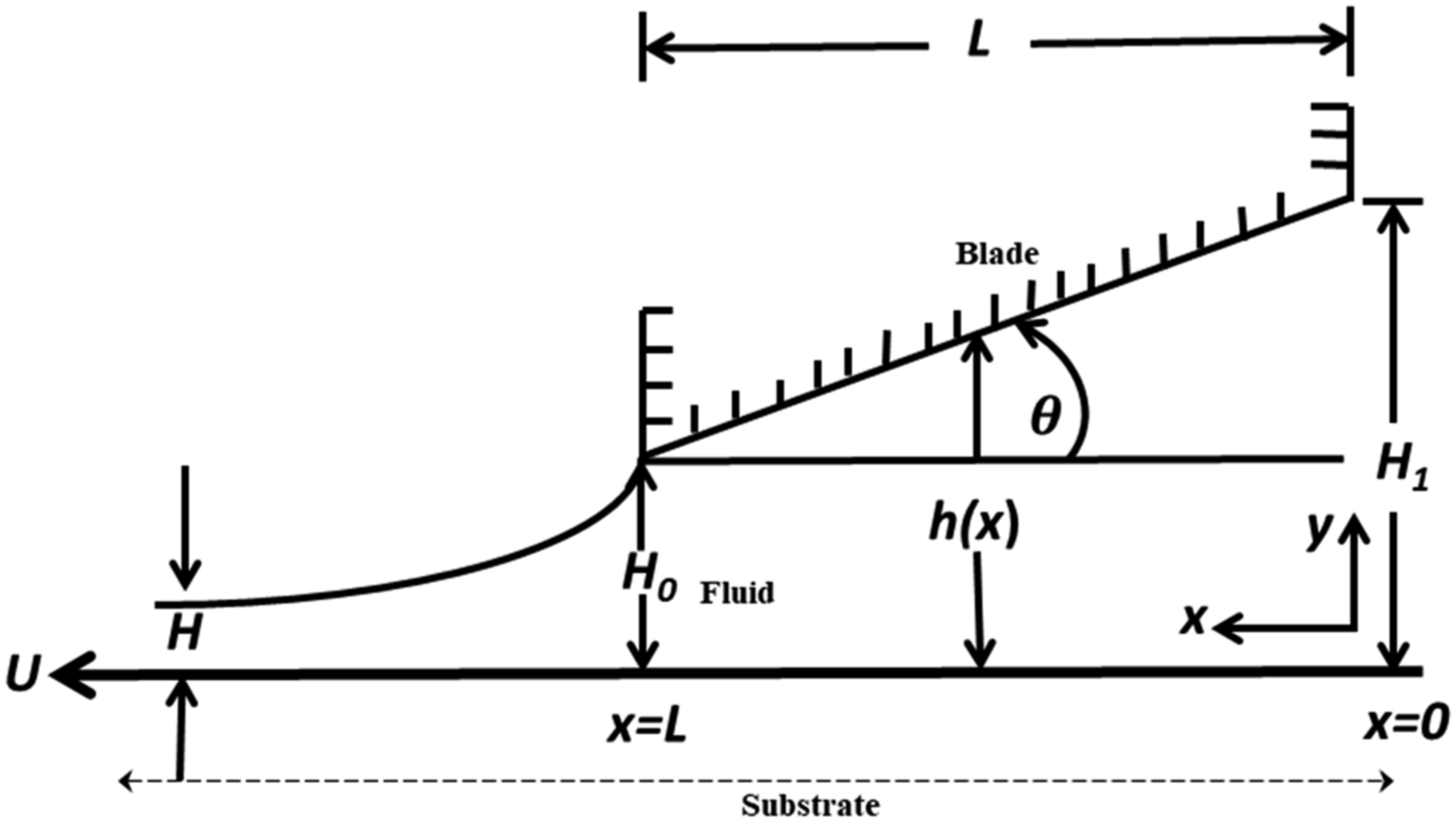
The governing expressions of the current problem along with the stress tensor for third-grade fluid are defined in the Appendix for simplification of the problem description. Under two-dimensional velocity





Here, the appropriate slip boundary conditions are as follows:



Solution of the problem
We use the stream function to obtain the numerical solution:







To derive the stream function
Results and discussion
In this study, we examine the application of a non-isothermal third-grade fluid for the blade coating method in both plane and exponential coaters. The shooting method is employed to generate velocity, pressure, and pressure gradient, all of which are influenced by various parameters. The numerical solutions for the plane and exponential coaters are depicted in panels (a) and (b) across all figures, respectively.
Verification
The present study is compared with existing research by Sajid et al. [13] which studies only third-grade fluid by perturbation technique. By taking both slip and magnetic field zero ( Comparison of present numerical and existing perturbation results of pressure profile by varying 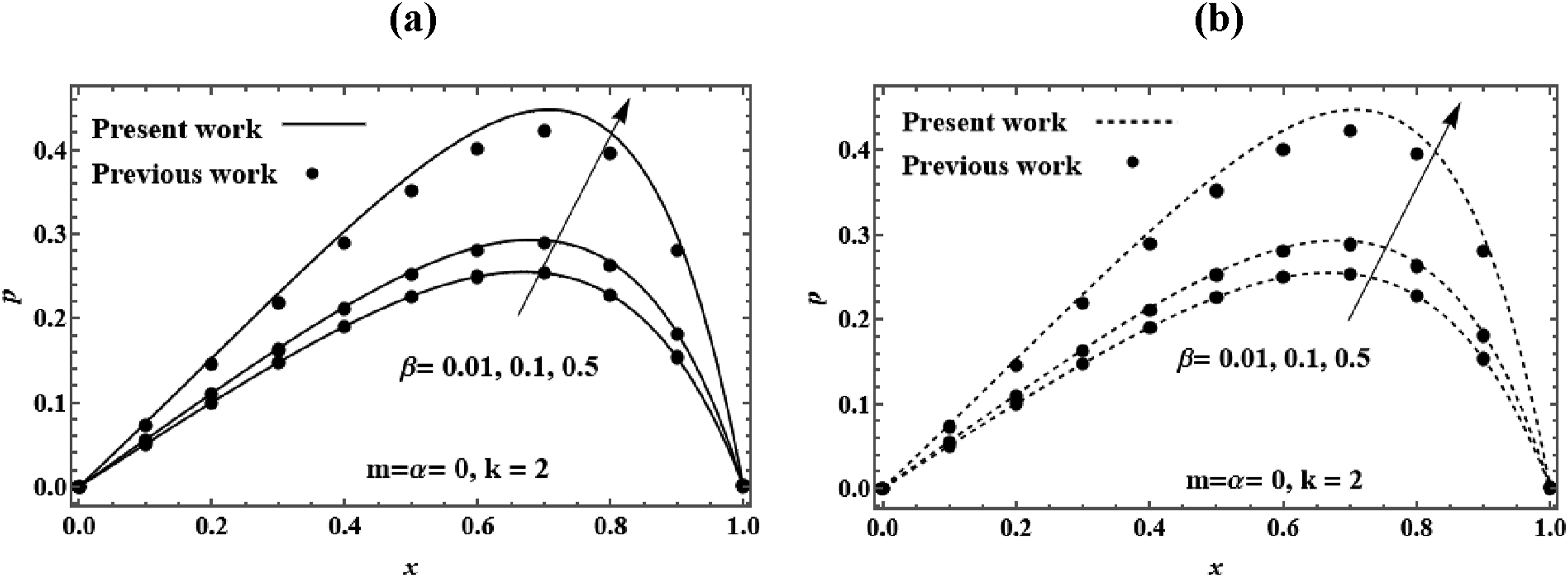
Pressure
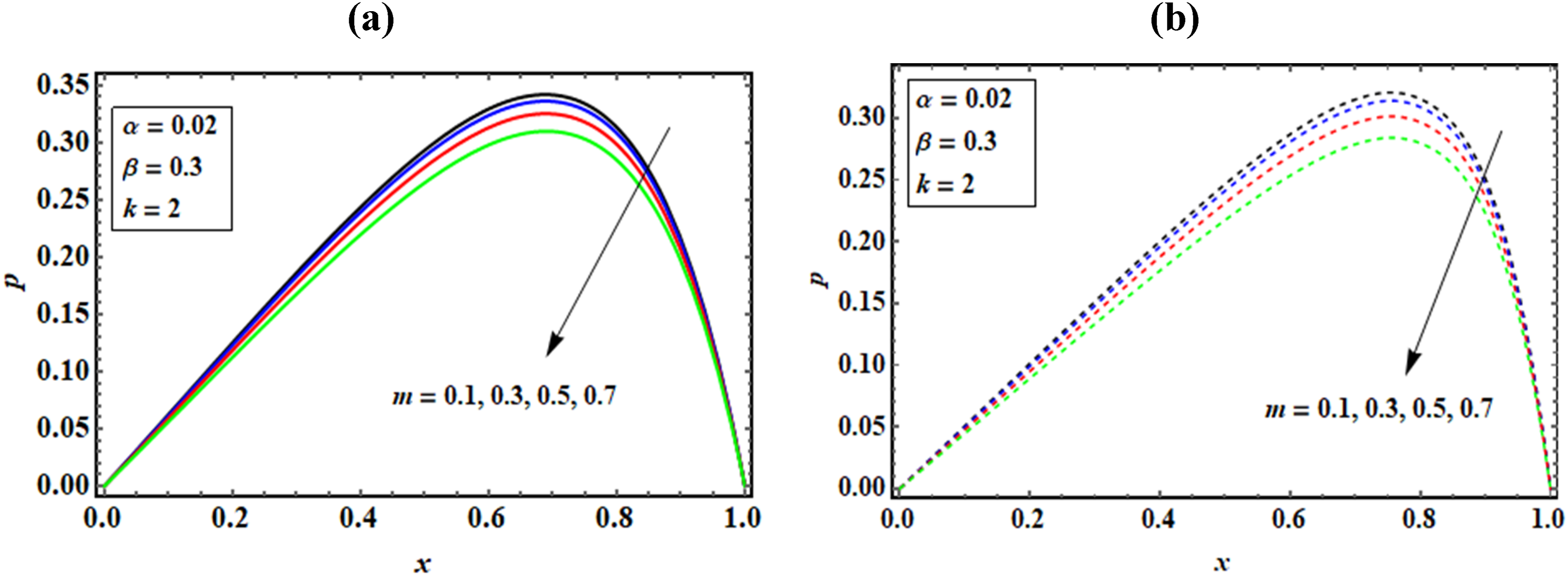
In Figures (3–6), the pressure distribution is plotted for distinctive values of Pressure against Pressure versus Pressure versus Pressure versus 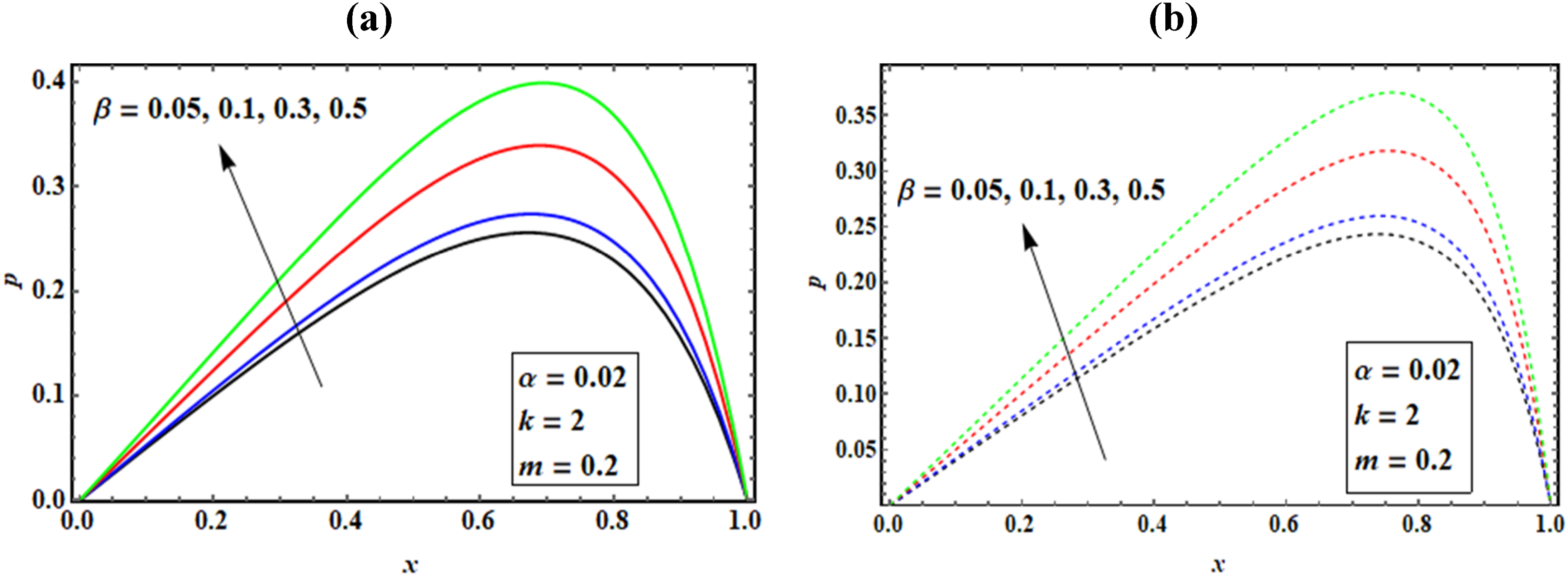


Pressure gradient
In Figures (7–10), pressure gradient ( Pressure gradient curves for Pressure gradient curves for Pressure gradient curves for Pressure gradient curves for 


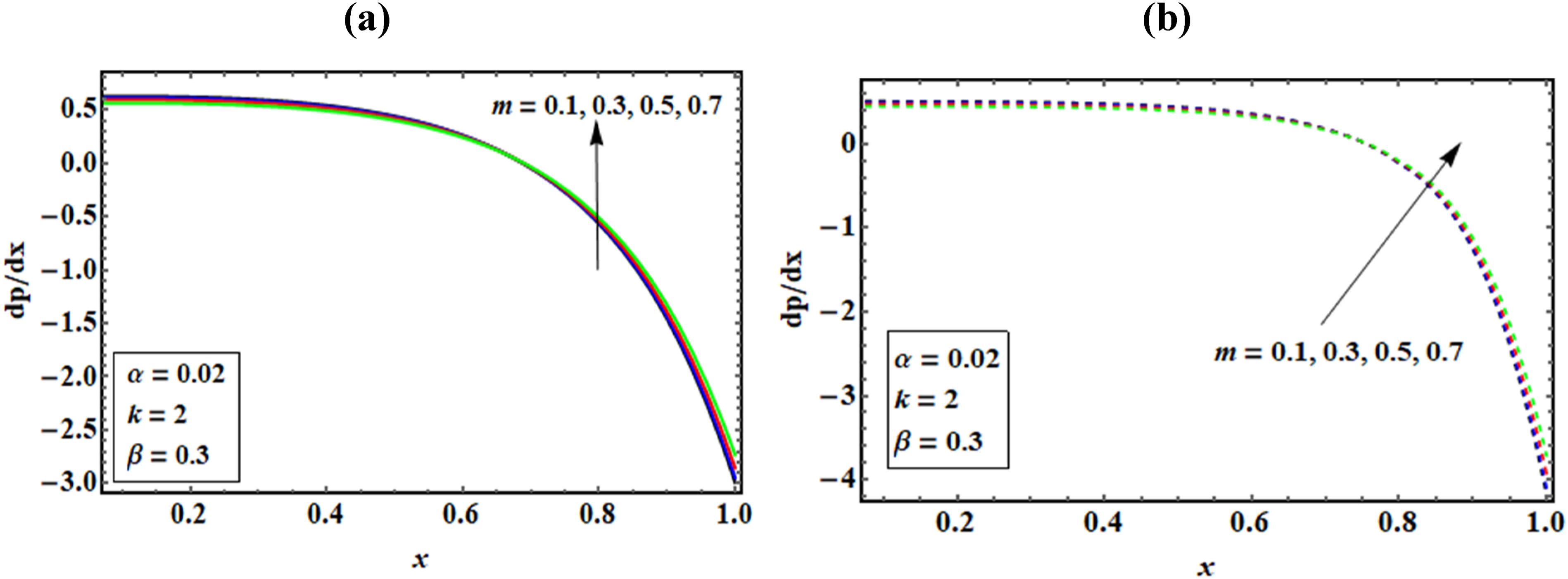
Velocity distribution
Figures (11–14) demonstrate the influence of the related parameters Velocity versus Velocity versus x for Velocity versus x for Velocity versus x for 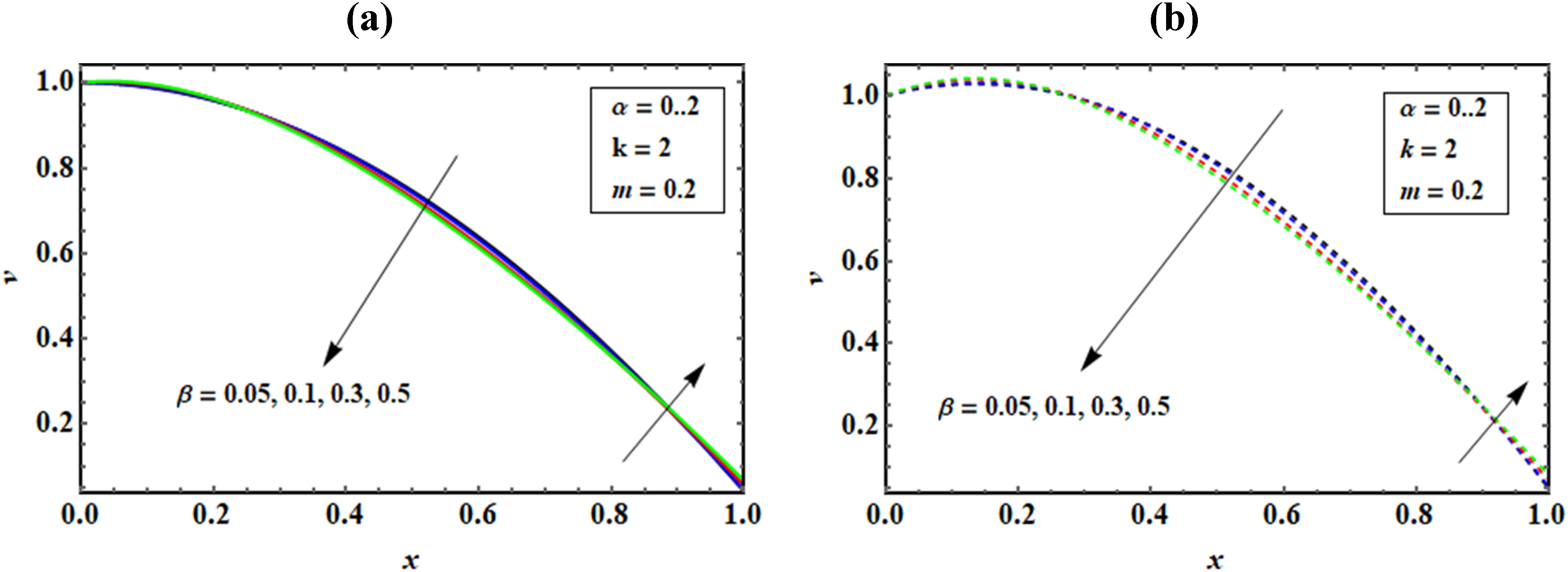


Temperature distribution
The temperature distribution is presented in Figures (15–18) for distinct values of Temperature graph for Temperature graph for Temperature graph for Temperature graph for 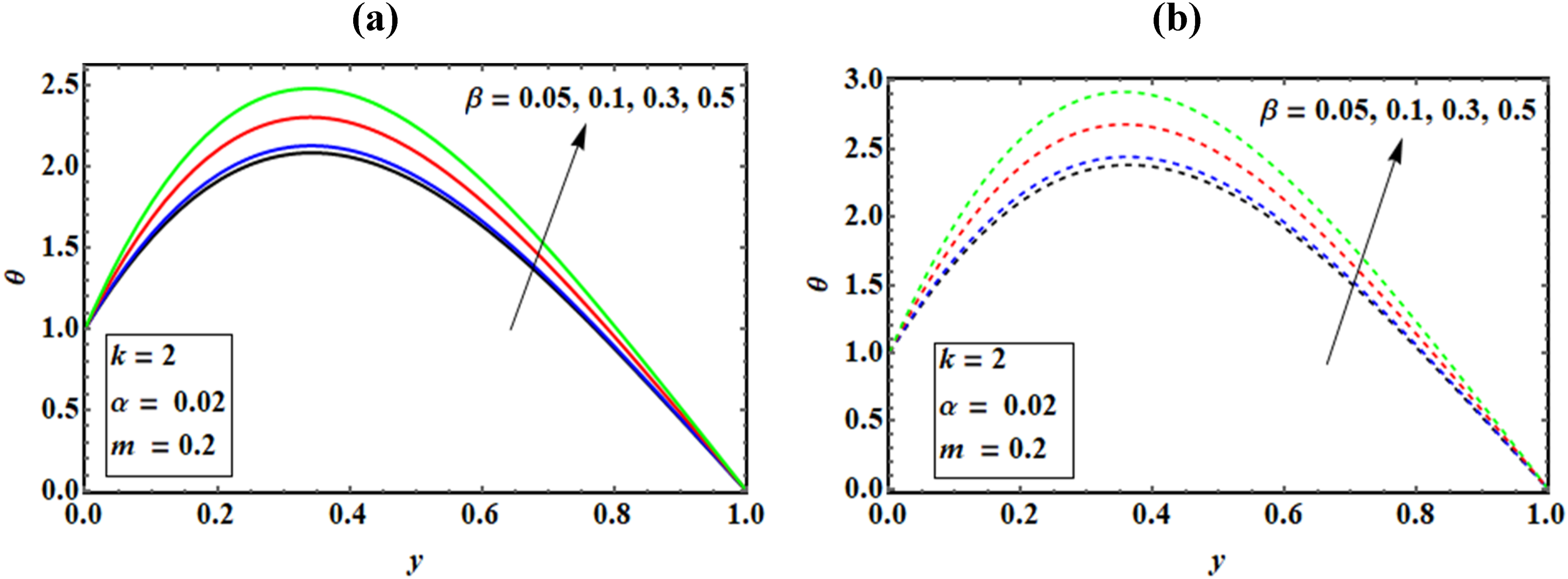

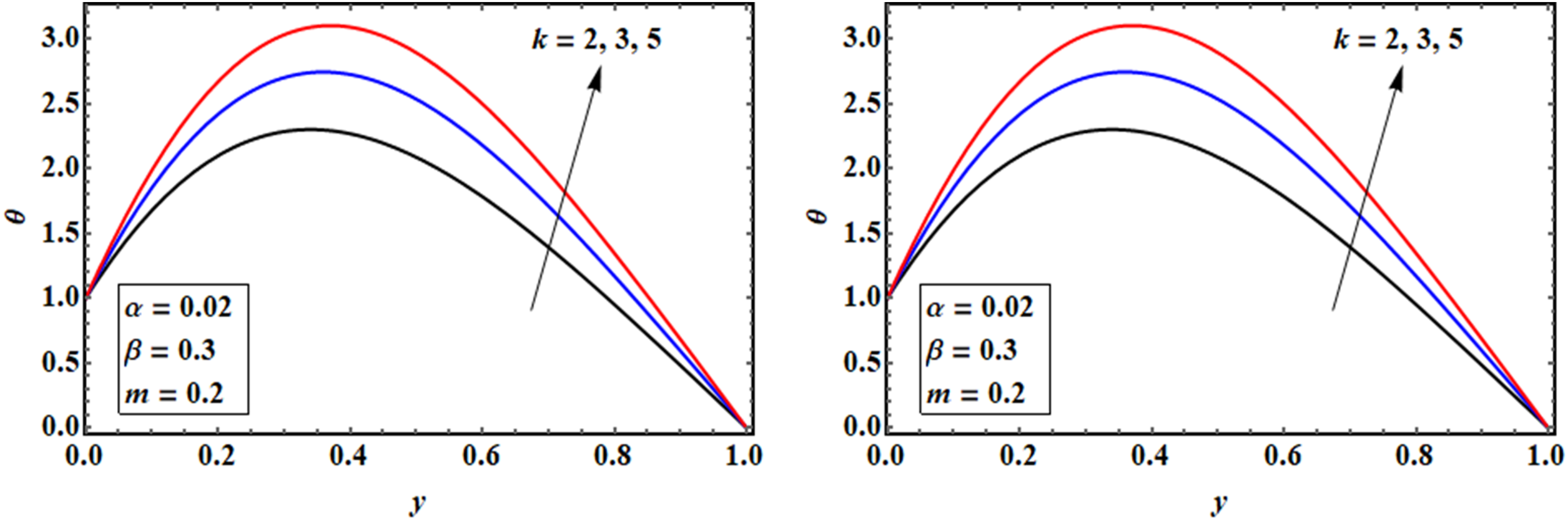

Influence of coating thickness and load

Impact of coating thickness and load

Influence of coating thickness

Impact of coating thickness H and load

Conclusions
This study discusses the blade coating procedure for both plane and exponential coaters for a third-grade fluid with wall slip, heat, and MHD. The equation of motion for the third-grade fluid in the influence of MHD and slip is calculated using the lubrication approximation theory. By using the shooting method and stream functions, we obtained numerical quantities of pressure, pressure gradient, velocity, and temperature. Plots and tables are used to illustrate the effects of various parameters, including coating thickness, MHD, third-grade fluid, and slip parameters. Following is the summary of the results: • The current numerical solution is compared with the previous perturbed solution and found to be in good agreement and also more accurate for large values of • As the material parameter • The fluid temperature rises with increasing material parameter, normalized coating thickness, and slip parameter. However, the MHD parameter induces the opposite effect on it. • The maximum velocity is observed near the blade tip as the material parameter and slip parameter increase. However, it begins to decrease with the elevation of the MHD parameter. • Coating thickness is the decreasing function for material parameter and MHD, and rising for slip and normalized coating thickness. • The results prove the viscoelastic nature of fluid along with MHD and viscous slip to be controlling parameters of pressure and blade load which lead to varying coating thickness, which may help in achieving improved substrate life and efficient coating process. • The current study provides a theoretical framework for the blade coating process, which can be in future validated with experimental findings. Also in the future, more non-Newtonian models can be studied to report the impact of variable fluid properties (viscosity and thermal conductivity).
Footnotes
Acknowledgements
We are thankful to the reviewers for their encouraging comments and constructive suggestions to improve the quality of the manuscript.
Declaration of conflicting interests
The author(s) declared no potential conflicts of interest with respect to the research, authorship, and/or publication of this article.
Funding
The author(s) received no financial support for the research, authorship, and/or publication of this article.

Appendix
The governing equations are
14
:
The extra stress tensor S for third-grade fluid is provided by21,26:
The low Reynolds number assumption leads to the vanishing of the induced magnetic field when associated with an applied magnetic field