



Abstract
At present, a variety of methods have been developed to realize the self-healing function of fiber-reinforced composites. However, the intrinsic mechanism of material damage recognition and self-healing initiation still lacks systematic research. In this paper, GF/(FeNip/PP) composites with multistage structures were prepared to study the self-healing properties and the mechanism of fiber-reinforced thermoplastic composites. The addition of a small amount of FeNip without affecting the melting peak temperature of the PP matrix (i.e., without reducing the use temperature of PP) can increase the electromagnetic loss (tanδ) of the composites by about 40% and the thermal conductivity by 36%. The cyclic stretching times of GF/(FeNip/PP) composites after microwave healing are doubled at 50% to 60%σmax load. It is indicated that FeNip endows the GF/PP composites with good microwave healing performance, and the purposeful repair can effectively extend the service life of the material. In addition, the self-healing mechanism of GF/(FeNip/PP) composites is discussed in detail from the aspects of microstructure change, multiphase interface effect, entropy enthalpy effect, starting and ending of self-healing procedures, etc. The magnetothermal effect, “entropy consumption” effect, and polymer chain diffusion are the fundamental reasons for the self-healing function of fiber reinforced thermoplastic composites.

Highlights
1. GF/(FeNip/PP) composites have a good self-healing function, which benefits from the entropy-induced diffusion and the magnetocaloric effect of FeNip. 2. The cyclic tensile times of GF/(FeNip/PP) composites under 50% ∼ 60%σmax load was double after microwave healing the cracks. 3. The magnetothermal effect of locally enriched FeNip provided continuous energy for the completion of the healing process.
Introduction
Due to the characteristics of lightweight, high-strength, and good designability, fiber reinforced thermoplastic composites (FRTCs) are widely used in aerospace, automotive, marine industry, and other fields. Different from the expansion of macroscopic cracks in homogeneous materials, such as metallic materials, the fatigue damage failure process of FRTCs is the overall damage formed by the accumulation between layers. Before the fatigue failure of FRTCs occurs, the damage has already accumulated to a considerable extent. Therefore, before reaching the overall damage, the self-healing procedures of FRTCs are initiated to restore performance and extend service time, which would effectively improve the service life of the component.
In recent years, important progress has been made in the field of self-healing polymer-matrix composites, and there has been a lot of research on the self-healing properties of different types of FRTCs.1–6 There are two main types of self-healing materials, through internal structural changes (physical or chemical cross-linking reactions) and relying on external implantation of healing agents (microcapsules, fibrous vessels, etc.). The addition of microcapsules or microvascular networks would damage the structural integrity of the composites and the microchannels within the composites may act as the initial site of damage after releasing the healing agents, resulting in a decrease in mechanical properties. Therefore, For fiber-reinforced composites with high mechanical performance requirements, the design strategies of intrinsic self-healing have more potential. Typical intrinsic self-healing fiber-reinforced composites are achieved by compounding thermoreversible resin adhesives (using them as the matrix or healing agents), using an external excitation source to drive the initiation and completion of the internal healing process. The necessary conditions for achieving self-healing are the input and conversion of external energy, mainly including electrothermal conversion, photothermal conversion, and magnetothermal response.7–11
Electromagnetic waves have high permeability to polymers, which is instrumental in improving the depth and efficiency of healing. So the magnetothermal conversion is more advantageous than the other two in terms of energy supply for intrinsic self-healing materials. Metal magnetic nanoparticles have good magnetic field response characteristics.12–14 A large number of theoretical models and indirect heating experiments of MNPs have proved that the magnetocaloric effect of MNPs in the nanocomposite system causes the matrix heating in the micro area around the particles under the external magnetic field, and the local micro area nanoscale thermal effect do not bring changes in the temperature of the material macro system.15–18 By adjusting the structure and magnetism of MNPs, external magnetic field parameters, and the content in the composite, the magnetic nanocomposites can be heated with a long-distance, contactless, and controllable method.19,20
The key to the self-healing function of FRPCs lies in the re-infiltration of debonded fibers. The most important healing foundation is ignored in both fiber vessel and microcapsule healing systems, and the microscopic conditions required for the healing of mechanical properties of materials have not been fundamentally resolved. The research on the self-healing methods of electrothermal effect, magnetothermal effect, and photothermal effect activated reversible resins have analyzed the healing degree of the mechanical properties of the materials and the healing of visible cracks from a macro perspective but has not explored the inherent driving factors for FRPCs to realize self-healing function from the microscopic healing mechanism. In addition, the intrinsic mechanism of material damage recognition and self-healing initiation is still lacking in systematic research. Therefore, this paper aims to analyze the mechanism of the self-healing FRTCs from a microscopic perspective and provide theoretical guidance for the design and preparation of structural and functional self-healing materials.
Our team has been engaged in the functional application of magnetic nanocomposites for a long time and obtained a series of research results in this field. In our study, we found that FeNip can give thermoplastic resin good microwave healing performance, and does not affect the mechanical properties of the matrix itself. Therefore, it is speculated that reasonable adjustment of the magnetothermal conversion ability of FeNip can enable the thermoplastic resin matrix composites to have microwave healing function. To expand the functional applications of magnetic nanoparticles, we selected GF/PP, the most widely used fiber reinforced thermoplastic composite on the market, as the research object to study its self-healing mechanism from the microscopic level.
In this paper, the self-healable thermoplastic soft magnetic nanocomposite (FeNip/PP) as the matrix, GF/(FeNip/PP) composites with multistage structure were designed and prepared to study the self-healing mechanism of fiber-reinforced thermoplastic composites. The healing properties of the composites were evaluated from the aspects of mechanical properties and crack healing before and after microwave healing. The outstanding contribution of this paper is to study and explain the healing mechanism of GF/(FeNip/PP) composites in detail from the aspects of microstructure change, multiphase interface effect, entropy and enthalpy effect, and the start and end of the self-healing process. Finally, the results of this study show that the magnetocaloric effect, “entropy depletion” effect, and polymer chain diffusion are the fundamental reasons for the self-healing function of fiber reinforced thermoplastic composites (GF/(FeNip/PP) composites).
Design and preparation of self-healing GF/(FeNip/PP) composite laminates
In this paper, a magnetothermal self-healing method applied to structural composites is designed to realize the non-contact multiple repeated self-healing of FRTCs. The FeNip/PP magnetic nanocomposite is used as the matrix film to composite with glass fibers forming laminate. The fatigue damage failure mode of GF/(FeNip/PP) composites and the microstructure change during the self-healing process are studied. The external energy source required for the healing is provided by the microwave field.
To endow the fiber composites with self-healing properties without reducing their mechanical properties, the internal structure of GF/(FeNip/PP) composites is designed as the multilevel structure of a “magnetic nanostructure-active matrix-fibers layer.” The thermoreversible polymer matrix, as healing agent for repairing damage, is the key to determining the self-healing function of the GF/(FeNip/PP) composites. The content of the active matrix affects the mobility of polymer chains in the healing process, which in turn determines the healing time of the material, but the strength of the material will be damaged as the content increases. The size, content, and surface state of magnetic nanoparticles determine the state change of “entropy and enthalpy” in the internal micro-domain of the material under fatigue load and during the self-healing process and have a direct impact on the strength of the matrix material, as well as the energy conversion efficiency and magnetic traction efficiency in the healing process.
How to reduce the molecular weight of the polymer to form active short chains and control their content to improve the mobility of the polymer chains in the self-healing process without damaging the strength of the composites is a major problem in the preparation technology. Secondly, how to uniformly disperse the easily agglomerated soft magnetic nanoparticles in high-viscosity polymers (PP) is also a challenge in the preparation technology. In addition, in multi-level structured materials, the interface structure has an important impact on the material properties, and the control of the interface structure at all levels also depends on the preparation technology. The paper intends to solve the preparation problem of self-healing fibers composites through key technologies such as “low-temperature liquid phase dispersion,” “high-temperature melt molding” and “active matrix pre-impregnation.”
The main raw materials.

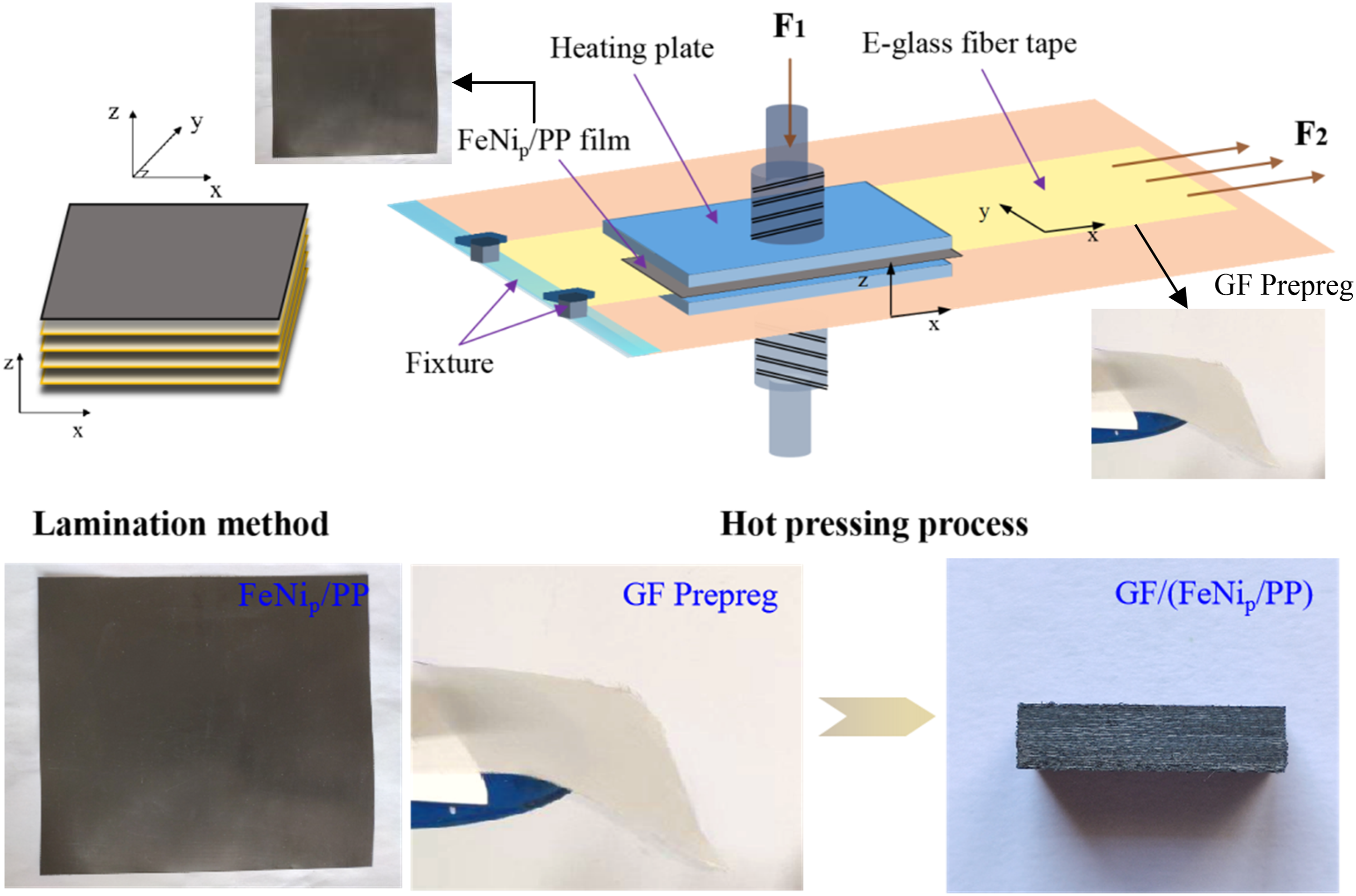
The preparation process of GF/(FeNip/PP) composite laminates.
The phase structure analysis of GF/(FeNip/PP) composites was performed by X-ray diffraction (XRD) on German PAN alytical X-ray diffractometer with CuKa radiation. The test conditions were that the tube voltage was 40 kV, the current was 40 mA, and the step was 0.02°/s. JEOL JSM-6701F scanning electron microscopy (SEM) was used to observe the microstructures and morphologies of GF/(FeNip/PP) composites. In this paper, the mechanical properties and cyclic loading tests of GF/(FeNip/PP) composites are carried out by using MTS microcomputer controlled electronic Universal Testing Machine (CMT4000). The test standard is MTS EM GB-T 1040.4-2006 (Determination of tensile properties of plastics Part 4: Test conditions for isotropic and orthotropic fiber reinforced composites). The thermal constants of FeNip/PP nanocomposites were tested using Tianjin Fred TPS thermal constant analyzer (GB/T 32064-2015) with the probe model P32126 of Tianjin FOREDA Technology Co. LTD.
The surface treatment process of glass fibers is shown in Figure 2. The purpose of surface treatment is to increase the specific surface area and surface roughness of the fibers, and increase the interfacial contact activity, to form better interfacial bonding between the fibers and the resin matrix. The PP resin was dissolved in the organic solvent to reduce viscosity and form an active matrix. The fiber tape was fully permeated by the active PP solution to form the prepreg, which was advantaged to form the tightly bonded interface between the glass fibers and the functional resin matrix (FeNip/PP). Surface treatment process of glass fibers.
Figure 3 visually shows the effect of surface treatment on the binding of glass fibers to PP resin. The surface of untreated fibers is smooth, and when preparing prepreg, PP resin penetrates the gaps of the fiber bundle to solidify and form, which is easy to peel off when subjected to external forces. The organic layer on the fibers’ surface was destroyed by the surface treatment process, which increased the specific surface area and surface roughness of the fibers. Silane coupling agents entered the molecular layer on the surface of the fibers and enhanced the interfacial contact activity of PP resin and the fibers. So the glass fibers and PP matrix were linked through chemical bonds by the functional groups. During the formation of prepreg, PP resin adhered to the fibers’ surface, forming good interfacial bonding and mechanical interlock. Fibers surface morphology of GF/(FeNip/PP) prepreg (a) untreated and (b) treated.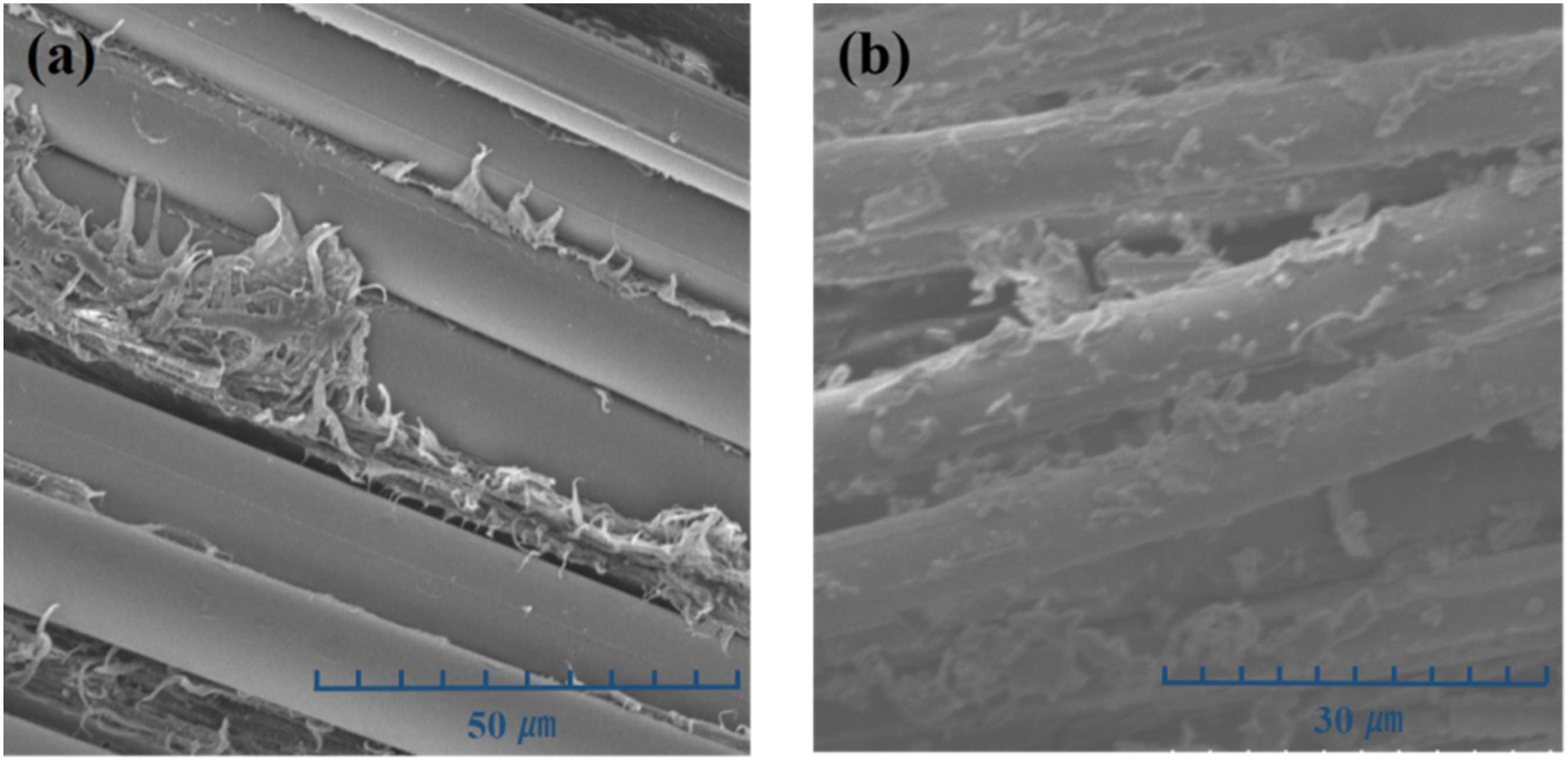
Results and discussion
Figure 4 shows the XRD spectrum of FeNip/PP film. There are only FeNi3 phases and (C3H6)n phases in the nanocomposite, indicating that no side reactions are produced during the process of preparation and dispersion. XRD spectrum of FeNip/PP film.
The samples of 180 mm × 10 mm × 3 mm (l × w × h) were used in this paper to study the damage forms of FRTCs, and the two ends (at the chuck) were protected by spacers (as shown in Figure 5 and Table 2). The number of samples in each group was 8∼10. The stress-strain curve of GF/(FeNip/PP) composites shows that its tensile strength is 287.91 MPa, and the material is a typical linear deformation stage III after experiencing brief initial elastic deformation stage I and plastic deformation stage II. In stage III, damages such as interfacial debonding, delamination, and matrix cracking occur until fracture failure. The tensile fracture is dominated by fiber fracture and matrix cracking, and the fibers show overall brittle fracture. The fibers and resin matrix at the fracture section were debonded and cracked, indicating that the preparation process of the composites met the requirements and that force of each fiber layer was uniform. The stress-strain curve of GF/(FeNip/PP) composites. Mechanical properties of the GF/(FeNip/PP) composites (GB/T1040).

The damage-healed performance of FeNip/PP and GF/(FeNip/PP) was evaluated. As shown in Table 1, the tensile strength of FeNip/PP nanocomposites can be restored to 90% of that before damage after microwave healed. 22 To obtain the fatigue damage state as soon as possible, GF/PP and GF/(FeNip/PP) composites were subjected to cyclic tensile tests under the load of 50%∼60%σmax. The average number of stretch cycles for the unrepaired composites was about 11 and 20, respectively. After 10 cycles of loading, the GF/(FeNip/PP) composite was placed in a microwave field to activate the self-healing process. After healing, the number of fatigue stretching cycles of the composite increased significantly, and the number of cycles was extended by up to two times. However, there was no significant change in the number of stretching cycles of GF/PP composites, indicating that FeNip plays a crucial role in microwave healing.
As shown in Figure 6, the cyclic loading fatigue failure of GF/(FeNip/PP) composite laminates manifests as obvious fibers debonding and matrix cracking. Local bulges and wrinkles also appear in the cyclically loaded samples. That’s because the deformation and elastic modulus of glass fibers and PP resin are significantly different, causing the degree of recovery differ to between glass fibers and resins after loading and unloading. It is worth noting that the peeling, delamination, and curling of FRTCs laminates are caused by the above two problems. Therefore, when considering the repair efficiency of materials, we simplify to focus on the solutions of these two problems. For this kind of local obvious damage, but the materials still retain a certain degree of mechanical properties, it is very necessary to repair regularly to restore and prolong the fatigue life of the material. Fatigue damage and failure modes of GF/(FeNip/PP) composite laminates (a) and (b) the samples with fatigue damag; (c) the sample with fatigue fracture.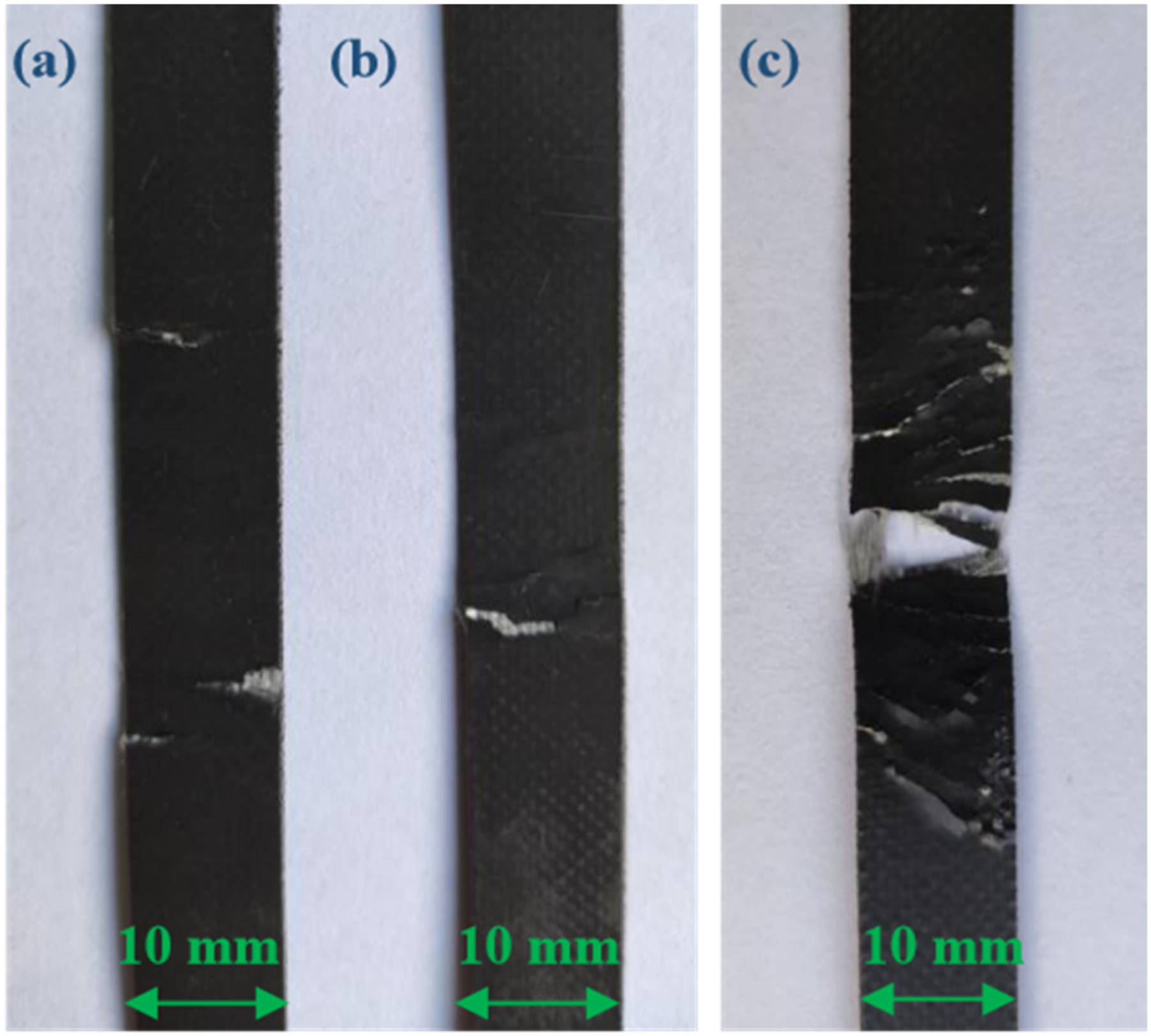
FRTCs are essentially layer-by-layer composites of fiber films under the action of resin glue. The strength and modulus of the fibers are much greater than that of the resin matrix. Therefore, when the material is subjected to external force (fatigue load, etc.), the impact on the matrix material is relatively large, and the matrix cracking and fibers debonding occur first. Then the damage of delamination and fiber fracture occurs continuously until failure. The healing of FRTCs is in the stage of initial damage, that is, the implementation of self-healing mainly lies in healing matrix cracking and interface debonding and the subsequent small-area delamination phenomenon. Briefly, the healing of FRTCs mainly consists of the repair of matrix microcracks and the rewetting of debonded fibers.
The microwave frequency in the study is 0.3 GHz and the power is 700 W. The microwave healing time is related to the size of the samples and the position of the microwave emission source. In our experiment, the samples was always at a distance of 10 cm from the microwave emission source. Microwave treatment for 10 min and repeated treatment 1–3 times can completely heal the surface cracks. Figure 7 showed the overall temperature change of FeNip/PP nanocomposites under microwave action. The surface temperature of the samples during the healing process is between 100 and 120°C. The non-ferromagnetic material (PP) reached a temperature of 113.7°C after 10 min, while FeNip/PP reached 134.8°C. This demonstrates that adding a small amount of ferromagnetic material (FeNip) enables reaching the critical healing temperature, as confirmed by microstructure analysis. Whether the composites placed in the microwave field can absorb microwave and how much it can absorb mainly depends on the properties of the composite itself (dielectric loss tangent value tanδe and dielectric constant εr), that is, the electromagnetic rate of the composite. The heat resistance temperature of PP was 120°C and the melting peak temperature of PP resin was 167.6°C. The melting peak temperature of FeNip/PP nanocoposites was 166–169°C. It should be especially emphasized that the addition of FeNip will not affect the melting peak temperature of PP matrix, and will not reduce the use temperature of PP resin. Secondly, according to the electromagnetic rate test results of FeNip/PP nanocoposites, the dielectric constant of 5 wt%FeNip/PP nanocoposites in the 0.3 GHz band is 23% higher than that of PP, and the electromagnetic loss (tanδ) is about 40% higher.21,22 Temperature change of PP and FeNip/PP under microwave treatment.
Figures 8 and 9 shows the surface state and internal microstructure of the samples under fatigue damage and after microwave healing. It can be seen from Figure 8(a) and (c) that under fatigue loading, obvious matrix cracks appeared in the inner part of the samples, and the expansion of the cracks caused the delamination of the interface between the fibers and the matrix. As shown in Figure 8(b), after 10 min of microwave healing, the damaged surface of the sample is re-bonded and tends to be flat. According to the microstructure observation in Figure 8(d), the surface of the debonded fibers was re-infiltrated and wrapped by the resin matrix, the fibers were tightly connected, the cracks on the surface of the matrix healed, and the transition between the fibers and the matrix layer was uniform without delaminating and peeling. The “filling cracks and gaps of low-viscosity melt” during the healing process of the composites were observed by SEM. The micromorphology of cracks and the dispersion state of FeNip under microwave were showed in Figure 9. The aggregation of FeNip occurred at the crack healed site. The self-healing of GF/(FeNip/PP) composites under microwave (a) fatigue damage samples; (b) after microwave healing for 10 min; (c) fibers debonding; (d) fibers re-infiltrated. The micromorphology of cracks and the dispersion state of FeNip under microwave.

Discussion on the self-healing mechanism of GF/(FeNip/PP) composites
Interface interactions in the healing process
Figure 10 showed three types of phases and their interconnected interfaces in GF/(FeNip/PP) composites: FeNip-PP interface, PP-GF interface, and FeNip-GF interface (with little effect on the materials). FeNip was wrapped in resin matrix (PP). The fiber surface was completely adhered to by the a resin matrix (PP). The phase interface structure inside GF/(FeNip/PP) composites has an important influence on the properties. In the process of damage healing, there are discrete interfaces in the crack area, and contact interfaces in the healing affected area, etc. There are two functions of the interfaces, one is energy exchange, and the other is the movement of the microstructures (movable polymer chains and nanoparticles) in the damaged area to heal the cracks. The interfaces in GF/(FeNip/PP) composites. (a) FeNip/PP interface. (b) GF-(FeNip/PP) interface longitudinal section. (c) GF-(FeNip-PP) interface cross section.
When the stress is transmitted in GF/(FeNip/PP) composites, the FeNip/PP nanocomposite matrix is prone to microcracks due to its relatively low strength, which leads to matrix cracking. Secondly, the elastic moduli of the matrix and the fibers are different, and the interface bonding strength is limited, which is prone to debonding between the fibers and the resin matrix. In addition, the propagation of matrix cracks may also cause debonding of the fiber-resin matrix interface.
For the FeNip/PP nanocomposite matrix, the interfacial structure formed by the fusion of the loose structure on the surface of nanoparticles and PP polymer chains is a buffer layer, which effectively prevents the particles from falling off and the deformation of the polymer chains. Rigid nanoparticles play the role of “pinning,” absorbing and consuming a large amount of damage energy and inhibiting the propagation of matrix cracks.23,24
Figure 11 shows the change of microstructure during the damage-healing process of GF/(FeNip/PP) composites. In the microwave-activated healing procedure, the magnetic nanoparticles absorb electromagnetic waves to trigger their magnetocaloric effect, convert the electromagnetic energy into thermal energy, and transmit it to the resin matrix through the interlaced structure of the FeNip-PP interface. The PP molecular chain in the healing micro-region is thermally relaxed, and the internal stress drives spontaneously “entropy increase,” so that the discrete interfaces of the crack contact and infiltrate each other until they disappear. In the fibers debonding part, the “micro-domain mobile phase” formed by the molten FeNip/PP nanocomposite re-wet the debonded fibers, the resin matrix is fully filled in the fibers voids to form dense structure, and then re-established the GF-(FeNip/PP) interface (as in Figure 11). That is the basis for the recovery of the properties of the fiber composites after repair. The fibers have low thermal conductivity, which is not conducive to heat transfer. The method of magnetic induction repairing completes the healing process by transferring heat in the matrix layer through internal thermal activation. Change of microstructure during damage-healing process of GF/(FeNip/PP) composites (a) damage area, (b) after self-healing.
Entropy and enthalpy effects in the healing process
In GF/(FeNip/PP) composites, the essence of the self-healing process lies in the changes in the entropy and enthalpy of the internal micro-domain of the FeNip/PP nanocomposite matrix under the action of external energy. Entropy (ΔS) is a measure of the “chaotic degree” of the material system. The higher the entropy value, the more chaotic the system is. At the same time, it can also be regarded as the more uniform distribution of the micro-state of the system. Enthalpy (ΔH) is a parameter that characterizes the energy state of the material system. 25 During the repair process, the distribution of polymer molecular segments and nanoparticles tends to “entropy increase” at the microscopic level, which in turn makes the local system distribution tend to be uniform, so that cracks are healed and defects are filled. The enthalpy change of the system is that the magnetic nanoparticles absorb and convert electromagnetic energy into heat energy and transfer it to the composites, thereby causing the change of the state of the micro-domain system. Part of the heat energy is dissipated outward in the form of heat dissipation, and part of it is converted into the internal energy of the system.
In FeNip/PP nanocomposite system, the presence of solid nanoparticles (FeNip) becomes an obstacles to the diffusion of polymer (PP) molecular chains. Molecular chains can only stretch around the nanoparticles, resulting in a loss of conformational entropy. When there is no specific high-strength interfacial interaction between the polymer matrix and the nanoparticles, the nanoparticles with small size are wrapped by the polymer molecular chains, and the larger nanoparticles are discharged from the polymer matrix structure toward the surface, interface, etc. That is the entropy-induced diffusion in nanocomposite systems, which affects the spatial distribution of nanoparticles in the polymer matrix.26–30 It is the entropy-induced diffusion that causes the nanoparticles to spontaneously aggregate towards the discrete interface at the cracks when cracks appear. The locally enriched magnetic nanoparticles produce a strong magnetocaloric effect (compared to the undamaged area) under the action of the alternating magnetic field, and the temperature increase brought by the local thermal effect intensifies the entropy-induced diffusion of the magnetic nanoparticles, and the local temperature continues to rises. It is further increased until the glass transition temperature (Tg) of PP polymer is reached, thereby forming a “micro-domain mobile phase.”
The magnetocaloric effect of magnetic nanoparticles originates from the hysteresis loss, Neil relaxation, and Brownian relaxation. In self-healing GF/(FeNip/PP) composites, the entropy-induced diffusion of nanoparticles is the “fuse” for the realization of the material’s self-healing process, and the magnetocaloric effect of locally enriched magnetic nanoparticles provides continuous energy for the completion of the healing process, and the “micro-domain mobile phase” formed by the diffusion movement of polymer chains is the fundamental reason for the repair of matrix cracking and fibers debonding.
The role of FeNip in the healing process
The self-healing of GF/(FeNip/PP) composites under microwave irradiation benefits from MNPs. As in Figure 12, FeNip is uniformly dispersed in FeNip/PP films and its single particle size is about 10–100 nm. The aggregation of FeNip at the surface crack is due to entropy-induced diffusion. The addition of functional nanoparticles (FeNip) brings many novel properties to thermoplastic resin materials. The entry of FeNip brings magnetic response and magnetic induction properties, which endow the composites with many sensitive characteristics to the outside world, which is conducive to the monitoring of the materials’ damage and self-healing implementation. Surface of FeNip/PP nanocomposites matrix.
The thermal constants of FeNip/PP nanocomposites were tested using Tianjin Fred TPS thermal constant analyzer (GB/T 32064-2015) with the probe model P32126 of Tianjin FOREDA Technology Co. LTD. The thermal conductivity test range is 0.1∼20 W/mK. Temperature resolution is better than 0.001 K. The heating power of FeNip/PP nanocomposites and pure PP is 0.1 W and the heating time is 80 s and 120 s respectively, as shown in Figure 13(a) and (b). Thermal conductivity, thermal diffusivity and volumetric specific heat capacity are obtained by measuring the temperature rise at one time. The average values of the three groups of samples were taken as valid test results. Thermal constant test interface: T-t (a) test heating time 80 s; (b) test heating time 120 s.
Thermal constants of the FeNip/PP nanocomposites.

Patti et al. analyzed the effect of introducing fillers on the thermal conductivity of PP matrix. It also emphasized the key issues in the preparation of thermal conductive plastics, namely particle dispersion and interface resistance. Thermal conductive fillers can be divided into three categories: metal powder, ceramic particles, and carbon based materials, which play a role in the heat and current transfer of the composites. 31 The thermal conductivity of PP reported in the literature is basically consistent with our test results, and the thermal conductivity of the composites is directly related to the type and content of fillers. The addition of trace amounts of FeNip has a significant impact on the thermal conductivity of PP and brings about an improvement in dielectric properties, Which profits from the uniform dispersion of FeNip in PP and the good interface bonding between the two.
When micro-cracks occur inside the FeNip/PP matrix, the FeNip under the action of “entropy consumption effect” is autonomously enriched towards the crack edge. The input of the external electromagnetic energy causes the magneto-caloric response of the internal FeNip. FeNip converts the energy of the electromagnetic field into thermal energy and accumulates locally. At the same time, the increase in temperature intensifies the enrichment of nanoparticles. The accumulation of energy causes the local molecular chain to relax (extend, expand) and reach a critical state.
With the continuous input of energy, the diffusion movement of the molecular chain occurs, and the resin matrix melts and expands. The pressure of expansion makes the flexible molecular chain move toward the gap, reducing the distance between the discrete interfaces at the cracks, then contact, infiltrate, and form the configuration of the physical network. This is the most critical process of polymer composites repair. Macroscopically, the microcracks of the resin matrix are healed, the fibers’ debonding parts are re-wetted, and the layers are bonded together. After the healing process is completed, the magnetic field is withdrawn with a little delay, so that the inner magnetic nanoparticles are redistributed under the action of entropy and enthalpy to homogenize them. After that, the material is heat treated and annealed to eliminate internal stress and strengthen the material properties. At this point, the healing process is complete (as shown in Figure 14). Microscopic mechanism of the self-healing composites in healing process.
The delivery of molten thermoplastic resin to the fracture occurs through low viscosity flow, nano entropy effects, electromagnetic field actuation, and pressure delivery mechanisms within the composites. The “mobile phase in micro-area” propagates along the crack lines to restore some or all of the interlaminar fracture toughness and fatigue resistance of the composites.
In this paper, the self-healing mechanism of magnetic nanoparticles-functionalized FRTCs is deeply analyzed and discussed. It is studied and explained in detail from the start of the healing system, the realization of the healing process, and the post-repair treatment. Among them, the magnetocaloric effect, “entropy depletion” effect, and polymer chain diffusion are the fundamental reasons for the realization of the self-healing function of FRTCs.
Strictly speaking, the initiation of this healing process is non-autonomous and relies on external stimuli providing energy to initiate and maintain the process. The electromagnetic field radiation combined with the magnetically responsive material is applied to the resin matrix composite to form cascade reactions during the healing process. Electromagnetic radiation causes the magnetic nanoparticles in the composite material system to be excited and heated, which converts the external electromagnetic energy into the internal thermal energy of the material. In the process, the matrix molecular chain is thermally excited, and the local diffusion ability is improved, so that the cracks are filled.
In addition, the uniformly distributed MNPs in composites are sensitive to external magnetic fields and can be used for non-destructive monitoring of materials, which is expected to realize the autonomy of intrinsic damage identification and heal initiation of large-scale fibrous structures.
Conclusion
1. The GF/(FeNip/PP) composite with a multi-level structure of “magnetic nanostructure active matrix fiber layer” was designed and prepared in the study, which has good self-healing function, profitting from the entropy induced diffusion and magnetocaloric effect of FeNip. 2. Microwave healing effectively extended the service life of GF/(FeNip/PP) composites, and the cyclic tensile times of the composites were doubled under the load of 50%–60%σmax after healed. 3. This study analyzed the self-healing mechanism of GF/(FeNip/PP) composites from the perspectives of interface structure, entropy and enthalpy effects, and the role of MNPs. FeNip were uniformly dispersed in GF/(FeNip/PP) composites, which brought good thermal conductivity and magnetic induction properties to the composite. Microwave treatment not only increased the overall temperature of the material, but also intensified the entropy induced diffusion of FeNip, thereby causing local micro aggregation of FeNip at the edge of the cracks. The magnetocaloric effect formed by the agglomerated FeNip under microwave causes the local matrix to be heated and melted to form “mobile phase in micro-area,” which is the activation and initiation of the healing process. Under the action of micro movement, the surface of the debonded fibers was re-wetted and wrapped by the resin matrix, and the matrix cracks were healed.
Supplemental Material
Supplemental Material - Study on self-healing mechanism of magnetic nano-powders functionalized fiber reinforced thermoplastic composites
Supplemental Material for Study on self-healing mechanism of MNPs functionalized fiber reinforced thermoplastic composites by Jiajia Xiang, Jie Chen, Jiejing Jin, Jinyan Xie and Ruru Bai in Journal of Polymers and Polymer Composites.
Footnotes
Declaration of conflicting interests
The author(s) declared no potential conflicts of interest with respect to the research, authorship, and/or publication of this article.
Funding
The author(s) disclosed receipt of the following financial support for the research, authorship, and/or publication of this article: The Natural Science Fund Project of Jiangxi Province (No. 20232BAB216014).

Supplemental Material
Supplemental material for this article is available online.
References
Supplementary Material
Please find the following supplemental material available below.
For Open Access articles published under a Creative Commons License, all supplemental material carries the same license as the article it is associated with.
For non-Open Access articles published, all supplemental material carries a non-exclusive license, and permission requests for re-use of supplemental material or any part of supplemental material shall be sent directly to the copyright owner as specified in the copyright notice associated with the article.
