




Abstract
A novel series of bioactive polymer nanocomposites was recently created using the polycondensation method in conjunction with ultrasonic radiation. These nanocomposites comprise multi-wall carbon nanotubes and polyazomethine, which is based on the pyrazole moiety with various derivatives. The polyazomethine polymer was supplemented with a 2% concentration of multi-wall carbon nanotubes. The produced polymer nanocomposites were identified by Fourier-transform infrared spectroscopy and characterized by common characterization tools including X-ray diffraction, Scanning electron microscopy, and Transmission electron microscopy. The thermal stability was measured by thermogravimetric analysis and differential thermal gravimetry. The results of the X-ray diffraction patterns indicate that the multi-wall carbon nanotubes are really in the polymer matrix. The thermal analysis of these polymer nanocomposites shows high thermal stability. The agar diffusion technique was used to assess the antibacterial properties of the freshly synthesized polymer nanocomposites against various bacterial and fungal species. The chosen bacteria and fungi were susceptible to varying degrees of antimicrobial and antifungal activity in the polymer nanocomposites that were evaluated. Moreover, the antibacterial properties of the fabricated Polymer nanocomposites were assessed through colony forming units against Escherichia coli bacteria and showed good effectiveness of all tested polymer nanocomposites. All samples showed an effect on bacterial growth after 12 h by 22%–35%. After 24 h, the percent inhibition of E. coli in the presence of the prepared polymer nanocomposites was highest; it showed 45%–60%.
Introduction
Research into polymer nanocomposites is one of the most exciting fields in the scientific community right now. Many people are interested in low-dimensional carbon nanomaterials such as graphene, carbon nanotubes (CNTs), and fullerene because of their remarkable electrical, optical, mechanical, and chemical capabilities. Sensing, energy storage, optoelectronics, biology, and medicine are just a few of the many fields that benefit from these sp2 hybridized carbon-based materials’ many uses.1–9 Particularly intriguing are polymer-based nanocomposites that combine polymer with carbon nanotubes (CNTs). The extraordinary improvement that they bring to the functional properties of polymers opens up a whole new universe of opportunities for their application in a wide variety of sectors. The excellent physical, chemical, and service features of carbon nanotubes (CNTs) are significantly influenced by the distribution and disentanglement of CNTs inside the polymer matrix. 10 The current spike in popularity of carbon-based nanomaterials (CNMs) can be attributed to the antibacterial capabilities that were discovered in these materials.11,12 The exceptional insoluble nature of carbon nanoparticles (CNMs) and their high level of chemical resistance are two of the most significant advantages of these materials. Due to the fact that the concentration of these antibacterial chemicals does not change over the course of time, it is anticipated that there would be no decline in activity. In the same way that a rolled-up sheet of graphene is similar to a carbon nanotube (CNT), hemi fullerenes are typically used to close their ends. Single-wall carbon nanotubes, also known as SWCNTs, typically have a diameter that is only a few nanometers in size. The outside diameter of Multi-Wall Carbon Nanotubes (MWCNTs) can reach up to 100 nm, and they are made up of concentrated single-walled carbon nanotubes (SWCNTs). However, polyazomethines are a kind of π-conjugated polymer that stands in opposition to this. As a result of the existence of HC = N, these polymers are one of a kind; they have the ability to complex and protonate. In the year 1923, Adams and his colleagues were the first to successfully synthesize polyazomethine. 13 Polymer science is fascinated by this material because of its nonlinear optical, electrical, optoelectronic, and liquid crystalline properties.14–19 Additionally, this material is quite stable in terms of temperature. Their extraordinary qualities make it possible for them to be utilized in a variety of contexts.11,12,20–26 Consequently, a novel class of pyrazole-based nanocomposites containing azomethine linkages and multiwalled carbon nanotubes PAZm/Py/MWCNTs have been created using the polycondensation method and ultrasonic aid. In addition to FT-IR spectroscopy for material identification, standard characterization methods including XRD, SEM, and TEM were used to evaluate the synthesized polymer nanocomposites. Also covered were thermal analyses, such as TGA and DTG, of PAZm/Py/MWCNTs nanocomposites. The antibacterial properties of the freshly synthesized nanocomposites were tested on several types of bacteria and fungus. Additionally, Escherichia coli was used to test the antibacterial characteristics, and the percentage of decrease was determined after 12 and 24 h.
Experimental
Chemicals, solvents, and reagents
Substituted aniline derivatives (4-nitroaniline, p-toluidine, 2-chloroaniline) were purchased from (Sigma-Aldrich) and used as starting materials for the synthesis of monomers. Sodium nitrite (NaNO2), malononitrile (CH2(CN)2), sodium acetate (C2H3NaO2), and hydrazine hydrate were purchased from (BHD) and used directly as it was received. Glacial acetic acid CH3CO2H (99%) from Sigma-Aldrich was used as a catalyst. Terephthalaldehyde purchased from NANO TECH Co. LTD Egypt. Concentrated hydrochloric acid (HCl) was received from (Merck), as a solvent with (% pure) was used for dissolving substituted aniline derivatives. Ethanol absolute (99.9% pure) provided by (Merck) was used as solvent in the monomers, polymer nanocomposites fabrication. Multi-walled carbon nanotube (CNTs) was supplied by NANO TECH Co. LTD Egypt (99% purity) and used to fabricate polymers nanocomposites. All of the chemicals and solvents mentioned were used without any more purification because they were all highly pure.
Preparation of monomers
The monomers were synthesized according to the following general procedure as in a previous study.27–29
In a suitable beaker, 0.01 mol of substituted aniline derivatives
4-((4-Nitrophenyl) diazenyl)-1H-pyrazole-3,5-diamine (a )
The monomer (
4-(p-tolyldiazenyl)-1H-pyrazole-3,5-diamine (b )
The monomer (
4-((2-Chlorophenyl) diazenyl)-1H-pyrazole-3,5-diamine (c )
The monomer (
Fabrication of PAZm/Py/MWCNTsa-c nanocomposites
Polymer nanocomposites codes, MWCNT % loading and reaction mixture.

PAZm/Py/MWCNTsa
PAZm/Py/MWCNTsa was fabricated in the presence of 1 mol (0.308 g) of monomer
PAZm/Py/MWCNTsb
PAZm/Py/MWCNTsb was fabricated in the presence of 1 mol (0.154 g) of monomer
PAZm/Py/MWCNTsc
PAZm/Py/MWCNTsc was fabricated in the presence of 1 mol (0.19 g) of monomer
Antimicrobial activity
The antimicrobial activities of the newly fabricated PAZm/Py/MWCNTsa-c nanocomposites were evaluated using the agar diffusion method with different bacterial species and fungi, including the Staphylococcus aureus (ATCC 29213) and Bacillus Cereus (ATCC 14579) as selected Gram-positive bacteria strains, (E. coli (ATCC 35218) and Serratia marcescens (ATCC 21074) as selected Gram-negative bacteria strains, and Aspergillus flavus (ATCC 9643) and Candida albicans (ATCC 76615) as selected fungi. The method used to determine the antimicrobial effect of the new nanocomposites has been described in the previous literature. 31 In brief, a 90 mm Petri dish was filled with 25 mL of Muller-Hinton agar; 200 μL of bacterial cultures were autoclaved for 25 min and then spread on the surface of the agar plates using sterile swabs. The targeted materials were cut into 6 mm diameter disk specimens. The discs were washed with distilled water and disinfected at 120°C/20 min. The discs were then placed on the surface of the media. Finally, the Petri dishes were incubated at 30°C for 24–48 h.
Antifungal and antibacterial activities of PAZm/Py/MWCNTsa-c nanocomposites against the selected fungi and bacteria.
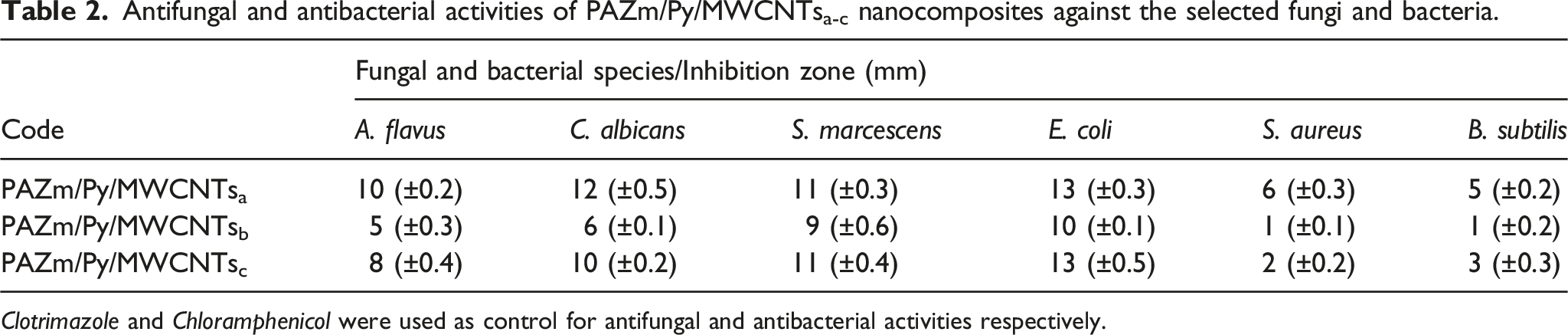
Clotrimazole and Chloramphenicol were used as control for antifungal and antibacterial activities respectively.
Bacterial cell culturing
For evaluation of the antibacterial activities, E. coli O157:H7 was used as a model, which was provided by National Research Center, Cairo. Bacterial cells were grown for antibacterial test on nutrient agar (Sigma-Aldrich-70148) containing 1 g/L meat extract, 5 g/L peptones, 2 g/L yeast extract, 2 g/L sodium chloride and 15 g/L agar in distilled water. Nutrient agar medium plates were prepared, sterilized and solidified. After solidification bacterial cultures were swabbed on these plates.
Antibacterial assessment
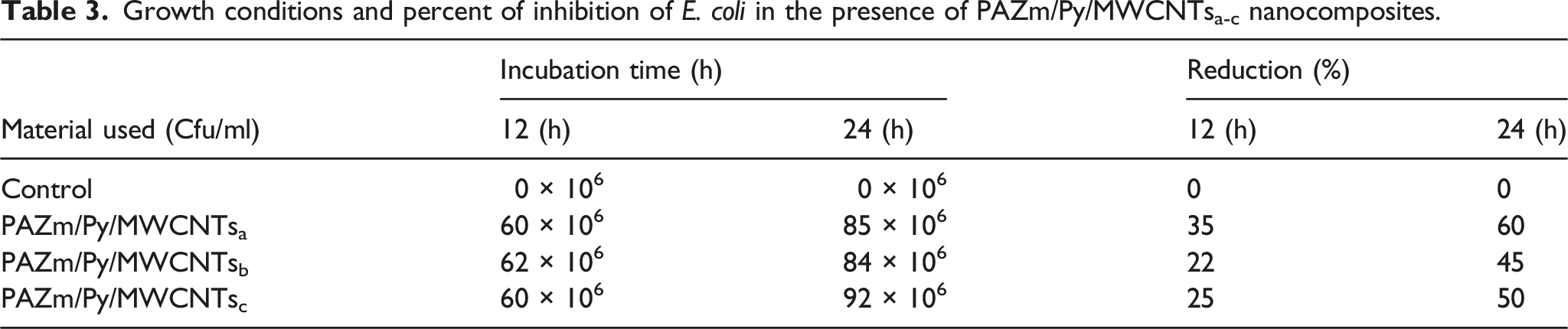
Growth conditions and percent of inhibition of E. coli in the presence of PAZm/Py/MWCNTsa-c nanocomposites.
Characterization method
Fourier Transform Infrared (FT-IR) spectrophotometer technique is used to analyze the functional groups present in final products, the (Perkin Elmer Precisely Spectrum 100) was used to record the infrared spectra. Each spectrum was in the 400–4000 cm−1 wavenumber range. The X-ray Diffraction (XRD) is a technique used to determine whether a material is crystalline or amorphous. The XRD of polymer nanocomposites was recorded using (XRD) D8 ADVANCE in the range 2θ between 5° and 80° at 40 kV voltage and 40 mA using Cu-Kα radiation. Scanning Electron Microscope (JSM-7610FPlus Schottky Field Emission) was used to know Surface morphology of PAZm/Py/MWCNTs. TEM micrographs of polymer nanocomposites were taken using the JEM-F200 Multi-Purpose Electron Microscope at magnification of 25x magnification and voltage of 100 kV. The thermal behavior of all PAZm/Py/MWCNTs was evaluated by a Thermo-Gravimetric Analysis (TGA) and derivative thermal gravimetric (DTG) using a Shimadzu TG-50H thermal analyzer at temperatures rising from air temp to 800°C and heating rate of 10°C/min.
Results and discussion
Chemistry part
The monomers 4-((4-nitrophenyl) diazenyl)-1H-pyrazole-3,5-diamine (a), 4-(p-tolyldiazenyl)-1H-pyrazole-3,5-diamine (b), and 4-((2-chlorophenyl) diazenyl)-1H-pyrazole-3,5-diamine (c) were prepared demonstrated in Figure 1 and characterized by FT-IR spectral analysis as clarified in the experimental section. Furthermore, the melting points of these monomers were measured, and the results were consistent with those found in the literature.27,29 Synthesis of monomers.
PAZm/Py/MWCNTsa-c nanocomposites containing polyazomethine and 2% of multi-walled carbon nanotubes were fabricated by polymerization procedures depending fundamentally on the polycondensation process. The fabrication process is based chiefly on diaminopyrazole derivatives and terephthalaldehyde in the presence of a 2% loading of MWCNT. The synthetic route for synthesizing the PAZm/Py/MWCNTsa-c nanocomposites is demonstrated in Figure 2. Synthetic route for synthesizing the PAZm/Py/MWCNTsa-c.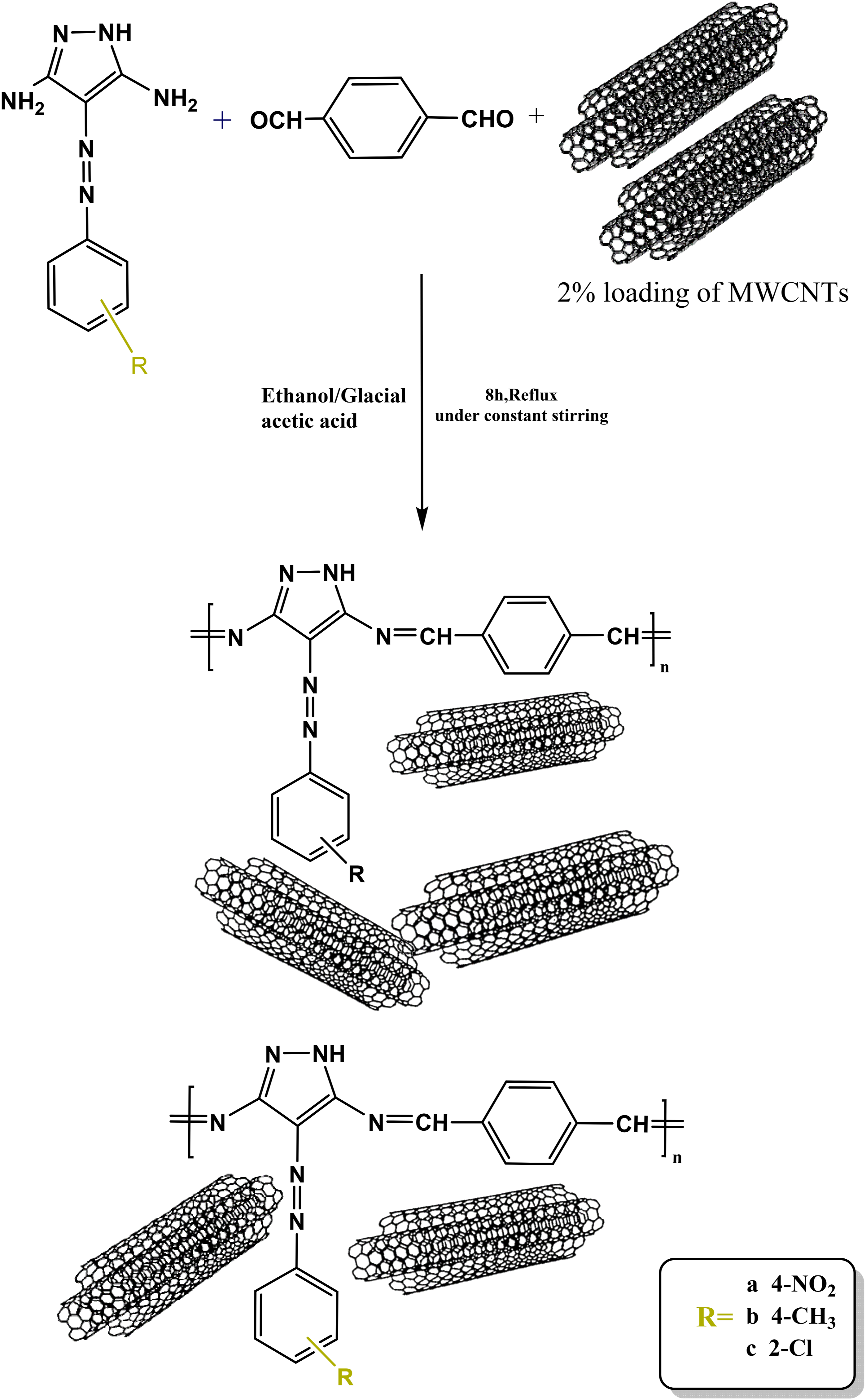
Identification and characterization of PAZm/Py/MWCNTsa-c composites
The chemical structures of these nanocomposites were gained using an FT-IR spectrophotometer in the wavenumber range of 4000–400 cm−1 as presented in the experimental section. The physical interaction between neat polyazomethine and its MWCNT type fabricated products is confirmed using FT-IR data. Figure 3(a) shows the FT-IR spectra of monomer(a), terephthalaldehyde and PAZm/Py/MWCNTsa which confirm the absence of terephthalaldehyde CHO bond in the PAZm/Py/MWCNTsa composite and the formation of the azomethine linkage (HC = N). Such observation illustrates an excellent interaction for the polymerization process, Whereas, Figure 3(b) shows the FT-IR spectra of PAZm/Py/MWCNTsa-c composites. The spectra displayed absorption bands at around 1628-1633 cm−1, indicating the formation of an azomethine bond in PAZm/Py/MWCNTsa-c. Furthermore, a peak of nearly 3257-3273 cm−1 is allocated to the N-H bond. The typical peak for MWCNTs is 1564 cm−1.
30
(a) FT-IR spectra of monomer (a) terephthalaldehyde and PAZm/Py/MWCNTsa. (b) FT-IR spectra of PAZm/Py/MWCNTsa-c composites.
The X-ray diffraction patterns of the PAZm/Py/MWCNTsa-c nanocomposites were analyzed using an X-ray diffractometer (D8 ADVANCE) throughout the 2θ range of 5° to 80°. Figure 4 demonstrates that the nanocomposites exhibit a combination of crystalline behavior and the amorphous nature of the polymers. In addition, the XRD nanocomposites exhibited many signal peaks, the most significant peak appeared at 2θ = 13.9°. The polymer chains in the PAZ/MWCNT nanocomposites effectively insert themselves between the layers of the carbon nanotubes, resulting in a substantial decrease in the crystalline structure of the polymer. This is in conformity with the results of a previous study.
33
The MWCNTs present a diffraction peak of about 26.13° (002) related to graphite planes as a feature of carbon-based materials.
34
The results indicate that the MWCNTs are really in the polymer matrix. No other peaks indicating the presence of impurities were found in PAZm/Py/MWCNTsa-c composite materials. XRD diffraction of PAZm/Py/MWCNTsa-c.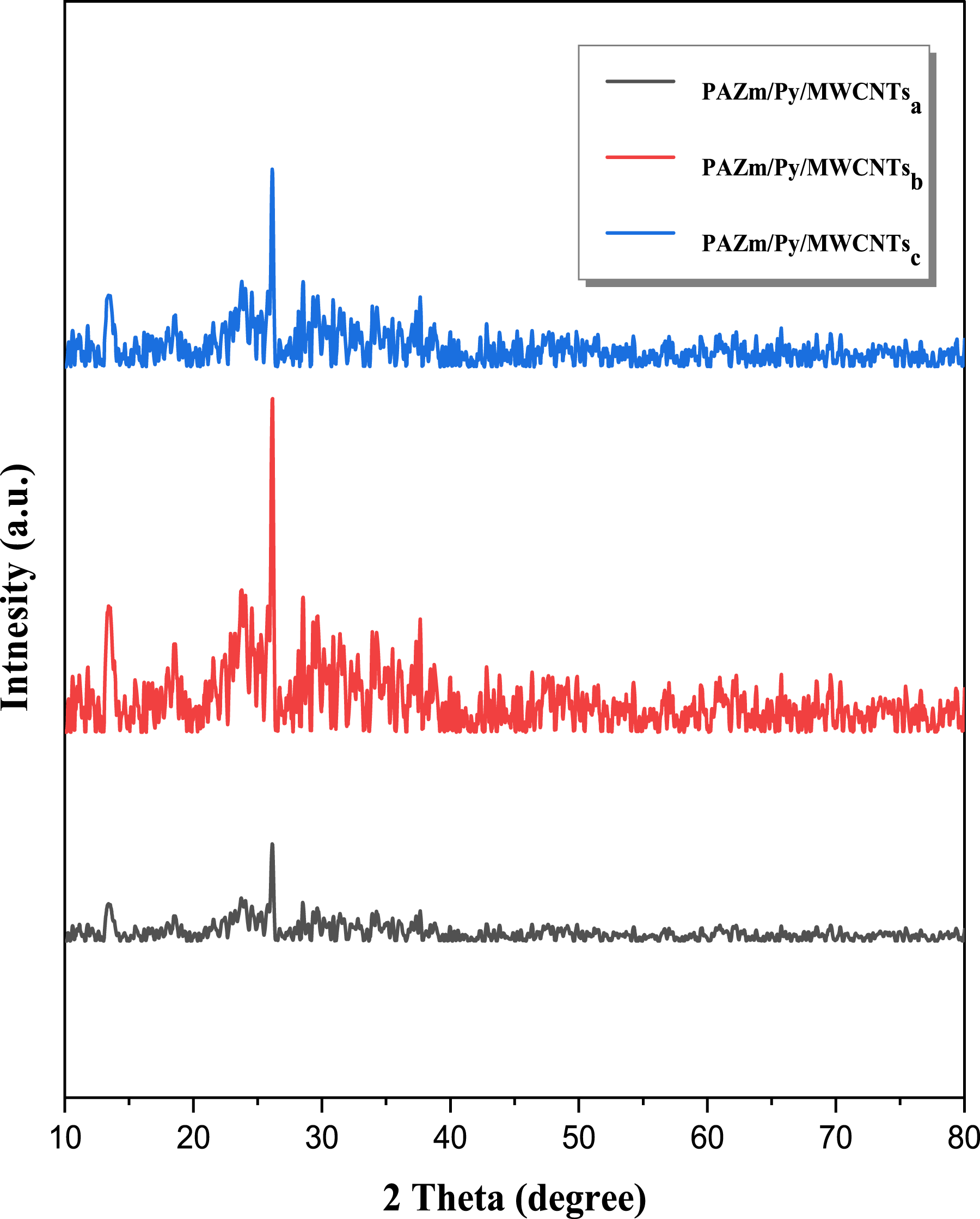
Thermal properties of PAZm/Py/MWCNTsa-c.

aThe values were determined from DTG curves.
bThe values were determined by TGA at 10°C per min heating rate.

(a) TGA thermograms of PAZm/Py/MWCNTsa-c. (b) DTG curves of PAZm/Py/MWCNTsa-c.
Scanning electron microscopy SEM (JSM-7610FPlus Schottky Field Emission) was used to investigate the morphological properties of the fabricated materials, as shown in Figure 6. SEM images for PAZm/Py/MWCNTsa as chosen example are given in Figure 6 at different magnifications, it shows clear morphological evidence for the composites’ expected formation. Coral reefs with mini holes in the form of porous spongy shapes can be seen on the polyazomethine surface with an aggregation of MWCNTs on the polymer surface. The other two samples PAZm/Py/MWCNTsb and PAZm/Py/MWCNTsc might show similar observation with significant variation caused by the different polarity of the produces due to the different groups attached to the polymer’s main chains 4-methyl and 2-chloro derivatives respectively rather than 4-nitro, for the first derivative. The thin component of the composites was also imaged using Transmission Electron Microscopy TEM (JEM-F200 Multi-purpose) to gain a better understanding of MWCNT diffusion. The TEM images of the PAZm/Py/MWCNTsa composite are shown in Figure 7. TEM images indicate that the immersed MWCNTs are distinctly seen in their nanotube form with a uniform distribution in the presence of some agglomeration. SEM images of PAZm/Py/MWCNTsa (a,b,c) at magnifications (x = 24,000, 30,000 and 60,000. TEM images of PAZm/Py/MWCNTsa composite material.

Antimicrobial activities
The diffusion method was used to determine the antibacterial activities of the newly fabricated PAZm/Py/MWCNTsa-c nanocomposites were evaluated against different bacterial species and fungi Antifungal and antibacterial activities diagram of PAZm/Py/MWCNTsa-c nanocomposites against the selected (a) fungi and (b) Gram-positive, Gram-negative bacteria.
The count method was used to determine the biological properties of PAZm/Py/MWCNTsa-c nanocomposites against E. coli as a selected Gram-negative bacteria through colony forming units (CFU).
32
Table 3 and Figure 9 provide illustrations of the results of the possibility of E. coli O157:H7 cell growth after treatment with PAZm/Py/MWCNTsa-c. Generally, the antibacterial activity of PAZm/Py/MWCNTsa-c nanocomposites was investigated against E. coli and showed good effectiveness of all tested polymer nanocomposites. The PAZm/Py/MWCNTsa, PAZm/Py/MWCNTsb, and PAZm/Py/MWCNTsc nanocomposites showed an effect on bacterial growth after 12 h by 35%, 22%, and 25%, respectively. After 24 h, the percent of inhibition of E. coli in the presence of the PAZm/Py/MWCNTsa-c nanocomposites were highest; it showed 60%, 45%, and 50% for PAZm/Py/MWCNTsa, PAZm/Py/MWCNTsb, and PAZm/Py/MWCNTsc respectively. The CFU values/mL are 60 × 106–62 × 106 for nanocomposites after 12 h. After 24 h, PAZm/Py/MWCNTsa-c show CFU values/mL in the range of 84 × 106–92 × 106. Reduction percentage of E. coli after contact with PAZm/Py/MWCNTsa-c nanocomposites for 12 and 24 h.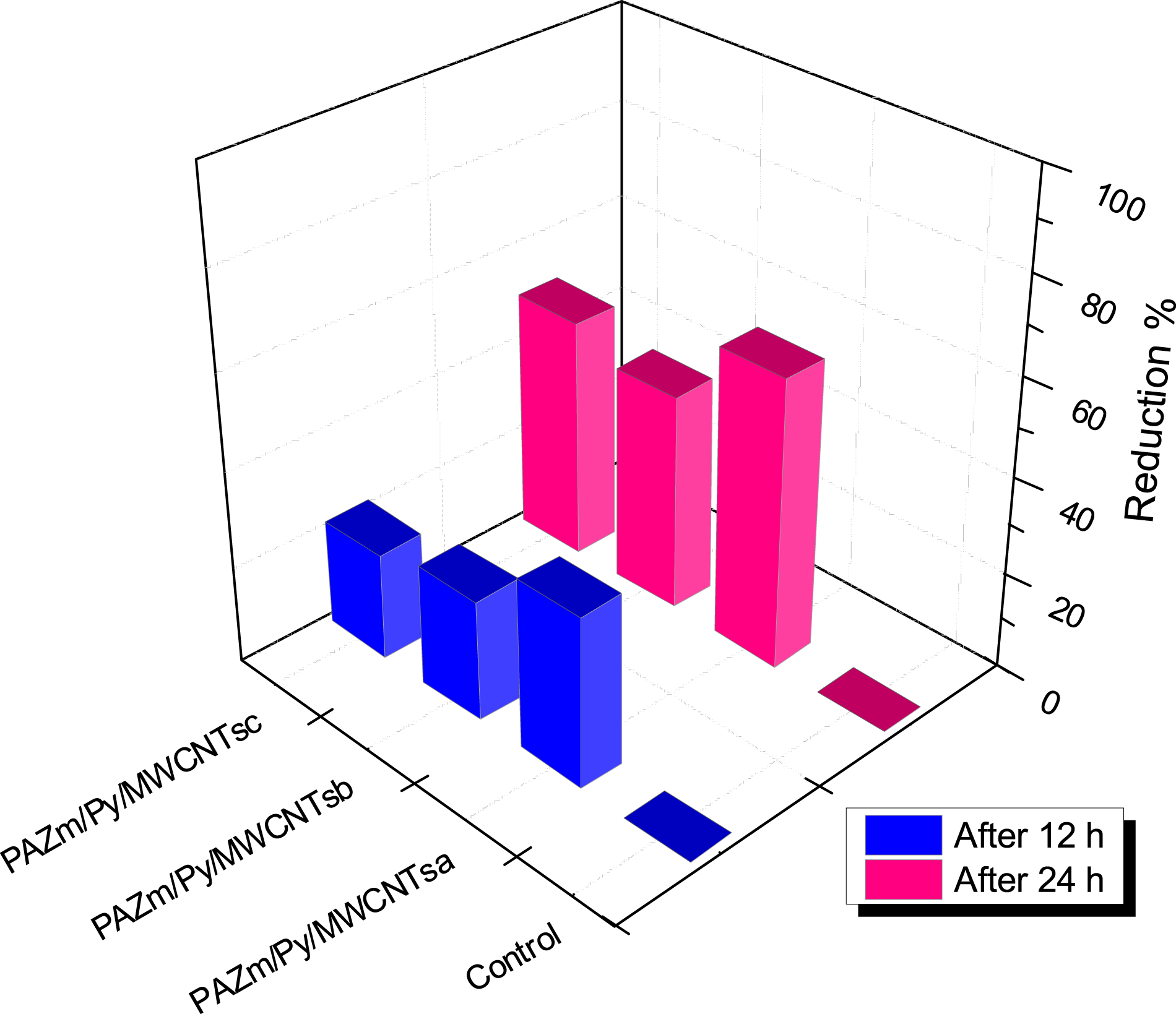
Conclusion
The researcher team has successfully produced aromatic polyazomethine nanocomposites PAZm/Py/MWCNTsa-c using the polycondensation process with ultrasonic assistance based on the pyrazole moiety. The polymer nanocomposites that were created were detected using infrared spectroscopy and studied using standard characterization techniques such as XRD, TGA, SEM, and TEM. The X-ray diffraction patterns confirm the presence of MWCNTs within the polymer matrix. The PAZm/Py/MWCNTs (a, b, and c) had weight losses of 71%, 69%, and 74% at 800°C, respectively, demonstrating the thermal resilience of these polymers. The PAZm/Py/MWCNTsa exhibits the highest thermal stability among all the manufactured items. The scanning electron microscopy (SEM) pictures of PAZm/Py/MWCNTsa reveal the presence of porous spongy structures resembling coral reefs, together with small holes on the polyazomethine surface. Additionally, there is an accumulation of multi-walled carbon nanotubes (MWCNTs) on the polymer surface. Additionally, the submerged MWCNTs are clearly visible in their nanotube shape in the TEM pictures. We tested the newly synthesized PAZm/Py/MWCNTsa-c nanocomposites against various bacterial and fungal species to find out how effective they were as antibacterial agents using the diffusion method. The antibacterial activity of the studied compounds was diverse; however, compound PAZm/Py/MWCNTsa exhibited the most potent inhibitory effect against the chosen bacteria, whereas compound PAZm/Py/MWCNTsb exhibited the least. Also, when tested against A. flavus and C. albicans, every single one of the manufactured polymer nanocomposites exhibited antifungal properties. All of the polymer nanocomposites examined showed good efficacy when evaluated for antibacterial activity against E. coli, including PAZm/Py/MWCNTsa-c.
Footnotes
Declaration of conflicting interests
The author(s) declared no potential conflicts of interest with respect to the research, authorship, and/or publication of this article.
Funding
The author(s) disclosed receipt of the following financial support for the research, authorship, and/or publication publication of this article: This research work was funded by Institutional Fund Projects under grant no. (IFPDP-297-22). The authors gratefully acknowledge the technical and financial support provided by the Ministry of Education and King Abdulaziz University, DSR, Jeddah, Saudi Arabia.
