



Abstract
This study focuses on the experimental characterization and micromechanical modeling of thermoplastic cork filler composites. The research investigates the influence of granule size on the mechanical properties of composites made with a polypropylene matrix and cork granulates. Tensile, compressive, flexural, and Charpy impact tests are conducted according to ASTM standards to assess the mechanical behavior of the Cork/Polypropylene composites with different size of cork granulates (2 mm, 0.5 mm and 50 μm). Additionally, a micromechanical model is developed to provide numerical insights into the composite’s mechanical properties. Results indicate that the use of smaller cork granules (50 μm) significantly enhances tensile, compressive, and flexural properties, while maintaining Charpy impact resistance comparable to the matrix material. The Young’s Modulus exhibits an augmentation of approximately 28%, the flexural modulus demonstrates a 10% increase, and the compressive modulus manifests a notable rise of 47.7%. One-way ANOVA analysis is employed to establish the statistical significance of granule size on the modulus. Numerical simulations reveal that the spherical morphology of fillers induces isotropic characteristics in cork composite materials.
Introduction
Composite materials reinforced with natural fibers offer several advantages compared to synthetic fibers. They possess desirable thermal, mechanical, and chemical properties, along with low density and cost, making them highly suitable for polymer reinforcement. Additionally, certain natural fibers exhibit excellent insulation and electrical properties. These outstanding characteristics have driven their widespread adoption in various industrial applications, including automotive, construction, electrical, and industrial equipment sectors.
Cork composites are materials that combine cork particles or granules with other matrices to enhance their mechanical properties. The mechanical properties of cork composites are influenced by various factors, including the composition, processing techniques, and the size of the cork granules. Micromechanical modeling is a useful approach to understand and predict the mechanical behavior of cork composites at the microscopic level. Granule size plays a crucial role in determining the overall mechanical properties of the composite material.
Researchers and engineers studying cork composites often investigate the effects of granule size on mechanical properties through experimental testing and micromechanical modeling. By understanding how granule size affects the composite’s behavior, it becomes possible to tailor the material for specific applications, optimizing its performance and functionality.
Several research studies have focused on composites reinforced with vegetable fibers and fillers, highlighting the advantages and limitations of these materials.1–5 Vegetable fibers have been successfully utilized with thermoplastic, thermoset, and biodegradable matrices, resulting in composites with notable specific mechanical properties.6,7 The incorporation of vegetable fibers, such as jute, flax, hemp, sisal, and kenaf, into composite materials has gained significant attention. These natural fibers offer several advantages over synthetic alternatives. They are renewable, biodegradable, and have lower densities compared to traditional reinforcement fibers. When combined with different matrices, vegetable fiber-reinforced composites exhibit unique mechanical properties that make them suitable for various applications. Furthermore, composites reinforced with vegetable fibers have gained attention in the packaging industry for their biodegradability and eco-friendliness. These materials are being explored as alternatives to synthetic composites for packaging applications, reducing environmental impact and promoting a circular economy. However, it is important to consider the limitations of vegetable fiber-reinforced composites. Moisture absorption is one significant drawback, as natural fibers tend to absorb moisture, which can affect their mechanical properties and dimensional stability. Moreover, the natural variability of vegetable fibers can lead to inconsistencies in composite properties, requiring careful material selection and processing techniques.
Extensive research8–10 has been conducted to investigate the reinforcement of thermoset resins using vegetable fibers. Specifically, the mechanical behavior of a composite material composed of Alfa fibers arranged in mats within a polyester resin matrix has been studied. 11 These studies have demonstrated the significance of the specific mechanical properties exhibited by composite materials reinforced with Alfa and Agave fibers. In comparison to glass fibers, vegetable fibers offer versatility for a wide range of applications.
The specific mechanical characteristics of composites reinforced with Alfa and Agave fibers have been a focal point of these studies. Specific mechanical properties refer to the material’s mechanical performance relative to its weight or volume. By incorporating Alfa and Agave fibers into the polyester resin matrix, the resulting composites have demonstrated enhanced strength and stiffness while maintaining a relatively low density.
The reinforcement of epoxy matrices with sisal and jute fibers has been investigated in research studies.12,13 These works specifically discuss the enhancement of mechanical properties through the treatment of fibers with silanation. Additionally, other researchers have utilized epoxy resin with jute fibers 14 Similarly, the use of vinyl ester resin reinforced with jute fibers has been explored. 15 Vinyl ester resin offers good corrosion resistance and high mechanical strength. When combined with jute fibers, the resulting composites exhibit improved specific mechanical properties, making them suitable for applications that require lightweight and high-strength materials. All of these investigations highlight the significance of reinforcing thermoset resins with sisal and jute fibers.
Numerous studies have demonstrated the successful reinforcement of thermoplastic resins with natural fibers, with a particular emphasis on the use of polypropylene matrix.16–20 Polypropylene is a widely used thermoplastic polymer known for its excellent balance of properties, including good chemical resistance, low density, and favorable processability. By incorporating natural fibers, such as flax fibers, into the polypropylene matrix, the resulting composites exhibit improved mechanical properties and performance. The addition of flax fibers to polypropylene has been investigated to enhance the mechanical properties of composite materials. Flax fibers possess desirable characteristics such as high strength, stiffness, and low weight. When combined with polypropylene, these fibers contribute to increased tensile strength, flexural strength, impact resistance, and overall mechanical performance of the composite. Researchers such as Sterzynski, Triki, and Zelazny 21 investigated the addition of flax fibers to polypropylene to enhance its mechanical properties. Similarly, Aurich and Mennig 22 conducted a study on composite materials based on polypropylene reinforced with flax fibers, focusing on the evaluation of their mechanical properties.
Andreas Keller’s research highlights the significance of incorporating hemp fibers into a poly (3-hydroxybutyrate-co-hydroxyvalerate) matrix. His findings demonstrate that by reinforcing the biodegradable resin with 27% degummed hemp fibers, the tensile strength doubled, and Young’s modulus quadrupled. Additionally, this reinforcement resulted in a fourfold increase in material stiffness. The study further indicates that increasing the average length of the hemp fibers leads to an improvement in the mechanical properties. 23
The utilization of Alfa fibers in combination with biodegradable matrices (starch and a copolymer of ethylene vinyl alcohol; and starch and cellulose acetate) has been explored in the research conducted by Ammar I, Ben Cheikh R, Campos A. R, and Cunha AM. The results obtained demonstrate a significant improvement in stiffness for both matrices in the biodegradable composites produced. 24 Their work has revealed a notable impact of treatment conditions on the mechanical properties of a short-fiber bio-composite utilizing Alfa fibers. Furthermore, Campos A. R, Cunha AM, Ben Cheikh R, and Ammar I 25 also investigated the same composite and examined the influence of varying fiber proportions on its mechanical properties.
The research conducted by Davies P, Morvan C, Sire O, and Baley C 26 focused on investigating Zostera marina fibers as a reinforcement material in a biodegradable polymer. The study demonstrated that these fibers offer an appealing option for reinforcing biodegradable composite materials. Individually, the stiffness of Zostera marina fibers varies between 10 GPa and 28 GPa, surpassing synthetic polymer fibers like nylon (5 GPa) or polyester (13 GPa). Additionally, the research highlighted that Zostera marina fibers have a small diameter of approximately 5 µm, comparable to carbon fibers and significantly smaller than glass fibers. This smaller diameter contributes to the enhanced mechanical properties of the composites.
The addition of cork granulates to a thermoplastic resin, specifically polypropylene, has proven to be a successful approach in enhancing the specific mechanical characteristics of composites while simultaneously reducing their weight and manufacturing cost. 27 To enhance the adhesion between the cork fiber and the matrix, various surface treatments of cork were conducted. Among these treatments, silanation was employed to modify the interfacial adhesion between the fiber and matrix, resulting in improved mechanical properties of the composites. 28 Cork and bamboo are mixed together to enhance the tensile strength of Cork/bamboo composite materials. 29 Composite structural materials are produced by combining cork granules and bamboo bundles. The entanglement of bamboo fibers and cork granules is employed to enhance the tensile strength and dimensional stability of the composite materials. 30 For the first time, the use of cork powder is being investigated in the development of new photocurable composite materials that are suitable for the SLA (stereolithography) technique. The research focused on studying the impact of cork particle size on the mechanical and thermal properties of the composites. 31
This research conducted by Shubham and al. focuses on the potential of conducting polymer nanocomposites (CPNCs) for sensors, highlighting their design flexibility and high sensitivity. The soft template procedure for tunable morphology is discussed, emphasizing applications in sensing pressure, gas humidity, and more. The incorporation of specific nanofillers and advanced fabrication techniques is suggested to enhance mechanical stability and create thin, flexible CPNC membranes for high-performance sensing applications, including bio-sensing. 32 .
The research conducted by G. R. Arpitha, H. Mohit, P. Madhu and Akarsh Verma explores the influence of sugarcane bagasse and alumina micro-fillers on epoxy composites. Utilizing central composite design and artificial neural networks, optimal concentrations of 3.5 wt.% for both fillers were identified for maximizing flexural properties. The analysis of variance revealed the essential role of these fillers in enhancing mechanical characteristics, and scanning electron microscope examination confirmed their uniform distribution, reinforcing the composite’s stability and performance. 33
The aim of this study is to explore the mechanical properties of composite materials composed of a polypropylene matrix reinforced with cork granules at a 5 wt% content. Specifically, the study focuses on elucidating the influence of three distinct sizes of cork granules (2 mm, 0.5 mm, 50 µm) on the mechanical behavior of the resulting composites.
For this purpose, composite materials are made with polypropylene matrix reinforced by cork granules with content of 5 wt%. Three different sizes of cork granules (2 mm, 0.5 mm, 50 µm) are utilized in the fabrication process. The composites are then subjected to various mechanical tests, including Tensile, Compressive, Flexural, and Impact testing, following the ASTM standard protocols. Micromechanical models are used to validate the experimental findings and understand the underlying mechanisms. Additionally, a one-way ANOVA (Analysis of Variance) study is conducted to analyze and evaluate the obtained experimental results.
This investigation contributes to the field by comprehensively examining the mechanical performance of polypropylene-cork composites under the influence of varied cork granule sizes. The unique aspect lies in the meticulous exploration of three distinct granule sizes and their impact on Tensile, Compressive, Flexural, and Impact properties. The application of micromechanical models adds a theoretical dimension to the experimental findings, fostering a more profound understanding of the composite material behavior. Furthermore, the incorporation of a one-way ANOVA study enhances the rigor of the analysis, providing statistical validation to the observed differences in mechanical properties.
Materials and methods
Specimens’ preparation
The polypropylene matrix used in this research is Basell/Moplen HP548T, which has a density of 0.9 g/cm3 and a melting point of 165°C. The filler material chosen is cork granules, which have a density of 0.23 g/cm3.
Before use, the cork granules underwent drying where they were left in the open air for 3 days at room temperature. This drying process helps remove any excess moisture from the cork granules. After drying, the granules were sieved to obtain different sizes of granules.
Three cork specimens were obtained with different average granule sizes: 2 mm, 0.5 mm, and 50 μm. Additionally, the moisture content of these cork specimens was measured and found to be 2%.
Extrusion, granulation, and injection molding processes were used successively for the production of a composite material consisting of 5 wt. % cork and 95 wt. % polypropylene. Extrusion was carried out using a Carvex extruder equipped with counter-rotating twin-screws. The extrusion parameters are as follows: rotating speed of the screws is 20 mm/sec, supply zone temperature is 130°C, 1st zone temperature is 150°C, 2nd zone temperature is 165°C, profile temperature is 175°C.
After extrusion, the next step is granulation. In this process, the extruded material is cooled and cut into small granules. These granules serve as the feedstock for the subsequent injection molding process.
Designation of Cork composites/Polypropylene.

Testing characterization
Tensile testing
Tensile tests were conducted following the ASTM D638 M 34 standard at room temperature. The tests aimed to determine the Young’s modulus, stress, and strain at break of the specimens. The testing machine used was a Zwick/Roell Z005 type traction machine equipped with a 50 kN load cell. The test specimens used were of type M-I, in accordance with the same ASTM standard. 34 The dimensions of the tensile specimens were 185 mm in length, 10 mm in width, and 4 mm in thickness.
The tensile test was performed at a constant speed of 5 mm/min. This controlled rate ensures a consistent and reliable analysis of the mechanical properties of the composite material. Five specimens were tested for each type of composite to obtain a statistically significant dataset for evaluation.
To determine the Young’s modulus, stress, and strain at break, the test results were analyzed following the guidelines provided by the ASTM D638 M standard. 34 These calculations help assess the material’s ability to withstand tensile forces and its overall mechanical behavior under tension.
Additionally, Poisson’s ratio, which describes the lateral contraction of a material when stretched, was measured experimentally using a strain gauge.
Overall, the tests were conducted with precision and adherence to professional standards, ensuring reliable data for evaluating the mechanical properties of the composite material.
Flexural testing
The Three-point flexural tests were conducted at room temperature using a universal INSTRON 4505 machine with a maximum load capacity of 100 kN. These tests were carried out following the ASTM D 790-97 standard, 35 which provides guidelines for determining the flexural properties of Polypropylene /Cork composites.
The purpose of the tests was to determine the flexural modulus, maximum stress, and flexural deflection of the composite material. These properties are essential for understanding how the material responds to bending forces and assessing its structural performance in real-world applications.
The test specimens used were of type I, with dimensions as follows: 80 mm in length, 10 mm in width, and 4 mm in thickness. The distance between the supports (L) was set to 60 mm, following the standard’s specifications.
During the testing process, a constant speed of 5 mm/min was maintained to ensure consistent and controlled loading conditions. The tests were stopped once the displacement reached 6 mm, as per the standard’s guidelines.
To obtain reliable data, five specimens were tested for each type of Polypropylene / Cork composite. This multiple-sample approach helps to ensure statistical significance and accuracy in the assessment of the material’s flexural properties.
Compressive testing
The compression tests were conducted at room temperature using a universal INSTRON 4505 machine, which has a maximum load capacity of 100 kN. These tests were performed following the ASTM D 695-96 standard, 36 which provides guidelines for determining the compressive properties of materials. The specimens used for the tests were of form type 2, characterized by a rectangular shape with dimensions of 24 mm in length, 12 mm in width, and 6 mm in thickness.
The purpose of these compression tests was to calculate the compressive modulus, stress, and strain at break of the composites under consideration. These parameters are crucial in understanding how the material responds to compressive forces and its ability to withstand deformation under pressure.
To ensure consistency and controlled loading conditions, the compression tests were carried out at a constant speed of 5 mm/min. This uniform testing rate allows for reliable comparison of results between different specimens.
In total, five specimens were tested for each type of composite material. This multiple-sample approach is necessary to obtain statistically significant data and ensure accuracy in the evaluation of the compressive properties.
By adhering to the ASTM D 695-96 standard 36 and utilizing the INSTRON 4505 machine, the compression tests were conducted professionally, and the obtained results will provide valuable insights into the compressive behavior and performance of the composites under consideration. These findings will be beneficial in determining the material’s suitability for specific applications that involve compressive loading conditions.
Charpy impact testing
The Charpy impact tests were conducted following the ASTM 6110 Standard 37 at room temperature. These tests aimed to determine the resilience of composite materials, which is a critical parameter in assessing the material’s ability to withstand impact forces.
For conducting the Charpy impact tests, a sheep pendulum equipped for Charpy testing was utilized. This type of testing machine is commonly employed for measuring the impact toughness of materials.
The test specimens used were notched rectangular composite materials, with the following dimensions: 130 mm in length, 12 mm in width, and 6 mm in thickness. The presence of a notch in the specimens ensures controlled and consistent failure during the impact test, which allows for accurate measurement of the material’s toughness.
To obtain reliable and statistically significant data, five specimens were tested for each type of composite material. This multiple-sample approach ensures that any variations in the test results can be adequately accounted for, leading to a more accurate assessment of the material’s resilience.
By adhering to the ASTM 6110 Standard 37 and using the appropriate testing equipment, the Charpy impact tests were conducted professionally. The results obtained from these tests will provide valuable information about the material’s ability to absorb impact energy and resist fracture under dynamic loading conditions. This information is crucial for evaluating the composite material’s suitability for applications that involve impact or sudden loading events.
Micromechanical modeling
The finite element method (FEM) is employed to analyze the elastic behavior of composite materials. In this study, the composite structure is approximated as a square mesh, with a spherical filler dispersed uniformly within the matrix. The representative volume element (RVE) investigated in this research is a cube consisting of the matrix, with a sphere of filler at its center. To take advantage of the symmetry of the RVE, the problem is solved by analyzing the eighth of the cell. Consequently, the RVE (Figure 1) is considered as a cube with side length “a” equal to 0.5, and one-eighth of a sphere (with the radius depending on the size of the filler) is included in the analysis. Representative volume element.
In the modeling study, the radius of the sphere is determined based on the granule size and the volume fraction of filler used in the experimental study. Consequently, three different radii are employed to represent the varying sizes of the granules in the model.
The elastic properties of Cork/Polypropylene composites are influenced by the properties of their individual components as well as the compatibility at the interface between them. Typically, composites are considered to be anisotropic, meaning their mechanical behavior varies with direction. However, for simplicity, the mechanical behavior of composite materials is often assumed to be orthotropic, which means it exhibits different properties along three mutually perpendicular axes.
The mechanical behavior of composite materials can be described by the following relation (1):
To determine the matrix coefficients Cijkl, the following six loads (as described in relation (2)–(7)) are applied to the Representative Volume Element (RVE).


The coefficients of the first three columns of the matrix (Cijkl) (relation 1) were determined by applying a load of uniaxial tension along each column (E1, E2, E3). In this case, the principal directions of the applied load coincide with the axes of the cell.
On the other hand, the coefficients of the last three columns of the matrix (Cijkl) were determined by applying a load of simple shear along each column (E4, E5, E6).
Results
The aim of the study was to investigate the impact of different sizes of cork granules on the mechanical properties of composite materials containing 5 wt % of cork. Both experimental and numerical modeling techniques were utilized to analyze the final properties of the composites.
The manufacturing process involved incorporating cork granules of varying sizes into the composite materials. By manipulating the size of the cork granules, the research aimed to understand how this parameter influenced the mechanical behavior of the composites.
Experimental tests were conducted to evaluate the mechanical properties of the composite materials. These tests included techniques: tensile testing, compression testing, flexural testing and impact testing. The results obtained from these experiments provided empirical data on the composite’s response to different loading conditions. A one-way ANOVA study is conducted to analyze these experimental results.
Additionally, numerical modeling techniques were employed to simulate the behavior of the composite materials. Computer-aided simulations, such as finite element analysis (FEA), were used to predict the mechanical properties of the composites based on the input parameters, including the size of the cork granules.
By combining the experimental and numerical data, the relationship between the size of the cork granules and the final properties of the composites was analyzed. This information is valuable for optimizing the manufacturing process and designing composite materials with specific mechanical characteristics.3.1. Subsection
Experimental results
Tensile properties
The effect of granule size on the tensile properties of Cork-PP composites.

However, the Stress and Strain at break showed only slight variations with different granule sizes. These properties may not be significantly affected by the size of the cork granules within the tested range.
Furthermore, Poisson’s ratio also exhibited a slight decrease as the size of the cork granules decreased, compared to the specimens with larger particles (2 mm).
Overall, the findings suggest that reducing the size of the cork granules in the composite material positively influenced Young’s modulus, while the impact on Stress, Strain at break, and Poisson’s ratio was relatively minor.
In order to substantiate these interpretations, the probability plot of tensile properties has been carefully analyzed, as illustrated in Figure 2. This plot serves as a crucial tool for validating and confirming the reliability of the results obtained. By scrutinizing the probability plot, we can confidently uphold the accuracy and robustness of the data’s implications. This step reinforces the credibility of the findings presented in this study, thereby enhancing the overall quality and trustworthiness of the research outcomes. A probability plot of tensile properties is a graphical representation that shows the distribution of data and assesses whether it follows a particular probability distribution, such as a normal distribution. It allows us to analyze the statistical characteristics of the tensile properties and determine if they conform to a specific distribution. Probability plot of Tensile properties: (a) Young’s Modulus; (b) Strain at break; (c) Stress at break; (d) Poisson’s ratio.
Figure 2 presents the results of an analysis of variance (ANOVA) for tensile properties. The objective was to assess the normality of the data for different tests by testing the null hypothesis that the data follow a normal distribution. The interpretation of the p-values obtained from the Anderson-Darling normality test at a significance level (α) of 0.1 determines whether there is enough evidence to reject the null hypothesis.
For Young’s Modulus (MPa), the p-value obtained from the normality test is 0.597. Since this p-value is greater than the chosen significance level (α), we do not have enough evidence to reject the null hypothesis. Therefore, we can conclude that there is not enough evidence to suggest a departure from normality for the Young’s Modulus data.
Similarly, for Stress at break (MPa) and Strain at break (%), the p-values obtained from their respective normality tests are 0.466 and 0.117. Both p-values are greater than the chosen significance level, indicating that we do not have enough evidence to reject the null hypothesis for these variables. This suggests that there is no significant departure from normality for the Stress at break and Strain at break data.
Lastly, for Poisson’s ratio, the p-value obtained from the normality test is 0.079. Although this p-value is slightly lower than the chosen significance level, it still does not provide sufficient evidence to reject the null hypothesis. Therefore, we interpret that there is not enough evidence to suggest a departure from normality for the Poisson’s ratio data as well, although it is worth noting that it is close to the significance level.
Flexural properties
Effect of granules size on the flexural properties of Cork–PP composites.

Regarding the stress max, it is approximately the same when using dimensions of 2 mm or 0.5 mm, and a slight increase can be observed when using a dimension of 50 μm. This similarity in stress max between 2 mm and 0.5 mm suggests that the size of the granules does not significantly affect the maximum stress that the material can withstand in flexural testing. However, there is a slight increase in stress max when using a dimension of 50 μm, indicating that smaller granules may contribute to slightly higher maximum stress values.
Furthermore, the deflection of the material is not affected by the size of the granules. The variation in deflection values is approximately the same for the composite materials using the three cork specimens with different granule dimensions. This suggests that the size of the granules does not have a significant impact on the deflection behavior of the material in flexural testing.
In summary, the flexural test results show similarities to the tensile test results. Decreasing the size of granules can improve the flexural modulus, while the maximum stress is not significantly affected by granule size. Additionally, the deflection values remain consistent across different granule dimensions in the composite materials.
Figure 3 presents the results of an analysis of variance (ANOVA) for flexural properties. The objective was to assess the normality of the data for different tests by testing the null hypothesis that the data follow a normal distribution. The interpretation of the p-values obtained from the Probability Plots determines whether there is enough evidence to reject the null hypothesis. Probability plot of Flexural properties: (a) Flexural Modulus; (b) Stress max; (c) Deflection.
For the Probability Plot of flexural modulus, the p-value obtained is 0.309. Since this p-value is higher than the chosen significance level, we do not have enough evidence to reject the null hypothesis. Therefore, it can be interpreted that there is not enough evidence to suggest a departure from normality for the data of flexural modulus, and it is possible that a normal distribution is followed by this data.
Similarly, for the Probability Plot of deflection, the p-value obtained is 0.584. Again, this p-value is higher than the chosen significance level, indicating that we do not have enough evidence to reject the null hypothesis. Therefore, we cannot conclude a departure from normality for the data of deflection, and it is possible that a normal distribution is followed.
However, for the Probability Plot of stress max, the p-value obtained is 0.073. In this case, the p-value is lower than the chosen significance level, providing some evidence to reject the null hypothesis. It suggests that the data for stress max may deviate from a normal distribution.
To summarize, based on the obtained p-values, there is not enough evidence to suggest a departure from normality for the flexural modulus and deflection data. However, there is some evidence to suggest that the data for stress max may deviate from a normal distribution.
The compressive properties
Effect of granules size on the compressive properties of Cork–PP composites.

On the other hand, the stress max (maximum stress) and strain at break values have remained almost unchanged regardless of the granule size. This implies that the size of the granules does not significantly affect the maximum stress that the material can withstand in compressive testing, nor does it have a substantial impact on the strain at break.
These findings in the compressive tests confirm the results obtained from the tensile and flexural tests. In all three types of tests, it has been observed that decreasing the size of the granules can lead to an improvement in the modulus of the material. This consistency across different testing methods suggests a consistent effect of granule size on the mechanical properties of the material.
Overall, the compressive tests demonstrate that the compressive modulus is the most affected property by the granule size, with a significant increase observed when using smaller granules. These findings align with the results obtained from the tensile and flexural tests, further supporting the relationship between granule size and mechanical properties.
Figure 4 presents the results of an analysis of variance (ANOVA) for compressive properties. The objective was to assess the normality of the data for different parameters by testing the null hypothesis that the data follow a normal distribution. The interpretation of the p-values obtained from the Probability Plots determines whether there is enough evidence to reject the null hypothesis. Probability plot of Compressive properties: (a) Compressive Modulus; (b) Stress max; (c) Strain at break.
For the Probability Plot of compressive modulus (MPa), the p-value obtained is 0.629. Since this p-value is higher than the chosen significance level, we do not have enough evidence to reject the null hypothesis. Therefore, it can be interpreted that there is not enough evidence to suggest a departure from normality for the data of compressive modulus, and it is possible that a normal distribution is followed by this data.
Similarly, for the Probability Plot of stress max (MPa), the p-value obtained is 0.306. Once again, this p-value is higher than the chosen significance level, indicating that we do not have enough evidence to reject the null hypothesis. Therefore, we cannot conclude a departure from normality for the data of stress max, and it is possible that a normal distribution is followed.
Lastly, for the Probability Plot of strain at break (%), the p-value obtained is 0.110. In this case, the p-value is higher than the chosen significance level, providing no significant evidence to reject the null hypothesis. It suggests that there is not enough evidence to suggest a departure from normality for the data of strain at break, indicating that a normal distribution is possibly followed.
To summarize, based on the obtained p-values, there is no significant evidence to suggest a departure from normality for any of the parameters (compressive modulus, stress max, and strain at break) examined in this analysis.
Charpy impact properties
Effect of granules size on the Charpy Impact properties of Cork–PP composites.

These findings suggest that reducing the granule size of cork down to 50 μm allows for maintaining the impact resistance of the matrix at a level similar to that of the Polypropylene matrix. On the other hand, using larger granule dimensions (2 mm or 0.5 mm) can lead to a decrease in impact resistance of the composite materials, with a potential drop of up to 12%.
In summary, the results indicate that decreasing the granule size of cork to 50 μm enables the composite materials to retain their impact resistance comparable to that of the Polypropylene matrix. However, using larger granule dimensions (2 mm or 0.5 mm) can result in a slight reduction in the impact properties of the composites, potentially leading to a decrease of up to 12% in impact resistance.
Figure 5 presents the results of an analysis of variance (ANOVA) for Charpy impact properties. The objective was to assess the normality of the data for Impact energy (J/m) by testing the null hypothesis that the data follow a normal distribution. The interpretation of the p-value obtained determines whether there is enough evidence to reject the null hypothesis. Probability plot of Impact energy.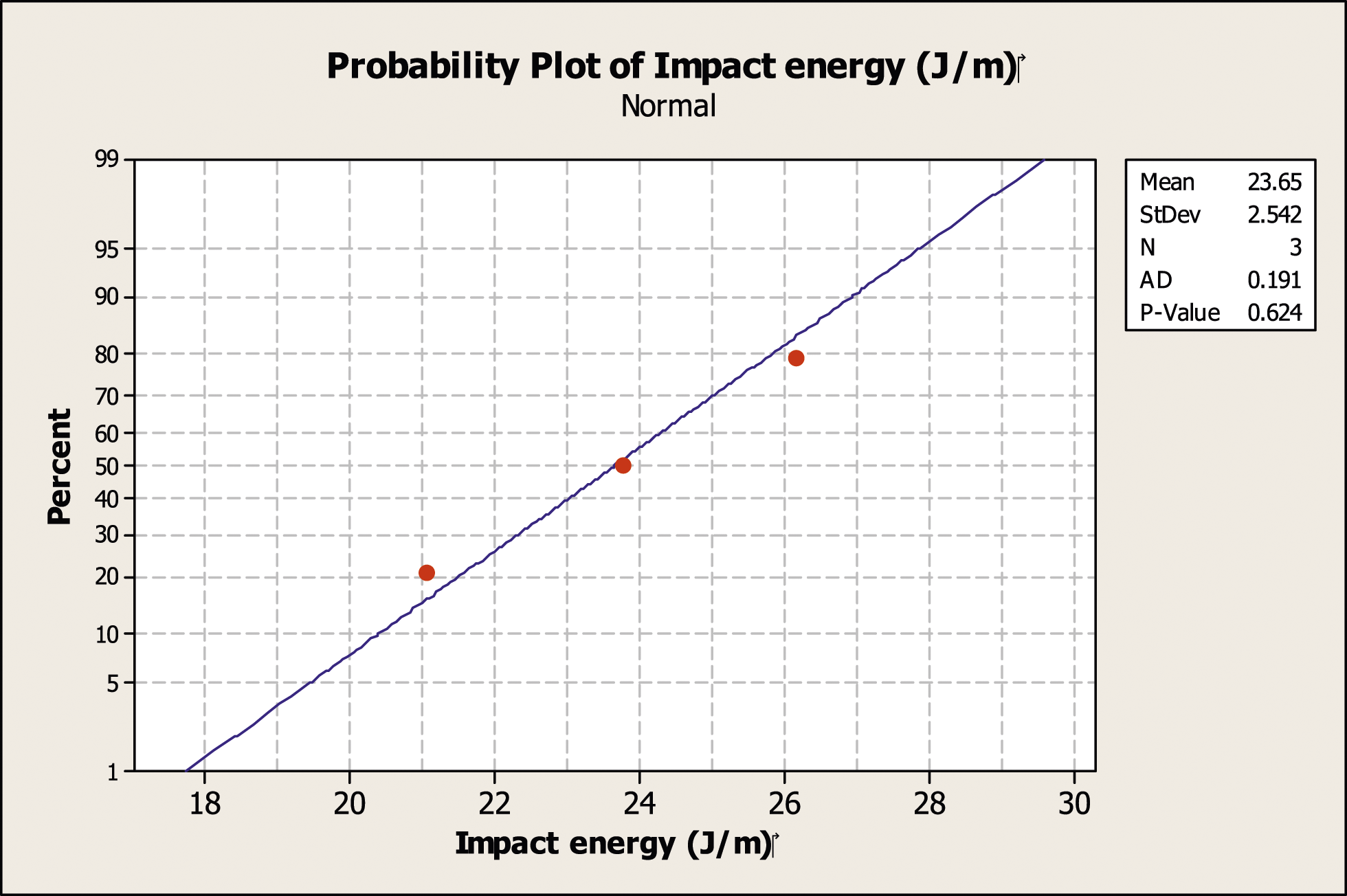
For the Probability Plot of Impact energy (J/m), the p-value obtained is 0.624. Since this p-value is higher than the chosen significance level, we do not have enough evidence to reject the null hypothesis. Therefore, it can be interpreted that there is not enough evidence to suggest a departure from normality for the data of Impact energy (J/m), and it is possible that a normal distribution is followed by this data.
The experiments conducted indicate the benefits of using smaller cork granules as fillers to reinforce polypropylene matrices. The obtained results confirm that when using granules with a size of 50 μm, the rigidity of the composite materials is improved while maintaining the impact properties of the matrix. This improvement is evident in the tensile, compressive, and flexural modulus, where the properties are enhanced. Furthermore, the impact energy does not exhibit a significant decrease, indicating that the composite materials retain their impact resistance.
In summary, based on the obtained p-value, there is no significant evidence to suggest a departure from normality for the Impact energy (J/m) data. The experiments demonstrate the advantages of utilizing smaller cork granules as fillers to enhance the rigidity of the composite materials while maintaining their impact properties. The improvements in tensile, compressive, and flexural modulus, coupled with the sustained impact energy, support the efficacy of using 50 μm granules in reinforcing polypropylene matrices.
Numerical results
For the numerical determination of the mechanical properties of cork composite materials, a three-dimensional model is established using the finite element method. The results obtained from the numerical analysis are presented in the stiffness matrix, as shown in equation (8). It is worth noting that all terms of the matrix are expressed in MPa (megapascals).
Based on the stiffness matrix, it can be concluded that the composite material is isotropic. Isotropic materials exhibit the same mechanical properties in all directions. In the context of the stiffness matrix, this means that the material’s response to mechanical loading is consistent regardless of the direction of the applied forces or deformations. This finding facilitates the characterization and modeling of the material’s behavior, as it can be treated as having uniform properties throughout.
Numerical results.

Observing the above results, we can deduce that the Young Modulus, Poisson s ratios and the Shear modulus are approximately the same in the three dimensions. Also, Shear modulus is linearly dependent. Consequently, modeling study confirms that Cork composite material is isotropic. And its mechanical behavior can be expressed by the Young modulus E1 (683,04) and the Poisson s ratio ν12.(0,382)
Based on the observed results, it can be deduced that the Young’s modulus, Poisson’s ratios, and shear modulus of the cork composite material are approximately the same in all three dimensions. Additionally, the shear modulus exhibits linear dependence.
These findings confirm that, due to the spherical form of filler, the cork composite material is isotropic, meaning it possesses the same mechanical properties in all directions. The isotropic nature of the material allows for simplified modeling and analysis of its mechanical behavior, as it can be assumed to have uniform properties regardless of the orientation of forces or deformations.
In this context, the mechanical behavior of the cork composite material can be characterized by the Young’s modulus (E1) value of 683.04 MPa and the Poisson’s ratio (ν12) value of 0.382.
These numerical calculations provide important information about the mechanical properties of composites. They allow for a quantitative assessment of the stiffness and deformation behavior of the materials, contributing to a better understanding of their performance in various applications.
Results comparison
Comparison between the numerically calculated and experimentally measured results of Young’s modulus and Poisson’s ratios for the cork composite material.

The results indicate a close agreement between the numerically calculated and experimentally measured values of the elastic modulus for the cork composite material. The difference between the numerical and experimental values is approximately 11%. This small discrepancy could be attributed to minor inaccuracies in the experimental measurements or approximations made during the homogenization process. It is important to note that the numerical model may not fully account for certain real-world factors such as the specific shape and geometry of the cork granules, as well as the precise nature of the interface adhesion between the cork and matrix.
Furthermore, the difference between the experimental and numerical values of Poisson’s ratio is relatively low, around 2%. This indicates a good agreement between the two sets of data for Poisson’s ratio.
Overall, these results suggest that the numerical model can be considered valid and reliable for predicting the mechanical properties of the cork composite material. While there is a small discrepancy between the numerical and experimental values, it is within an acceptable range given the inherent complexities and challenges associated with experimental measurements and modeling assumptions. The findings support the validation of the numerical model and its effectiveness in capturing the behavior of the cork composite material.
It is important to continually refine and improve the numerical model by considering additional factors and constraints, such as the precise granule shape, interface adhesion, and other real-world conditions. This iterative process can lead to even better agreement between numerical predictions and experimental measurements, enhancing the accuracy and reliability of the model.
Discussion
The mechanical properties of cork composite materials and the impact of cork granule size on these properties have been investigated through experimental and numerical studies. The results obtained indicate that the composite prepared with the smallest cork granule size exhibits enhanced tensile, compressive, and flexural properties. Additionally, this composite demonstrates comparable Charpy impact properties when compared to the matrix material.
The use of smaller cork granules (50 μm) contributes to the improvement of tensile, flexural, and compression modulus. While there may be slight variations in other properties, it is crucial to note that the resilience of the matrix is maintained when utilizing 50 μm granules, as opposed to using granules of sizes 2 mm and 0.5 mm. This can be attributed to the effective dispersion of small granules within the matrix, leading to increased mechanical properties.
The key factors influencing these mechanical properties are likely related to the microstructure, interfacial bonding, and dispersion characteristics of the cork granules within the matrix.
Smaller cork granules provide a significantly higher surface area per unit volume compared to larger granules. This increased surface area allows for more contact points between the cork particles and the matrix material. The higher number of contact points enhances the interfacial bonding between the cork particles and the matrix, leading to improved load transfer and distribution.
The 50 μm cork granules, being smaller in size, are more likely to disperse homogeneously within the matrix. This is crucial for achieving a uniform distribution of reinforcement throughout the composite material. Homogeneous dispersion ensures that the reinforcing effects of the cork particles are spread evenly, contributing to consistent mechanical properties across the material. Consequently, the smaller cork granules achieve better dispersion within the polypropylene matrix. Despite being composed of two different materials (fibers and matrix), the composites are considered homogeneous materials. The proper dispersion of fibers within the matrix enhances their homogeneity, subsequently improving the mechanical properties. Maintaining a uniform distribution ensures material homogeneity, whereas a non-uniform distribution decreases rigidity due to the initiation of material rupture in areas with poor reinforcement, thus reducing the strength of the composite.
The effective dispersion of smaller cork granules facilitates better stress transfer between the matrix and the reinforcing particles. This efficient stress transfer mechanism results in an overall improvement in mechanical properties, as the load is more effectively carried by the reinforcing cork particles.
Smaller cork granules can fill void spaces and interstices more effectively than larger granules. This reduces the overall porosity within the composite material. Lower porosity is associated with improved mechanical performance, as it minimizes weak points and potential stress concentration areas within the matrix.
The smaller cork granules are more likely to pack efficiently within the matrix, optimizing the arrangement of particles in three-dimensional space. Improved particle packing enhances the material’s structural integrity, influencing properties such as tensile, flexural, and compression modulus.
Conclusion
In conclusion, the experimental and numerical investigations into the mechanical properties of cork composite materials, with a specific focus on the impact of cork granule size, have yielded significant insights. The study demonstrates that the use of smaller cork granules, particularly those with a size of 50 μm, leads to substantial enhancements in tensile, compressive, and flexural properties. Notably, the composite with 50 μm granules exhibits comparable Charpy impact properties to the matrix material, indicating that the reduction in granule size does not compromise resilience.
The observed improvements in mechanical properties can be attributed to the effective dispersion of smaller cork granules within the polypropylene matrix. This dispersion enhances material homogeneity, thereby contributing to increased rigidity and strength of the composite. The study underscores the importance of maintaining a uniform distribution of fibers within the matrix to prevent material rupture in areas with poor reinforcement.
Beyond mechanical enhancements, the utilization of cork composites brings additional benefits, including reduced product weight and increased biodegradability and recyclability. These environmental considerations enhance the overall sustainability of cork composites.
In addition to the enhanced mechanical properties, the use of cork composites results in reduced product weight and increased biodegradability and recyclability.
Based on the findings from the research, the future directions and considerations in the field of cork composite granule size could include: - Nanoscale Cork Composites: Explore the potential of nanoscale cork particles as reinforcement in composites. Investigate the effects of reducing cork granule size to nanoscale dimensions on the mechanical, thermal, and barrier properties of the resulting composites. - Tailored Granule Size for Specific Applications: Continue exploring how the granule size of cork composites can be precisely tailored to suit specific applications. Understanding the optimal granule size range for different industries will enable the development of customized composite materials with enhanced performance characteristics. - Advanced Processing Techniques: Investigate and develop advanced processing techniques that can efficiently and consistently produce cork composites with controlled granule sizes. This may involve adopting innovative milling methods, sieving techniques, or even exploring novel approaches like additive manufacturing. - Sustainable Materials and Circular Economy: Emphasize the use of sustainable raw materials for cork composites and promote circular economy principles. Investigate ways to utilize waste cork and recycling streams to produce composite materials with controlled granule sizes, reducing environmental impact and conserving resources. - Multifunctional Composites: Focus on designing cork composites with multiple functionalities achieved through controlling granule size and incorporating additives or nanomaterials. These multifunctional composites can find applications in diverse industries, providing added value and versatility. - Performance Prediction and Modeling: Develop robust computational models and simulation techniques to accurately predict the mechanical behavior and performance of cork composites at different granule sizes. Such predictive tools will streamline material design and optimization processes. - Environmental Impact Assessment: Conduct comprehensive life cycle assessments (LCAs) to quantify and compare the environmental impact of cork composites with varying granule sizes against traditional materials. This will help substantiate the eco-friendliness and sustainability of cork-based materials. - Hybrid Composites and Synergistic Effects: Investigate the potential of combining cork granules of different sizes with other natural or synthetic materials to create hybrid composites with synergistic properties. Understanding the interactions between different granule sizes and additives can lead to innovative material combinations. - Long-Term Durability Studies: Conduct long-term durability studies to assess the aging behavior and performance degradation of cork composites with different granule sizes. This will enable engineers and manufacturers to predict the material’s lifespan and reliability in real-world applications.
By focusing on these future considerations, researchers can unlock the full potential of cork composites with controlled granule sizes, leading to more sustainable, versatile, and high-performance materials for various applications.
Footnotes
Declaration of conflicting interests
The author(s) declared no potential conflicts of interest with respect to the research, authorship, and/or publication of this article.
Funding
The author(s) disclosed receipt of the following financial support for the research, authorship, and/or publication of this article: The authors extend their appreciation to the Deputyship for Research & Innovation, Ministry of Education in Saudi Arabia for funding this research work through the project number RI-44-0362.

Data availability statement
The datasets used and/or analysed during the current study available from the corresponding author on reasonable request.