



Abstract
Macroporous cation exchange resins (CER) were used as carriers, and CuO loaded cation exchange resin composites was successfully prepared under thermostatic oscillation and hydrothermal conditions. The results showed that the as-prepared composites exhibited obvious shell-core structure. The different amounts of NaOH affected the micro morphology of CuO on the surface and in the internal pores of the resin, and also affected the percentage content of Cu element. XRD characterization clearly revealed that the products were monoclinic crystal system CuO species with a grain size of about 16 nm. The highest degradation rate of polyacrylamide (PAM) by CuO@IER-1g reached 81.94%, after 6 cycles CuO@CER-1g has still good photocatalytic activity, and the decrease in degradation rate was the combined effect from the adsorption of ion exchange resins and the electron-hole pairs formed by CuO and a series of free radical transfer reactions under ultraviolet light. This study has important theoretical basis and practical significance for enriching ion exchange theory, developing the photocatalytic industry, and purifying the environment.
Introduction
Polyacrylamide (PAM) is a general term for polymers obtained by homopolymer or copolymerization with other monomers of acrylamide, and is one of the most widely used varieties in water-soluble polymers. 1 It has a wide range of applications in oilfield exploitation, water treatment, textiles, papermaking, pharmaceuticals, etc. And is known as a “hundred industry additive”.2–4
In the field of oilfield wastewater treatment, PAM and its derivatives are kinds of important synthetic organic polymer flocculant. Compared with traditional inorganic flocculants, PAM has several advantages, such as multiple varieties, high flocculation efficiency, and less sludge.5–8 The previous studies9,10 have shown that PAM itself is not toxic, but it is easily decomposed by physical and chemical factors. Acrylamide monomer, as one of the intermediate products, has neurotoxicity, reproductive toxicity, and genetic toxicity. The International Agency for Research on Cancer (IARC) of the World Health Organization (WHO) has listed it as a possible human carcinogen (Class 2A). 11 In addition, the content of PAM in oil displacement wastewater is mostly 100 ∼ 500 mg/L. Hence, the discharge of a large amount of wastewater containing PAM can cause serious environmental pollution problems and potential hazards to human life and health, thus it is necessary and extremely urgent to treat wastewater containing PAM correctly.
The treatment of wastewater containing PAM is a relatively complex process. Currently, the main treatment methods include chemical degradation, physical treatment, biological degradation, etc. 12 As one of the chemical degradation methods, photocatalytic degradation has many advantages, such as normal temperature and pressure, completely destroy organic pollutants, no secondary pollution, low cost, and easy operation. Therefore, this method has become a new path for the treatment of wastewater containing PAM, and demonstrated significant economic, social, and environmental benefits. Furthermore the key to photocatalytic degradation technology lies in the preparation of efficient photocatalysts and the optimization of photocatalytic operation conditions.13,14
In recent years, the unique pore structure of ion exchange resins has been increasingly utilized as templates to prepare nano CeO2, Zn-AlLDHs, and other materials.15–17 At the same time, the researchers have also used them as carriers to load metals or oxides inside or on the surface of particles to prepare composites with catalytic and antibacterial properties.18–20 For example, Wang et al. 21 synthesized TiO2/AER composite photocatalysts using 717 anion exchange resin (AER) as a carrier with solvothermal method. With the synergistic effect of AER adsorption performance and TiO2 photocatalysis, TiO2/AER exhibited excellent photocatalytic activity and reusability for methyl orange solution. Nguyen et al. 22 presented a proof-of-concept for preparing cation exchange resin-supported iron and magnesium oxides/hydroxides composite (Fe-Mg/CER), and this material had a high nitrate adsorption capacity of 200 mgNO3−·g−1 with a fast equilibrium adsorption time of 30 min at pH 5. This not only expands the application field of ion exchange resin, but also adds the preparation methods for inorganic nanomaterials.
In this study, macroporous cation exchange resins were used as carriers, and via thermostatic oscillation method and hydrothermal method, Cu2+ adsorbed or exchanged onto the surface and pores of the resin was precipitated into Cu(OH)2, and then dehydrated to form CuO. By adjusting the external environment, CuO with certain morphology was naturally generated on the surface of resin particles, and the spatial confinement effect of resin pores was utilized to limit the growth of CuO crystals in the pores and regulate their morphology, to ultimately obtain nanoscale CuO@CER photocatalysts. The as-prepared CuO@CER solid photocatalyst was applied to the degradation of organic pollutant water sample containing PAM, to study the degradation rule and catalytic mechanism of the photocatalyst. Furthermore, the CuO@CER composite prepared in this experiment is a solid photocatalyst that is not easily lost, agglomerated, and easily recycled in applications, while maintaining adequately the original skeleton structure and mechanical properties of the resin.
The objective of this work is to fully utilize the structure of cation exchange resin, use it as a carrier to prepare composite materials loaded with CuO, and then apply this composite as a solid photocatalyst to degrade PAM wastewater for the first time. This study can further enrich the theory of ion exchange, expand the application of ion exchange resins in the preparation of inorganic nanomaterials, and have important scientific significance for the development of the photocatalytic industry and environmental purification.
Experimental
Materials and instruments
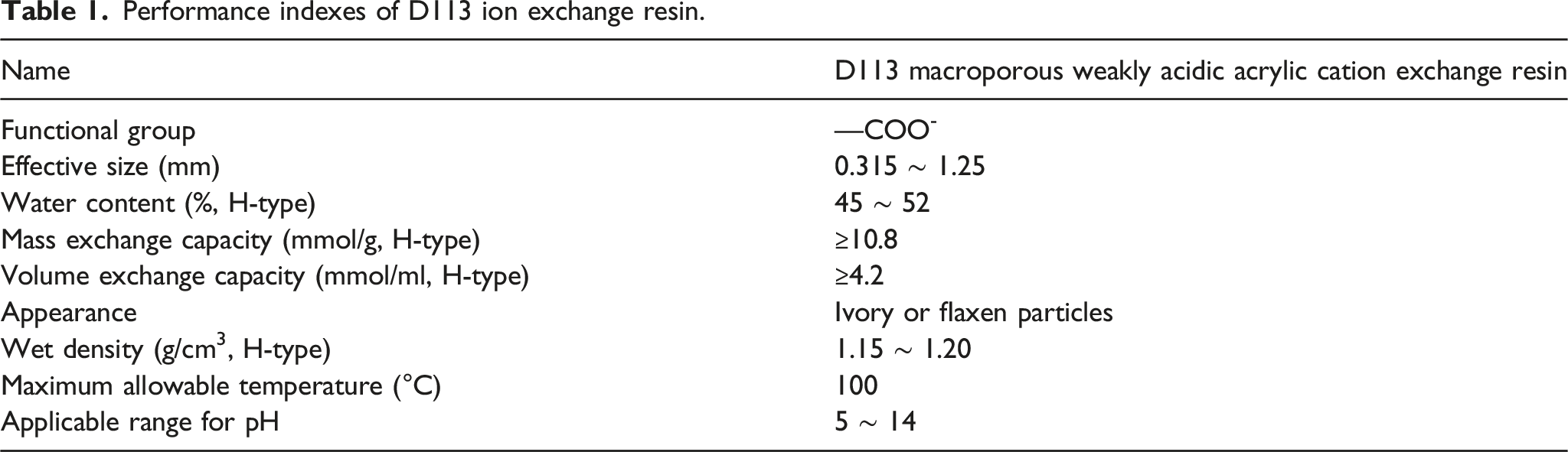
Performance indexes of D113 ion exchange resin.
The instruments included thermostatic oscillator (SHA-B, Lichen Technology Group), hydrothermal synthesis reactor (100 mL), electric thermostatic drying oven (DHG-9030A, Shanghai Yiheng Technology Co., Ltd), xenon lamp (300 W, Guangzhou Xingchuang Electronics Co., Ltd), visible light spectrophotometer (7200 type, Unico Shanghai Instrument Co., Ltd), etc.
Pretreatment of resins
According to GB/T5476-2013 of the people’s Republic of China, D113 cation exchange resins were sequentially pretreated with NaOH and HCl solution, and then they were immersed in NaOH solution for 4 ∼ 6 h to transform into Na type. Finally, the resins were placed in an electric thermostatic drying oven at 40°C until constant weight.
Preparation of Cu type ion exchange resins
10 g of CuSO4·5H2O dissolved in 50 mL of deionized water to obtain CuSO4 solution in triangular flask, and then 2 g of pretreated resin was added into the above solution. The flask was oscillated discontinuously in a thermostatic oscillator with 30°C, 150 r/min for about 10 h to complete a full replacement reaction. Afterwards, the resins were fully washed with deionized water for 2 ∼ 3 times, until there was no SO42− in the filtrate, which was detected with 1% BaCl2 solution. Finally, the resins were placed in an oven at 40°C to remove excess moisture. The reaction formula is shown in (1). Among them, R represents the part on the resin other than the ion exchange group.
Preparation of CuO@CER composites
1 g of NaOH was added to 50 mL of deionized water to obtain NaOH solution for 13.31 of pH value. The alkaline solution was poured into the conical flask containing Cu type ion exchange resin mentioned above, and to seal the flask, and to place it in a thermostatic oscillator at 50°C, 150 r/min and for 2 h, and then keep it warm for extra 2 h. Subsequently, the solution containing the resins was transferred to a 100 mL hydrothermal reactor together and continued to react for 2 h in an thermostatic drying oven at 80°C. After that, the reactor was taken out and cooled to room temperature. The pH value of the supernatant was measured for 13.06. At last, the ion exchange resins were thoroughly washed with a small amount of anhydrous ethanol for 3 times, and dried at 40°C to constant weight. The obtained product was labeled as “CuO@CER-1g”. The reaction formula is presented in (2) and (3).

In addition, in order to investigate the effects of hydrothermal reaction and dispersant on the products, the products labeled “CuO@CER-Lack of hydrothermal” and “CuO@CER-Hydrothermal/dispersant” were successfully prepared, that is, during the preparation process of CuO@CER-1g, the former did not undergo hydrothermal reaction, while the latter was added 4 g of polyethylene glycol-400 before the thermostatic oscillation.
Characterization of CuO@CER composites
All obtained composites were characterized and analyzed by field emission Scanning Electron Microscope (SEM, Zeiss-Supra55, Germany), Energy Dispersive Spectrometer (EDS, Zeiss-Supra55, Germany), and Empyrean X-ray Diffraction spectrometer (XRD, Bruker-D8 Advance, Germany), the micromorphology and structure on the surface and cross-section of resins were observed, and the element distribution and the crystal form were determined. XRD operating conditions are as follows: X-rays are generated from copper targets, the tube voltage and current are 40 kV and 40 mA, respectively, and the scanning range is set to 2θ = 5 ∼ 80°.
Photocatalytic degradation experiment of CuO@CER
The photocatalytic performance of the as-prepared CuO@CER was investigated detailly using polyacrylamide (PAM) as the target pollutant in water. The specific operation is as follows:
0.5 g CuO@CER was placed in a 200 mL 1000 mg/L PAM aqueous solution, and firstly the mixed samples was placed in a darkroom for 30 min to facilitate sufficient adsorption equilibrium between the solid photocatalyst and the PAM solution; Then the conical flask with mixed samples was transferred into a thermostatic oscillator, and to oscillate under room temperature and at low speed to ensure sufficient contact between CuO@CER and PAM solution. At the same time, the long arc xenon lamp was placed above the oscillator, and the distance between the conical bottle mouth and the xenon lamp was maintained for about 10 cm. The entire experimental device was covered with a light shield to isolate sunlight and eliminate interference. 5 mL of sample solution was taken every 20 min during the experiment, and the total duration was controlled at 120 min.
The photocatalytic degradation rate of the sample solution was determined using the turbidity method 23 : PAM sample solution, 5 mol/L CH3COOH solution, and 1.31% NaClO solution were mixed accurately in a volume ratio of 5:2:2, subsequently the sample bottle was gently shaken, and the solution became turbid gradually. After about 30 min, the precipitation reaction was basically completed. The absorbance of the sample solution was measured at a wavelength of 470 nm with a visible spectrophotometer, while a blank PAM solution was adopted as a reference.
The photocatalytic degradation rate of PAM sample solution is calculated by formula (4):
Cycling experiment of composite
For the composite with the best photocatalytic effect, after first photocatalytic experiment, it was soaked in 0.5 mol/L NaOH for 24 h and subsequently rinsed to neutral, and then the photocatalytic experiment was repeated until the PAM degradation rate decreased to below 60%.
Result and discussion
Characterization of SEM
SEM images of the CuO@CER surface and the cross-section after crushing the resin are shown in Figure 1, among them Figure 1(a), (c) and (e) represent SEM images of the CuO@CER surface, and Figure 1(b), (d) and (f) represent SEM images of the CuO@CER cross-section. The SEM images of the cross-section after crushing the resin can be used to observe the deposition status of the product in the resin pores. For comparison, the surface of the original resin before the reaction is also characterized by SEM (as shown in Figure 1(g)), and the magnification of the above samples is 10000 times. SEM images of CuO loaded ion exchange resin. (a-b): CuO@CER-0.5g, (c-d): CuO@CER-1g, (e-f): CuO@CER-1.5g, (g): Original D113 cation exchange resin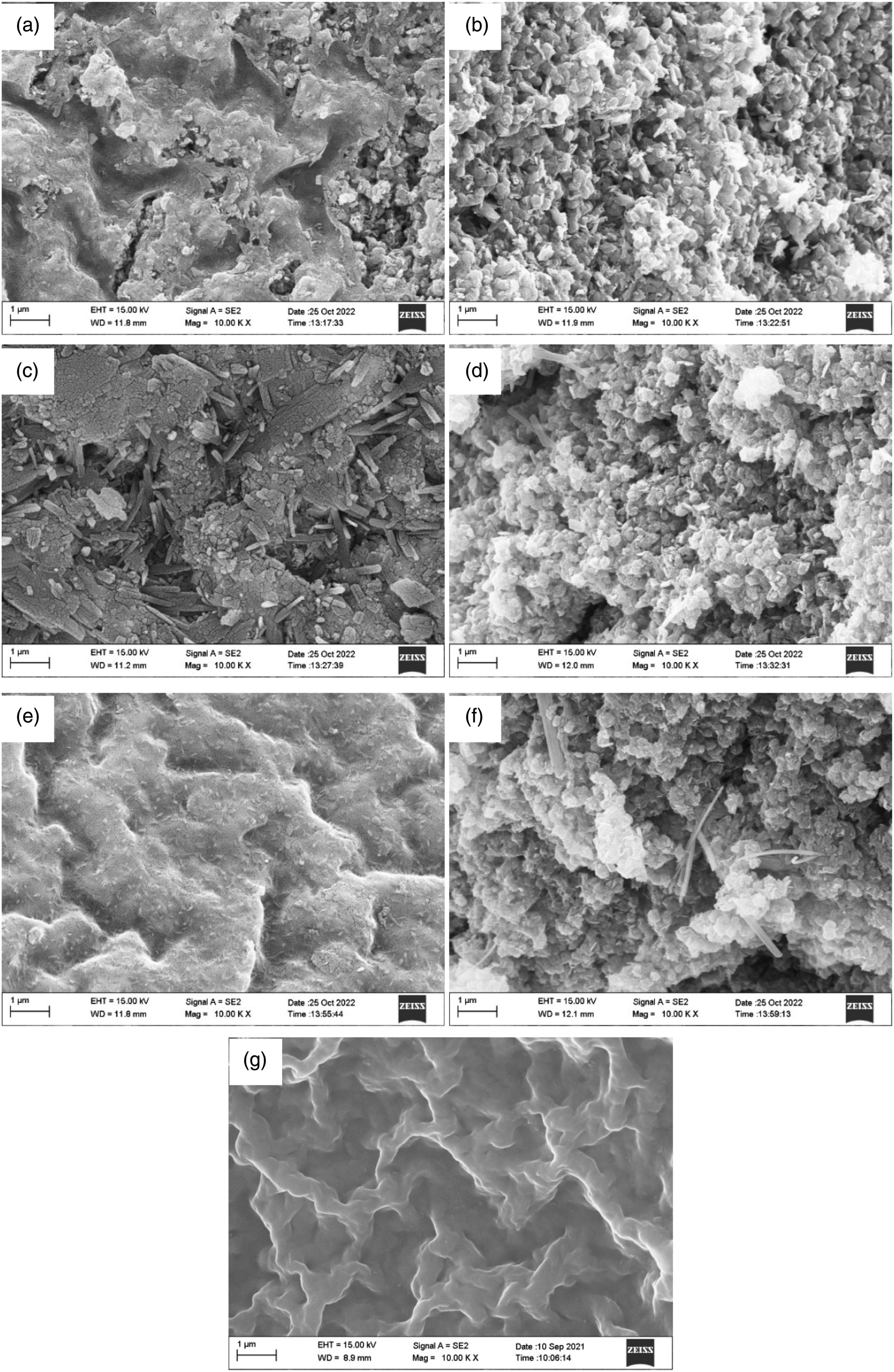
From Figure 1(g), it can be seen that the surface of the resin before the reaction exhibits many obvious clean and regular gully structures, which have a certain depth and a width of about 1 μm. Comparing the surface morphology with the original resin, Figure 1(a), (c) and (e) display that the surface morphologies of CuO@CER prepared with different concentrations of NaOH solution show significant changes, and their surfaces are covered with a layer of oxide, which resulted in a clear shell-core structure of the oxide and the resin, and the original gully depth of the resin has decreased, and the width has been reduced to less than 0.5 μm.
From Figure 1(a) and (b), it can be seen that there are sheet-like products on the surface of the resin particles, and some products aggregate and cover the surface of the particles. Meanwhile the SEM image of the resin cross-section shows more fragmented and dispersed products. Figure 1(c) and (d) reveal that there are short rod-shaped CuO crystals with a length between 400 and 800 nm in the gullies of the resin, which is similar to the characterization results of other researchers, 24 and in the SEM image of the resin particle cross-section, there are also fragmented and dispersed products. From Figure 1(e) and (f), it can be observed that there are obvious small particle precipitates with good dispersibility on the surface of the resin particles, while a small amount of long and straight thin plate structures can be observed in the internal pores of the resin particles, with the length of about 2 μm and the thickness of less than 100 nm, and some scattered fragmented structures can still be revealed in the resin particle cross-section.
Based on the above characterization, it can be seen that the method used in this experiment can prepare a large number of CuO adsorbed and covered on the surface of ion exchange resin with different micro morphologies by adjusting the initial concentration of alkali solution, and CuO products are more easily generated in the pores of resin particles. This is because the initial alkaline solution could provide a certain amount of OH−, which reacted with Cu2+ to produce CuO. With the increase of OH−, the small flake shaped CuO adsorbed on the resin surface would gradually grow along the longitudinal direction, becoming a short rod structure. However, more OH− would cause the small flake shaped CuO to continue growing around, which might further cover the surface of the resin particle. The small particle precipitation observed in Figure 1(e) is highly likely to be the initial formed CuO nanocrystals. 25 In addition, regardless of the initial concentration of alkali solution, the fragmented products could be observed on the cross-section of resin particles. The long and straight sheet structure in Figure 1(f) is the result of a large number of OH− interactions, and it is also the result of the regularity of the internal pores of the resin itself. 26
Figures 2(a) and (b) respectively show SEM images of the surface and cross-section of “CuO@CER-Lack of hydrothermal”. From Figure 2(a), it can be clearly seen that irregular CuO crystals are deposited on the surface of ion exchange resin with larger particle sizes and more severe agglomeration. This is because the hydrothermal process can promote the formation and growth of crystal nuclei at lower temperatures and shorter times, and the natural gradual cooling process after hydrothermal treatment is more conducive to the gradual growth of crystal nuclei, and prevents the aggregation of crystal nuclei. Therefore, this comparative experiment confirms that the hydrothermal process greatly contributes to the dispersion of CuO products. From the cross-section of the resin particles in Figure 2(b), it shows that the morphology of the products is similar to that of the products after the hydrothermal process. This is because the morphology of the products inside the resin particles is determined by the nanoscale pore inside the resin. The pore size of the macroporous ion exchange resin after wetting is 100 ∼ 500 nm, which facilitates the free migration of exchangeable ions, and restricts the growth of the products and regulates the morphology.
27
SEM images “CuO@CER-Lack of hydrothermal” and “CuO@CER-Hydrothermal/dispersant”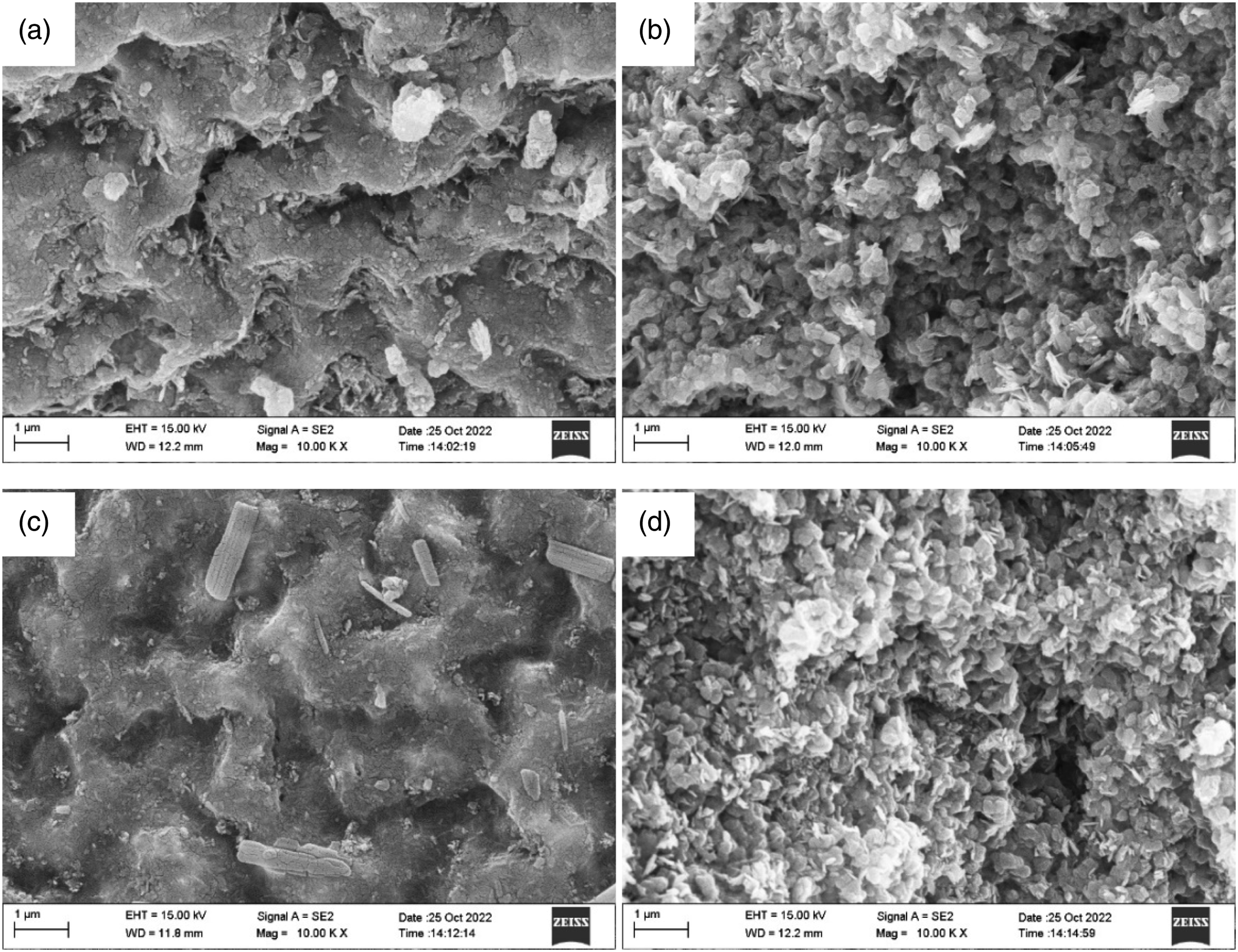
Figure 2(c) and (d) display SEM images of the surface and cross-section of “CuO@CER-Hydrothermal/dispersant”. From Figure 2(c), there is a small amount of rod-shaped structure CuO crystals with a width less than 300 nm and a length of 1–1.5 μm on the surface of resin, at the same time, the granular products are also adsorbed on the resin surface, and the morphology of the resin cross-section is similar to one of the product prepared without the dispersant. This indicates that the addition of dispersant does not achieve the expected effect and does not optimize the formation of the product, which may be related to many factors such as the amount of dispersant used, the amount of OH− in the solution, and the amount of Cu2+ loaded on the resin. 28 In later research, the systematic experiments and the detailed analysis will be conducted.
Characterization of EDS
EDS data of CuO@CER prepared under the different conditions.

According to the mass exchange capacity (≥10.8 mmol/g) and usage (2 g) of D113 resin, the theoretical calculations required for CuSO4·5H2O and NaOH are 2.7 g and 0.864 g, respectively. Therefore, the 10 g CuSO4·5H2O adopted in this experiment is excessive, and its purpose is to transform the resin into Cu type as much as possible. When the amount of NaOH exceeds 1 g, it is actually excessive, which puts the resin in a high alkaline environment. At the same time, Cu(OH)2 solution has acid-base amphotericity, so the generated Cu(OH)2 easily reacts with excess NaOH to generate sodium tetrahydroxycuprate (Na2 [Cu(OH)4]) during continuous oscillation and hydrothermal processes. 29 The Na2 [Cu(OH)4] is not stable enough, and can only be decomposed to generate CuO over a long period of time, and the relatively short duration of this experiment is not enough to promote its decomposition. Therefore, when the amount of NaOH used exceeds 1g, the amount of CuO adsorbed on the surface and inside of the resin is relatively low. Furthermore, the CuO content on the surface and cross-section of the CuO@CER-0.5g particles is high, but previous SEM analysis shows that a large amount of CuO exhibits agglomeration, and the morphology is not satisfactory.
In addition, Table 2 shows that the Cu content measured on the internal pores of the resin particles is similar to that on the surface of the particles, indicating that a certain amount of Cu ions were free to enter the resin pores during the reaction process, thereby generating CuO products. This result is basically consistent with the aforementioned SEM characterization results.
EDS data of “CuO@CER-Lack of hydrothermal” and “CuO@CER-Hydrothermal/dispersant” are also shown in Table 2. Comparing with EDS data of CuO@CER-1g, the percentage contents of Cu on the surface and cross section of the composites prepared under two conditions are both increased. This may be because the hydrothermal environment at 80°C speeds up the migration of metal ions, and promots some adsorbed Cu2+ to detach from the resin surface and pores, which causes that the content of Cu in the final product is less than that in the product without hydrothermal process. 30 Additionally, the polyethylene glycol-400 dispersant has a certain viscosity, which is conducive to the dispersion and uniform slow release of Cu2+, 31 so as to approach the resin particles and enter the interior of the resin orderly, resulting in an increase in the content of Cu on the surface and cross section of the resin. 32 However, considering the SEM results of the resin surface and cross section, the micro morphology of “CuO@CER-Lack of hydrothermal” and “CuO@CER-Hydrothermal/dispersant” is irregular and not ideal, which may have adverse effects on the subsequent photocatalytic applications. Therefore, the hydrothermal process has a positive effect on the morphology of the product, and in the case of adding dispersant to prepare products, the dosage, reaction time, reaction temperature and other conditions will be discussed systematically in the follow-up study.
Characterization of XRD
Figure 3 shows XRD patterns of CuO loaded cation exchange resin prepared under the different conditions. The main components and grain size in the composites can be determined through these patterns. Marked with “*”, i.e. 2θ = 32.51, 35.54, 38.71, 48.72, 53.49, 58.26, 61.52, 65.81, 66.22, there are sharp characteristic diffraction peaks with large intensity, which correspond to crystal planes (110), ( XRD patterns of CuO loaded cation exchange resin prepared under the different conditions.
XRD structural parameters of CuO@CER (

Photocatalytic degradation of polyacrylamide aqueous solution
The above five composites were applied to the photocatalytic degradation of PAM aqueous solution, and the degradation rate curves with time are shown in Figure 4. Moreover, the photocatalytic experiment of the original ion exchange resin was accordingly added to complete the comparative experiment. Change curves of PAM photocatalytic degradation rate over time.
There are a large number of permanent micro pores and large meshes inside the D113 macroporous ion exchange resin, and the pore size of the wetting resin ranges from 100 to 500 nm, and the surface area of the pores can increase to over 1000 m2/g. Hence this type of resin has excellent adsorption characteristics. 37 From Figure 4, the highest degradation rate of PAM adsorption by single ion exchange resins is 56.03%. In addition, after 30 min in the dark room, several samples have certain degradation effects on PAM, and most ion exchange resins loaded with nano CuO have a higher degradation rate of PAM than single resins, indicating that the oxide also exhibits significant adsorption on PAM.
With the extension of experimental time and continuous oscillation, the resin and nano CuO would undergo desorption, that is, some PAM molecules that had already been adsorbed on the resin surface would re-enter the solution, which could lead to a decrease in degradation rate. Subsequently, during the continuous oscillation process, some PAM molecules entered the resin pores, causing a small increase in degradation rate. The degradation rate of PAM by single ion exchange resins is only 38.6% at 120 min.
By comparison, it can be seen that after 120 min of photocatalysis, the composite with the best treatment effect on PAM is CuO@CER-1g for the highest degradation rate of 81.94%; the composite with the worst degradation effect is CuO@CER-1.5g for the degradation rate of 56.43%. Combining SEM images of CuO@CER-1g, CuO can be well dispersed on the surface and pores of the ion exchange resin, which enhances the specific surface area of the composite, thereby exerting greater adsorption and photocatalytic properties. Meanwhile, compare three degradation curves of CuO@CER-1g, “CuO@CER-Lack of hydrothermal” and “CuO@CER-Hydrothermal”, it is shown that the degradation rate is significantly lower in the absence of hydrothermal than in the presence of hydrothermal, and the addition of dispersant does not increase the degradation rate, which is consistent with the previous EDS analysis results. The above analysis implies that the higher the mass percentage of CuO loaded on the resin, the better the photocatalytic effect may not necessarily be. It is also necessary to consider various factors including the dispersion on the resin and the micro morphology of nano CuO.
In addition, it can be seen from the figure that the degradation rate of all the curves shows a downward trend at 60 min, which is the lowest point during the entire experimental process. It is speculated that the heat might be generated during continuous oscillation and xenon lamp operation, which increased the solution temperature and disrupted the adsorption balance between resin and PAM, causing PAM molecules to desorb from the resin into the solution, further leading to an increase of PAM concentration and a decrease of photocatalytic degradation rate. Therefore, the decrease of degradation rate between 40 and 60 min was due to the fact that the desorption rate of PAM was greater than the photocatalytic efficiency. From 60 to 120 min, the resins were in a new oscillating and high temperature environment, thus, they were under the combined action of adsorption equilibrium and photocatalysis. Therefore, the degradation process after 60 min was dominated by the photocatalytic effect of the CuO@CER on PAM.
The xenon lamp is a high-intensity light source that uses the inert gas xenon to generate visible, ultraviolet, and near-infrared light. When ultraviolet or visible light irradiates CuO, the electrons in its conduction band will be excited into the valence band to form electron-hole pairs, and then the transfer or recombination of photogenerated carriers will naturally occur. Finally, the oxidation and reduction reactions are generated to produce hydroxyl radical (·OH), and the strong oxidation of ·OH will cause the pollutant molecules to decompose into non-toxic and harmless small molecules such as CO2 and H2O. That is, the oxidative degradation of PAM is mainly due to free radical transfer reaction. Moreover, CuO can exhibit the highest photocatalytic activity under ultraviolet light. 38
In addition, the pH value of PAM aqueous solution with an initial concentration of 1000 mg/L was about 6.5. Because each link of PAM contains an amide group (-CONH2 with negatively charged, and there is hydrogen bond between amide groups. Previous studies 39 have shown that under neutral conditions PAM linear molecules have a good degree of crimp, which is conducive to the full access of photogenerated holes, so as to improve the photocatalytic degradation rate of PAM.
It is worthwhile to notice that CuO loaded ion exchange resin is a kind of solid photocatalyst. In application, the catalyst has the advantages of being less prone to loss, aggregation, and easy to recycle. At the same time, after multiple uses, the resin can still maintain its original skeleton structure and mechanical properties.
In summary, the optimal condition and result for photocatalytic experiments in this experiment are that under the action of a 300 W long arc xenon lamp and continuous oscillation, 0.5 g CuO@CER-1g performed a photocatalytic reaction on 200 mL 1000 mg/L PAM aqueous solution for 120 min, and the degradation rate of PAM aqueous solution could reach 81.94%. Furthermore, the decrease in PAM degradation rate is attributed to the synergistic effect of the photocatalytic properties of nano CuO and the adsorption properties of ion exchange resins.
Based on the above experimental results, CuO@CER-1g was chosen for cycling experiment, and the results are shown in Figure 5. It can be seen that as the number of cycles increases, the degradation rate of the photocatalyst for PAM aqueous solution gradually decreases, from 81.94% in the first cycle to less than 60% in the sixth cycle. After six cycles, the degradation rate of PAM is higher than that of single ion exchange resin (38.6%). It can be seen that after six cycles, the CuO loaded on the ion exchange resin still exhibits good photocatalytic activity against the organic polluted wastewater. In addition, the cyclic experiments have also confirmed the excellent mechanical properties of ion exchange resins. Cyclic experiment results of PAM degradation by CuO@CER
Conclusions
Using CuSO4·5H2O and D113 cation exchange resin as raw materials, CuO loaded ion exchange resin composite was successfully prepared using thermostatic oscillation and hydrothermal synthesis method. The results showed that the products obtained with different dosages of NaOH exhibited a clear shell-core structure, and there were needle shaped and rod-shaped CuO crystals with a length of 400–800 nm in the resin gully for CuO@CER-1g; EDS results displayed that the Cu content on the surface and cross-section of CuO@CER-0.5g composite was the highest with 30.71 and 23.60%, respectively; XRD characterization showed that the product was CuO species with monoclinic crystal system structure, and CuO grain size was about 16 nm. The photocatalytic degradation results of PAM revealed that after 120 min of photocatalysis, the highest degradation rate of PAM by CuO@CER-1g reached 81.94%, which was due to the excellent morphology of CuO@CER-1g. After six cycles, the CuO loaded on the ion exchange resin still exhibited good photocatalytic activity for PAM aqueous solution. The decrease in PAM degradation rate was attributed to the combined effect of the photocatalytic activity of nano CuO and the adsorption characteristics of ion exchange resins.
The results of the experimental and characterization indicates that the method used in this experiment is simple and feasible, and the ideal CuO loaded ion exchange resin photocatalyst can be successfully prepared. This not only expands the application field of ion exchange resins, and combines of ion exchange resins with the inorganic nanomaterials preparation, but also develops a green and environmentally friendly photocatalyst, which has important scientific significance for the development of the photocatalytic industry and environmental purification in the future.
Footnotes
Declaration of conflicting interests
The author(s) declared no potential conflicts of interest with respect to the research, authorship, and/or publication of this article.
Funding
The author(s) disclosed receipt of the following financial support for the research, authorship, and/or publication of this article: This work was supported by the Central Guidance on Local Science and Technology Development Fund of Liaoning Province, China (No. 2020JH6/10500062).https://journals.sagepub.com/doi/full/10.1177/09673911231212803#data-availability
