



Abstract
The analyses of the calendering processes using Oldroyd 8-constant fluid model with the non-linear slip condition effects are discussed in this paper. To model the flow equations for the study of calendering, we utilized the conservation of mass, momentum equations, and Oldroyd 8-constant model. The final equations are reduced into fourth order differential equations by utilizing lubrication approximation theory (LAT). MATLAB’s built-in function bvp4c is employed to calculate the stream function and the fluid velocity. Furthermore, pressure gradient, pressure, and mechanical quantities of calendering processes are obtained by fourth-order Runge-Kutta method. The effects of the slip and material parameters of Oldroyd 8-constant fluid on the physical quantities related to calendering are illustrated via graphical figures. The presence of slip is resistive to length of contract and pressure distribution. On the other hand the pressure showed the increasing trend with increase the value of material parameter (
Introduction
Calendering is a method that involves pressing melted polymer between two rotating cylinders to produce a sheet of specific thickness. During calendering, molten plastic is extruded and forced between two sets of heated rollers, where it is shaped into a sheet. The thickness of the plastic sheet is determined by the gap between the roller pairs. Initially used primarily in the rubber industry, calendering is now employed in various applications such as creating sheets, thermoplastic films, converting polyvinyl chloride into plastic, and producing different types of coverings. Calendered materials find extensive use in the manufacturing of coated fabrics, plastic sheets, and textile fabrics to achieve the desired surface smoothness and texture. The versatility of calendering is evident in its widespread use across industries. Calendered materials are commonly employed in the production of coated fabrics, such as those used for upholstery or protective covers. The process can also yield plastic sheeting that finds applications in packaging, construction, and other areas requiring durable and flexible materials. Additionally, calendering enables the creation of thermoplastic films for various purposes, ranging from food packaging to electrical insulation.1,2
In 1938, Ardichvili 3 is the first one to investigate the fluid mechanics of calandering process. He utilized lubrication theory and viscous fluid to explore the said process. Gaskell 4 made the theoretical basis for hydrodynamic analysis of calendering. He experimented with Newtonian and Bingham polymeric materials to analyze the calendering process. His assumptions were predicated on a minimal roll curvature. Bergen and Scott 5 used pressure distribution to empirically confirm Gaskell’s theoretical results and his model. Mckelvey 1 wrote a book titled “Polymer Processing,” in which he briefly discussed the calendering approach using power-law fluid. Tokita and White 6 discovered the mathematical significance and purpose of the second order fluid for the analysis of calendering. Chong 7 used three rheological models of mathematical status known as modified second-order, Oldroyd-B and power-law fluid concerning hydrodynamic version to examine the calendering process. He explained the non-uniform interior draining patterns in calendering sheets in terms of the Weissenberg number. Brazinsky et al. 8 used the power law fluid to build an analytical description of the relationship between spread height and upstream reservoir. Alston and Astill 9 investigated the calendering process of a one-dimensional flow using a hyperbolic tangent model. They computed the governing equations using two iteration methods: cascade iteration and Gauss Legendre quadrature. Krozer et al. 10 evaluated an asymmetrical calendering problem using Newtonian fluid. The governing equations were transformed from Cartesian coordinates to bipolar cylindrical coordinates and then solved analytically to yield the velocity profile, pressure and temperature. Kiparissides and Vlachopoulos 11 simplified the flow equations of Newtonian and non-Newtonian fluids by employing lubrication assumption. These reduced equations are solved via FEM (Finite element method). Middleman’s book “Fundamentals of Polymer Processing” 2 contains a mathematical analysis of the calendering mechanism. Non-isothermal viscous fluid flow in the nip region was identified by Dobbles and Mewis. 12 They noticed a remarkable difference in mechanics by varying the speed of rollers at various spots as a significant amount of heat is experienced at the nip exit, which is also generated by a lubricating layer. Calendering with molten polymers in a two-dimensional flow was reported by Agassant and Espy. 13 They used the finite element method (FEM) to find the numerical solution. According to their findings, the pressure distribution created by finite elements is similar to the results obtained using lubrication approximation theory (LAT). Mitsoulis et al. 14 investigated the non-isothermal calendering analysis for Newtonian and Power-law fluid models. They compared the results obtained with and without the lubrication approach, indicating that the temperature distribution in the nip area is underestimated by the lubrication approximation hypothesis. Levine’s et al. 15 introduces a model that captures the two-dimensional flow of power-law fluids during the calendering process of finite sheets. In contrast to the conventional one-dimensional calendering models that neglect sidewise flow, the model proposed in this study considers both lengthwise and sidewise flow of the fluid. The comparison between the experimental data and the model results suggests that the model effectively describes the two-dimensional calendering of power-law fluids in finite-width sheets.
Luther and Mewes 16 presented a three-dimensional investigation of Newtonian fluids in the calendering method. They compute the velocity and pressure profiles in the nip region using the finite element method (FEM). The calendering analysis of Pseudoplastic and Viscoplastic fluids is study by Sofou and Mitsoulis. 17 Sajid et al. 18 provides an exact solution for calendering a third-order fluid under the lubrication approximation. They deduced that as the third-order fluid parameter increases, the thickness of the exiting sheet, power input, and roll separating force also exhibit an increase. Polychronopoulos et al. 19 conducted a computer study of the calendering process using OpenFOAM fluid dynamics software. The primary objective of their study was to ascertain the current sheet thickness by passing it through the calender. The pressure profile and pressure gradient were also sensed by the 3D system.
The calendering mechanism was investigated by Ali et al. 20 using the mathematical FENE-P model. The governing equations were reduced using the lubrication approximation theory. They investigated the effect of the viscoelastic material parameter on velocity and pressure profiles, pressure gradient, and final sheet thickness. They observed that when the viscoelasticity of the fluid rose, the internal pressure of the calendering process decreased. Arcos et al. 21 discussed the effects of the temperature dependent properties of power law fluids on the final sheet thickness. Their numerical calculation shown that the thickness of final sheet modifies 6.91%, when they considered the viscosity as the function of temperature-dependent. Hernández et al. 22 presented the theoretical analysis of the calendering process using Newtonian model with viscosity as function of pressure–dependent. Their graphical results demonstrated that the final sheet thickness and leave-off distance increases for the case of pressure dependent viscosity when they compared with constant physical properties.
The Ellis fluid model was employed by Javed et al. 23 to theoretically investigate the calendering mechanism. Ali et al. 24 examined the heat transfer analysis using the couple stress model in the calendering mechanism. A heat transfer study for calendaring utilizing the Rabinowitsch fluid model was provided by Sajid et al. 25 They developed Rabinowitsch fluid flow equations and looked at how fluid parameters affected calendering processes. The Oldroyd 4-constant fluid model was used by Atif et al. 26 to quantitatively study the calendering process. In order to better understand the non-isothermal calendaring process, Zaheer and Khaliq 27 utilized water-copper nanofluid. Using Sutter by fluid model, Zaheer et al. 28 reported the perturbation investigation of the calendering processes. Javed et al.29,30 most recently reported a numerical investigation of calendering process with inspection of slip at upper roll surface and heat transfer analysis using different non-Newtonian fluid models.
The Oldroyd 8-constant fluid model is particularly useful for analyzing complex flow phenomena in various fields such as polymer processing, biomedical engineering, and geophysics. It allows researchers to understand and predict the flow behavior of viscoelastic fluids under different conditions and external forces. One notable advantage of the Oldroyd 8-constant fluid model is its ability to capture different modes of material behavior. By considering multiple relaxation timescales, the model can account for the intricate dynamics exhibited by viscoelastic fluids. This flexibility enables accurate predictions of material responses, such as shear thinning, normal stress effects, and viscoelastic instabilities. Researchers often utilize the Oldroyd 8-constant fluid model to develop numerical simulations, analytical solutions, and experimental design for a wide range of applications.31–35 It serves as a fundamental tool for investigating flow behavior, optimizing processes, and designing materials with tailored viscoelastic properties. The Oldroyd 8-constant fluid may be reduced in the second grade, Maxwell, Oldroyd 4-constant, Oldroyd 6-constant, and Newtonian fluid models by setting the material constants to be zero. In the case of constant single-direction passages, these fluid models do not disclose rheological properties. The Oldroyd 8-constant fluid model, on the other hand, is being a typical non-Newtonian fluid model, which is well adapted to deal with this problem. In calendering processes, the Oldroyd 8-constant fluid model is highly valuable. It corresponds to the Oldroyd -B model, which employs the term from the Oldroyd 8-constant model.
As far as we know, no attempt has been made to investigate the calendering process using the Oldroyd 8-constant fluid model in the previously mentioned scientific literature study. In order to better understand how the fluid parameter impacts engineering quantities and exit sheet thickness during calendering process, the present effort will look at this issue. This study examines the impact of rheological behavior on final thickness and other flow properties during isothermal calendering. Specifically, the investigation focuses on Oldroyd 8-constant fluid, as well as non-linear velocity slip at the surface of the rolls. The research aims to mathematically formulate the problem and propose a solution method. The obtained results are presented and discussed through graphs, leading to conclusions about the findings.
Governing equations and mathematical formulation



In the given context, the terms 
The calendering mechanism is depicted geometrically in Figure 1. It is made up of two identical cylinders that rotate counterclockwise. Each cylinder has a radius R and moves with a set angular velocity Physical model for calendering processes.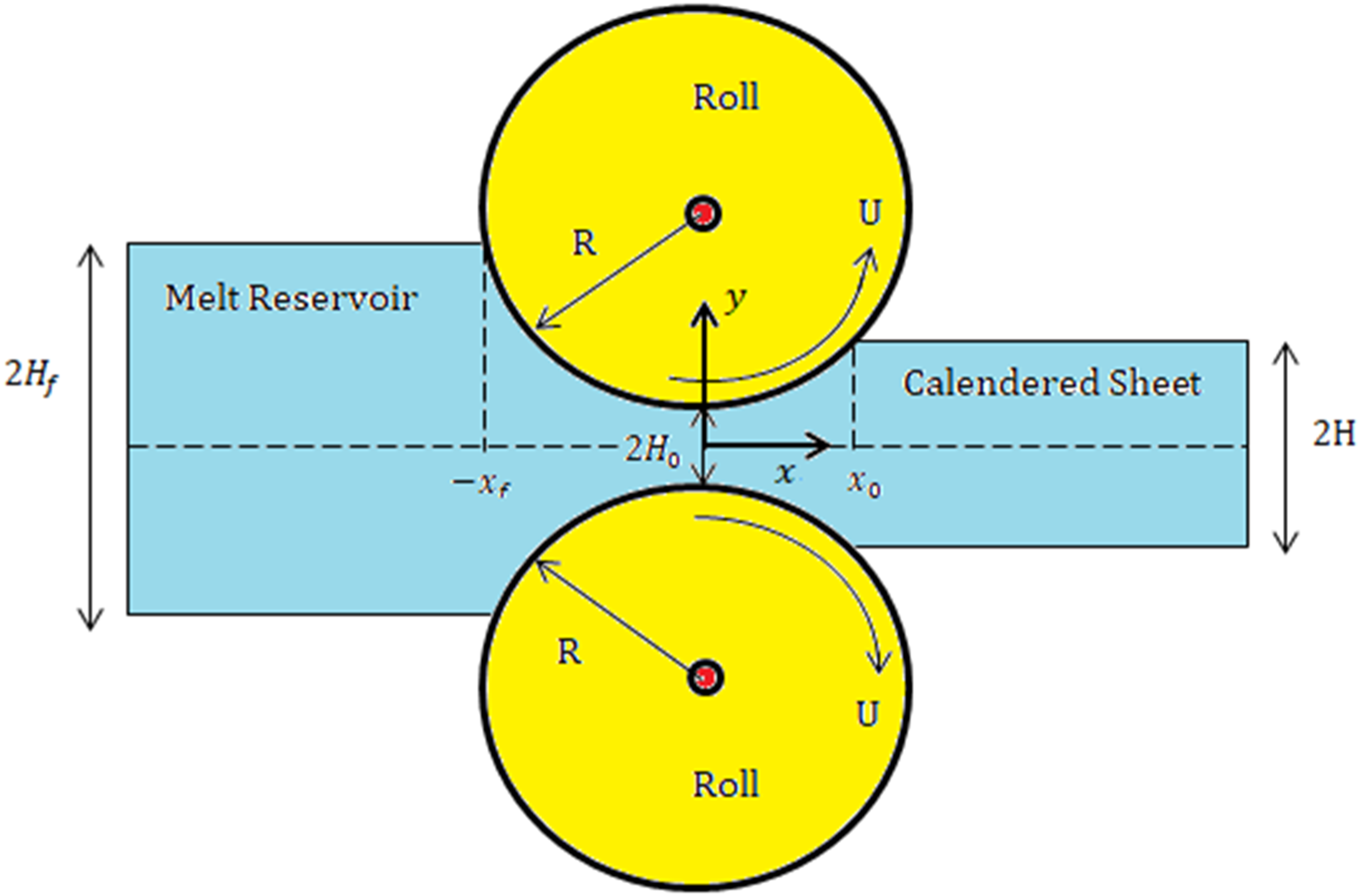
The component form of equations (1)–(4) is provided as follows






In order to investigate the effects of the slip coefficient, we introduced nonlinear slip condition to the upper roll surface of the calender.29,30
In the center of the rolls boundary condition is defined as
Introducing dimensionless variables and parameters
We may express equations (6)–(13) as follows by invoking dimensionless variables


Let us define K as the slip parameter, given by 





By substituting the values of 


By incorporating equation (29) into equation (22), we obtain
It is depicted from equation (23) that pressures only a function of x. Differentiating equation (32) with respect to y, we get the following equation
The equation (33) represent highly non-linear differential equations, making it challenging to find analytical solutions. Therefore, a numerical approach is adopted to obtain the results. To facilitate this, we introduce a stream function as follows
By utilizing the stream function relations defined in equation (34), equations (32) and (33) can be casted as

The relevant boundary conditions in terms of stream function can be casted into way,

Two additional boundary conditions are required because equation (36) involves the fourth-order derivative. To address this, the following volumetric flow rate is defined
The dimensionless form of equation (39) is
So we have”
The frequently used boundary conditions for pressure and pressure gradient are defined as2,20,22

Therefore, by solving equation (36) in conjunction with equations (37), (38) and (41) via MatLab’s “BVP4c,” we derive the stream function. This stream function is subsequently employed in equations (34) and (35) to calculate the velocity component u and the pressure gradient dp/dx.
The pressure can be numerically calculated by integrating the pressure gradient.
In the present study, we are unable to get the analytical expression for pressure. To find the numerical value of the pressure, we assume that the value of
The roll-separating force and power function2,20,22 is defined in the following manner


Results and discussion
In this section, we delve into the effects of three important parameters, namely
Pressure distribution
Figures 2–4 are presented to examine the influence of the slip parameter (K), and material parameters Effects of slip parameter K on pressure with Effects of Impact of, 


From Figure 3, it becomes apparent that the magnitude of pressure increase as the material parameter
Figure 4 illustrates the pressure distribution characteristics for various values of
Pressure gradient
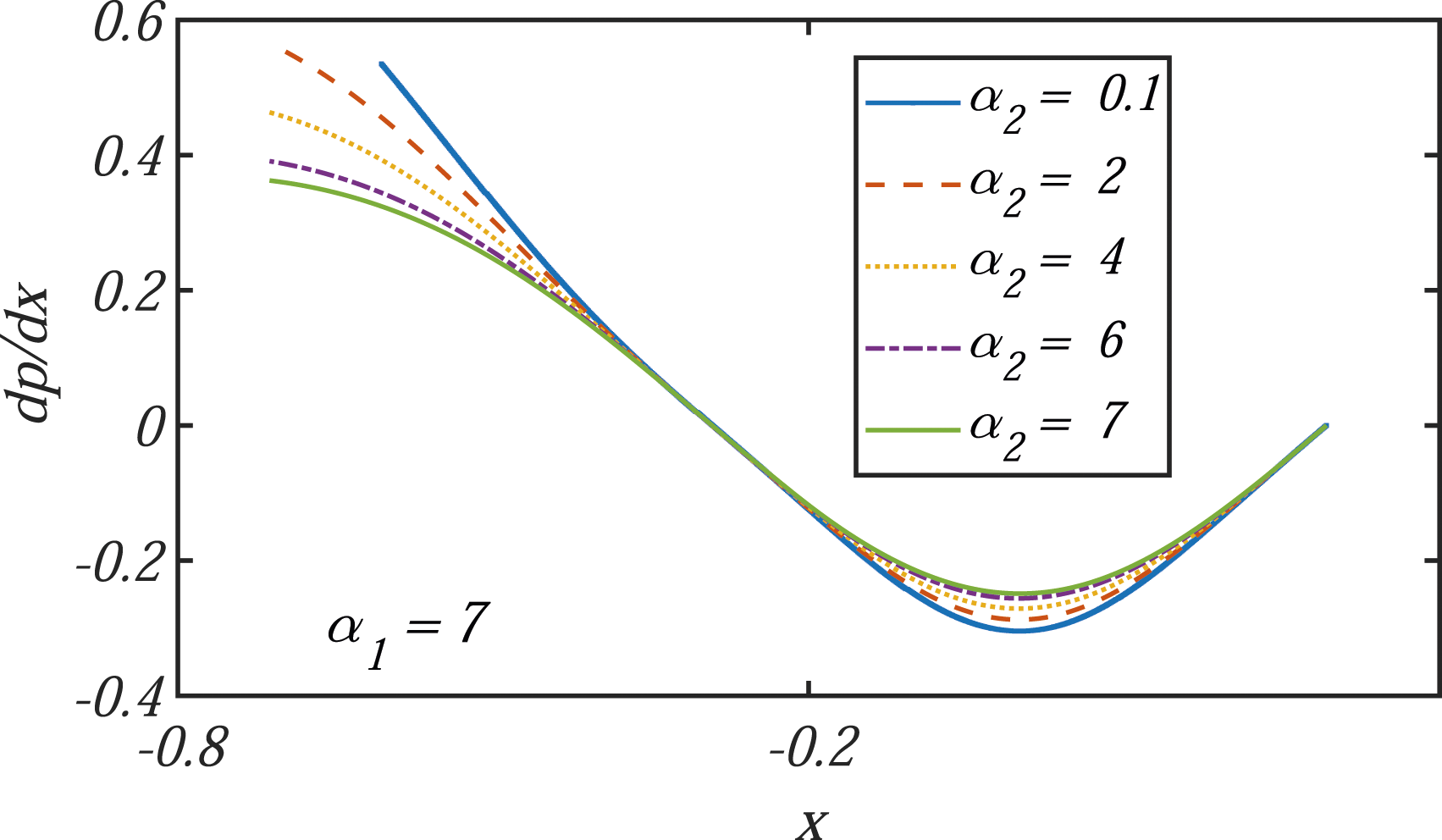
Figures 5 and 6 illustrate the pressure gradient in the domain Effects of slip parameter K on pressure gradient. Effects of 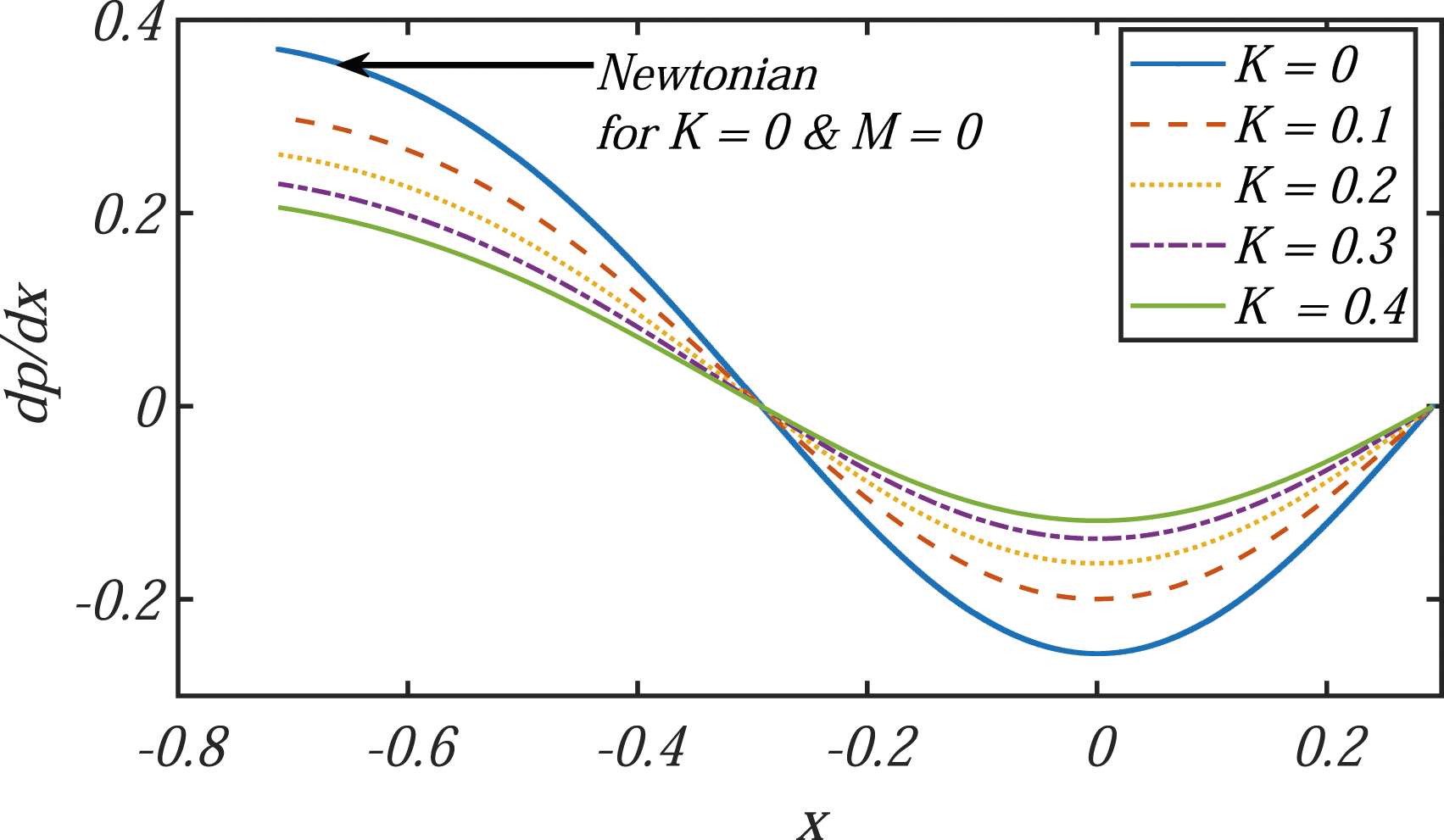
Velocity distribution
Figures 7 and 8 illustrate the impact of the slip parameter K on the velocity profile u (x, y) at specific axial positions, Influence of dimensionless slip parameter K on velocity. Influence of dimensionless slip parameter K on velocity.

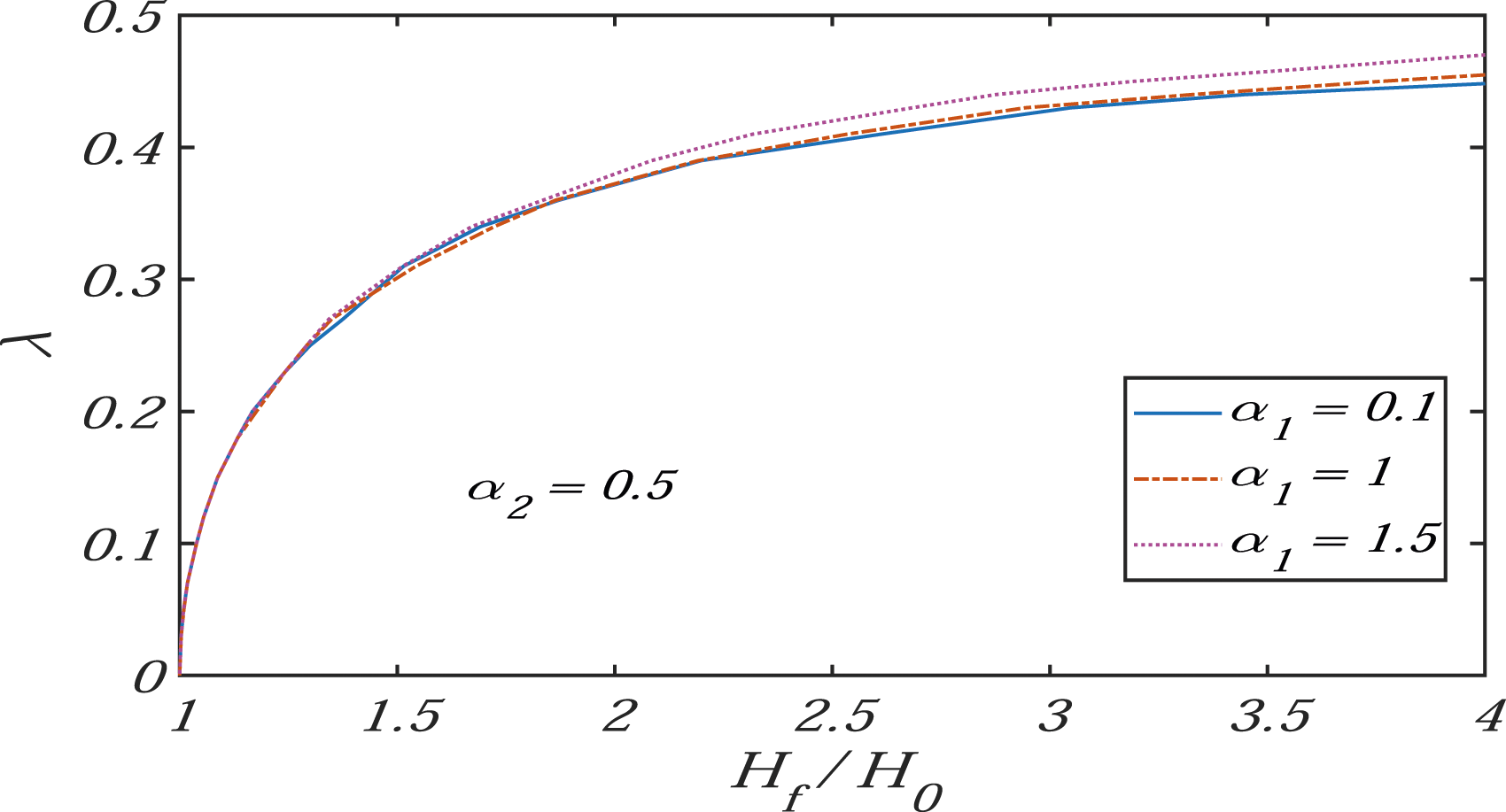
The effects of the slip parameter (K) and leave-off distance Force function (F) in left panel and power function in right panel versus Leave of distance 
Conclusion
This article presents a numerical framework for the mathematical modeling of the calendering process. The Oldroyd 8-constant fluid model is employed to estimate the rheological properties of the calendering sheet. MATLAB's built-in function “bvp4c” is utilized to solve the fourth-order differential equation. Additionally, the Runge-Kutta 4th order technique is employed to calculate p, dp/dx, and other calendering-related quantities. Graphical representations are displayed and discussed regarding the effects of various parameters on the calendering mechanism. The following summarizes the overall findings of the study. • The study demonstrates a significant 53% decrease in pressure when comparing the slip parameter K = 0.4 to the no-slip condition, i.e., Newtonian pressure
2
(When the material parameters • The pressure distribution experiences a notable decrease of 20% when • The force and power functions show the increasing trend with increase the value of the leave off distance. • The final sheet thickness increased with increasing the material parameter • The numerical study shows that as the slip parameter K increases, the velocity of the polymer sheet near the center increases, but it decreases near the roll surface compared to the Newtonian velocity. • The article provides valuable theoretical insights that can serve as a foundation for future experimental validation and verification.
Footnotes
Acknowledgments
Dr. Zeeshan Asghar would like to thank Prince Sultan University for their support through the TAS research lab.
Declaration of conflicting interests
The author(s) declared no potential conflicts of interest with respect to the research, authorship, and/or publication of this article.
Funding
The author(s) received no financial support for the research, authorship, and/or publication of this article.
