



Abstract
The synergistic effect of silica (SiO2) and copper (Cu) nanoparticles in polyimide (PI) on the friction interfacial deformation of polyethersulfone/polyimide (PES/PI) blends was studied. Results indicate that the effect of SiO2 and Cu nanoparticles on the tribological performance of PES/PI nanocomposites is quite different from each other. The addition of SiO2 nanoparticles into PI improves the antifriction of PES/PI nanocomposites by 24.4%, but has little effect on the wear resistance. The incorporation of Cu nanoparticles into PI enhances the wear resistance of PES/PI nanocomposites by 55.5%, but has little effect on the antifriction. PES/PI nanocomposites achieve the better comprehensive tribological performance when the content of SiO2 and Cu is 0.8 wt and 0.2 wt%, respectively. The friction interfacial deformation analysis reveals that SiO2 in PI improve the continuity and uniformity of deformation in friction interface and reduce the severe wear of transfer film. Cu nanoparticles in PI improves the continuity but not the ununiformity of deformation. Thus, the abrasive wear of counterpart ball is severe. The synergistic effect of SiO2 and Cu nanoparticles in PI improves the continuity and uniformity of friction interfacial deformation, which contributes to the improvement of friction and wear of PES/PI nanocomposites.
Introduction
Polymers are widely used in friction pairs ascribing to their excellent self-lubricating performance or wear resistance.1–4 Such as polyimide (PI), polytetrafluoroethylene (PTFE), polyetheretherketone (PEEK), polyethersulfone (PES) and so on. Polymer composites with excellent tribological properties can be obtained by blending different polymers. In addition, the tribological performance of polymer blends can be further improved by adding inorganic or metal nanoparticles into polymers.5–13 For example, silica (SiO2), silicon carbide (SiC), copper (Cu), alumina (Al2O3), molybdenum disulfide (MoS2), graphene, and so on. The effect of nanoparticles on the friction and wear mechanism of polymer composites has always been one of the most important research topic.
Many researchers have studied the effect of nanoparticles on the friction and wear mechanism based on the morphology and chemical composition of the worn surface and transfer film. 14 Various positive effects of nanoparticles on friction and wear has been found, such as the roller effect of nanoparticles in friction interface, 15 the enhancement of nanoparticles on the mechanical performance of polymer composites and transfer film, 16 the facilitation of nanoparticles on the formation of transfer film, 17 the enhancement of nanoparticles on the bonding strength between transfer film and counterpart 18 and so on. All of these studies are very helpful to reveal the role of nanoparticles in the friction and wear of polymer nanocomposites. However, the effect of nanoparticles on the friction and wear mechanism of polymer is not revealed completely, which needs further study.
In general, the performance of polymer nanocomposites is significantly determined by the dispersion of nanoparticles in polymer matrix and the interfacial adhesion between fillers and polymer matrix. 19 In general, the compatibility between inorganic or metal nanoparticles and polymers is very poor and the agglomeration of nanoparticles is inevitable. As a result, the interfacial bonding between inorganic or metal nanoparticles and polymer is weak, and the dispersion of nanoparticles in polymer blend system is uneven. 20 The introduction of nanoparticles into one of the polymers is effective for the improvement of tribological properties. 21 It is well known that the friction interfacial deformation of polymer resin under friction load influences the tribological performance of polymer composites greatly.22–25 However, the synergistic effect of different nanoparticles in one polymer of the polymer blends on the friction interfacial deformation and its effect on friction and wear have not been revealed. It is necessary to investigate the synergistic effect of two different nanoparticles in one polymer of polymer blending system on the friction and wear of polymer blending system using the friction interfacial deformation.
In this paper, polyethersulfone and polyimide (PES/PI) blend system was employed to investigate the synergistic effect of inorganic and metal nanoparticles in PI on the friction interfacial deformation of blending system. Polyethersulfone (PES) is widely used in industry because of its excellent comprehensive performance, such as automobile, aviation, microelectronics.26,27 However, poor lubricating performance and wear resistance of PES limits its tribological application. The friction and wear performance of PES can be further improved by introducing fillers. 28 PI is one of the best self-lubricating polymers and PI can be used to improve the tribological performance of polymer matrix effectively. 18 The chemical performance of SiO2 and Cu nanoparticles is stable and the tribological performance of polymer composites can be improved by SiO2 and Cu nanoparticles. 8 Firstly, SiO2 and Cu nanoparticles are introduced into PI and PES/PI nanocomposites are prepared. Secondly, the tribological performance of PES/PI nanocomposites was studied. Then, the synergistic effect of SiO2 and Cu nanoparticles in PI on the deformation of friction interface was explored. Finally, the friction and wear mechanism was investigated based on the synergistic effect of SiO2 and Cu nanoparticles in PI on the deformation of friction interface.
Experimental details
Materials
Polyethersulfone powders were purchased from Jida High Performance Materials Co., Ltd, Jilin, China. 3,3′,4,4′-oxydiphthalicanhydride (ODPA) and 4,4′-oxydianiline (ODA) were supplied by Changzhou Sunchem Pharmaceutical Chemical Material Co., Ltd., China. ODPA and ODA were used to synthesized PI and PI nanocomposites. SiO2 (30 nm) and Cu (50 nm) nanoparticles were purchased from Aladdin industrial corporation, China. 3-glycidyloxypropyltrimethoxysilane (GOTMS), acetone methylbenzene, triethylamine and acetic anhydride were commercially obtained from various sources without modification.
Preparation of PES nanocomposites
SiO2 and Cu nanoparticles were introduced into PI according to the literature. 9 PI nanocomposites and PES powders were passed 200 mesh screener (about 75 μm), and then blended in ethanol at room temperature for 5 min. After drying, the mixture was compressed under 25 MPa at room temperature for 30 min. Then the mixture was compressed under 15 MPa at 320°C for 60 min. After cooling, PES/PI nanocomposites were obtained.
The composition of PES/PI nanocomposites.

Friction and wear tests
Tribological tests of PES/PI nanocomposites were carried out on a reciprocating ball-on-disc friction and wear tester (CSM Tribometer) based on ASTM G 133-2010. The schematic diagram of the tribological test is depicted in Figure 1. The size of PES/PI nanocomposites were cut into 18 mm × 10 mm × 3 mm and polished with abrasive papers. The diameter of GCr15 ball is 6 mm. The friction tests were carried out under room temperature and humidity for 30 min. The sliding velocity is 0.08 m/s, the friction load is 5 N and the length of stroke is 10 mm. The schematic diagram of friction test.
The friction coefficient (COF) of PES/PI nanocomposites was recorded using the tester. The wear rate of PES/PI nanocomposites was calculated using the formula
14

Characterization
Nanoparticles and PI nanocomposites were investigated using Scanning electron microscope (SEM) after gold spraying. In addition, PI nanocomposites was studied using Fourier transform infrared spectroscopy (FT-IR) spectrum (Nicolet IS5), X-ray diffraction (XRD) (WJGS-009 X-ray diffractometer) and Thermogravimetric (TG). XRD was measured with Cu Kα radiation (40 kV, 40 mA.) at the scanning speed of 4° min−1. TG was carried out on an approximately 20 mg samples at a heating rate of 10°C min−1 from 35 to 1000°C in air atmosphere.
The worn morphology of friction pairs was inspected and the profiles of wear scar were measured using white light scanner. The profiles of PES/PI nanocomposites and GCr15 balls were employed to investigate the total deformation of PES/PI nanocomposites and transfer film in friction interface. As shown in Figure 2, the profiles of PES/PI nanocomposites and GCr15 balls after wear are measured firstly. Then, the intersection point of worn and no worn profiles of GCr15 ball was coincided with the profile of PES/PI nanocomposites. Finally, the surrounded area of profiles was employed to inspect the total deformation of friction interface. The friction interfacial deformation of friction pairs.
Results and discussion
Morphology of nanoparticles and PI nanocomposites
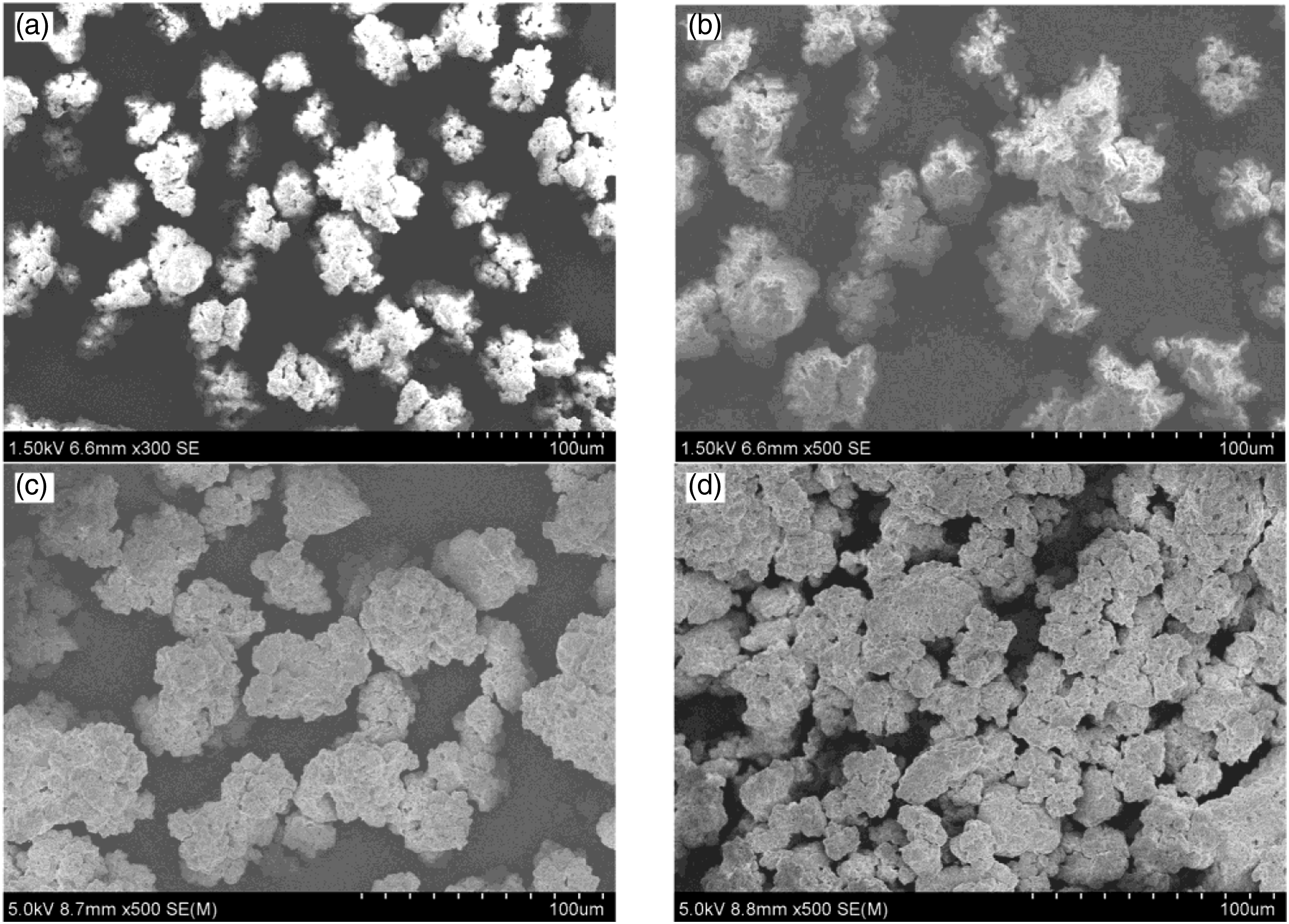
The SEM images of SiO2 and Cu nanoparticles are shown in Figure 3. The morphology of SiO2 and Cu nanoparticles can be observed clearly. The morphology of SiO2 nanoparticles is small sphere and the morphology of Cu nanoparticles is small cylinder. In addition, the size of SiO2 and Cu nanoparticles is about 30 nm and 50 nm, respectively. This is cosistent with the commercial specifications of nanoparticles. The SEM images of PI nanocomposites are depicted in Figure 4. The morphology of pure PI, PI/SiO2, PI/SiO2/Cu, PI/Cu nanocomposites are irregular particles. And the morphologies of different PI nanocomposites are similar with each other. SEM images of SiO2 (a) and Cu nanoparticles (b). SEM morphology of pure PI (a), PI/SiO2 (b), PI/SiO2/Cu (c) and PI/Cu (d).
Composition analysis of PI nanocomposites
FT-IR, XRD and TG were employed to investigate the composition of PI nanocomposites as shown in Figure 5, Figure 6 and Figure 7. The FT-IR spectra of PI/SiO2, PI/Cu and PI/SiO2/Cu nanocomposites were shown in Figure 5. From Figure 5(a), the absorption bands of imide rings are at 1720 cm−1 (C=O symmetric stretching) and 1780 cm−1 (C=O asymmetric stretching) in the spectrum of pure PI.
29
In addition, these characteristic peaks of PI can be observed from the spectrum of PI/SiO2, PI/Cu and PI/SiO2/Cu nanocomposites. All of these phenomena implies that PI was synthesized successfully. Compared with pure PI, the bands of PI/SiO2 in the 1000–1100 cm−1 and 469 cm−1 region are enhanced apparently as shown in the partial magnification in Figure 5(b). The characteristic bands of SiO2 is 1089 cm−1 and 469 cm−1 (the Si-O-Si stretching and bending vibration).
30
Thus, the incorporation of SiO2 nanoparticles into PI will enhance the intensity of these absorption bands. This cannot be observed from the spectrum of PI/SiO2/Cu nanocomposites, which might ascribe to the lower content of SiO2 nanoparticles. FT-IR of PI nanocomposites (a) and the partial magnification (b). XRD spectra of PI nanocomposites. TG curves of pure PI, PI/SiO2 and PI/Cu nanocomposites.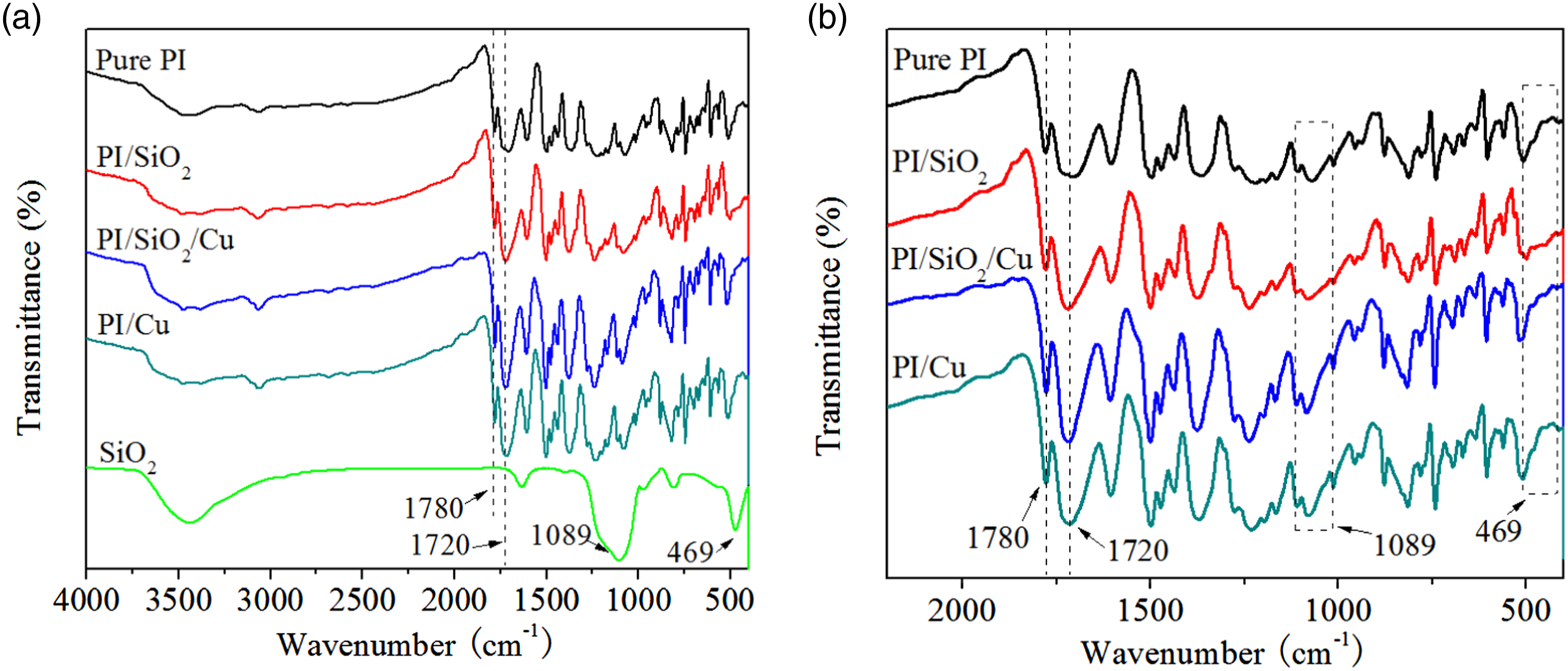


The XRD spectra of PI nanocomposites are shown in Figure 6. The spectrum of pure PI exhibits weak diffraction peak at 17.3°, implying the lower crystallization of PI resin. The spectrum of PI/SiO2 is similar with that of pure PI. This indicates that the structure of SiO2 nanoparticles is amorphous. 31 The spectra of PI/SiO2/Cu and PI/Cu exhibit diffraction peaks at 43.2° and 50.2°. This phenomenon ascribes to the addition of Cu nanoparticles. 32 The diffraction peak at 17.3° is disappear. This might due to the inhibition of Cu nanoparticles on polymer crystallization. 33 All of these illustrate that Cu nanoparticles were introducted into PI resin successfully.
TG curves of PI nanocomposites were shown in Figure 7. It can be seen that the residual of pure PI is zero, which attributes to the decomposition of PI at high temperature in air. Compared with pure PI, the residual of PI/SiO2 composites is about 5.1 wt % which corresponds to the addition of SiO2 nanoparticles (5 wt %). The residual of PI/Cu composites is 6.4 wt% which is a little higher than the addition of Cu nanoparticles (5 wt%). This might ascribe to the inevitable oxidization of Cu nanopaarticles at high temperature in air. All of the FT-IR, XRD and TG results imply that SiO2 and Cu nanoparticles were introduced into PI matrix successfully.
Tribological properties of PES/PI nanocomposites
The tribological performance of PES/PI nanocomposites was studied and the results are summarized in Figure 8. From Figure 8(a), COF of PES/PI nanocomposites increases firstly and then reaches steady. The COF and wear rate of PES/PI nanocomposites are shown in Figure 8(b). The COF and wear rate of PES/PI is about 0.45 and 4.29 × 10⁻⁵ mm3 (N·m)−1. PES/PI/SiO2 exhibits lower COF (0.34) and wear rate (4.03 × 10⁻⁵ mm3 (N·m)−1), which reduces about 24.4% and 6.1% than those of PES/PI. The COF and wear rate of PES/PI/Cu are 0.44 and 1.89 × 10⁻⁵ mm3 (N·m)−1, which decrease 2.2% and 55.5% than those of PES/PI, respectively. The effect of SiO2 and Cu nanoparticles in PI on the COF and wear rate of PES/PI illustrates that SiO2 nanoparticles in PI is beneficial to improve the antifriction and Cu nanoparticles in PI contributes to enhance the wear resistance. This can be also demonstrated by the COF and wear rate of PES/PI nanocomposites when SiO2 and Cu nanoparticles are introduced into PI simultaneously. PES/PI nanocomposites achieve the better comprehensive tribological performance when the content of SiO2 and Cu is 0.8 wt and 0.2 wt%, respectively. The curves of COF against the sliding time (a) and the COF and wear rate (b).
The COF and wear results of PES composites in references.

Worn analysis of GCr15 balls
The worn morphology of GCr15 balls and the profiles of wear scar’ midline were carried out to investigate the worn of the counterpart balls as shown in Figure 9. The wear area of GCr15 balls can be observed clearly as shown in Figure 9(a). The profiles of wear scar’ midline exhibit the wear depth of GCr15 balls apparently as depicted in Figure 9(b). The worn morphology of GCr15 balls corresponding to PES/PI nanocomposites (a) and the profiles of wear scar’ midline (b).
The profile of GCr15 ball corresponding to PES/PI is very rough. In addition, the area bounded by the fitting profile of original ball and the profile of GCr15 ball corresponding to PES/PI is the biggest. This implies that the severe wear of ball corresponding to PES/PI. Compared with PES/PI, the profile of the GCr15 ball corresponding to PES/PI/SiO2 is relative smooth. In addition, the area bounded by the profiles of original ball and GCr15 ball corresponding to PES/PI/SiO2 is relatively small. Compared with PES/PI/SiO2, profile of the GCr15 ball corresponding to PES/PI/SiO2/Cu is uneven. And the area bounded by the profiles of the original ball and the GCr15 ball corresponding to PES/PI/SiO2/Cu is small. Thus, the addition of Cu nanoparticles into PI of PES/PI composite reduces the wear of the counterpart ball, this is especially true for the GCr15 ball corresponding to PES/PI/Cu. All of these demonstrate that the incorporation of SiO2 and Cu nanoparticles into PI phases of PES/PI inhibits the wear of counterpart ball. The addition of nanoparticles promotes the formation of transfer film, which will inhibit the direct contact between friction pairs. However, polymer composites will be deformed under friction load inevitably.23,24 The uneven deformation of friction interface will induce uneven wear of GCr15 balls. This can be also demonstrated by the rough and asymmetric profiles of GCr15 balls.
Worn analysis of PES/PI nanocomposites
The worn morphology and profiles of PES/PI nanocomposites were employed to investigate the worn of PES/PI nanocomposites as shown in Figure 10. From Figure 10(a), the wear surface of PES/PI nanocomposites can be observed clearly. The profiles of wear scar exhibit the depth of wear scar as depicted in Figure 10(b). The depth of wear scar of PES/PI/SiO2 is similar with that of PES/PI. This implies that the incorporation of SiO2 nanoparticles in PI has little effect on the wear resistance of PES/PI composite. The depth of wear scar of PES/PI/Cu is the least, indicating that the addition of Cu nanoparticles into PI phases contribute to the improvement of wear resistance of PES/PI composite. The worn morphology of PES/PI nanocomposites (a) and the profiles of wear scar (b).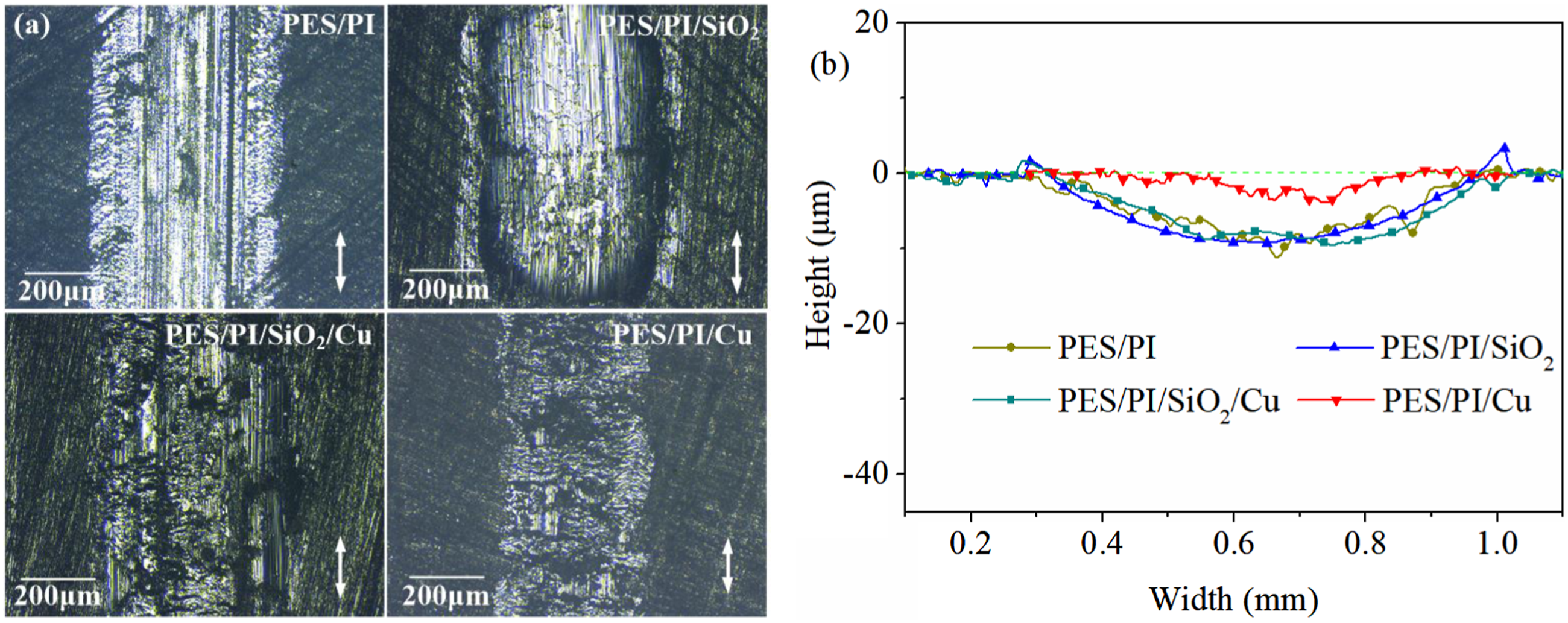
The deformation of friction interface
The profiles of PES/PI nanocomposites and the GC15 balls are shown in Figure 11(a). The height difference of profiles against the width of wear scare is depicted in Figure 11(b). The profiles of friction pairs (a) and their height difference against the width of wear scar (b).
From Figure 11(a), the profiles of PES/PI and the counterpart ball is rough and the interleaving of profiles is severe. Its height difference along the wear scare is displayed in Figure 11(b). In addition, the height difference along the width of wear scar is discontinuous and the height difference is not flat. This phenomenon indicates that the deformation of PES/PI in friction interface is quite discontinuous and uneven. It can be inferred that the load distribution in the friction interface between PES/PI and GCr15 ball is discontinuous and uneven. This will directly induce the uneven wear of PES/PI, GCr15 ball and transfer film. The deterioration of transfer film will aggravate the wear of friction pairs. In summary, the friction interface between PES/PI and GCr15 ball is very unstable. This is consistent with the worn morphology of PES/PI and GCr15 ball as shown in Figure 6(a). On the contrary, PES/PI/SiO2, PES/PI/SiO2/Cu, PES/PI/Cu and the counterpart ball exhibits relative smooth profiles and slight interleaving area. And the height of the adjacent interleaving area is continuous, slight and uniform. This means that the deformation of friction interface is uniform and continuous when SiO2 or Cu nanoparticles were introduced into PI. Thus, the load distribution in friction interface is uniform and the wear of transfer film will be mild and homogeneous. Compared with PES/PI/Cu, the height difference of PES/PI/SiO2/Cu and GCr15 ball in friction interface is more even and continuous, this is especially true for PES/PI/SiO2. The uneven deformation of friction interface induces the nonuniform force distribution of friction interface, resulting the uneven wear of transfer film, GCr15 ball and PES/PI nanocomposites. This can be also demonstrated by the more rough worn morphology of GCr15 ball corresponding to PTFE/PI/Cu. In summary, the addition of SiO2 nanoparticles into PI is more conducive to the stability of friction interface than that of Cu nanoparticles.
Wear mechanisms of PES/PI nanocomposites
The analysis of worn morphology and transfer film is an essential way for the investigation of friction and wear mechanism of polymer nanocomposites.37,38,39 The optical and three dimensional morphology of PES/PI nanocomposites and GCr15 balls are shown in Figures 12–15. The optical and three dimensional morphology of PES/PI (a) and GCr15 ball (b). Worn morphology of PES/PI/SiO2 (a) and GCr15 ball (b). Worn morphology of PES/PI/SiO2/Cu (a) and GCr15 ball (b). Worn morphology of PES/PI/Cu (a) PES/PI/Cu and GCr15 ball (b).


The worn morphology of PES/PI and the counterpart ball is shown in Figure 12. From Figure 12(a), furrows can be observed clearly from the worn surface of PES/PI. This illustrates that the dominant wear mechanism of PES/PI composite is abrasive wear. From Figure 12(b), the GCr15 ball exhibits scratches apparently. All of these indicate that the abrasive wear of PES/PI and GCr15 ball is very severe, implying the severe wear and unstable transfer film. This is agreed with the literature that PES and PI blend is adverse for the formation of stable transfer film. 3 The deformation of PES/PI and transfer film in friction interface is quite discontinuous and uneven as mentioned earlier, which will induce discontinuous and uneven load distribution in the friction interface.
Worn morphology of PES/PI/SiO2 and GCr15 ball are depicted in Figure 13. From Figure 13(a), slight scratches can be observed from the worn surface of PES/PI/SiO2 composite. This indicates that the dominant wear mechanism of PES/PI/SiO2 is slight abrasive wear. In other words, the addition of SiO2 nanoparticles inhibits the abrasive wear of PES/PI. From Figure 13(b), there are almost no scratches on the surface of GCr15 ball and smooth transfer film can be observed clearly. The incorporation of SiO2 nanoparticles contributes to the formation of transfer film, which inhibits the direct contact between polymer composites and steel ball.8,9 In addition, the incorporation of SiO2 nanoparticles in PI increases the continuous and uniform deformation of PES/PI/SiO2 nanocomposites in friction interface. All of these beneficial aspects contributes to the reduction of severe abrasive wear of friction pairs.
Worn morphology of PES/PI/SiO2/Cu and GCr15 ball are shown in Figure 14. From Figure 14(a), worn surface of PES/PI/SiO2/Cu exhibits scratches and pits clearly. This implies that the dominant wear mechanism of PES/PI/SiO2/Cu is abrasive wear and adhesive wear. In addition, the GCr15 ball exhibits more scratches and poor transfer film than that of PES/PI/SiO2. On one hand, the incorporation of Cu nanoparticles decreases the thermal properties of PI resin (Figure 7). Poor thermal properties will deteriorate the wear resistance of polymer composites. On the other hand, Cu nanoparticles increase the uneven deformation of friction interface as mentioned earlier, which will aggravate the wear of transfer film. This can be also demonstrated by the worn morphology of PES/PI/Cu and GCr15 ball as depicted in Figure 15. From Figure 15(a), worn surface of PES/PI/Cu without scratches exhibits much more pits, implying that Cu nanoparticles aggravate the adhesive wear of PES/PI nanocomposites. Friction heat will be generated in friction interface inevitably. In addition, the incorporation of Cu nanoparticles decreases the thermal properties of PI resin (Figure 7). Thus, the adhesive wear of PES/PI/Cu is much more severe. From Figure 15(b), scratches are very clear and transfer film cannot be observed from GCr15 ball. This is consistent with the uneven deformation of PES/PI/Cu in friction interface as mentioned earlier, which will cause severe wear of transfer film inevitably.
Conclusion
The synergistic effect of SiO2 and Cu nanoparticles in PI on the tribological performance, friction interfacial deformation of PES/PI blends was investigated. The conclusions can be drawn as follows:
The effect of SiO2 and Cu nanoparticles in PI on the tribological performance of PES/PI blends is quite different from each other. The COF and wear rate of PES/PI/SiO2 decreases about 24.4% and 6.1% than those of PES/PI, respectively. But, the COF and wear rate of PES/PI/Cu are decrease 2.2% and 55.5% than those of PES/PI composite, respectively. In addition, the comprehensive tribological performance of PES/PI nanocomposites is better when the content of SiO2 and Cu is 0.8 wt and 0.2 wt%, respectively. Compared with Cu nanoparticles, the roller effect of SiO2 nanoparticles is beneficial to the improvement of antifriction. In addition, the dominant wear mechanism of PES/PI is severe abrasive wear. The friction interfacial deformation of PES/PI composite is discontinuous and uneven. The addition of SiO2 nanoparticles in PI improves the continuity and uniformity of friction interfacial deformation. Continuity and uniformity deformation of PES/PI/SiO2 inhibits the severe wear of transfer film, which contributes to the improvement of antifriction. Compared with SiO2 nanoparticles, the addition of Cu nanoparticles in PI improves the deformation continuity of PES/PI/Cu in friction interface effectively. But the nonuniform deformation of PES/PI/Cu in friction interface induces severe Wear of transfer film, which is harmful for the antifriction of PES/PI nanocomposite. When SiO2 and Cu nanoparticles were incorporated into PI of PES/PI, the synergistic effect of SiO2 and Cu improves the continuity and uniformity of friction interfacial deformation.
Footnotes
Declaration of conflicting interests
The author(s) declared no potential conflicts of interest with respect to the research, authorship, and/or publication of this article.
Funding
The author(s) disclosed receipt of the following financial support for the research, authorship, and/or publication of this article: The authors are grateful for all support given by National Key R&D Program of China (2022YFE0199100) and Natural Science Foundation of Shandong Province (ZR2020QE162).
