




Abstract
The use of porcelain and thermoplastic based materials as High voltage insulators has always been dominant in the industry. Several elastomers were also investigated, mainly Ethylene Propylene Rubber and Silicone rubbers were used as replacement of the traditional Porcelain high Voltage insulators. In this study we experiment with new elastomer, Ethylene propylene diene rubber (EPDM), that is capable of withstanding high voltage as well as being resistant to severe weathering conditions. In addition to having excellent mechanical properties that we discussed elsewhere. Detailed dielectric breakdown measurements were carried out for room temperature vulcanized and high temperature vulcanized samples. The effects of exposure to UV radiation on the dielectric breakdown strength was also studied. Different fillers were used to improve the dielectric breakdown strength of different polymer matrices. Both carbon black based fillers and inorganic fillers were experimented in order to reach optimum mix properties that provide the best dielectric breakdown strength. Resistance to thermal aging and UV radiation was also carried out on EPDM samples.
Keywords
Introduction
Traditionally, porcelain has been the material of choice for high voltage insulation. However, porcelain has several disadvantages including a low strength-to-weight ratio and a brittle nature. Three materials emerged as most suitable for high voltage applications. These are, Ethylene Propylene Rubber (EPM), Ethylene Propylene Diene Rubber (EPDM) and Silicone Rubber (SR). EPM and EPDM (jointly referred to as EP) are known for their inherent resistance to tracking and erosion, as well as their acceptable physical properties. SR offers good contamination performance and UV resistance but its cost is very high. Hybrid materials have been developed by alloying silicone with EP rubber. This creates a product that achieves the hydrophobicity of silicone and the electrical and mechanical advantages of EP rubbers. New materials available today, especially polymer filled composites are frequently used in the insulation of high voltage electrical equipment.1–7 The use of polymeric materials in high voltage insulators is greatly affected by contaminated environments, they have several general advantages for example polymer products weigh significantly less than their porcelain counterparts. This is an advantage that can result in cost savings for the utility in structure and installation costs. Polymer insulators and surge arresters must be resistant to damage resulting from installation and also to damage from vandals.8–14
Many polymers were previously evaluated, but they had no chance to replace porcelain because of their poor weathering and tracking resistance. Recently, advanced technology of compounding rubbers enabled the use of silicone rubber, it suppresses the ultraviolet degradation especially in carbon black filled composites as it absorbs the ultraviolet radiation. However, they have relatively high cost compared to EPDM which opens a new window for modifying EPDM composites for high voltage insulations. Future prospects require further evaluation of the fundamental characteristics of polymers as high voltage insulators to withstand high temperature and bad weathering.7,15–17
In this paper we present the variation of dielectric breakdown strength (V/mil) for EPDM rubber samples filled with different carbon black and other inorganic fillers. Different types of carbon black were investigated and three different inorganic fillers. Effect of weathering conditions such as; dry, wet, and wet + salt was discussed. The exposure to ultra violet and thermal aging for EPDM rubber samples was also studied and the results are discussed below.
Experimental procedure
Electrical test supply
The desired test voltage may be obtained from a step-up oil transformer (Auto transformer maximum voltage 100 kV, Power of the transformer 5 MVA) energized from an adjustable low-voltage source (220 V). The test transformer circuit shall be protected by an automatic circuit – breaking device capable of opening as quickly as possible on the current produced by breakdown of the specimen.
The method used in this work to measure the dielectric strength of EPDM rubber samples are short-time test. The voltage will be increased from zero to breakdown at a uniform rate. The rate of rise will be 100, 500, 1000 up to 3000 V/s depending on the total test time and the voltage – time characteristic of the samples material. The rate of rise of voltage shall not vary more than ±2% from the specified rate at any point. It may be calculated from measurement of time required to raise the voltage between two selected values. The voltage was measured in accordance with IEEE standard C62.59-2019. The response time of the voltmeter was adjusted such that its time lag does not introduce an error greater than 1% of full scale at any rate of rise used. Accuracy of the voltmeter and the voltage measuring device used shall be such that measurement error will not exceed 5%. The dielectric breakdown is generally accompanied by an increasing current in the circuit which may either trip a circuit breaker or a blow fuse. If the circuit breaker is well coordinated with the characteristics of the test equipment and the material under test its operation may be a positive indication of breakdown.
The dielectric breakdown strength is reported here in V/mil. A volt per mil (V/mil) is a non-SI unit of the strength of the electric field. The strength of 1 V/mil is achieved if a voltage of 1 V is applied between two infinite parallel planes spaced 1 mil apart.

Dielectric strength test arrangement
The dielectric strength of an insulating material varies with the thickness of the material. Figure 1 represents content of the circuit such as testing transformer, water resistance, tested electrode. The clamp insulator to water resistance is manufactured from porcelain which withstands a maximum voltage of testing transformer. Schematic diagram of dielectric breakdown strength test arrangement.
The test electrodes
The contact pressure of the electrodes shall be adequate to obtain good electrode contact with the test specimen. The electrode type is cylindrical rods 2.5 cm and with diameter edges rounded to 0.3 cm, thickness used in computing the dielectric breakdown strength shall be made at a temperature of 25 ± 5°C in accordance with ASTM D374 test for thickness of solid electrical insulation.
Results and discussion
The dielectric breakdown strength has been measured for different samples at room temperature under different testing conditions. Dry, wet (after immersing the sample in water) and wet + salt (after immersing the sample in water containing 1000 ppm of salt). The effects of variation of different parameters on the electrical properties of polymer samples is studied and the results are presented below. Also, the effect of adding some fillers to polymers to improve the electrical properties is investigated. The effect of percentage of filler on the electrical performance of EPDM is discussed.
Effect of percentage of carbon black on the dielectric breakdown performance of EPDM rubber
EPDM mixes containing different amounts of carbon black.

a6PPD: N-(1,3-dimethylbutyl)-N-phenyl-p-phenylene diamine.
bMBT: mercaptobenzothiazole.
Circular samples of diameter 5 cm and thickness 2 mm were made according to ASTM D374, to measure the dielectric breakdown as shown in Figure 2 which represents optical images of EPDM samples prepared at High Temperature Vulcanization (HTV) contacting different loadings of carbon black (0 phr, 25 phr, 50 phr, 75 phr and 85 phr) of samples to determine the ideal percentage of carbon black that can be taken to improve the electrical performance of EPDM as HV insulator. Optical images of EMDM samples containing different percentages of GPF carbon black as a filler. Diameter of all test samples is 5 cm.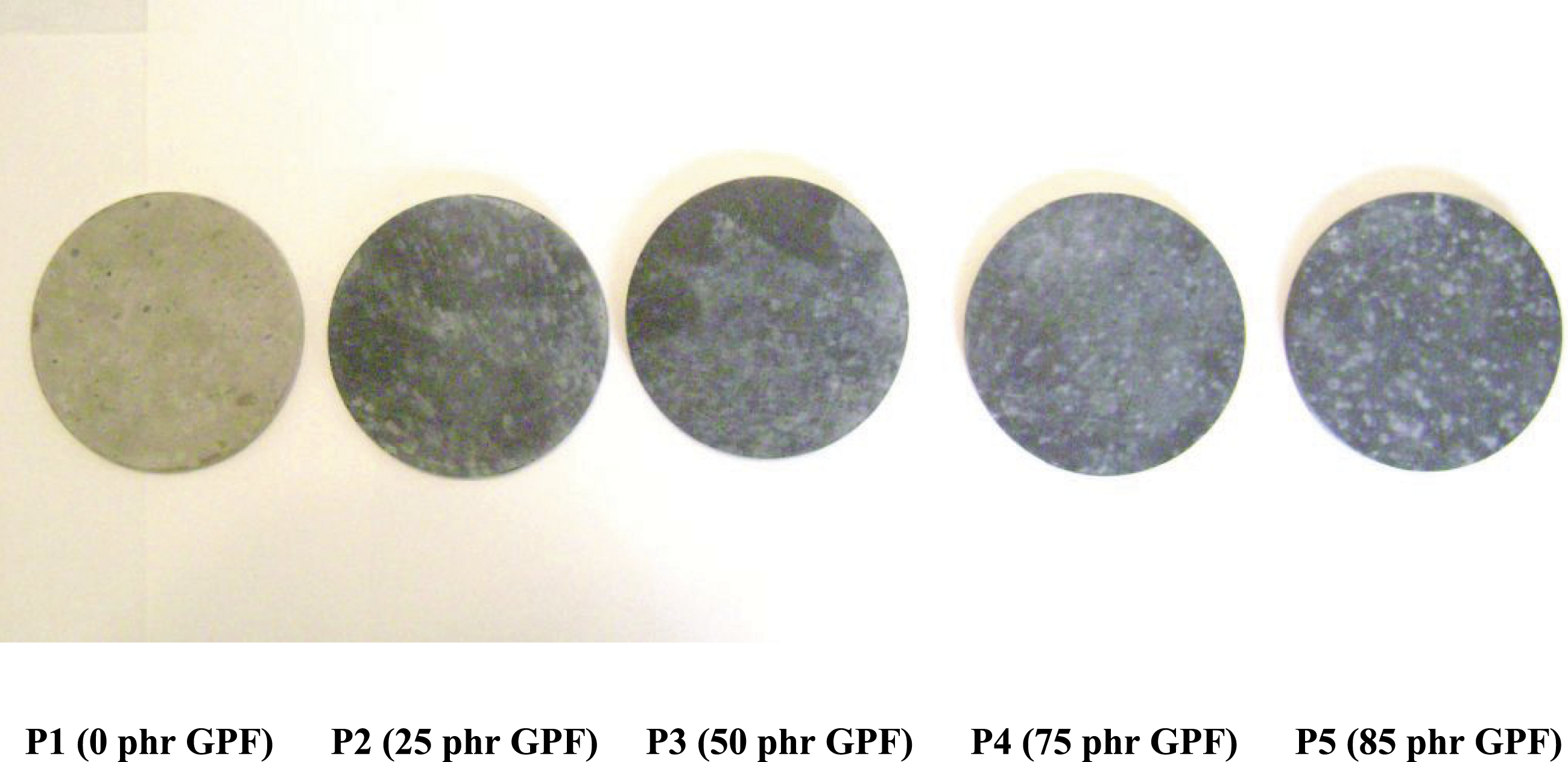
The mechanical tests carried out to withstand mechanical stress exerted for HV insulators requirements and reported in our previous publication [18], where GPF black was proven to act as a reinforcement material to improve the mechanical properties of EPDM. The values of dielectric breakdown strength of the samples under A.C. voltage, 50 Hz at different testing conditions are shown in Figure 3. Dielectric breakdown strength (V/mil) at HTV for EPDM samples with different weight percentages of carbon black filler under different environmental conditions [dry, wet, wet + salt].
It is clear from Figure 3 that sample P2 containing 25 phr GPF shows the highest dielectric breakdown strength in all three measurement conditions, dry, wet and wet + salt. This sample also shows the best mechanical properties 18 it is clear that this filler content represents the best reinforcement conditions for EPDM rubber and the best dielectric breakdown strength values. It must be noted here that the sample P5 was short circuited in wet and wet + salt conditions and no dielectric breakdown strength values are reported here. The lower dielectric breakdown strength values for higher weight percentages of carbon black can be attributed to the higher conductivity of carbon black that reduces the dielectric breakdown strength. Carbon black being conductive material, increasing its loading increases in the possibility of tracking and short circuiting by increasing the filler content.
Effect of different types of carbon black on the dielectric performance of EPDM rubber
Mix nomenclature and particle size of different types of carbon black.

Figure 4 represents EPDM samples prepared at HTV with different types of carbon black (C1, C2, C3, C4, C5 and C6) to select the ideal type of carbon black which can be used to improve the electrical performance of EPDM as HV insulator. It can also be seen from Figure 4 that due to the leakage current passing on the sample surface tracking appears on sample C6 while the sample C3 with stands the dielectric breakdown strength at different tested conditions. Optical images of EPDM Samples different types of carbon black as filler. Diameter of all test samples is 5 cm.
The values of dielectric break down strength of the samples under A.C. voltage, 50 Hz and different testing conditions are shown in Figure 5. The dielectric breakdown strength of EPDM samples containing similar loadings of different types of carbon black. The dielectric breakdown strength values vary with different types of carbon black at different environmental conditions. It can be observed that in dry conditions sample C3 having the highest value of dielectric breakdown strength than other samples. Sample C1 and C6 have the lowest value of the dielectric breakdown strength. This means that too big or too small carbon black particle size lead to the deterioration of the dielectric breakdown strength of EPDM rubber. Sample C3, containing GPF, showing more than 60% improvement in dielectric breakdown strength compared to other types of carbon black. Dielectric breakdown strength (V/mil) at HTV for EPDM samples with different types of carbon black filler and with 25 phr [C1, C2, C3, C4, C5 and C6] under different environmental conditions (dry, wet, wet + salt).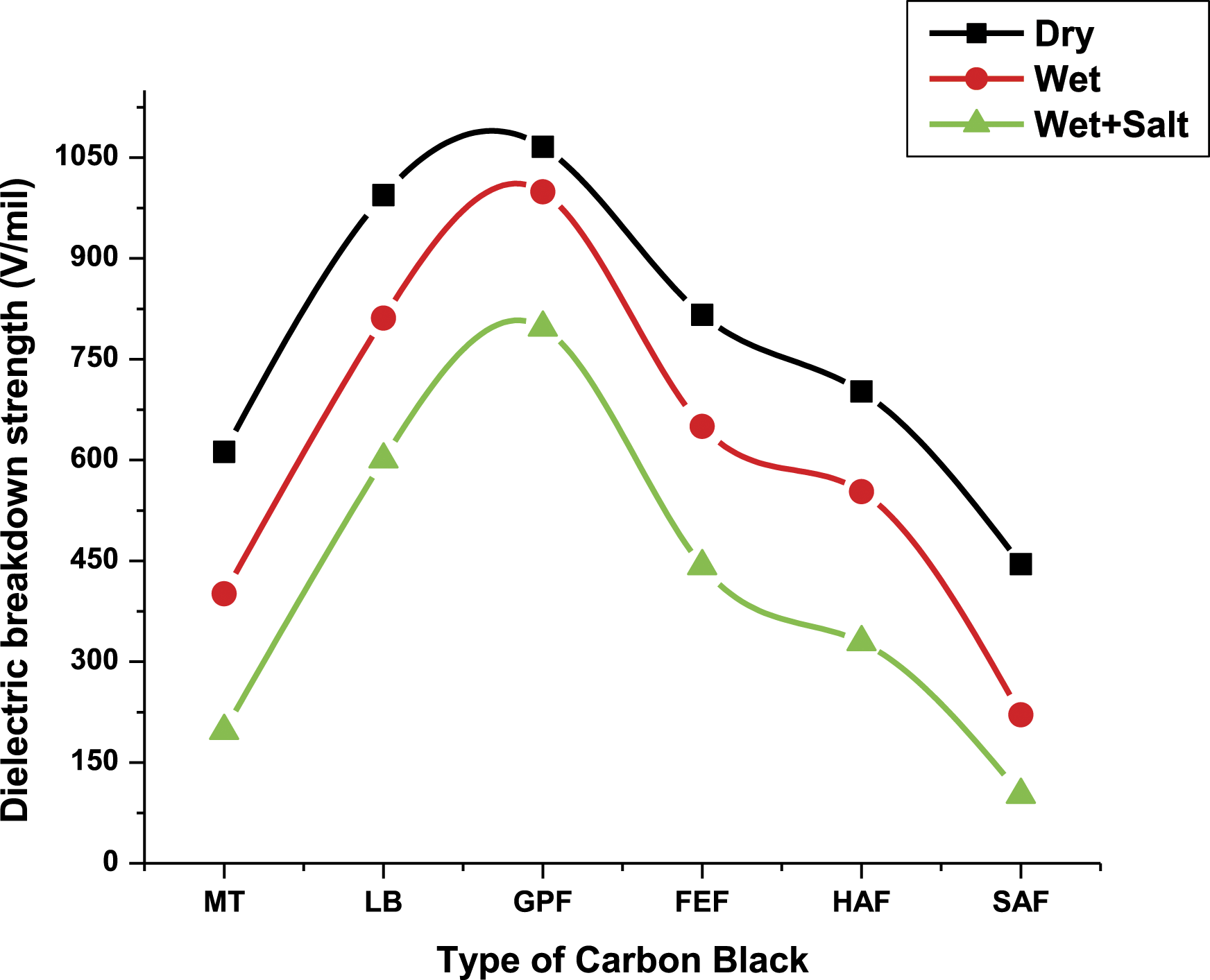
In wet conditions, Figure 5, sample C3 still gives the highest value of dielectric breakdown. The increased value of dielectric breakdown strength is about 77% compared to the value of sample C6. At wet + salt conditions sample C3 still shows the highest value of dielectric breakdown strength with an improvement of about 87% form the value observed in sample C6. Accordingly, GPF black (sample C3) is preferred as a carbon-based organic filler with EPDM mixes to improve the electrical and the mechanical performance of EPDM rubber used in high voltage insulation applications. This can be attributed to the better reinforcement of GPF black to EPDM compared to other types of carbon black used in this study as well as its medium particle size that enables it to better fill the interstitial spaces in the elastomer and leads to better reinforcement of EPDM rubber which was also proved by the ultrasonic characteristics of different mixes. 18
Effects of inorganic fillers
EPDM mixes containing different types of inorganic fillers.

Figure 6 represents optical images of EPDM samples with different types of inorganic fillers such as kaolin, feldspar and Quartz to select the ideal type of inorganic filler that can be used to improve the electrical performance of EPDM as HV insulators. Clearly samples prepared at room temperature (RTV) show high surface roughness and are still containing air bubbles which leads to increase the leakage current on the sample surfaces resulting in the decrease of the dielectric breakdown strength. Optical images of EPDM samples with different types of inorganic fillers, 25 phr of Kaolin, Feldspar and Quartz prepared at RTV (a) before Testing and (b) after testing. The diameter of all the test pieces is 5 cm.
The values of dielectric break down strength of the samples under A.C. voltage, 50 Hz and different testing conditions have been given in Figure 7. It is clear from Figure 7 that the dielectric breakdown strength values of all samples before high temperature vulcanization is much less than the values reported for carbon black vulcanized samples. This is obviously due to the lack of sufficient crosslinks that lead to better fuse the polymer chains together. EPDM mixes in dry conditions gives higher values of dielectric breakdown strength compared to those in wet conditions by about 22% while the dielectric breakdown strength value of EPDM at wet + salt condition fall by about 66% than it is value in dry conditions. This is expected due to the higher probability of arcing in wet condition and wet + salt conditions. The dielectric breakdown strength (V/mil) for EPDM samples without filler and with various types of inorganic fillers, Kaolin, Feldspar and Quartz under different conditions (dry, wet and wet + salt) before high temperature vulcanization.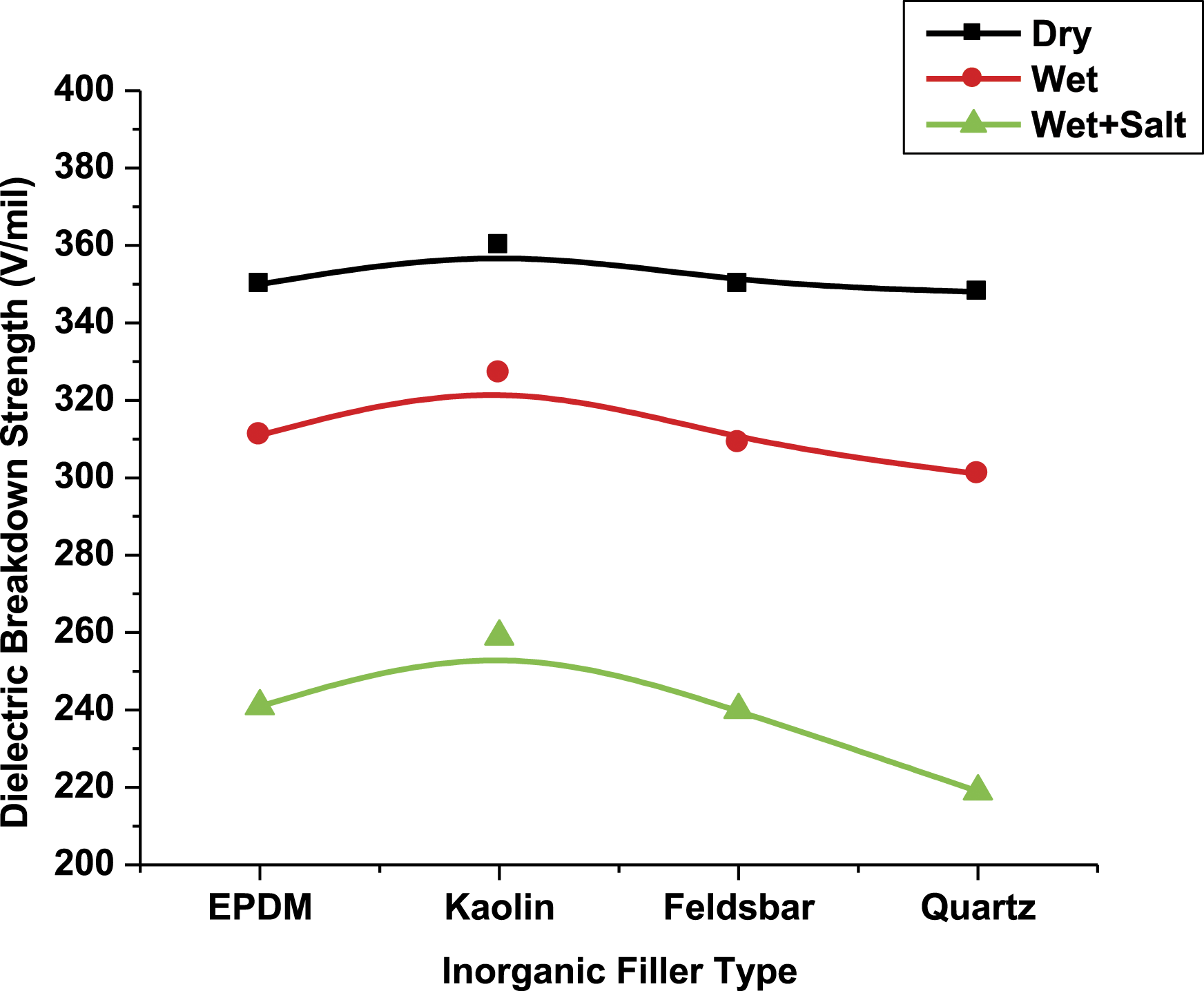
It can also be observed that in dry conditions the EPDM filled with kaolin has the highest value of dielectric breakdown strength than it is for neat EPDM, EPDM filled with feldspar and EPDM filled with Quartz. EPDM sample with Quartz gives the lowest value of dielectric breakdown strength. The increasing value of dielectric breakdown strength for the EPDM with kaolin increase 3% forms the value of EPDM with Quartz at dry conditions. In wet conditions the EPDM with kaolin still shows the highest value of dielectric breakdown strength compared to EPDM, EPDM with feldspar and EPDM with quartz also the EPDM with quartz gives the lowest value. The dielectric breakdown strength increases by 8% from the value of EPDM with quartz. Under wet + salt conditions the EPDM with kaolin sample shows the highest value of dielectric breakdown strength than it is for EPDM, EPDM with feldspar and EPDM with quartz also EPDM with Quartz still gives the lowest value of dielectric breakdown strength. EPDM sample filled with kaolin shows an increase in the dielectric breakdown value of quartz by about 18% at wet + salt conditions. This illustrates kaolin is preferred to use as inorganic filler with EPDM mixture to improve the electrical performance of EPDM at any environmental condition especially when the weather is dry.
Characteristics of HTV EPDM rubber containing inorganic fillers
Figure 8 represents optical images of EPDM samples without filler and with inorganic fillers, kaolin, feldspar and quartz prepared at HTV. The dielectric breakdown measurements were carried out as explained above in order to determine which samples can be used as outdoor HV insulators. All samples prepared at HTV has smooth surfaces and no voids caused by any air bubbles as visually observed in Figure 8 unlike RTV samples. Bubbles in un-vulcanized samples can lead to increase the leakage current on the sample’s surfaces decreasing the values of dielectric breakdown strength as observed above. Optical images of EPDM samples with and without different types of inorganic fillers (kaolin, feldspar and quartz, vulcanized at 153°C (a) before dielectric breakdown testing and (b) after dielectric breakdown testing. Sample diameter is 5 cm.
The values of dielectric breakdown strength of EPDM samples with different types of inorganic fillers vulcanized at high temperature and tested under A.C. voltage, 50 Hz and different testing conditions are shown in Figure 9. The dielectric breakdown strength (V/mil) for EPDM samples without filler and with various types of inorganic fillers, kaolin, feldspar and quartz, under different environmental conditions, dry, wet, wet + salt.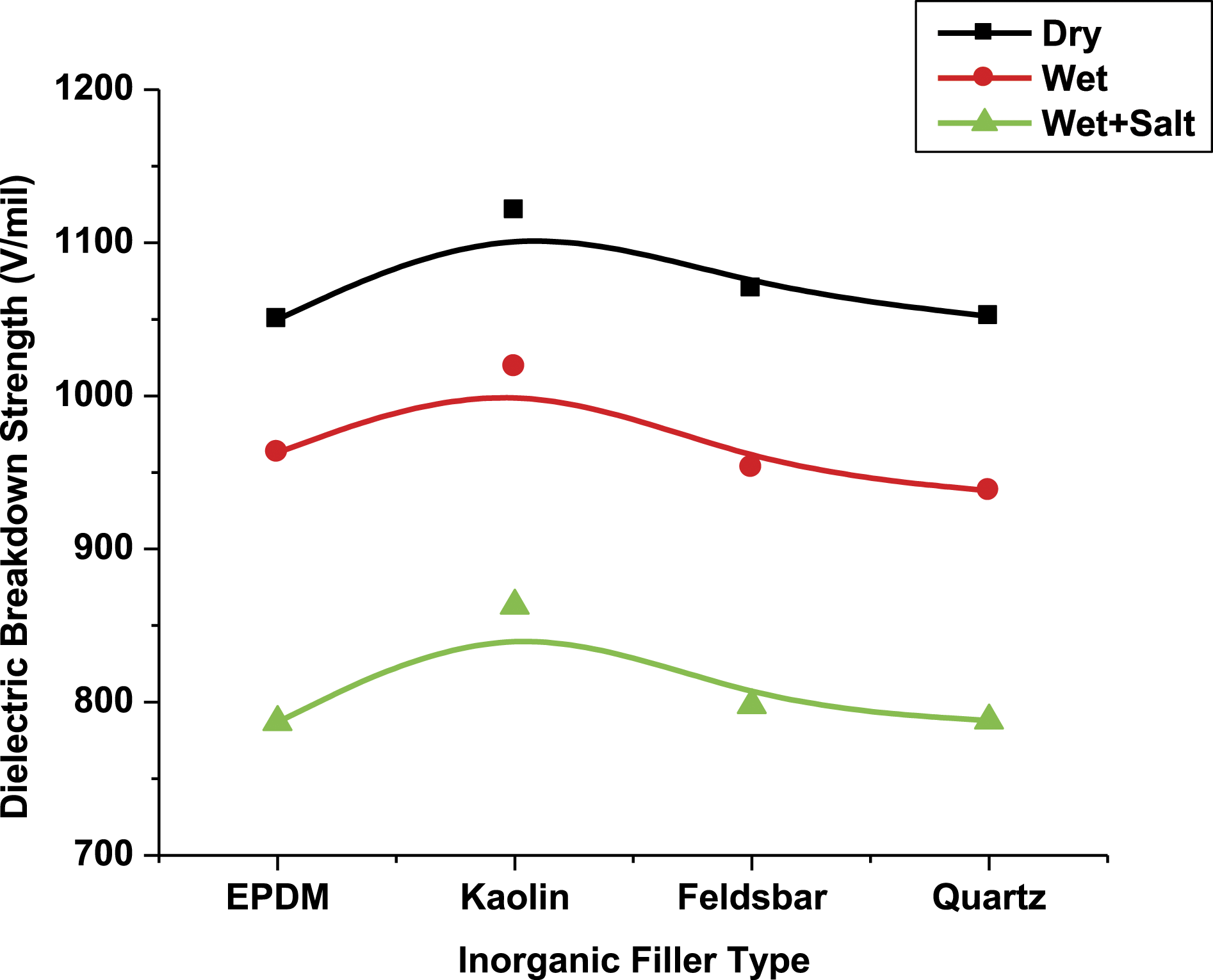
From Figure 9 it can be observed that in dry condition the sample EPDM with kaolin has the highest value of dielectric breakdown strength EPDM, EPDM with feldspar and EPDM with quartz, while the EPDM with quartz gives the lowest value of dielectric breakdown strength. The value of dielectric breakdown strength for the EPDM filled with kaolin increases by 6% form the value of EPDM filled with quartz at dry conditions. In wet conditions the EPDM with kaolin still exhibits the highest value of dielectric breakdown strength than that of EPDM, EPDM with feldspar and EPDM with quartz. Also, the EPDM with quartz gives the lowest value of dielectric breakdown. The value of dielectric breakdown strength in wet condition exceeds by 8% the value of EPDM filled with quartz.
At salt condition the EPDM sample with kaolin has the highest value of dielectric breakdown strength than for EPDM, EPDM filled with feldspar and EPDM filled with quartz. EPDM samples with quartz gives the lowest value of dielectric breakdown strength which is 9% lower than EPDM filled with kaolin. From these results it can be observed that the values of dielectric breakdown strength for all samples which prepared at HTV and under different tested environmental conditions has increased compared to all values of dielectric breakdown strength for all samples which prepared at RTV and also tested under the same environmental conditions which is due to the better crosslinking taking place for samples vulcanized at high temperatures showing better resistance to dielectric breakdown. It is also observed that kaolin is preferred to be used as an inorganic filler with EPDM mixture at HTV to improve the electrical performance of EPDM at all environmental conditions especially dry weathering.
Effect of ultra violet exposure and thermal aging
The surface hydrophobicity in outdoor insulating materials is important with respect to long life reliability because it determines the wettability, and accordingly the leakage current which in turn determines the dry band arcing and other electrical activities. Pristine EPDM samples were tested using an Ultra Violet Products, UV, cross linker model CL-1000 exposure chamber and were subjected to UV radiation of wavelength 365 nm (UV) radiated from 5 × 8 W UV dual bi-pin discharge type tubes for different time intervals. The dielectric breakdown strength was measured up to 500 h to give the values of dielectric breakdown strength. Figure 10 presents the values of dielectric breakdown strength for EPDM samples without filler under the testing of ultra violet exposure up to 500 h, as shown the EPDM samples show steep exponential decrease in dielectric breakdown strength with exposure to UV radiation. The dielectric breakdown strength (V/mill) for EPDM samples without filler vulcanized at high temperature under ultra violet exposure and thermal aging for different time intervals.
Pristine EPDM samples were also tested under the exposure to thermal heat in an air circulating oven at 90°C for several hours, the dielectric breakdown strength was measured up to 500 h to gives the values of dielectric breakdown strength. It is obvious that EPDM can withstand thermal aging with very small decrease of dielectric breakdown strength value until 500 h which means high electrical performance of EPDM as HV for outdoor applications in high temperature conditions. The weak resistance to UV radiation can be overcome by the addition of other ingredients to the sample mix as discussed earlier.19,20
Conclusions
The main conclusion drawn from the present investigations will be summarized in terms of EPDM rubber can be used in high voltage electrical insulation and that its dielectric breakdown strength is improved greatly during HTV compared to RTV blends. EPDM blends containing 25 phr GPF black were shown to have the best dielectric breakdown strength under all weathering conditions. Also, Kaolin filled EPDM showed the best dielectric breakdown strength under all weathering conditions, they can accordingly be used as high Voltage (HV) electrical insulators. Unfilled EPDM samples showed high thermal aging resistance but quick and severe deterioration in dielectric breakdown strength under UV radiation. It is aimed that UV resistance will be discussed in more detail in future studies.
Footnotes
Acknowledgements
E. L. Farid would like to thank late M. A. Moustafa, Faculty of Engineering Ain Shams University for the fruitful discussions.
Declaration of conflicting interests
The author(s) declared no potential conflicts of interest with respect to the research, authorship, and/or publication of this article.
Funding
The author(s) received no financial support for the research, authorship, and/or publication of this article.
