



Abstract
Polymer-based dielectric composite films with large energy density are urgently demanded for various applications. Compared with the ones with inorganic fillers, polymer blends exhibit the advantage of mechanical matching as well as the interfacial compatibility. Herein, poly(vinylidene fluoride) (PVDF) composite films with various volume fractions of methyl methacrylate-butadiene-styrene (MBS) were prepared via the solution casting. The maximum energy density of 6.4 J/cm3 at 390 MV/m was obtained by optimizing the content of 12 vol% MBS in MBS/PVDF composite films. The energy density of the optimized composite films was further improved with the help of post-treatments including quenching and/or hot-pressing. At last, the composite films display the enhanced energy density of 8.7 J/cm3 at 500 MV/m with the efficiency of 67.4% via the comprehensive post-treatments. This work provides a paradigm to improve the energy storage performance of PVDF-based composite films for dielectric electrostatic capacitors.
Keywords
Introduction
Dielectric capacitors with high power density and efficiency have been applied in various technological fields, such as wearable electronic devices, advanced weapons, smart grids and electric vehicles.1–6 Among all kinds of dielectric capacitors, polymer based films have attracted many researchers’ attention due to its high electric breakdown strength (E
b
), low dielectric loss, light-weight and easy fabrication process.7–10 The U
e
of a capacitor is theoretically expressed as:
Incorporating ceramic fillers with large
Two types of polymers are much easier to blend together compared with composite containing inorganic fillers. The improved compatibility leads to the enhancement of electric breakdown strength and energy density. In present work, two organic polymers of PVDF and methyl methacrylate-butadiene-styrene (MBS) are combined to form composites. PVDF is the main matrix to provide dielectric properties while MBS is introduced to enhance the mechanical strength. As a result, the electric breakdown strength was thus improved and did favor to the energy density. Besides, solution casting, quenching and hot-pressing were separately or comprehensively employed to prepare and improve the composite film. Among PVDF with various volume fraction of MBS, 12 vol% MBS/PVDF obtained the maximum energy density of 6.4 J/cm3 with an efficiency of 60.3% at 390 MV/m. With the help of various post-treatments, the energy density of above optimized composite films was further improved. Firstly, the energy density of these films was increased to 7.7 J/cm3 with the efficiency of 63.1% at 430 MV/m via quenching treatment. And then, the composite films obtained maximum energy density of 8.7 J/cm3 with the efficiency of 67.4% at 500 MV/m under comprehensive treatment involving both hot-pressing and quenching, which was about 2 times than that of pristine PVDF (4.3 J/cm3 at 320 MV/m). This work demonstrates the validity of hot-pressing and quenching in enhancing the energy density and efficiency.
Experimental
Materials
Poly(vinylidene fluoride) (PVDF) was purchased from Arkema (Changshu) Fluorochemical Co., Ltd (Jiangsu, China). Methyl methacrylate-butadiene-styrene (MBS) was supplied by Kaneka Corporation (Shanghai, China). N, N-dimethylformamide (DMF) was obtained from Sinopharm Chemical Reagent Co., Ltd (Shanghai, China). All purchased chemicals or reagents were analytically pure without further treatment.
Fabrication of PVDF-based composite films
In this work, PVDF-based composite films with 6 vol%, 12 vol%, 18 vol% and 24 vol% MBS were fabricated via the traditional solution casting method. First, MBS was added to 8 mL DMF followed by the ultrasonic dispersion for 100 min. Then, PVDF was proportionally added to above suspension and stirred at 50°C for 12 h. The mixture was then cast into films on clear glass mould and dried at 60°C for 6 h in vacuum. Finally, the dry composite films were peeled from glass mould. In order to check the thickness of the composite films, the samples were ripped into two parts while they were soaked in liquid nitrogen, the ripped crack was used for cross-sectional characterization.
To improve the discharged energy density of the composite films, post-treatments were utilized for the MBS/PVDF composites, including (i) the quenching, (ii) the comprehensive treatment of hot-pressing and quenching. For the quenching process, the as-grown composite films were heated up to 210°C and kept for 7 min before they were quenched in the ice water. For the hot-pressing process, the prepared films were hot-pressed at 150°C for 30 min with the pressure of 10 MPa and then quenching in ice water immediately. After the post-treatments, the films were dried at 60°C for 12 h. The schematic illustration of the whole process was presented in Figure 1. The schematic illustration of the whole process.
Characterization
The cross-sectional images of the films were characterized via the field emission scanning electron microscope (FE-SEM S4800, Hitachi). The XRD patterns of the films were carried out on Bruker D8 Advance. Differential scanning calorimetry (NETZSCH, DSC-214 Polyma) was performed for all samples. For the measurement of electrical performance, gold electrodes (diameter of 3 mm and thickness of 90 nm) were sputtered on both sides of the films. Dielectric constant and dielectric loss were tested by the HP 4294A precision impedance analyzer (Agilent). Unipolar displacement-electric field (D–E) curves were measured at 100 Hz by using a Premier II ferroelectric test system (Radiant Technologies, Inc.).
The discharged energy density (Ue), charged energy density (U) and lost energy density (Uloss) of dielectrics could be calculated from D-E curve. As shown in Figure 2, the green shaded area represents Ue and it could be calculated by integrating the orange curve on the vertical axis and expressed as: The schematic illustration of D-E curve of a dielectric under electric field of a triangular wave.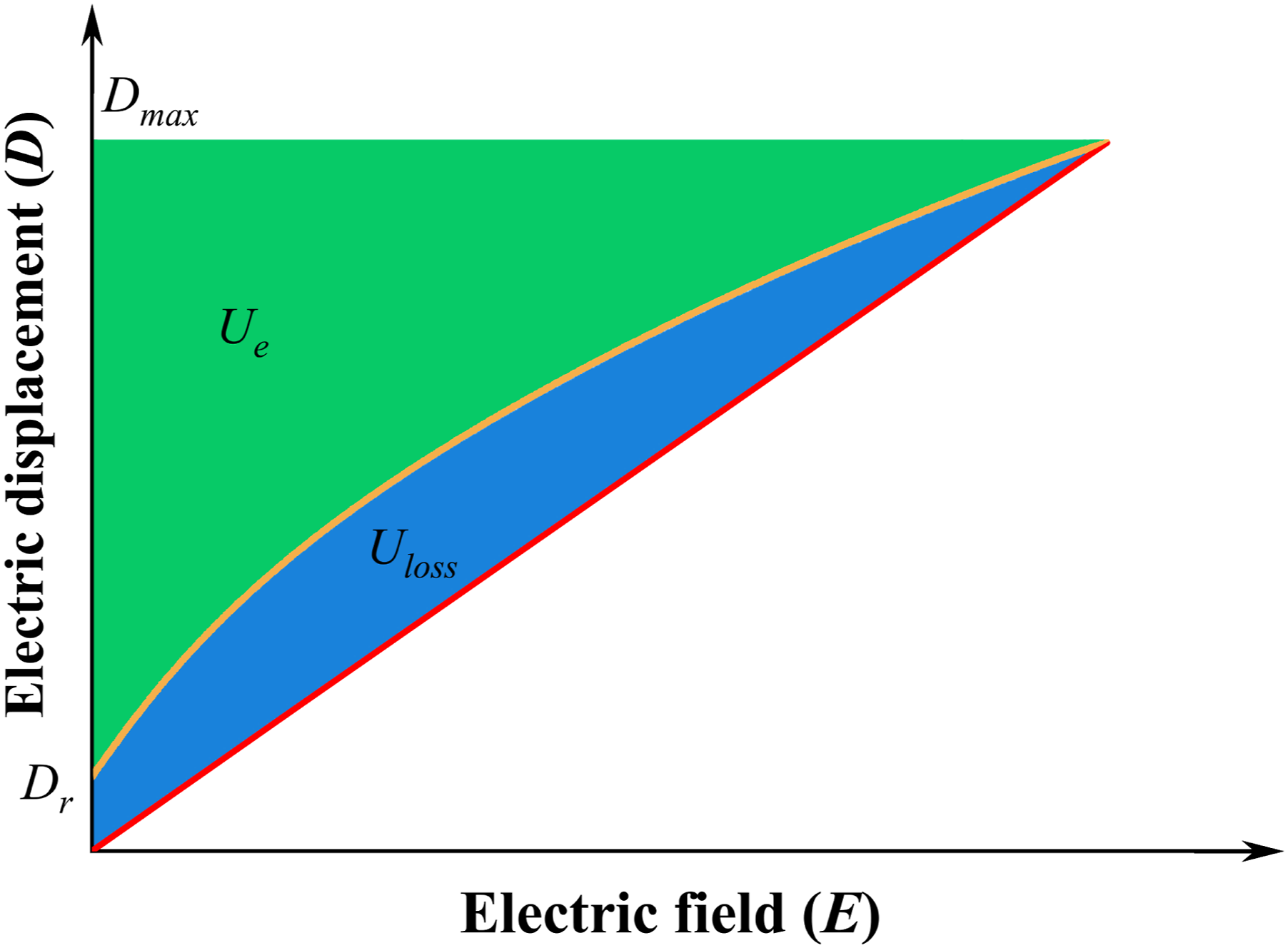
Results and discussion
Figure 3 reveals the structures and properties of PVDF with various content of MBS prepared via the solution casting. As is known, PVDF is a kind of semi-crystalline polymer, the crystalline structures of pristine PVDF and MBS/PVDF composite films are exhibited in Figure 3(a). XRD pattern of MBS/PVDF is nearly the same as pristine PVDF and the peaks corresponding to α and β phase of PVDF. The FT-IR spectra of MBS/PVDF is shown in Figure 3(b), the peaks at 765 cm−1 and 839 cm−1 come from the α and β phase of PVDF and these peaks are hardly changed with the introduction of MBS. There is only one peak of MBS at 1725 cm−1 and increases with the incremental content of MBS.
25
Those results indicate the introduction of MBS hardly affects the PVDF crystal phase. (a) XRD patterns, (b) FT-IR spectra, (c) frequency-dependent dielectric constant and dielectric loss, (d) failure probability of dielectric breakdown deduced from Weibull distribution, (e) D–E curves at the electric field approaching Eb and (f) discharged energy density, efficiency and Eb for MBS/poly(vinylidene fluoride) composite films with different volume fractions of MBS. MBS: methacrylate-butadiene-styrene; XRD: X-ray diffraction; FT-IR: Fourier Transform infrared.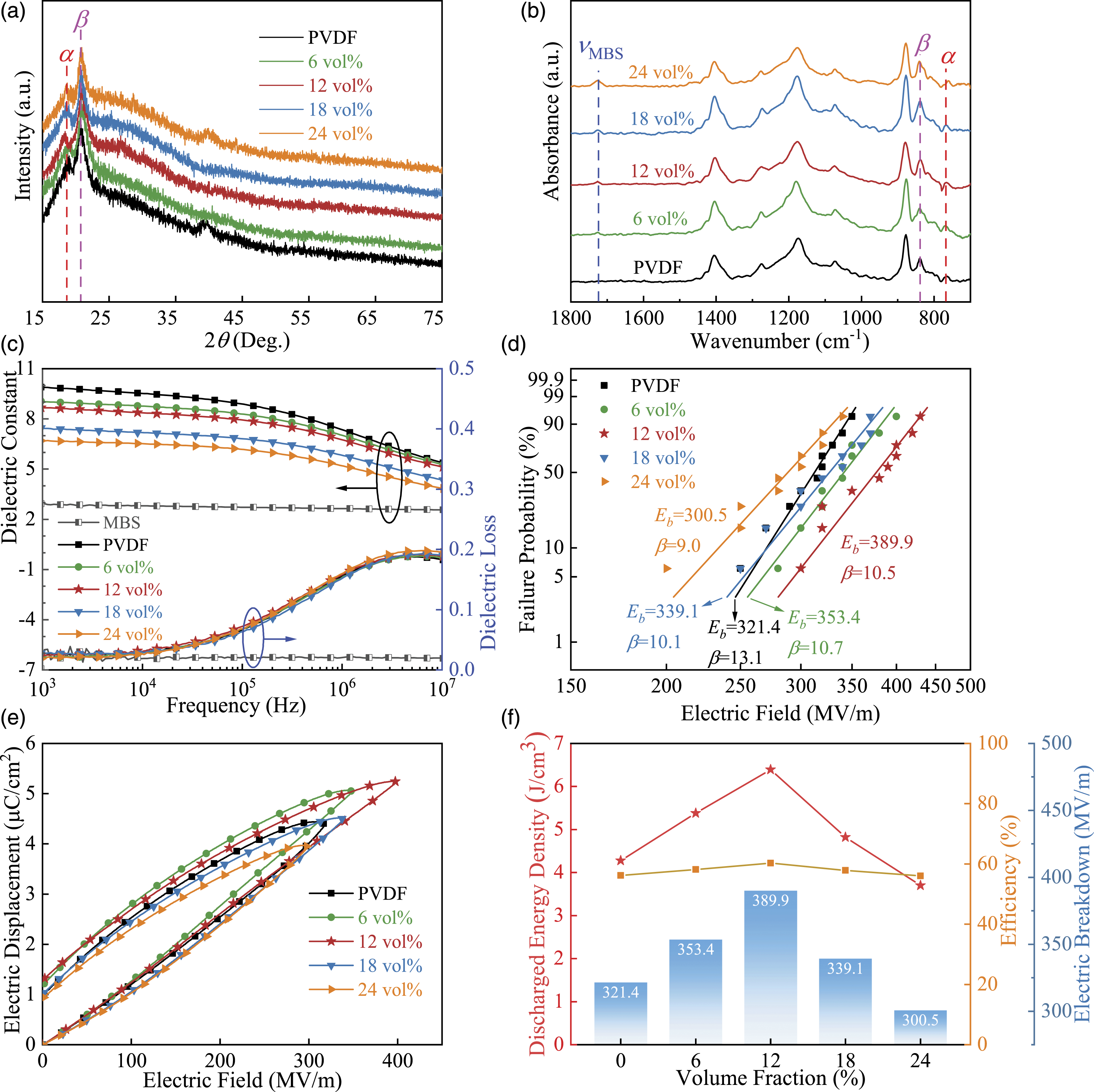
Figure 3(c) displays the dielectric properties of pristine PVDF and MBS/PVDF composite films. As the frequency increases, the dielectric constant of PVDF decreases while in contrast the dielectric constant of MBS nearly keeps constant. The dielectric constant of composite films decreases with the introduction of MSB due to its small dielectric constant of MBS (i.e., 2.9 at 1 kHz). Taking the dielectric constant at 1 kHz for example, the dielectric constant of pure PVDF, 6 vol%, 12 vol%, 18 vol% and 24 vol% MBS/PVDF is 9.8, 9.1, 8.6, 7.5 and 6.7, respectively. It is worth noting that the dielectric constants of pristine PVDF and all the MBS/PVDF composite films decrease quickly when the frequency reaches 106 Hz, which should be ascribed to the dielectric relaxation in PVDF matrix.26–28 As to the dielectric loss, the same trend was observed. The dielectric loss of MBS is the smallest and keeps constant with varied frequencies while the dielectric losses of pristine PVDF and MBS/PVDF composite film vary with the increasing frequency. Different from the obvious increases in dielectric loss once inorganic fillers are introduced into polymer matrix,29–31 the dielectric losses of all composite films in present work do not change too much. For example, they are 0.022, 0.025, 0.027 and 0.018 at 1 kHz, which are a little larger than that of the pristine PVDF (i.e., 0.026) and are beneficial to improve electric breakdown strength and energy density.
Two-parameter Weibull distribution function
Above results indicate that 12 vol% MBS/PVDF shows the best energy storage properties. To further enhance the electric breakdown and energy density, various post-treatments were performed on the optimal composite films of 12 vol% MBS/PVDF. The cross-sectional SEM images of pristine PVDF and 12 vol% MBS/PVDF with various post-treatments are shown in Figure 4. The thickness of the films varies in the range of 8–12 μm and there are some grids emerge in the cross-section of films with the introduction of MBS. The grids become more clearly after quenching and comprehensive treatment process. It is hard to distinguish the interface of PVDF and MBS owing to MBS particles are composed of rubber core and plastic shell which tend to tangle with random chains of PVDF in the amorphous area.
25
Such good compatibility provides the basics for benign electric breakdown strength and large discharged energy density. Cross-sectional SEM images of (a) pristine PVDF, (b) 12 vol% MBS/PVDF, (c) 12 vol% MBS/PVDF after quenching method (heated at 150°C), (d) 12 vol% MBS/PVDF after comprehensive treatment of hot-pressing and quenching. MBS: methacrylate-butadiene-styrene; PVDF: poly(vinylidene fluoride).
The composite films were firstly heated to 120°C, 150°C, 180°C and 210°C for 7 min and then quenched in ice water immediately. Weibull distribution presented in Figure 5(a) reveals that the quenching process did little on uniformity of the films, but the E
b
was greatly affected. After heating to 120°C–180°C, the E
b
increased up to 430.5 MV/m while the heating to 210°C and quenching leads to an E
b
of 292.4 MV/m. It is mainly attributed to the fact that the appropriate heating temperature could improve the quality and density of the films. Figure 5(b) presents D–E curves of the quenched samples at the electric field approaching E
b
. The 12 vol% MBS/PVDF heated at 150°C shows the maximum electric displacement and smaller remnant electric displacement (Pr), which is beneficial for improving discharged energy density. The characteristic E
b
and discharged energy density deduced from D–E curves are summarized in Figure 5(c). Clearly, the composite films heated at 150°C obtain the maximum E
b
of 430.5 MV/m and maximum discharged energy density of 7.7 J/cm3, which is about 1.1 and 1.2 times larger than the films without thermal treatment. The DSC traces upon heating for the pure MBS, pure PVDF and 12 vol% MBS/PVDF composite films are shown in Figure 5(d). There is only one exothermic peak at around 200°C in MBS, which reveals that MBS has the non-crystalline phase. After the introduction of amorphous MBS into the crystalline PVDF matrix, the exothermic peak of PVDF keeps at the same position, indicating the little effect of MBS introduction on the crystallinity of PVDF. In addition, during the heating, the MBS in the MBS/PVDF composite films sustains its amorphous feature until 210°C. At 210°C, the exothermic peak gradually weakens or disappears, indicating the thermal decomposition of MBS. As a result, a decreased E
b
was observed as exhibited in Figure 5(a). (a) Failure probability of dielectric breakdown strengths deduced from Weibull distribution, (b) D–E curves at each maximum electric breakdown, inset shows the remnant electric displacement at Eb, (c) Eb and discharged energy density and (d) DSC curves for 12 vol% methacrylate-butadiene-styrene/poly(vinylidene fluoride) composite films with different heated temperature DSC: differential scanning calorimetry.
12 vol% MBS/PVDF composite film after heating at 150°C and quenched in ice water achieved the best Ue. So that an attempt involving the hot-pressing at 150°C with a pressure of 10 MPa for 30 min was employed to further improve its energy density. Figure 6(a) and (b) summarize the Weibull distribution and D–E curves at the electric field approaching Eb of pristine PVDF and 12 vol% MBS/PVDF with varying post-treatments. It is worth noting that the composite film after hot-pressing obtains the highest electric breakdown strength and the lowest remnant electric displacement among these films, which foreshows the further improvement of energy storage performance including Ue and efficiency as shown in Figure 6(c) and (d). The electric breakdown of pristine PVDF, 12 vol% MBS/PVDF, 12 vol% MBS/PVDF after heating at 150°C and 12 vol% MBS/PVDF after hot-pressing are 321.4, 389.9, 430.5 and 501.6 MV/m, respectively. Meanwhile, their discharged energy density and efficiency show the same increasing tendency. The composite film after hot-pressing obtains the highest discharged energy density of 8.7 J/cm3 with the efficiency of 67.4% at 500 MV/m which are 2.0 and 1.2 times larger than those of pristine PVDF (4.3 J/cm3 and 56.0% at 320 MV/m). These properties of the films enhance simultaneously with the optimization of the MBS content and post-treatments. Therefore, the improved performance of the composite films could be highly anticipated via the rational content modulation and optimal post-treatments. (a) Failure probability of dielectric breakdown strengths deduced from Weibull distribution, (b) D–E curves at the electric field approaching Eb, inset shows the remnant electric displacement at Eb, (c) discharged energy density, electric breakdown and enhancement ratio of Ue, (d) efficiency and enhancement ratio of hour for pristine PVDF and 12 vol% methacrylate-butadiene-styrene/PVDF with varying post-treatments. PVDF: poly(vinylidene fluoride).
Conclusions
In summary, MBS/PVDF composite films with varied contents of MBS were fabricated via the traditional solution casting method and followed with various post-treatment for high discharged energy density. Compared with the pure PVDF films, the PVDF-based composite films with 12 vol% MBS exhibited an improved energy density of 6.4 J/cm3 and 60.3% at 390 MV/m. The discharged energy density of above optimized composite films was increased to 7.7 J/cm3 at 430 MV/m after heating at 150°C and quenching process. With the help of comprehensive hot-pressing and quenching, the composite film obtained the maximum discharged energy density and efficiency of 8.7 J/cm3 and 67.4% at 500 MV/m. The PVDF-based composite films blended with MBS could provide a sample implementable approach of tuning and improving dielectric constant and energy density of polymers. The enhanced discharged energy density makes it promising candidates for application in high performance capacitors and flexible energy storage devices.
Footnotes
Declaration of conflicting interests
The author(s) declared no potential conflicts of interest with respect to the research, authorship, and/or publication of this article.
Funding
The author(s) disclosed receipt of the following financial support for the research, authorship, and/or publication of this article: his work was supported by the National Natural Science Foundation of China (Grant No 52073144), the Natural Science Foundation of Jiangsu Province (Grants No BK20201301) and Qing Lan Project; A Project Funded by the Priority Academic Program Development of Jiangsu Higher Education Institutions (PAPD); State Key Laboratory of New Ceramic and Fine Processing Tsinghua University (No. KF202114).
