



Abstract
In this paper, a rotating functionally graded (FG) polymer nanocomposite shaft-disk assembly reinforced with graphene nanoplatelets (GPLs) resting on elastic supports is modelled and its vibration behaviours are analysed. The effective material properties of the shaft and disk are assumed to vary along their radius directions and determined via the Halpin–Tsai model together with the rule of mixture. Different non-uniform and uniform distributions of GPLs in the rotating assembly are taken into account. In accordance with the finite element (FE) method, the modelling and free vibration analysis of the nanocomposite shaft-disk rotor system is conducted. To verify the present analysis, both the theoretical and experimental methods are employed. A comprehensive parametric study on the effects of the graphene nanoplatelets (GPL) weight fraction, GPL distribution pattern, length-to-thickness ratio and length-to-width ratio of GPLs, shaft length, elastic support stiffness and rotating speed on the free vibration results are investigated, which gives effective ways to achieve improved mechanical performance of a rotating nanocomposite disk-shaft assembly.
Introduction
Rotating shaft-disk assemblies are diffusely put into use in rotary machines, such as gas turbines, aeroengines and so on. As an important research content, its vibration behaviour has been investigated by lots of research.1–11 By adopting the experimental and numerical methods, Venkatachalam et al. 12 investigated vibration performance of orthotropic shaft-disk assembly. Heydari et al. 13 examined the effects of disk location and disk size on the critical speeds and natural frequencies of a shaft-disk rotor. Considering the nonlinear stiffness and damping, AI-Solihat et al. 14 studied the force transmissibility and frequency response of a shaft–disk rotor. Tuzzi et al. 15 studied the coupled vibration between shaft bending and disk zero nodal diameter modes in a flexible system. By employing the IHB method, Ri et al. 16 conducted nonlinear vibration analysis of a shaft-disk assembly combined reduced model.
Traditional uniform metal materials are no longer suitable because modern rotary machines have higher requirements on structural stiffness. Due to the outstanding mechanical performance, GPL reinforced material takes the cake. A larger number of scholars have paid attention to the GPL reinforced structures.17–21 By employing the FE method, Zhao et al. 22 studied the bending and vibration performance of a GPL reinforced trapezoidal plate. Based on the first order shear deformation theory, Reddy et al. 23 presented the free vibration of GPL reinforced plates under different boundary conditions. Feng et al. 24 studied the nonlinear vibration of FG-GPL reinforced beams. By using the element-free IMLS-Ritz method, Guo et al. 25 studied the free vibration of laminated quadrilateral plates reinforced by GPLs. Song et al. 26 investigated the nonlinear vibration of edge-cracked beams reinforced with GPLs. Wang et al. 27 conducted nonlinear free vibration analysis of dielectric beams with GPLs under electrical field. Thai et al. 28 developed an NURBS formulation based on the four-variable refined plate theory for vibration analysis of GPL reinforced plates. Wang et al. 29 studied nonlinear vibrations of porous GPL reinforced cylindrical shells.
To sum up, few research focus on vibrations of a slender shaft coupled with a thick disk assembly reinforced with GPL. It is very important to study the vibration characteristics of the functionally graded rotating shaft-disk assembly reinforced with GPLs, where the material poetries are changing along the radial directions. According to the finite element (FE) method, the modelling and vibration analysis of the nanocomposite rotor are conducted in this paper. The effects of material and structural parameters on the natural frequency are examined in detail.
Theoretical formulations
Physical model and material property
The dynamic model of a rotating shaft-disk assembly resting on elastic supports is shown in Figure 1. The structure parameters of the assembly are: shaft length l
S
, shaft radius r
S
, disk radius r
D
and disk thickness h
D
. In addition, the rotor is made of polymer matrix and GPL nanofillers, where the material parameters are varying along the blade thickness direction, disk thickness direction and shaft radius direction. Rotating shaft-disk assembly resting on elastic supports.
On the basis of the Halpin-Tsai model,
30
the effective Young’s modulus is obtained as

For characterizing the geometry and dimension of GPL nanofillers, ξ
l
and ξ
w
are determined by

Moreover, according to the rule of mixture, the effective mass density and Poisson’s ratio are



Variation of graphene nanoplatelet weight fraction indices.

As depicted in Figure 2, three different GPL distribution patterns, including uniform and non-uniform distributions, are taken into account. Figure 2(a) shows the positive parabolic GPL distribution, where the GPL weight fraction is zero at the mid-plane and is maximum at the surfaces; Figure 2(b) displays the uniform GPL distribution, where the GPL weight fraction remains constant along the radius direction; Figure 2(c) plots the negative parabolic GPL distribution, where the GPL weight fraction is zero at the surfaces and is maximum at the mid-plane. Graphene nanoplatelet distribution patterns in the shaft-disk rotor system.
Finite element implementation
The element displacements are
The shape function N
i
is
The relationship between strain and stress is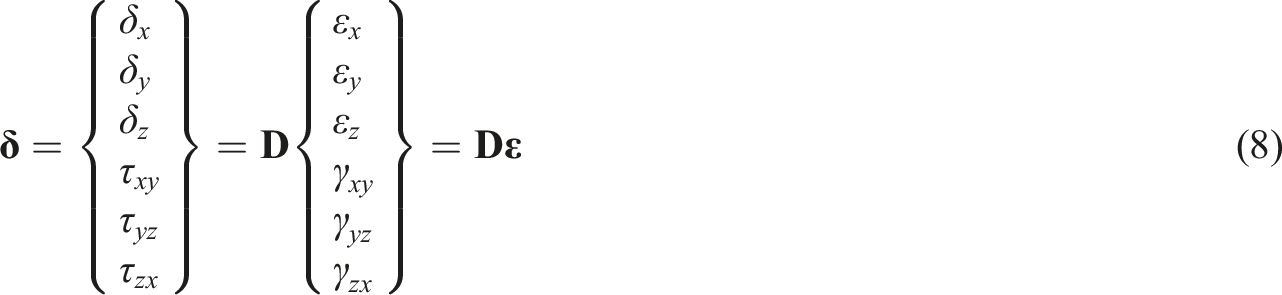
The stiffness matrix 
Based on the geometrical relationship, one can get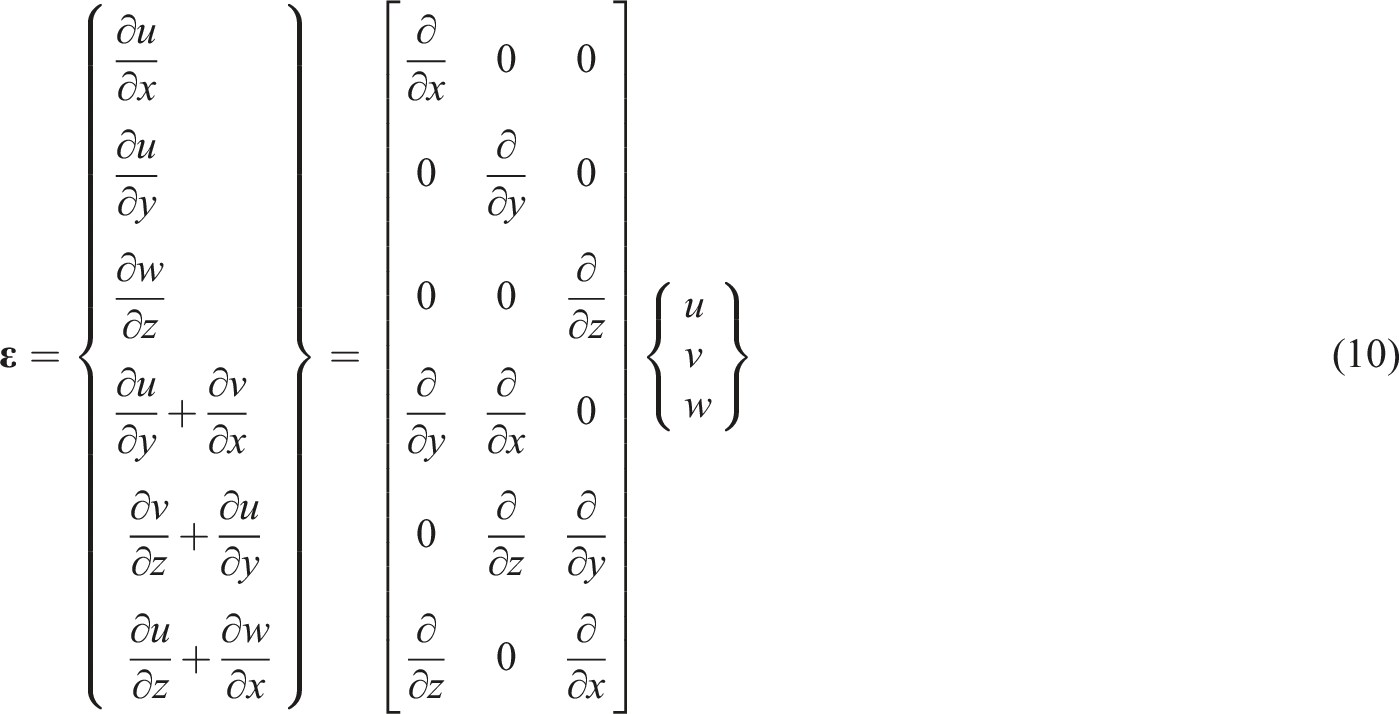
Considering the expressions

The geometric matrix 
The deformation energy and kinetic energy are
Setting

Solving the following eigenvalue problem
In addition, the forward and backward travelling wave frequency are considered as ω
f
and ω
b
, respectively, in the form of
Comparative study
First four natural frequencies (rad/s) of the spinning annular plate with different element numbers by finite element (FE) method (Ω = 500 rad/s).

Before the vibration characteristic analysis, the comparative verification investigation should be conducted first, where the experimental and theoretical methods are adopted together. In this section, the homogeneous material rotor is employed as an example. Unless otherwise stated, the length, diameter and weight of the shaft are 500 mm, 10 mm and 375g, respectively; the diameter, thickness and weight of the disk are 78 mm, 20 mm and 660 g, respectively; the materials of the shaft and disk are Steel No. 45 and carbon alloy steel, respectively; the distance between the two bearings is 440 mm.
Experimental analysis
The rotor test system is composed of three parts: rotor test platform, measuring system and software analysis system which are shown in Figure 3. National Instruments and Lab VIEW virtual instrument technology are used in this paper. The shaft is supported by two bearings which are used by external lubricating oil supply. The rated current and output power of the motor are 2.5 A and 250W. The rotor speed can be infinitely variable, and the maximum rate of rise can be reached 800 rpm/min. The measuring system are composed of five eddy current displacement sensors, one vibration velocity magnetoelectric sensor, one vibration acceleration sensor, one rotary speed photoelectric sensor and eight-channel vibration data analyser. The diameter and sensitivity of sensor probe are 8 mm and 8 mV/mm. They are installed on sensor brackets by non-contact mode and used with preamplifier. The distance of displacement sensors is 1 mm. The disk-shaft rotor system: 1. Foundation support, 2. Oiler, 3. Bearing, 4. Eddy current displacement sensor, 5. Displacement sensor preamplifier, 6. Shaft, 7. Disk, 8. Speed sensor, 9. Vibration data analyzer, 10. Coupler, 11. Motor, 12. Speed governor, 13. Computer.
Theoretical analysis
According to Jeffcott rotor, the rotating shaft-disk assembly is modelled as shown in Figure 4. To describe the motion of the rotor, three coordinate systems are established, where o-xyz is the fixed coordinate system; o’-xyz and o’-ξηζ are the reference coordinate systems. The included angles (α, β, and φ) and relations between coordinates are depicted in Figure 5. Theoretical model of shaft-disk rotor system. The relations between the three coordinate systems.

As shown in Figure 6, the moments (M
x
, M
y
) and the forces (F
x
, F
y
) are acted on the rotor, where a and b are the distances between supports and the disk. The resulted displacements are The relations between the three coordinate systems.

The deflection and deflection angle are
Thus, the moment and force can be obtained as

Similar, the moment and force in the other direction are given by
Based on the motion theory of mass center, the equations of motion can be determined by
Due to the rotationally symmetric motion, equation (24) can be expressed as
Equation (25) can be given in the matrix form of
For non-zero solution condition, one has
The frequency equation can be obtained as
The natural frequency ω can be calculated by solving equation (27). In addition, the backward travelling wave frequency ω
b
and forward travelling wave frequency ω
f
of the rotor are given by
Comparative verification
Comparison of fundamental natural frequencies (rad/s) between finite element, theoretical and experimental results.

Results and discussion
In this section, the effects of rotating speed, material parameters and bearing stiffness on the foundational natural frequency are examined in graphical form. Unless otherwise stated, the structure parameters are same as the ones in Comparative Study; the material parameters are EGPL = 1050 Gpa, EM = 130 Gpa, νGPL = 0.186, νM = 0.34, ρGPL = 1062.5 kg/m3, ρM = 8960 kg/m3, gGPL = 1%, lGPL/hGPL = 10, and lGPL/wGPL = 2. In addition, GPL distribution pattern X is taken into account if not specified in the following analysis.
Figure 7 shows the variation of foundational natural frequency of the shaft-disk rotor system with different GPL weight fractions. The solid line and the dotted line represent the backward and forward travelling wave frequency, respectively. As can be seen, the backward travelling wave frequency increases significantly, while the forward travelling wave frequency decreases dramatically. Moreover, it is obvious that an increase in GPL weight fraction from 0% to 1% results in increased natural frequency. This indicates that dispersing more GPLs into the polymer matrix has an evident advantage in improving the mechanical performance of the rotor. Natural frequency versus rotating speed for different graphene nanoplatelet weight fractions.
Figure 8 depicts the variation of foundational natural frequency of the shaft-disk rotor system with different GPL distribution patterns. It can be seen that Pattern X provides the highest natural frequency among the three distributions, while Pattern O gives the smallest one. This tells that the better reinforcing effect occurs when more GPLs are scheduled around the surfaces of the disk and shaft in the case of the same total GPL content. Natural frequency versus rotating speed for different graphene nanoplatelet distribution patterns.
Figure 9 depicts the variation of foundational natural frequency of the shaft-disk rotor system with different GPL length-to-thickness ratios. The observation is that the natural frequency rises markedly with the increase of the GPL length-to-thickness ratio. For the same content of GPLs, the greater GPL length-to-thickness ratio represents that each GPL has less single graphene layers. This implies that the rotor reinforced with thinner GPLs has greater structural stiffness. Natural frequency versus rotating speed for different graphene nanoplatelet length-to-thickness ratios.
Variation of foundational natural frequency of the shaft-disk rotor system with different GPL length-to-width ratios is presented in Figure 10, where the GPL length remains constant. Results show that the natural frequency decreases with the increase of the GPL length-to-width ratio because of better load transfer capability. Actually, a smaller value of GPL length-to-width ratio denotes that each GPL has a larger surface area. This illustrates that adding more GPLs with larger surface areas into the polymer matrix is an effective way to improve the vibrational behaviour of the rotor. Natural frequency versus rotating speed for different graphene nanoplatelet length-to-width ratios.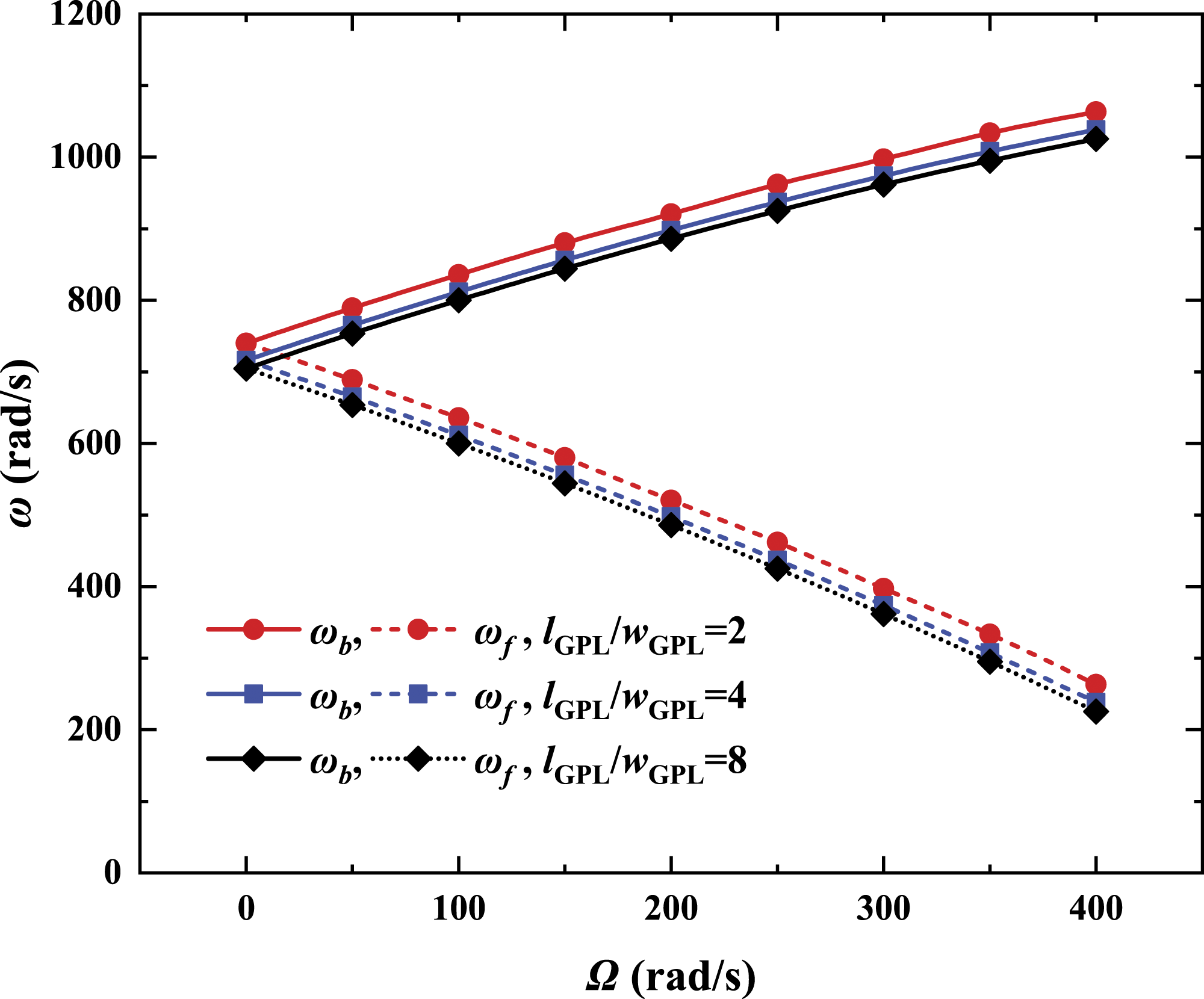
To sum up, the influences of material parameters on the foundation forward and backward travelling natural frequencies are examined. Moreover, the effects of structure parameters on the forward and backward travelling natural frequencies are also investigated in the following analysis. Since these results exhibit quite similar trend, only those concerning the backward travelling natural frequencies are displayed in Figure 7–10.
Figure 11 plots the variation of backward travelling wave frequency of the shaft-disk rotor system with shaft length-to-radius ratio, where the shaft radius remains constant. One can see that an increase in the shaft length leads to significant reduction in the natural frequency. It is worth noting that shorter shaft or more supports can make the rotor to achieve better mechanical behaviour. Natural frequency versus shaft length-to-radius ratio for different rotating speeds.
Figure 12 gives the variation of backward travelling wave frequency of the shaft-disk rotor system with disk thickness-to-radius ratio, where the disk radius remains constant. It can be clearly seen that the decreasing of disk thickness gives rise to the natural frequency. This indicates that the rotating assembly with a thicker disk has stronger structural stiffness. Natural frequency versus disk thickness-to-radius ratio for different rotating speeds.
Figure 13 displays the variation of backward travelling wave frequency of the shaft-disk rotor system with support stiffness. As can be seen, the natural frequency rises visibly with increase of support stiffness from 103 (N/m) to 104 (N/m). In addition, the variation tends to be converged when the support stiffness is larger than 105 (N/m) because this support can be regard as simple support. It can be told that greater support stiffness should be designed in engineering application. Natural frequency versus support stiffness for different rotating speeds.
Conclusions
This paper studies the vibration behavior of a rotating GPL reinforced shaft-disk assembly resting on elastic supports. The effective material properties are considered to vary along the radius directions of the shaft and disk. The modelling and free vibration analysis of the rotor are conducted by employing the finite element method. Both the theoretical and experimental methods are adopted to verify the accuracy of the present analysis. The effects of the rotating speed, GPL distribution pattern, GPL weight fraction, length-to-width ratio and length-to-thickness ratio of GPLs, shaft length-to-radius ratio, disk thickness-to-radius ratio and support stiffness are discussed in detail. Some interesting conclusions can be draw as follows:
1) Dispersing more GPLs into the polymer matrix has a evident advantage in improving the mechanical performance of the rotor; 2) Better reinforcing effect occurs when more GPLs are scheduled around the surfaces of the disk and shaft; 3) The rotor reinforced with thinner GPLs has greater structural stiffness; 4) Adding more GPLs with larger surface areas into the polymer matrix is an effective way to improve the vibrational behavior of the rotor; 5) Shorter shaft or more supports can make the rotor to achieve better mechanical behavior; 6) The rotating assembly with a thicker disk has stronger structural stiffness; and 7) Greater support stiffness should be designed in engineering application.
Footnotes
Declaration of conflicting interests
The author(s) declared no potential conflicts of interest with respect to the research, authorship, and/or publication of this article.
Funding
The author(s) disclosed receipt of the following financial support for the research, authorship, and/or publication of this article: This project is supported by the National Science Foundation of China (No. U1708255 and No. 51805076), the National Science and Technology Major Project of China (J2019-I-0008-0008), the major project of aeroengine and gas turbine of China (HT-J2019-IV-0016-0084) and the Fundamental Research Funds for the Central Universities of China (N2105013).
