




Abstract
Composites are subjected to different use conditions. Hence, the mechanical properties under different aging conditions are crucial in the composite field. This study aims to investigate the aging effect of a glass/epoxy unidirectional composite in three distinct conditions: mechanical, hygrothermal (hot water), and combined (mechanical and hygrothermal) aging. The composites in the longitudinal [0°] and transversal [90°] directions were molded by RTM with a 37% volume fraction. The aging effects on tensile, compressive, shear, short-beam properties, and dynamic-mechanical characteristics, in 0° and 90° fiber direction, were studied. The aging conditions are affected differently, depending on the property analyzed. Comparing aged and non-aged composites, the tensile (from 380 GPa to 140 GPa and from 80 GPa to 40 GPa for non-aged and combined aging in 0° and 90° directions, respectively) and compressive strength (from 250 MPa to 50 MPa and from 100 MPa to 25 MPa for non-aged and combined aging in 0° and 90° directions, respectively) showed greater relative drop than the elastic modulus (a decrease of 3–4 GPa for all aging analyzed compared to the no-aged composites) due to a deleterious effect on the interface and the chemical aging present in the polymeric matrix attenuates the deleterious effect on it. Besides, the properties measured in the 0° direction were more affected than in the 90° direction with the combined aging the most affected property.
Keywords
Introduction
Polymer matrix composites (PMC) are usually associated with high specific strength and a wide range of properties, depending on the combination of reinforcement/matrix, nature of the constituents, volumetric content, and arrangement of the reinforcement, among others. 1 However, since the composite properties are very dependent on their characteristics, such as type and proportion of constituents as well as the manufacturing conditions, 2 it is difficult to predict and describe a general behavior under certain environmental conditions, as compared to metals, for instance. 3
The chemical structure of the polymer matrix is particularly sensitive to external factors, modifying the physical, chemical, and especially mechanical properties. 3 The main degradation mechanisms include thermo-oxidative, thermal, and hydrolytic. 4 Hygrothermal aging in PMCs induces various physical and/or chemical effects such as i) plasticization of the matrix by water, hydrolysis of the matrix or molecular degradation with the breaking of polymeric chains, ii) swelling and induced internal stresses, cracking/crazing due to both osmosis and the change in water state; and iii) damage of the fiber/matrix interface and debonding.5,6
In severe temperature, humidity, and time, hygrothermal aging promotes fiber degradation through dissolution (reduction of strength and stiffness) in addition to the matrix and interface degradation. In glass fiber composites, dissolution consists of the extraction of alkalis from the glass structures. 7 It is important to mention that the factors that may cause the deterioration of a specific product do not act in isolation, i.e., mechanical loading is usually associated with temperature, radiation, and/or fluids exposure. 8 Thus, knowledge of the combined effect of those agents is very important for PMCs in many sectors. The addition of external loading (mechanical) increases the rate, and level of moisture penetration 9 resulting in volume changes. 10 Mechanical degradation mechanisms are irreversible, observable on a macroscopic scale, and include matrix cracking, delamination, interface degradation, fiber breaks and anelastic deformation, with a direct effect on engineering properties such as stiffness and strength. 11 The hygromechanical coupling changes moisture diffusion coefficients and the amount of moisture in the laminas of a laminate. The interlaminar moisture flow is continuous, and the amount of moisture is discontinuous. Basic principles of irreversible thermodynamics can justify this behavior. This effect is explained by the strong coupling between the moisture transport in polymers and the local stress state. Therefore, heterogeneous wetting leads to the absorption/desorption of water and the creation of a multi-scale stress profile (residual mechanical stresses) in a laminate. 9
Dogan et al. 12 studied the effect of hygrothermal aging and UV radiation on the mechanical behavior of glass/epoxy composites. The authors studied different conditions and a decrease of tensile strength tensile modulus, absorbed energy, short-beam strength, and the compression-after impact was found for all aging conditions. The exposition of the composites on UV radiation seems to affect more significantly the results obtained, leading to a higher reduction of the properties. In another study, Dogan et al. 13 focused on the glass/epoxy composites coated and the effect of hygrothermal and UV radiation of the gelcoat coloration (black and yellow). The authors claimed a more pronounced decrease of the tensile strength and impact perforation for the black-coated samples in comparison to the yellow one. Wang et al. 14 studied the hydrothermal aging on carbon fiber/epoxy composites with different interfacial bonding strengths and concluded that degradation of the interface was caused by moisture absorption. Surface treatment improved the hydrothermal durability of the composites.
In this context, this work focus on the investigation of the aging of a unidirectional glass/epoxy composite in hot water under simultaneous mechanical loading compared to isolated mechanical and hygrothermal loadings. The main novelty of the study is to compare the effect of mechanical, hygrothermal, and combined aging in some of the most important mechanical properties in the use of composite materials in the longitudinal and transverse directions. The main findings point out that the properties are affected differently, depending on the test and the direction studied.
Materials and methods
The materials used to produce the composites were: (i) Unidirectional glass-fiber VEW 090/50 (E-Glass) fabric from Owens Corning (aerial density: 450 g/m2); (ii) DGEBA (di-glycidyl ether of bisphenol A) epoxy resin (LY 1316) from ARALSUL, and (iii) polyamidoamine hardener (Aradur 450) from ARALSUL. A 100:13 (weight/weight) ratio was used according to the supplier.
Composites were produced by resin transfer molding (RTM) with a fiber volume fraction of 37% according to ASTM D2584 (burning test at 4h/600°C in Sanchis oven). Firstly, the resin + hardener mixture was stirred and degassed in a vacuum oven (at 25°C for 5 min). After, unidirectional glass/epoxy composites (30 × 30 × 0.27 cm) were molded. The RTM was carried out using a positive pressure of 1.34 bar for infiltration, followed by curing at room temperature for 24 h and post-curing in an oven at 60°C for 4 h. It was tested from 2 (DMA) to 5 (other mechanical tests) valid specimens for each test. It was included a representative curve for the DMA test.
In this work, three aging conditions for 15 days (360 h) were studied. For the hygrothermal aging, the samples were cut with an extra length of 10 mm for the orifice. Prior to submersion, the composites were sealed in the transversal area with Epoxy resin. After curing, the samples were subjected to hygrothermal aging in an oven with air circulation at 80°C (Figures 1(a) and (b)) (sealed container to prevent water evaporation) inside an air-circulation oven. For the mechanical aging, the samples were subjected to a constant strain using the apparatus shown in Figure 1(c). Unidirectional 0° or 90o samples were accordingly oriented in that apparatus, being subjected to three-point bending under constant flexural strain (11%) with the aid of three bars perpendicularly aligned in relation to the specimens and controlled displacement of 4 mm at room temperature (this condition is situated in the elastic regime). Finally, some specimens underwent simultaneous hygrothermal aging and mechanical loading by placing the apparatus inside the oven. In this aging condition, it was repeated the mechanical aging requirement, i.e, the mechanical loading (as previously described) was done with the samples immersed in distilled water at 80°C (Figure 1 (d)). Samples with and without hygrothermal aging were analyzed using Scanning Electron Microscopy (SEM) to check if any morphological changes occurred in the composite after aging. Hygrothermal aging for short-beam (a) and tensile tests (b), tensile samples under long-term bending (c), and simultaneous hygrothermal and mechanical loading with the apparatus inside an oven (d).
After aging, tensile, compression, in-plane shear, and short-beam tests, as well as dynamic mechanical analysis (DMA), were performed on the specimens. The mechanical tests were performed in an Instron 3382 universal testing machine with a 100 kN load cell. Tensile tests were performed according to ASTM D3039, at a speed of 2 mm/min and using clip-extensometers to produce elastic modulus, Poisson’s ratio and tensile strength of the composites. Compression tests were carried out according to ASTM D6641 at 1.3 mm/min, and In-plane shear tests according to ASTM D7078 at 2 mm/min. Short-beam tests were performed according to ASTM D2344 using the same equipment but with a 5 kN load cell and at 1 mm/min. And a non-destructive test (ASTM E−1876) was performed using Sonelastic equipment to determine the modulus of elasticity for comparison.
Furthermore, the dynamic mechanical properties of composites were obtained with a DMA Q-800 equipment of TA instruments. The analysis was performed under a single cantilever loading mode, and the conditions were: temperature range of 25–150°C, a heating rate of 5 °C/min, a fixed frequency of 1 Hz, and a strain of 0.1%. Theoretical simulated DMA curves were plotted and compared to the experimental ones.
To better assess the reinforcement role in the composite, the reinforcement effect in the composite was estimated as reported in,
15
using the 0° non-aged and 90° non-aged specimens as references. The effectiveness of the reinforcement
Results and discussion
Tensile strength
Figure 2 shows the mean values of tensile strength of the composites before and after being subjected to mechanical loading and/or hygrothermal aging. Comparing Tensile strength of the composites studied.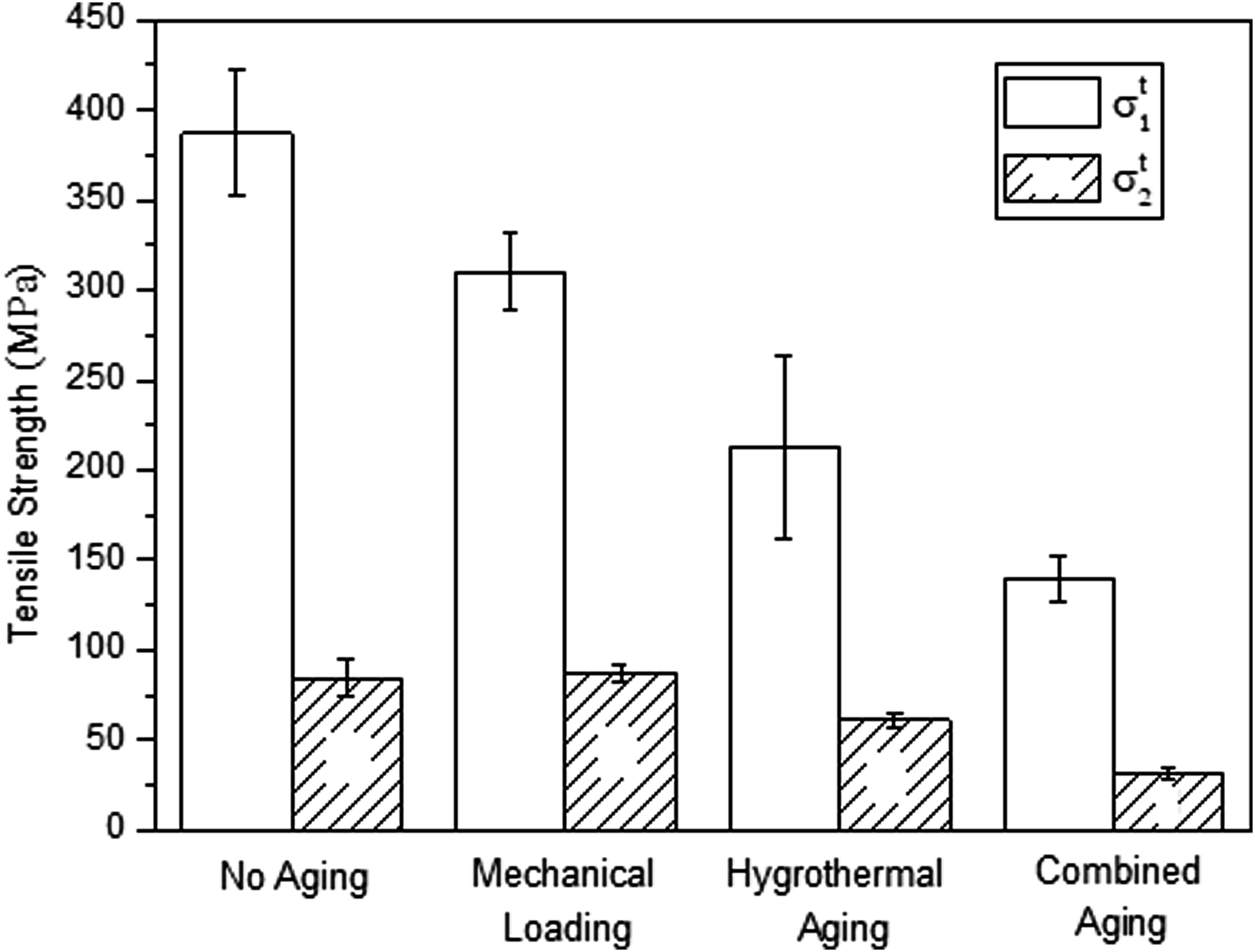
Also, for the conditions used in this work, hygrothermal aging caused a much greater impact in the composite than the mechanical loading, because the flexural strain was low or the matrix absorbed too much water at 80°C.
17
According to Zhong et al.,
18
epoxy/glass fiber composite hygrothermal aging at 80°C caused swelling of the matrix and cracks near the fiber tows due to differential expansion. Furthermore, an increase in the free volume of the composite due to the tensile stresses under bending for the combined loading allowed an increase in moisture absorption,
19
which resulted in a greater drop in tensile strength compared to the sample subjected to hygrothermal loading only, with greater loss in fiber/matrix adhesion, delamination and microcracking.
20
It is important to notice that the decrease in
Microscopy
The micrographs before (Figure 3(a)) and after hygrothermal aging (Figure 3(b)) of the composites show chemical degradation (represented by embossed region in the matrix) characterized by swelling regions. This effect is related to matrix hydrolysis that, along with plasticization and loss in fiber/matrix adhesion, tend to reduce their strength and modulus.
21
50-fold magnified micrographs of composites before (a) and after hygrothermal aging (b).
Elastic modulus
Figure 4 shows the mean E1 and E2 (longitudinal and transverse elastic modulus) values from tensile and nondestructive testing. E1 is much higher than E2, as expected, and E1 from the nondestructive testing is slightly higher than that from the tensile testing. For both directions, a decrease from 3 to 4 GPa was observed comparing the non-aged composites (20 GPa and 7 GPa) with mechanical (17 GPa and 5 GPa), hygrothermal (18 GPa and 6 GPa), and combined (16 GPa and 4 GPa) aging. This is in accordance with Divós and Tanaka,
22
who mentioned that it is natural to find values up to 10% higher using a dynamic technique instead of a static technique (tensile test) due to the difference in testing time and strain. Elastic modulus of the composites from tensile (a) and nondestructive (b) testing.
As for the influence of aging, Figure 4(a) and (b) shows a similar trend for E1 and E2. Also, it is interesting to notice that the continuous mechanical loading was more detrimental to the composite stiffness than the hygrothermal aging. This may be also due to damage at the interface resulting from shear stresses 20 that might have caused a flow in the matrix. According to Belec et al., 23 water is expected to plasticize the epoxy network and lower the modulus due to an increase in free volume and ease of segmental motion when a load is applied to the composite.
In-plane shear strength
The in-plane shear strength
Compressive and short-beam strength
Figure 5(a) shows the mean values of compressive strength of the composites. The transverse compressive strength Compressive strength (a) and short-beam strength (b) of the composites.
Figure 5(b) shows the mean values of the short-beam strength of the composites. In relation to hygrothermal loading, the second crosslinking of the polymeric matrix may be dominant since there was chemical degradation (Figure 3) (the values increase from 22 MPa to 28 MPa for 0° and from 12 MPa to 15 MPa for 90°). The mechanical loading may have influenced the interface, reducing void content, due to the loading that the specimen is subjected to (for 0° the values increase to 27 MPa and for 90° decreases for 7 MPa). In the case of the combined loading, in addition to the above factors, spacing between laminas may increase facilitating the transport of water in the composite, with the appearance of microcracks due to hygroscopic stresses from matrix swelling. 25 This facilitates the entry of water accelerating the loss of property. Kafodya et al. 25 studied this property but found a decrease in strength after aging (for the temperature of 24°C), which may indicate the absence of chemical degradation because it is carried out at low temperatures. For the longitudinal direction, the values were maintained similarly while a reduction of 42% was observed for the transverse direction.
Dynamic mechanical analysis
Regarding the DMA results, Figure 6(a) and (b) shows the storage modulus and tan delta of the composites. In Figure 6(a), the glassy storage modulus curves follow a similar general trend regardless of aging. Since the change in glassy modulus is a complex function of many influencing factors, it cannot be directly related to the crosslink density or the moisture content. Table 1 shows the C values for the studied composites and the results suggest that the fibers present the highest reinforcement effect after hygrothermal aging and the lowest after mechanical loading. (a) Storage modulus and (b) tan delta dynamic curves for composites exposed to aging. Coefficient of reinforcement effectiveness for the studied composites. *Non-aging composites were used as reference.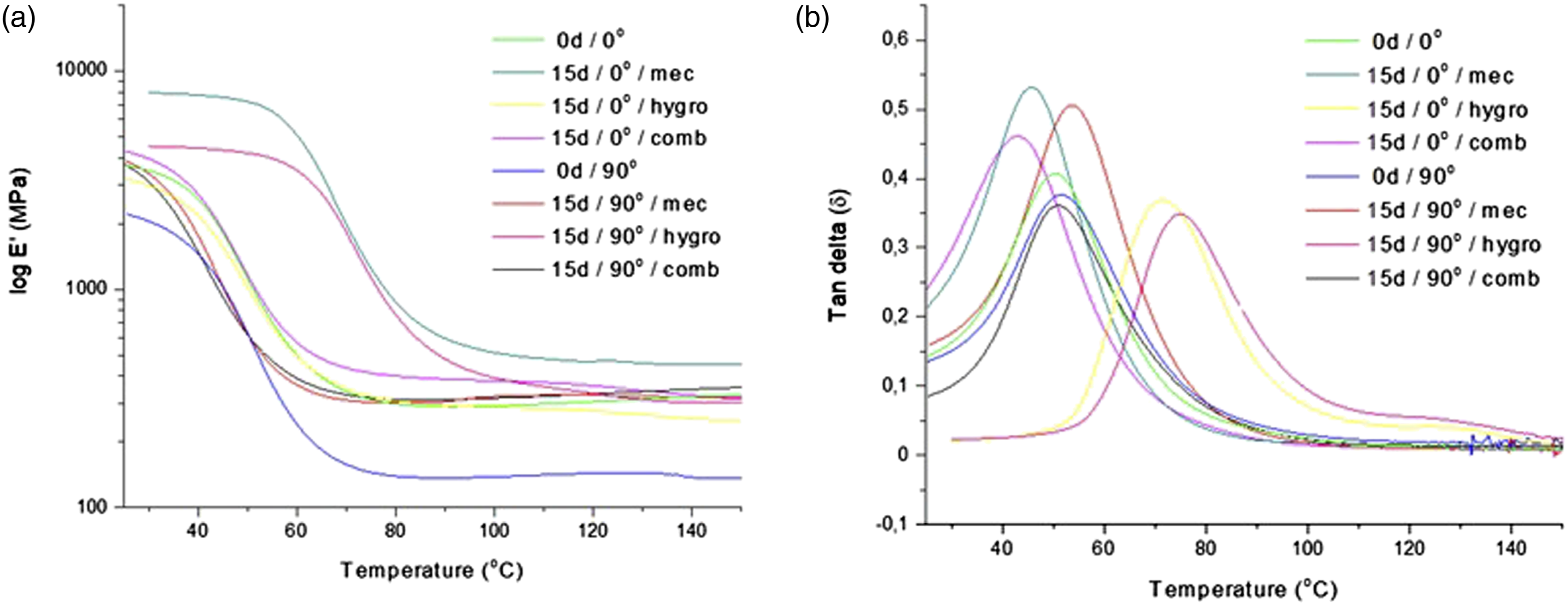

In Figure 6(b), the decrease in Tg indicates plasticization effects with moisture uptake. The height of the tan delta peak gradually decreases with aging, reflecting the effects of slow curing under room conditions and moisture-induced plasticization. Post-curing probably enhanced the crosslink density and reduced mobility of the molecular chains as indicated by the lower energy loss in the transition region. Moisture between molecular segments can also reduce segmental interaction, contributing to that decrease.29,30
Tan δ peak height maximum and the associated temperature (Tg, in parenthesis) for the studied composites.

The decrease in Tg values upon the hygrothermal environment is due to resin plasticization and water/resin interaction in the composite, 32 with degradation of the fiber/matrix interface.33,34 At lower temperatures, the plasticization effect is usually reversible whereas, at elevated temperatures, it can produce irreversible effects due to chemical degradation of the matrix and interface, and an increase in internal voids from chain expansion producing microcracks in the matrix. 34



Constrained region for the composites studied. The values were compared considering the composites with higher peak height (see Table 2).

In the glassy region, there is a minimal or even negative contribution of the stiffness of the fibers to a higher modulus. The values are dependent on the fiber orientation and aging and not on the fiber. With temperature, the abrupt drop of the matrix modulus is compensated by fiber stiffness, which reduces the modulus drop in such a way that it is noticeable only in the elastomeric region. In the glass transition zone, an increase in the free volume is expected because of an increase in molecular motion.36,37 Since the reinforcement content is the same for all composites, the constrained region will be a reflection of the aging type. Both lower (mechanical loading) and higher (combined aging) constrained regions were obtained for 90° composites. The higher constrained region presented by the combined aging is indicative that this method was less susceptible to plasticization effect on interface compared to the other samples in the glass transition region.
The interfacial strength determines how much of the applied stress can be transferred to the load-bearing fibers and reflects in the energy dissipation peak. The contact area between fibers and matrix and adhesion level at the contact points play a major role in interfacial strength.34,38,39 The width of the relaxation curve reflects changes in the relaxation time distribution which can cause debonding of fiber/matrix interface during hygrothermal and/or combined aging conditioning. If the interface is affected by aging, modifications in the relaxation mechanism take place, with possible changes in the α-transition and/or peak height. So, peak dissipation will be reduced by poorer interface adhesion, with a reduction in Tg. This hypothesis is corroborated by shear strength as well other mechanical properties not dominated by the fiber properties. A schematic representation of the energy dissipation and the influence of the fiber can be found on Ornaghi Jr et al. 40 study.
Conclusions
In this work, the influence of mechanical loading and hygrothermal aging, isolated or combined, on epoxy/glass unidirectional composites was studied at 0° and 90°. In general, the hygrothermal aging presented a greater influence on the mechanical properties than the mechanical loading, leading to the conclusion that the predominant factors were second matrix crosslinking (which can be inferred by the chemical degradation verified in the SEM) and the loss of fiber/matrix adhesion.
The tensile and compressive strength were the most affected with aging, with a greater reduction for the samples oriented at 0°- a reduction from 380 MPa to 140 MPa for tensile and from 250 MPa to 50 MPa was observed for compressive strength, respectively. For the samples oriented at 90° a reduction from 80 MPa to 0 MPa for tensile and from 100 MPa to 25 MPa for compressive strength was noted. For both orientations, the mechanical aging showed less influence compared to the non-aged composite. For the elasticity modulus properties, this decrease was less significant, due to a greater influence of the second matrix cross-linking. A reduction in an order of 3–4 GPa was observed for all conditions compared to the non-aged composite. A more negative influence of the combined aging was found for the aforementioned tests. The in-plane shear strength showed higher values for the mechanical aging (∼45 MPa) compared to the non-aged and hygrothermal aging (38 MPa). Again, the combined aging showed lower values of 22 MPa. The short-beam analysis showed higher values for mechanical (27 MPa), hygrothermal (28 MPa), and combined (23 MPa) compared to the non-aged composite (22 MPa) for the 0°. For the 90° orientation higher values were obtained for the hygrothermal aging (15 MPa) compared to the non-aged (12 MPa), mechanical (7 MPa), and combined (5 MPa). In the dynamic mechanical analysis, the lower difference between the glass and elastomeric states was observed for the hygrothermal aging. Post-curing probably enhanced the crosslinking density, reducing molecular mobility at the glass transition region, shifting the Tg to higher temperatures. This was corroborated by the lower dissipation energy for the tan delta peak. Also, hygrothermal composites showed a greater reinforcement effect.
Briefly, the aging yielded different effects on distinct properties, and cannot be always estimated by simply adding the isolated mechanical or hygrothermal effects. Therefore, the study of the aging behavior of composite material should simulate the actual service conditions for a more suitable analysis.
Footnotes
Acknowledgements
The authors would like to thank CAPES and CNPq for the financial support.
Declaration of conflicting interests
The author(s) declared no potential conflicts of interest with respect to the research, authorship, and/or publication of this article.
Funding
The author(s) disclosed receipt of the following financial support for the research, authorship, and/or publication of this article: This work was supported by the CNPq and CAPES (01).
