



Abstract
Polyurethane (PU), designed with pre-polymer method involving polyol as cross-linker, has been utilized for shape memory applications. Neat PU or PU-PS (polystyrene) interpenetrating network (IPN) samples have been prepared. Functionalized multiwall carbon nanotubes (FMWCNTs) have been utilized as reinforcements. PU composites have been studied for shape recovery time and found better than neat PU. 1wt% incorporation of FMWCNTs in PU has reduced shape recovery time to 22 s for 100% shape recovery, in comparison to neat PU with 62 s of 100% shape recovery. PU-PS IPN has reduced 100% shape recovery time to 17s. Superior hydrogen bonding in neat PU has been suggested as per longer shape recovery time against thermal actuation, in comparison to PU composite and IPNs with FMWCNTs. Decreased thermal stability has been observed with FMWCNTs incorporation, indicating enhanced heat dissipation. Field emission scanning electron microscopy analyses confirmed the difference of morphologies in neat PU, PU composite, and IPNs. A distinctive filler-matrix interaction in IPNs has been observed. XRD confirmed the presence of amorphous component. Rutherford Backscattering Spectrometry and Thermal Gravimetric Analysis have been utilized for analyses. Shape recovery study has been made by a simple experimental set up prepared in lab.
Introduction
Shape-memory polymers (SMPs) adapt between deformed configuration (temporary) and original build (permanent). After deformation, SMPs have the ability to recover their original shape upon exposure to an external stimulus 1 and have applications in medical field, sensors, actuators, auto body parts, aerospace, and transducers.2,3 SMPs have a higher recoverable strain (up to 400%), lower density, convenient processing/fabrication techniques, and properties that are more easily tailored (e.g., transition temperature (°C), stiffness, bio-degradability, functional gradient). 4 Despite of these edges, a major drawback of the SMPs is their comparatively low tensile strength and superior stiffness, due to the addition of filler particles, which are added to cover low thermal conductivity of polymeric matrix, along with inertness to electrical, light and electromagnetic stimuli accompanied by slow response ability and low recovery time during actuation. As a result, their potential applications are often limited especially when high-performance is required. To overcome these difficulties material scientists either target new shape-memory nanocomposites (SMCs),5,6 or polymer blending methods.7,8 Both the strategies have shown interesting prospects so far. For example, in the earlier case, there is a report on incorporation of 3 wt% multiwalled carbon nanotubes (MWCNTs) into polyurethane SMPs resulting in an increase of the recovery stress by 200%. After several cycles of training, the nanocomposites retain a high shape recovery ratio (more than 90%). 9 And in line with latter strategy, definite sub-classes of polymer blends and post-cross linking polymer/IPN have been identified so far. 10 It is worth noting that a mix of two strategies shown above, that is, incorporation of nano-fillers into polymer blends matrix has scarcely been studies so far. There is a series of two component interpenetrating polymer networks (IPN) of modified castor oil based polyurethane (PU) and polystyrene (PS) blends prepared by the sequential method. 11 Composites of PU/PS blends have been reported12–14 and successfully characterized by FTIR, XRD, and SEM. 15
Pholorglucinol (PGC), being economical, eco-friendly, and multi-functional has been utilized as chain extender to probe for its effects on shape memory of these kinds of polymeric blends. It is believed that PU being hydrogen bonded will act as crystalline segment and PS will behave as amorphous segment of IPN and has the potential to act as smart polymeric material with right reinforcements.
Materials
MWCNTs (dia 6–9 nm, length 5 mm, assay >95%), PS (Mw∼192,000), polyethylene glycol (PEG average Mn∼4000), toluene diisocyanate (TDI, assay=97%), tetrahydrofurane (THF, assay=99.5%), and pholorglucinol (PGC, assay=99.0%) were purchased from Sigma Aldrich, and used as received.
Methods
FMWCNTs preparation
MWCNTs was refluxed in 5M nitric acid and 8M sulfuric acid (1:3) mixture at 70°C overnight, filtered, and washed till 6.5 pH, to get FMWCNT. 11
Preparation of PU-5Sim
Segmented polyurethane was prepared by condensing polyethylene glycol (PEG) with toluene diisocyanate (TDI) in THF. The mixture was refluxed at 80°C for 2–3 h. Then pholorglucinol (PGC) was added into mixture at room temperature and refluxed for 3 h to get segmented PU-5Sim.
Preparation of PU-5Com
Sample IDs and compositions.

Preparation of PU-5A1, PU-5A2, and PU-5A3
PU/PS-FMWCNTs composites were prepared as per formulations in Table 1. PS-PU mixture was refluxed at 80°C for 2 h, and cooled to room temperature then FMWCNTs was mixed in it. PU/PS-FMWCNTs solution was refluxed at 80°C for 3 h and sonicated for 2 h (Figure 1). Prepared samples (a) PU-5sim, (b) PU-5A1, (c) PU-5A2, and (d) PU-5A3.
Results and discussion
FTIR
FTIR (6600A JASCO, 4 cm−1 resolution, %transmittance) has been utilized to study interaction between surface chemistry of filler and matrices to make samples compact or flexible (Figure 2(a)). Peak at 3150-3700 cm−1 indicates stretching vibrations of NH group
16
: broad peak in PU matrix represents hydrogen bonding in PUs which might be attributed to the closely arranged functionalities because of PGC chain extender; in contrast IPNs showed less intense peak in this region due to incorporation of PS as hard component. The same has also been confirmed by slight shifting of carbonyl group peaks at 1601 cm−1.
16
PU-5Com has shown almost equal strength of peak at 3150-3700 cm−1, as that of PU-5Sim. It might be attributed to boosted interaction between FMWCNTs and PU
16
furthermore an increase in carbon contents of PU-5Com has been observed at 2900 cm−1.
17
High intensity peak at 2891 cm−1 in IPNs represents stretching vibrations of aliphatic –CH2_ of PS.
17
Strong peak at 1240 cm−1 have been observed in IPNs, representing stretching vibrations of C=C.18,19 Peaks at 1050-1110 cm−1 represent PGC and PEG contribution in the form of C-O-C symmetric stretching.
20
(a) FTIR, (b) XRD, (c) RBS spectra of PU, composite, and IPNs.
XRD
To study crystal structure and atomic spacing, XRD was performed using X-ray Theta-Theta diffractometer by STOE. XRD pattern for prepared samples (Figure 2(b)) showed a strong diffraction peak at 19.82° and a mild peak at 42.15° as an indication of micro-phasic structure of polymeric network. High peak intensity in PU-5Sim revealed schematized pattern of polymeric network, which might be attributed to PGC chain extender. In PU-5Com a huge decrease in intensity has been observed indicating declined hydrogen bonding, which may be attributed to the presence of FMWCNTs, having the potential to interact with available functionalities on polymeric chains. Comparative to PU-5Com, samples PU-5A1-3 have shown better peak intensities, indicating that PS component of polymer chain masked the activity of FMWCNTs. Hence data indicated that incorporation of FMWCNTs or PS into PU has reduced its crystalline nature.
Rutherford backscattering spectrometry
Chemical composition of composites analyzed through RBS.

Scanning electron microscopy
Field emission scanning electron microscopy (MIRA3 TESCAN, 20 KV, secondary electron mode) was utilized to observe sample morphologies particularly considering the effect of filler on surface of films. SEM micrographs of PU (Figure 3(a) and (b)) presented smooth surface, whereas PU composite (Figure 3(c) and (d)) showed a wrinkled surface yet without any segregation of components. This change in morphology from PU-5Sim to PU5-Com indicated proper interaction between polymeric matrix and filler, and unsegregated composition confirmed homogeneity of reaction. Upon the addition of PS, in IPNs (Figure 3(e-h)), micro-phasic separation is clearly visible between matrix and filler in the form of voids. This indicates PS component hindered filler dispersion in matrix and created voids in samples. Increased void formation has been observed at high filler concentration. Since void formation has hindered matrix-filler interaction, it may be concluded that crystalline component of shape memory composite is reduced around the filler surface, adding amorphous component to impart elasticity. This might be the reason of reduction in shape recovery time of IPNs. SEM micrographs of PU-5Sim (a&b), PU-5com (c&d), PU-5A1 (e&f), and PU-5A3 (g&h).
Thermal gravimetric analysis
TGA (Mettler Toledo) was performed, to estimate relative thermal stability of prepared samples (Figure 4(a) and (b), Table 3). TGA graph (Figure 4(a)) shows three clear segments of thermal degradation: segment 1 from ambient to 300°C, segment 2 from 301 to 600°C and segment 3 from 601 to 750°C. All the samples showed least thermal degradation in segment 1 indicating loss of solvent or physically adsorbed volatile species. In segment 1, PU-5Sim showed maximum degradation in comparison to composite and IPNs, signposting that incorporation of filler particle or PS augments thermal stability of composite materials. This thermal stability may be attributed to enhanced cross-linking between functionalized filler and matrix. In segment 2, a huge weight loss in all the samples has been observed, which is due to higher oxidizable contents on the exposed surface of composite materials. In this segment neat (PU-5Sim) and composite (PU-5Com) have shown higher stability than IPNs, which confirms hydrogen bonded polymeric network due to PGC incorporation. On the other side of the picture, in IPNs a decreased thermal stability has been observed, due to increased oxidizable species, particularly PS component which is in high mass ratio. In segment 3 minimum weight loss has been observed, due to leftover un-oxidizable species or inorganic components. (a) TGA, (b) DTG plots for neat PU and blend composites. TGA data for neat PU and blend composites.

Thermal instability as a result of PS component and filler incorporation has been confirmed by DTG analysis against different temperatures (Figure 4(b)). Area under neat (PU-5Sim) curve has been observed comparable to composite with 1wt % FMWCNTs (PU-5Com), but IPNs with 1-10wt% filler (PU-5A1-3) has shown augmented peak area, which evidently demonstrated PS component responsible for the quick degradation. More area in DTG curves indicated more weight loss during thermal treatment. As evident from peak height and width, thermal degradation increased with PS incorporation which reduced hydrogen bonding component, or thermal degradation increased with filler incorporation which augmented oxidizable contents.
Shape memory study
For shape recovery study, prepared samples were indirectly heated above glass transition temperature (T ≥ Tg: Tg=85–90 °C) by a simple experimental set up prepared in lab. Heating above Tg generated hard and soft domains in samples, triggering chain mobility. Samples were molded into desired temporary shape by cooling, till fixation temperature (T < Tg) to freeze polymer chain movements. Deformed samples were placed in pre-heated glass chamber at 85–90°C to find out shape recovery time. By heating above Tg the stored elastic energy got released and contraction force was reproduced, hence recovery of permanent shape was observed by using a very simple approach
22
by using equation (1)
lD = Length of total deformed shape
lR = Length of recovered shape
%age shape recovery of prepared samples.


Shape recovery of synthesized PU-5Sim.
Under similar conditions, shape recovery test was also performed on PU-5Com (after incorporation of 1 mass % of FMWCNTs). 14% shape recovery was observed after 2s of heating. Similarly, 42% and 65% recovery was achieved after 5 and 10s of respective heating until 100 % shape recovery observed after 22s as seen in Table 4 and Figure 6. Shape recovery test for PU-5Com.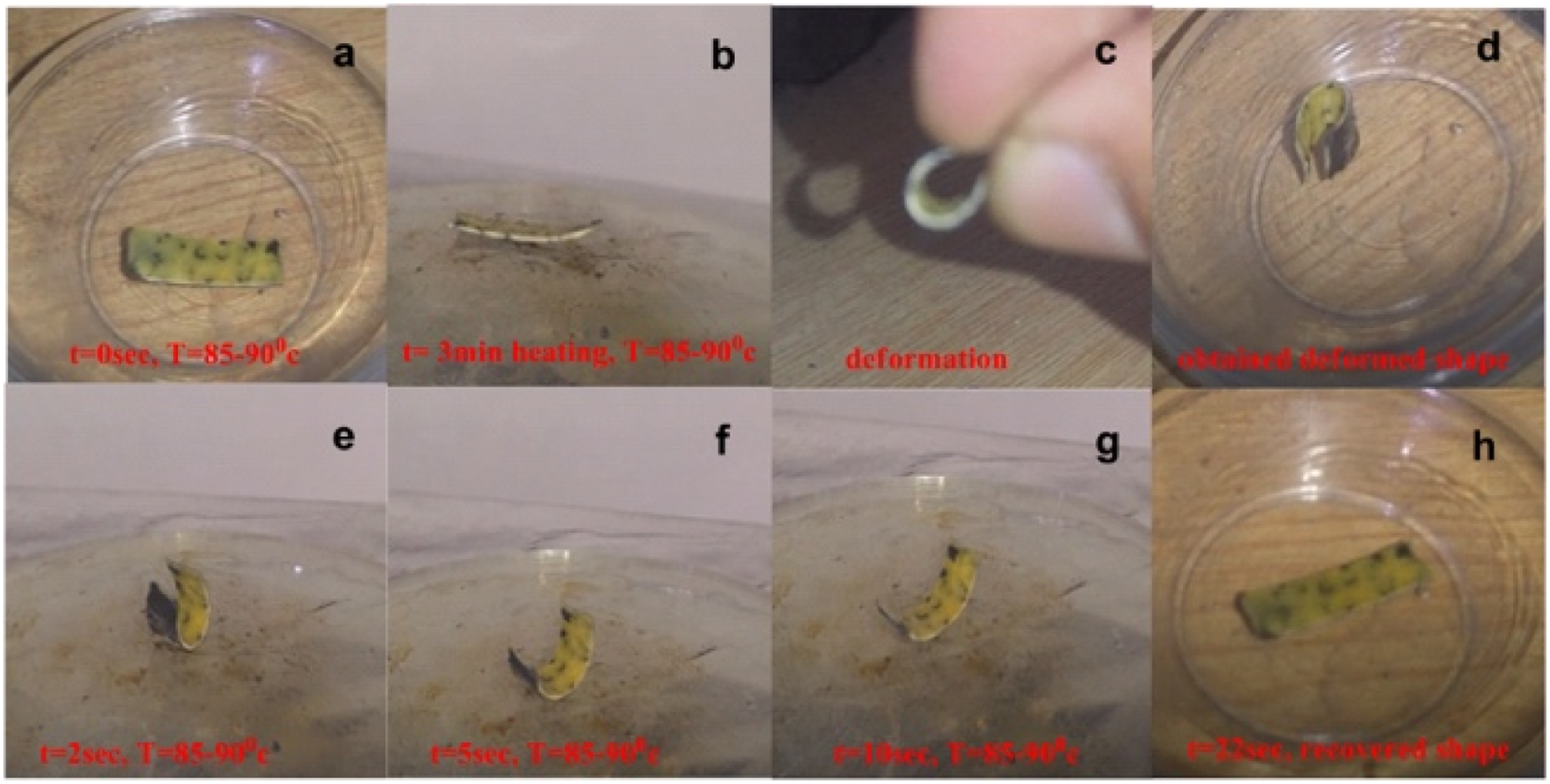

Longer shape recovery time for PU-5Sim might be attributed to stronger hydrogen bonding between the polymeric chains, as evident from FTIR and XRD data. Whereas, PU-5Com, due to filler particles, has greater heat dissipation than PU-5Sim, as established from TGA data. This provides the justification for the comparatively shorter shape recovery time of PU-5Com.
In case of IPNs shape recovery study showed shortest shape recovery time (Table 4, Figure 7). As observed through SEM, IPNs have shown micro-phasic separation in the form of voids, establishing the concept of non-crystalline layer around the surface of filler. It might also be concluded that soft configuration of composite was contributed by PS which caused the formation of voids. In IPNs, 16%, 48%, and 76% shape recovery was observed after 2, 5, and 10s of respective, constant heating. As compared to neat-PU and its composite, only 17s required to obtain 100% of shape recovery in IPNs with 1 mass% of FMWCNTs. Shape recovery test of PU-5A1.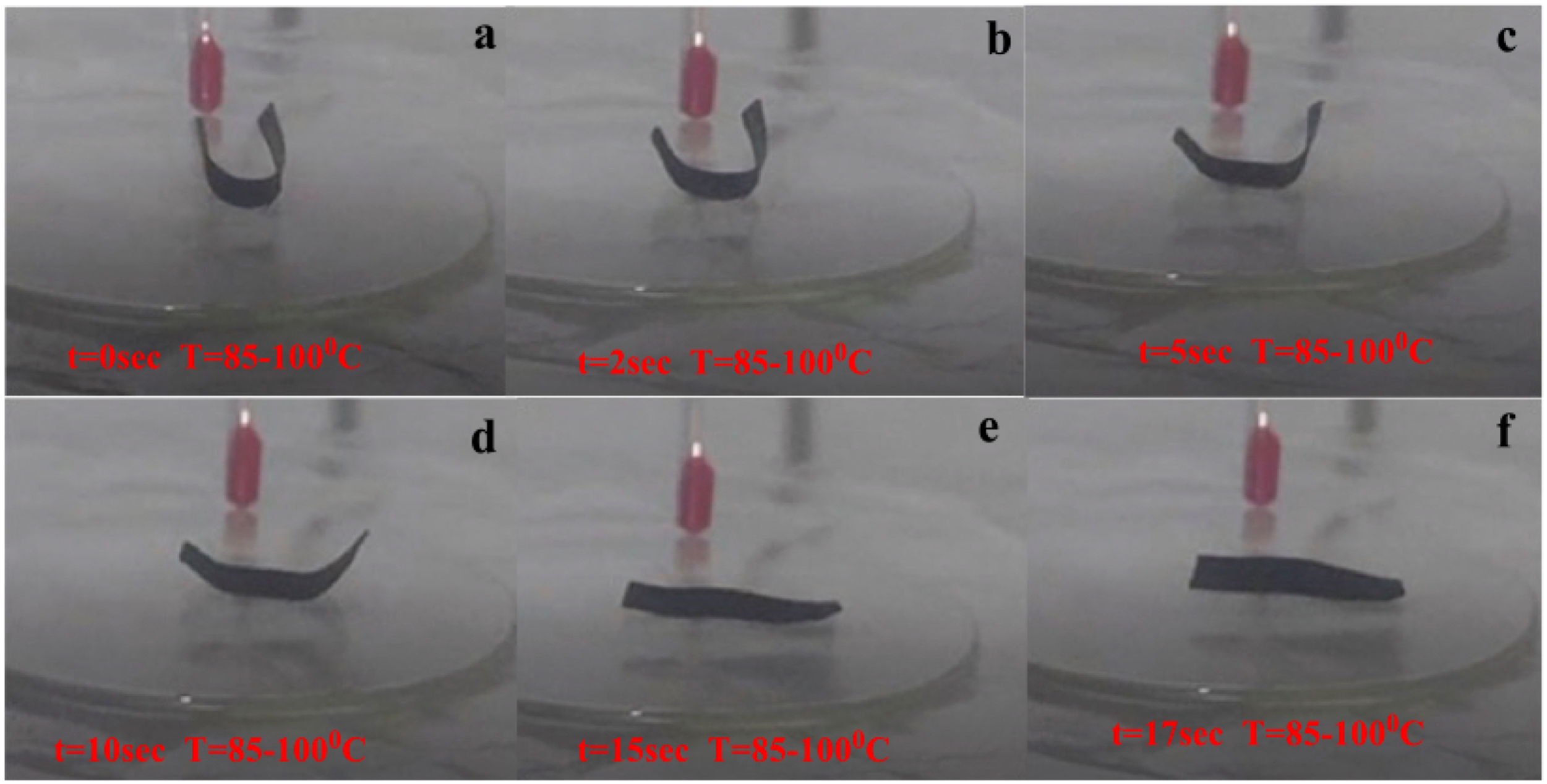
The results clearly indicated that IPN samples more quickly adjust their soft and hard domains upon temperature and stress application.
Results (Figure 8) indicated that neat PU took greater time for complete shape recovery, might be due to cross-linked polymeric network with hydrogen bonding and greater thermal stabilities in temperature range below 300°C, as indicated by instrumental data. PU-composite took lesser time for shape recovery due to heat dissipative nature of filler which actuated crystalline component of composite to behave elastic with temperature. So the heat dissipation by filler assisted comparatively quick shape recovery of composite in comparison to neat-PU. In IPNs shape recovery behavior was more strong, which confirmed PU as hard component due to hydrogen bonding and PS as soft component, which also caused voids around filler particles. Shape recovery data.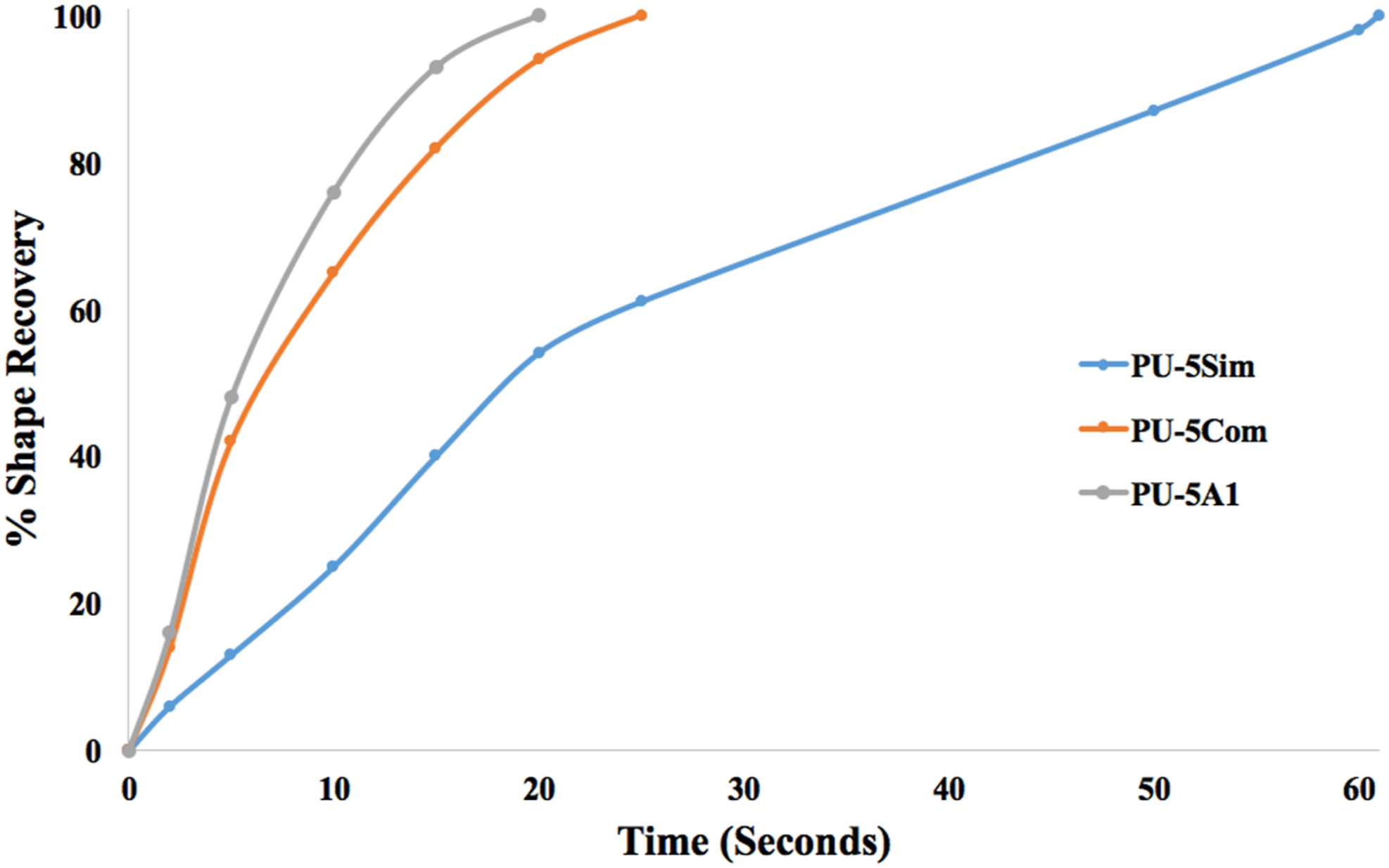
Conclusion
Thermo-responsive shape memory samples comprising of neat PU, PU composite, and PU/PS blends with FMWCNTs have been characterized. Instrumental findings confirmed very little change in morphology and thermal response of neat PU and PU composite due to PGC induced hydrogen bonding within polymeric network. Whereas in IPNs interaction of PS with PGC based PU matrix has resulted in voids as well as thermal instability. In PU/PS composites, progressive thermal degradation @1-10wt% FMWCNTs has been observed, indicating better thermal dissipation through the matrix, with increasing filler concentration, hence thermo-responsive shape recovery property of IPNs took least time to recover their original shape below Tg, that is, 100°C. In multi-phasic matrix, PS contributed as soft part and heat dissipation activated soft part (PS) easily. Similarly, PU composite, due to conductive nature of filler, took shorter shape recovery time than neat PU, where enriched hydrogen bonding restricted actuation of shape recovery. In IPNs reheating temporary shape quickly shifted into its permanent shape showing full recovery which is remarkable for such kind of polymeric materials. So IPNs prepared, may be considered for molecular switches as per their quick shape recovery than single phasic matrix. Almost 100% shape recovery has been observed for all prepared samples.
Footnotes
Declaration of conflicting interests
The author(s) declared no potential conflicts of interest with respect to the research, authorship, and/or publication of this article.
Funding
The author(s) disclosed receipt of the following financial support for the research, authorship, and/or publication of this article: This study was supported by Higher Education Commission of Pakistan for providing financial support for this research work through NRPU Project number 6475. Authors further extend the gratitude for Project Ref No. 7940/KPK/NRPU/R&D/HEC/2017.
