




Abstract
Polymer nanocomposite films, comprising of polymethylmethacrylate (PMMA) as the matrix and zinc oxide (ZnO) nanoparticles as reinforcement, have been prepared using ultrasonication and spin-coating techniques, with ZnO content up to 20 wt.%. The effect of the processing on the microstructure and nanomechanical properties have been investigated. The nanocomposite film thickness is found to vary from 2.4 ± 0.2 µm for pristine PMMA to 33.1 ± 0.5 µm for PMMA/20 wt.% ZnO nanocomposite. Quasi-static nanoindentation showed that the indentation modulus varied from 4.68 ± 0.07 GPa for pristine PMMA to 5.04 ± 0.14 GPa for PMMA/20 wt.% ZnO nanocomposite, while the indentation hardness varied from 275.94 ± 5.67 MPa to 292.39 ± 10.88 MPa in the same range. However, the highest indentation modulus and the highest hardness are exhibited by PMMA/10 wt.% ZnO nanocomposite. Scanning electron microscopy of the synthesized films provided the evidence behind such variation in material properties. In addition, the experimentally obtained elastic moduli were compared with values predicted by using Eshelby-Mori-Tanaka micromechanics. Nanoindenter-based dynamic mechanical analysis of the PMMA nanocomposite thin films revealed the variation of storage modulus, loss modulus and loss factor of the films in the frequency range of 10 Hz to 201.5 Hz. For all PMMA/ZnO nanocomposites, the storage modulus is found to increase monotonically from 10 Hz to ∼100 Hz, beyond which the values reached a plateau. The loss modulus and loss factor for all PMMA/ZnO nanocomposites are found to decrease with increasing frequency. These results form an essential step toward establishing process-structure-nanomechanical property relationships for PMMA/ZnO nanocomposite films.
Introduction
Formulations based on poly(methyl methacrylate) (PMMA) have been traditionally used as resists in electron-beam lithography 1 and in deep ultra-violet lithography. 2 However, with the advancement of micromachining techniques 3 like hot-embossing, PMMA is increasingly being utilized in the fabrication of MEMS devices. 4 Nanocomposite films, composed of PMMA as matrix and zinc oxide (ZnO) nanoparticles as reinforcement, are potential candidates as structural and functional components of flexible optical devices. 5 The choice of ZnO nanoparticles as reinforcement to PMMA is due to the multifunctional nature of ZnO, with bio-compatible and piezoelectric properties. These flexible polymer-based microdevices can have applications in the biomedical industry as well as in vibrational mechanical energy-harvesting. The mechanical properties of the bulk composites may not be applicable for the composites present in the form of thin films due to differences in processing. As such, the main objective of this work is to study the mechanical behavior of the composites in the form of thin films. The primary goal of this work is to provide engineers with appropriate quasi-static and/or dynamic mechanical properties for the design of robust and reliable microdevices.

A study of the existing literature on PMMA/ZnO nanocomposite films suggests that a considerable amount of work exists on the evaluation of elastic and elasto-plastic properties of PMMA and PMMA/ZnO nanocomposite films via quasi-static nanoindentation.6–9 However, there is a gap in the literature regarding the evaluation of viscoelastic properties of PMMA/ZnO nanocomposite films formed using spin-coating, as a function of the ZnO content, and as a function of loading frequency at room temperature. Viscoelastic properties of melt-cast PMMA/ZnO nanocomposites have been measured using dynamic mechanical analysis (DMA) as a function of temperature.10,11 However, the effect of loading frequency and ZnO content on the viscoelastic properties of PMMA/ZnO films at room temperature has not been reported to date. A summary of the literature-review is provided as follows.
One of the earliest works on the depth-sensing indentation of PMMA is by Drechsler et al., who used a combination of a scanning-force microscope and an instrumented micro-indenter to evaluate elastic properties of PMMA. 6 Klapperich et al. used a spherical diamond indenter with a radius of curvature of 20 μm, with maximum loads in the range of 150–600 μN, and with loading rate in the range of 7.5–600 μN/sec to characterize bulk PMMA. 7 Klapperich et al. observed that the indentation modulus of PMMA decreases, and the hardness of PMMA increases with increasing contact-depth. 7 Bulk PMMA has been used as a standard material for calibration by Olek et al. 8 Chakraborty et al. have evaluated indentation modulus, indentation hardness and scratch hardness of PMMA/ZnO nanocomposites with ZnO content up to 1 wt.%. 9
Anžlovar et al. have reported viscoelastic properties of plates of PMMA/ZnO nanocomposites, consisting of ZnO nanorods up to 1 wt.%, using the dynamic mechanical analyzer, in the temperature range of 30°C to 150°C, at a displacement frequency of 10 Hz and with a displacement amplitude of 15 μm. 10 Dai Prè et al. have performed dynamic mechanical analysis of melt-cast and hot-pressed plaques of PMMA/ZnO nanocomposite with 0.1 wt.% ZnO and reported the storage moduli and loss moduli in the temperature range of 20°C to 130°C at a tensile deformation frequency of 1 Hz and with an amplitude of 4 μm. 11 It is to be noted that dynamic mechanical analysis reported in the literature cannot be performed on spin-coated films that remain attached to the substrate.
As such, this work focuses on nanoindenter-based quasi-static and dynamic nanomechanical testing of spin-coated PMMA/ZnO nanocomposites with an aim to study the effect of composition, i.e. ZnO content on the effective properties of the nanocomposite films. An effort has been made to correlate the variation of the effective properties with microstructure. This has been accomplished by microstructural characterization, as well as by using computational Eshelby-Mori-Tanaka micromechanics. Previous studies 9 have reported similar PMMA/ZnO composites with ZnO content limited to only 1 wt.%. The use of ultrasonic probe sonication has allowed an increase of the ZnO content up to 20 wt.%. The spin-coating process reported here is also compatible with microfabrication processes used for polymer-micro-electro-mechanical systems (polymer-MEMS). To the best of our knowledge, this work reports the first systematic study of the effect of composition (i.e. ZnO content) and loading frequency on the effective viscoelastic properties of the composite at small length scales. To our understanding, this study forms the first step toward establishing process-microstructure-nanomechanical properties of PMMA/ZnO films. The steps of synthesis of the polymer nanocomposite films will be beneficial to microfabrication process-integration engineers, while our results of quasi-static and dynamic mechanical properties of the nanocomposites will be of importance to design-engineers of flexible electronics as well as low-frequency vibrational energy-harvesting microsystems.
The manuscript is organized in the following fashion. The next section describes in detail the process of synthesis and deposition of the nanocomposite films, the methods employed for nanomechanical and microstructural characterization of these nanocomposite films, as well as the procedure of computational estimation of the indentation moduli of the PMMA/ZnO nanocomposite. Next, in the third section, the results obtained from the characterization tests are presented and discussed. A comparison between the indentation moduli obtained via quasi-static nanoindentation tests and the results obtained using Eshelby-Mori-Tanaka micromechanics is also presented in this section. Finally, in the fourth section, a summary of the results obtained from this work is presented.
Materials and methods
Deposition of nanocomposite films
1.5 grams of PMMA (Alfa Aesar), with an average molecular weight of 550,000 gram/mole, was dissolved in 25 ml of Trichloroethylene (Merck) in a 50 ml glass-beaker, and the mixture was stirred at 65°C for 2.5 hours on a hot-plate with a magnetic stirrer, till the mixture became transparent. Next, ZnO (Sigma Aldrich), with a mean particle-size of ∼50 nm, was weighed using an analytical balance, and the nanoparticles were added to PMMA mixture while stirring at room temperature using a magnetic stirrer, and the stirring was continued for 3.5 hours to get a stable mixture. The resulting mixture was probe-sonicated using an ultrasonic probe sonicator (BIOMATRIX BMS-750T) with the aim of enhancing the dispersion of the nanoparticles in the polymer matrix. The probe sonication was performed with a stainless-steel circular-cylindrical probe-tip having a diameter of 13 mm. The frequency of the ultrasonic wave was maintained at 20 kHz and at a power-setting of 75 Watts. A pulse-wave program maintained the ultrasonic pulse on for 5 seconds and switched off the pulse for the next 5 seconds. This was used to prevent the heating of the probe-tip and the polymer nanocomposite mixture. The total time of ultrasonic probe sonication was 20 minutes. Next, the liquid mixture in the beaker was put inside a vacuum desiccator, and the desiccator was pumped down to low pressure to drive out any trapped gasses. The liquid mixture was left in the evacuated vacuum desiccator for 10 minutes. The ultrasonicated PMMA/ZnO mixture is a stable solution, and the particles were not found to settle with time during the entire duration of the vacuum desiccation and subsequent curing.
Square glass-slides (25 mm × 25 mm × 1.3 mm) were cleaned using isopropyl alcohol (IPA) in an ultrasonic bath, washed with de-ionized water, and dried in air. Next, the liquid PMMA/ZnO nanocomposite was taken out of the vacuum desiccator, and the glass-slides were spin-coated with the PMMA/ZnO nanocomposite, using a programmable spin-coater (Apex, spin NXG-P1). The spin-coating program involved an initial ramp-up to 500 rpm at the rate of 100 rpm/second for 5 seconds, maintaining the spin-speed of 500 rpm for 60 seconds, and finally a ramp-down at the rate of 100 rpm/second for 5 seconds. The spin-coated glass-slides were transferred to a desiccator immediately and maintained at room temperature for 12 hours. This led to the curing of the PMMA/ZnO nanocomposite films. Finally, the spin-coated glass-slides were baked at 50°C for 10 minutes using a hot-plate to drive out any remaining solvent. The process described above was used to create thick films of: (i) pristine PMMA, (ii) PMMA/1 wt.% ZnO, (iii) PMMA/5 wt.% ZnO, (iv) of PMMA/10 wt.% ZnO, and (v) PMMA/20 wt.% ZnO.
Characterization of nanocomposite films
The nanomechanical properties of the spin-coated films were measured using a nanoindenter (Hysitron TriboIndenter TI950) via quasi-static nanoindentation and via dynamic nanoindentation. Details of nanoindentation tests on thin films are available through some excellent reviews.12,13 All tests were performed at room temperature using a Berkovich indenter, with a tip-radius of 100 nm, and under feedback-controlled mode. Calibration tests were first performed with a standard fused quartz-sample, and next with a polycarbonate sample. The term “quasi-static” in the present context indicates that load is applied slowly in a controlled manner such that the material also deforms at such slow rates that the effect of time dependence of material properties can be neglected. For the quasi-static, load-controlled nanoindentation tests, a maximum load of 100 μN was used, with a loading/unloading rate of 10 μN/second. In addition, the peak load was maintained at 100 μN for 10 seconds before unloading. The results from the quasi-static nanoindentation were analyzed using the Oliver-Pharr method 14 to evaluate indentation modulus and indentation hardness. For the dynamic nanoindentation tests, a sinusoidal force with an amplitude of 20 μN was superimposed on the load-profile, at the peak load of 100 μN for 10 seconds. The dynamic nanoindentation tests were performed in the frequency range of 10–201.5 Hz. The evaluation of storage modulus, loss modulus and loss factor from dynamic nanoindentation is based on a simple Kelvin spring-dashpot model, as shown in the study of Krishna et al. 15
Cross-sectional scanning electron microscopy (Zeiss, Merlin Compact FE-SEM) was performed to measure the thickness of the spin-coated PMMA and PMMA/ZnO nanocomposite films. Top-view scanning electron micrographs of the nanocomposite films also revealed the nature of the distribution of ZnO nanoparticles in the PMMA matrix.
Computational estimation of elastic properties
In this work, Eshelby-Mori-Tanaka micromechanics 16 is used to calculate the effective elastic properties of the composite based on the material properties of the matrix and the reinforcement phases, as well as the geometry and the volume fraction of the reinforcement phase. The reinforcements are assumed to be circular cylindrical, and the aspect ratios are calculated from image-analysis of the ZnO nanoparticles using ImageJ software. The present analysis also takes into account the distribution of aspect ratio of ZnO nanoparticles. X-ray diffraction spectra (provided in Online Supplemental Material) of the PMMA and the polymer nanocomposite films did not show any significant crystallization at the matrix/reinforcement interface. Hence, the presence of a distinct interface material with properties different from those of the matrix or the reinforcement was neglected. Two cases were considered in the micromechanical analysis via MSC-Digimat software. In the first case, it was assumed that all ZnO nanoparticles (in the form of discontinuous short fibers) were arranged in a unidirectional fashion in the PMMA matrix, the direction of alignment coinciding with the axis of anisotropy of ZnO. In the second case, it was assumed that the nanoparticles were oriented in a random fashion in PMMA. The matrix, PMMA, is assumed to be isotropic, and the average elastic modulus obtained from quasi-static nanoindentation experiments is used. The Poisson’s ratio of PMMA is considered to have a value of 0.35. 17 The reinforcement, ZnO, is considered to be transversely isotropic. The five elastic material properties of ZnO, namely the axial Young’s modulus, the in-plane Young’s modulus, the transverse shear modulus, the in-plane Poisson’s ratio, and the transverse Poisson’s ratio are 144.09 GPa, 127.22 GPa, 44.24 GPa, 0.28, and 0.43, respectively. These values have been calculated from the stiffness constants of ZnO available in the literature. 18
Results and discussion
Figure 1 shows that thickness of the spin-coated PMMA/ZnO nanocomposite films increases with increasing ZnO content, from a value of 2.4 ± 0.2 µm for pristine PMMA to a value of 33.1 ± 0.5 µm for PMMA/20 wt.% ZnO. The thicknesses were measured from cross-sections of the thin films imaged via scanning electron microscopy. Thickness measurements were made at various locations over the entire cross-section, taking into account measurements from the vicinity of the edges as well as from locations close to the center. Each data point represents the average of at least six sets of measurements. The low standard deviation in the measured thickness shows the uniformity of thickness obtained by spin-coating. The addition of ZnO is expected to increase the viscosity of the liquid PMMA/ZnO nanocomposite mixture, leading to an increase in the thickness of the spin-coated films with increasing ZnO content.

Thickness of PMMA/ZnO nanocomposite films.
Figure 2 shows the hardness of PMMA/ZnO nanocomposite films plotted as a function of ZnO content. The hardness values are calculated from the applied load versus indentation-depth plots using the Oliver-Pharr method. 14 Each data point in Figure 2 represents the average value of hardness obtained from at least 15 quasi-static nanoindentation tests. Overall, it is observed that the hardness does not increase significantly with addition of ZnO nanoparticles. The hardness is found to remain significantly unchanged from a value of 275.94 ± 5.67 MPa for pristine PMMA on addition of 1 wt.% ZnO. The mean hardness is found to increase with further addition of ZnO, and is found to attain a value of 300.29 ± 19.21 MPa for PMMA/10 wt.% ZnO nanocomposite film, i.e. an increase of ∼9% with respect to PMMA. Beyond this concentration and up to 20 wt.% ZnO, the hardness of PMMA/ZnO nanocomposite films does not change significantly with the further addition of ZnO. It appears that the major proportion of the plastic deformation is borne by the polymer via re-arrangement and compaction/densification of the polymer chains under the indenter due to compressive stresses. This points to poor load transfer from the matrix to the reinforcement. The decrease in mean hardness of PMMA/ZnO nanocomposites beyond ZnO content of 10 wt.% may be attributed to clustering of ZnO nanoparticles.

Hardness of PMMA/ZnO nanocomposite films.
Figure 3(a) shows a representative image of the ZnO nanoparticles obtained by scanning electron microscopy. The micrograph shows that the nanoparticles are prismatic in shape with hexagonal cross-sections. However, since Eshelby-Mori-Tanaka micromechanics can only deal with ellipsoids, it has been assumed that the nanoparticles are circular cylindrical in shape. Hence, the aspect ratio has been calculated by measuring the axial length of each nanoparticle and dividing it by the width of the nanoparticle, measured perpendicular to the axis. Images of at least 45 nanoparticles were analyzed, and the distribution of aspect ratios obtained from these measurements are plotted in Figure 3(b). The distribution of aspect ratios of ZnO nanoparticles was used as an input in Digimat-MF to predict the effective properties of PMMA/ZnO nanocomposites.

(a) Representative scanning electron micrograph of ZnO nanoparticles and (b) histogram of aspect ratio of ZnO nanoparticles obtained from image-analysis of the ZnO particles.
Figure 4 shows the variation of indentation modulus as a function of ZnO content in the range of 0 wt.% to 20 wt.%. The indentation modulus is also obtained using the Oliver-Pharr method. 14 In the calculation of the indentation modulus from the reduced modulus, it was assumed that the Poisson’s ratio (ν) of the PMMA/ZnO nanocomposites remain unchanged with ZnO addition (in the range considered in this work), i.e. ν = 0.35. As in the case of the hardness plot, each data point in Figure 4 represents an average value of indentation modulus, evaluated from at least 15 sets of quasi-static nanoindentation tests. Indentation modulus increases from 4.68 ± 0.07 GPa for pristine PMMA to 5.36 ± 0.21 GPa for PMMA/10 wt.% ZnO nanocomposite, i.e. an increase of ∼14.5% with respect to PMMA. However, the indentation modulus of PMMA/20 wt.% ZnO drops to 5.04 ± 0.14 GPa.

Indentation modulus of PMMA/ZnO nanocomposite films.
Figure 4 also shows the predicted indentation moduli of the PMMA/ZnO nanocomposite films, calculated using Eshelby-Mori-Tanaka micromechanics, using the histogram of aspect ratios, as shown in Figure 3(b). The solid curve indicates the predictions based on the assumption that the ZnO nanoparticles are unidirectionally aligned, while the dashed line indicates the predictions for randomly-aligned ZnO nanoparticles. The figure clearly shows that at low ZnO content, especially below 10 wt.%, the micromechanics-based predictions underestimate the experimental results. It is observed that at 10 wt.% ZnO, the experimentally obtained mean value of the elastic modulus exceeds the effective elastic modulus predicted for unidirectionally aligned ZnO by ∼5.2% with respect to the experimental value. At low volume fractions, ZnO nanoparticles are expected to be uniformly dispersed in the polymer matrix, and the densification of polymer chains may occur in the immediate vicinity of the nanoparticles. 19 This may lead to higher indentation moduli of the nanocomposites, with ZnO below 10 wt.%. In addition, it is also possible that spin-coating leads to alignment of the ZnO nanoparticles in the PMMA matrix, and the nanocomposite may exhibit some amount of mixed 0–3 and 1–3 connectivity close to its percolation threshold, as suggested by Prashanthi et al. for SU8/ZnO nanocomposites. 20 This mixed connectivity can lead to underestimation of the elastic moduli by Eshelby-Mori-Tanaka micromechanics, which in this case, assumes only 0–3 connectivity. However, at large volume fractions beyond the percolation threshold, the ZnO nanoparticles are expected to form randomly-aligned large clusters, leading to a significant reduction in elastic modulus. The scanning electron micrographs given in Figure 5(b) to (d) confirm well-dispersed of ZnO nanoparticles. However, clustering of ZnO nanoparticles could not be completely avoided. A series of higher magnification scanning electron micrographs (Figures S4 and S5) are also provided in the Online Supplemental Material. However, as observed in Figure 5(e), PMMA/20 wt.% ZnO nanocomposite shows a large number of clusters of ZnO nanoparticles. Agglomeration of ZnO nanoparticles at higher ZnO content leads to improper load transfer between the matrix and the reinforcement, leading to the poor elastic property of PMMA/20 wt.% ZnO nanocomposite. It is observed from Figure 4 that the experimentally measured mean indentation modulus of PMMA/20 wt.% ZnO nanocomposite is ∼3% lower than the values predicted by Eshelby-Mori-Tanaka micromechanics for a random distribution of ZnO nanoparticles.
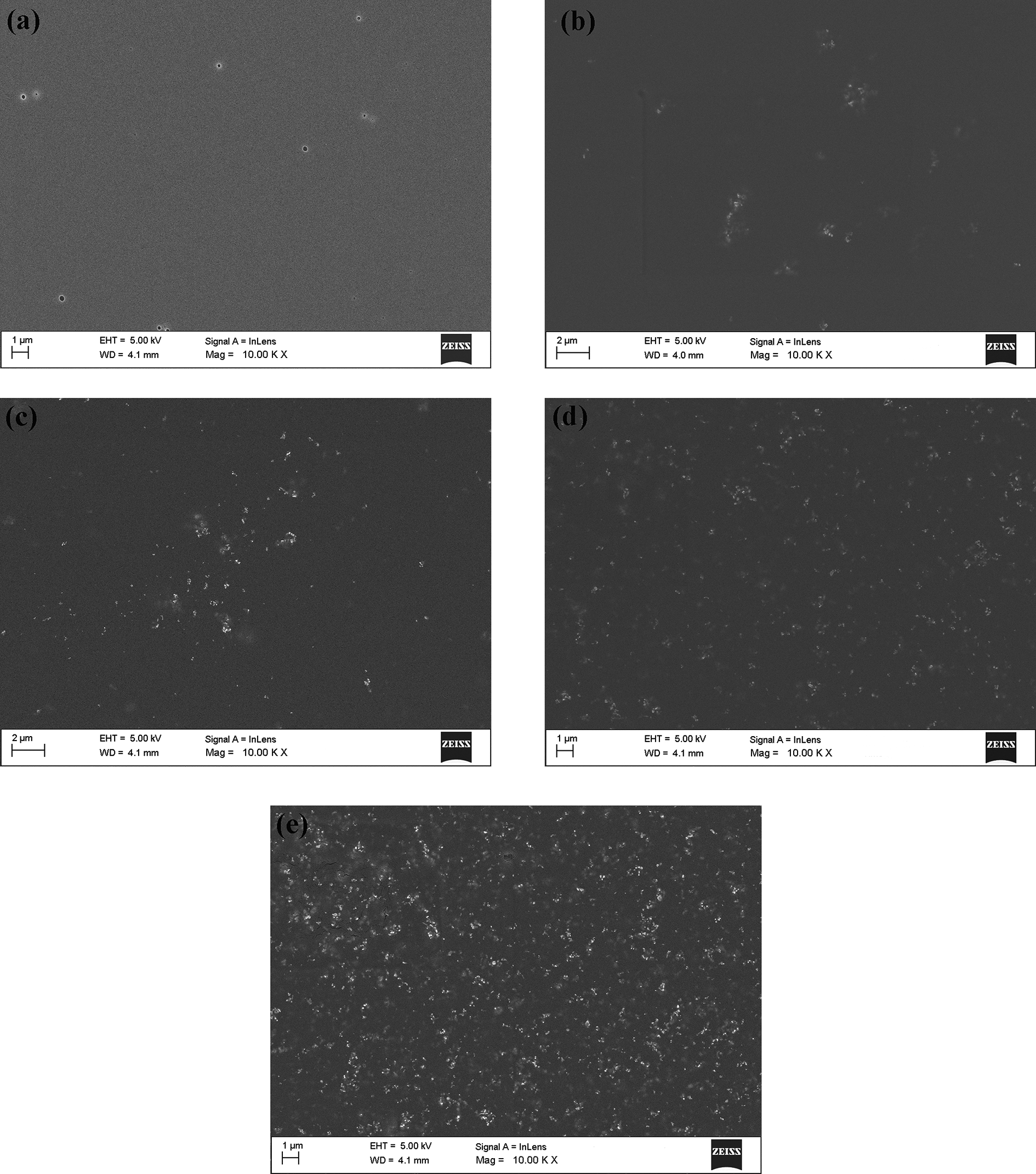
Scanning electron micrographs of top surface of PMMA/ZnO nanocomposite films: (a) pristine PMMA, (b) PMMA/1 wt.% ZnO, (c) PMMA/5 wt.% ZnO, (d) PMMA/10 wt.% ZnO, and (e) PMMA/20 wt.% ZnO.
Figures 6, 7, and 8 show the variation of storage modulus (E′), loss modulus (E″) and loss factor (tan δ), respectively, of PMMA and PMMA/ZnO nanocomposites as functions of frequency. The frequency is varied in the range of 10 Hz to 201.5 Hz. Each data point in Figures 6, 7, and 8 represents an average from 18 sets of measurements at a given frequency. The error-bar associated with each of these data-points spans 1 standard deviation about the average value.

Frequency-response of storage modulus of PMMA/ZnO nanocomposite films.

Frequency-response of loss modulus of PMMA/ZnO nanocomposite films.

Frequency-response of loss factor of PMMA/ZnO nanocomposite films.
Figure 6 shows that the mean storage moduli for PMMA, as well as for all PMMA/ZnO nanocomposites, increase with oscillating frequency, from 10 Hz to ∼100 Hz, beyond which the values remain unchanged till 201.5 Hz. This flattening of the frequency-response of storage moduli indicates a high degree of polymerization. At low frequency, especially at 10 Hz, a trend, similar to the one observed in the variation of quasi-static indentation modulus of PMMA/ZnO nanocomposites with ZnO content (Figure 4), is reflected. It is also important to note that the values of storage moduli, measured at the lowest frequency of 10 Hz, exceed the corresponding values of quasi-static indentation moduli of various compositions of PMMA/ZnO nanocomposites. This is in confirmation with the viscoelastic response that can be described through a Prony series of two generalized Maxwell elements that are connected in parallel,21,22 as described in the Online Supplemental Material. The mean value of storage modulus is found to increase from pristine PMMA to PMMA/10 wt.% ZnO nanocomposite, at a given frequency. In addition, the mean value of storage modulus for PMMA/20 wt.% ZnO nanocomposite is not significantly different from that for PMMA/10 wt.% ZnO nanocomposite, at a given frequency. A significant overlap in the spread of the storage moduli of PMMA, PMMA/1 wt.% ZnO, and PMMA/5 wt.% ZnO is observed. A similar overlap in storage modulus is also observed for PMMA/10 wt.% ZnO and PMMA/20 wt.% ZnO.
Figure 7 shows the variation of loss modulus for PMMA/ZnO nanocomposites as a function of frequency. It is observed that for all compositions, the loss modulus shows a monotonic decrease as the oscillation frequency increases from 10 Hz to 201.5 Hz, with mean values of loss moduli decreasing from ∼500–600 MPa at 10 Hz to ∼380–20 MPa at 201.5 Hz. As was observed in the case of mean storage modulus, the mean loss modulus of PMMA and PMMA/ZnO nanocomposites also shows a similar trend with respect to ZnO content at low frequency (especially at 10 Hz). Figure 8 shows the variation of loss factor of PMMA and PMMA/ZnO nanocomposites as a function of frequency. Loss factor shows a similar frequency-response as loss modulus, with mean values of loss factor decreasing from ∼0.09–0.10 at 10 Hz to ∼0.06–0.07 at 201.5 Hz. Due to the significant overlap of the error-bars in Figure 7 and in Figure 8, it is not possible to distinguish the frequency-response of loss moduli and loss factor of the nanocomposites from those of pristine PMMA. The room-temperature frequency-response of the viscoelastic properties of PMMA/ZnO nanocomposites can be extracted from the plots and directly used as viscoelastic material properties in commercial finite element software.
A comparison of the nanomechanical properties of PMMA/ZnO nanocomposites reported in this work with those in the literature is difficult due to differences in testing methodology, as well as due to differences in processing. In addition, the literature on the nanomechanical characterization of PMMA/ZnO nanocomposite films is limited. However, an attempt has been made to compare the results with those in literature which use similar indenter-geometry as well as have similar processing. Quasi-static nanoindentation tests were done with composites up to 1 wt.% of ZnO, and mean indentation modulus values of ∼4.3 ± 0.7 GPa for PMMA and ∼4.9 ± 1.0 GPa for PMMA/1 wt.% ZnO were reported by Chakraborty et al. 9 These values of indentation modulus are in close agreement to the mean indentation moduli of 4.68 ± 0.07 GPa and 4.82 ± 0.08 GPa for PMMA and PMMA/1 wt.% ZnO nanocomposite, respectively, reported in this work. In addition, mean hardness values of ∼320 ± 60 MPa for PMMA and ∼370 ± 60 MPa for PMMA/1 wt.% ZnO have been reported by Chakraborty et al. 9 The mean hardness values of 275.94 ± 5.67 MPa and 275.09 ± 6.93 MPa reported for PMMA and PMMA/1 wt.% ZnO nanocomposite, respectively, in this work are slightly lower than the values reported by Chakraborty et al., 9 and the difference can be attributed to the difference in contact-depth. While the present work involves contact-depth in the range of 70–80 nm, the work by Chakraborty et al. 9 involves contact-depth in the range of 1–2.1 μm. Klapperich et al. 7 have shown that the hardness of PMMA increases with increasing contact-depth. Moreover, the values of indentation modulus and hardness of PMMA reported in this work, closely match the values reported in the literature. For example, Dukali et al. have reported a reduced modulus value of 4.68 ± 0.34 GPa, and a hardness value of 281 ± 18 MPa for PMMA. 23
To the best of our knowledge, the results of dynamic nanoindentation presented in this work are the only available results on PMMA/ZnO nanocomposite films. However, comparison can be made with dynamic mechanical analyses of PMMA. Leal-Junior et al. performed the dynamic mechanical analysis of a PMMA optical fiber and have reported a value of ∼5.1 GPa for storage modulus of PMMA at room temperature and at a frequency of 10 Hz. 24 One application note by Bruker Surface Sciences on the use of nano-DMA reports a value of ∼5.1 GPa for room-temperature storage modulus of PMMA, and a value of ∼0.075 for the room-temperature loss factor of PMMA. 25 These values are in close agreement to the storage modulus value of 5.31 ± 0.15 GPa, and the loss factor value of 0.097 ± 0.001 reported in this work for PMMA at 10 Hz.
Conclusion
In summary, a combination of ultrasonic mixing and spin-coating has been used to produce PMMA/ZnO nanocomposite thin films with ZnO content in the range of 0 to 20 wt.%. Quasi-static and dynamic nanoindentation tests have been performed on these nanocomposite films with mean thickness ranging from ∼2.4 µm for pristine PMMA to ∼33.1 µm for PMMA/20 wt.% ZnO nanocomposite. Indentation modulus and hardness calculated for these nanocomposite thick films indicate that the PMMA/10 wt.% ZnO nanocomposite film exhibits the maximum elastic modulus and hardness among the compositions tested, with an increase of ∼14.5% for indentation modulus, and increase of ∼9% for hardness w.r.t. pristine PMMA thin film. The drop in these mechanical properties beyond the ZnO content of 10 wt.% is attributed to clustering and has been corroborated by microstructural investigation via scanning electron microscopy. A comparison of the experimentally obtained indentation modulus with those values obtained via Eshelby-Mori-Tanaka micromechanics indicates that the spin-coated nanocomposites may exhibit mixed 0–3 and 1–3 connectivity at low volume fractions of ZnO and clustering at high volume fractions of ZnO. Frequency-response of PMMA/ZnO nanocomposite films obtained via nano-DMA indicate that the PMMA matrix has been suitably cured and that the PMMA/ZnO composites exhibit significant viscoelastic behavior in the frequency range of 10–201.5 Hz.
Supplemental material
Supplemental Material, sj-pdf-1-ppc-10.1177_0967391121998484 - Quasi-static and dynamic nanomechanical characterization of PMMA/ZnO nanocomposite thick films synthesized by ultrasonication and spin-coating
Supplemental Material, sj-pdf-1-ppc-10.1177_0967391121998484 for Quasi-static and dynamic nanomechanical characterization of PMMA/ZnO nanocomposite thick films synthesized by ultrasonication and spin-coating by B Krishna, A Chaturvedi, Neelam Mishra and K Das in Polymers and Polymer Composites
Footnotes
Declaration of conflicting interests
The author(s) declared no potential conflicts of interest with respect to the research, authorship, and/or publication of this article.
Funding
The author(s) disclosed receipt of the following financial support for the research, authorship, and/or publication of this article: This work was supported by the Department of Science and Technology-Science and Engineering Research Board (DST-SERB), Government of India, under the Young Scientist Scheme (Grant no. YSS/2014/000830).

Supplemental material
Supplemental material for this article is available online.
References
Supplementary Material
Please find the following supplemental material available below.
For Open Access articles published under a Creative Commons License, all supplemental material carries the same license as the article it is associated with.
For non-Open Access articles published, all supplemental material carries a non-exclusive license, and permission requests for re-use of supplemental material or any part of supplemental material shall be sent directly to the copyright owner as specified in the copyright notice associated with the article.
