



Abstract
Poly (vinyl alcohol) is blended with ethylene glycol by casting method to form PVA-EG blend films. These films were irradiated by both N2 ion beam extracted from dc ion source at different ion fluences and γ-rays with various irradiation doses. The effects of ion beam and γ-rays irradiation on the thermal, micro-hardness, and gel fraction properties of PVA-EG blend films were investigated. The gel fraction % and micro-hardness increase with increasing the γ-rays doses up to 150 kGy and then decreased, where they increased at all fluences of ion beam irradiation. The improvement in the gel fraction percentage and micro-hardness suggest that PVA-EG blend films exhibited a crosslink density. The thermal behavior was examined by thermogravimetric analysis and it shows different thermal patterns depending on the type and dose of radiation. The thermal stability parameters of γ-rays- and ion beam-irradiated PVA-EG samples were evaluated using the Ti, Ts, T0.5, Tf temperatures, and activation energy (Ea) values. The thermal stability parameters were dependent on both the type and extent of irradiation dose and fluence. Finally, there is a good agreement between the obtained results from different measurement techniques.
Introduction
Gamma rays and ion beam irradiation are efficient tools for modifying and improving the physical and chemical properties of polymeric materials, for example, they can lead to important effects such as degradation or crosslinking.1,2 Such effects depend on the chemical structure of the polymer, the process conditions, and the type of radiation besides other factors specific to the polymeric material, such as its processing, degree of crystallinity, and additives.3,4 The changes caused by irradiation on polymeric materials can lead to gains of certain properties, expand their scope, and aggregate value to the final product.5–7 The ion irradiation can vary and enhance the material properties as a result of the implanted ions such as the proton, argon, and nitrogen.8,9 The ion beam implantation has a large effect on the surface morphology and chemical state of polymers.
Recently, the blends of polymers and their copolymers have been studied for a wide range in many applications due to their different properties than the homo-polymers. Moreover, the blending of polymers is the simplest way to control the properties that affect thermal stability, hardness, gel fraction, etc. Irradiation effects on the chemical and physical properties of PVA blends compared with other polymers have been measured by many researchers.10–12 PVA has a good thermo-stability, chemical resistance, and film-forming ability, so it has been utilized in many sophisticated bio-medical applications as contact lenses, artificial organs wound dressing, and wound management due to its good biocompatibility. 13 Also, it can be used for sizing, adhesives, 14 biosensors, 15 and high-energy dosimeter or solid-state batteries. 16 Ethylene glycol (EG) has many applications as raw material for the production of polyester fibers, plastic, and automotive antifreeze used in radiators and cooling systems of internal combustion engines in vehicles. 17 It is also used as a reagent in explosives, alkyd resins, thermodynamic hydrate inhibitors, and synthetic waxes. 18
Both PVA and EG are polar; thus, a blend of PVA and EG is likely to produce a material having excellent mechanical properties and barrier behavior. The PVA-EG-water gels with various PVA concentrations and various EG contents were investigated.19–20 These gels were found to be influenced strongly by the addition of EG. EG interacts with hydroxyl groups in PVA gel-forming polymer such as agarose. In the presence of higher EG content, the gelation was inhibited by free EG, and in the lower EG content, the gelation was inhibited by free water. 21 For a higher PVA concentration, approximately half of the EG in the system is found to be bound to the polymer. 22
Several researches have been performed on the synthesis and characterization of polyvinyl alcohol and EG blend. However, specific work focusing on modifying polyvinyl alcohol and EG hydrogel by irradiation has not been done. In our previous work, the effect of γ-rays and ion beam irradiations on optical and structural properties of PVA-EG composite samples was investigated. 23 The aim of this work is to investigate and discuss the change in the physic-chemical properties such as gel fraction, micro-hardness, and thermal properties of γ-rays- and N2 ion beam-irradiated PVA-EG blend films based on the irradiation dose and fluence of the ion beam.
Experimental
Materials
Poly (vinyl alcohol) with average molecular weight of 96,000–124,000 and 98–99.5% hydrolyzed powder were purchased from OCI (Seoul, Korea). EG, M.wt 62.07, was obtained from Sigma-Aldrich (St Louis, USA). They were used without further purification and the distilled water was used as a solvent in all experiments.
Preparation of PVA-EG blend films
PVA powder (6 wt%) was dissolved in 2% acetic acid solution at 60°C for 4 h. EG was added to the PVA solution with stirring. The contents of EG were a 20 wt/v % of PVA solution. The PVA-EG solutions were then poured into dishes and dried at 50°C for 48 h to confirm the removal of excess solvent traces. The flexible uniform and transparent films had been obtained and retained in the desiccators. 24
Gamma rays and ion beam irradiations
The prepared PVA-EG blend films were cut into 1 cm x 1 cm samples and irradiated with various γ-rays doses, namely, 50, 100, 150, 200, 250, and 300 kGy at ambient temperature in the presence of air using 60Co γ-cell-220 sources (manufactured by the Atomic Energy Commission, India) installed at the National Center for Radiation Research and Technology, Egyptian Atomic Energy Authority, Nasr City, Cairo, Egypt. The irradiation dose rate is 1.2 kGy/h.
Direct current ion beam source was designed and constructed from copper conical anode and disc cathode with radial extraction. The output ion beam was withdrawal from the copper disc ion exit aperture collected on Faraday cup. The nitrogen gas was admitted through a fine controlled gas admittance needle valve to control and adjust the gas flow rate. The operating conditions are 3.5 × 10⁻⁴ mmHg pressure, 1 kV discharge voltage, 0.45 mA discharge current, and 185 μA output ion beam current. 24 Then, the PVA-EG blend films were irradiated by N2 ion beam at various fluencies, namely, 109.15, 218.3, 327.4, 655, and 1310 J/cm2.23,25
Gel fraction determination
The PVA-EG samples were accurately weighed (Wi) and then immersed in distilled water for 24 h at room temperature. The swollen samples were weighed (Ws) after drying in an oven at a constant temperature of about 60°C for 24. The gel fraction percent was calculated as follows

Micro-hardness testing
PVA-EG samples were cut according to ASTM D-2240-95 with a thickness of 5–6 mm and tested with type A shore durometer made by Harteprufer. The micro-hardness measurements were carried out at room temperature and the data recorded at 15 s of indentation after the pressing probe touched the sample.
Thermogravimetric analysis
TGA was carried out using a TG-50 instrument from Shimadzu (Tokyo, Japan) with a heating rate of 10°C/min under nitrogen atmosphere. The primary TGA thermograms were used to determine the different thermal parameters such as the onset temperature (Ti, °C), temperature at maximum weight loss (Ts, °C), temperature at 50 wt % of weight loss (T0.5, °C), and the final temperature at the end of decomposition reaction (Tf, °C). The activation energy of the degradation process for the investigated samples was calculated using the Horowitz and Metzger approximation method.
26
The equation used for the calculation of energy of activation (Ea) is

Results and discussions
Gel fraction measurements
The effects of γ-rays and N2 ion beam irradiations on the gel fraction percentage of un-irradiated and irradiated PVA-EG blend films were investigated. Figure 1 shows the effect of γ-rays irradiation dose and N2 ion beam fluence on the gel fraction of the PVA-EG samples. Gel fraction percentage of PVA-EG samples with different γ-rays irradiation doses and for various N2 ion beam fluences.
The gel fraction of γ-rays-irradiated PVA-EG samples increases by increasing irradiation dose up to 150 kGy, and then it gradually decreases with increasing dose up to 300 kGy. The gel fraction data reveals that the 50–150 kGy γ-irradiation dose range causes an increase in the crosslinking density and thus creates a more entangled structure. Radiation-induced crosslinking of polymeric samples might be formed via combination of macro-radicals formed throughout polymeric chains. The decrease in the gel fraction percent at higher γ-rays irradiation dose may be correlated to the degradation process as a result of bond chain scission of PVA and EG components. With respect to PVA-EG samples irradiated by N2 ion beam, the gel fraction percentage increases with increasing fluence. For N2 ion beam-irradiated blend films, a high level of crosslinking reaction is predominated especially at lower fluencies due to the absence of O2 or air which in turn reduces or prevents the degradation/chain scission reaction.
Finally, it seems that the irradiated samples by γ-rays at lower doses and N2 ion beam at various fluences exhibits higher gel fraction. It is noticed that the gel fraction percentage of the samples exposed to N2 ion beam fluence was relatively higher gel content as compared to γ-rays-irradiated samples. This can be correlated to the absence of degradation reaction in PVA-EG samples as a result of N2 ion beam irradiation. The extent of crosslinking reaction in a blend due to the radiation is reflected by its gel fraction percent. Here, one can conclude that the N2 ion beam irradiation of PVA-EG blends is more effective in the enhancement of structure due to the induced crosslink density on the surface of N2-irradiated samples and the absence of degradation process as compared with the irradiation at higher irradiation doses. In other words, the higher gel fraction % of N2 ion beam-irradiated samples can be investigated based on the higher induced crosslink density.
Micro-hardness measurements
The hardness data of γ-rays- and N2 ion beam-irradiated PVA-EG blend films compared with un-irradiated one are shown in Figure 2. It can be seen that the hardness of the γ-rays-irradiated samples depends on the γ-rays irradiation dose. Firstly, the hardness for un-irradiated PVA-EG sample (45 Shore A) decreases as a result of γ-rays irradiation with 50 kGy (34 Shore A). This decrease in hardness is related with the rapid decrease of crystallinity of PVA-EG samples due to irradiation. Un-irradiated PVA-EG sample exhibits the lowest degree of crosslinking which show higher hardness. The difference between un-irradiated and 50 kGy irradiated PVA-EG samples is due to the higher degree of crystallinity for un-irradiated sample and to the radiation-induced crosslinking. This observation is explained with a very strong effect of crystallinity on micro-hardness of polymer.
27
Secondly, the hardness of γ-rays-irradiated PVA-EG samples increases with increasing irradiation dose from 50 up to 150 kGy. This increase in hardness can attribute to the increase of crosslink density due to irradiation. At higher irradiation doses 150–300 kGy, the hardness decreases with increasing irradiation dose. This can be correlated to the higher extent of radiation-induced degradation behavior at higher irradiation dose, which includes a mixture of chain scission and chain branching, that is, a trend in decrease of the hardness with radiation-induced degradation reaction. Variation of hardness for PVA-EG blends with different γ-rays irradiation doses and for various N2 ion beam fluencies.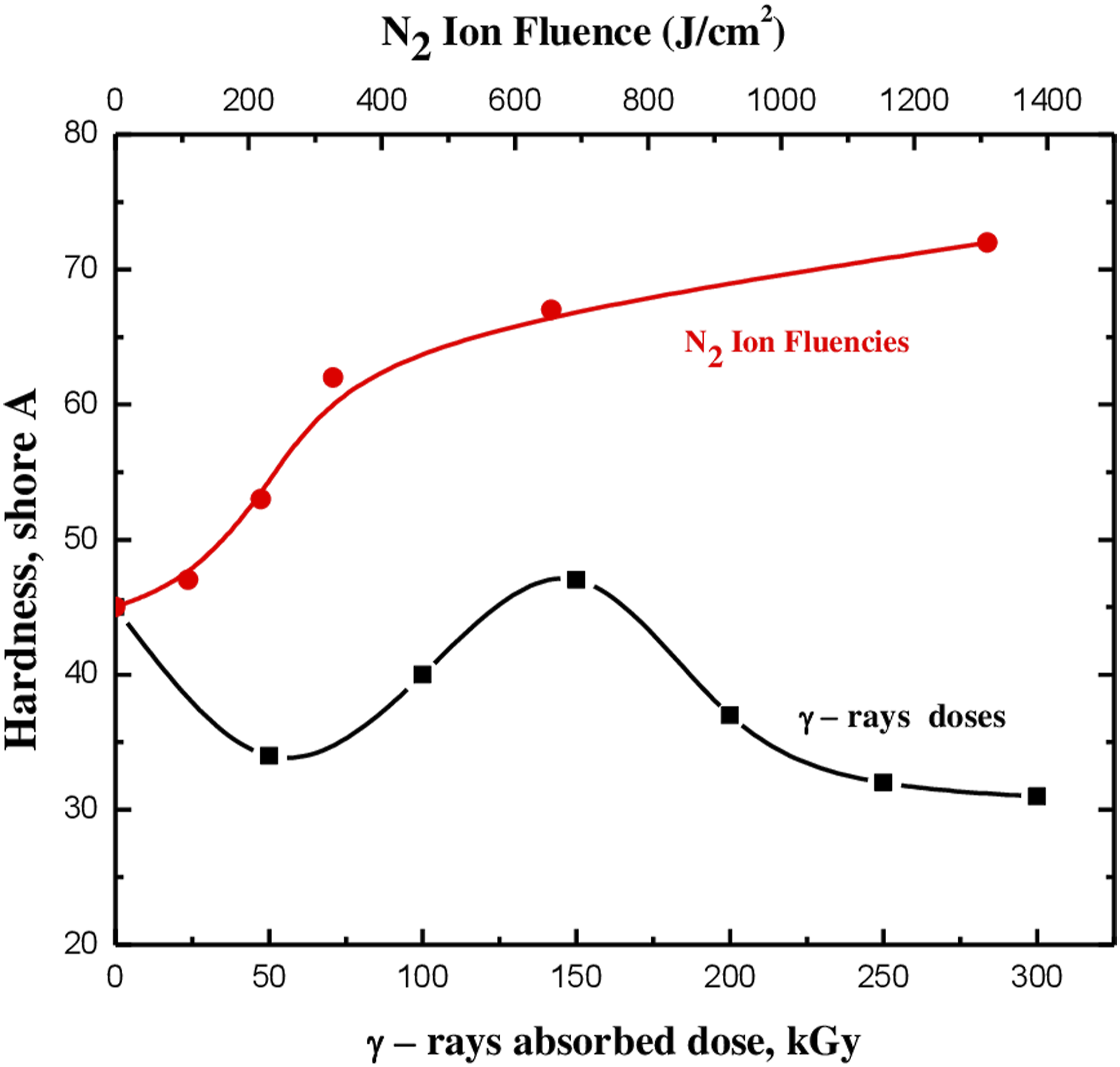
In case of N2 ion beam irradiation, the hardness results show gradual increase for all N2 ion beam-exposed samples and reaching to 72 Shore A at 1310 J/cm2. Here, the obtained data concerning the hardness of N2 ion beam-irradiated samples can be attributed to the higher level increase of crosslink density for ion beam irradiation. Nevertheless, no trend in the decrease of the hardness with ion beam irradiation due to the absence of induced degradation process for N2 ion beam irradiation is found. In conclusion, the obtained data concerning the hardness of γ-rays and N2 ion beam irradiation are consistent with swelling data. Moreover, the N2 ion beam-irradiated PVA-EG blend samples exhibited a higher hardness value (70 Shore at higher fluence) throughout a gradual increase behavior as compared to 30 Shore at higher γ-rays-irradiated samples (300 kGy). In general, the level of hardness for N2 ion beam-irradiated samples is higher than that for γ-rays-irradiated ones.
Thermogravimetric analysis
Thermogravimetric analysis (TGA) was used to investigate the thermal stability of PVA-EG blend films. In this respect, TGA curves and their derivative (dw/dt) as a function of temperature are presented in Figures 3 and 4 for both γ-rays- and N2 ion beam-irradiated PVA-EG blend films, respectively. TGA thermograms of un-irradiated and irradiated PVA-EG blend films: (a) γ-rays doses and (b) N2 ion beam irradiations. dw/dt as a function of temperature for un-irradiated and irradiated PVA-EG samples.

The thermal stability parameters of un-irradiated and γ-rays- and N2 ion beam-irradiated PVA-EG samples.

The obtained data show that the initial temperature (Ti) is increased by increasing the γ-rays irradiation dose for PVA-EG samples, whereas the final and saturation temperatures (Tf and Ts) were decreased by increasing γ-rays irradiation dose. Also, it is seen that the weight loss % decreases at Ts temperature and at most temperatures by increasing the γ-rays irradiation dose as shown in Figures 3(a) and 4(a). The γ-rays-irradiated samples exhibit a smaller weight loss values for the first decomposition step 40–100°C followed by more significant weight loss % values for the degradation steps at 300–400°C. The lower values of weight loss in the first degradation step may be due to the evaporation of water molecules, whereas the higher values of weight loss in the second degradation step may be attributed to the oxidative degradation and chain scission of PVA and EG polymer matrix. The TGA thermograms indicate that all the γ-rays-irradiated samples underwent similar thermal decomposition. The peak temperature at which the maximum weight loss of the main degradation step (Ts °C) decreases from 203°C to 176°C as the irradiation dose increases. This observation is an indication to the extent of crosslinking/degradation ratio. The value of Ts°C increases with increasing the crosslinking of the blend due to irradiation. Crosslinking affects both, crystallinity and physical network, and hence originates the variations in Ts. 27
The initial temperature (Ti°C), temperature at maximum weight loss (Ts°C), temperature at 50 wt % of weight loss (T0.5°C), and the final degradation temperature (Tf°C) of N2 ion beam-implanted samples were increased with increasing N2 ion beam fluencies with higher levels as compared with γ-rays-irradiated samples. It can be seen clearly that the thermal stability of N2 ion beam-irradiated PVA-EG samples is higher than that of γ-rays-irradiated ones. This can be attributed to the higher induced surface crosslink density (three-dimensional structure) as a result of N2 ion beam irradiation. In addition, the extent of the degradation process of PVA-EG samples irradiated with N2 ion beam has lower values at the higher temperatures.
Activation energy (Ea) was calculated using approximation method of Horowitz and Metzger (equation 2). Figure 5 a, b, and c shows the relation of ln(ln W0/Wt) versus θ for un-irradiated and irradiated PVA-EG blend films by γ-rays doses and N2 ion beam irradiations. The slope of the plot of ln(ln W0/Wt) versus θ for major degradation events is a straight line with a slope equal to −Eaθ/RTs2.
26
Ea values of all the samples are presented in Table 1. In general, the activation energy (Ea, kJ/mol) of the main degradation step in both γ-rays and N2 ion beam-irradiated samples increase with increasing both γ-rays irradiation dose and fluence of N2 ion beam irradiation. Also, N2 ion beam-irradiated samples exhibited higher activation energy as compared to γ-rays-irradiated samples. As mentioned above, this can be correlated to the level of N2 ion beam irradiation-induced crosslink density due to the absence of O2 in the N2 ion beam irradiation process. Relation of ln(ln W0/Wt) versus θ for PVA-EG blend films: (a) un-irradiated, (b) γ-rays doses, and (c) N2 ion beam irradiations.
Conclusion
- The influence of γ-rays and N2 ion beam irradiation on the physical and chemical properties of PVA-EG blend films was investigated. The gel fraction % increases by increasing irradiation dose up to 150 kGy, and then it decreases with increasing dose up to 300 kGy. - The gel fraction percentage for the γ-rays-irradiated PVA-EG films can be correlated to both radiation-induced crosslinking at lower doses and induced degradation process at higher irradiation doses. - The N2 ion beam-irradiated PVA-EG samples showed that the gel fraction percentage increases with increasing ion fluence. - N2 ion beam-irradiated PVA-EG samples exhibit a gradual increase in the gel fraction percentage as a result of the induced crosslinking reaction on the surface of the investigated samples due to irradiation with N2 gas. - Hardness of N2 ion beam-irradiated PVA-EG blend exhibits a gradual increase behavior with higher values as compared with γ-rays-irradiated samples. This can be attributed to the radiation-induced crosslinking reaction on the surface of N2 ion beam-irradiated samples. - For N2 ion beam-irradiated PVA-EG blends, a high level of surface-induced crosslinking reaction is dominated due to the absence of O2 or air which in turn reduces or prevents the degradation/chain scission reaction. - As the degree of crosslink density increases, the thermal stability parameters increase that appear in the ion beam-irradiated samples more than γ-rays-irradiated ones. - The thermal stability and the kinetic parameter (activation energy of the main degradation process) for N2 ion beam-irradiated PVA-EG blends exhibit higher values as compared with γ-rays-irradiated samples. - This behavior can be correlated to the induced surface crosslink density of N2 ion beam-irradiated samples throughout the studied fluencies.
Footnotes
Declaration of conflicting interests
The author(s) declared no potential conflicts of interest with respect to the research, authorship, and/or publication of this article.
Funding
The author(s) received no financial support for the research, authorship, and/or publication of this article.
