



Abstract
The influence of fibre orientation on physical, mechanical and dynamic mechanical properties of Hibiscus sabdariffa fibre composites has been studied. The composites with longitudinal (0°), transverse (90°) and inclined (45°) fibre orientation were prepared using the hand layup technique. ASTM standards were used for characterization of continuous Hibiscus sabdariffa fibre composites. The composite with longitudinally placed fibres yields improved mechanical characteristics. The addition of longitudinal (0°) oriented continuous Hibiscus sabdariffa fibres to the epoxy enhances tensile strength by 460%, flexural strength by 160% and impact strength by 603% compared to neat epoxy. The longitudinal (0°) fibre oriented composite offers higher resistance to water absorption and thickness swelling compared to other types of composites. All continuous Hibiscus sabdariffa fibre epoxy composites possess an improved storage modulus than the neat epoxy resin. The glass transition temperature of continuous Hibiscus sabdariffa fibre composites is 8%–31% lower than that of neat epoxy. Scanning electron microscopy (SEM) images confirm the existence of voids in the matrix, fibre pullout and crack propagation near the fibre bundle, which indicates the stress transfer between fibre and matrix is non-uniform.
Introduction
Reinforcing polymers with synthetic fibres such as carbon, aramid and glass can improve their mechanical performance. 1 Hence, these synthetic fibre polymer composites are widely used in aerospace, marine, automotive, sports and agricultural applications.2,3 The heavy use of synthetic fibre composites raised many environmental issues.4,5 From the last few decades, natural fibres are the most commonly used reinforcement in polymer composites. It is because of their benefits such as being eco-friendly, cheap, light in weight and good strength.6,7 The natural fibres are readily available in nature, and their extraction is also so simple. Natural fibres like jute, sisal, kenaf, hemp, banana, roselle, coconut coir, pineapple leaf, sugar palm and date palm are frequently used to reinforce the polymers.8,9 Hibiscus sabdariffa is the scientific name of roselle plant. H. sabdariffa is cultivated in South Asia and Africa for food and medicine purposes. 8 H. sabdariffa bast fibres can be extracted from dried Hibiscus sabdariffa plants using the water retting process. 8 The mechanical properties of H. sabdariffa fibres are comparable to those of jute and kenaf fibres. 9
Singha and Thakur10–12 developed Hibiscus sabdariffa fibre phenol-formaldehyde composites. For this, they used Hibiscus sabdariffa fibres in particle and chopped form. Kazi et al. 13 investigated characteristics of woven Hibiscus sabdariffa fibre epoxy composites and suggested these materials for automotive interiors, door panels, dashboards, etc. Chavali and Taru 14 studied the tensile and wear behaviour of unidirectional banana fibre epoxy composites. They examined 0°, 15°, 45°, 75° and 90° fibre oriented composites and concluded that 0° fibre oriented composite performs better. Roa et al. 15 investigated the impact of fibre orientation and fibre loading on the mechanical behaviour of Hardwickia binata and bamboo fibre composites. They prepared both Hardwickia binata and bamboo fibre composites with 0°, 45°, 60° and 90° orientations, and 8%, 16% and 24% fibre content by weight. They concluded that composites with a fibre content of 24% by weight and 0° orientation yield better results. Cordin et al. 16 examined the mechanical characteristics of 0°, ±22.5°, ±45°, ±67.5° and 90° oriented lyocell fibre polypropylene composites. Yoganandam et al. 17 explored characteristics of madar and gongura fibre reinforced hybrid composites. Hassan et al. 18 investigated tensile and flexural properties of 0°, 45° and 90° oriented oil palm empty fruit bunch fibre composites. They observed excellent tensile and flexural properties for 0° oriented composite. Tholibon et al. 19 studied the tensile behaviour of continuous kenaf fibre polymer composites. Devireddy and Biswas20,21 explored the physical, mechanical and thermal characteristics of unidirectional banana and jute fibre hybrid composites.
Venkatachalam et al.22,23 studied the impact of alkali treatment on the mechanical behaviour of jute and gongura hybrid fibre polymer composites. Biswas et al. 24 compared the mechanical and thermal performance of jute fibre composite with bamboo fibre composite. Kumarsen et al. 25 revealed that the longitudinal-oriented sisal fibre epoxy composite yields better mechanical properties than the cross-ply sisal fibre composites. Badrinath and Sethilvelan 26 compared the mechanical properties of banana and sisal fibre composites. Mahjoub et al. 27 studied the influence of fibre content on tensile characteristics of the unidirectional kenaf fibre composites. Tensile and flexural properties of unidirectional sisal fibre composite are better than mat-type sisal fibre composite. 28 Laranjeira et al. 29 compared the mechanical properties of unidirectional kenaf polyester composite with short- and random-oriented kenaf polyester composite. Wazzan 30 carried out a comparison between the mechanical properties of woven and unidirectional date palm fibre composite. Herrera-Franco and Valadez-Gonzalez 31 studied the influence of silane treatment on the mechanical properties of continuous henequen fibre composites. Lee et al. 32 investigated the combined effect of fibre orientation (0°, 45°, 90° and random) and fibre loading (30%, 40% and 50% by weight) on the mechanical properties of kenaf fibre composites. They found that the 0° oriented kenaf fibre composite with 40 wt. % fibre loading possesses improved mechanical properties.
The present study covers the physical, mechanical and dynamic mechanical performance of continuous Hibiscus sabdariffa fibre reinforced epoxy composites. The composites with longitudinal, transverse and inclined fibre orientation are considered for this study.
Materials and methods
Materials
In this study, continuous Hibiscus sabdariffa bast fibres are used as reinforcement, and the mixture of epoxy (GY257) and hardener (HY140) is used as matrix material. The Hibiscus sabdariffa fibres were purchased from the local market. Epoxy (GY257) and hardener (HY140) were obtained from Shree Industrial Composite Products, Hyderabad, India.
Composites preparation
For this research work, continuous Hibiscus sabdariffa fibre epoxy composites with fibre orientation 0° (longitudinal), 90° (transverse) and 45° (inclined) were prepared by using the hand layup method. The composite plates were fabricated using an aluminium mould measuring 300 mm by 150 mm by 4 mm. At first, all mould surfaces coated with Carbonblack Composite’s mould releasing wax for quick release of the composite plate from the mould. The resin is prepared by mixing epoxy and hardener in a 2:1 weight ratio. The prepared epoxy resin is applied on the mould bottom surface, and then the continuous Hibiscus sabdariffa fibres are arranged manually in the mould. The remaining epoxy resin is poured onto it. The trapped air bubbles in the composites were eliminated with the help of a roller. Finally, the mould was closed, and the load of 60 kg was put on it. After 24 hours, the cured composite plate was collected from the mould, and test specimens were cut as per ASTM norms. The fibre loading for all these composites was maintained at approximately 30% by weight. For this, the required exact amount of resin and fibre is determined using the composites rule of mixture. Figure 1 shows a schematic representation of the continuous Hibiscus sabdariffa fibre composites used in this study. Schematic representation of the continuous Hibiscus sabdariffa fibre composites with various fibre orientations.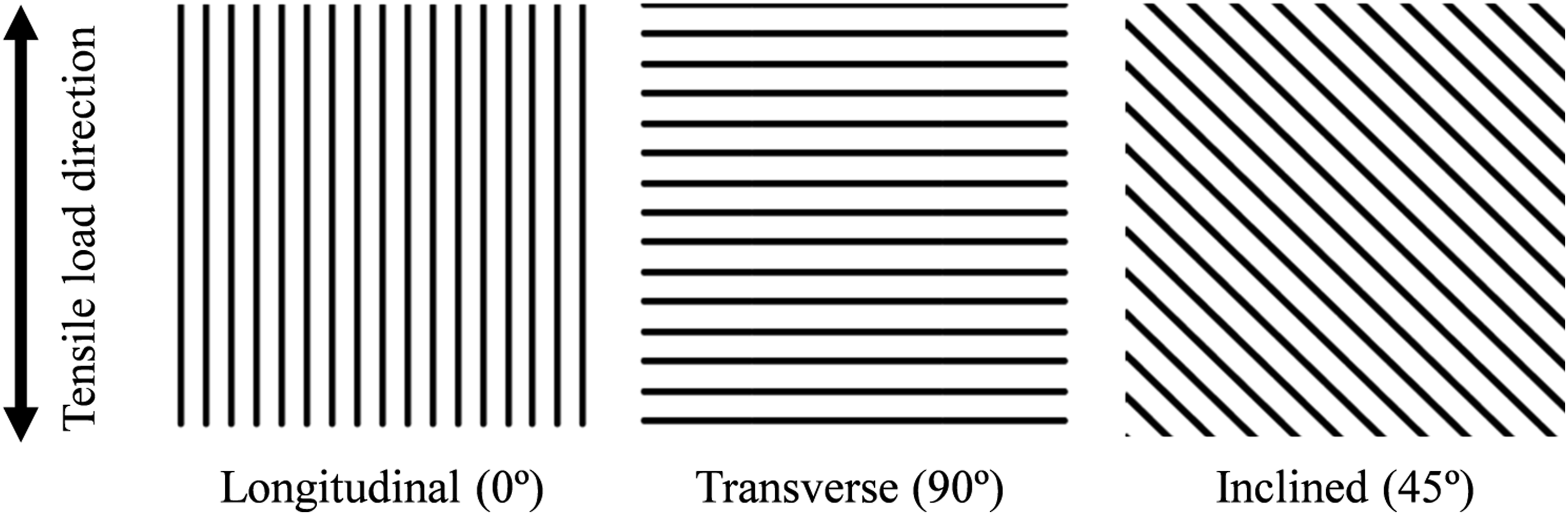
Characterization of the composites
Physical properties
Density and void content
Experimental densities of continuous Hibiscus sabdariffa fibre composites are obtained according to the ASTM D 792 standard. For this work, specimens are sized to 50 mm by 10 mm by 4 mm. The specimen mass in air and mass in distilled water were recorded using an analytical balance with 1 mg resolution. Based on equation (1), the composite density is determined

The void content is determined using ASTM D 2734 standard. The given equation (2) gives an expression for percentage void content

Water absorption behaviour
Water absorption behaviour of continuous Hibiscus sabdariffa fibre composites studied as per ASTM D 570 standard. For this test, specimens are sized to 76 mm by 25 mm by 4 mm. At first, the test specimens are dried in the oven for 5 hours at 50°C. On cooling in a desiccator, the dried specimen mass is recorded using an analytical balance. The specimen is then immersed in distilled water, and specimen mass is recorded at every 24 hour time interval for the next 15 days. An analytical balance with 1 mg resolution was used for this test. The percentage of water absorption is determined based on equation 3

Thickness swelling behaviour
The specimens of size 76 mm by 25 mm by 4 mm were used for the thickness swelling test. The oven-dried specimen thickness was measured using a Vernier calliper. The specimen is placed in distilled water, and the thickness is recorded at every 24 hour time interval until no change in specimen thickness is observed. The percentage thickness swelling is determined based on equation 4

Mechanical testing
Tensile and flexural behaviour of Hibiscus sabdariffa fibre composites studied using Zwick-Roell (model Z020) universal testing machine with a load cell capacity of 20 kN. The tensile test specimens are as shown in Figure 2. Izod impact tester is used to conduct an unnotched impact test. For the flexural test, the support span to thickness ratio of the specimen was maintained at 32:1. The support span is the specimen length between two supports in the flexural test set up. Table 1 shows details for mechanical testing. Tensile test specimens (a) Longitudinal (0°) fibre oriented composite, (b) Transverse (90°) fibre oriented composite and (c) Inclined (45°) fibre oriented composite. Mechanical testing details.
13


Scanning electron microscopy
Scanning electron microscopy (SEM) analysis is done to inspect the tensile failure surfaces of the composites. FEI (Model: Apreo LoVac) microscope with a magnification range from 10× to 300,000× is used for this study. At first, sputter coating is done on tensile failure surface using Leica Ultra Microtome sputter coater (Model: EM UC7). Then, the sputter-coated surface was studied under the microscope at magnifications of 100× to 650×.
Dynamic mechanical analysis
Dynamic mechanical analysis (DMA) test is carried out as per ASTM D 4065 standard. TA instrument DMA Q 800 is used for this test. DMA test specimen is sized to 50 mm by 10 mm by 4 mm. The DMA test is done in dual cantilever mode at 1 Hz frequency by varying temperatures from 0°C to 200°C.
Results and discussion
Physical properties
Density and void content
Density and void content of Hibiscus sabdariffa fibre composites.

Water absorption behaviour
H. sabdariffa fibres are hydrophilic in nature. Hence, water absorption behaviour is a significant physical property of the Hibiscus sabdariffa fibre composite. Figure 3 shows the percentage of water absorption for Hibiscus sabdariffa fibre composites with water immersion time. The water absorption graph for all composites demonstrates quick water absorption in the beginning period. It happens because the surface voids and roselle fibre cellulosic structure absorb water quickly in the beginning. With increased immersion time-period, fibres absorb more water through capillary action until saturation occurs.
33
It is a slow process. Hence, the water absorption curve flattens with time and achieves an equilibrium condition. All composites reached water absorption saturation after 240 hours of water immersion. The maximum water absorption for 0°, 90° and 45° fibre orientated composites are 5.4%, 9.4% and 7.7%, respectively. The neat epoxy (NE) saturates after 24 hours by absorbing only 0.4% water, which is negligible compared to composites. Water absorption of Hibiscus sabdariffa fibre composites.
Thickness swelling behaviour
The thickness swelling is directly proportional to the water absorption of the material. Figure 4 shows the thickness swelling percentage for the composites as a function of immersion days. The maximum thickness swelling for 0°, 90° and 45° fibre orientated composites are 7.5%, 12.4% and 8.8%, respectively. The neat epoxy (NE) reflects no change in thickness. Thickness swelling of Hibiscus sabdariffa fibre composites.
Mechanical properties
Mechanical properties of Hibiscus sabdariffa composites.

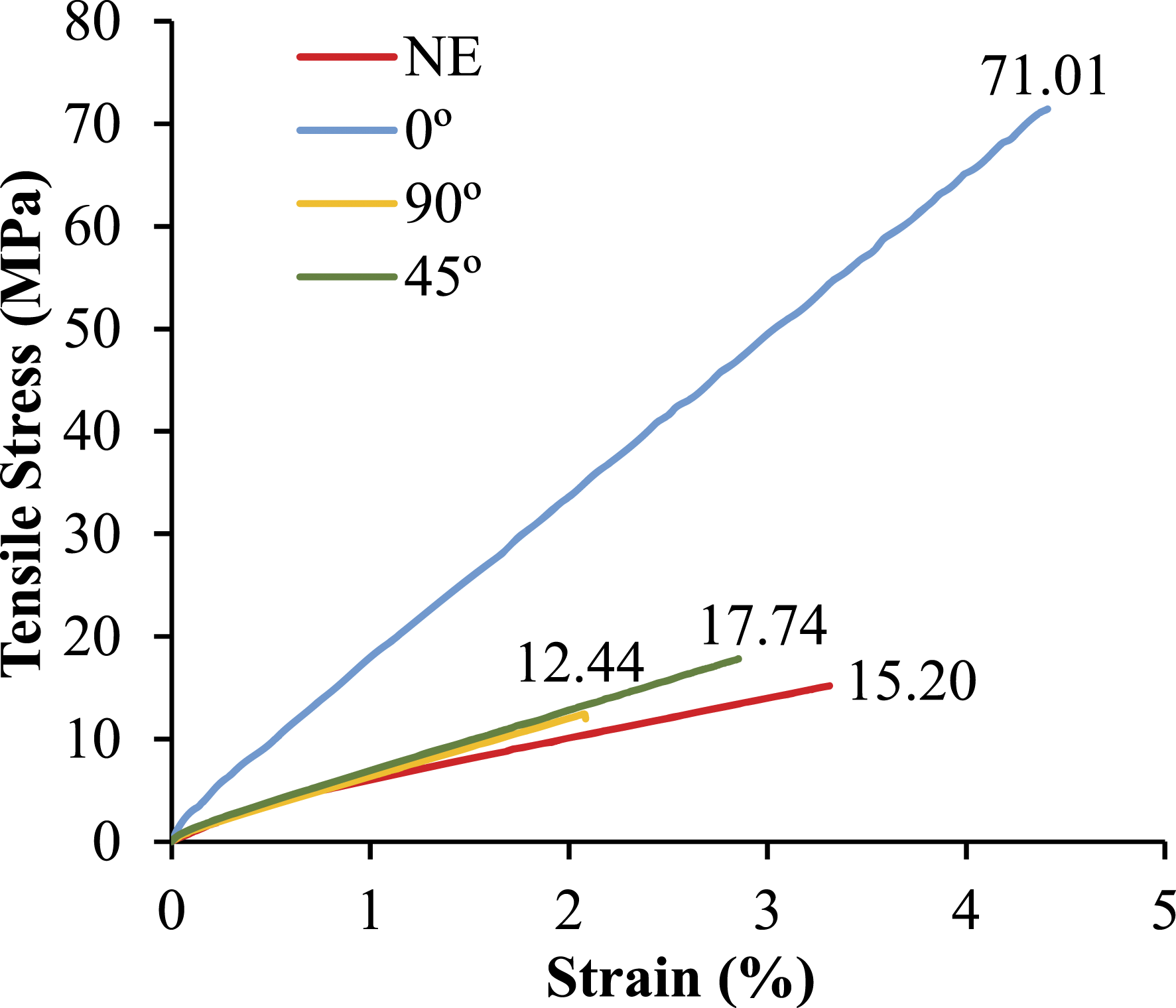
Stress–strain curves for continuous Hibiscus sabdariffa composites under tensile load.
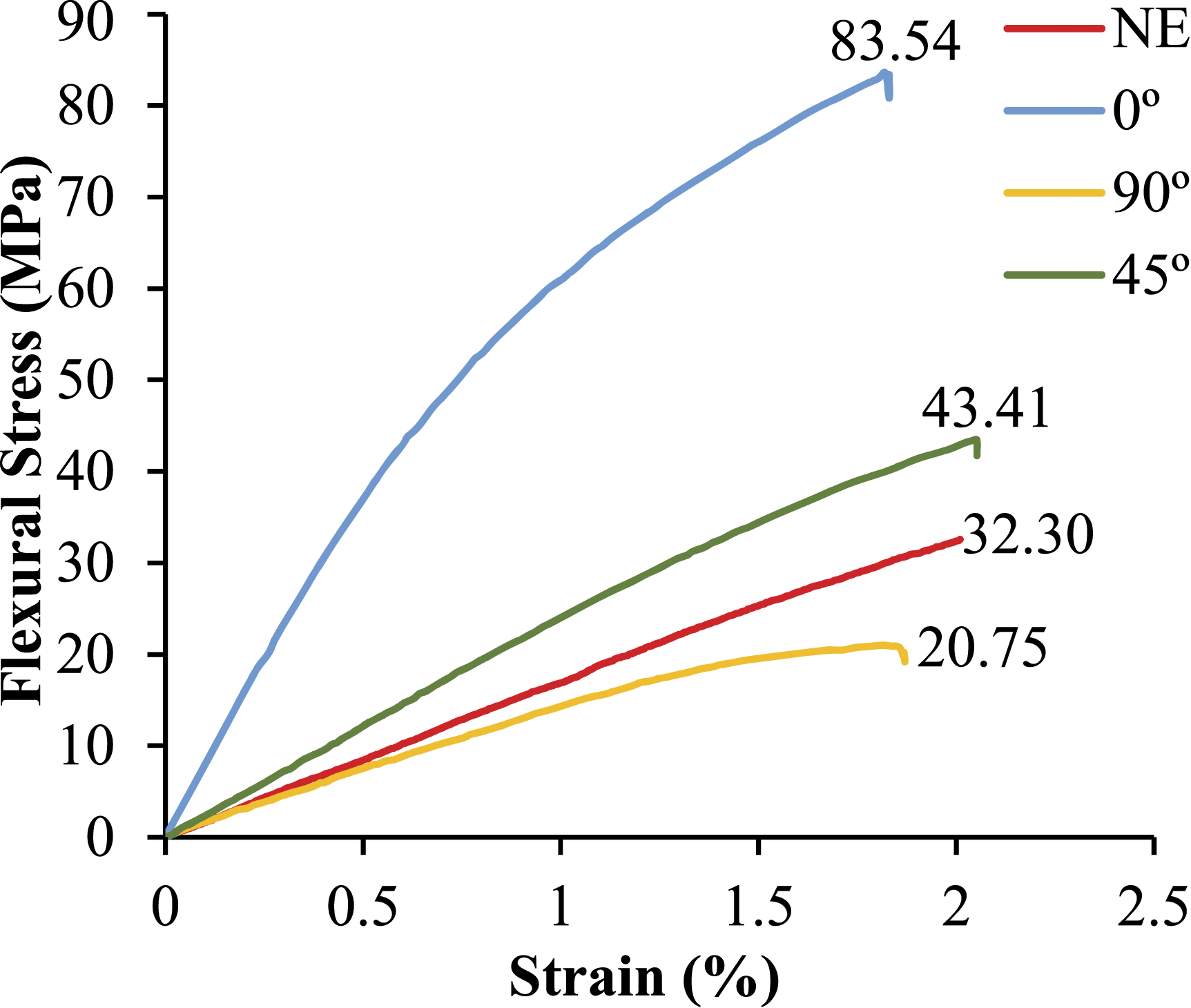
Stress–strain curves for continuous Hibiscus sabdariffa composites under flexural load.
Scanning electron microscopy (SEM)
Scanning electron microscopy images for tensile failed continuous Hibiscus sabdariffa fibre epoxy composites are shown in Figure 7. Figures 7(a) and (c) display fibre pullout and crack propagation near damaged fibres, which describes non-uniform stress transfer between fibre and matrix. Figure 7(b) shows the failure of a 90° fibre oriented composite at the fibre–matrix interface. SEM images of tensile failure surface of continuous Hibiscus sabdariffa fibre epoxy composites (a) longitudinal (0°) composite, (b) transverse (90°) composite and (c) inclined (45°) composite.
Dynamic mechanical analysis
Storage modulus (E’)
Storage modulus is the measure of material stiffness. Storage modulus plot consists of three zones, namely, glassy, transition and rubbery zones. Storage modulus values are found higher in the glassy zone. The polymer chain mobility increases with increased temperature, which causes a sudden fall in storage modulus values. This zone is known as a transition zone. In the rubbery zone, the storage modulus value falls considerably. Figure 8(a) shows the storage modulus plot for Hibiscus sabdariffa fibre composites. The 45° fibre oriented composite has higher storage modulus in the glassy zone that is up to 60°C. It is due to the 45° oriented fibres bear both the normal stress and shear stress generated in the composite during cyclic loading of DMA.
16
The 0° and 90° fibre orientations yield a unidirectional reinforcing effect, resulting in reduced storage modulus.
16
In the rubbery zone, 0° fibre oriented composite has higher storage modulus. All Hibiscus sabdariffa fibre epoxy composites possess a higher storage modulus than the neat epoxy resin. Dynamic mechanical behaviour of continuous Hibiscus sabdariffa fibre epoxy composites (a) Storage modulus, (b) Loss modulus, (c) Loss factor and (d) Cole–Cole plot.
Loss modulus (E’’)
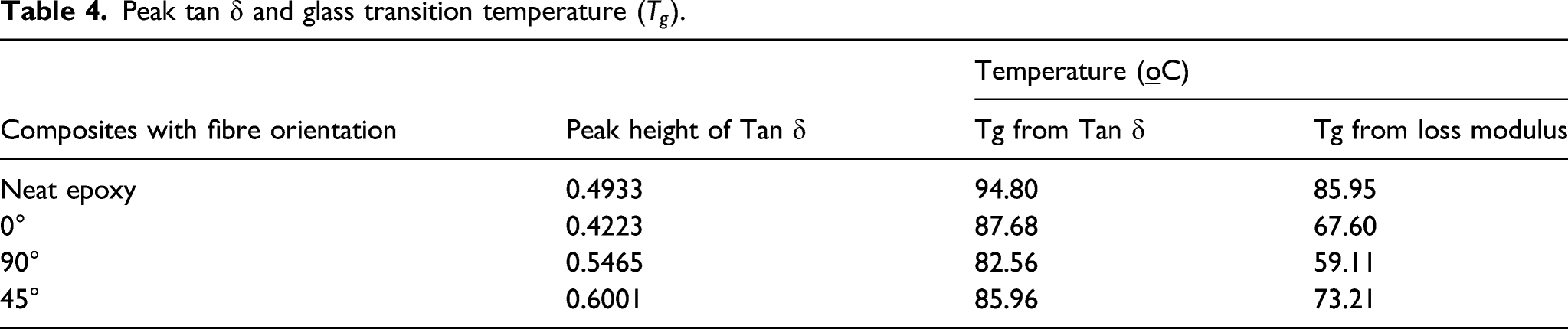
Peak tan δ and glass transition temperature (
Material loss factor or Tan δ
The ratio of energy dissipated to energy stored under cyclic load is known as the material loss factor. Figure 8(c) shows the material loss factor plot for Hibiscus sabdariffa fibre composites. The composites with 45° and 90° fibre orientation have higher peak values of loss factor, and the composite with 0° fibre orientation has a lower peak value of loss factor than neat epoxy. For all composites, loss factor peak values appeared at a lower temperature as compared to neat epoxy. The incorporation of continuous Hibiscus sabdariffa fibres in epoxy enhances epoxy polymer chains mobility resulting in reduced glass transition temperature than neat epoxy. The peak of loss factor (tan δ) and glass transition temperature (Tg) based on loss factor are as shown in Table 4.
Cole–Cole plot
The Cole–Cole plot exhibits structural behaviour of polymer composite like material homogeneity, the interaction between fibre and matrix, etc. The material is said to be homogeneous when the Cole–Cole plot is pure hemispherical. Figure 8(d) shows the Cole–Cole plot for Hibiscus sabdariffa fibre composites. The Cole–Cole curve for neat epoxy is smooth and semi-circular which indicates homogeneity of the material. Whereas the graphs for longitudinal (0°), transverse (90°) and inclined (45°) fibre oriented composites are rough semi-circular, indicating composites heterogeneity.
Conclusion
The influence of fibre orientation on physical, mechanical and dynamic mechanical properties of Hibiscus sabdariffa fibre composites has been studied. From this experimental study, we arrived at the following conclusions:
• Result proves that longitudinal (0°) fibre oriented composite possesses excellent mechanical properties than other composites. The longitudinal (0°) fibre oriented composite yields tensile strength of 73.87 MPa, flexural strength of 83.9 MPa and impact strength of 23.48 kJ/m2.
• The longitudinal (0°) fibre oriented composite offers higher resistance to water absorption and thickness swelling compared to other types of composites. At saturation point, the thickness of the longitudinal (0°) fibre oriented composite increased by 7.5% after absorbing 5.4% water by weight.
• DMA result shows that all continuous Hibiscus sabdariffa fibre epoxy composites possess an improved storage modulus than the neat epoxy resin. The longitudinal (0°) fibre oriented composite has a lower loss factor value than other composites.
• It is observed that the glass transition temperature of continuous Hibiscus sabdariffa fibre composites is 8%–31% lower than that of neat epoxy.
• Scanning electron microscopy (SEM) images confirm the existence of voids in the matrix, fibre pullout and crack propagation near the fibre bundle, which indicates the stress transfer between fibre and matrix is non-uniform.
Footnotes
Acknowledgements
Authors thank Department of Mechanical Engineering, Koneru Lakshmaiah Education Foundation, Vaddeswaram, Andhra Pradesh for providing facilities to carry out this research. Authors also thank Central Analytical Laboratory, Department of Chemistry, BITS Pilani Hyderabad Campus for to carry out SEM analysis. Authors also thank Plastic Testing Centre, CIPET: Institute of Plastic Technology (IPT), Chennai for extending DMA testing facility.
Declaration of conflicting interests
The author(s) declared no potential conflicts of interest with respect to the research, authorship, and/or publication of this article.
Funding
The author(s) received no financial support for the research, authorship, and/or publication of this article.
