



Abstract
The mechanical properties of nanocomposites based on poly lactic acid/polyolefin elastomer (PLA/POE) were investigated. The compounds were made using an internal mixer. POE in two levels at 10–20 wt.% and nano fillers, including multi-walled carbon nanotubes (MWCNT) and graphene nano-platelets (GnPs) in 1, 2, and 3 wt.% levels, were added to the PLA. Impact and tensile tests were conducted to extract the impact and tensile properties, respectively. The dispersion quality of the fillers was also studied by using field-emission scanning electron microscopy (FESEM) images. The FESEM images demonstrated that the MWCNT at all levels were well distributed in different orientations, while the GnPs accumulated into the PLA/POE matrix. The simultaneous presence of nano fillers was dispersed with high quality in the matrix only in low loading. The tensile test results showed that by increasing the nano fillers individually and in a hybrid form in the presence of different loadings of POE, Young’s modulus and T-strength were improved, but impact strength and deformation at break were decreased. The addition of the POE to the PLA matrix significantly increased the impact strength and deformation at break by 128% and 75%, respectively, and the presence of POE reduced Young’s modulus and T-strength of the PLA matrix.
Keywords
Introduction
Poly lactic acid (PLA) is obtained from renewable materials such as beets and corn. This biocompatible thermoplastic has better mechanical properties compared to petroleum-derived polymers. 1 Therefore, PLA can be a good candidate for using in the packaging of food products, medicine, electrical tools, and automotive industries. An important factor in the case of renewable polymers is the strengthening of their mechanical properties in various ways. 2 PLA is a brittle polymer with low impact strength and deformation at break. 3 For PLA to be able to compete with other widely used polymers, its mechanical properties must be improved. Much effort has been made to enhance the impact properties of PLA. Copolymerization, blending and incorporation of fillers are the well-known methods for modification of PLA performance. To improve its deformation at break and impact strength, many researchers have blended PLA with softer and tougher polymers, especially rubbers.4–6
To improve the impact strength and toughness of brittle polymers, they are usually blended with polymeric materials with elastomeric properties, 7 such as polyethylene (PE), 8 polybutylene succinate (PBS), 9 polybutylene adipate-co-terephthalate (PBAT), 10 and polyolefin elastomers (POEs). 11 A polymer used to reduce the brittleness of polymeric materials is POE owing to its superior elasticity and toughness. Da silva et al. 7 used POE and EPDM as impact modifiers in the PP matrix. The results indicated that both of them improved the impact strength of PP by an incredible 270%, while the presence of the POE and EPDM reduced the modulus from 555 to 340 MPa and 555 to 320 MPa, respectively. Chiu et al. 12 confirmed that adding 10 wt.% POE to the polyamide6 matrix increased impact strength from 37 to 105 J/m, indicating a significant increase by 183%. On the other hand, the presence of 10 wt.% POE reduced the T-strength and Young’s modulus of the polyamide6 matrix by 8% and 15%, respectively. Zhou et al. 11 reported that adding POE up to 20 wt.% was associated with a 71% increase in PLA impact strength. Interestingly, the presence of 5 wt.% POE not only did not reduce the T-strength of the PLA matrix but also increased it by 7%. A comparison of the addition of POE and other impact and toughness modifiers in different matrices reveals that POE significantly decreases their brittleness and does not have a severe decreasing effect on strength and modulus. 13
Many researchers have employed nanomaterials as a third component and made polymer nanocomposites to compensate for strength and modulus reduction due to adding toughening modifier polymers to more brittle polymers. 14 Carbon nanotubes,15–17 graphene nano-platelets and graphene oxide,18,19 carbon black, 20 titanium dioxide, 21 nano clay, 22 and silica nanoparticles 23 are the fillers with different structures and shapes that have been added to the PLA to improve some of its properties. A comparison of modifier mechanical properties of polymer matrices, especially PLA, with the help of nano fillers shows that carbon nanotubes have an amazing effect on their T-strength and Young’s modulus. Mat desa et al. 15 reported that adding up to 9 phr MWCNT to the PLA matrix resulted in a brilliant increase in Young’s modulus by 194%. However, the impact strength of PLA was severely reduced by 83%. The effect of the presence of carbon nanotubes on the PLA’s tensile properties has been investigated in several studies, all showing that the addition of nanotubes to PLA improves its strength and modulus tremendously and weakens its impact strength.24–26
On the other hand, the presence of graphene nano-platelets (GnPs) with the plate structure in polymer matrices at low loading not only improves the strength and modulus but also increases the deformation at break and impact strength of the polymer matrices in some cases, unlike the nanotubes. The dispersion of GnPs has been difficult at high loading in the polymer matrix; their presence only at low loading (up to 1 wt.%) has improved the mechanical properties of polymer matrices.18,19 Chakraborty et al. 2 reported that with the addition of a low content of GnPs within the PLA matrix, Young’s modulus, T-strength, and deformation at break increase by 31%, 18%, and 12%, respectively. Furthermore, Scaffaro et al. 27 reported that the increase in the GnPs content up to 1 wt.% in the PLA led to a rise in Young’s modulus, T-strength, and deformation at break. Ching et al. 28 concluded that the addition of GnPs up to 1 wt.% to the PLA/PEG binary matrix was associated with an increase in T-strength (from 22 to 30 MPa), Young’s modulus (from 420 to 780 MPa), and deformation at break (from 400 to 500%).
Simultaneous addition of nano fillers to a polymer matrix and the fabrication of polymer hybrid nanocomposites has led to the achievement of balance among the mechanical properties. Also, the simultaneous addition of nano fillers to a polymer and the fabrication of polymer hybrid nanocomposites leads to the achievement of interesting electrical, mechanical, and thermal properties. 29 Mondal et al. 30 have studied the mechanical properties of NBR/GnPs/MWCNT hybrid nanocomposites. The simultaneous addition of both nano fillers to the NBR matrix showed a significant increase in T-strength, Young’s modulus, and deformation at break. The study of the mechanical properties of PLA/nano clay (NC)/nano calcium carbonate (NCC) hybrid nanocomposites indicated that the highest T-strength was obtained for the PLA-3wt.% NC-7wt.% NCC condition. 31 The hybrid nanocomposite properties are exclusively related to factors such as the nano fillers, type, dimension, and shape, as well as the nano fillers-matrix adhesion. 32 Studies show that the simultaneous addition of an elastomeric polymer (such as POE) as a toughness modifier and one or more nano fillers (such as carbon nanotubes and graphene nano-platelets) as reinforcement fillers can provide attractive results and create a proper balance between the mechanical properties of widely used polymers such as PLA.
This study aimed to investigate the mechanical properties of nanocomposites based on the PLA/POE binary matrix. Mechanical properties including the impact strength, T-strength, Young’s modulus, and deformation at break of nanocomposites were also examined in the presence of three reinforcement agents: the POE polymer (at 10–20 wt.%), MWCNT (at 0–3 wt.%), and GnPs (at 0–3 wt.%).
Experimental
Materials
PLA 05 BIOKAS based grades, with a density of 1.25 g/cm3, melt flow index of 7 g/10 min (210°C/2.16 K), T-strength of 45 MPa (ASTM D638), deformation at break of 3%, and impact strength of 4 J/m (ASTM D256), was provided from CHEMIE KAS GmbH (Austria); POE (DF640) with a melt flow index of 3.6 g/10 min (190 C/2.16 kg) and a T-strength of 3 MPa (ASTM D638) was purchased from Mitsui Chemicals (Japan); multi-walled carbon nanotubes with 25 nm diameter, 10 μm length, and 220 m2/g specific surface area were provided from United Nanotech, Karnataka, India; and graphene nano-platelets (Research Grade, purity 99.5+%, thickness 2–8 nm, 3–6 layers) were prepared from US-Nano, Houston, TX, USA. FESEM images from multi-walled carbon nanotubes and graphene nano-platelets powders were prepared before fabrication of the samples and are shown in Figure 1. FESEM images from nanomaterials powder (a) multi-walled carbon nanotubes, and (b) graphene nano-platelets.
As can be seen from Figure 1(a), carbon nanotubes are clearly visible in the form of tubes. Also, graphene nano-platelets in the form of light plates are well seen in Figure 1(b).
Characterizations of MWCNT and GnPs.

Sample preparation
Compounds and their constituents.

Characterization
A RESIL IMPACTOR instrument (Italy) was employed to perform the Izod crotch method impact testing at room temperature according to ASTM D256. The energy obtained from the impact tests for each sample was divided on width of the samples. Thus, the impact energy of each sample was extracted in term of J/m. A Zwick/Roell–Z100 instrument (Germany) also was used to conduct the tensile test according to ASTM D638 with a crosshead speed of 5 mm/min at room temperature. The output of the Zwick/Roell–Z100 instrument provided a stress-strain diagram and a PDF file including T-strength, Young’s modulus and deformation at break for each sample tested. To observe the quality dispersion of nano fillers in the polymer field, a VEGATESCAN scanning electron microscope with a voltage of 20 kV in a vacuum was utilized. Before extracting the FESEM images, the surfaces of the samples were coated with gold.
Results and discussion
Tensile strength
The effects of MWCNT, GnPs, and MWCNT/GnPs loading on the PLA/POE binary matrix are plotted in Figure 2. As Figure 2(a) indicates, the increase in MWCNT into the both binary PLA/10 wt.% POE and PLA/20wt.% POE exhibits similar behaviors. An increase in MWCNT contents from 0 to 3 wt.% levels continually improved the T-strength of the PLA/10wt.% POE matrix from 32 to 39 MPa (a rise of 22% and the PLA/20wt.% POE matrix from 29 to 37 MPa (a rise of 27%). T- Strength for (a) PLA/POE/MWCNT, (b) PLA/POE/GnPs, and (c) PLA/POE/MWCNT/GnPs.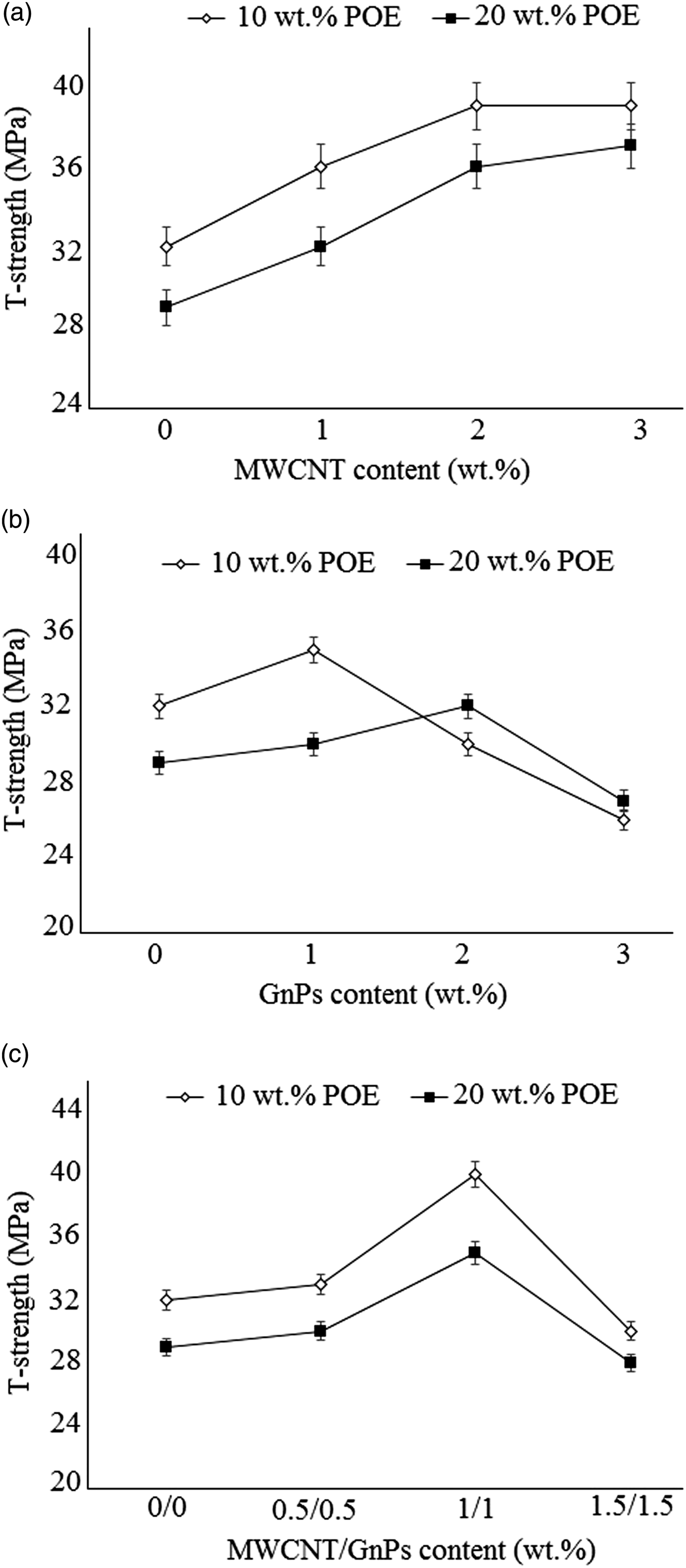
The FESEM images from broken surface of PLA/POE/MWCNT with 35kx magnification are depicted in different parts of Figure 3. It can be seen, MWCNT as tubular form with a lighter color than the matrix in the different parts of Figure 3. The addition of MWCNT from 1 to 2 wt.% into the PLA/10 wt.% POE and PLA/20 wt.% POE matrices (Figures 3(a), (b), (d) and (e)) was associated with good dispersion and distribution. However, the addition 3 wt.% nanotubes into the both PLA/10 wt.% POE and PLA/20 wt.% POE matrices (Figures 3(c) and (f)) only was associated with acceptable dispersion. If the nano fillers are well dispersed with random orientation in the polymer matrix and accompanied by interfacial adhesion between the filler and the matrix, the strength of the matrix will increase.
25
Therefore, this increment of T-strength is attributed to the proper distribution of MWCNT. When, MWCNT with special surfaces and high aspect ratios are well dispersed and distributed in the PLA matrix, a proper interaction between the matrix and fillers is created and, T-strength of matrix is improved.
26
This result is consistent with the results of other studies on PLA/MWCNT nanocomposites.15–17 FESEM images for (a) PLA/10 wt.% POE/1wt.% MWCNT, (b) PLA/10 wt.% POE/2wt.% MWCNT, (c) PLA/10 wt.% POE/3wt.% MWCNT, (d) PLA/20 wt.% POE/1wt.% MWCNT, (e) PLA/20 wt.% POE/2wt.% MWCNT, and (f) PLA/20 wt.% POE/3wt.% MWCNT.
The effect of GnPs fillers on the T-strength of the PLA/POE matrix is displayed in Figure 2(b). An increase in GnPs from 0 to 1 wt.% to the PLA/10wt.% POE matrix increased the T-strength by 12%, while the further addition of GnPs loadings reduced the T-strength of PLA/10wt.% POE matrix from 36 to 27 MPa. In contrast, adding GnPs up to 2 wt.% to the PLA/20wt.% POE matrix improved the T-strength by 10% and then reduced it. A rise in T-strength is due to the proper distribution of GnPs into the PLA/POE matrix. 28 However, the large accumulation of GnPs at high loading and the poor adhesion between the platelets and matrix lead to a declining trend in the T-strength of nanocomposites. 2
Figure 4 indicates the FESEM images from the broken surface sections of PLA/POE/GnPs nanocomposites. As can be seen from different parts of Figure 4, GnPs are visible with a lighter color than the matrix. From Figure 4(a), the addition of 1 wt.% loading of GnPs are well dispersed into the PLA/10 wt.% POE matrix. In contrary, the presence of 2wt.% and 3wt.% loadings of GnPs (Figures 4(b) and (c)) are accompanied with agglomeration into PLA/10wt.% POE. The agglomeration location is indicated by using an arrow and a circle, respectively. Also, according to Figures 4(d) and (e) the addition of GnPs from 1 wt.% to 2 wt.% loadings into PLA/20 wt.% POE matrix was associated with acceptable dispersion. FESEM images for (a) PLA/10 wt.% POE/1wt.% GnPs, (b) PLA/10 wt.% POE/2wt.% GnPs, (c) PLA/10 wt.% POE/3wt.% GnPs, (d) PLA/20 wt.% POE/1wt.% GnPs, (e) PLA/20 wt.% POE/2wt.% GnPs, and (f) PLA/20 wt.% POE/3wt.% GnPs.
Finally, as shown in Figure 4(f) with the help of a circle, 3 wt.% loading of GnPs into PLA/20 wt.% POE matrix led to severe accumulate of them. The van der Waals forces between the graphene lamellae and its insolubility lead to an unsuitable distribution of GnPs in matrices, and thus GnPs tend to agglomerate. 33 The results of the T-strength of PLA/POE/GnPs nanocomposites were in agreement with the morphological analysis. Chieng et al. 33 reported similar results about the addition of GnPs to the PLA/PEG binary matrix in the case of T-strength.
The effect of the simultaneous presence of MWCNT and GnPs on the T-strength of the PLA/POE matrix is demonstrated in Figure 2(c). The simultaneous addition of fillers to the matrix up to 1 wt.% of each one increased the T-strength of PLA/10wt.%POE by 25%, and then decreased its T-strength. In addition, there was no difference between the behavior of adding MWCNT/GnPs to the PLA/10wt.%POE and PLA/20wt.%POE matrices in terms of T-strength. The FESEM images from the broken surfaces of PLA/POE/MWCNT/GnPs hybrid samples are presented in different parts of Figure 5 with two different magnifications (1kx and 5kx) in the presence of 10 wt.% POE. As can be seen in the various sections of Figure 5, carbon nanotubes in the form of long tubes are widely visible in the field. Also, the presence of graphene nano-platelets, which are marked with black arrows in Figures 5(a) and (b), is associated by acceptable dispersion in the matrix. FESEM images for (a) PLA/10 wt.% POE/0.5wt.% GnPs/0.5wt.% MWCNT, (b) PLA/10 wt.% POE/1wt.% GnPs/1wt.% MWCNT, and (c) PLA/10 wt.% POE/1.5wt.% GnPs/1.5wt.% MWCNT.
The simultaneous presence of both fillers with the addition of 0.5 wt.% and 1 wt.% of each one was well distributed in the PLA/POE matrix. Of course, a slight accumulation was observed for GnPs in Figure 5(b). It seems, there is no considerable adhesion between the two fillers at this contents of the nanoparticles and simultaneous presence of them in the matrix have been associated with good distribution. In hybrid nanocomposites, when the nano fillers are well dispersed simultaneously in the matrix, the proper interaction between the matrix-filler and the filler-filler leads to a synergy. Therefore, this synergy improves the tensile strength of the polymer matrix. 27
Finally, Figure 5(c) shows that the simultaneous addition of 1.5 wt.% of MWCNT and GnPs was associated with severe aggregation. This severe aggregation causes a decrease in the T strength of the matrix. The location of the MWCNT and GnPs aggregation is depicted in Figure 5(c) with white arrows and circles, respectively.
The T-strength of pure PLA was 38 MPa. A comparison of the different parts of Figure 2 demonstrates that the maximum value for T-strength was obtained for the PLA/10wt.% POE/1wt.% MWCNT/1wt.% GnPs hybrid compound by 40 MPa, which is slightly higher than the T-strength of pristine PLA.
Young’s modulus
Figure 6 illustrates the effect of MWCNT and GnPs fillers separately and simultaneously on Young’s modulus of PLA/POE matrix. As demonstrated in Figure 6(a), by increasing the MWCNT content from low to high in the PLA/10wt.%POE and PLA/20wt.%POE matrices, Young’s modulus continually increased by 45% and 39%, respectively. This ascending trend in Young’s modulus proves that the addition of MWCNT up to 3 wt.% loading with proper dispersion deeply affects the stiffness of the matrix.
34
This improvement in Young’s modulus is consistent with the outcomes of other studies on PLA/MWCNT compounds.
35
Mat desa et al.
15
demonstrated that the addition of MWCNT to the PLA significantly raises Young’s modulus. Young’s modulus for (a) PLA/POE/MWCNT, (b) PLA/POE/GnPs, and (c) PLA/POE/MWCNT/GnPs.
According to Figure 6(b), with raising the GnPs content in the PLA/POE matrix Young’s modulus first increased slightly and then decreased. Only the addition of GnPs content up to 1 wt.% could increase Young’s modulus of PLA/10 wt.% POE matrix from 266 to 274 MPa, a slight rise of 3%. This behavior of GnPs in the case of Young’s modulus of polymer/GnPs nanocomposites can be explained by the fact that their dispersion in high loading (up to 1 wt.%) is difficult. Therefore, a decrease in Young’s modulus is because of less homogenous dispersion and accumulation of GnPs into polymer matrices. 19 Similar results in terms of Young’s modulus of PLA/GnPs nanocomposites were also presented by Scaffaro et al. 18
The Young’s modulus of PLA/POE/MWCNT/GnPs hybrid nanocomposites is presented in Figure 6(c). A slight rise was exhibited in Young’s modulus with the simultaneous addition of MWCNT and GnPs up to 1 wt.% of each into the binary matrix from 266 to 290 MPa. This improvement can be attributed to the distribution quality of fillers in the binary matrix (Figures 5(a) and (b)). It is quite clear that the stiffness of the matrix improves when the simultaneous presence of carbon nanotubes and graphene nano-platelets rigid fillers in the polymer matrix is properly distributed. 29
Further addition of both fillers to the matrix led to a drastic decrease in Young’s modulus because of severe agglomeration (Figure 5(c)). The Young’s modulus of pristine PLA is 300 MPa. Different parts of Figure 6 indicate that the maximum value for Young’s modulus (387 Mpa) was achieved with the addition of 3 wt.% of MWCNT, which is 29% higher than the pure PLA.
Deformation at break
The effect of MWCNT, GnPs, and MWCNT/GnPs concentration on the deformation at break of the PLA/POE matrix is plotted in Figure 7. The addition of MWCNT and GnPs separately and simultaneously did not improve the deformation of the PLA/POE blends. Only the addition of 1 wt.% GnPs could increase the deformation at break of the PLA/POE matrix by 9%. Further addition of GnPs decreased the deformation at break, which made the matrix more brittle. These results are consistent with the observations made on PLA/GnPs nanocomposites.16,17 Note that the deformation at break of the PLA is 20%, showing a structure with low flexibility. However, the simultaneous addition of POE and fillers caused a dramatic increase in deformation at break from 20% to 38%, an improvement of 90%. Deformation at break for: (a) PLA/POE/MWCNT, (b) PLA/POE/GnPs, and (c) PLA/POE/MWCNT/GnPs.
When the propagated micro-crack reaches the stiff GnPs, the crack propagation path may be altered. The main toughening mechanisms in polymer nanocomposites are fillers reinforcement, particle pullout, and crack deflection. 25 Regarding the better effect of GnPs with a concentration of 1 wt.% on matrix deformation, it can be said that GnPs have a high surface area compared to WMCNTs. Therefore, they have a higher chance of being wetted by polymer chains to create strong bonds through functional groups on their surface. 30 On the other hand, high amounts of GnPs and MWCNT with a large aspect ratio lead to a weak interaction between them and the PLA/POE matrix, which restricts the movement of polymer chains. 28
Finally, by comparing the two plots presented in each part of Figure 7, it is concluded that blending the PLA with 20 wt.% POE improved the deformation at break better than blending it with 10 wt.% POE. This phenomenon is evident because POE is much softer and ductile compared to the PLA matrix. Therefore, a higher loading of POE in the PLA matrix results in a greater deformation at break.
Impact strength
The Izod impact strength results of the notched specimen of PLA/POE/fillers are shown in Figure 8. According to Figure 8(a), the impact strength of the PLA/20wt.%POE matrix decreased with increasing the MWCNT content from 11.92 to 9.54 J/m (a decrease by 20%). In fact, the addition of MWCNT to the matrix not only did not increase the impact strength but also increased its brittleness.
24
Mat desa et al.
15
also reported a descending trend in impact strength for the PLA matrix modified by MWCNT. Impact strength for: (a) PLA/POE/MWCNT, (b) PLA/POE/GnPs, and (c) PLA/POE/MWCNT/GnPs.
Similar to MWCNT, the addition of GnPs content from low to high levels decreased the impact strength of the binary matrix by 26% (Figure 8(b)). The poor impact strength obtained clearly illustrates that the strength of the polymeric matrix can be improved by adding rigid nano fillers, but this occurrence is associated with a reduction of ductility. 37 Therefore, the PLA/POE blends lost their ductility and became more brittle by compounding with MWCNT and GnPs. Figure 8(c) shows that the simultaneous addition of MWCNT and GnPs has a result similar to the individual presence of each filler into the PLA/POE matrix for impact strength.
The various parts of Figure 8 show that an increase in POE concentration in the PLA matrix was associated with a significant increase in its impact strength. The impact strength of pure PLA is 5.21 J/m. The presence of 20 wt.% of POE in the absence of nano fillers improved the impact strength of the PLA from 5.21 to 11.92 J/m, a significant rise of 128%. A major weakness of PLA is its brittleness. To overcome this shortcoming, there have been attempts to modify the brittleness of PLA by blending it with biodegradable and non-biodegradable flexible polymers such as POE. 36 If the high-energy-absorbing polymers such as POE are blended with a brittle polymer such as PLA, the impact strength increases. This can be a reason for the significant increase in the impact strength of PLA by adding POE.
Conclusions
The main objective of this work was an experimental investigation on the effect of MWCNT and GnPs nano fillers on the mechanical properties of the PLA/POE binary matrix. It is found that the T-strength and Young’s modulus of PLA/POE/filler nanocomposites improve with increasing the nano fillers content up to 3 wt.% by 27% and 39%, respectively. The addition of both fillers to the PLA/POE matrix decreased the deformation at break and impact strength of the samples. The deformation at break of the PLA/POE matrix slightly increased by 9% with the addition of 0.5wt.% loading of GnPs.
As for the mechanical properties of PLA/POE/MWCNT/GnPs hybrid nanocomposites, some interesting results were obtained. The simultaneous presence of both fillers in the PLA/POE matrix created T-strength by 5% higher than pure PLA, Young’s modulus by 2% lower than pure PLA, deformation at break by 15% higher than the pure PLA, and impact strength by 38% higher than pure PLA. These results exhibit that the addition of POE as an impact modifier, MWCNT, and GnPs as stiffness modifiers may significantly improve the mechanical properties of the PLA matrix.
Footnotes
Declaration of conflicting interests
The author(s) declared no potential conflicts of interest with respect to the research, authorship, and/or publication of this article.
Funding
The author(s) received no financial support for the research, authorship, and/or publication of this article.
