



Abstract
This study investigates the free vibration responses of laminated composite sandwich beam with multi-cores using experimental and numerical methods. The laminated composite face sheets are made by using hand layup method. An experimental modal test has been carried for different configurations of multi-core sandwich beams under different end conditions. The single-core and multi-core sandwich beams has been modeled and the natural frequencies of sandwich beams are determined using ANSYS software. The numerical model is verified by comparing the obtained natural frequencies with experimental results. The numerical and experimental results indicate that the multi-core sandwich beam greatly influences the structural stiffness compared with single-core sandwich beam under different end conditions. Furthermore, the influence of several parameters such as the end conditions, thickness of the core layer, and stacking sequence on the natural frequencies of the various configurations of the multi-core sandwich beams are presented.
Keywords
Introduction
Viscoelastic sandwich structures are mostly used in many areas such as automotive, marine structures, aircraft, and lightweight applications. The advantages of laminated viscoelastic sandwich structures such as high stiffness, greater strength, better damping, and lightweight. A typical sandwich structure is made up of the viscoelastic core layer with two stiff face sheets on top and bottom of it. To achieve effective vibration control, the selection of the core layer is of prime interest. The core layer has to be selected in such a manner that it offers sufficient stiffness and damping characteristics for efficient control of vibrations and noises. Sokolinsky et al. 1 studied the free vibration behavior of the sandwich beam with soft polymer foam core using an experimental and numerical approach. They developed the numerical model using higher order shear deformation theory (HSDT), classical theory, and two-dimensional finite element analysis. It was concluded that the HSDT theory accurately predicts the vibration behavior of softcore sandwich beams compared with experimental observations. Frostig and Thomsen 2 investigated the free vibration analysis of sandwich panels with a flexible core using high order theory. Howson and Zare 3 obtained the natural frequencies of the viscoelastic sandwich beam by using dynamic stiffness model. Banerjee et al. 4 investigated the vibration responses of the beam made of viscoelastic material by using the dynamic stiffness model based on Timoshenko beam theory. Li et al. 5 obtained the natural frequencies and loss factors of the magnetorheological fluid (MRF) sandwich plate by using the finite element (FE) method. They concluded that the dynamic properties are increased by increasing the strength of the magnetic flux. Arvin et al. 6 did free and forced vibrations of composite sandwich beam and it was observed that the loss factors were increases and the natural frequencies were decreases with increasing the fiber angles of face sheets and core thickness of the beam. Arikoglu et al. 7 analyzed the free vibrations of three-layered viscoelastic sandwich beam using differential transform approach.
Mahmoudkhani et al. 8 studied the random vibrations of thick viscoelastic cored sandwich plates. The variation of material and geometric properties of the sandwich plates with the effect of natural frequency, damping, and transverse responses were presented. Sakar and Bolat et al. 9 performed the structural responses of honeycomb sandwich beam using experiments and ANSYS simulations. The effect of face sheets thickness, core thickness, and cell angle on the natural frequencies of honeycomb sandwich beams was presented. Akoussan et al. 10 investigated the damping properties of orthotropic sandwich plates with viscoelastic core using first-order zig-zag theory. The natural frequencies and loss factors with the influence of the ply sequence of face sheets were presented. Adessina et al. 11 presented the dynamic characteristics of two-core sandwich structures and their study showed that two-core sandwich structures offered better damping performance as compared to single-core structures. Filippi et al. 12 carried out free vibration response of structures with viscoelastic materials using higher order beam elements based on FE method. The natural frequencies and modal loss factors were validated with available results in the literature. Khdeir et al. 13 did the free vibrations of a softcore sandwich beam using zig-zag theory. They concluded that the zig-zag model accurately predicts the natural frequency of the softcore sandwich beam. Zhang et al. 14 analyzed the vibration response of sandwich beams with honeycomb-corrugation hybrid cores using numerical and experimental methods. It was concluded that sandwich beams filled with hybrid honeycomb core significantly influence flexural rigidity and natural frequencies of the structure.
Yurddaskal et al. 15 numerically and experimentally investigated the vibration responses of sandwich composite panels with different types of foam core. It was shown that the stiffness increased with intensifying the curvature of the sandwich panel for all types of foam cores. Zhai et al. 16 numerically investigated the vibration characteristics of five-layered composite plate with two viscoelastic core layers. They compared the vibration responses with three-layered and five-layered sandwich plates. It was concluded that two-cores in five-layered sandwich plate give the best damping performance compared to the three-layered sandwich plate. Ojha et al. 17 did the vibration behavior of sandwich composite plate with leptadenia pyrotechnica rheological elastomer (LPRE) based on FE method. They concluded that the composite LPRE plate increases the stiffness and damping compared to isotropic LPRE plate. Prabhu et al. 18 investigated the performance and failure modes of hybrid composite structures with the influence of room temperature cure liquid adhesives using uni-axial static tests. Wang et al. 19 investigated the damping behavior of co-cured composite structures with viscoelastic damping layers. They modeled the structure by considering the damping of fiber-reinforced layer using first-order zig-zag theory based on Rayleigh-ritz method. Selvaraj and Ramamoorthy 20 performed the vibration characteristics of with and without carbon nanotube (CNT) reinforced magnetorheological elastomer (MRE) sandwich beams using experiments and ABAQUS simulations. An increase in stiffness and damping were observed with the reinforcement of CNTs in MRE. D’Ottavio et al. 21 investigated the free and forced vibrations of multi-core sandwich structures using extended Ritz formulation.
From the literature survey, it could be found that multi-core sandwich structures may possess a better structural response while comparing with the single-core ones in real-time practice. Because of the significance, it created the necessity for the investigation of their vibration responses of the multi-core sandwich structure. However, very few works are reported with numerical methods on the vibration characteristics of the multi-core sandwich structures. Also, the experimental validation of the multi-core sandwich beam on the free vibration behavior has not been addressed so it paves an interest to explore the vibration responses of the multi-core sandwich beam. In this research work, the free vibration behavior of laminated composite sandwich beam with multi-cores has been investigated using numerical and experimental methods. The multi-core sandwich beam has been modeled using finite element formulation based on ANSYS software. The present finite element model is validated with experimental results in terms of natural frequencies. Also, the effects of end conditions, thickness ratios, and ply orientations on the vibration characteristic of various configurations of the laminated composite multi-core sandwich beams are presented.
Finite element modeling
A laminated composite multi-core sandwich beam comprising glass fiber–laminated composites as face layer and rubber, foam as core layers is considered for developing a finite element model. The top and bottom laminate consist of four layers of glass fibers. A schematic of laminated composite single-core and multi-core sandwich beams is shown in Figure 1. The length, width, and overall thickness of the multi-core sandwich beam are presented by L, B, and H, respectively. Schematic representation of composite sandwich beam. (a) Single-core sandwich beam (b) Multi-core sandwich beam.
The stress–strain equation for orthotropic composite laminate with respect to global axes is given as





In the finite element model, an eight-noded structural shell element with six degrees of freedom (DOF) at each node is taken for the analysis. The DOF used in this study are Ux, Uy, and Uz, are the translational deformations and θx, θy, and θz are the rotational deformations for the x, y, and z coordinates of the sandwich beam.
The standard dynamic equation of motion is given as

Fabrication and experimental study
The glass fiber–reinforced laminated composites were prepared by using vacuum-assisted hand layup method. Initially, the unidirectional four plies of E-glass fiber with dimensions of length 450 mm width 550 mm was placed on the mold, and then the HY951 hardener with LY556 epoxy was blended in the ratio of 1:10 was applied over the fiber layers. The fiber layers were arranged as per the ply orientation [0/90/0/90]. The uniform distribution of the resin was maintained by extracting the excessive resin by a vacuum bag. Later, the laminated composite face layers were cured with an autoclave at 70
Photographs of multi-core sandwich beams having a different arrangement of cores.
Further, free vibration analysis of the multi-core sandwich beams were performed experimentally under the clamped-clamped (CC) and clamped free (CF) end conditions. The photograph of the multi-core sandwich beam and experimental setup are shown in Figure 3. The multi-core sandwich beams were maintained in the uniform dimensions of 300 mm (length) x 50 mm (width), and the roving hammer technique was used to stimulate the multi-core sandwich beam. The accelerometer was placed over the beam to measure the response signals. The data acquisition system (Model: ATA–DAQ042451) converts the response signals into digital form which can be processed using fast Fourier transform (FFT) algorithm present in DEWESOFT 7.1.1 software. Further, the DEWESOFT software is used to analyze the frequency response function peaks in the form of graph to obtain the natural frequencies (Hz) of the multi-core sandwich beam. The first three natural frequencies (Hz) were identified using the corresponding mode shapes of the multi-core sandwich beam. All the experimental results are compared with finite element solutions. Experimental setup under clamped free condition. (a) Block diagram.
Validation
The vibration response of multi-core sandwich composite beams was studied using finite element method. The composite sandwich beam with multi-core is modeled using ANSYS software. The element type used to model the sandwich beam is the eight-noded structural shell 281 with six degrees of freedom at each node and it is preferably suited for modeling thick composite structures. The layup was implemented using the section-layup options in ANSYS finite element software.
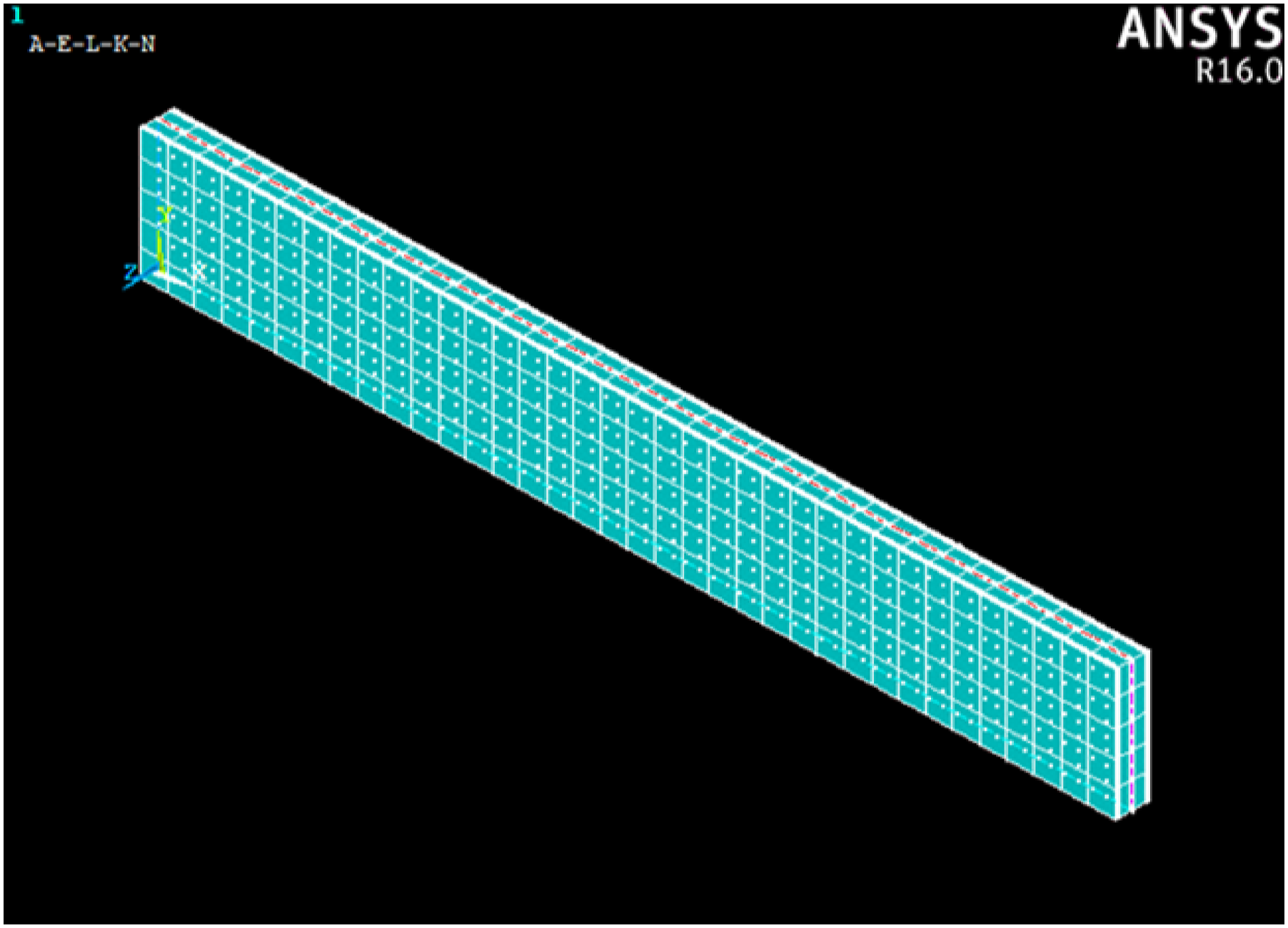
Figure 4 shows the numerical model of a sandwich beam with multi-cores and laminated composite face sheets. Figure 5 represents the layup sequence of the laminated composite multi-core sandwich beam. In order to demonstrate the accuracy of the ANSYS model, the results reported in the literature are validated with the results obtained from the present analysis and the results are shown in Table 1. The obtained outcomes are in good agreement with the results given by Howson and Zare.
3
The validation is further carried out by comparing the first three natural frequencies of the single-core sandwich beam under various end conditions with those reported by Subramani et al.
23
The natural frequencies of the first three modes under different end conditions are determined and the percentage deviation is presented in Table 2. As can be seen from Table, the comparisons show an excellent agreement thus, the numerical model seems to be accurate. Finite element model for laminated composite multi-core sandwich beam. Layup sequence of the laminated composite multi-core sandwich beam. Validation of natural frequencies of present model under clamped free condition with Howson and Zare.
3
Validation of natural frequencies of present model under different end condition with Subramani et al.
14


Validation of natural frequencies of present model under different end conditions with experimental results.

Results and discussion
The influence of the end conditions, stacking sequence, and variation in core thickness on the natural frequencies of laminated composite multi-core sandwich beam is investigated for different configurations of the laminate layers and core layers. The effect of various multi-core layers on natural frequencies was obtained experimentally and compared with the present simulated ANSYS results. The dimensions of the laminate has length l = 0.3 m, width b = 0.05 m, skin thickness h t = h b = 0.0012 m, and the thickness of rubber and foam core layers are h r = 0.0015 m, h f = 0.011 mm. The material properties of composites layers are presented in the section Fabrication and experimental study, and the material properties of rubber and foam core layers are used as G r = 0.3 MPa, ρ r = 910 kg/m 3 , and G f = 82.6 MPa, ρ f = 32.8 kg/m 3 . The dimensions and weight of the laminate layers are constant for all the configurations. The order of laminate layers in the multi-core sandwich beam is kept unchanged and the core layers are varied to perform the parametric study. A five composite sandwich beams with the various arrangement of core layers such as laminate-rubber-laminate-rubber-laminate (L-R-L-R-L), laminate-foam-laminate-foam-laminate (L-F-L-F-L), laminate-rubber-laminate-foam-laminate (L-R-L-F-L), laminate-rubber-foam-rubber-laminate (L-R-F-R-L), and laminate-foam-rubber-foam-laminate (L-F-R-F-L) are considered for the analysis. From the above configurations, the first three configurations of multi-core sandwich beam consist of top, bottom, and middle layers are made of composite laminates and the rest of two layers are made of viscoelastic core layers. Similarly, the other two configurations of multi-core sandwich beam consist of top and bottom layers are made of composite laminates and the rest of three layers are made of viscoelastic core layers.
First three natural frequencies (Hz) of the various patterns of multi-core sandwich composite beams under different end conditions.

Further, the influence of using two laminate layers on top and bottom and three viscoelastic core layers on the middle portion of the multi-core sandwich beam is studied, and the outcomes are tabulated in Table 4. The higher natural frequencies were obtained in two outer layers of foam and one middle layer of rubber core used in the multi-core L-F-R-F-L sandwich beam compared with the multi-core L-R-F-R-L sandwich beam. This can be attributed to the higher density of rubber material compared to that of foam material considered for the analysis. During the replacement of rubber core in multi-core L-R-F-R-L sandwich beam with foam core in L-F-R-F-L sandwich beam configurations, the decrease in mass of the structure of L-F-R-F-L sandwich beam dominates the increase in stiffness of the structure and hence the natural frequencies of the L-F-R-F-L sandwich beam is much higher than those of the L-R-F-R-L sandwich beam.
The effect of core thickness on the natural frequencies of the multi-core sandwich beam is investigated under different end conditions. The sequence of arrangement of laminate and core layers are considered for the analysis as laminate-rubber-laminate-rubber-laminate (L-R-L-R-L). The variation in the natural frequency with increasing the core layer thickness is represented in Figure 6. From the analysis results, it can be observed that the natural frequencies of all three modes are increased with intensifying the thickness of the core. It is because the stiffness of the multi-core sandwich beam increases significantly than the mass of the sandwich beam as core thickness increases. The increase in stiffness is more significant than the increase in the mass of the sandwich beam. A similar effect is also seen in Subramani et al.
14
Influence of using different core thickness on the natural frequency of the multi-core L-R-L-R-L sandwich beam under clamped–clamped and clamped free condition.
Effect of ply angle orientation on the natural frequencies (Hz) of the various patterns of laminated composite multi-core sandwich beams under different end conditions.

Conclusions
In this study, the vibration characteristics of composite multi-core sandwich beams were investigated. Experimental measurements were used to obtain the natural frequencies of the single-core and multi-core sandwich beams under different end conditions. The experimental results in terms of natural frequencies were validated with the present ANSYS simulation results and a good agreement was observed. The influence of different core materials, thickness ratio, and fiber angle orientations on the natural frequencies were studied under different end conditions. • The multi-core sandwich beam with top, bottom, and middle laminated layers, the L-F-L-F-L sandwich beam has the highest natural frequencies as compared to other multi-core sandwich beams. • Among the sandwich beams with top and bottom laminated layers, the L-F-R-F-L sandwich beam has the highest value of natural frequencies as compared to all other multi-core sandwich beams. The reason behind the increase of natural frequencies by varying core layers is due to an increase in structural stiffness of the multi-core sandwich beams. • It was shown that the increase in thickness ratio intensifies the natural frequencies of the multi-core sandwich beam under different end conditions. • It was also concluded that the natural frequencies obtained under clamped-clamped condition is higher than the natural frequencies obtained under clamped free condition and simply supported conditions. • Further, it was shown that the composite face sheets with [0/0/0/0] ply angle orientation exhibits the highest natural frequencies for all the configurations of multi-core sandwich beams under different end conditions. The fibers oriented along longitudinal direction influences the stiffness of the sandwich beams. • Finally, it can be concluded that the variation in core layers, core thickness, fiber angle orientations, and different end conditions influence the stiffness of the multi-core sandwich composite beams. This study provides the guidelines to the researchers that the selection of multi-core materials and thickness depends on the applications.
Footnotes
Declaration of conflicting interests
The author(s) declared no potential conflicts of interest with respect to the research, authorship, and/or publication of this article.
Funding
The author(s) received no financial support for the research, authorship, and/or publication of this article.
