



Abstract
Rice wastes are abundant, low-cost, cellulosic-based materials. The potential of using rice waste such as husk, straw, and bran in bio-composite production is a crucial target of the composite industry. Chemical composition is the main factor that offers diverse possible applications of rice wastes in bio-composite-based materials. Eco-friendly products of bio-composite polymers can be produced by reinforcing and filling polymer matrices with high cellulosic content materials such as rice waste. From manufacturing point of view, rice wastes can be used to reduce the production cost of polymer-based products and meet the requirements for green packaging materials.
Introduction
Plastics have gained a unique position in food packaging technology for reasons including higher strength, elongation, and barrier properties against waterborne organisms responsible for food spoilage; lower cost and higher energy effectiveness; and lightness and water resistance. 1 The continuous growth of several polymer materials for food packaging applications in conjunction with their resistance toward degradation and their visibility in the environment when discarded have stimulated further research in the field of food packaging materials. It has been estimated that 2% of all plastics eventually reach the environment, thus contributing considerably to ecological problems. For this reason, there have been recent trends toward preparation of degradable natural or synthetic polymers or natural/synthetic blends. In an attempt to overcome these problems, synthetic polymer/starch blends have been investigated.1–7 Biodegradable and compostable products, especially those made out of renewable resources from disposable agricultural wastes (agrowastes), are essential innovations for applications of environmentally friendly materials. Materials of organic origin have inherent tendency for biodegradation or decomposition. A mixture of agricultural wastes including husks from corn, wheat, rice, and soy (major component) and biodegradable polymers (minor component) are attractive alternative selection biodegradable packaging materials. Usage of synthetic polymers in packaging applications is declining as a result of ecological problems which are the main concern of scientists. 8 Enhancing food quality and reducing packaging waste have encouraged the exploration for novel bio-based packaging materials, such as comestible and biodegradable films.9,10 Bio-based packaging materials must serve important functions including protection of food, maintaining its physical quality and safety.11,12 Application of biodegradable films in food packaging is limited due to the poor barrier and mechanical properties of natural polymers. 13 Several bio-plastics are combinations or blends containing synthetic components, such as polymers and additives, to improve the functional properties of the finished product and to expand the range of application. 14 Studies have been conducted on biodegradable packaging and biopolymers by incorporation of natural polymers such as starch and natural fiber with a synthetic polymer such as polyolefin. These biodegradable packaging materials are not completely degraded in the environment due to the incorporation of polyolefin. Besides, other problems such as incompatibility of the starch with polyolefin may arise due to its polar structure and hydrophilic property to high water affinity which decreases the mechanical and chemical properties of the packaging film. Fiber-reinforced composites are increasingly used due to their relative low cost and their recycling potential compared to conventional materials. As a result, natural fiber–reinforced plastics have the potential to replace synthetic fiber–reinforced plastics in many industrial sectors including the automotive industry, packaging, and furniture production. Generally, cellulosic-based bio-fibers, including cotton, flax, hemp, jute and sisal, and wood fibers, are used to reinforce plastics due to their relative high strength, high stiffness, and low density.15–19
Rice is the major cereal crop cultivated in the world and considered a staple food for several countries including India, China, Thailand, and the Philippines. Rice is grown in more than a hundred countries, with a total production of 640 million metric tons of milled rice annually.20,21 Starch is the larger part of the rice grain and is considered the major component of the endosperm. Rice starch is one of the most important biopolymers in many applications such as thickening, binding, emulsifying, clouding, and gelling agents. Rice starch is often modified using physical, chemical, and enzymatic methods to enhance shear resistance and syneresis properties for particular applications. 22 Previously, low-density polyethylene (LDPE)/wheat or soluble starch blends, varied in starch or moisture content, have been prepared to study their properties and their biodegradation rate. Several methods were used to study the biodegradation rate, such as mass losses, changes in mechanical properties, and biochemical oxygen demand (BOD) by exposure to bioreactor. In general, high starch contents promoted brittleness and resulted in lower tensile strength and modulus and higher gas permeability (GP) and water vapor transmission rate (WVTR) but the their biodegradability was higher. Increasing the moisture content of these composite materials induced plasticization of the samples. Degradability of samples tested by immersion in bioreactors and burial in soil showed a substantial decrease in mechanical strength, tensile and flexural modulus, and elongation percentage.1,23 A series of novel blends of 1,4-trans-polyisoprene (TPIP) with gelatinized starch (GS), with or without plasticizers (glycerol) or compatibilizers such as ethylene acrylic acid (EAA), was prepared in an attempt to preserve the excellent biocompatibility of gutta-percha (essential for biomedical applications) and to impart biodegradability for eventual food packaging applications. The determined gas and water permeability values of the blend were intermediate values of the two components. 23 Some studies proposed a biomass made of thermoplastic starch and polyvinyl alcohol (starch/PVA) with enhanced mechanical strength, forming capability and biodegradability of the starch-PVA composite materials. Meanwhile, the biodegradable rate is almost the same as that of starch.24,25 This review is to investigate the potential of using rice wastes (husk, straw, and bran) in different applications such as food packaging, furniture manufacturing, natural adhesives, and bio-composite materials.26–30
Biodegradation, biopolymer, and bio-composites
Nowadays, the largest part of materials used in packaging industries is based on synthetic plastics with a production of more than 200 million tones/year and annual growth of approximately 5%, which represents the largest field of crude oil utilization.14,31,32 Packaging materials for food, like any other short-term storage packaging material, present a serious global environmental problem due to their degradation properties. Petrochemical-based plastics such as polyethylene terephthalate (PET), polyvinylchloride (PVC), polyethylene (PE), polypropylene (PP), polystyrene (PS), and polyamide (PA) have been increasingly used as packaging materials due to their availability at relatively low cost and good mechanical performance such as tensile and tear strength; good barrier to oxygen, carbon dioxide, anhydride; and aroma compound and heat sealability.23,33 Biodegradation is defined as the conversion of materials to CO2, H2O, and other inorganic products by the microorganisms under aerobic conditions or to CH4, CO2, and other inorganic products under anaerobic conditions. The rate of biodegradation depends on temperature (50–70°C), humidity, number, and type of microbes. The degradation is fast only if the three requirements are present. Generally, biodegradation occurs at very low rate at home or in a supermarket in comparison to compost medium. In compost medium, bio-plastics are converted into biomass, water, and CO2 in 6–12 weeks. Natural polymers such as rubber, lignin, and natural fibers and synthetic polymer like polyolefin are degraded by oxo-biodegradation mechanism and consequently cannot satisfy the rapid mineralization criteria required for standard biodegradation.
34
Also, at ambient temperature, oxo-biodegradation is a slower process than hydro-biodegradation as described by Scott and Wiles.
14
Figure 1 shows a typical biodegradation process of rice waste–based packaging materials. A typical life cycle of rice waste–based packaging materials.
Comparative properties of bio-derived polymers and comparison with polyethylene and polystyrene.
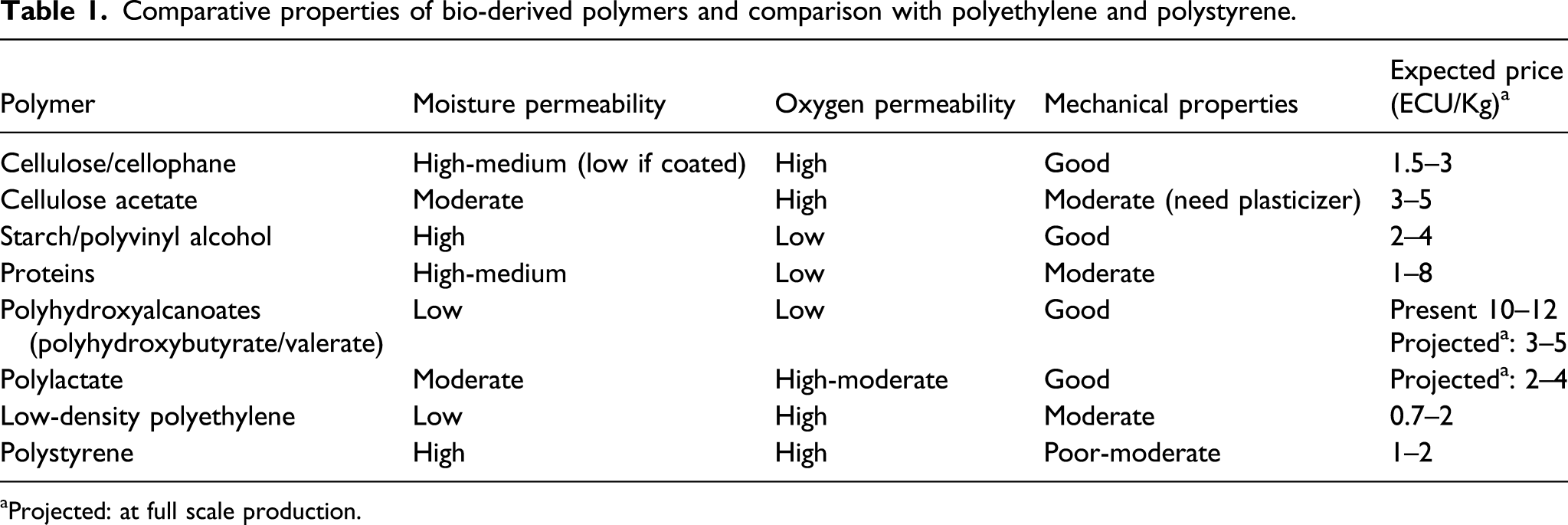
aProjected: at full scale production.
The European Directive 94/62/EC of 31 December 1994 specifies composting as a form of recycling. The European Commission has given a mandate to European Normalization Committee to develop norms and criteria for organic recycling of packaging materials and to come up with a final testing scheme, which should enable a clear identification and certification/labeling of compostable products such as paper and bio-plastics that could then be accepted as feedstock for composting. While European Directive 2018/852 in 30 May 2018 stated that “Member States should put in place adequate incentives for the application of the waste hierarchy including economic instruments and other measures, such measures should aim at minimizing the environmental impacts of packaging and packaging waste from a life cycle perspective, taking into account, where appropriate, the benefits of using bio-based materials and materials suitable for multiple recycling. Measures to increase public awareness of the benefits deriving from packaging made from recycled materials can contribute to expanding the recycling sector for packaging waste.” Therefore, rice wastes have the potential and the appropriate properties to be used to produce bio-based material composites for packaging application.
Rice waste–based polymer composites
Rice bran–based polymer composites
Rice bran is a byproduct of rice milling, produced by abrasive milling of brown rice to remove the outer tissues to produce polished rice. The total amount of rice bran production is estimated to be 63 to 76 million tons each year worldwide, which is 12 kg for each 100 kg of produced paddy.30,44 The rice bran has been mostly utilized as an animal feed ingredient, fertilizer, and fuel. Globally, India is considered a major country with a large quantity of rice bran as abundant waste.
45
Though rice bran can be used as food ingredient for human consumption after series of processing stages, the processing cost could make its products hard to compete with food ingredients from other sources. Thus, it is desirable to find applications that increase the value of this important byproduct. Figure 2 shows the rice bran after milling process. Rice bran after milling process.
A typical proximate composition of defatted rice bran is 15–20% protein, 0.5–1.5% fat, 10–15% crude fiber, and 9–12% ash and other inorganic materials. Rice bran also contains a significant amount of starch, which can be incorporated into polyolefin for enhancing the biodegradability. The starch can vary from 10 to 20%, depending on the amount of rice breakage and degree of milling. Proteins extracted from heat-stabilized defatted rice bran could be used as a nutraceutical food ingredient. 46 Rice bran contains starch and protein that may also be used as a bio-based adhesive with good bonding strength and reasonable working life. Based on further study, rice bran adhesive could be considered a promising alternate adhesive in many applications such as paperboard bonding and plywood. It provided a potential byproduct of agriculture (rice bran) as industrial raw material. In addition, the modified rice bran adhesive is promising to partially or completely replace urea formaldehyde resin that is mainly used in wood industry, avoiding formaldehyde emission and reducing the dependence on petroleum products. 30 A previous study indicated that the overall quality performance of rice bran produced with pH 12 and 100°C treatment appeared to be acceptable as a natural adhesive. 47 Johnsy 45 investigated the incorporation of different contents (5–10%) of rice bran into LDPE using a twin-screw extruder and blowing into films of uniform thickness using blowing equipment. Mechanical properties of LDPE are found to be decreased by the addition of rice bran, while the oxygen transmission rate, water vapor transmission rate, and global migration were increased. Optical properties such as specular gloss found to decrease with the increase in rice bran content. DSC analysis indicated a shift in glass transition temperature (Tg) as the filler incorporation increases, whereas there is no significant change in the melting temperature (Tm) of LDPE rice bran composite. Thermal decomposition found to be higher for rice bran–filled LDPE films than that for control film sample. The activation energy profile of 10% rice bran–filled LDPE composite indicated that the increase in filler concentration decreased the interfacial adhesion and dispersion of filler in LDPE matrix. At higher loads of rice bran incorporation in LDPE, a compatibilizer as well as a coupling agent is recommended to enhance the wettability between rice bran and HDPE matrix and subsequently improve the mechanical properties of the final composite. 45
Rice straw–based polymer composites

aMidpoint value is reported.

Ash content is very high relative to wood, which is primarily made up of 75–80% silica contained in pocket cells within the cellular structure. Hot water soluble extractives for rice straw are also high and this may include some components of ash, waxes, chlorophyll, and other plant constituents. 52 Rice straw fibers have an average diameter of 8 µm and lengths from 0.65 to 3.48 mm, giving an average aspect ratio of 170; although rice straw cells are smaller than softwood cells, they have more favorable aspect ratios. The aspect ratio is important in determining the strength of the raw fiber. There is potential to take advantage of this internal strength if some of the problematic parts of rice straw structure can be overcome. 52 Recently, low-cost lignocellulosic biomass, such as rice straw, has become attractive as a renewable resource because it is available in large quantities and routinely cultivated. There have been some efforts to study the effective treatment techniques for efficient utilization of lignocellulosic biomass. Rice straw can be hydrolyzed enzymatically into fermentable sugars, which can then be converted to ethanol or can be utilized in pulp and paper industry. Straw paper has been available for centuries and has been used in a wide variety of commercial applications. Factors such as the length and width of the single cells play a major role in determining the length and fineness of the multicellular fibers obtained. Rice straw fibers have smaller width single cells, which produces finer fibers. Rice straw fibers have good strength and elongation required for textile and other high value applications. The strength of the rice straw fibers is higher than that of cornhusk, cornstalk, or PAL fibers, which have strengths of about 2.7, 2.2, and 3.0 g/denier, respectively.54,55 The elongation of the rice straw fibers is similar to that of cornstalk and PAL fibers with 2.2%, but lower than that of cornhusk fibers of 13–16%. The higher percentage crystallinity and better orientation of the cellulose crystals in rice straw fibers contribute to its higher strength and lower elongation, respectively, compared to the other biomass fibers. Although rice straw fibers have relatively high modulus, it is not soft and flexible as cornhusk and cornstalk fibers. Products made from the rice straw fibers will be durable because of their high work of rupture, which is similar to that of linen fibers. The fineness, length, strength, elongation, and modulus of rice straw fibers indicate that rice straw fibers are closer to linen and would be suitable for most high value fibrous applications.51,54,56
Rice husk–based polymer composites
Rice husk powder is one of the favorite fillers of unmilled rice (paddy). On the average, paddy production in Malaysia is about two million tons annually. Malaysia produced nearly two million tons paddy in 2002 with residues in the form of rice husk estimated at 22%, in which a total volume of 0.44 million tons of rice husk would theoretically be available. The rice husks generated becomes a problem especially when open burning is no longer permitted due to environmental concerns. These circumstances motivate the utilization of agricultural residues in bio-composites industry to produce value-added products. The average chemical composition of rice husk as reported is 20% silica, 22% lignin, 38% cellulose, 18% pentosans, and small amount of other organic matters.57–59 The high percentage of silica, which is very unusual within nature, and this intimate blend of silica and lignin make the rice husk resistant to water penetration and fungal decomposition. Previous studies on rice husk at 25°C indicated that the equilibrium moisture content of rice husk at 50% relative humidity was at or below 10%, while at 90% relative humidity, the equilibrium moisture content of rice husk remained at or below 15%. This Rice husk–based products produced by injection molding technique.
Dai 24 presented the blendability of the mixture of rice husk (RH) powder and biodegradable PVA solution associated with processing methodology. The processing methodology was carried out based on the glass Tg and the moisture content for the blending of PVA solution and RH mixture with most favorable blending conditions. Tg temperature is used as the guidance of working temperature for PVA blending. Based on mixing and forming behaviors of the RH/PVA mixture, water content plays a significant role for lowering glass transition temperature or promoting plasticization, and thus the flow ability and rebinding capability of the RH powders for mold forming can be enhanced under the proper control of water content. Furthermore, for obtaining better bonding and forming capability, the limitation of size difference for the blending of RH powders has to be considered. 24
Conclusion
Based on the presented data of the requirement for biodegradable materials to be used in packaging industries, rice wastes have high potential as a replacement for conventional materials. Bio-products based on rice wastes are eco-friendly and biodegradable materials, which can be suitable for packaging applications. Injection molding, extrusion, and blowing techniques can be used to produce bio-composites based on rice waste. Cellulose, lignin, hemicellulose, and silica are the main chemical composition of rice waste. Rice waste can be considered as raw materials for polymer bio-composites production. Using rice waste to produce biofilms is one solution to reduce the use of synthetic polymers in packaging application, which can be the answer of plastic waste.
Footnotes
Declaration of conflicting interests
The author(s) declared no potential conflicts of interest with respect to the research, authorship, and/or publication of this article.
Funding
The author(s) received no financial support for the research, authorship, and/or publication of this article.
