



Abstract
Dynamic mechanical properties of polymeric materials are of direct relevance to a range of unique polymer applications. The aim of the study is to investigate the dynamic mechanical properties of composites of short nylon 6 fiber with acrylonitrile butadiene rubber (NBR). The storage modulus (G′), loss modulus (G″), and the damping factor (tan δ) have been analyzed with reference to the effects of fiber loading, curing systems, and bonding agents over a range of temperature and at varying frequencies. The storage modulus increases with increment in fiber loading, whereas loss modulus and damping factor decrease. The glass transition temperature shifts to higher temperature upon increment in fiber loading. Dicumyl peroxide (DCP)–cured composites show higher storage modulus and lower damping than the corresponding sulfur-cured one. The addition of hexa-resorcinol and phthalic anhydride as bonding agents enhances the dynamic mechanical properties of the composites. The experimental results have been evaluated by comparing with Einstein, Guth, and Nielsen models.
Keywords
Introduction
Rubbers show both elastic and damping behavior because of their visco-elastic nature. When they are deformed by a sinusoidal stress, the resulting strain will also be sinusoidal but will be out of phase with the applied stress. Dynamic losses are usually associated with specific mechanisms of molecular or structural motion in polymeric materials. The damping in the system can be measured from the tangent of the phase angle or loss tangent (tan δ) which is defined as tan δ = G″/G′ where G′ is the storage modulus due to stored elastic energy in the materials and G″ is the loss modulus due to viscous dissipation. The method that has been used to investigate the storage modulus, loss modulus, and loss tangent is dynamical mechanical analysis (DMA).
In DMA, the response of a given material to an oscillatory deformation is measured as a function of temperature. This technique has widely been employed for investigating the visco-elastic behavior, stiffness (modulus), damping (energy dissipation) characteristics, phase transitions, and the interfacial adhesion of polymer composites as they are deformed under periodic stresses.1–2 It is particularly useful because of its non-destructive nature unlike other static mechanical testing methods.
Polymers at the transition region from glassy to rubbery state have great potential for vibration damping. The intensity and breadth of the damping factor (tan δ) peak and the value of the loss modulus generally determine the damping capacity of a polymer at that particular temperature. For fiber-reinforced polymer composites, the dynamic mechanical properties depend on the type of fiber, length of the fiber, orientation of fiber, fiber loading (phr), fiber dispersion in matrix, and interaction between fiber and matrix.3–4
Several researchers have studied the dynamic mechanical properties of rubber composites. Malas et al. studied the reinforcing effect of expanded graphite (EG) and modified EG (MEG) with and without carbon black (CB) on the properties of emulsion polymerized styrene butadiene rubber (SBR) vulcanizates. 5 Flaifel et al. carried out the thermal conductivity and dynamic mechanical analysis of Ni–Zn ferric nanoparticle-filled thermoplastic natural rubber nanocomposites. 6 Dynamic mechanical analysis of polylactic acid (PLA)-hemp bio-composites with different reinforcement content was carried out by Durante et al. 7 Recently, Surajarusarn et al. conducted a comparative study of pineapple leaf microfiber and aramid fiber-reinforced natural rubbers using dynamic mechanical analysis. 8 The dynamic properties like damping factor, storage, and loss moduli of areca/kenaf fiber-reinforced epoxy hybrid composites were studied by Palani et al. 9 Dynamic mechanical analysis of natural nano banana particle-filled polymer matrix composites was conducted by Surya et al., and it was found that incorporation of nano banana particles in polyester matrix induces reinforcing effects appreciably at higher temperatures. 10 Recycled tire rubber was utilized as a filler to fabricate wood-high density polyethylene (HDPE) composite by Feiyu et al., and it was found that rubber-filled materials exhibit advantageous energy absorption performance compared to wood-HDPE composites under repetitive compressions. 11
Acrylonitrile butadiene rubber (NBR) is a synthetic elastomer widely used in many industrial applications especially in automotive products. It has good resistance to fuel and oil even at elevated temperatures. On the industrial side, NBR finds uses in roll covers, hydraulic hoses, conveyor belting, graphic arts, oil field packers, and seals for all kinds of plumbing and appliance applications. In the automotive area, NBR is used in fuel and oil handling hoses, seals, and grommets. Nylon 6 fiber is a semicrystalline polyamide. It has high melting point, tensile strength, and modulus. The objective of the present work is to examine the dynamic mechanical properties of nylon 6 fiber-reinforced NBR composites at varying frequencies and temperatures with special reference to the effects of fiber loading, curing systems, and bonding agents.
Experiment
Materials
Acrylonitrile butadiene rubber (Apar Industries, Mumbai, India) having 35% acrylonitrile content and nylon 6 fiber (Sri Ram Fibers Polymers Limited, Chennai, India) in yarn form were used in the study. The rubber ingredients such as vulcanizing agents, accelerators, and activators used were of commercial grade. Hexamethylene tetramine, resorcinol, and phthalic anhydride used as bonding agents were of laboratory reagent grade.
Composite Preparation
Formulations of mixes (phr a ).

aParts per hundred rubber.
bAcrylonitrile butadiene rubber.
cMercapto benzo thiazyl disulphide.
dTetramethyl thiuram disulphide.
eDicumyl peroxide.
fHexamethylene tetramine.
Dynamic mechanical analysis (DMA)
Dynamic mechanical thermal analyzer (NETZSCH DMA 242) was used to measure the dynamic storage modulus (G′), loss modulus (G″), mechanical damping (tan δ), and the glass transition temperature (Tg). The temperature range through which the properties were determined was −110 to 104oC, at a heating rate of 2oC/minute. Three-point bending method was used as forced vibration at varying frequencies such as 0.1, 1, 10, and 50 Hz with strain amplitude of 120 μm.
Results and discussion
Effect of fiber loading
The variation of storage modulus (G′) with fiber loading of nylon 6/NBR composites as a function of temperature, at a frequency of 10 Hz is given in Figure 1. The gum compound, without fibers, has the lowest stiffness and hence the lowest storage modulus at a given temperature. The fibers can participate in effective stress transfer, and as a result, the stiffness of the composites increases leading to higher storage modulus. The hydrodynamic effects of the fibers embedded in a visco-elastic medium and the mechanical restraint introduced by them at their higher concentrations reduce the mobility and the deformability of the matrix.
12
Effect of fiber loading on storage modulus as a function of temperature at a frequency of 10 Hz.
It has been observed that the storage modulus increases with increasing fiber loading at all temperatures. As the fiber loading is increased, the stress is more evenly distributed and the storage modulus of the composite increases. Similar observation is reported by other authors for fiber-reinforced rubber composites. 13 The increment in G′ is prominent in the glassy state, below Tg, while it is not so significant in the rubbery plateau region. It can be seen that in the glassy region, the modulus values gradually increase while in the rubbery region, the change is relatively very less. In the glassy region, the components are in a frozen state, that is, highly immobile. In such a state, there exists a close and tight packing in the composite structure resulting in higher modulus. It is important to mention that the modulus in the glassy state is determined primarily by the strength of the intermolecular forces and the way the polymer chains are packed. As temperature increases, the components become more mobile and lose their close packing arrangement. As a result, in the rubbery region, there is no significant change in the modulus.

Effect of Fiber Loading on the Characteristics of Composites at a Frequency of 10 Hz.

Figure 2 shows the variation of loss modulus (G″) with temperature as a function of fiber loading at a frequency of 10 Hz. Loss modulus measures the energy dissipated or lost as heat per cycle of sinusoidal deformation. It is in fact the viscose response of the material. Loss factors are more sensitive to molecular motions. The loss modulus values generally increase with increase in fiber concentration at temperatures well below the glass transition. The loss modulus peak values are less for composites than for the gum in the region of transition. A specific interaction between the filler and the polymer layer would create a layer of immobilized polymer between the filler and matrix. The matrix surrounding the fibers can be taken as an inter-layer which is in a different state compared to the rest of the matrix where the molecular motions are relatively hindered.
16
A shell of immobilized polymer surrounds the fibers,
17
and the higher the volume fraction of the matrix, the more the restraint at the interface. Effect of fiber loading on loss modulus as a function of temperature at a frequency of 10 Hz.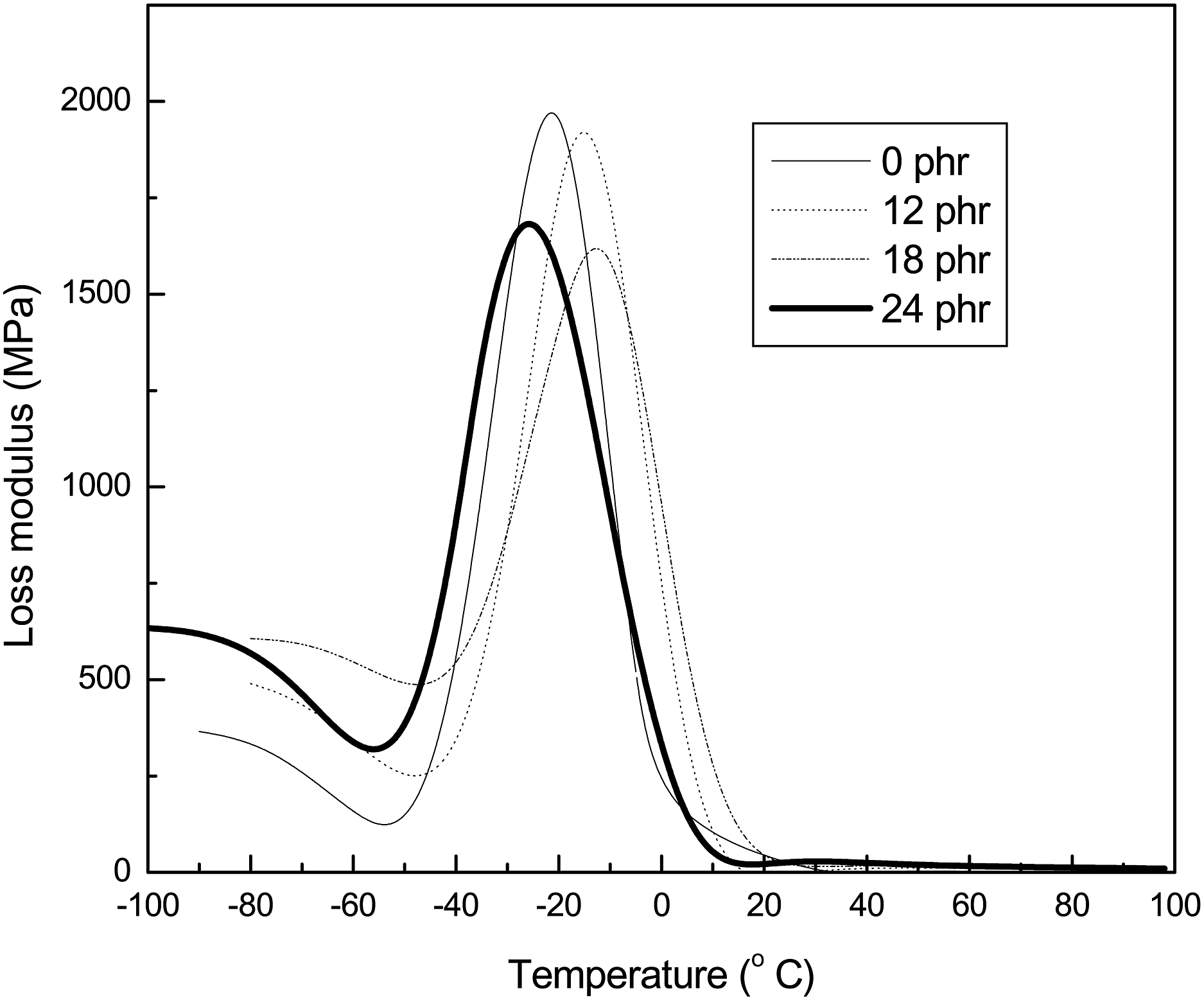
The effect of fiber loading on the damping factor (tan δ) as a function of temperature at a frequency of 10 Hz is illustrated in Figure 3. The tan δ values can be related to the impact resistance of the material as it expresses the out-of-phase time relationship between an impact force and the resultant force that is transmitted to the supporting body. The damping in composites is due to the shear stress concentration at the fiber ends and visco-elastic energy dissipation in the matrix material. It can be seen from Figure 3 that tan δ value is highest for the gum sample and it decreases with increase in fiber loading. The decrease in tan δ values is due to the improvement in the interfacial bonding in composites with increment in fiber loading. When the fiber concentration is less, the packing of fibers will not be efficient in the composites. This leads to matrix rich regions and thus to an easier failure of the bonding at the interfacial region. At higher fiber loading, when there is relatively high close packing of fibers, crack propagation will be prevented by the neighboring fibers. Effect of fiber loading on damping characteristics (tan δ) as a function of temperature at a frequency of 10 Hz.
The fibers restrict the movement of polymeric chains, causing the reduction in the peak of the tan δ. The temperature at which maximum damping occurs (tan δmax) represents the glass transition temperature (Tg) of the system. As the fiber loading increases, the tan δmax decreases and the Tg values show a positive shift (Table 2). The shifting of Tg to higher temperatures can be associated with the decreased mobility of the chains by the addition of fibers. Elevation in Tg is taken as a measure of interfacial interaction.
Effect of curing agents
Effect of different curing systems on the dynamic mechanical properties of composites was studied with reference to samples containing optimum loading of fiber. Optimization of fiber loading has already been done by our group by studying the static mechanical properties of composites.
18
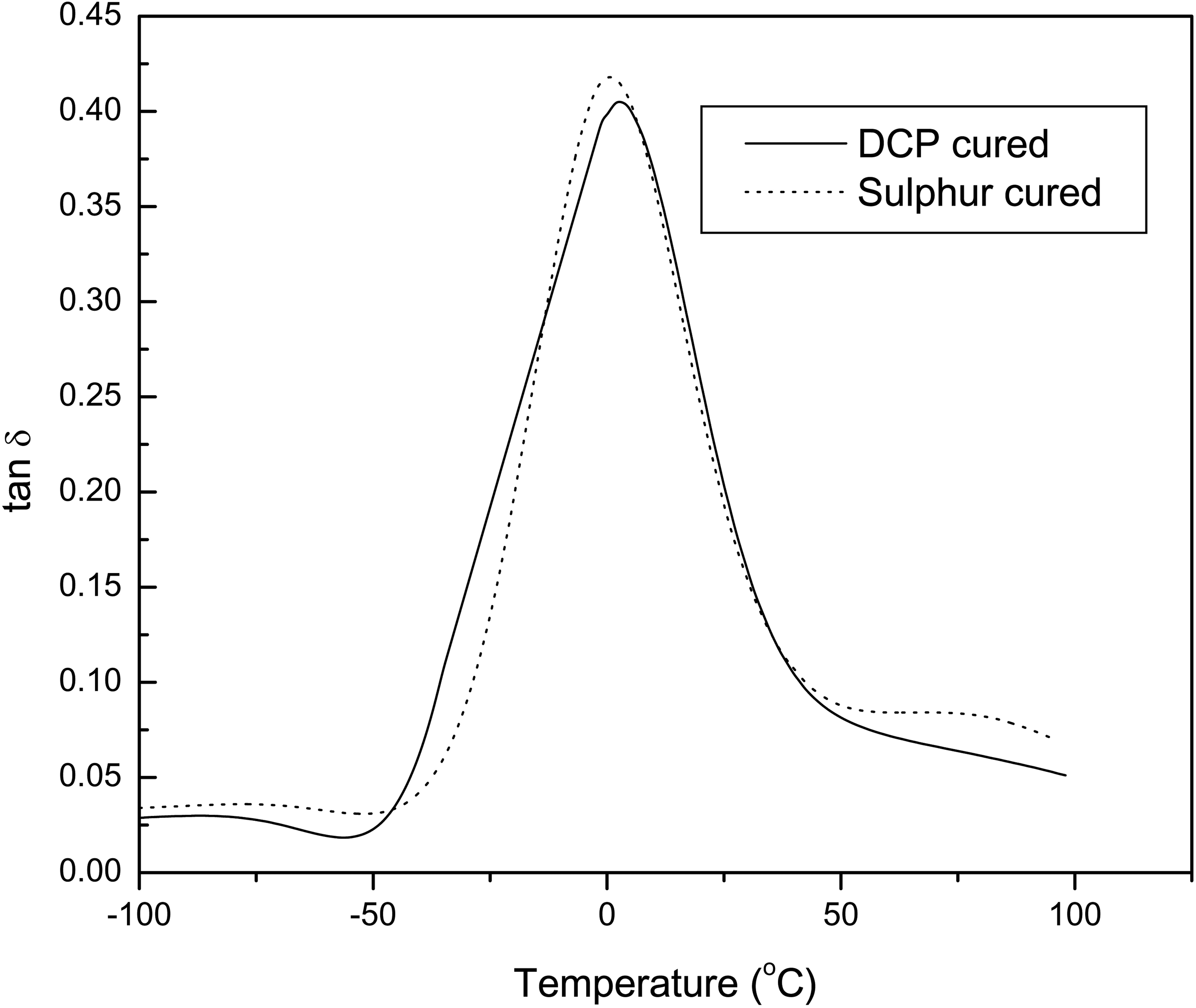
It can be seen from Figure 4 that at optimum fiber loading (24 phr), the storage modulus of DCP cured sample is higher than that of sulfur cured one. The difference in this behavior can be attributed to the difference in cross-links introduced by DCP and sulfur. DCP introduces rigid C–C linkages, whereas sulfur creates mono, di, and polysulfidic linkages during curing. These results are in well agreement with the observations from the static mechanical tests of the present composite system and the measurement of cross-link density through restricted equilibrium technique.18-19 The variation of tan δ with temperature of DCP- and sulfur-cured samples is given in Figure 5. It can be seen that DCP-cured sample shows lower tan δmax compared to corresponding sulfur-cured one. Variation of storage modulus of dicumyl peroxide- and sulfur-cured samples with temperature at a frequency of 10 Hz. Variation of tan δ of dicumyl peroxide- and sulfur-cured samples with temperature at a frequency of 10 Hz.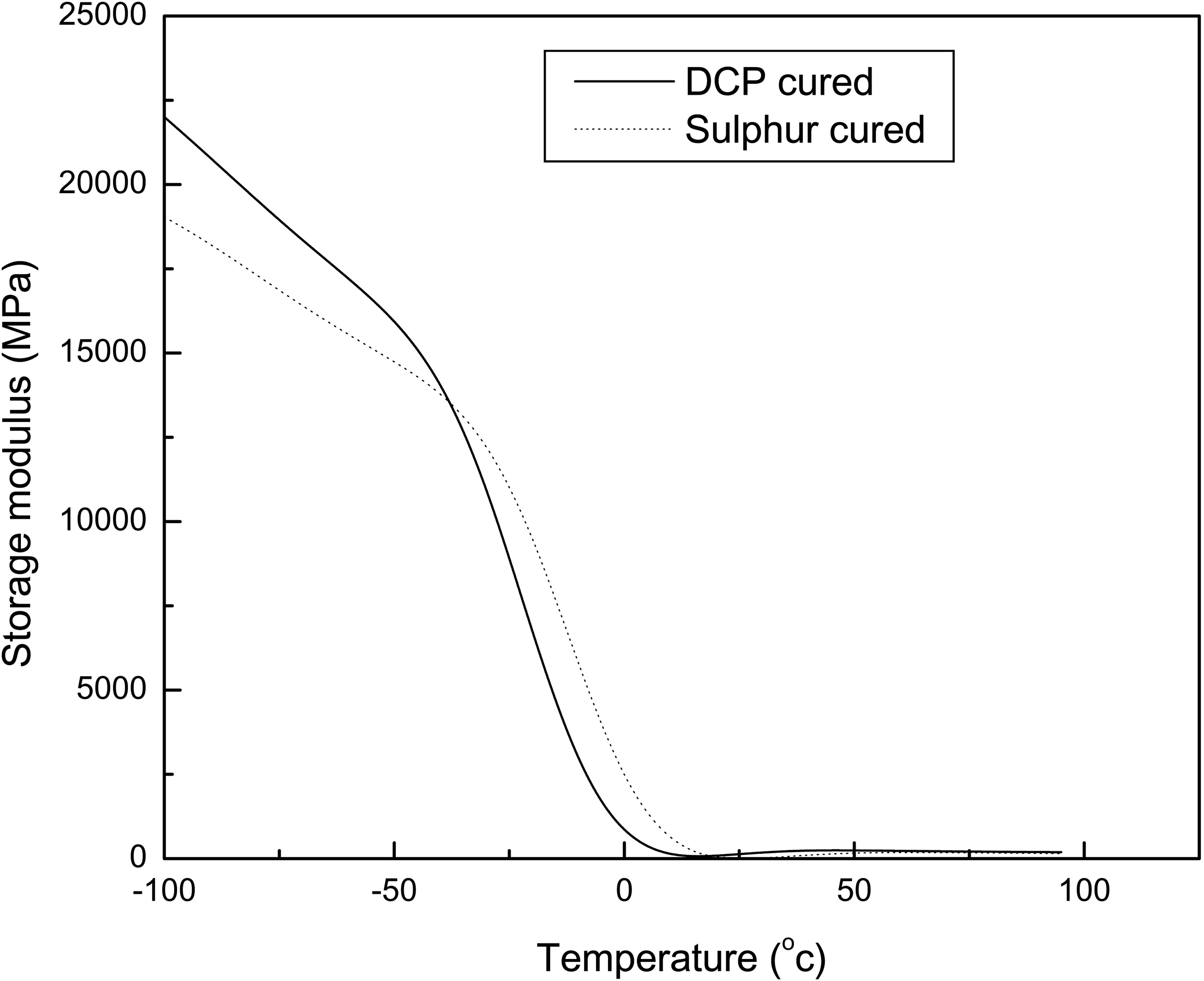
Effect of bonding agents
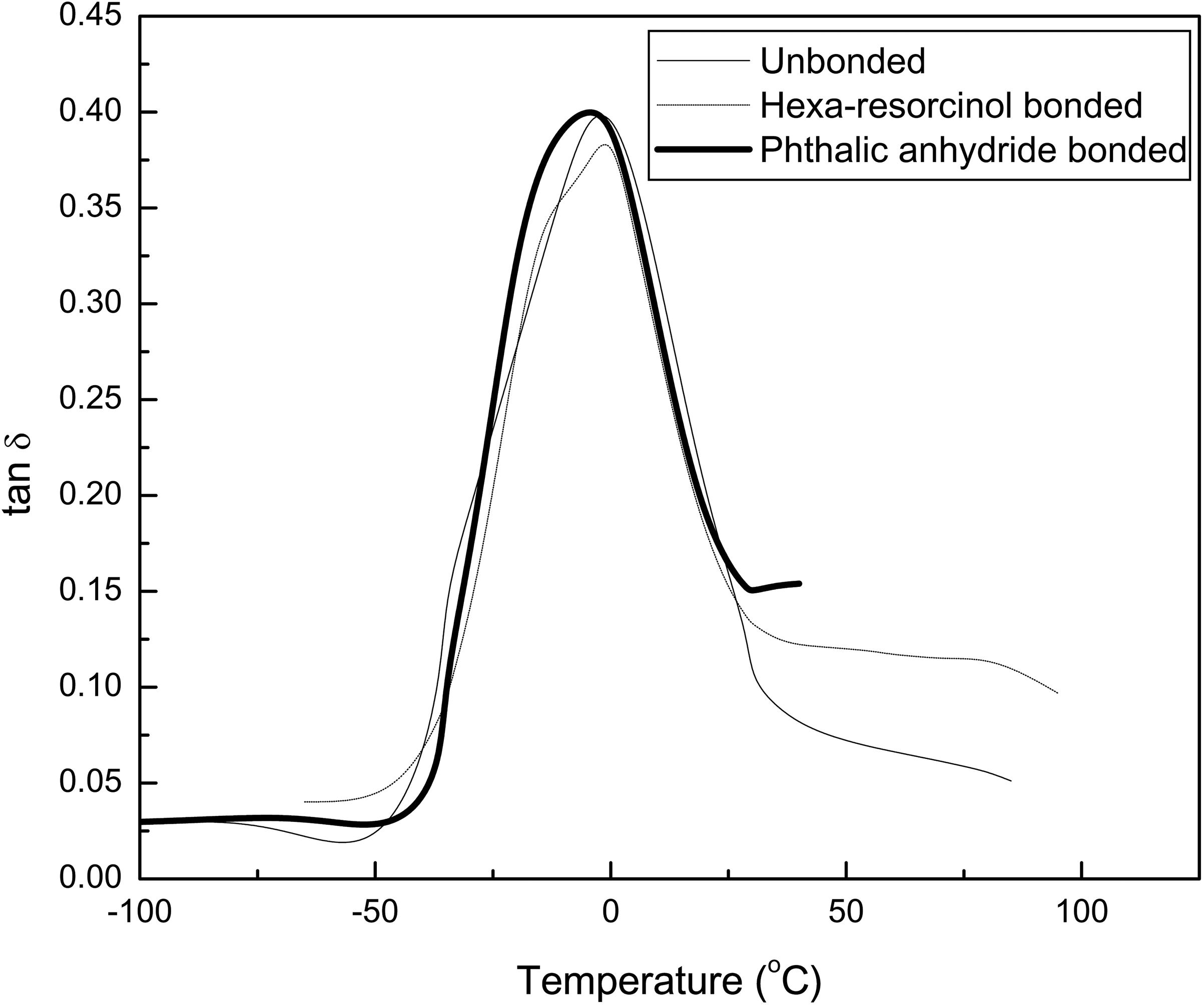
Figure 6 shows the effect of two bonding agents, viz., hexa-resorcinol and phthalic anhydride on the storage modulus (G′), as a function of temperature, at a frequency of 10 Hz. It is evident that the G′ values of composites containing bonding agents are higher than that of the unbonded one at 24 phr fiber loading. This is due to the better interfacial adhesion in bonding agent-added composites. The variation of tan δ with temperature for composites with and without bonding agent at the frequency of 10 Hz is given in Figure 7. It is obvious that the presence of bonding agent reduces the tan δ values. Bonding agent-added composites show lower value of tan δmax than that of the unboned one. Also, the Tg values are shifted to higher temperatures due to greater interfacial interaction. The broadening of tan δ peak is also indicative of the improved interfacial adhesion in bonding agent-added composites. Variation of storage modulus with temperature of unbonded and bonded composites at a frequency of 10 Hz. Variation of tan δ with temperature of unbonded and bonded composites at a frequency of 10 Hz.
Effect of frequency
Figure 8 shows the variation of storage modulus (G′) of composite sample containing 24 phr fibers (Mix D) as a function of temperature at different frequencies. It can be seen that the storage modulus increases with frequency from 0.1 to 50 Hz. At high frequency (short time), the modulus measurements results in higher values, whereas low frequency (long time) result in lower values.
2
The lesser mobility of polymeric chain at higher frequencies results in better bonding between the fibers and matrix, which thereby increases the stiffness of the composite. Effect of frequency on storage modulus (G′) of composite containing 24 phr fibers as a function of temperature.
Figure 9 shows the effect of frequency on damping factor (tan δ) of composite sample containing 24 phr fibers (Mix D, Table 1) as a function of temperature. At lower temperature regions, the tan δ values are found to be decreased with an increase in frequency. However, the reverse occurs in the higher temperature regions. Below Tg, the deformation by the fillers is non-virtual, the components are in a frozen state, that is, highly immobile, and hence, the damping is mainly dependent on the segmental mobility of the matrix. In such a case, an increment in frequency can induce the segmental mobility or molecular motions of the matrix resulting in lower damping properties. However, in higher temperature regions (above Tg), as the frequency increases, the molecules will not get time to undergo rearrangement, and as a result, the material behavior will be more like a liquid with enhanced damping properties. Due to the same reason, it has been observed that the temperature corresponding to tan δmax or Tg is shifted to the high temperature region at higher frequencies. Effect of frequency on tan δ of composite containing 24 phr fibers (Mix D) as a function of temperature.
Energy of activation for glass transition
The apparent activation energy (E
a
), for the glass transition of different composite systems, was calculated using the modified form of Arrhenius relationship
20

Cole–Cole plots
Figure 10 shows the Cole–Cole plots of various composite systems, where the loss modulus data (log G″) are plotted as a function of the storage modulus (log G′) at a frequency of 10 Hz. The nature of Cole–Cole plot is indicative of the nature of the system. Homogeneous polymeric systems show a semicircle diagram,
2
whereas the two-phase systems show modified semicircles.
21
On analyzing the Cole–Cole plots of the present composite systems, it is seen that the curves show the shape of imperfect semicircles. The shape of the curves thus points toward good fiber-rubber adhesion. Cole–Cole plots of composites with different fiber loadings at a frequency of 10 Hz.
Theoretical modeling
The simplest equation for calculating the reinforcement in polymer matrix, theoretically, given by Einstein
22
is

The experimental and theoretical storage moduli (G′) as a function of fiber loading at a temperature of −50oC and at a frequency of 10 Hz are given in Figure 11. The experimental values of the storage modulus of the composite system show a reasonably good agreement with Einstein’s and Guth’s models. The experimental G′ values show a good agreement with Guth’s model especially at 24ophr fiber loading (Mix D, Table 1). This indicates that the fiber population is just right at 24ophr loading for maximum orientation so that the fibers can actively participate in stress transfer and the composites show optimum properties. Comparison of experimental and theoretical storage modulus (G′) of composites as a function of fiber loading.
Conclusions
The dynamic mechanical properties such as storage modulus (G′), loss modulus (G″), and damping behavior (tan δ) of nylon 6 fiber-reinforced NBR composites have been studied as a function of fiber loading, cross-linking systems, and bonding agents, at varying temperatures and frequencies. The storage modulus was found to be increased with increment in fiber loading, whereas it decreased with temperature. The damping characteristics were decreased with fiber loading. As the fiber loading increases, the glass transition temperature shifts to higher temperature. The DCP-cured composite showed higher storage modulus and lesser damping than the corresponding sulfur cured one. The addition of hexa-resorcinol and phthalic anhydride as bonding agents increased the storage modulus and decreased the damping. The energy of activation for glass transition of the composites was found to be increased with increase in fiber loading indicating improved interfacial adhesion. The Cole–Cole plots of the present composite systems showed the shape of imperfect semicircles pointing toward the relatively good fiber–rubber adhesion. The experimental values of the storage modulus of the composite system showed a reasonably good agreement with Einstein’s and Guth’s models.
Footnotes
Declaration of conflicting interests
The author(s) declared no potential conflicts of interest with respect to the research, authorship, and/or publication of this article.
Funding
The author(s) disclosed receipt of the following financial support for the research, authorship, and/or publication of this article: This study is supported by Department of Science and Technology, Govt. of India, FIST Programme (SR/FST/College-191/2014).
