



Abstract
Among many applications, elevated-temperature cured epoxy resins are widely used for high-performance applications especially for structural adhesive and as a matrix for structural composites. This is due to their superior chemical and mechanical properties. The thermosetting nature of epoxy produces a highly cross-linked polymer network during the curing process where the resulting material exhibited excellent properties. However, due to this cross-linked molecular structure, epoxies are also known to be brittle, and once a crack initiated in the material, it is difficult to arrest the crack propagation. Earlier research found that the inclusion of encapsulated healing agents is able to introduce self-healing ability to the room-temperature cured epoxies. The current study investigated the self-healing behaviour of an elevated-temperature cured epoxy, which incorporated the dual-capsule system loaded with diglycidyl-ether of bisphenol-A (DGEBA) resin and mercaptan. The microcapsules were prepared by the in-situ polymerisation method while the fracture toughness and the self-healing capability of the tapered-double-cantilever-beam (TDCB) epoxy specimens were measured under Mode-I fracture toughness testing. We investigated the effect of temperature on viscosity of the healing agents and how these values influence the formation of uniform healing on the fracture surfaces. It was found that incorporation of the dual-capsule self-healing system onto an elevated-temperature cured epoxy slightly changed the fracture toughness of the epoxy as indicated by the Mode-I testing. In the case of thermal healing at 70°C, the self-healing epoxy exhibited a recovery of up to 111% of its original fracture toughness, where a uniform spreading of the healant was observed. The excellent healing behaviour is attributed to the lower viscosity of the healant at higher temperature and the higher glass transition temperature (Tg) of the produced healant film. The DSC analysis confirmed that the healing process was not contributed by the post-curing of the host epoxy.
Keywords
Introduction
Thermosetting polymers such as epoxy resins play an important role and have widely been used as a matrix in structural composite materials, as structural adhesives and as an organic coating due to their superior mechanical and adhesive properties.1,2 Despite their excellent mechanical properties, epoxies are vulnerable to damage in the form of microcracks due to their brittleness. 3 Therefore, many efforts have been devoted in the past to improve the fracture toughness of epoxy resin by modifying the monomers with microscale fillers. 4 Despite these efforts, once microcracks formed in the structure, there is no way to completely halt the crack from propagating, and this will significantly compromise the reliability of this material. Self-healing/self-repair ability on polymeric materials is seen as a potential solution to this problem and has been extensively studied in the past two decades, with the first viable concept introduced by White et al. 5 in the year 2000. Self-healing material is a material that possesses an ability to repair damage and fully/partially restore its degraded properties due to the inherent characteristic available in the system. 6
Several approaches to introduce self-healing ability to man-made materials have been studied over the years. The three approaches receiving the most attention are the capsule-based healing system,5,7–14 intrinsic healing system15–17 and vascular self-healing system.18–20 Among these approaches, capsule-based self-healing can be applied in composite laminates with the advantage of easy dispersion into matrix resins with little change to manufacturing procedures or microstructure of the composites.21,22 Since its introduction, the microencapsulated self-healing system has received a lot of attention, with three of the most common systems being (i) capsule-catalyst,5,7,23 (ii) dual-capsule8,10,11,24 and (iii) single-capsule.25–28 The capsule-catalyst healing system involves the curing reaction between the monomer that has been encapsulated with the pre-dispersed catalyst phase, such as Grubbs’ catalyst, inside the host material. The dual-capsule self-healing systems involve a polymerisable monomer and hardener/curing agent, in which both parts have to be respectively protected and dispersed in the host materials. 29 In this system, when damage such as microcracks happens to the host material, healing will be triggered by the release of the healants on the damage area; at this point, the reaction between the two substances will create a film that will repair the damage. However, in the single-capsule system, the polymerisation of the encapsulated monomer depends on the latent functionality of the host materials or the ability of the encapsulated substance to harden upon exposure to air. 30 A comprehensive review on the self-healing approach based on microencapsulated healing agents can be obtained elsewhere. 31
Among the three approaches, the dual-capsule approach shows the most promising advantages to be employed in composite parts that consist of high fibre volume fraction (≈65%). This is because both catalyst-capsule and single-capsule systems are dependent on the matrix of the composites; where in these types of composites parts, the lack of matrix portion in the system is not sufficient to activate the self-healing ability of the material. In contrast, in dual-capsule systems, the healing can be triggered independently by reaction of the microencapsulated monomer and hardener and does not depend on the host matrix of the system. Furthermore, for the single-capsule self-healing approach, where some of the polymeric healant film formed by atmospheric oxidation upon healing, the strength of this film is inadequate to repair the load-bearing capacity of the composites.
To the best of the authors’ knowledge, epoxy/amine-based,10,12,32,33 epoxy/mercaptan8,9,24,34,35 and Sylgard 184 part A/hydrogen silicone oil 36 are the only three reported dual-capsule self-healing systems. Normally, the preparation of capsules containing a reactive liquid amine is difficult and quite complex34,37; therefore, to employ this type of microcapsules is a less efficient alternative. Whereas, for elastomeric materials such as Sylgard 184, its strength is not sufficient to adequately restore the strength of structural composites. Meanwhile, for the epoxy/mercaptan dual-capsule healing system, the microencapsulation technique of both epoxy and mercaptan is less complex in comparison, with the resultant healant film which possesses a highly cross-linked thermoset polymer, making it a more suitable self-healing approach for structural composites.
An elevated-temperature cured diglycidyl-ether of bisphenol-A (DGEBA) epoxy with piperidine as a curing agent has been widely used as the matrix material for fibre reinforced composites.38,39 In general, when epoxy was cured at an elevated temperature, the resultant polymer product possesses a high thermal stability in comparison to the room temperature cured epoxies. However, due to a high-temperature fabrication process for this type of epoxy, the healing agent with good thermal stability is also needed; and for good adhesion and miscibility with the host material, DGEBA-loaded microcapsules were reported as suitable candidates. 40
DGEBA-loaded microcapsules paired with mercaptan-loaded microcapsules have been reported to provide room temperature healing of epoxy. 40 However, at room temperature, the resistance to flow due to DGEBA resin’s relatively high viscosity can adversely affect its self-healing ability. 41 In high fibre volume fraction composites, the number of capsules that can be embedded is restricted to the area and thickness of the interlaminar region; thus, the flow ability of the substance is vital in order to ensure the trigger of healing upon a damage. In the current study, an experimental investigation was conducted on the elevated-temperature cured epoxy as a host material, embedded with the dual-capsule self-healing system consisting of DGEBA- and mercaptan-loaded microcapsules. This study is essential to provide a clear understanding on the healing performance of the DGEBA/mercaptan self-healing system at different healing temperatures. The influence of healing temperature on (i) the viscosity of the healant, (ii) the uniformity of healant film on the fracture surface and (iii) the glass transition temperature, Tg, of the film were thoroughly researched.
Experimental
Microencapsulation of self-healing agent
The specification of the dual-component microencapsulated self-healant.


Dual-mechanism microencapsulated self-healant: (a) DGEBA-loaded microcapsules; (b) mercaptan-loaded microcapsules.
Fracture toughness and flexural tests
Epoxy sample preparation
For the control experiment, neat epoxy samples were prepared by mixing 100 parts of DGEBA resin with five parts of its curing agent, piperidine. The control samples were left to cure at room temperature for 8 h followed by 16 h at 120°C.
For the self-healing samples, microcapsules with the weight ratio of 10 wt. % (1:1 ratio of DGEBA/mercaptan microcapsules) were added to the host epoxy resin and further dispersed in an ultrasonic bath. This mixture was then stirred with piperidine and subsequently degassed and poured into a silicon mould before it was left to cure at room temperature for 8 h, followed by 16 h at 120°C.
Mechanical testings
For the Mode-I fracture toughness test (the tapered double cantilever beam), TDCB specimen geometry as employed by Brown et al.44,45 was used. The Mode-I fracture toughness test was done with an Instron universal testing machine, model 5567, equipped with 1 kN load cell under displacement control at a rate of 5 μm/sec using pin loading. The specimen was pre-cracked with a fresh razor blade before loading and then tested to failure. The TDCB geometry allowed for the crack to grow along the centre line of the specimen. Load and displacement data were recorded throughout the test.
Data points from the load versus displacement curves were used to generate the Mode-I stress intensity factor (KIC) and the Mode-I energy release rate (GIC) values. The KIC values were calculated according to equation (1).
Given that the geometry of the TDCB specimen is adapted from Brown et al., 44 an experimentally determined constant α = 11.2 × 10³ m−3/2 was used for the calculation.
For a crack that propagates in a straight line, the KIC is related to GIC following equation (2)
Both neat epoxy and self-healing epoxy samples exhibit unstable ‘stick-slip’ crack propagation, which was expected for a brittle polymeric material. This crack-propagation behaviour produced various peaks of critical load, PC, for the onset of crack propagation, leading to multiple values of the KIC and GIC. For this reason, rather than characterising KIC and GIC with only a single maximum value, the average value of fracture toughness was considered.
Assessment of healing of neat epoxy through a tapered double cantilever beam test
Three different healing temperatures were chosen to highlight the role of temperature on the viscosity of the healant and consequently its healing efficiency: (i) 25°C (room temperature) for 24 h, (ii) 50°C for 24 h and (iii) 70°C for 24 h. Four self-healing samples were tested for each healing temperature.
After the initial fracture toughness test, a steel jig was used to clamp the fractured surfaces of the specimen. For room temperature healing, the sample was left at room temperature for 24 h. Whereas, for thermal healings, the samples were left inside the vacuum oven at respective temperatures (50°C and 70°C) for 24 h. Subsequently, the specimens were cooled down to room temperature and retested using the same procedure as the initial fracture toughness test described previously. The quantification of healing efficiency was calculated according to equation (3)20, 44
Differential scanning calorimetry
DSC analysis was done on neat epoxy to ensure that it is fully cured. This is to eliminate the possibility of post-curing effect of host epoxy contributing to healing at an elevated temperature. Calorimetric analysis was carried out by a DSC, TA Instruments (2920 Modulated DSC). The analysis was performed by scanning the temperature from room temperature to 200°C at a scan rate of 10°C/min. The mass of the sample was about 10 mg, in an aluminium pan with a diameter of 5 mm.
Conversely, to highlight the effects of different healing temperatures on the glass transition temperature (Tg) of the resultant healant films, DSC analysis were also done on DGEBA cured with mercaptan in the presence of DMP-30. Samples cured at these three different healing conditions were tested: (i) 25°C (room temperature) for 24 h, (ii) 50°C for 24 h and (iii) 70°C for 24 h. The measurements were carried out at a heating rate of 10°C/min in nitrogen atmosphere. The sealed sample pans made of aluminium were closed with a pierced lid. The sample masses amounted to approximately 10 mg.
To highlight the stability of the shell of the microcapsules and the core materials at an elevated temperature, the samples were also analysed using DSC in a nitrogen environment with a sample weight of about 12 mg. The heating rate was maintained at 10°C/min in the temperature range of 30–500°C.
Fracture surface analysis
Scanning electron microscopy (SEM) fractography analyses were carried out after the specimens were tested to understand the toughening and the healing mechanisms. For the best contrast, the samples were coated with a thin layer of gold to increase conductivity. SEM Hitachi S4600 and SEM Zeiss EVO/Qemscan at low voltage were used for the analyses.
Results and discussion
Effect of incorporation of dual-capsule on the fracture toughness of the elevated-temperature epoxy
Figure 2(a) shows the load versus displacement curves obtained from the three-point bending tests. Based on the results, it was found that the modulus of elasticity of the neat epoxy and self-healing epoxy are 3.12 and 2.59 GPa, respectively. These values were used in the calculation of GIC according to equation (2). (a) Load versus displacement from three-point-bending test; (b) load versus displacement of Mode-I fracture toughness test.
Figure 2(b) shows load versus displacement curves of neat epoxy and self-healing epoxy specimens after Mode-I fracture toughness tests. Both epoxies show the same stick/slip crack-propagation behaviour, indicating unstable brittle fractures. The average KIC and GIC for neat epoxy are 0.62 (±0.12) MPa.m1/2 and 133.22 (±47.30) J/m2, respectively, whereas the average KIC and GIC values for self-healing epoxy are 0.56 (±0.03) MPa.m1/2 and 121.46 (±12.86) J/m2, respectively.
The incorporation of microcapsules into an elevated-temperature cured epoxy has slightly changed its original properties. A reduction in modulus of elasticity can be observed with the inclusion of microcapsules into the host epoxy. A decrease in KIC value can also be observed, and a slight difference in GIC value was observed. The fracture surface of the self-healing epoxy is shown in Figure 3(a). Although the toughening effect is not noticeable in this study as evidence by the reduction of the fracture toughness, the ‘tail’ like markings near the microcapsules (Figure 3(b)) as observed by Brown et al.
45
can be seen on the fracture surface, indicating the appearance of a crack pinning fracture mechanism.
46
However, it is worth noting that, by comparing the plastic deformation on the fracture surface of the elevated-temperature cured epoxy with the fracture surface of the room temperature cured epoxy as in Ref. 45, the plastic deformation on the fracture surface for the elevated-temperature cured epoxy in this current study is almost unnoticeable. Indicating that the elevated-temperature cured epoxy is less ductile. Thereby, for the more ductile epoxy, it can deform plastically to a higher extend and contribute to additional toughening.
47
(a) Fracture surface of the epoxy sample after the original fracture test (virgin sample); (b) enlarged image of ‘tail’ like marking near microcapsules.
DSC analysis on unmodified elevated-temperature cured epoxy
Figure 4 shows the DSC curve of the host epoxy. Piperidine was used as curing agent with a cure cycle of 8 h at room temperature followed by 16 h at 120°C. Note the Tg of the host epoxy at 96°C; no exothermal peaks were present during the analysis, suggesting that the maximum cure was achieved. From this analysis, it can be concluded that the healing effect of the elevated-temperature cured epoxy containing the DGEBA/mercaptan dual-capsule was not contributed by the post-curing of the host epoxy. DSC curve of cured unmodified DGEBA epoxy.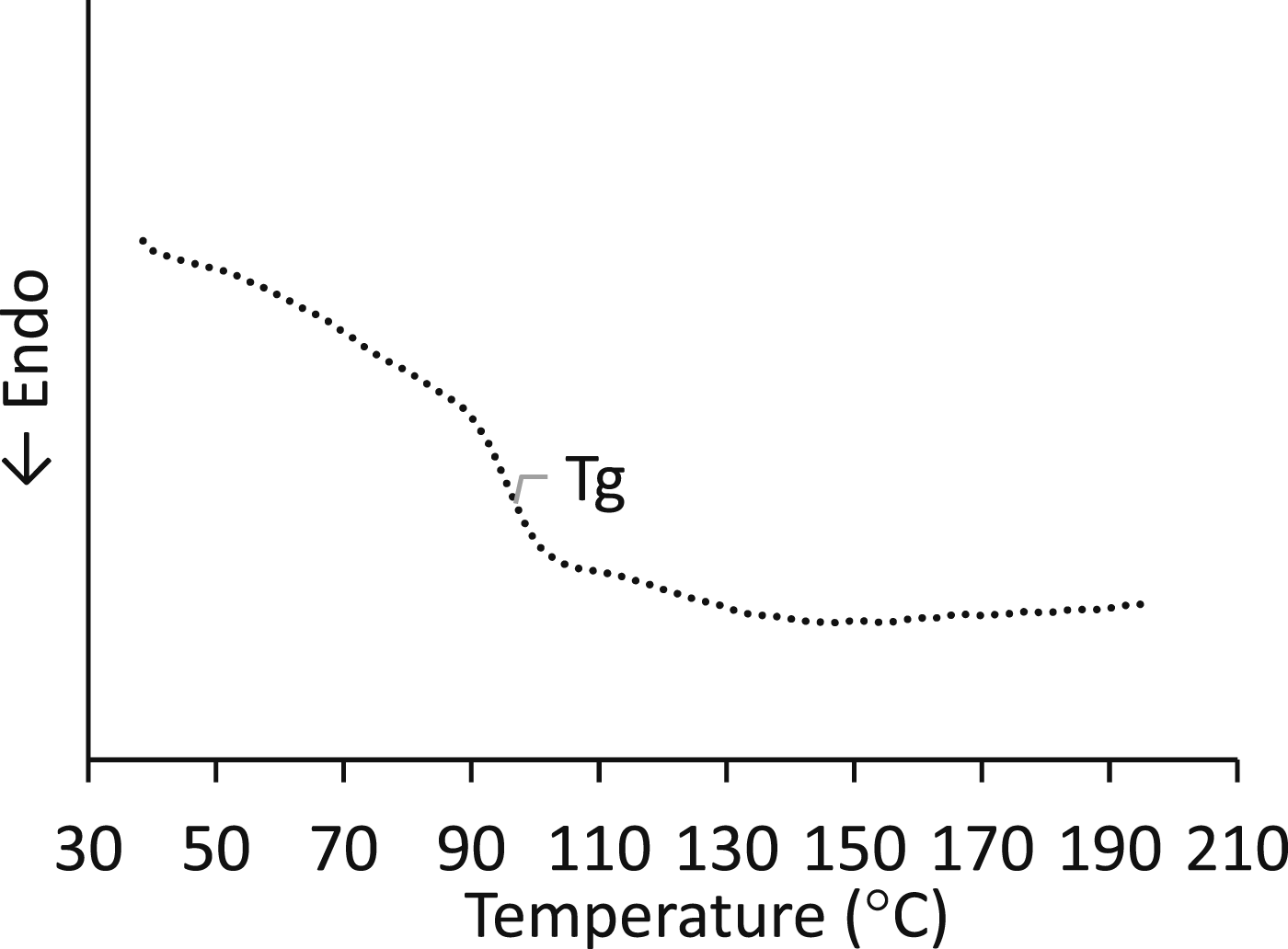
Viscosity of the core content/healant of the microcapsules
The viscosity of the healant is a key factor in achieving high healing efficiencies. Healants with lower viscosity are required since they have better capacity to move on the fracture surface.48,49 The viscosity of both DGEBA resin and mercaptan used in this study were measured using a parallel-plate type rheometer (Anton Paar - MCR 300 rheometer) at three different temperatures: (i) 25°C, (ii) 50°C and (iii) 70°C. The viscosity of the samples was recorded over a shear rate ranging from 0.1 to 100 s−1. As can be seen in Figure 5, the viscosity of DGEBA resin and mercaptan decreases with increasing temperature, indicating better flow ability. The viscosity of DGEBA resin decreases dramatically at higher temperature, comparable to the viscosity of DTHP epoxy resin which has been used as a self-healing agent before.
8
This indicates that DGEBA resin is more effective to be used as a healing agent at an elevated temperature, as it can uniformly spread on the fracture surface due to its lower viscosity. Effect of temperature on viscosity of core content/healants of the microcapsules.
Room temperature healing with the DGEBA epoxy/mercaptan self-healing system
Figure 6(a) shows typical load versus displacement curves of original and healed fractures of the self-healing epoxy when healed at room temperature. Unlike the ‘stick and slip’ fracture behaviour of the original fracture, for healed specimens, most of the samples failed after the maximum value was achieved; by this time, a sudden decrease of load can obviously be seen (rapid propagation). An average healing efficiency of 26% can be observed for room temperature healing of the TDCB specimens. (a) Load displacement curves for the TDCB sample healed at room temperature; (b) SEM images of the healed fracture surface of cured epoxy containing 10 wt. % DGEBA/mercaptan microcapsules (the clean fracture surface indicating poor healing); (c) load versus displacement of unmodified cured epoxy healed with an injected mixture of DGEBA/mercaptan/DMP-30.
The low healing efficiency can be attributed to the high viscosity of DGEBA resin at room temperature of about 10.6 Pa s. And, since the flow ability and viscosity are inversely proportional to each other, healing with DGEBA-loaded microcapsules might not be beneficial at room temperature. 50 An investigation on the healed fracture surface of the specimen is shown in Figure 6(b), which appears to be in agreement. As can be observed from the micrograph, a clean fracture surface with small lumps of the polymerised healant indicating the lack of a uniform healant film formed on the fracture surface. As described in our previous study, 9 due to the high viscosity of the epoxy at room temperature, some of the healant remains intact inside the capsule resulting in poor healing performance.
To simulate the effect of uniform spreading on the healing effectiveness, a mixture of DGEBA resin and mercaptan (mixed with DMP-30) with 1:1 weight ratio was prepared and immediately spread thoroughly onto the crack surface after the initial fracture of neat epoxy samples. The specimens were left at room temperature and retested with the same Mode-I fracture toughness test procedure. Figure 6(c) shows the load versus displacement curves of the original fracture and the healed fracture (healed with the prepared mixture) of the neat epoxy. It can be seen that, when the mixture of the healant uniformly spread onto the crack surface, the healing efficiency of around 60% can be achieved. This is an increment of more than 100% compare to the in-situ room temperature healing.
Besides, to reach the maximum adhesive properties, a higher temperature healing cycle should be selected to achieve a higher cross-link density of the DGEBA resin. In general, when epoxy is cured at lower temperature, the crosslinks will form gradually, causing a highly expanded polymer network structure with a lower cross-link density, which in turn can affect the physical properties of the healant film. Conversely, a higher cross-link density formation will enable the cured epoxy to display enhanced mechanical, physical and adhesive properties.
51
DSC analyses on cured DGEBA/mercaptan healant films shown in Figure 7(a), displayed the Tg of the healant films cured at different temperatures. Since the relationship of cross-link density and Tg is substantially linear,
52
it is obvious that the resultant healant film was unable to show the best performance with a room temperature healing condition. With Tg of only 18°C, even at room temperature service application, the resultant healant film will start to soften and likely to lose some of its strength. (a) DSC curves of showing Tg of the DGEBA epoxy/mercaptan healant cured at room temperature, 50°C and 70°C; (b) DSC curves of epoxy- and hardener-loaded microcapsules.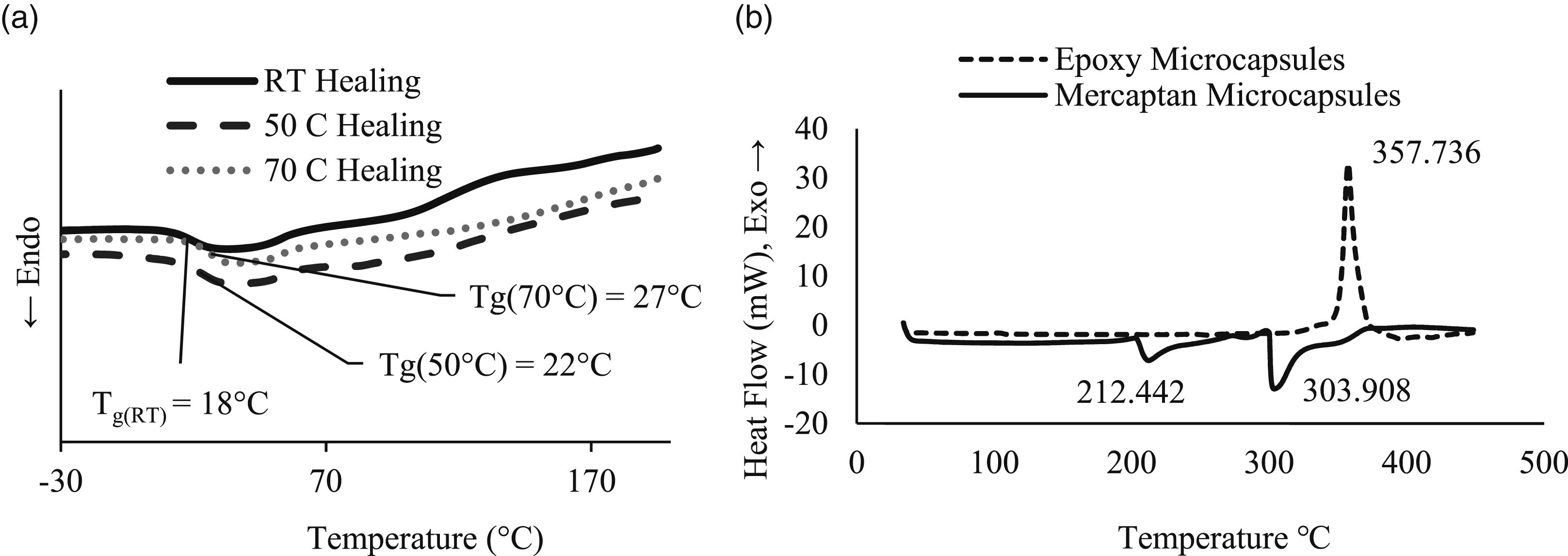
The thermal property of microcapsules plays an important role in their application as healing agents for an elevated-temperature cured epoxy. The DSC curve of epoxy-loaded microcapsules showed exothermic peak at 357°C (Figure 7(b)). This prominent exothermic peak may be due to the self-polymerisation reaction of core materials and the decomposition of the shell material. The DSC plot of mercaptan-loaded microcapsules contained two endothermic peaks. The endothermic peak at 212°C represents the melting of the core material, while the second endothermic peak at 303°C may represent the decomposition of the shell materials. These results show that neither microcapsule decomposed nor having any reaction until being heated to a very high temperature.
Thermally activated healing with the DGEBA epoxy/mercaptan self-healing system
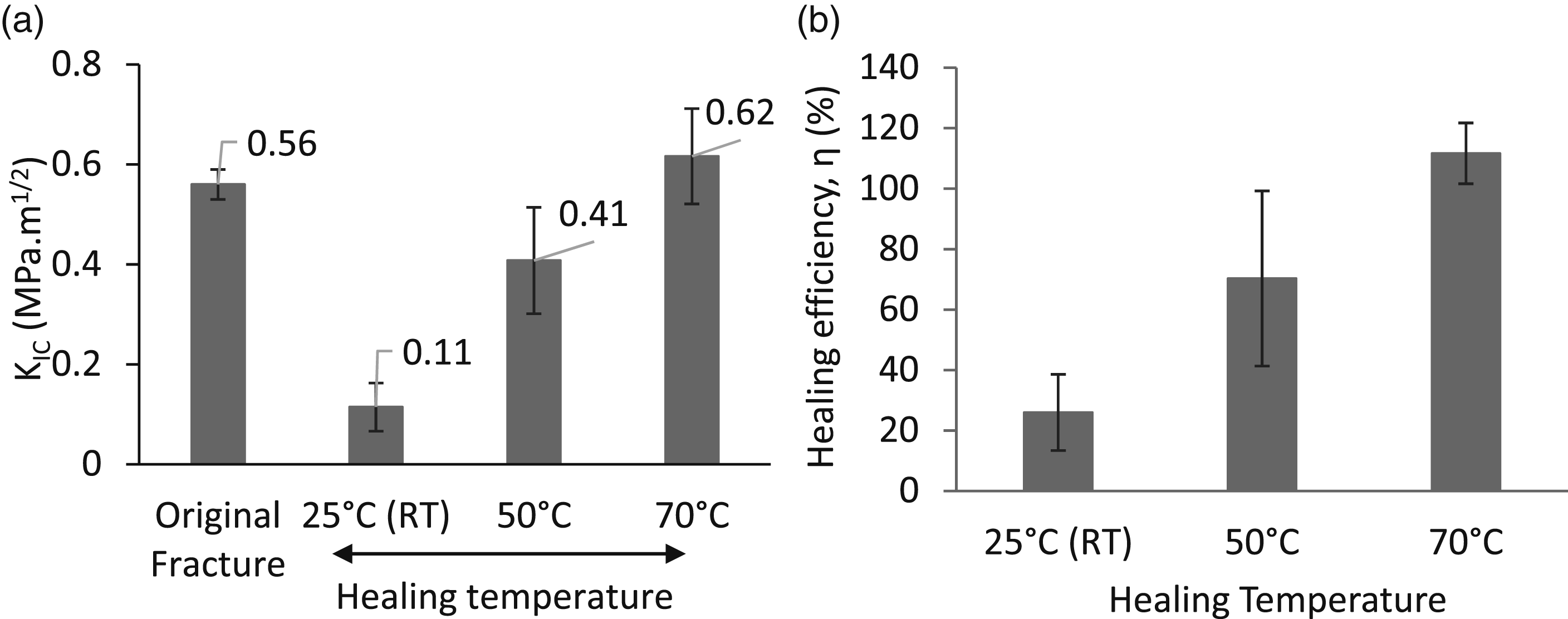
Figures 8(a) and (b) show load versus displacement curves of elevated-temperature cured epoxy specimens that were healed at 50°C and 70°C, respectively. The curves of the thermally healed specimens show the same ‘slip and stick’ characteristic as the original fracture. The average healing efficiency of specimens thermally healed at 50°C and 70°C are 70% and 111%, respectively. This is an indication that the thermally activated healing process is better suited for DGEBA/mercaptan healing chemistry. Figures 9(a) and (b) summarise the fracture toughness and healing efficiency for specimens healed at room temperature and the specimens that have undergone a thermal healing process. Load versus displacement of thermally activated healing of cured epoxy containing 10 wt. % microcapsules: (a) healing at 50°C and (b) healing at 70°C. (a) Average fracture toughness of original fracture and healed fracture at different healing temperature; (b) healing efficiency of a epoxy-based polymer containing 10 wt. % DGEBA/mercaptan microcapsules at different temperature. Vertical error bars represent one standard deviation.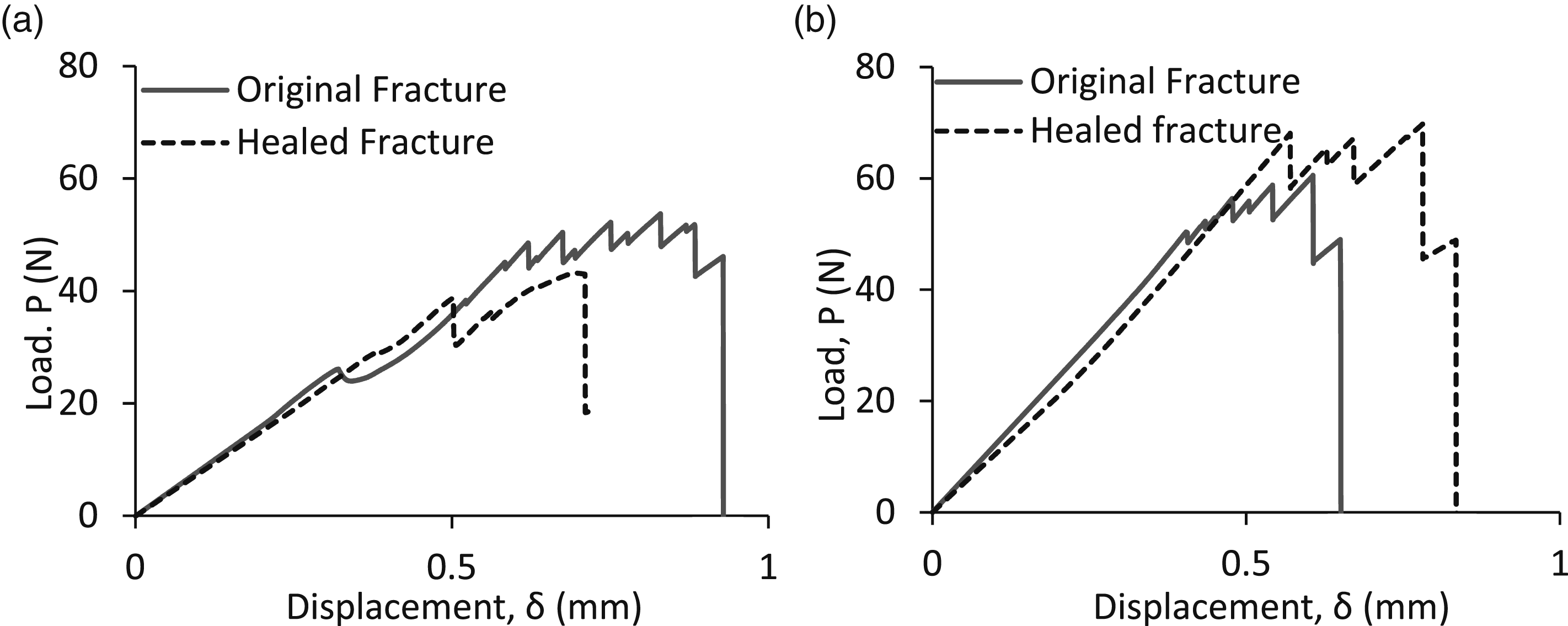
Figures 10(a) and (b) show the fracture surfaces of the epoxy samples that were healed at 50°C and 70°C, respectively. As can be seen from these images, the formation of healant films were more widespread and uniform when the thermal healing process was employed. Owing to the low viscosity of the DGEBA resin at higher temperatures, the flow ability of DGEBA resin was enhanced. Clearly, the chemical reaction between the DGEBA resin and the mercaptan can only happen when the two substances come in contact; thus, with lower viscosities, the substances have a higher likelihood to come into contact with one another. SEM images of healed fracture surfaces of healed at elevated temperature (the healant film highlighted in purple): (a) 50°C healing temperature; (b) 70°C healing temperature; (c) good adhesion between the healant with the host material causing the healed crack plane to deviate from the original fracture plane (different colours indicate different crack plane).
It was also observed that the healing of the elevated-temperature cured epoxy at 70°C shows a recovery of fracture toughness higher than its original fracture toughness. This shows that the healing ability of the DGEBA/mercaptan dual-capsule system at higher temperature not only heals the crack but also provides the damage locations with a higher fracture toughness. As explained by Gupta et al. 51 in their glassy state, large-strain properties of epoxy such as their tensile strength and toughness, shows dependency on the intermolecular packing, molecular architecture and molecular weight between crosslinks. Therefore, as the healing temperature increases, the healed epoxy film shows a relatively large change in these parameters, consequently resulting in higher fracture toughness. In Figure 10(c), it was observed that the DGEBA film healed at 70°C has a Tg at about 27°C, whereas when the DGEBA is healed at temperature below 70°C, the Tg is below the room temperature. This indicated that even at ambient temperature, the healant that was cured below 70°C was in its rubbery state, which is undesirable for load-bearing applications.
Additionally, since DGEBA resin is the same polymerisable monomer used as the host material, when healed at 70°C, a good adhesion between the healant film and the host materials can be expected; consequently this can cause the crack to deviate from the original fracture Figure 13(c) 49 ,53. This subsequently contributed to a higher healing efficiency. However, one the limitation of this dual-mechanism self-healing approach is that the repeated healing is only possible after the first healing event if uncured resin is present at the damage region.
Conclusion
From the experimental results, the following can be concluded: 1. The inclusion of 10 wt. % of DGEBA/mercaptan microcapsules into an elevated-temperature cured epoxy caused slight changes in the mechanical properties of the epoxy sample as evidence by the Mode-I fracture toughness and three-point bending tests. 2. The DSC analysis on unmodified neat epoxy shows that maximum cure was achieved with the epoxy curing cycle of 8 h at room temperature followed by 16 h at 120°C. This indicates that the thermal healing of the epoxy containing DGEBA/mercaptan microcapsules was not contributed by the post-curing of the host epoxy. 3. At 70°C, viscosity of DGEBA reduced to 0.1 Pa s from 10.6 Pa s at room temperature. SEM images revealed uniform formation of healant films on the fracture surface due to good flow properties of the healant during thermal healing. 4. Thermal healing at temperature of 70°C lead to an increase in both the rate of polymerisation and the best degree of cure, producing an increased fracture toughness recovery of up to 111%. 5. The thermal healing leads to healant film with a higher glass transition temperature, Tg, which in return generated relatively a higher cross-linking density film, and this attributed to a better healing performance. 6. Investigation of the fracture surfaces shows that the healing agents remained intact inside the microcapsules when healed at room temperature. This is due to their higher viscosity. Therefore, uniform spread of the healing agent cannot be achieved, resulting in low healing efficiency (26%).
Footnotes
Acknowledgements
Special thanks to Professor Ming Q. Zhang from Sun Yat-Sen University, China, for his participation in this project directly and indirectly.
Declaration of Conflicting Interests
The authors declared no potential conflicts of interest with respect to the research, authorship, and/or publication of this article.
Funding
The authors disclosed receipt of the following financial support for the research, authorship, and/or publication of this article: This work was supported by Universiti Teknologi Malaysia, UTMER grant, cost center no. Q. J130000.3851.19J39.
