



Abstract
Alkali treated (5 wt. % alkali was used on the total weight of the alkali solution and the treatment time was 2 h) discontinuous cellulosic fiber (jute and sisal were used as cellulosic fibers and 35 wt. % filler content was incorporated) reinforced chemically modified ZrO2 (ZrO2 was used as 10 wt. % of total filler content. In this context, it is worthwhile to mention that when both fillers were used, the fiber content was taken in the weight ratio of 1:1.) dispersed hybrid unsaturated polyester composites were fabricated by a compression molding technique. The mechanical behavior of the fabricated composites was evaluated at the sub-micron scale by nanoindentation (indentation with an applied load on the composites surface at the nano-metric range) or depth-sensing instrumented indentation technique. The significant effect of incorporation of the dispersing phases within the unsaturated polyester matrix with respect to mechanical properties at microstructural length scale was observed. A marked improvement in the nanoindentation-derived parameters viz., nanohardness, reduced modulus, elastic recovery, and indentation creep was observed which may be attributed due to the influence of fillers inclusion within the unsaturated polyester matrix. An extensive effort was laid to analyze the dynamic mechanical properties using the sinus indentation mode associated with nanoindentation measurements to further correlate the influence of fillers addition with the indentation-derived parameters.
Keywords
Introduction
Polymeric matrix–based composite reinforced with fiber and particulate is a quite established research area. A significant improvement in properties of the composites has been achieved by incorporating multiple dispersing phase(s) viz., cellulosic fibers along with particle within the polymeric matrix. Natural fibers possess several outstanding properties viz., low density, high flexibility, eco-friendly, abundance, and economical that make it as a best alternative when compared with synthetic fiber for it is used as reinforcement. Such composites display superior mechanical properties which make them a suitable candidate for use in the automotive sector. 1 A superior mechanical and thermal property of the unsaturated polyester (UP) resin, epoxy, and cement matrix can be achieved by reinforcing it with natural fiber as well as metal oxide particle (in some cases carbon nanotube) for it is used in structural applications.2-5 Apart from the bulk mechanical property, the estimation of the same at the sub-micron scale to access the effect of the dispersing phase on the matrix has drawn special attention. Such estimation of mechanical properties at the sub-micron scale can be obtained through nanoindentation or depth-sensing instrumented indentation technique that measured the quantitative force versus displacement data and formative the elastic modulus (E) and hardness (H) of the materials even beyond their elastic limit. 6 The effect of various loading of nanoclay dispersoids on the nanomechanical properties of layered silicate nanoclay reinforced unsaturated polyester (UPE) composites has been investigated by nanoindentation. The results display that these systems reveal significantly superior mechanical properties than unreinforced UPE. 7 In this context, it is worthwhile to mention that few previous literatures have been devoted toward the used of multiple reinforcements within the polymeric matrix. A significant improvement in mechanical strength has been reported after the addition of red mud along with sisal and banana fiber within unsatuated polyester matrix. 8 Moreover, Manikandan et al. have reported a noteworthy improvement both in hardness along with wear after incorporation of fly ash within jute fiber reinforced unsaturated polyester composites. 9 V. Manikandan et al. studied the influence of fly ash fillers on mechanical properties of woven jute fiber reinforced unsaturated polyester composites. Considerable improvement in properties of the composite was observed upon increasing the filler content. 10 Such studies have opened up an approach toward the used of multiple reinforcements within the polymeric matrix to develop a hybrid composite with desirable properties. In this present investigation, the nanoindentation-derived parameter has been estimated for cellulosic fiber reinforced ZrO2 dispersed UPE hybrid composites and correlated its structure with the properties obtained through the nanoindentation testing. In the present investigation, both fibrous and particulate phases were incorporated within UP matrix to obtain improved mechanical properties at the sub-micron scale through nanoindentation measurements. An attempt was made to correlate such improvement with the influence of filler inclusion within the UP matrix. An extensive effort was further laid to analyze the dynamic mechanical properties to correlate the influence of fillers addition with the indentation-derived parameters. Such investigation will open up a new window toward the evaluation of mechanical properties at small volume in case of hybrid reinforcement-based polymeric composites. The evaluation of mechanical properties of such composites at small scale is quite imperative with respect to its applications as miniaturized components.
Materials and methods
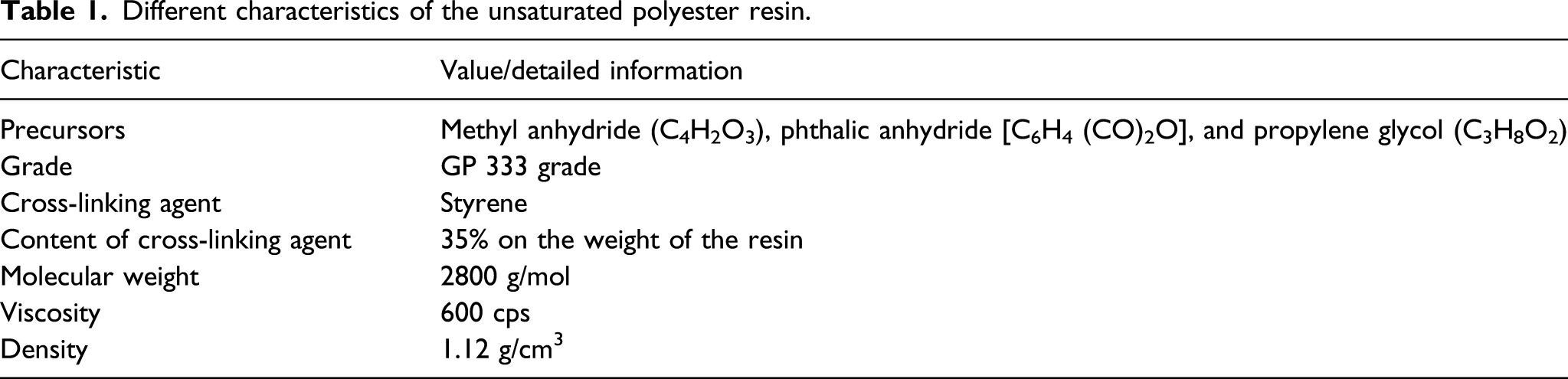
Different characteristics of the unsaturated polyester resin.
Sample preparation and formulations and the ASTM standard for the testing methods.

The morphological features of the fabricated composites and various tested composite samples were examined by using a scanning electron microscope (Hitachi S-3400N) with the operating voltage of 15 kV. The detailed nanoindentation measurements (Table 2) of the UP and UP-based composites were successfully conducted by CSM NHTX S/N: 55-0019 nanohardness tester with a triangular pyramidal (Berkovich) diamond indenter (Ref: B-I 93, the radius of curvature = 20 μm) under a static load of 10 mN and frequency of 2–10 Hz at an interval of 2 Hz for sinus mode and holding time used from 10 to 120 s for standard loading mode, respectively.
The nanohardness (H) and reduced modulus (E
r
) were estimated by the Oliver and Pharr methods from the initial gradient of the unloading curve
12

The elastic recovery behavior of the samples was extracted from the recovery index (η) parameter as reported elsewhere.
13
It is worthwhile to mention here that the parameter is a reflection of elastic energy component of the work of indentation

The wear rate of the UP and UP-based composites was further expressed in terms of estimated H and E
r
as (GPa)−115
The dynamic mechanical properties can also be obtained using a unique mode “sinus” for which a load of 10 mN (loading/unloading rate = 20 mN/min, pause = 2 s) with a variable sinus frequency of 2, 4, 6, 8, and 10 Hz and a constant sinus amplitude of 5 mN was adopted. The load–penetration depth curve of an indentation was switched to the dynamic mechanical analysis (DMA) mode of the instrument which was purely based on a spring–mass mechanical model involving a damper with a damping coefficient of 239.700 Ns/mm, a mobile mass of 11.272 g, and spring stiffness of 1.070 N/mm. The storage (E′) and loss modulus (E″) along with the loss factor (tanδ) and specific damping capacity (SDC) (2π tanδ) were estimated from the sinus nanoindentation mode. 16 The viscoelasticity is measured in complex modulus; the term E′ called storage modulus is a measure of the energy that a material can store at a particular time. The E″ called loss modulus is a measure of the amount of energy that is transferred/dissipated by the material during loading.
The ratio E″/E′ is termed as the loss factor and is often used as a measure of damping in a linear viscoelastic material
14

Collectively, these frequency-dependent properties are used to characterize the viscoelastic response of a material. Another important indentation-derived property is specific damping capacity. It is obtained by multiplying the loss factor with 2π. It is also the measurement of damping of the materials.
16

Results and discussions
Scanning Electron Microscope analysis
The Scanning Electron Microscope (SEM) images for the 35 wt. % UP/Jute/Sisal/ZrO2 have been presented in Figure 1(a) and (b). The uniform and consistent dispersion of the fillers, that is, cellulosic fibers (jute and sisal) and ZrO2 particles (marked with white circles) within the UP matrix is quite evident from the images as depicts from Figure 1(a). The proper dispersion of the fillers is mainly due to influence of chemical treatments of the fillers which significantly enhanced the wettability of the fillers with UP matrix, thereby providing a better interfacial bonding between the same. A better interfacial bonding leads to marked improvement in the mechanical properties of the fabricated composites. Such a uniform distribution of the fillers is further validated from the cross-sectional image of the composite as presented in Figure 1(b). SEM images of UP/Jute/Sisal/ZrO2 composites with 35 wt. % filler content showing (a) morphological features and (b) cross sectional view (fillers are marked with white circles).
Mechanical behavior at sub-micron scale
The mechanical behavior of the UP matrix and UP-based composites was successfully executed at the sub-micron length scale using the nanoindentation or depth-sensing instrumented indentation technique. It is worthwhile to mention here that since the 35 wt. % of filler content-based composites display the superior bulk mechanical properties
Load–depth of penetration profiles
The load–depth profiles for UP matrix as well as UP/Jute/Sisal and UP/Jute/Sisal/ZrO2 composites with a maximum load of 10 mN are presented in Figure 2(a)–(c). The maximum load was held at different time duration of 10, 30, 60, 90, and 120 s. It was observed that with the increment in holding time the penetration depth gradually increases for UP and UP-based composites. Moreover, it was evident from the profiles that a significant effect of incorporation of fillers was visible with respect to depth recovery after unloading. Such effect was in similar agreement with the results reported by Biswas et al.
17
The depth recovery was more for UP/Jute/Sisal composite than UP matrix during various holding times. This that may be due to presence of jute fiber that provides hindrance toward the movement of the UP chains. Such impediment was much higher after further incorporation of ZrO2 particles within UP/Jute/Sisal composite and as a result, the depth recovery was much superior for UP/Jute/Sisal/ZrO2 composite as compared to its UP/Jute/Sisal counterpart. Load versus depth of penetration profiles for (a) UP matrix, (b) UP/Jute/Sisal composite, and (c) UP/Jute/Sisal/ZrO2 composite. UP: unsaturated polyester.
Variation with holding time
Figure 3(a)–(d) shows the variation of various parameters (an error of around ±5%) derived from nanoindentation of UP matrix and UP-based composites with holding time. The effect of incorporation of the fillers (jute, sisal, and ZrO2) within the UP matrix was quite evident from the nanohardness (H) values as presented in Figure 3(a). It was observed that with increment in the holding time, the nanohardness of the UP and UP-based composites decreases steeply. The steady decrement in the load-bearing capacity of the UP and UP-based composites follows a similar trend. The variation in reduced or effective modulus (E
r
) with holding time for the UP and UP-based composites follows a similar fashion. Such a similar tendency of variation with the increase in holding time is mainly due to a reduction in the load-bearing ability. Variation of (a) nanohardness (H), (b) reduced modulus (Er), (c) recovery index (η), and (d) residual depth (hp) with holding time for UP matrix and UP-based composites. UP: unsaturated polyester.
The variation in recovery index (η) or the elastic energy component of the work of indentation with holding time for UP and UP-based composites is represented in Figure 3(c). It was observed that with increase in the holding time, the recovery index values decrease. The ability of recovery is enumerated from the tendency to recover the depth after unloading at peak load. It is worthwhile to mention here that such a tendency of depth recovery is in similar accord to the outcome reported by Biswas et al. 17 In the present investigation, the tendency of depth recovery at peak load was quite significant in the case of UP matrix incorporated with jute, sisal fiber, and ZrO2 particles all together as fillers. Such recovery was more for UP-based composites than the UP matrix. Moreover, the decrement in the recovery index values was less with the holding time for UP/Jute/Sisal/ZrO2 composite than UP/Jute/Sisal composite or UP matrix. The trend in recovery index is further validated from the variation in residual depth (h p ) with holding time for UP and UP-based composites as presented in Figure 3(d). The recovery index and residual depth vary inversely with the former that mainly conveys the elastic recovery of the matrix whereas the latter depicts the irrecoverable deformation or the plastic energy component of the work of indentation of the same under the application of load.
The variation of H/E
r
2
(an error of around ±5%) values with holding time for UP and UP-based composites as presented in Figure 4 provides the information regarding the wear rate of the same. The variation along with the holding time clearly revealed a significant increase in wear rate of the UP matrix than for the UP-based composites. This is probably due to addition effect of the fillers within UP matrix that decreases the wear rate under the applied load. Variation of H/Er2 with holding time for UP and UP-based composites. UP: unsaturated polyester.
Indentation creep
Figures 5(a)–(c) and 6(a)–(c) show the depth of penetration with time in the case of UP and UP-based composites for two different holding times of 10 (minimum) and 120 (maximum) s, respectively. The plots clearly revealed that with time the strain increases proportionally, and after attaining a definite value, the strain rate changes abruptly. This is the indentation creep obtained as a result of holding the materials at a constant load. But the strain value at the holding time of 10 and 120 s is maximum for UP and minimum for UP/Jute/Sisal/ZrO2 composites, and the strain value of UP/Jute/Sisal composites is in between the same. It can also be concluded that with increment in holding time, the strain value increases remarkably. Depth of penetration versus time plots for (a) UP, (b) UP/Jute/Sisal, and (c) UP/Jute/Sisal/ZrO2 composites with 35 wt. % filler content at a holding time of 10 s. UP: unsaturated polyester. Depth of penetration versus time plots for (a) UP, (b) UP/Jute/Sisal, and (c) UP/Jute/Sisal/ZrO2 composites with 35 wt. % filler content at a holding time of 120 s. UP: unsaturated polyester.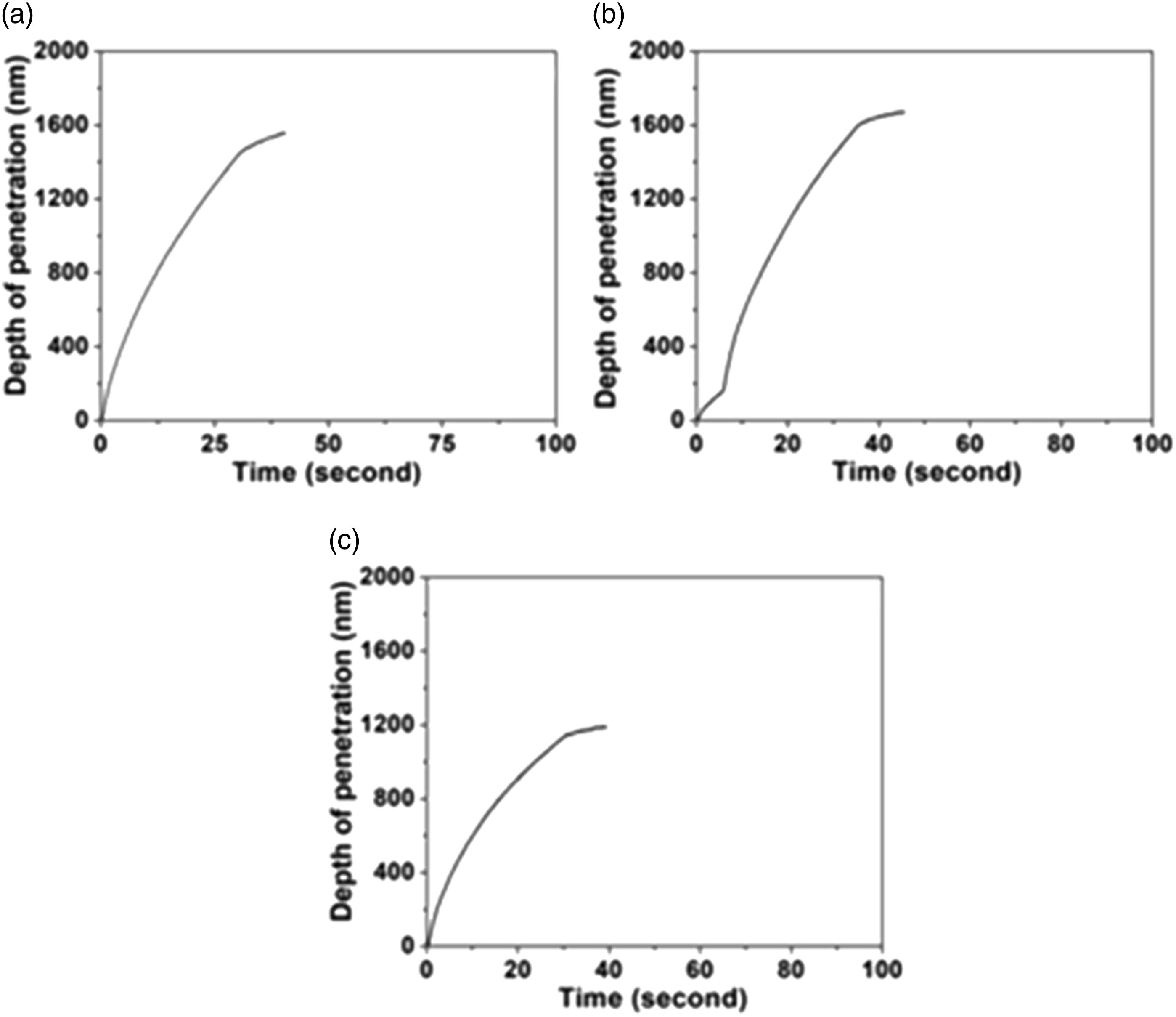

Indentation creep (%) for UP matrix and UP-based composites with 35 wt. % filler content at different holding time.

UP: unsaturated polyester.
Nano DMA
The sinus mode of the nanoindentation was utilized to obtain various dynamic mechanical properties viz., storage modulus, loss modulus, loss factor, and specific damping capacity that are plotted with sinus frequency in the case for UP, UP/Jute/Sisal and UP/Jute/Sisal/ZrO2 as presented in Figure 7(a)–(d) by adopting an error of around ±5%. It is clearly observed from Figure 7(a) that the storage modulus increases with sinus frequency for UP matrix as well as UP-based composites. This implies an enhancement in the stiffness of the UP matrix under higher loading cycles. This level of enhancement in stiffness was further increased with fillers incorporation within the UP matrix. This fact is obvious as the jute as well as ZrO2 particles significantly strengthen the UP matrix thereby escalating its stiffness. It is further observed from Figure 7(b) that the loss modulus decreases with sinus frequency for UP and UP-based composites. The present study revealed that the recoverable deformation reduces along with increase in the sinus frequency. It is also observed that with the inclusion of fillers within UP matrix, the composites become more stiff so the deformation decreases that implies reduction in loss modulus. Figure 7(c) shows that the loss factor, that is, the ratio of loss modulus to storage modulus decreases with sinus frequency for UP and UP-based composites. These depict that with increase in frequency, the tendency of energy loss by the materials become less. This propensity further improved for the UP matrix due to incorporation of the fillers within the same. The specific damping capacity is obtained by multiplying 2π with the loss factor for respective samples. The specific damping capacity of UP, UP/Jute/Sisal, and UP/Jute/Sisal/ZrO2 composites is presented in Figure 7(d). It was clearly observed that along with increment in sinus frequency, the specific damping capacity as well as the loss factor decreases and value reaches maximum in the case for UP/Jute/Sisal/ZrO2 composite at 2 Hz frequency. Variation of (a) storage modulus (E′), (b) loss modulus (E″), (c) loss factor (tan δ), and (d) specific damping capacity (2π tan δ) with frequency for UP and UP-based composites. UP: unsaturated polyester.
The Figure 8 presented the mode of deformation under nanoindentation for the fabricated composites. The fiber and particulate fillers are agglomerated around the portion of the indenter which penetrated within the composite. The retardation of filler increases up to a certain limit then collapses beyond a certain loading on the composites. Along with increase in load, the fillers failed to accommodate the strain; as a result, the hardness at the sub-micron scale decreases. It was further studied that along with the increase in load, the residual depth increases as the materials failed to recover the depth beyond a certain load. The same behavior was noticed if there is an increment in holding time under an application of certain load. Schematic representations of the indentation at the sub-micron scale for unsaturated polyester–based composite.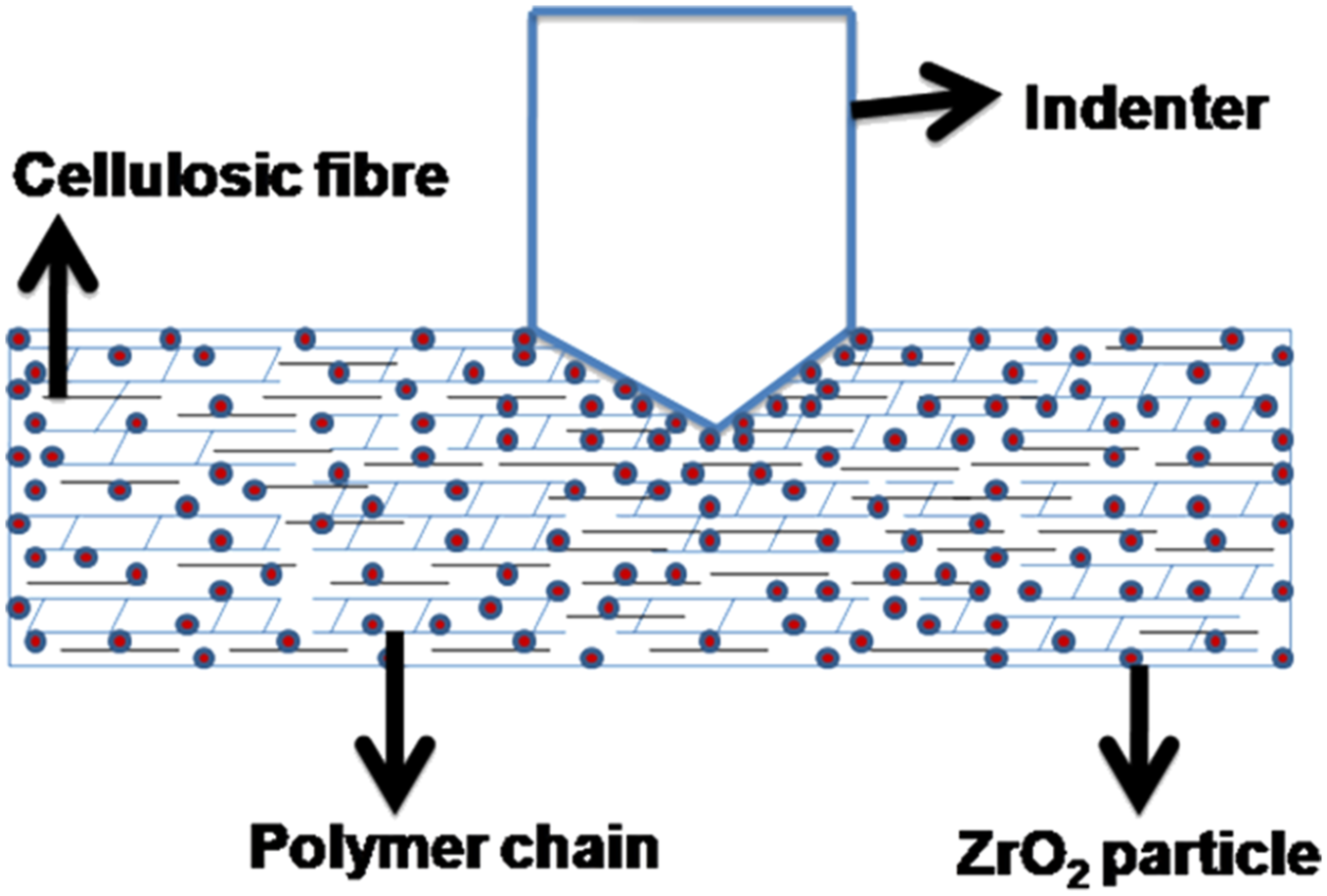
Conclusions
The present investigation has allowed to draw the attention toward the fact that with filler addition, the mechanical properties at the sub-micron scale improved significantly. A successful attempt to investigate the effect of fillers inclusion within the UP matrix through various nanoindentation-derived parameters viz., nanohardness, reduced modulus, elastic recovery, and indentation creep as well the wear rate and dynamic mechanical properties was successfully achieved. A significant improvement in the indentation-derived parameters viz., nanohardness (∼160%), reduced modulus (∼80%), recovery index (∼45%), wear rate (∼66%), and indentation creep (∼36%) was observed for UP matrix due to fillers addition. It was further noted that a similar enhancement in the dynamic mechanical properties, namely, storage modulus (∼50%), loss modulus (∼25%), loss factor, (∼25%) and specific damping capacity (∼60%), respectively, with the incorporation of fillers within the UP matrix. The mechanical behavior at the sub-micron scale for the UP/Jute/Sisal/ZrO2 composites was observed to be much superior as compared to UP and UP/Jute/Sisal composite. The current investigation has opened up with an idea to successfully employ such composites in the various applications in the automotive sector.
Footnotes
Acknowledgments
The author Bhabatosh Biswas is grateful to Indian Institute of Engineering Science and Technology (IIEST), Shibpur, for providing him the fellowship for doing the research work.
Declaration of conflicting interests
The author(s) declared no potential conflicts of interest with respect to the research, authorship, and/or publication of this article.
Funding
The author(s) received no financial support for the research, authorship, and/or publication of this article.
