



Abstract
The current world environment scenario demands new and more eco-friendly solutions to global problems that cover the demands for materials. This sector has included green polymer-based composites and natural reinforcers from origins of renewable sources, these Green Composites (GC), natural-fiber-reinforced bio-composites in which the matrix is a bio-based polymer, have shown attractive characteristics. Biodegradability is one of the most important attributes for these new “green” materials, in that this characteristic allows for their introduction into the world market as an environmental solution. The manufacturing processes for obtaining these materials have observed important improvements because each raw material exhibits different properties and characteristics and their eco-friendly character has facilitated its incorporation into diverse sectors, such as construction, automotive, packaging, and medicine, among others. At present, this segment represents an important income for some economies, especially those where these resources are available, enhancing the creation of green economies, strengthening the world’s efforts toward sustainability.
Introduction
Growing environmental awareness and increasing interest in sustainability have led to the development of biocomposites for structural applications, such as electronics, medicine, construction, sports, and automotive sectors. 1 At that time, the high economic cost of oil-based polymers was the main factor with which to search for new sources, based on more affordable biological origins, such as biomass and animal fibers. However, these fibers represented a minor percentage of the total mass of the composites, in that they were blended with Organic and Inorganic Matrices (OIM) that could confer on them physical, chemical, and structural properties for optimal performance in their applications, reducing the total cost of the final product. 2
The persistence in the environment of these biocomposites is significantly shorter compared to those that are entirely composed of oil-based materials. 3 The majority of natural fibers are easily degradable under environmental conditions, 4 also, these fibers show important advantages, for example, are renewable, abundant, inexpensive, light in weight, strong and non-abrasive, so they can be used as an excellent reinforcement material to reduce the utilization of synthetic fibers.
However, before the substitution of oil-based material by natural fibers, there are some crucial issues that have been addressed, for instance, moisture adsorption, low impact strength, and durability; diverse studies have resulted in the improvement of mechanical performance of the bio-based composites, nevertheless, more investigation is still required.
Defining the sustainability of GC has been challenging; in the majority of these studies, at least one component, i.e. the economic, social, and environmental aspect is not considered in its entirety.5,6 Some contradictions have been observed, specifically those related to the stage of the extraction of the raw materials, when lack of regulation can place the resource under pressure and, as a consequence, the whole system 7 or, when the manufacturing process uses similar amounts of energy 8 and toxic residues than in conventional processes of oil-based materials. The incorporation of concepts such as recyclability, renewability, and biodegradability 9 has made the conceptualization of green materials easy.
In this review, we describe aspects related to green composites, i.e. type of raw materials, manufacturing methods, the physical and chemical properties of the green composites, their applications, regulatory frame, and the participation of these materials in the global markets. We also analyze the contribution of GC toward sustainability.
Availability of biological resources for the synthesis of green composites
Biological resources, i.e. biomass, have emerged as a feasible source of new materials to improve the properties of polymers, for instance, mechanical performance, antimicrobial activity, and degradability, among others. 10 Two categories must be considered in the green composites field: the resources for synthesizing a bio-based polymer matrix, and the resources for blending with this polymer matrix, both of which are described here.
Bio-based polymers
Depending on the type of feedstock, biological strategies for developing biopolymers had been classified into the following three generations 11 : the first generation focused on the use of crops to obtain natural carbohydrate biomass (e.g., starch and cellulose) and proteins; second-generation strategies were developed around the use of non-edible waste materials, mainly agroindustrial residues, which offers the advantage of simple processing since the raw materials had already been preprocessed, and finally, the third generation was developed referring to algal biomass as feedstock.
Polysaccharide polymers
Polysaccharides are a wide group of polymers composed of tens or thousands of monosaccharides joined by glycosidic linkages (covalent bonds that join a carbohydrate molecule with another group, which may or may not be another carbohydrate). 12 In Figure 1, the chemical structure is presented of the most common polysaccharide polymers, i.e. cellulose, chitosan, starch, alginate, and pectin. Their characteristics and applications are mentioned in the figure.

Main characteristics and applications of polysaccharide polymers.
Natural fibers
Plant fibers can be classified according to their origin, considering six categories as follows: bast/stem; leaf: fruit/seed; stalk; grass, and wood. 13 Bast, stalk, and leaf fibers are naturally organized into bundles, whereas fibers from seeds occur in single form. Fibers comprising these categories, along with their chemical composition and mechanical performance, are summarized in Table 1.
Chemical composition and mechanical performance of natural fibers.
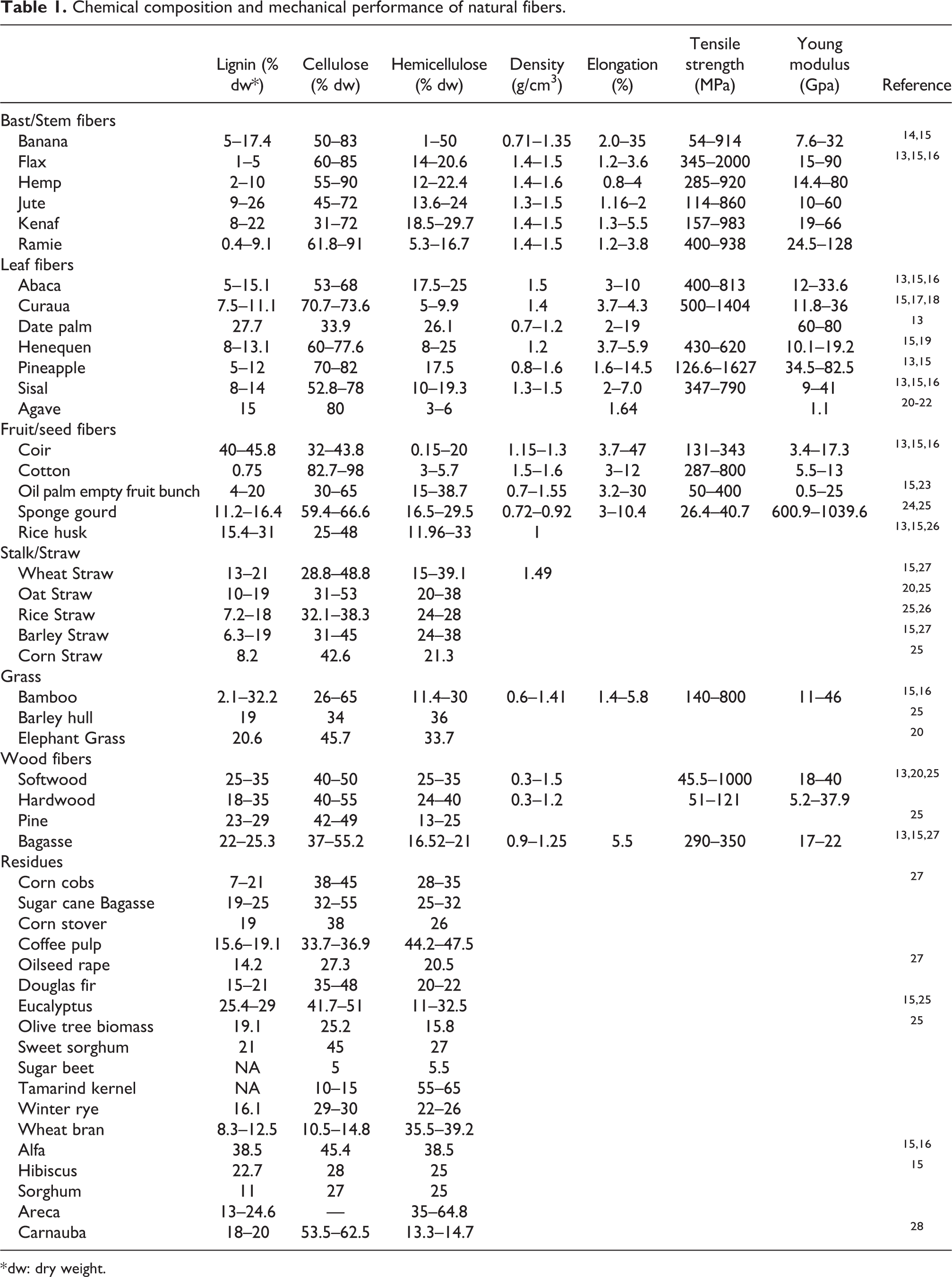
* dw: dry weight.
Fibers from bast or stems, separated from the extreme outer part of plant stems, are typically long fibers with high mechanical strength: thus, these are traditionally used in bags, curtains, yarn, textiles, and rope, among others. 29 The leaves, on the other hand, yield coarse and hard fibers with relatively low strength. 30 They can be obtained by hand-scraping or by mechanical extraction and utilized in woven ropes, fabrics, carpets, and mats.
Fruit and seed fibers are extracted from the outer husk of the respective fruit or seed. Because they are lightweight and strong, they have been used for the fabrication of ropes, mats, brushes, and textiles. Tall grasses are employed for the extraction of grass fibers and are mainly utilized as reinforcements for cement-based composites.
Plant fibers are produced worldwide, in that they can be obtained from many resources; however, a wider variety of plant fibers is found in tropical countries. Asia is considered the leader in terms of production, with India, Pakistan, and Bangladesh supplying coir and jute in high quantities, and China is one of the main global producers of wool and cotton, the latter along with India, Pakistan, and Thailand. 16
The Americas also account for an important production of plant fibers. The United States, Brazil, and Canada are among the top five producers of wood in the world, while sisal, abaca, and cotton attain high yields in Brazil, Ecuador, and the U.S., respectively. Mexico, on the other hand, might play a leading world role as a producer of lignocellulosic materials,31,32 which could be used as raw material for manufacturing composites. The cultivation of flax and hemp, however, is more favored in some countries in Europe because of their temperate climate. 16
The cultivation of vegetable fiber has also proven to be one of the few viable economic activities for generating income in the least developed countries, especially as an alternative to agricultural production, while revalorizing food-production by-products.33,34
Polymer matrix
An essential component of GC is the bio-based polymeric matrix, defined as organic macromolecules (human-made or human-processed) derived from biological resources for plastic and fiber applications. 35
To date, several bio-based polymeric matrices have been developed, exhibiting attractive performances in different sectors. In Figure 2, we find representations of the chemical structures of PolyButylene Adipate Terephthalate (PBAT), PolyButylene Succinate (PBS), PolyCaproLactone (PCL), PolyLactic Acid (PLA), and PolyHydroxyAlkaonates (PHA) and their methods of synthesis, properties, and relevant applications in diverse sectors.

Bio-based polymeric materials and their applications.
Methods for the industrial manufacturing of green composites
Interest in natural fiber composites is growing due to their advantages against synthetic materials, for example, high specific strength and stiffness, renewability, lower production cost, low hazard manufacturing process, and low emission of toxic compounds during incineration at end of life. On the other hand, they possess lower durability and strength, high moisture absorption, and more significantly, their variability represented to date, all of the above remarkable aspects to consider in terms of their acceptability and the incorporation of these materials into new sectors.36,37
The mechanical performance of green composites depends on the following factors: type of fiber (method of extraction, pretreatment, ratio, harvest time): selected matrix; fiber dispersion, and porosity, among others. 38
The technology for the manufacture of green composites is led by molding (injection and compression)39,40 and pultrusion.41,42
Table 2 shows some examples of green composites manufactured by applying the previously mentioned methods to the treatments and under the manufacturing conditions.
Manufacturing conditions, treatment and composition of green composites.

* wt: weight percent.
Injection and compression molding
The major advantage of the injection molding technique lies in its high processability, although the fiber could be degraded during the procedure. 57
The factors-to-analyze before deciding on the use of this method include the following: a) machine properties, i.e. barrel temperature, coolant temperature, packing pressure, back pressure, and injection pressure, and b) process parameters, i.e. molding and melting temperature, cooling temperature, melt pressure, cooling time, material flow rate and injection rate, and quality indices, i.e. the dimension of the parts, sink marks, appearance and strength, surface texture, and aesthetic defects.58,59
Compression molding is used to produce complex parts 60 ; part-quality requirements are an important consideration for the selection of this method. The process is characterized by being usually discontinuous, being applied to produce a low volume of materials, and the raw materials can be supplied as sheets, composite granules, and prepregs. 61
Pultrusion
This technology involves a process of pulling reinforcing fibers through a bath where they are impregnated with some formulated resins, and then through a heated die, creating a continuous composite profile. This method is utilized to produce traditional composites, i.e. natural flax fibers, hemp, and wool fibers, 62 jute fibers, 63 jute, wood, and starch. 51
Many advantages of this method are reported, for instance, the increase of composite strength, improving overall properties through better impregnation, distribution, and alignment of the reinforcing fibers. This technology is also a highly automated process, one that permits high volumes of production with homogenized quality. Pultrusion has demonstrated an excellent performance for the production of composites with a high percentage of natural fibers. 64
Hand lay-up
This method for manufacturing composites has been employed for forming composite structures since ancient times as it can be performed as long as the mold, skills, and materials are available. 65 However, the final characteristics and properties differ from one composite to the other, even though they are made with the same materials and composition. This is because the composites are made purely using of human skills; the presence of bubbles or non-uniform surfaces are, among others, recurrent characteristics.
Solvent/solution casting method
This method involves the dissolution of the polymer in an organic solvent, mixing it, and casting the solution into a mold. The solvent is subsequently allowed to evaporate, citing its main advantage as ease-of-preparation and -operation without the need for specialized equipment. 66 However, the polymer must be soluble in a volatile solvent or water and, because of the mostly insoluble character of fibers, the variability of the produced composites is high. The use of a solvent in the process could affect the green character of these composites; however, solvents in the process can be collected and recycled.
Summarizing, in Figure 3 are schematized the three most common methods that can be used for manufacturing green composites, a) Solution casting, b) compression molding, and c) injection molding.
During the solution casting method, the polymer is dissolved in an organic solvent and then mixed with fibers. The solution is then cast into a mold, and subsequently, the solvent is allowed to evaporate. b) During compression molding, the polymer and fibers are mixed and placed into the mold cavity. The polymer is melted by applying heat and pressure. Then, the composite is allowed to cool and solidify previous to its removal. c) Injection molding has been paramount for decades in the mass-production of bio-plastic products. Fibers are mixed with the polymer in solid-state. The mixture is then added into a heated barrel and injected in different molds, allowing the formation of different shapes.

Methods used to manufacture green composites.
Physical and chemical characteristics of renewable, recyclable, and biodegradable composites
Green composites exhibit comparable properties to those reinforced with synthetic fibers, explicitly mechanical, thermal, and tribological, and acoustic and electrical insulating properties; while offering clear advantages regarding the environmental impact due to their renewability and natural biodegradability. 67
Despite these benefits, green composites are not capable of replacing their synthetic counterparts in all applications entirely due to some significant limitations, i.e. high flammability, high moisture absorption, and a wide variation in properties, a consequence of their natural origin. 37
Diverse studies have shown that the composite properties of green composites depend primarily on fiber size, shape, orientation, the crystallinity index, chemical composition, and dispersion. The volume and weight fraction of the fiber in the composite play a crucial role in determining the composite’s properties. 22
It is well known that applying pretreatments i.e. mechanical, physical, chemical and biological to raw materials used to manufacture green composites may improve the mechanical and physical characteristics of GC. 68 In Figure 4 are mentioned the main effects on the raw materials after the pretreatment and their particular characteristics; these effects might impact some physical and chemical properties of composites and are explained in detail in further sections.
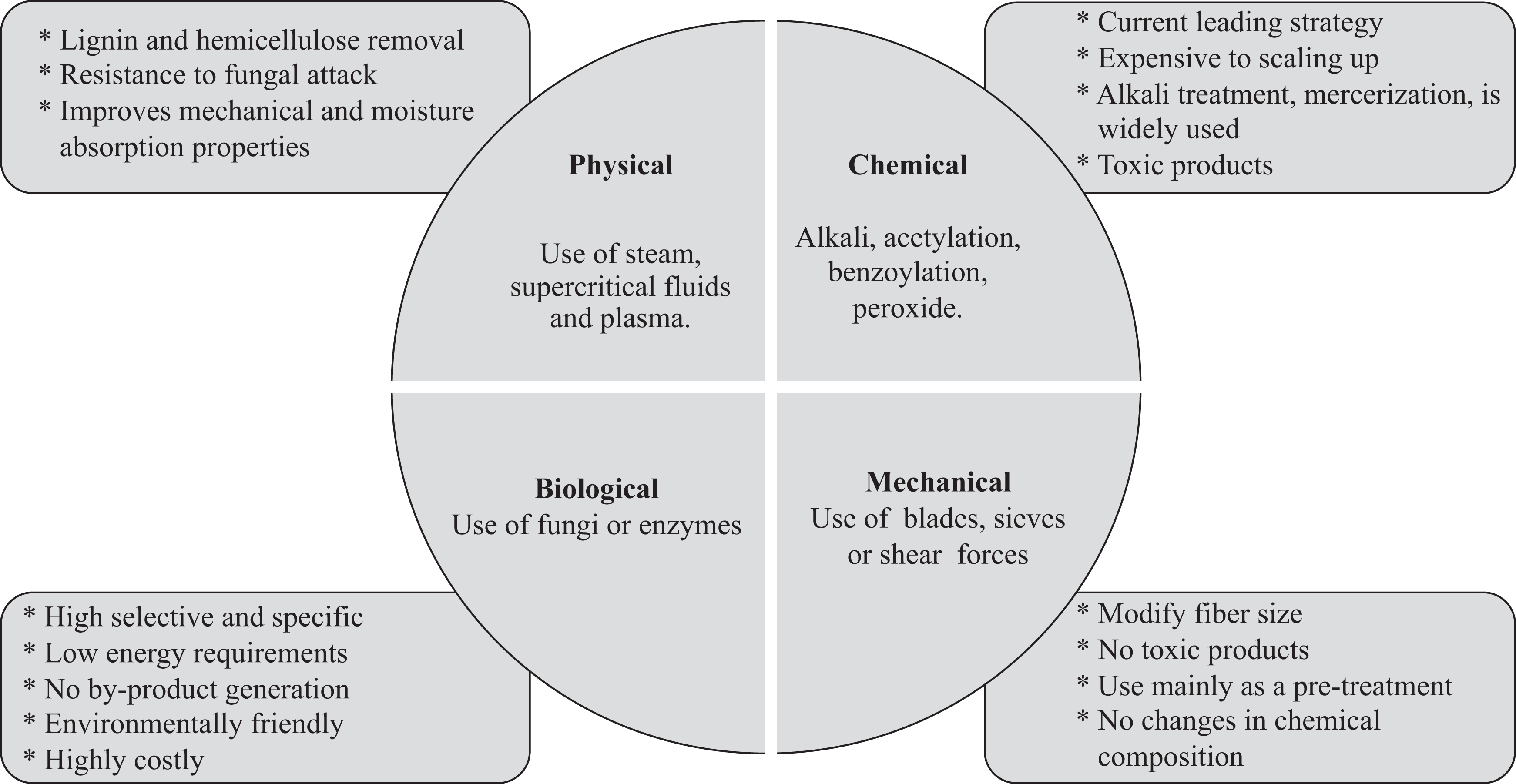
Pretreatments applied to natural fibers to manufacture green composites.
Mechanical properties of green composites
Mechanical performance is one of the most relevant parameters in composite materials since it is fundamental to assess their suitability for the targeted application.
Incorporating two or more fibers into a polymeric matrix is also a popular technique to obtain better properties of mechanical and moisture absorption. These types of materials have been designated as hybrid composites, and these materials have proven to be a cost-effective way to develop a better performance of composites. The compatibility between the fibers and the fiber-matrix is of utmost importance, in that this selection will determine the final properties of the composite. 69
Natural fibers have shown to have comparable specific stiffness and specific strength to glass fibers 70 ; however, when comparing the mechanical performance of composites made with each of the fibers, the trend does not always reveal the same patterns. Natural-fiber composites exhibit comparable tensile strength, impact strength, and interlaminar shear strength to synthetic fiber composites, and higher resistance to fracture. 71
The natural fiber controls the mechanical properties of composites. Its performance can be affected by the location of the plant, crop variety, seed density, soil quality, field location, climate, and harvesting, 72 which determine the chemical composition of the fiber, thus explaining the variability in properties.
The physical properties of fibers can also alter their mechanical performance; for instance, fibers with a small fibrillar angle, small fiber diameter, and high aspect ratio achieve higher mechanical properties. 73
Regarding the matrix-fiber system, fiber dispersion, size, orientation and volume fraction, and interfacial adhesion 74 might exert an influence of the mechanical behavior of the composites, particularly the interfacial adhesion, which is established as the most crucial key to determining the mechanical properties of the composite. This is due to that a strong adhesion will attain an effective transfer and distribution of stress on their interfaces, successfully achieving fiber reinforcement. 75
Fiber orientation has been demonstrated to improve fiber strength, while fiber length and volume fraction has been reported to entertain a relationship with flexural and tensile strength. 76 For example, small lengths confer a reduction on the composite’s tensile strength by decreasing the possibility of critical flaws. 77 However, it is important to emphasize that for structural applications, because short fibers lead to increased variability, fiber length should be maximized and aligned with the applied load to prevent failure. 78
Yussuff et al. 79 evaluated the tensile and flexural properties of PLA-based hybrid green composites reinforced by kenaf, bamboo, and coir fibers, observing that the combination of the high strength and stiffness of the bamboo and kenaf fibers and the high ductility of the coir fiber improved tensile and flexural strengths compared to those of single-fiber GC.
Table 3 summarizes the chemical and physical properties conferred on composites reinforced with natural fibers. Some parameters are included, such as the Young modulus, flexibility, tensile strength, elongation, etc.
Modification of physical and chemical properties of composites reinforced with natural fibers.

* wt: weight percent.
Moisture absorption
When dealing with natural-fiber composites, moisture absorption is a critical element to consider, because it can strongly influence the mechanical properties of the composite. Its importance increases if the matrix is a bio-based polymer, as these materials absorb more moisture than their oil-based counterparts.
Green composites have proven to perform poorly when immersed in water 97 ; therefore, it is essential to consider this major limitation when designing a green composite for a tailored application.
Moisture absorption in green composites is mainly driven by the natural hydrophilicity of plant fibers. 98 The volume fraction of fibers and the environmental temperature has also been reported to significantly influence water absorption, exhibiting an increasing effect with higher fiber content and temperature. 99
Incompatibility between the hydrophobic polymer matrix and the hydrophilic fibers can create micro-voids, which might increase water retention. 100 Micro-gaps between polymer molecular chains also contribute to water absorption by allowing the inward diffusion of water molecules. 15
The absorbed water molecules severely affect the fiber–matrix interface. The capillary effect transports water through the interface, which leads to a decrease in the adhesion between fiber and matrix, creating regions of poor transfer efficiency, weakening of the composite mechanical properties, deformation, and even degradation.101,102
Thermal
Determining the thermal properties of composites is relevant since they can limit the range of suitable applications and processing methods, especially when dealing with natural fibers and synthetic polymer–matrix combinations, given that the processing temperature of the matrixes can surpass the degradation temperatures of fibers. This, however, is not a great concern for bio-based polymers, since these materials have relatively lower processing temperatures 103 ; in the case of fibers, it is reported that decomposition occurs at 200°C when hemicelluloses degrade. The temperature range between 300 and 400°C corresponds to cellulose degradation, while lignin decomposition takes place between 400 and 500°C. 104 Selection of the polymer matrix must consider these temperature ranges to achieve the successful manufacturing of the composite.
Flammability
The flammability of natural-fiber composites depends on the type and content of the fiber in the material. 105 However, the majority of fibers are considered poor flame-retardant materials; therefore, they have not exhibited improvements concerning fire resistance in green composites. 106 When dealing with a particular interest in flame retardancy, it is common to find added flame-retardant agents and treated fibers for achieving the desired property for green composites.
Biodegradability and recyclability
The American Society for Testing and Materials (ASTM) defines a biodegradable plastic as a material in which all of the organic carbon can be converted into biomass, water, carbon dioxide, and/or methane via the action of naturally occurring microorganisms such as bacteria and fungi, in time-frames consistent with the ambient conditions of the disposal method. 107 The biodegradation of composites is determined by the degradation of its constituents 104 and, while plant fibers exhibit inherent biodegradability, not all bio-based plastics can be defined as biodegradable. Such is the case of PLA, which falls into the compostable category.
The degradation rate is mainly controlled by the chemical backbone of both the matrix and the fiber 72 ; thus, this can be predicted based on their chemical composition with respect to the natural fibers, cellulose, and hemicellulose, and the –OH. The remaining polar groups in cellulose and hemicellulose induce biological degradation through the creation of a moist environment that favors the growth of microorganisms. Fibers are also susceptible to different types of degradation, such as ultraviolet (UV) and fire degradation due to lignin, as well as thermal degradation due to hemicellulose. 108
The degradation of green composites is also affected overall by the environmental conditions to which the material is exposed. Moisture, UV radiation, temperature, and microorganism activity can negatively impact the interfacial adhesion, causing micro- and macro-cracks in the material, accelerating the biodegradation of the composite. 109
A time of degradation is not always desirable. It is also a positive aspect of the slow degradation of composites used in long-term applications, i.e. in the packaging and transportation of goods 110 ; in this manner, the material can be used for longer times, thus reducing costs.
Microorganism growth on green composites can lead to a reduction in mechanical properties such as bending strength, hardness, and color fading, which will impact the aspect of the material. 111 When long durability is required, some pretreatments and new processes are included, for example, copolymerization, fiber treatment, and the addition of compatibilizers, to name a few. 112
The measurement of biodegradability has been addressed via the emission of specific guidelines stipulating parameters that must be accomplished to determine whether the material fulfills the requirements. 113
In terms of recyclability, there is little information available on green composites. The recyclability of bio-based plastics is not possible, since the infrastructure required is not widely available and the addition of fibers may prevent recycling of the composite, as occurs with synthetic composites reinforced with glass fibers. 114
Regarding tools for the measurement of sustainability. Life Cycle Assessments (LCA) may also be a suitable technique, in that it can explain information concerning the material beyond its biodegradability. These analyses consider many factors, such as freshwater eutrophication, marine eutrophication, terrestrial ecotoxicity, freshwater ecotoxicity, marine ecotoxicity, agricultural-land occupation, natural-land transformation, metal depletion, and water depletion. Overall, green composites have proven to be non-toxic, with no or heavily reduced environmental damage throughout their life cycle. 72 In some cases, their capacity for CO2 sequestration brings them closer to their consideration as carbon-neutral materials. However, this is not the case for all plant-fiber composites. Korol et al. 115 compared the LCA of polypropylene composites blended with glass, cotton, jute, and kenaf fibers. The cotton-fiber composites exhibited the highest total environmental impact, even more than that of glass fiber, which is caused mainly by agricultural-land occupation. Studies such as this shed light on considering many other aspects, aside from end-of-life options.
Industrial applications of green composites
Construction
The majority of materials utilized in construction exert a high negative environmental impact 116 ; only in the U.S., around 40% of landfill volume belongs to demolition wastes, finding wood, drywall, and plastic. 117
The use of composites has been addressed in terms of their incorporation into structural and non-structural applications, 118 concernig their physical and chemical characteristics. For example, Christian and Billington 119 tested the mechanical performance of eco-friendly materials based on cellulose and polyhydroxybutyrate mixed with hemp fibers, in that these composites possessed mechanical properties similar to those of structural wood, opening the possibility for use in formwork, flooring, scaffolding, walls, and temporary construction.
Natural fibers such as coconut, sisal, banana, hemp, sugarcane, and cotton are commonly reinforced in the polymer system to complement certain specific properties in the final product. Cellulosic fibers as reinforcement for various matrices comprise an important option for the construction industry. 89
Automotive sector
The automotive industry has included green composites as internal and external components. 120 This shift to more sustainable components is not only an initiative toward a better environment, but it is also a demand of European regulations. 121 According to European Guideline 2000/53/EG issued by the European Commission, around 85% of the automobile would have to have been recycled by 2015. 122 Composites composed of green renewable materials are employed for either interior or exterior car-body components, i.e. dashboards, door panels, parcel shelves, seat cushions, and car linings. 1
Many experts on materials from different automakers highlight that an all-advanced-composite auto-body could be 50–70% lighter than a current, similarly-sized steel auto-body compared with a 40–55% mass reduction for an optimized steel auto-body. 123 Also, the new trend toward the production of electric cars is predominant, and the inclusion of lighter materials for chassis is critical for maximizing the performance of the battery. 124
Several automotive manufacturers have included car components using natural-fiber composites, for instance, Audi, BMW, Fiat, SEAT, and Volkswagen, among others. These companies have applied these composites in door panels, parcel shelves, seat cushions, backrests, cabin linings, etc. 125
Biomedical applications
Tissue engineering is one of the most active areas concerning the incorporation of new materials, mainly because of their biodegradability and compatibility, such as those of PLA and poly-d-lactic acid, which demonstrated excellent performance in biodegradability and mechanical properties. 2 These polymers have been successfully mixed with other biopolymers, i.e. PolyLactic-co-Glycolic Acid (PLGA), PolyEthylene Glycol (PEG), and chitosan, improving their mechanical properties to an even greater degree.
The materials that have been utilized for orthopedic implants or medical applications include metals, such as stainless steel, cobalt-chrome, and titanium alloys, 126 polymers (ultrahigh-molecular-weight polyethylene, poly (ether-ether-ketone),127,128 and ceramics (hydroxyapatite). 129 However, during recent decades, there has been a shift from the use of biostable biocompatible materials to bioabsorbable or biodegradable biomaterials for medical devices used to repair and regenerate tissue damage. 130
Packaging
Different blended materials have been developed to satisfy the growing demand in packaging. For instance, the fibers of Sterculia urens were employed as reinforcement for PLA composites, 131 revealing good mechanical properties and excellent performance in degradability processes. It was established that PLA resins are suitable for the manufacture of S. urens uniaxial fabric-reinforced biocomposites with superior engineering properties, useful for food packaging.
Nurul Fazita et al. 132 described the potential of utilizing green composites in packaging applications as compared to conventional thermoplastics. The study of these authors aimed to compare the functional properties related to the packaging applications of bamboo-polypropylene and bamboo-poly(lactic) acid composites, the results showing that Charpy impact strength was increased for bamboo-PP compared to pure polymers. Supplementary analyses, i.e. thermogravimetric, differential scanning calorimetry, and heat deflection temperature, demonstrated that the addition of bamboo improved the thermal resistance of these composites. The study concluded that bamboo fibers comprise a potential reinforcement material for PLA composites and their use in packaging applications, with the sole restriction of their mechanical performance in high-humidity environments.
A new window of applications of agroresidues and their use as reinforcements materials has arisen. This proposal has become attractive, not only in economic terms due to the low cost of the raw materials, 133 but also due to the mechanical properties 134 conferred on the biomaterials. The surplus of agricultural residues has driven the utilization of straw as fillers in composites, whether in polyesters or in protein-based matrices. 135 For instance Berthet et al. 136 investigated the impact of some characteristics of wheat straw fibers, such as size, morphology, and content, on their processability and functional properties, such as mechanical properties and water-vapor permeability in PolyHydroxyButyrate Valerate (PHBV) composites. It was demonstrated that the highest filler level was higher when there was a decrease in fiber size (over 50 wt % in the case of micrometric fibers), due to reduced film heterogeneity and improved fiber wetting by the polymer. Similarly, when increasing fiber size and/or content in composites, a decrease was observed in tensile properties, while the Young modulus was not significantly affected.
Srivastava et al. 137 analyzed the effect of the pretreatment of banana pseudostem fibers on the preparation methods of films with PolyVinyl Alcohol (PVA) for packaging uses. The results showed that composite films were permeable to water but able to maintain consistency and composition upon drying. Chemical cross-linking by citric acid and glutaraldehyde, between banana pseudostem fibers and PVA, all of which are hydroxyl functionalized, improved water resistance in films. Composite films with alkali-treated banana pseudostem fibers had a maximal tensile strength of 34.2 MPa and a water uptake of only 60%.
New studies analyzed the incorporation of natural ingredients into green composites, for instance, antimicrobial compounds such as oregano essential oil. 138 Ketkaew et al. 138 evaluated the antimicrobial activity of sugarcane bagasse fiber-reinforced starch foam composites with added essential oregano oil incorporated from 2–8 wt % to improve the microbial effectiveness of bioactive packaging. It was found that combining 8% wt % of oil achieves the maximal inhibitory effect against Escherichia coli and Staphylococcus aureus.
In Figure 5 are exemplified some of the most common applications of GC in the mentioned sectors i.e. construction, automobile, biomedical and packaging.
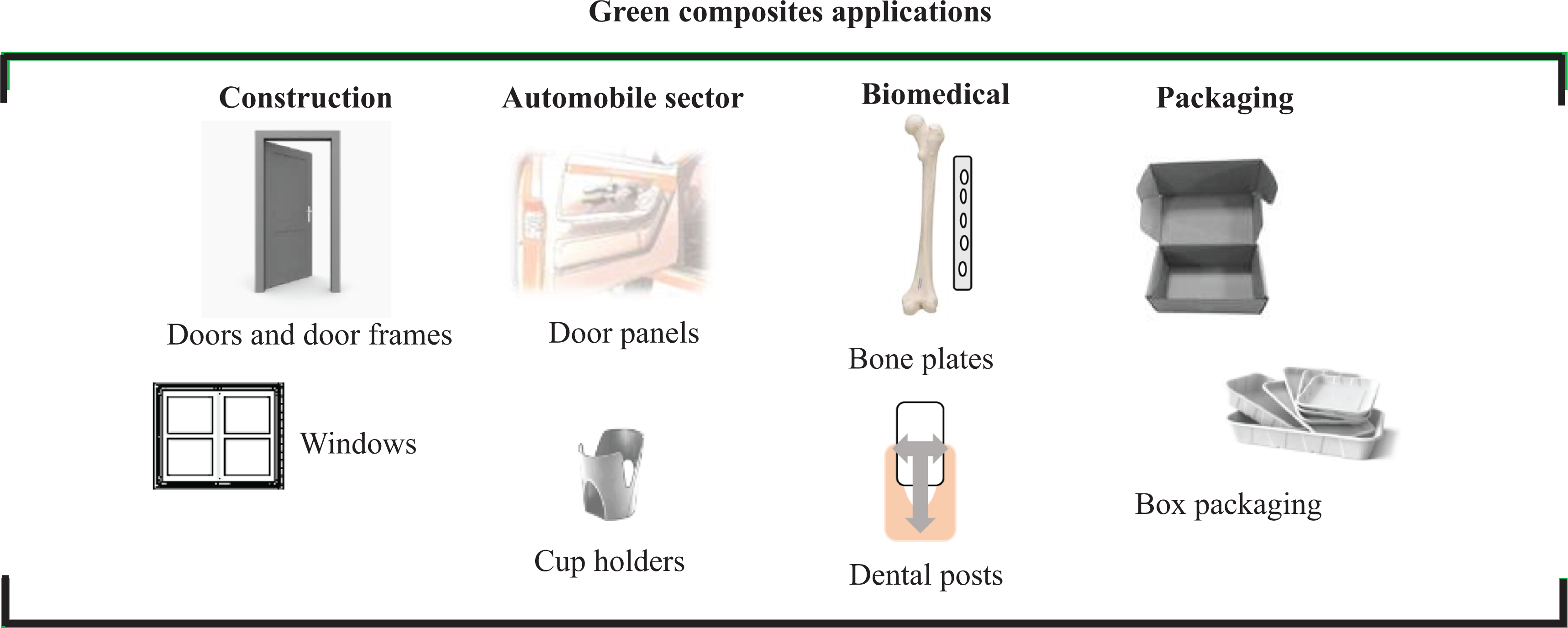
Representative applications of green composite in diverse sectors.
World institutions regulating the green composites sector
Diverse initiatives have emerged in European countries, in the United States, Canada, and Japan, to foster the use of green non-oil-based composites instead of oil-based materials, promoting the use of renewable conventional and non-conventional sources.
The ASTM has released documents regulating the evaluation of some physical and chemical characteristics of materials, including green composites, 139 in the following types of materials: test methods; specification; classification; practice; guide; and terminology. These standards are classified into five categories These include applications, materials, processes, properties, and measurements, in addition to test methods, in which methodologies and procedures can be found for analyzing and characterizing the physical, chemical, and biological properties of materials or composites of plant origin. 140
In the European Union, the organisms in charge of the standardization and regulation of green composites include the European Telecommunications Standards Institute (ETSI), the Commission of European Standards (CEN), and the European Committee for Electrochemical Standardization (CENELEC). The latter has released standards defining the technical specifications for products, production processes, services, or test methods, facilitating integration among companies, and increasing the value chain and trade.141-144
Asian manufactured products, processes, and materials follow local standards. For instance, the Japanese Industrial Standards Committee (JISC) takes part as a Japanese contributor in setting international standards through its work with the International Organization for Standardization (ISO). In the Chinese market, the China National Institute of Standardization (CNIS), subordinated to the State Administration of Market Regulation, is the responsible entity for strategic standardization in the national economy and industrial development of China. The CNIS is committed to taking part in international standardization activities and world homologation of standards.144,145
Finally, the ISO has published 22,482 international standards and related documents, covering nearly every industry, i.e. products, services, and systems, to ensure quality, safety, and efficiency, and facilitate international trade.144,146,147
International trading of green composites
According to estimations, the world fiber market will reach USD 10.89 billion by 2024.148,149 Wood-fiber materials dominated the global market in 2015 150 and it is considered that this trend will continue over the next 10 years. Raw materials including hemp, flax, and kenaf are increasingly employed in the production of lightweight and fuel-efficient cars.
The U.S. dominates the world’s green materials market, 151 meanwhile, in Europe, the government has supported new regulations and incentivized the latest strategies to facilitate the incorporation of new eco-friendly materials.152,153
The global natural-fiber composite market size was valued at USD 4,46 billion in 2016. According to some predictions, this means an incremental Compound Annual Growth Rate (CAGR) of 11.8% from 2016 to 2024. Wood dominated the market and represented around 60% of the overall income, followed by flax with 13% of the world market; kenaf, cotton, and hemp complete the list. 154
Among the most important natural polymers are starch, rubber, PHB, and PLA. In 2015, this segment accounted for around 25% of the global market matrix.147,155 As the trend of consuming matrixes continues, synthetic polymers will take second place in market consumption.
The current segmentation in natural-fiber composites by sector application include construction (60%), automotive (20%), electronics (10%), sporting goods (7%), and others (3%).156,157
Regarding green-food packaging, the European Union, Canada, the United States, and Japan, among others, have focused their efforts on regulating the use of green composites in packaging operations, such as regulations on biodegradability, mechanical properties, and performance and iniquity according to the final specific use.147,158
Developing economic, societal, and environmental development by manufacturing green composites for sustainability
The global tendency toward sustainable development has been focused on “greening” the world economies as a new strategy for social transformation, reducing environmental pressures, promoting economic growth, and enhancing social well-being.159,160
Green growth is defined as the process of transition toward a low-carbon and resource-efficient society with economic development that safeguards the functioning of ecosystems and enhances human well-being and social equality. 161 This definition includes elements of eco-efficiency, 162 resource efficiency, 163 and circular economy. 164
Several studies have analyzed the environmental impact of the whole process to obtain green composites. For instance, Yuan and Guo 165 evaluated the environmental impact of the use of bamboo fiber as reinforcement in composites; the study was executed by using Life Cycle Analysis (LCA) of the manufacturing process. The authors found that pretreatment and energy consumption are the main contributors to the global environmental impact. In a similar study, Koronis et al. 166 concluded that in terms of the reduced amount of energy associated with the manufacturing of green composites positively affects the environment when the green-based process is compared with oil-based composite processes. Moreover, the authors concluded that the addition of plant-based content and natural fibers acts absolutely as a complementary effect and increases their environmental performance, given that both derive from annually renewable resources.
In addition to the reduction of CO2 emissions, it is also important to consider that the replacement of plastics and oil-based materials by biopolymers or bioplastics reinforced with natural fibers has become an important global issue, not only from the environmental perspective, but also in terms of the improvement of living conditions in rural areas and, as a result, economic growth. 167
Along with this review, the main concepts regarding green composites that the technology has developed for their production, and interesting examples of green composites for each sector and world markets and trades for these materials have been mentioned. The environmental impacts and economic benefits continue to stimulate new research, especially due to that, each day, novel natural sources appear and seem to be ideal for blending with biopolymers, offering desirable mechanical and biodegradative performances. This is similarly due to the origin of the materials: concerns are addressed to the possible depletion and dwindling of wood resources from forests or non-conventional sources. 168
The growth of the world market entertains a rampant increase in the short term and represents a multimillionaire sector. Therefore, taking the economic aspect as the only important part of development could imply a new imbalance among economic pillars and generates a new, unfavorable world scenario.
Conclusions
Green materials represent a consolidated alternative as substitutes for oil-based polymers. Diverse laboratory and field studies have demonstrated that these materials exhibit adequate mechanical properties for use in strict sectors, such as the construction and automotive sectors, and may represent a significant reduction of their cost production and also for having a better environmental performance.
To achieve better physical, chemical, and mechanical properties, new raw materials have been evaluated, including the development of new manufacturing processes, and the inclusion of new regulations to avoid the incorrect management of natural and biological resources is now required.
Finally, it is essential to note that, although these raw materials entertain several challenges, such as the lack of proper technical and governmental policies, world market changes, price fluctuations, and technological challenges for processing them. Their role as a social driver toward improvement in economically deprived areas might be fundamental, in that it brings new alternatives to poor rural areas around the world where they are available.
Footnotes
Acknowledgments
AMAR thanks to CONACYT for the economic support with the scholarship number 2018-000012-01-NACF-03334, EVN acknowledges to DIQEB—Universidad de Guanajuato and CA IQMAyM for all the technical support, thanks to SICES (Project PNPC/SICES/CONV/190/2019UG) for financial funding and B V-F for her patience help. M. del R. C thanks to Universidad Autónoma del Estado de Hidalgo for the support and B V-P thanks to ITESM Campus Edo. Mex and Massachusetts Institute of Technology for all the support received.
Declaration of conflicting interests
The author(s) declared no potential conflicts of interest with respect to the research, authorship, and/or publication of this article.
Funding
The author(s) disclosed receipt of the following financial support for the research, authorship, and/or publication of this article: This work was financially supported by the CONACYT (scholarship no. 2018-000012-01-NACF-03334) and the SICES (project PNPC/SICES/CONV/190/2019UG).
